high holy days · sermon · theology

You are the impossible child God yearned for.

You are the impossible child God yearned for.

You are a miracle. 

You may not hear that often, and you probably think about it even less, but you truly are.

The British-Indian poet Nikita Gill has written about just how unlikely is the fact of your existence:

“The very idea that you exist considering those extremely low odds is a miracle on its own. You see, the exact DNA that comes from your parents to create you could have only happened when your parents met, which is 1 chance in 20,000. That alone should be enough, but when you add up the fact that it has taken 5-10 million years of human evolution for you to exist at this time, in this moment, you begin to recognise just how much of an impossibility you are.”

– Nikita Gill

Add to that, and remember that you are a Jew. Remember that in those 10 million years of evolution, Judaism has existed for only 3,000 of them, and is still one of the world’s oldest continuously existing cultures. You are the product of a long line of ancestors, dating back to desert nomads, who, at one time, heard the voice of an invisible God, and kept that story alive for hundreds of generations. That is a miracle.

In the last century, the ancestors who held onto that story fled from countries all over the world, and migrated to farthest corners of the earth, and faced down war and genocide, and survived extermination. Faced with such experiences, many turned away from their heritage and disappeared from Jewish life.

But you are here, in the 21st Century, alive, and Jewish, and living out that story. You are the product of billions of years of matter interacting and millions of years of human evolution and thousands of years of cultural transmission. You are here. And that is an incredible, awe-inspiring miracle.

One of the prevailing themes of Rosh Hashanah is the miracle of human life. It is everywhere: in our liturgy, in our Torah portions, and in our haftarah. All of them are bound together by a sense of wonder at our existence.

Three weeks ago, we read the prophet Isaiah, who expressed joy at the wonder of childbirth. His great prophecy opens:

“Sing for joy, infertile woman, you who never bore a child! Sing for joy and laugh aloud, you who never felt a stomach cramp. Because the children of the barren are more numerous than those who suckled infants.”

But who is this talking about? Who is the sterile woman giving birth to the miracle child?

In the 9th Century, the great collection of rabbinic stories, Midrash Pesikta Rabbati, offered us three answers: Sarah, Hannah, and Jerusalem. At Rosh Hashanah, we read the stories of all three.

In the Torah portion, we read of Sarah’s miraculous labour. Sarah was elderly and post-menopausal. When three angels told her she would give birth in a year, she laughed. For years, she had yearned for a child, but, in her old age, she had given up. How would her withered husband and her empty womb bear a child? 

A year later, Sarah gave birth. She ate her words and called her baby boy Yitzhak, meaning ‘laughter.’ She said: “God has brought me laughter, and everyone who hears about this will laugh with me.”

A miracle. An impossible birth. So that infertile woman who had never had a child rejoiced, just as Isaiah described.

In our haftarah, we read, too, of Hannah’s wondrous labour. She was infertile. Her husband Elkanah’s other wife, Peninah, had plenty of children. Peninah became her rival, and relentlessly mocked her, saying that God had closed her womb.

In the depths of her despair, Hannah prayed to God. She whispered fervent promises to God that, if she was allowed a baby, he would be dedicated forever to religious service. 

As Hannah prayed, she was so full of silent anguish and tears, that the High Priest Eli thought she was drunk. He heckled her to sober up. But when she explained that her behaviour was the product of deep distress, Eli prayed with her that her wish be granted.

A year later, Hannah gave birth, and called her baby “Shmuel,” meaning “I asked God for this.”

Another miracle. A barren woman who bore no children rejoiced, just as Isaiah described.

Pesikta Rabbati offers a third infertile woman to whom Isaiah’s proclamation might refer: the city of Jerusalem.

At the last major event in the Jewish calendar, Tisha BeAv, we commemorated Jerusalem’s destruction. We fasted, wept and prayed, remembering how the holy city was razed to the ground. Following the destructions by Assyria and Rome, that city was left stripped of its inhabitants. Its most sacred spaces were desecrated and burned. The whole town was abandoned like an empty womb.

And out of that barren place came Judaism. At the time when it most seemed like the Jews had been destroyed, the rabbis came forward and gave them life previously unknown. They developed tefillah, Mishnah, midrash, and Talmud. 

They spread the message of ethical monotheism throughout the entire globe. Judaism, from its point of near-destruction, became one of the world’s most notable religions, and influenced civilisations everywhere.

Jerusalem was an infertile womb, out of which came more children than could ever have been imagined.

Sarah yearned for a child and was blessed. Hannah yearned for a child and was blessed. Jerusalem yearned for children, and now has millions.

But there is another impossible birth that we must celebrate. An unbridled miracle. A human being created by God out of nothing, who had the potential to be the saviour of all humanity.

Whose birth was that? 

Yours.

What, did you think I was going to say somebody else?

For the Christians, that person was Jesus. In their story, their Messiah was born by immaculate conception to a virgin mother. For them, Jesus’ birth fulfilled the prophecy related by Isaiah.

In the 9th Century CE, when this midrash was composed, Christianity had become a full-fledged international religion. It was the official doctrine of the Roman Empire, and was spreading throughout Europe through the Carolingian Empire. Christian polemicists criticised Jews for denying the truth of their Testament, and insisted that their story completed our Torah. 

Part of the motivation for the compiler of Pesikta Rabbati must have been to show that Isaiah could easily be proven from texts within the Jewish canon. But, more than a difference of interpretation, this midrash speaks to a fundamental difference between how Jews and Christians have seen the world. For us, Jesus is not the beloved child of God born by miracle. You are.

As Lily Montagu, the great religious reformer and East End social worker, put it:

“We have the belief that man can directly commune with his God, that he needs no intercessor […] The Christian feels himself brought into contact with God by means of Jesus, his Saviour. Jesus is conceived as, in a special sense, the son of God, and as able to direct all seekers to the divine sanctuary. We Jews hold that every man is the son of God, and that all His children have access to Him when they try to live righteously.”

– Lily Montagu

So, all humanity is God’s miraculous creation. All humanity is in direct relationship with our Divine Creator. And all humanity has the potential to bring this world closer to its salvation.

Rosh Hashanah, as a festival, marks the sixth day of the world’s creation, on which the first ever human being was made. It celebrates the miraculous creation of Adam HaRishon, the original person, sculpted from clay and breathed alive with the sacred air from God’s nostrils.

Consider what a wonder this is. Knowing all that we do about the history of the universe, how many billions of years must God have spent yearning to create the first ever person. 

How impossibly beautiful is it, that, after the creations of thousands of galaxies and multitudes of planets, the Universe somehow put together the exact elements that would support life. And that life became social and conscious and able to reflect on its own existence. And, conscious of its own selfhood, that being was able to reach beyond itself and worship the Eternal Mystery that created it.

Who knows what the chances are? But it is certainly a miracle.

The cosmos was, at one point, an insignificant speck, devoid even of matter, and now it includes human beings. And now it includes you.

You are the impossible child God yearned for. You are a miracle.

However much you wish to connect with your Creator, just think how much your Creator wants to connect with you. Whenever you feel like you can’t quite find God, just take a second to contemplate how many billions of years God spent trying to find you.

Your existence is a miracle, and I am so glad you are here.

Shana tovah.

judaism · sermon · theology

Barbie World’s Jewish Metaphysics

As you know from all the advertising hype, there is a film out at the moment that deals with some of the most complex moral and philosophical questions of our time. It is already touted to win many awards, and has spurned fantastic conversations about truth, ethics, and politics.

I’m talking, of course, about Barbie.

Barbie already holds such a sentimental place in my heart. While the other boys liked wrestling, Fifa and war toys, I just wanted to play with my dolls’ hair. 

I know, you’d never guess it. The butch man you see before you was once obsessed with the Dreamtopia Mermaid Barbie.

So, last week I did my duty as a good consumer, and went to the cinema for the first time since Dead Pool 2 came out. A lot has changed since I last went to the movies five years ago, and it seems that now everyone dresses up as the characters in the film. I was thrilled to get out my Ken costume, which I never knew I would have a use for.

During the film, I laughed, I cried, I reminisced. And as I left the theatre, I thought: “I’m sure I can squeeze a sermon out of this.”

Yes, that’s right, welcome to your Shabbat morning dvar Torah on the theological metaphysics of Barbie World.

Don’t worry if you haven’t seen the movie: I promise that will not help this make any more sense. 

To help put this into perspective, I’ll give a quick summary of the storyline. Margot Robbie is a Barbie girl, in a Barbie world. Her life in plastic is fantastic. She is driven by the power of imagination. Life is her creation. 

In Barbie World, a doll can be anything. A President, a marine biologist, a Nobel Laureate, a mechanic, a pastry chef, or a lawyer. Even a rabbi.

But then a great intrusion comes into Barbie’s dream world. She finds that she now has cellulite and existential dread. This plastic world of fantasy suddenly starts to turn into something… horrifyingly human. 

Barbie therefore must travel to the world in which people play with her, to find out what is going on in the world of real girls. 

The result is distressing. It turns out that the real world is defined by misery and hatred, and, in this world, girls absolutely cannot do anything they want. 

I am interested in the interplay between these two worlds. In the plastic world, anything is possible, but none of it matters. In the human world, everything matters, but nothing is possible. These two versions of reality conform to two popular narratives.

The first is that this world is just a simulation. That view is being propogated right now by Elon Musk and Neil deGrasse Tyson. It says: none of this is really real. Our world is like Barbie World: it is someone else’s fantasy that we are stuck in, playing roles. Anything is possible, but only the terms of the magnificent computer directing our lives.

I understand why that idea is so appealing. The word is a mess. There is something reassuring about believing that none of it is really happening and it’s all out of our control.

Although today this idea can appeal to new innovations in quantum physics, it is actually a very old idea. In the 17th Century, Irish philosopher Bishop George Berkeley promoted a similar philosophy, called “immaterialism.” We are all, he said, simply ideas in the mind of God.

Berkeley continues: if this world is just an illusion, your only duty is to conform to the role you have been given. You must blindly follow authority. We must all submit to the law and do as we are told.

Barbie has been told that she must fulfill the stereotype she has been molded in, and she has no choice but to accept it.

We need not wonder why a group of billionaires would like us to think this way. If reality is just an illusion, we just have to accept our place. And there’s no point resisting it, because the script has already been written, and none of it means anything anyway.

But the alternative world of the Barbie film – the human world – is not compelling either. In the human world, everything is made up of futile facts. It’s all real, and there’s nothing you can do about it. The grass is green. People grow old. You will get cellulite. Patriarchy is inevitable. It is all meaningful, but its only meaning is that everything is deeply, existentially depressing.

This is also a very popular worldview right now. It is best encapsulated by conservative talk show host, Ben Shapiro, whose dictum is “facts don’t care about your feelings.”

And that idea can be seductive too. The world is changing so fast and so much. Why can’t everyone just accept that everything is the way it is and stop moving so much?

Ben Shapiro offers brutal reality as an antidote to too many ideas. You think this world is horrible? Tough. You’re lumbered with it. This vulgar materialism, that says everything just is the way it is and nothing will ever change, is just as reactionary as the immaterialism that says nothing matters. 

So, let’s get to the point. What does Judaism have to say about this? 

Is this all just a simulation so that we are all just living in a fantasy world?

Or is this all the cold, hard, truth of reality?

In the 20th Century, Jewish philosopher Ernst Bloch tried to offer a third way. Bloch was a religious socialist from Germany, who fled around Europe as the Nazis took power everywhere he went. For him, it was deeply important to develop a view of the world where the unfolding horrors of fascism could be stopped. Any metaphysics that kept people from changing their circumstances had to be resisted.

Bloch turned to great religious thinkers of the past to remind people: it doesn’t just matter what is; it matters what could be. 

This world is real, and the one thing we know about reality is that it is constantly in flux. Everything is as it is, and everything will be different. 

Everything is subject to change. Everything that is is also something else that is not yet.

Ice turns into water turns into steam. Acorns become sprouts become mighty trees. People grow and age and learn. Societies progress from hunter-gatherers out of feudal peasantry and move to abolish slavery. 

In all of their forms, these things are exactly what they are, and are also everything they could be. They are only what they are for a brief moment as they are becoming something else. The movement of water into ice is just as real and possible as the movement for women’s equality.

To put it another way: this world is real, but it doesn’t have to be. There are so many other very real worlds we could live in. 

Ernst Bloch would have loved the metaphysics of Barbie World. It doesn’t just leave us with the misery of the real world or the pointlessness of the fantasy world. It shows us that both worlds speak to each other. The real world can become more like the fantasy world, and the fantasy world can become more like the real one.

This is the Jewish approach. Our task is not just to accept the world but to change it. As Rabbi Jonathan Sacks used to teach: “faith is a protest against the world-that-is by the world-that-ought-to-be.” Faith, for Sacks, is the demand that this imperfect world could be more like the utopian one. Like Bloch, Sacks talked about Judaism as the “religion of not-yet,” always moving towards what it would one day be.

This is what animates the Jewish religious mind: the possibility that this world, here and now, could be transformed into the vision we have of a perfected Paradise. 

So, how do we get there? 

Once again, we have to take our inspiration from Barbie. When Barbie  wanted to get from the fantasy world to the real one, first, she got in a car, then on a boat, a tandem, a rocket, a camper, a snowmobile, and finally a pair of rollerskates. 

To bridge the gap between worlds, all she had to do was put one foot in front of the other. 

That is what we must do too. We must take small steps in our pink stilettos, and set out towards the real fantasy world.

Utopia already awaits us.

Shabbat shalom.

sermon · theology

Numbers don’t matter

In the last decade, the number of Jews in Redbridge decreased by 37%. Meanwhile, the number of Jews in Epping Forest increased by 18%, and in Havering they increased by 16%.

These are our numbers. And they don’t matter.

According to the last census, the East of England has now overtaken Yorkshire as having one of the largest Jewish populations, with over 42,000 individual Jews living in this area.

These are our numbers. And they don’t matter.

In 2022, SWESRS gained 43 new household members. In the first quarter of 2023, we continued the same trajectory, gaining 15 new household members.

These are our numbers. And they don’t matter.

None of these numbers matter.

But. There is one person sitting in the synagogue this morning, praying. That number matters. There is one person watching on Zoom, feeling connected to the community despite not being able to attend. That number matters. One of us is in hospital; another just had a baby; another is sitting shiva; another is preparing for a wedding. Yes, those numbers matter. Those ones. Those ones are the only numbers that really matter.

In general, our Scripture takes a pretty dim view of counting activities. In the Book of Samuel, when King David takes a census of the Israelites, he instantly feels guilty and repents before God. God is furious that David has done this, and sends instant punishment. A plague falls on the kingdom lasting three days and wipes out 70,000 people. 

At the time of the census, there had been 130,000 possible warriors. Now their numbers are significantly reduced. 

But why? What’s so bad about counting Jews?

Abravanel says it was a proud and haughty thing to do. David was impetuous, believing that he could control his fate by counting his people. God is saying: you like numbers? Tough. Have fewer. You think your strength comes from how many of you there are? Wrong. Have fewer.

Maybe. But that doesn’t explain the attitude to censuses elsewhere in Scripture.

In our Torah portion this week, Moses takes a census of the Israelites. Moses counted up every man of fighting age who might be able to bear arms. They counted them up by tribe: 46,500 for Reuben; 59,300 for Simeon; 45,650 for Gad… and on it went, until the census reached its total. There were 603,550 Israelites in the desert, ready to fight.

And, as it turned out, those numbers didn’t matter. They listed them all, got them into procession, and then… nothing happened. There was no war to be had. They never entered into combat. 

Instead, the entire narrative instantly pivots completely. Now, instead of talking about all the thousands of people that Moses has on command, the story shifts to talking about Aaron’s two sons, Nadav and Abihu, who died while making strange sacrifices to God. All those big numbers and none of them matter. The only ones that do matter, it turns out, are those two young priests, whom Aaron is still mourning many chapters after their deaths.

That’s right, we’re in the Book of Numbers, and the message of the Book of Numbers is… numbers don’t matter that much.

It’s individuals that matter.

The best explanation comes, I think, from the Jewish philosopher Emmanuel Levinas. Levinas had survived a prisoners’ camp in World War Two. He was one of the most eminent philosophers in the world, but was aghast at how educated people had been seduced by the disease of fascism. What was wrong with his intellectual colleagues and teachers, that they could become Nazis?

The problem, he felt, was that they did not understand the value of human life. 

Every human being, he taught, is infinitely valuable. Not in the mathematical sense. In a deeper spiritual sense. Every one of us is immeasurably, inconceivably sacred. 

We cannot be counted because we are already infinite. We are already part of God, who is beyond any number. People, like God, are unique and infinite. They cannot be divided in any way. 

None of us are supposed to be counted. We are not supposed to have a number assigned to us as individuals. 

This was precisely the sin of the Nazis: they thought that they could measure, quantify, and categorise people. They were so committed to this rationalisation that they tattooed the numbers of their prisoners on their arms. 

Counting people, then, is a detestable thing. No number can be put on our lives. We were created by God to serve a purpose so much higher than any number can describe.

This is why the Torah rebukes counting. Any effort is a complete miscalculation. If you think you can work out how many people there are to prepare for war, you are wildly underestimating what you have before you. In each human being is a living, breathing, spark of the Divine, far beyond calculation.

So, let’s go back to the census. I will be honest at my own sin. I have spent ages poring over it, thinking on how many Jews there are in different areas, and working out what they mean for our synagogue’s development. I have tried to keep track of how many members we have, and where they’re coming from, and where they live. And that is, at best, an error. At worst, it is a grave underestimation of who we already are.

Rabbi Jacob Rader Marcus, one of the leaders of the American Reform movement through the 20th Century, warned: “When you survey your congregation on a Friday night, don’t count bodies, count souls. These chosen few, this elect, has a job to do: these Jews are our future; they have to save us; even more they have something to tell the whole world, to distil for all humanity what the Jew has learned after 3,000 years of bitter experience […] They taught us to abhor hatred, violence, brutality, to avoid every aspect of any concept that manifests itself in contempt for fellow human beings.”

We must count souls, not bodies. We must reject the logic of quantifying people. We must love each other as irreducible, wonderful, infinite expressions of the ultimate Creator, our God.

sermon · theology

A grown-up God for grown-up Jews


When we are children, we have a child’s view of God. A big bearded man in the sky with a benevolent smile, a beard and sandals. Maybe a maternal godhead, embracing us.

We imagine God as our idealised parent, fulfilling all our needs, giving punishments and rewards, guiding us to do right. We see the world as children because we have no other reference point.

Then, we become teenagers, and our worldview shifts. Suddenly, we are able to question authority, push boundaries, and assert our own independence.

We go through growth spurts, physically and emotionally. We close the gap in height with our parents so that we can see over their shoulders. They are no longer demigods, but imperfect human beings that we can challenge.

At this point, many of us give up on God. The childlike view we once had cannot hold, because the view we had of our parents has altered too. We realise that, if we can challenge authority, we can push back against the ultimate force we had imagined too.

I fulfilled the stereotype of a rebellious teenage atheist. I rejected the sky-daddy and all the nonsense of religion. This was a pretty lacklustre rebellion to my parents, who were themselves Marxist atheists.

I don’t remember the moment I stopped believing, or when I started again. But when I came back to faith, the beliefs I held were not the same as when I had been a child. I had to reconstruct God.

I took snippets from Jewish tradition. I listened attentively to my friends who were Quaker, Baptist, Muslim, Sikh, and Catholic, finding the parts that resonated. I reimagined what it would mean to believe in God if the Divine Parent surrounded by clouds no longer existed.

I realised that many others had engaged in the same thoughts too. All the while, when grown-ups had been talking about God, they hadn’t believed in the primary school version either. They had also gone through that process of maturing, and their ideas had developed with them.

It turns out that the God that atheists don’t believe in, the religious don’t believe in either.

This week is the Israelites’ coming of age.

Throughout Genesis, we only knew the God of stories. God created the world; God made people and gave them special purpose; God gave out punishments for wrongdoing and rewarded the good.

Now, we find ourselves in a situation in which we must rebel. We enter the Book of Exodus, where the Israelites are enslaved and forced to do hard labour. They are beaten and abused. Meanwhile, all around them, the Egyptian empire and the social order on which it is built are crumbling. We cannot believe in their gods, and we cannot find our own.

Our hero, Moses, sees through the nonsense. He stands up against his father’s power in the royal palace. He beats a slaver to death. He breaks away from the only regime he has known and runs into exile.

In the years that Moses ran away, he had to give up on all his old beliefs. The fantasies he’d held about his family. The dreams he’d had about what his own life meant.

He married a woman of a different tribe, Tzipporah, and worked for her father, Yitro. They were Kenites, and Yitro was a Midianite priest. Perhaps Moses could just have substituted his old beliefs for the Midianite ways. He would have simply worshipped a new pantheon of gods and taken on different customs.

Instead, Moses is forced to reimagine God altogether.

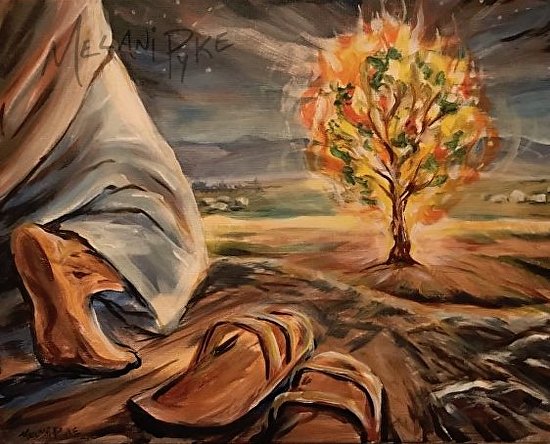
While tending his flocks, Moses meets his Creator in a thicket on a mountain. He sees a bush on fire, but not burning, that calls out to him and demands he remove his shoes.

Could this be one of the gods of Midian or Egypt? Could it be one of the spirits that inhabited the ancient world?

Moses must know. He asks “who are you?”

The voice from the burning bush replies: “אהיה אשר אהיה.” I will be what I will be.

This God does not have a name. It is not one of the idols that the nations worship. It is not something that can be held or controlled. This God will be what it will be. This God is the sum total of all that will ever exist.

When I teach bnei mitzvah children portions, I try to get them to understand what they are saying, so I teach them the roots of Hebrew words. They learn what is going on in each word of their parashah.

In Hebrew, every word has a root: three letters that hold all the possible meanings. Words like kaddish (the prayer for the dead), kiddush (blessing the sabbath), and kiddushin (getting married) all have the same root: kaf-dalet-shin. The root gives us all the words to do with holiness and making things special.

In nearly every parashah, we get to the unpronounceable name of God. The students nearly always try to pronounce it, but find it quite impossible.

We don’t say the word as it appears, but substitute it with “Adonai” (my Ruler) or “Hashem” (the name). That way the name stays sacred, or kadosh.

And then I teach them the root of this ineffable name. Hashem is a composite of three words: היה (what was); הוה (what is) and יהיה (what will be). God’s root is existence. God is the thing that always exists, and from which all existence comes.

When God says “I will be what I will be,” it means that God is everything. God is existence itself. God is whatever it means for something to actually exist.

This is the mature view of God. It is not a fairytale or a Santa Claus. It is a way of understanding all of reality.

This God will not do what it is told, or sort out your problems for you.

That’s why this God comes with a demand. “Go back to Egypt. Get over there and bring the people out of that land. Do whatever you can, bring everyone with you, and get yourselves free.”

When we are children, we have a child’s view of God. One who gives out punishments and rewards. One like an ideal parent.

Now, we are faced with the good of adulthood. The one who is the foundation of all existence. The one who gives all life meaning. The one who says: “I am not going to free you by magic. You will have to start freeing yourself.”

Shabbat shalom.

high holy days · sermon

Stop the privatisation of God


God is for everyone. God is supposed to unite everyone. Worship is supposed to be collective.

But, right now, God is under threat of privatisation.

In recent years, people have begun attempting to carve up God into small pieces and sell God off in individual packages.

Just 100 years ago, people knew that God was something they encountered with their fellow human beings, as they assembled in synagogues. These institutions were often the primary sources of solidarity, comfort, and welfare in any community. They bound people together.

Today, much of that community is collapsing in favour of individualism, where people are left alone to fend for themselves.

To combat this, some religions are starting to run on fee-for-service models, wherein people need not affiliate or contribute anything, but can buy access to religious experiences when it suits them.

This practice won’t save the synagogue. They are its enemy.

In these models, God is reduced to a commodity that individuals can purchase in their own homes. You need not go anywhere, but can browse online for your favourite version of God, packaged however you like it. The privatised God can be paid for whenever required, to perform whatever rites you like. The more money you have, the more of God you can get.

God was never meant to be divisible. The knowledge of the One God did not come from clever men in caves and deserts. Our prophets never claimed to have arrived at their conclusions alone.

Moses was a prince in Egypt, learned multiple languages, and could communicate expertly. But he was also the leader of a mass slave uprising in Egypt. His understanding of God’s unity came from a revelation to thousands at Mount Sinai. Together, they heard through clouds of fire: You are one people. There is one God.

Jeremiah was the eldest son of King Josiah’s High Priest, and aided by a scribe. Yet, when Jeremiah preached God’s unity, he did not do so as a lone prophet, but as a spokesperson for a large-scale anti-imperial movement. Huge groups of people were organising to resist invasion by Babylon, under the name of the one God. This collective had built over centuries, amassing momentum, as they agitated for refusal to accept foreign powers or their false gods.

Monotheism was born out of great social movements, in public, among peers.

It began with stories people told each other to build bridges. To keep peace and make relationships beyond their own homes, people developed common narratives.

“Did you know that we share a common ancestor, Abraham? Let me tell you a story of Abraham…” “Have you heard that we come from the same mother, Leah? In my tribe, this is what we know about Leah…” These stories were passed as oral traditions for many centuries, binding people together so that they could trust each other and work together.

As societies developed, so did their stories. Peoples formed into nations, and nations had their gods. The Hittites had Alalus; the Canaanites, Baal; the Egyptians had Ra; and the Sumerians, Anu. These gods looked after specific people within their borders, and supported them in their national wars, triumphs and tragedies.

Initially, the Israelites only had a national god, too, whom we now know as Hashem, or Adonai. It took time for them to develop the understanding that the god they worshipped in Israel was the God for the entire world. And that learning happened on the commons.

In the ancient world, all public activity happened on the commons. The commons brought in strangers from faraway places, and was the meeting-point for every tribe to engage with each other. It was a hub of activity, bursting with children playing, teachers educating the masses, exchange of goods and vegetables and, above all else, ideas.

There, in the open fields and marketplace, where people brought their stories, they swore oaths by their gods, and wrote promissory notes witnessed by every national god, so that their contracts would be binding in every country.

They said to each other: “I swear by Anlil… by Asherah… by Set…” They told the stories of their gods, who had created the world; flooded it; destroyed it; redeemed it.

“Perhaps,” they said, “the god that oversees Babylon is the same as the one who rules Egypt. Perhaps we simply have many names for one entity. Perhaps there is a force greater than national borders, whose justice is as expansive as the heavens, whose providence extends not just to the borders of one nation but to the entire world.”

“Just as we are one here on the commons, we might also be one at a deeper level, united by a common humanity, birthed by the same Creator. We might share a common destiny, to bring about unity on this earthly plane and to make known that God is one.”

Monotheism was a force of thousands of people seeking to reach across boundaries and divisions. A movement to imagine a future in which all people were diverse and equal. The original professors of the truth of one God sought unity of all humanity and nature , held together by something incomprehensibly greater than any of them.

Today, we still know the one God by many names. Hashem, Adonai, Shechinah. Allah, Buddha, Jesus, Jah. The names come from many languages but speak of a single truth. One God. One world. One people. One justice.

Of course, that unity is threatening to some. There are those who have a vested interest in maintaining tight borders, ethnic supremacy, and division. They have stoked up wars between the different names for the one God, seeking to divide that single truth again along national lines. Buddha was pitted against Allah; Jesus against Hashem. In Europe, they waged wars in the name of different understandings of one God and one book. Catholics and Protestants took doctrinal divisions and used them to carve up an entire continent and suppress all dissent.

For three centuries, European states fought each other over which version of God was the correct one. On either side of the divide, Jews were murdered, tortured and exiled, because if other Christians could be wrong, the Jews were really wrong. Hundreds of thousands of people were slaughtered because powerful people had stripped monotheism of its context and abused it to create new divisions.

At the end of the wars, European leaders ushered in a new age, that they called modernity. They vowed that they would never again fight wars on such grounds. They decoupled citizenship from faith.

Religion was now not national, but completely private. You could have a religion, but only in the privacy of your own home. The Jew would be a Jew at home and an Englishman in the street. If you want to keep a kosher kitchen, that’s your business, but you’d better not bring your values out into our political space.

In some countries, every detail of religious life was taken under the state’s authority. The religious could no longer do anything that would interfere with the supremacy of the nation state.

But monotheism was never meant to serve private individuals. It was developed to bring people together, regardless of nation or creed. The problem of wedding religion to nations was not that it made religion too public, but that it made religion not public enough. The one true God was supposed to transcend all borders and remind people that no matter their language or appearance, they originated from the same Creator.

In recent times, the privatisation of God has gone even further.

The mass collective meetings of religious people have declined in favour of each individual having their own “spirituality.” No more can people develop their sense of unity in public, but they must have their own little snippet of truth that they hold tightly and do not share. The one God has been carved up into tiny little pieces so small that they can only be held in each individual’s heart. The one great God is now reduced to seven billion small ones.

All of this only further divides people. It breaks people apart, entirely contrary to what monotheism was supposed to do.

Monotheism began as a movement of ordinary people coming together on the commons.

The task of this generation is to bring God back to the commons. Religion must again become a force that breaks down all divisions and brings people together.

To stop this tide of individualism, there is really only one thing you need to do: join and build the synagogue.

It doesn’t even have to be this one – although, obviously, we would love to have you. The important thing is to join.

The synagogue still stands as a bulwark against this atomisation of society. It requires of people what we really need to keep the one God alive: commitment to each other in public. When people pay their subscriptions into a synagogue, they are not buying a service for themselves, but sustaining a community for everyone else.

In this synagogue, we are seeking to build community beyond our own walls, currently fundraising for local youth, the nearby refugee group, and our sister community of Jews that have fled Ukraine.

We must build communities in these small places where we live, while looking beyond them, with a knowledge that our God is so much bigger than any one community.

The message of monotheism is that all of truth is for all the people. Not some bits of truth for some. One love, one justice, one truth, uniting one people on one planet.

Our liturgy teaches that, once humanity has shaken off the fetters of prejudice and the worship of material things, equality and justice will reign over every land.

We must work towards the day when all peoples declare in every tongue that they have a common Creator, and that the destiny of one person is bound up in the fate of all humanity.

On that day, God will be one and known as One.

Shanah tovah.

high holy days · sermon

Why the world was made

There are some places in this world that fill me up with an awe of creation more than anywhere else can. Places so beautiful they make me wonder why they exist.

The Scottish Highlands are such a place. Those mountain landscapes are cragged rocks and stark hills stitched together by seas and tarns and smaller rock pools. They are peat bogs and waterfalls growing shrubs and trees, so full of life it feels as though they are themselves breathing. 

This year, I went to visit them. With my partner, we walked through the hills, saw old churches, visited a beloved rabbinic mentor, and witnessed the birds and wildlife. 

In between completing my dissertation and getting ordained as a rabbi, I decided to make a pilgrimage to mark the transition. It truly felt like a religious moment; a chance to draw closer to something sacred.

As we walked, we met with a land that was part of our country but felt decidedly foreign, and we met myths that, while part of our heritage, seemed alien. 

For the Gaelic-speaking peoples of Scotland and Ireland, these landscapes have their own origin story.

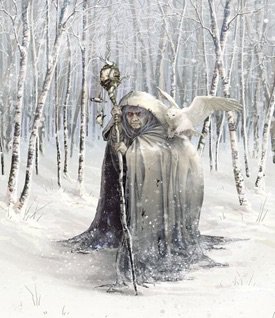
Those mountains are no accident. They were built intentionally, but a type of deity called Cailleach. Known also as Beira, or the Queen of Winter, she is an aged crone; one-eyed and completely white. 

She battles spring each year to reign her icy dominion over this hemisphere. She is a deer-herder, a lumberjack, and a warrior. She carries in her hand a great hammer as she strides across the Celtic Isles. She is the mother-goddess.

It was Cailleach who built the Highlands. She pulled rocks out of the sea and carved out stepping stones for her giant strides. She pushed through the space, breaking up new mountain faces with her hammer. She walked as winter through the new landscape she had made, and allowed waters to flow and overflow in every crevice.

I was enamoured by this story. Yes, that is what it looks like. It looks like an enormous witch has made it. It feels bursting with purpose.

My boyfriend prefers another version. He is a scientist, a doctor. We see the same world but through different lenses.

Millions of years ago, he read, the earth endured an ice age. Frozen water cut through the earth and wore down the ancient mineral rocks at a glacial pace. When the waters finally thawed, they left behind these precipices and pastures on the Scottish coastlines.

But isn’t that just the same story, told in a different way? Cailleach is simply an anthropomorphic ice current. The processes attributed to gods and fairies – that breaking and carving and flooding – are repackaged in scientific language. The scientists can give us approximate dates and name when the layers of sediment formed, but they are effectively telling the same story.

What difference does it make whether these wells were made by frozen currents or by the Wild Woman of Winter?

It is not fair to say that one is rational and the other is mythical. Both accounts are testament to humanity’s ability to understand its surroundings. The story of Cailleach is no less important a contribution, and we cannot just dismiss it. 

Equally, we cannot treat the national myth in the same way as we would our best scientific discoveries. They are not equally weighted as theories about how the earth was formed. Centuries of technological advancement and detailed research have given us this account of the Highland’s foundations.

The difference between these stories is not whether they tell us something true, but what kind of truth they point us to. The scientific explanation tells us the history of the world in context of great geological events. It teaches us how to identify, exploit or protect the natural surroundings we have inherited.

The story of Cailleach, by contrast, tells us about the unquantifiable truths of the Highlands: the awe they inspire; the magic they seem to hold. It teaches us about the shared national destiny of the Scottish, Irish, and Manx people who tell her story. 

These are not competing, but complementary, stories of creation. One tells us the truth of how a place was made, the other tells us why.

At this time of year, we turn to our own national myth and origin story. Our new year recalls the creation of the world. It is a day for us to delight in the fact that we are alive.

The biblical account of creation does not only explain the origins of one geological formation, but seeks to tell the genesis of the entire world.

5,783 years ago, the world was made in six days, from explosive dividing light, through land and seas and atmosphere, through to sea creatures, winged beasts, mammals, and human beings.

It is no good to compare this religious tradition with the theories of the Big Bang or evolution through natural selection. They are telling the story of the same thing, but from totally different perspectives. 

Science attempts to understand how the world was made; our myths ask us why.

The first chapter of Genesis suggests some reasons. The world was created with great purpose. Each day, with everything that God created, God saw that it was good.

When God created humanity, God gave us responsibility for the earth and what is in it. God gave us companions and promised us regular rest. God created the world for goodness, with humanity at heart.

The scientist and the theologian alike look at the world with a sense of wonder. We both feel awe as we track their stars in their orbit. We both marvel at the fact that a planet has produced the perfect conditions for life to form and grow entire ecosystems to sustain myriads of plants and creatures.

On this we agree.

The difference is that, for the believer, we do not just gaze in awe. Awe gazes back at us. 

You are not just amazed at the world, but the world is amazed by you. 

Not just the parts of you that you share in common with all other living beings, but those things that are unique to you. 

Not just the fact that you have functioning organs and limbs, but you. That transcendental, magical part of you. We might call it personality or soul or neshama.

It is not something mechanical or quantifiable. There is something about you that is wonderful and irreplaceable.

That is you

When we are confronted with the wonder and beauty of the world in which we live, we are tempted to ask what it is all here for. The answer of Judaism is that it is here for you.

To the religious imagination, your life is not an accident. It is a blessing. You were created for the sake of the world and the world was created for the sake of you. 

According to our Torah, at first creation, God wandered round to take in the Garden of Eden in the cool of day. And, there, God called out to the first human being: “Where are you?” God was looking for the human.

The great Jewish philosopher, Martin Buber, understood that this question is addressed to every human being in every age. We, too, are forever hiding, behind the stories we tell ourselves that our lives are meaningless and our actions matter little. We find ways to try and escape truth, even to hide from ourselves. 

And God, that great Source of amazement, nevertheless seeks us out, asking “where are you?”

So, Buber says, you have to answer that question. You have to seek deep inside your soul and answer who you really are. You have to try and give an account of what you are doing on this earth. You have to make yourself present, ready to face Truth, and, crucially, to change.

Where are you?

You are on this beautiful earth, crafted by a magnificent Creator. You are here and alive. You are a miracle.

God is amazed at how wonderful you are.

And now you have to show that God’s faith is rightly placed.

Shanah tovah.

Cailleach, Queen of Winter
spirituality · story

God is sharing her location on WhatsApp

The king is in the field.

Last weekend, a new moon hung in the sky, marking the new month of Elul. This season, is a time dedicated to reflection on who we are and who we can become. It is a time when we turn back to God and aim at healing our relationships.

At this time, you may hear Chabadniks greet each other, saying “the king is on the field.” It comes from a story taught by the Alter Rebbe, Rabbi Schneur Zalman of Liadi, who was the founder of the Chabad-Lubavitcher dynasty in the 18th Century. He used to explain the month of Elul using the parable of a king coming out in a field.

According to the analogy, the king’s usual place is in the capital city, in the royal palace. Anyone wishing to approach the king must go through the appropriate channels in the palace bureaucracy and gain the approval of a succession of secretaries and ministers. He must journey to the capital and pass through the many gates, corridors and antechambers that lead to the throne room. His presentation must be meticulously prepared, and he must adhere to an exacting code of dress, speech and mannerism upon entering into the royal presence.

However, there are times when the king comes out to the fields outside the city. At such times, anyone can approach him; the king receives them all with a smiling face and a radiant countenance. The peasant behind his plow has access to the king in a manner unavailable to the highest ranking minister in the royal court when the king is in the palace.

The king described by the Alter Rebbe in this metaphor is God. In his analogy, God is the ruler of all, but is hard to access except by an elite few. During Elul, the heavenly king comes out from his palace and makes himself accessible to all. In this month leading up to the High Holy Days, everyone has the chance to approach God, seeking favour and forgiveness.

It’s a beautiful analogy. But metaphors also have their problems, and we need to check them to see if they really work for us.

First of all, is God really a man? Well, of course not. God is too great and infinite to be held by anything as small as a body or a gender. Some Jews have therefore chosen only to use gender-neutral language to describe God, deploying words like “Holy One” and “Source of Life.” Alternatively, some Jews have chosen to reclaim divine feminine language, emphasising God’s femininity.

As Reform Jews, our belief in gender equality is essential to us, and that is bound to come through in how we think about God. To be honest, I’m happy addressing God by any pronouns because none of them capture what God really is. You can really insert whatever gender you like.

The much bigger question is what kind of personality this anthropomorphic God has. In the Lubavitcher parable, God is a king. There is plenty of precedent in Jewish tradition for such a reading: God is “adon olam,” the Lord of the universe; God’s throne is eternal and His sceptre stands upright; God is described as the king over all kings, and we are called upon to build God’s kingdom on earth.

I really don’t like this imagery at all. True, it tells us something about how powerful God is, but the image of a benevolent ruler isn’t very helpful to self-improvement. If a king tells you to change your ways, you’ll do it out of fear of violence or retribution. A king, to me, conjures up images of unearned power, and I want to deliberately rebel against it.

I prefer the idea of God as a loved one. When I approach Elul, I want to improve so that I can be the best possible version of myself. The people that make me aspire to that are my partner, best friends, and close family members. They remind me that I’m loved, and inspire me to do better by others.

This idea is also very present in Jewish interpretations of Elul. Some rabbis have noticed thar the letters of Elul could be an acronym for the beautiful love poetry of the Song of Solomon: ani ledodi vedodi li; “I am my beloved’s and my beloved is mine.” In this allegory, God and Israel are lovers working together. I much prefer this idea of equality and mutual partnership.

This idea of equality really doesn’t fit with how Chassids imagine God or social relationships. As they explain in the Alter Rebbe’s fable, God is only accessible to elite people most of the time. That is a core ideological belief for many Chassids. They see their rebbes not only as teachers but as holy men, who have a special connection to God. They advocate dveikus: cleaving to special people so that we, through them, can get closer to God.

They don’t hold this belief because they are somehow traditional and we are not. At the time when Chassidism was birthed, roughly contemporary with Reform Judaism, many of its greatest opponents within Orthodoxy criticised them for creating hierarchies and dynasties within Judaism. God, they said, had no intermediaries, and Judaism did not have hereditary hierarchies.

The story of the king in the field is quite beautiful, but when subjected to scrutiny, it looks much less appealing. It speaks to a worldview in which everything is divided up on a power ladder. Men above women; special Jews above ordinary people; and God as a king on top of it all.

That doesn’t mean we should completely abandon this teaching about Elul. The idea of coming back to God is helpful, and I adore the image of meeting God in the open country.

I want us to imagine an alternative. I want us to imagine what this theology would look like if all of humanity were equals. What would we say if our relationship to God was not a vertical one of subject to king but a horizontal one between lovers?

So, I submit to you, an alternative telling of the analogy of the king in the field, updated for modern times and modern beliefs.

God has turned on location sharing.

You receive a WhatsApp message. She is letting you know she’s on her way.

You haven’t seen her all year, so your heart immediately flutters with excitement. You can’t wait to see her again.

You love her. When she’s around, you feel like the best version of yourself. You laugh more. You give more of yourself. You feel more compassionate and honest. You want to bottle up the love you feel when you’re with her so that you can share it with others the rest of the year.

The little location sharing pin says she is inching closer towards you.

Only inching. She appears to be walking through fields. You calculate how long it might take him to reach you. Weeks, perhaps.

Still, seeing her is worth the wait. You wonder if you could meet her sooner.

You text back: “Can I meet you somewhere along the way?”

She answers instantly: “Yes.”

Your heart beats a little faster as you get dressed, tie your walking boots and head out. She walks faster than you. You will be reunited soon.

It is Elul. God is coming closer to you, and you are getting closer to God. As we trudge through the muddy fields of this month, let us relish the chance to draw nearer to our loving God.

Shabbat shalom.


judaism · sermon

Ordination address

The most commonly asked question I’ve had while training to be a rabbi is “why?”

And I always tell them the same thing.

I was sitting in synagogue one shabbat morning, when a great beam of light came in through the sanctuary window, the heavens opened, and a great booming voice said: “Lev! Apply to Leo Baeck College!”

Of course, that didn’t happen. And it doesn’t take people long to realise I’m joking.

Rabbis don’t get called on by God. In fact, the rabbis of the Talmud were pretty suspicious of any purported voices from heaven.

Today, I will share with you the real reason I wanted to be a rabbi. During my twenties, I began to wonder what happened to gay men over 30. I knew so few.

At the same time, I saw some friends, in different ways, destroy themselves. They were all queer.

And I didn’t need to ask why. I understood how living in a homophobic and transphobic society could make them believe that the world didn’t want them.

I had grown up in that world too, often experiencing homophobic violence.

But I had one thing that differentiated me from some of my friends who didn’t think they belonged in this world.

I never had to doubt that I had a family, a community, and a God who loved me.

I grew up in a synagogue that accepted and embraced me as a gay and gender non-conforming child.

I knew, too, that were gay rabbis out there. At least two. Over decades, pioneers had fought for a Judaism that would benefit people they would never know. That would shamelessly embrace difference. That would speak out for social justice against conformity.

And I wondered if, perhaps, I could pass on something similar. That others might grow up with a God and a community and a religion that loved them. That, if they did, perhaps they wouldn’t destroy themselves.

So, in that sense, I feel like I was called.

Called upon by future queer kids, asking, will you make space for us?

Called upon by past generations of Jews, many lost to the centuries, saying, we brought this Judaism this far. We nurtured inclusive Judaism for you to inherit it. Will you keep it alive for us now?

Called upon by those that didn’t make it, asking, will there be communities that can love us, too?

And yes. Called upon by a loving God. The voice of justice. The moral force of the universe that will always stand with the oppressed.

The outstretched hand that brought us out from Egypt so that we might spread a prophetic message of equality and justice throughout the world.

That voice doesn’t come as a booming sound from the heavens. It is a still, small voice. It is a gentle murmur, calling us to do right, urging us to rectify iniquity, offering hope.

Such a voice can only be heard if there are people to amplify it. To those who have kept it reverberating throughout the ages – thank you.

It is calling us all.

May we merit to answer.

Amen.

judaism · liturgy · sermon

Pray for the right kind of rain

Every day, we pray for the right kind of rain. 

The Amidah praises God’s holiness and dominion over the natural world. 

We change how we address God in rhythm with the seasons. In the summer, we thank God for making dew descend. in the winter, for bringing on heavy rains. 

For us living in cities, we can feel quite disconnected from how important this water cycle is. I only catch snippets of how it causes concern. A radio broadcast says British farmers are worried that there hasn’t been enough frost in January. In a supermarket, a cashier tells me there is a shortage of aubergines because there wasn’t enough rain in Portugal this year. 

The cycle of the right rains affects whether we have enough to eat. It can mean the difference between living safely and losing everything. There is a reason the greatest catastrophe our ancestors could imagine was a flood.

This week, we gained a sense of how important and delicate the rain cycle is. 

At the start of the week, I was heading back from a holiday in the Lake District. It was searing hot. The hottest summer we’ve ever had, people kept saying. As I climbed mountains, normally soft moss felt like dry straw under my hands. The shops had stopped selling barbecues and matches. 

Everyone said that the slightest spark could set the whole forest on fire. We would wind up like California or the Amazon, with acres burnt to a crisp. Thankfully, it didn’t happen, but I left with an awareness of the forests’ fragility and a deep concern that England was not ready for climate catastrophe. 

Only days later, I came back to intense flooding. The rains fell intensely, relentlessly. I thanked God that I was safe inside as the skies turned black and stayed that way for what seemed like days. The area around our synagogue was drenched. Charlie Brown’s roundabout flooded again. Some in this community saw damage to their property. Members of our synagogue were displaced: moved initially to the higher floor of the care home, then relocated. 

I was taken aback by how well our care team took to handling the crisis. Claire, Sue, Debz and others made sure everyone who might be affected received calls, and that anyone who needed help got it. They showed the very best of what this synagogue is for. 

But I was most impressed by the bnei mitzvah students I met this week. Jacob and Layla, twins, are preparing to come of age around Pesach, at the time when we stop praying for heavy winter rains and start celebrating the gentle dew. I asked them what they want to be when they grow up. Jacob wants to be a primary school teacher. Layla says she wants to be an environmental activist.

I have to be honest. When I was Layla’s age, I had no idea campaigning could be a job. It is a testament to her curiosity and sense of justice that she has found this out.

But it is also a wake-up call of how dire things are with our environment that Layla has to think of this job. The problems we saw this week had many causes. We have a rapidly changing climate. Companies have over-consumed fossil fuels and spoiled the ecosystem. Developers have built on flood plains. Much of the development after the Olympics destroyed natural wetlands, worsening the situation. But all of these factors share a common problem: we have taken nature for granted.

In this week’s parashah, we read: 

If you listen, if you truly pay attention, the Eternal One your God will grant the right rains at the right times: autumn rain for autumn and spring rain for spring. You will be able to eat and so will your cattle. 

But you must guard yourself against a straying heart. If you serve other gods and bow down to them, God’s anger will blaze out against you. God will shut up the sky. There will be no rain.

This text might feel familiar. It is the second paragraph of the Shema, found on page 214 in your siddur for the Shabbat morning service. You may have read it before, but it’s unlikely you’ll have heard it read aloud in any service. 

It is the custom of this synagogue, and of all Reform synagogues, to read these verses in silence. So, why do we whisper it? 

One reason is that we are very uncomfortable with what is implied theologically here. It suggests that good things happen to good people and bad things to bad people. We know this isn’t true. The righteous suffer and the wicked prosper. Our rabbis knew long ago that there is no individual reward for good deeds in this life. So we won’t say it out loud when we have doubts about it.

But what if it is true? The warnings in these verses are not about how God might deal with individuals, but the impact of actions on entire groups of people. If you don’t pay attention to the ethics of Torah, you all can be destroyed. If you worship gods other than the Source of all creation, you will find yourself helpless before the forces of nature. Cause and effect. Action and consequence. 

In the biblical world, worshipping other gods meant turning to material things. Whereas the idol-worshippers bowed down to wood and stone, what marked out the ancient Israelites was that they only prayed to the transcendental God, who held all of nature in balance.

And that is what is happening in our world today. We are disregarding our ethical obligations to care for the planet, and we are seeing what happens. People have substituted the Eternal God for the material elilim of oil and gas. We have traded humility before nature for the arrogant belief that we can control and manipulate our environment without consequences. 

Now we are living the impact. We are dealing with the wrong rains. We are witnessing floods here, in China, in Germany, in New York, and in India. 

The Torah warns us: “Do not believe you have made all this with your own hands!”

We may have built cities and roads and bombs and planes, but we didn’t make the grass grow. We haven’t made the sun shine. It’s not us that makes the rains fall. 

All that is in the hands of a supreme Creator, who has charged us with protecting and sustaining this planet. We must hear, and truly pay attention, to that God, whose Word calls to us today. We must take up the challenge of replacing fossil fuels with renewable energy; of rebuilding our world in harmony with nature, rather than against it; of tackling carbon emissions and climate disaster. We must enable Layla to inherit a living planet so that she actually has something to protect.

We must act now. 

Shabbat shalom.

This sermon is for South West Essex and Settlement Reform Synagogue, 31 July, Parashat Eikev

article · spirituality

A Letter to God

Hi Judy,

I hope you don’t mind me calling you Judy. I know Lionel Blue used to call you Fred. I remember reading about it in one of those compilations of Thought for the Day segments he put out. He said we should talk to you like an old friend, with the same degree of familiarity. He called you Fred and addressed you like you were his conscience; a kind voice coaxing him to do better. I picture something approximate to Jiminy Cricket.

So I’ll address you as a friend and call you Judy. I want to call you Judy because I don’t know anyone who goes by that name, so I can invent an image from scratch without knowingly projecting my ideas of others onto you. I want to talk to you as a woman, maybe because I’m just sick of having religion dictated to me by older men. I imagine you queer, because Judy only you truly know how much I need my God to be non-conforming. 

So I’ll picture you, if I may. Pixie dyke haircut and hooped earrings. Comfortable trainers. A flowing blouse. Sitting on one of the chairs in my back garden, any back garden I’ve ever had. And you smoke a rolled-up cigarette, or maybe it’s a joint, and you don’t offer it to me because you know I quit smoking a long time back. But you are immortal and immutable, so you don’t need to worry about what impact all that tar will have on your health. 

Judy, I hope you don’t mind that I say “you” and not “You.” If I were writing high liturgy or biblical translations, I think I would have to capitalise you. But I’m following a theology that Rabbi Blue picked up from Martin Buber, who adopted it from German Protestants. I’m supposed to speak to you unguarded and as my full self, without illusions of grandeur, neither yours nor my own. 

I have to ask forgiveness just for talking to you this way, because I know it is heretical. Even imagining you is an affront to who you really are. Maimonides long ago instructed us that you had no physical form nor anything resembling one. Like the Rambam, I admire the austere iconoclasm of philosophical Islam. It pushes us to realise that you are incomparable to a human being. You are more akin to a force, like gravity or entropy. You are like the moral vibrations of the universe. We only can say what you are by saying what you are not.

But I can’t talk to a vibration or an equation. I can’t make friends with an abstraction. The truth is, Judy, I need you, and I need you to be a relatable human being, because I depend on your guidance for change. I need to picture someone who believes in me and my capacity for goodness, especially on days when I feel like I have nothing to give. I try hard to be someone better than I am, I honestly do, and imagining a slightly stoned lesbian can help with that.

I’m writing this because I want to connect to you, truly and faithfully. I want to reflect on what you mean to me. I want to try and develop morally and spiritually. So I talk to you like you’re here.

I don’t need you to say anything back. I don’t have any illusions about what role you play in the universe. I just need to feel that somehow you are there; listening to me; encouraging me. I just imagine a warm smile and a gentle hand on my shoulder. Jonah’s God. Shechinah. Someone intimate and loving.

If I have to accept that you are beyond comprehension, I wouldn’t be able to talk to you. I would feel like I’m shouting into a silent void. Elijah’s God. The God who isn’t there.

And there are few things I find more frightening than silence. Part of what prompted this letter was a series of exercises where I had to keep quiet for long periods because it was supposed to be spiritually enriching. I get that it is supposed to be enlightening. That’s the popular image of Orientalist postcards showing gurus meditating on the Ganges and fully-robed Buddhist monks sat for hours in silence. It is a significant part of the imagination of Westerners who can’t connect with their own traditions.

That’s not fair. That’s not (the only reason) why it makes me so uncomfortable. It’s also part of English religious history. There is so much I admire about the Quakers. I normally find myself chiming with their politics; impressed by the way they turn anti-militarist protest into acts of religious service. I admire that. I have felt deeply connected to you when in their presence. In your queerness and hunger for justice, I imagine that you blockade arms fairs too.

But I don’t feel your presence when in their silences. I feel anguished and frustrated when I’m forced to contend with silence. I once walked into a retreat happening in the home where I lived. The people weren’t talking or engaging with each other. It reminded me of hospices and retirement homes I had visited where the patients were so drugged up or afflicted by dementia that they had no idea what was going on. I left instantly. 

Later, I returned to sleep. While the more enlightened sat in the living room experiencing their quiet contemplations, I washed the dishes with a friend. She talked about her own discomfort, that these practices were stripped from their original contexts of social justice movements and anti-colonial practices, then re-packaged into the medicalised language of “wellness” or the neoliberal politics of “self-improvement.” I had not considered that such a practice could be radical, because I understood silence to be entirely isolating and alienating.

That comes from my own experiences. So much of being gay has, for me, been about deciding what to share and when. In nearly new spaces I wonder whether I can be camp, or if it will put people off. I wonder if I can tell the stories of who I am and who I love and the small queer family I am building, or whether it will invoke new anger from people. In most circumstances, I have to kill part of myself in order to fit in. Coming out isn’t a one-time event, and nor is being in the closet. It is a constant process of ascertaining whether somewhere is safe, and how much. That is why being coerced into silence affects me so much. It’s why I need to be able to talk to a God like you, Judy; someone who is an outsider too.

When I construct my own gay deity, I don’t feel like my queerness is the problem. I feel like it’s part of the solution. Growing up in a world made by other people to suit their own hierarchies has made me empathetic to the struggles of others. I don’t claim to understand what it is like for black men in Chicago or Palestinian children in Sheikh Jarrah or women working in Bangladeshi sweatshops. But I care about it because I know how I have felt when faced with injustice. And that burning rage against oppression feels holy. 

It doesn’t just feel like endless anger when I’m with you, Judy. It feels like it means something so much bigger. It is not just politically expedient solidarity or, worse, bleeding heart liberalism. The combined grief and anger of all persecuted people feels like it is deeply spiritually meaningful. It is the foundation for divine justice. It is proof that all of humanity is connected by something bigger than ourselves: a sense of righteousness in resisting iniquity. I think that is what the Latin American liberation theologians are getting at. I feel like they have sat in the back garden with you too.

Judy, it matters greatly that you are there at those barricades and back gardens. Without you, as a real and personal presence, all my fears about the world and desires to change it are misplaced. There is no right and wrong. Oppression is just something that happens. We are alone on a burning planet in an empty universe. There is nothing we can do to change that and, even if we did, it wouldn’t matter. I have to believe you are real. And that you are really real, not just as a story that I have chosen to believe, like existentialists who are nihilists with self-deception. I have to believe that moral statements mean something and a greater tomorrow can come.  I have to believe you are real or life will not be worth living. 

There are so many who want to treat you like you don’t exist. Some of them claim the Holocaust as a reason to deny you. God abandoned them at Auschwitz, so they will abandon God in turn. Or: if God were real, God would have intervened. I was asked this last year by Shoah survivors at a Tu Bishvat seder. I just listened. I told them they did not have to believe anything. Because my instinctive reaction is to say: what did you think would happen? Did you imagine God would strike Hitler down with a thunderbolt from the sky? Did you think God should just swallow up the camps into pits before they piled the Jews into the gas chambers? How would that work? But, faced with living survivors, I had nothing to say. Albert Friedlander taught that any theology had to be able to be repeated in front of a million murdered Jewish children. Faced with them, I had no answer.

I think that’s why I have to imagine you silent, just listening, and refusing to intervene. If I thought you could respond or intervene, I would be so angry at you. So I imagine you calmly reflecting, nudging me on, reminding me with your eyes that you did not kill all those people, Nazis did. You remind me with your smile that human beings are responsible for our own actions. Above all – that I am responsible for mine.

Because of that, I do look upon some atheism with cynicism. There are people whom it suits very well to deny that there is a God or that morality has any meaning. The world created by Thatcher and Reagan is one where everyone is an individual atom, compressed to its smallest form, seeking nothing but the maximisation of its own wealth and happiness. If there were some great force holding us all together, their entire project would be at an end. If there were such a thing as love or justice or retribution, they would have nowhere to turn. So they pretend not to know you. When they sit down and feel your presence beside them, they shut off the part of them that knows what it means. They are no different to those who thank you for their success, as if you would ever hand out rewards like cookies to children. 

I think I heard you once. I was in intense pain and struggling with life, around seven years ago. I was standing on top of a roof, smoking a cigarette. (I wasn’t looking to kill myself instantly, just slowly with tobacco.) I looked up at these overpowering grey clouds and I asked what I should do. And I heard this voice saying “forgive yourself.” It said “forgive yourself” over and over again, quietly at first, and then louder and louder. At that time, I felt like I had always been hearing those words; I’d only just paid attention to them for the first time. I felt like you were there with me, and that was your message for me. And once I’d heard it, truly heard on it, I no longer heard it, because I no longer needed it. Suddenly, I felt ten stone lighter and like I had a message for the whole world. 

Judy, you might be imaginary. I might have had a moment of insanity. We might be alone in a meaningless universe. There are so many scientific explanations, and I’m sure there could be so much wonder in the world even without faith. Maybe justice doesn’t matter as much as I think it does. Maybe. Maybe all kinds of things. But I’ve chosen a story that makes sense so I can live a life that feels right.

I have to believe. So I talk to you and write to you and call you Judy. I only ask one thing of you, Judy. Please don’t answer. Please don’t tell me what you think or what I need to do. The only thing worse than silence would be to hear your voice. I couldn’t bear your judgement, or your love. Either would be too much. Let me remain in doubt, that’s all  I ask. 

You take the last drags on your roll-up. You stub out the fag end on the ground. You put a hand on my shoulder and use my body to lift yourself upright. And you leave me again, for a while.

Thanks for listening, Judy.

Thanks for being here.

I love you.