protest · sermon · social justice

Do British Jews have dual loyalty?


Friends, at this season of teshuvah, I want to begin with an apology. I am terribly sorry, because I have been selling KLS short.

When people asked me over the last couple of years what Kingston Liberal Synagogue was like, I told them that we were a friendly suburban family shul with good Progressive values.

What an embarrassment, because all this time I neglected to tell anyone that we are really the centre of a Zionist conspiracy. That’s right, this community in Thames Ditton is, in fact, the beating heart of a Mossad plot to control the Green Party.

If you’re surprised, you can only imagine what a shock this is for our Green Party members.

Although I joke, something quite serious has happened. The Canary, a conspiracy website owned by a used car salesman, has decided to run “an exposé” on some of our Green-affiliated members.

On their social media channels, they ran with the headline “Zionist synagogues in the pipeline to defend Zionism.” It explains that some of the core Jewish Greens are members of Kingston Liberal Synagogue, which was part of Liberal Judaism, and is now part of Progressive Judaism, then declares: “all these organisations and all member synagogues are formally signed up to the Zionist movement.”


Its author, David Miller, is a TV host for Iran’s state-run media channel, Press TV. He has collected a database of “foreign influences” on British policy, which now includes members of the synagogue Council who are not even members of the Greens. His database looks remarkably like a list of British Jews.

This incident has inspired many feelings. I do feel scared, as this carries frightening historical memories. This is not the first time somebody has decided to collect a list of enemy Jews, whether they were labelled as “Zionists” in Iraq, “counter-revolutionaries” in Russia, or “Communists” in America.

I feel outraged that people I care about should be subjected to such attacks. I feel sad that people who have devoted their lives to causes like sustainable transport, fair economic distribution, and indeed Palestinian human rights, have been tarred with such an ugly brush.

But most of all, I feel proud. Proud to be a Progressive Jew and proud to be a rabbi to Progressive Jews. Proud to know and support people who consistently stand up for their values, even when faced with hostility.

People like David Miller want to stop Jews from participating in public life. But when people want you to shut up, the best thing to do is get louder.

So I want to bolster our members with proud defiance. The values of Progressive Judaism cut across party, affiliation and creed, and those who uphold them should always be encouraged in what they do.

Now, if you are not au fait with internal Green Party bureaucracy, you may be wondering what crime these notorious Israel propagandists committed.

Some of them criticised a motion to the Green Party, which said that Zionism is racism. The goal of its proposers was that the Greens would be Europe’s first anti-Zionist Party and declare all Zionists unwelcome.

Unsurprisingly, some Jews had reservations. Party leader Zack Polanski said it depended entirely on how Zionism was defined. There are, we know, versions of Zionism that promote racist and murderous policies.

And then there are versions, such as we have supported here, that involve Jews going out to provide protective presence to Palestinian olive farmers in the West Bank, or to promote democracy and minority rights, or that seek to defend the land’s natural resources.

Any of these projects might be subjected to legitimate critique, from left or right, but I cannot see how any of them would warrant being kicked out of public life. Indeed, the most vociferous critiques, that these are liberal plasters on nationalist wounds, come from the exact people named as Zionist agitators by Miller.

And that is precisely the concern that some raised. Our member, Dr Joshua Alston, warned that declaring the party free from all Zionists would disqualify most Jews from party membership.

As Miller has demonstrated, that is not quite true. The witch hunt for Zionists excludes all Jews from public life.

The logic for Miller in pinpointing our congregants as part of this great conspiracy is precisely their Jewishness. They are suspicious because they are Jews doing Jewish things.

A Jew goes to synagogue. A synagogue is part of a national organisation. The national organisation is part of an international denomination. And, all of them, says Miller, are signed up to the “Zionist movement.”

Only Jews who have no connection to other Jews or to Judaism could possibly pass Miller’s purity test. And that’s the point.

This database of Zionist lobbyists and suspicion of all Jews has roots in a deep-seated European prejudice that Jews have a “dual loyalty.” On the one hand, we may seem to be citizens of Britain, but, in reality, our secret loyalty is to the global network of Jews.

This was notoriously demonstrated by the Dreyfus Affair of 1894. Captain Alfred Dreyfus, a Jewish artillery officer in the French Army, was accused of spying for Germany. He was stripped of his title and shipped off to a penal colony.

As many noted at the time, Dreyfus was a scapegoat for the military establishment. The government and army knew that the real spy was one of their own, but used a Jew to deflect blame and cover up their failings.

Dreyfus worked as a foil because, being Jewish, he could never be trusted to be truly loyal to France, despite having done nothing wrong. Jews could never be true patriots to their country.

The Dreyfus Affair

To think that, only a year ago, Kingston Liberal Synagogue was a touted hot bed of anti-Zionism. It feels like only yesterday that our little shul was expelled from the Board of Deputies for being insufficiently loyal to Israel.

Our elected Deputy committed the heinous offence of joining with Israeli civil society by opposing the war on Gaza. Along with 35 other representatives, she condemned the Israeli government for breaking the ceasefire and attacking civilians in Gaza, rather than engaging in diplomacy to bring the hostages home.

These incidents are, I believe, related. They show examples of Progressive Jews refusing to be forced into binary choices. Whether it is Greens defending the presence of Zionists in their party, or Deputies insisting on their right to oppose war, these are people demonstrating real compassion and nuance in an increasingly polarised culture.

And they are both examples of that Jewish dual loyalty. The Jewish Greens have refused to hide their Jewishness to appear more palatable as Progressives.

The rebellious Deputies refused to compromise their Progressive values for their Jewishness. They would not engage in slavish national loyalty when they saw their core ethical principles violated.

So, perhaps British Jews do have dual loyalty. This was the reason given by Tory politicians in the early 19th Century for refusing to allow Jews civic rights in England. In 1830, Catholics had just been emancipated, and the Jews hoped they were next.

One of the greatest advocates for Jewish emancipation was a Whig MP named Thomas Babington Macaulay. Macaulay was a liberal historian and powerful orator with a firm belief in equal rights.

Macaulay issued a pamphlet addressing the claim by opponents of progress that Jews “are not Englishmen. They are a separate people, living locally in this island, but living morally and politically in communion with their brethren who are scattered over all the world.”

Rather than refuting the charge of being insufficiently patriotic Macaulay said: of course they are! So is everyone!

Who is so simple minded that they can only swear allegiance to one nation, or so naive that they only feel sympathy for one cause?

Look at those pesky Quakers, the cantankerous Wesleyans, or those treacherous Huguenots. Everyone feels loyalty to multiple people and causes.

Just look at the Catholics. If you wait two hundred years, one of them may even become prime minister!

Macaulay argued that if Jews didn’t feel passionate enough about Britain, it was the job of the government to give people reasons and responsibilities to care about building the country.

People are not mindless servants. They are full human beings, with ethical codes, family attachments, sacred texts, personal histories, and values. The role of Britain wasn’t to force Jews into some box, but to make the box bigger.

Thomas Babington Macaulay


Jews, in turn, responded to the Whigs’ call. They threw themselves into English civic life and volunteered for every posting where they could be helpful. (If you’ve ever wondered why we say weekly prayers for the King and his government but no other religion does, it’s a hangover from Victorian efforts by Jews to be accepted in Britain.)

We have fully embraced the modern world, and taken on the universal promises of the Enlightenment: peace; equality; human rights for everyone; the triumph of love over all. And we have synthesised them completely with our love of Judaism, its ancestral traditions, its strange ways, and its peculiar people.

We have indeed embraced multiple loyalties: to the country where we live; to Jews everywhere; and to our deeply-held beliefs in universal religion.

This is the way of Progressive Judaism. It requires a constant mediation between our particular attachment to the Jews and our universal concern for human rights. It is an ongoing struggle to love one’s people and all other people in a world beset by hatred.

How easy it would be to only have one! To only be Progressive or only be Jewish. To ditch empathy for pride and be a vulgar nationalist. Or to forfeit self-respect for compassion and welcome our own annihilation.

In late October 2023, as Israeli society was still reeling from the horrors of Hamas attacks, and violent reprisals against Palestinians were well underway, the peace activist Neta Hazan reflected on this dichotomy.

The Israeli Left, she said, is constantly accused of dual loyalty for advocating for the Palestinians as well as their own. She said that now it was time to take that label as an honour. She wrote:

“Dual loyalty is probably not the right word. It is double pain, double heartbreak, double caring, double love. It is holding onto everyone’s humanity. And it is hard. It is so hard to hold onto humanity here. It is exhausting, and it feels like time after time the world simply asks you to give up. It would be so much easier to “choose a side”—any side. Just to choose, to stick to one, and at least reduce the amount of pain you hold. At least to feel part of a group and less alone in all of this… And this pain that some of us in our small community hold, this “dual loyalty,” is probably the only hope this place has.”

So, dear Progressive Jews, we will never be sufficiently British for the white supremacists. We will never be Zionist enough for Netanyahu’s cheerleaders. And we will never be anti-Zionist enough for Iran’s Islamic Revolutionary Guard.

And that’s great. That’s a cause for real pride.

It means that we are full people with open hearts, who care about ourselves and about others. We are capable of love that those bigots cannot comprehend.

As a community, we span ideologies and political parties. The way we vote and hold party memberships is just one of our loyalties.

Another is the love and support we show for each other. Let us strengthen that loyalty.

Our loyalty to our members. To our movement. To our cause. And to our God.

Let us hold our hands together and keep our heads high, in love and pride.

Shabbat shalom.

Progressive Jewish thought leaders
judaism · sermon

Have you considered therapy?

Isaiah stood up on his soap box and preached to the people:

‘Listen to this, you wasters who sit in a drunken stupor, though not from drinking wine. This is what the Sovereign, your God and Defender, says: “See, I have taken the terrible cup from your hands. You will drink no more of my fury. Instead, I will hand that cup to your tormentors, those who trampled you into the dust and walked all over your backs!”’

The people stood and watched his prophecy, then replied: “Isaiah, have you considered therapy?”

Isaiah, you should go to therapy.

Isaiah, beloved prophet, seer of justice, speaker of truth, visionary of God, I do think you would have benefited from a bit of counselling. I read your words, so filled with passion, as you swing between abject rage against all humanity’s follies and then salivating at the possibility of God’s vengeance against your enemies. And I love your words, these are such beautiful Torah, but I also just want to give you a hug.

Isaiah, my friend, my favourite prophet of them all, do you need someone to talk to? Are you going through something just now? When was the last time you were able to open up and be vulnerable? Because this… these speeches… they’re beautiful, they really are, and I think you might need some help processing all of this.

There are tools available. There are ways you can access your feelings and address some of the root causes of your pain. 

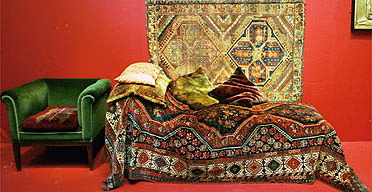
I’d like to introduce you to a nice Jewish boy who lives in Hampstead. He doesn’t care much for shul, but he likes studying some of our texts, and he’s had some good ideas. His name is Sigmund Freud. 

He had this fantastic idea that, if a person spoke freely about all that was worrying them, they might feel a little better. 

He found trends that showed that some of what makes us angry or sad or anxious can be connected to our childhood. Now, being honest, some of his theories have lost their appeal. He put a lot of stock in a couple of Greek myths. But, in general, he understood that by re-telling our internal narratives, we can live in ways that are calmer and more fulfilling. 

During his lifetime, Freud had to deny that his techniques were a “Jewish science,” but later his daughter Anna was able to reclaim the label as a “badge of honour.” 

I think it probably is something of a Jewish science, and I wish more Jews would try it.

I look at some of the characters in our Torah and think how much they might have benefited from a trip to a therapist’s couch. 

Would Isaac have pitted his sons Jacob and Esau against each other so callously if he’d been able to cope with the betrayal he felt when his father Abraham tried to kill him?

Could Moses have kept his temper in check a little if he’d had space to talk through the displacement of discovering he had been adopted?

Maybe Rachel and Leah could have done with some family therapy to process their jealousy and build better relationships.

Of course, they wouldn’t have given us such compelling stories if they’d been better adjusted, and we wouldn’t have the Torah we do. 

It’s too late now for the biblical protagonists, but it’s not too late for us. We actually can go to therapy, and learn to like others and ourselves a little better.

As a community, one of our great highlights is Sandra Webber’s Shabbat Island Discs, where members share their life stories alongside their favourite tunes.

Believe it or not, the idea didn’t begin at KLS, but originated on BBC Radio 4, where it is called Desert Island Discs. On 4 August 1989, the show welcomed on a castaway by the name of Rabbi Lionel Blue. You can still listen now on iPlayer, as he speaks with such gentle warmth, and offers up a song about his Yiddishe Momme. 

But there is a really profound moment when Rabbi Lionel describes the benefits of therapy to us all. He had learnt about himself through a self-taught psychotherapist who took him on for free. His first session took 10 hours! 

He says his reason for promoting the benefits of therapy is that “you can only love God as much as you love yourself.”

This approach, that we ought to get to like ourselves better through therapy, positively impacted on how rabbis were trained at Leo Baeck College. For several decades, it has been actively encouraged as part of rabbinic training.

On and off, in various forms, I’ve been going to therapy for about 15 years. And I swear by it. It has helped me know myself better and love myself more. It has made me a better pastor, partner, and friend. 

And I think Lionel was right: it has made me love God more.

With the lengthy commute between Essex and Surrey, I wasn’t able to go so often. But now, with space and time for it, I find myself back on the couch. It’s doing me a world of good.

As Jews, we don’t evangelise, but if I were asked to give a rabbinic endorsement to anything, it would be psychotherapy. If you’re not already bought in, I encourage you to give it a try. 

Spend just under an hour talking to a trained listener, and see how much better you feel.

Shabbat shalom.

social justice · spirituality · theology

One God, No Masters

We are, all of us, sparks of the divine.

There is something within each of us that is holy. 

We are more than moving limbs and functioning organs. We have a quality that cannot be reduced to DNA, or psychology, or narrative. 

There is something about a person that makes them who they are: more than their physical experiences, and more than our experiences of them. 

It is a feature that we can’t perceive by touch, sight or smell, but we know it is definitely there. It is the unfathomable essence within a human being that glows invisible and breathes without lungs and animates without moving.

This property cannot really be named, but it has been known in English as soul, spirit, or lifeforce; in Hebrew as neshama, ruach, nefesh.

There is something unique about life. And, if anything deserves to be called sacred, it is that.

In Judaism, we call it “the spark of the Divine.” As if God were one burning bonfire in which all of us were the flames. As if, inside every one of us, a candle was lit before we were born and cannot be extinguished after we die. 

There have been moments in my life when I have truly felt it. When I have seen the sacred spark in myself and realised, in a way I still cannot explain, that I am made in God’s image. 

There have been times when I have truly seen the sacred spark in others. Not just that another person was special or lovable, but infinite: that, qualitatively, their true essence could never be contained. 

I hope you have felt this at times too, or already know it to be true, because I want to talk about how radical this concept is.

If you truly believe, as I do, that we all have sacred souls, how could it ever make sense for one person to be better than another? 

In the light of God’s majesty, the divisions of gender, race, nation, and physical characteristics look like pale imitation of reality. Our bodies are real and diverse, but our spirits have a reality that is incomprehensibly more real and more diverse.

The Divine Spark within us comes from the Source of all Truth. And because God has implanted it within us, every life is equally, completely, and unassailably holy.

Every human spirit is remarkably equal. Not because each one is in some way alike, but because each one is infinitely different. 

In this week’s haftarah, the Prophet Isaiah proclaims: “O Eternal God, masters other than you have ruled over us, but we only remember your Name. Those others are dead and lifeless; sunken beings who will never rise. You, O God, have wiped them out and obliterated their memory.”

Who are these other masters? And why can God destroy them so decisively?

We might be tempted to imagine this as we do the Pagan pantheon, where one god comes in and destroys the others, as the Titan Cronus usurped his father, Uranus, only in turn to be vanquished by Zeus. 

But this is not a myth of many gods. In the Jewish understanding, there is only one God. So who else has ruled over us?

Midrash Tehillim says that this is referring to Nebuchadnezzar, the tyrant of the Neo-Assyrian Empire. Nebuchadnezzar ran colonial campaigns throughout the Middle East, suppressing all revolt, and establishing himself as sole dictator over the Levant. In 586, Nebuchadnezzar besieged and ransacked Jerusalem. He bulldozed Solomon’s Temple, conquered the Land of Israel, and carried away its leaders as captives. 

According to our tradition, Nebuchadnezzar demanded that the Israelites he had imprisoned bow down to idols. They refused. Nebuchadnezzar heated a furnace to seven times its regular temperature and attempted to burn the Israelites alive. But, by a miracle, God saved them, and the three pious believers walked out from the fire unscathed.

In this understanding of the text, there is only one True Ruler, and that is God. The lords who attempt to subjugate others are men. Sure, they may be able to win some wars, defeat some people, and make some people bow down to their will. But, ultimately, they are mortal.

Their lives are nothing in the span of God’s eternity. Their empires are worthless in the expanse of God’s universe. They are lying to themselves and others that they can be anything but dust and ashes. 

Only one being is immortal – that is God – and all are equal in the Eternal One’s beneficent eyes. The rulers of the world can never conquer us in a way that truly matters, because our spirits belong to something greater than their meager understanding.

If we deeply internalised this sanctity of every life, our entire world order would seek to function. Consider what it would mean to believe in the profound equality of every soul. How could anyone take more than they need from society, or abide for anyone else to have less? Surely nobody would ever be able to kill another and there would be no more wars. 

How would we have borders and checkpoints, when no human being can own the earth, because everything is God’s possession? Nobody could ever dominate or govern another.

And, in truth, if we truly got rid of all borders, states, laws, militaries, and inequalities, civilisation would fall apart. Society, as we know it, would cease to exist.

Well, good, said Rabbi Avraham Yehuda Heyn. He was one of the leading intellectuals among the Chabad Chassidim in 20th Century Ukraine. He taught that Judaism was a rejection of hierarchy, force, and inequality. We wrestle against the strong arm to make everyone strong and uproot weakness. 

He outlined a view of the world that would upturn all order. Absolute equality for everyone in everything. Complete refusal to participate in states or war. The abolition of all classes, and the levelling of all people.

Avraham Yehuda Heyn was part of a cohort of rabbis from Eastern Europe, profoundly educated in Talmud, as well as the modern thought of Tolstoy, Nietzsche, and Kropotkin. There were many like him, in the 19th and 20th Centuries, who believed that the only logical conclusion to Judaism’s insistence on the sanctity of life was freedom and equality for all. In his recent book, No Masters but God, Hayyim Rothman calls this ideology of strictly Orthodox mystics “anarcho-Judaism.”

This idea may sound radical, and even intimidating. You can feel that it belongs to the heady days of a time when Jews were becoming free and anything felt possible. It belongs with the revolutionary optimism of mystics in another era. It is bold.

And yet: it is hard to honestly believe what we do – in God and the sanctity of the spirit – without arriving at some pretty bold conclusions. 

Think seriously about what it would mean to say that we are all holy embers. To say that we are sparks of the divine.

As if God were one burning bonfire in which all of us were the flames. As if, inside every one of us, a candle was lit before we were born and cannot be extinguished after we die. 

Breathe life into the flames. Give fuel to the candle. And, perhaps, something within us all, will set this world ablaze.

Shabbat shalom.

judaism · sermon · spirituality

My body and my soul are always growing


A few years ago, I started putting on a lot of weight. I got a spare tyre around my waist and started to sag in unexpected places.

After a lifetime of enjoying a diet of junk food and fizzy drinks, my metabolism had finally caught up with me.

I felt a lot of shame about my body shape. At the time, I was midway through rabbinic College, and blessed to be surrounded by sensitive and thoughtful colleagues.

I took my worries to my classmate, David Yehuda Stern. I said: “I’m getting fat, and I don’t like it.”

He smiled lightly and shrugged. “My body’s changed too. But my body’s always been changing. It changed when I was a teenager. Why would I expect it to stop changing now?”

This is some of the best advice I’ve ever had, and I refer back to it often. This week, I texted Rabbi David Yehuda to ask if he’d be OK with me passing on these words of wisdom.

He said that, of course, he had no recollection of ever having said such a thing, but it sounded like an important message, so I should feel free to share it with you.

Having a healthy, happy relationship with my body has been one of the great challenges of my life. I sometimes joke that I’d be a lot better off if I didn’t have a physical form and could just be a concept.

But I definitely feel more at home in my skin at 37 than I did at 27, and certainly far more than I ever did at 17. I find some beauty, now, in accepting that my body, like my soul, is always growing and changing.

When I think about working on my spirit, I know that the perfected version isn’t the one that’s superficially nicest to look at. It’s the one that has lived, learned, and adapted from experience, maintaining its tenderness, while toughening its boundaries. Why should my body be any different?

The best version of my body will be the one that has fully experienced life: wrinkled from laughter; weathered from sunshine; built by adventure and experimentation; and, if I am lucky enough, blessed to reach a very old age.

Our haftarah for this week points us to a similar message of embracing our changing bodies and souls. The Prophet Isaiah preaches to us:

“Consider the rock from which you were cut, the quarry from which you were mined. Think about Abraham, your ancestor, and Sarah, who gave birth to your nation. Abraham was only one man when I called him. But when I blessed him, he became a great nation.”

It’s an interesting formulation, to put “the rock from which you were cut” and “the quarry from which you were mined” alongside Abraham and Sarah. Why should these two concepts be parallel to one another?

In the structure of a biblical poem, which these words from Isaiah certainly are, you usually get a mirroring of similar words in succession like this. Why would Abraham be compared to a rock and Sarah to a quarry?

Our rabbis see an interesting message in the use of language. In Tractate Yevamot of the Babylonian Talmud, they see this as a commentary on the lives of our ancestors, Abraham and Sarah.

Rabbi Yitzhak says this is a commentary on their infertility. Abraham and Sarah were both initially unable to conceive. In this sense, says the Talmud, they were barren like rocks and quarries.

God wanted them to pray and to grow spiritually enough before they were ready for progeny. God needed to see that their souls had grown so that their bodies could change to accommodate miracle births.

Building on this, Rabbi Ami goes even further. He says that, initially, Abraham and Sarah were tumtumim. This is a word that comes up a fair bit in rabbinic literature but a lot less so in modern medical journals. It means that, biologically, they were sexless. They had the same genitals as Action Man and Barbie: just one smooth surface.

(I checked with an obstetrician friend, who said that this was not something she had seen so far in her career. Truly special people then, were Abraham and Sarah.)

So Abraham and Sarah were not just infertile inside. Externally, to begin with, they simply didn’t have the equipment to make Isaac.

According to our rabbis, then, our ancestors went on a great journey with their bodies, spirits, and names. They began like a rock and a quarry, but gradually, over time, they eroded the hard outer layers until their bodies and souls were porous enough to receive God’s blessings. Only then did Avram become Abraham and Sarai become Sarah.

Now, most of us are not going to undergo such dramatic transitions, but there are lessons here for us all. We, like the founders of monotheism, can embrace our bodies and souls as works in progress.

In our society, that is very counter-cultural. The modern world glamourises youth and shuns any body-type that deviates from an unattainable ideal. We are taught to hate our bodies and neglect our souls.

Judaism has a different message for us entirely. When we first wake, we are supposed to thank God for our soul, which the prayer says, God is constantly creating and implanting within us.

Upon getting up, Jews are meant to thank God for our body; for all its openings and closings; for getting to breathe and have a heartbeat; to sit and stand and walk. We say to God: I am so grateful to be alive.

I can’t lie and pretend I’m good at doing this every day. I definitely can’t claim to have suddenly developed a great relationship with my body.

But the principle, taught by our text and our tefillah, has been a great relief to me. The idea, that I first learnt from my classmate, that my body has never stayed the same, gives me permission to see my body not as my enemy, but as an ever-changing vehicle for exploring the world.

My body and my soul are cherished gifts from God. May I be blessed enough to see them grow and change.

Shabbat shalom.

sermon · social justice · theology

Who am I to judge?


Have you ever heard someone say “who am I to judge?”

Not just casually. I’m talking about major situations, when something clearly is wrong. There are those who will shrug off great indecencies, and say they don’t feel qualified to provide a moral assessment.

There is a tendency, in the modern West, to avoid moral judgment, even when something quite clearly deserves condemnation. There are situations when people say “who am I to judge?” when they really ought to be judging.

This desire not to act as judge likely comes from certain interpretations of the Christian tradition. In the Gospel of Matthew, Jesus teaches: “Judge not, lest ye be not judged” and in the Gospel of Luke, he instructs: “Judge not, and ye shall not be judged: condemn not, and ye shall not be condemned.”

There is a fundamentally Christian idea underpinning the notion that we shouldn’t judge. We are flawed flesh and blood, whereas God, who is perfect, is the only one who has the right to judge.

This is, I think, the direct opposite of the Jewish attitude towards judgment. Quite on the contrary, we are expected to be God’s hands in the world. We are expected to look at the world, analyse it, judge it, and find ways of making it better. We are supposed to be active participants in the world, working towards holiness and justice, by discerning right from wrong. God is not going to intervene for us: we have to intervene for God.

(I should be clear here that I don’t want to set up a false dichotomy between Christian and Jewish teachings. Some Christians say the verses I quoted from the Gospels are really about avoiding hypocrisy; and some Christians are in fact overly quick to judge others. I draw this distinction only to show that, in Judaism, judging is good. According to our Torah, our Prophets, our Mishnah, and our philosophy, judgment is the key to living righteously.)

In our parashah this week, Moses recalls the system of government he established with his father-in-law, Yitro. He reminds the Israelites that he appointed judges and told them: ‘You must hear the cases of your fellow Israelites and the foreigners living among you. Be perfectly fair in your decisions and impartial in your judgments. Hear the cases of those who are poor as well as those who are rich. Don’t be afraid of anyone’s anger, for the decision you make is God’s decision.’

For Moses, it’s not that God makes perfect judgments in Heaven and we make flawed ones on Earth. The process of judging is sacred. Finding a way to judge everyone fairly is doing God’s work.

We are supposed to judge. Fairly, honestly, without deference to the rich or patronising the poor, without fear or favour, human beings are supposed to judge each other.

In our haftarah, the Prophet Isaiah tells us exactly what happens when we stop judging. He chastises Israel: “Your leaders have become rebellious and companions of thieves; everyone loves bribes and runs after payments; they do not advocate for the orphan, and the quarrel of the widow does not come to them.”

When you abrogate responsibility for judging, it is the most vulnerable people who suffer. Unless people are willing to say that something is wrong, the people with the least power are left without advocates or intercessors. In Isaiah’s time, he saw that this created “a sinful nation, a people heavy with iniquity.”

Not everyone will sit on the Sanhedrin, but all of us are supposed to be on the lookout for infractions against the moral order. In the aftermath of the Second World War, this became especially relevant.

Hannah Arendt, one of the 20th Century’s greatest philosophers, escaped from the Nazi Gestapo in 1933. She was a stateless refugee in Paris throughout the war, during which she spent some years in an internment camp.

Afterwards, Arendt moved to New York, and became one of the only foreign journalists to report on Israel’s trial of the Nazi war criminal, Adolf Eichmann. Arendt coined the phrase “the banality of evil” to refer to the Final Solution’s pen pusher. Anybody, said Arendt, could perform the most wicked acts in the most indifferent ways. She warned that, if the most disgusting crimes could be prosecuted, they could almost certainly be committed again.

When Arendt wrote her reports, and turned them into a book, she received considerable backlash from readers. Sometimes, she defended what she had said. Some of it caused her to revise her position. But only one criticism made her truly incensed. What got her truly angry were those who said she had no right to judge.

“Who are we to judge?” her critics asked. “How can we say that we would behave any differently to Eichmann under the circumstances? How easy it must have been to get swept up in the fog of committing genocide. Maybe anybody else would do such a thing.”

Arendt wrote a furious riposte to such critics, called Responsibility and Judgment. She said:

“Who am I to judge? actually means We’re all alike, equally bad, and those who try, or pretend that they try, to remain halfway decent are either saints or hypocrites, and in either case should leave us alone. Hence the huge outcry the moment anyone fixes specific blame on some particular person instead of blaming all deeds or events on historical trends and dialectical movements, in short on some mysterious necessity that works behind the backs of men and bestows upon everything they do some kind of deeper meaning.”

This reluctance to judge Nazi war criminals who oversaw death camps was offensive to Arendt, as one who had survived that terrible era. But it was also, she felt, philosophically abhorrent.

If you can’t judge, says Arendt, nobody can ever take responsibility for anything. And if nobody can take responsibility, then history is just a bunch of forces acting on us all, that never requires us to take action.

On the contrary, judgment is the prerequisite for recognising when something is wrong in the world, and doing all we can to change it.

You can’t blame psychology or circumstances or material realities. Everyone must take moral responsibility.

That is by no means easy. The Christian rebuttal against judging warns that if you judge someone, you will be judged to the same standard.

Yet surely that is the point! Saying that something is morally wrong means making a commitment not to do it. Labeling another’s actions as monstrous means we commit ourselves never to be like them.

Arendt saw Eichmann, the mass murderer and war criminal, as an everyman. He was a mindless bureaucrat, who had never given any thought to whether what he was doing might be wrong. To adopt the familiar phrasing, Eichmann was “just following orders.”

One of the central goals of Shoah education must be moral instruction. Not only to teach about what happened to our people, but to show what any person is capable of doing. It must be to train people to look critically, with judging eyes, at all that happens in the political sphere, and never excuse it by blaming circumstances, history, psychology, or upbringing.

No, let us never say “who am I to judge?” Let us instead insist on appraising right from wrong and good from evil at every possible opportunity. Let us be willing to assess, without fear or favour, what we feel lives up to and defies God’s law.

May we fulfil the words of the Prophet, and live out Isaiah’s proclamation, that we shall be redeemed through justice and find repentance through righteousness.

Shabbat shalom.

judaism · sermon · social justice

People! Remember that there is a God!

In the Zhitomyr Oblast of what is now Ukraine, there is a city called Berdichyiv. In the middle of the 18th Century, this was a great market town in the Polish-Lithuanian Commonwealth.

To here, flocked all the great, the good, and the downright nasty from every quarter of their empire. But, of the permanent residents, three-quarters of those who lived here were Jews.

So, come with me, on any ordinary day, to the old Jewish city of Berdichyiv. You will find the streets lined with stalls; you will see shop fronts wide open; you will meet throngs of people moving to music and entertainment. Here, you can buy just about anything, and sell just about anything too.

You have to watch your wallet for thieves, of course; and be very careful not to get involved in any of the gambling games on the side streets, because you are sure to be hustled. And pay attention to the great crush and clamour of shoppers beating each other for products, or tradesmen jostling for space and trying to bargain.

But that’s not the main show. You have to really listen if you want to know why we’ve come here. Can you hear it?

Can you hear the man shouting? You have to strain your ear to get a good grip on the sound over all the noise of the market square, but you’ll catch it. There it is!

“People! Remember that there is a God! People! Remember that there is a God!”

Look. There he is, standing atop the clocktower. The man with the fluffy shtreimel and wispy beard and sidelocks. He’s thin and spritely, and he’s gripping the side of the wall and calling out with all his might:

“People! Remember that there is a God!”

To most of the people shopping here, that’s Levi Yitzchok. But to his supporters, that’s the Holy Berdichever, the great Hassidic rabbi, the disciple of the Maggid of Mezritch.

To most of the people here, he’s just a madman. But to his supporters… well, they think he’s mad too. But they love him.

Of all of the places in the world that this sage could go, he chose to go to the most corrupt town with the most unbelieving Jews with the most sinful dispositions and minister to them with fanatical spiritual messages.

Sometimes he did that by going out to the poorest and the most despised, and treating them with great love, as if they were the shining light of God on Earth. And sometimes, like today, he would stand on a platform ranting at everyone to remember that there was a God.

Now, you might indeed think this man sounds like he was mad. But I think he sounds… relatable.

I cannot tell you how much I would love to find a spot at the London Stock Exchange or the arms fairs at the City Hall or on the steps of Parliament and do exactly this. “People! Remember that there is a God!”

Would our politicians and corporations treat our planet as if it were their own dustbin to be discarded and destroyed if they knew that it was a gift from their loving Creator?

Would they treat human life as if it were something so disposable and meaningless if they understood that each person was created in God’s image?

Could they behave in ways that are so shamelessly venal and debased if they thought they would one day have to answer for their deeds?

No. They act as if there is no God but greed itself, as they sacrifice everything on the altar of the market.

Oh sure, there are those who pretend to believe in God. If you like, Donald Trump will sign a copy of his own version of the Bible, which he has hawked in American public schools to make as much as $300k. But does anyone believe that Trump actually thinks there is One above him?

His only faith is in the false idols of wealth and power.

The snivelling lapdogs around him from the Christian fundamentalist right know that Trump doesn’t fear God. That’s what they like about him.

They are impressed by his ability to manipulate and lie for their own purposes. Their religion, whatever god they worship, wants racial segregation, control over women’s bodies, war on every continent, refugees in cages, and queer people excised from public life.

This doctrine of reaction may be one of the world’s major religions. (In fact, I think it’s the true belief system shared by many of the world leaders, whatever their outward claims may be.) But it has nothing to do with the God of our Scriptures.

In our haftarah, the Prophet Jeremiah takes to task exactly these people who profess belief on the one hand and behave amorally on the other. The priests, the teachers, and the rulers, he says, have all given up looking for God and decided to waste their time on their worthless idols.

In the world to which Jeremiah brought God’s message, the leaders worshipped the work of their hands. They venerated material things, but treated life as something disposable.

They loved their possessions but turned their back on the Fountain of Living Waters. They did deals and went to war with all the empires of the world, but neglected the still small voice of conscience implanted within them.

Today, has anything changed?

Actually, I think it has. We can do far more damage now than ever before.

The kinds of weapons held in very few hands were unimaginable to the biblical prophets. The levels of environmental destruction that companies could reap on God’s forests, skies, and waters have never been so great. The cost of such cruelty and indifference has never been so high.

In our liturgical cycle, we are in the three weeks of warning: where we read the Prophets’ greatest indictments against the Jews. That is why today we read the words of Jeremiah, chastising our people to remember their God and cease lusting after vanity and emptiness.

In this build-up to Tish Bav, we are supposed to be confronted by the scale of the world’s wrongs and the dangers of our inaction. So, we could just leave it there, to feel angry and devastated by all the brazen ruination.

But, the rabbis taught, even in these weeks of warning, we should never go away feeling hopeless. So, in constructing the haftarah, they skip an entire chapter, to Jeremiah’s promise of restoration, where he vows:

“Turn away from your love of material possessions, and God will come straight back to you. You will be able to speak of your faith with truth, justice, and righteousness. Then you will be a blessing to the nations of the world, and everyone will come and praise my name.”

Jeremiah offers us a way out, available at any moment.

The great condemnations of the prophets might better be delivered at Davos or the United Nations, but we all have a role to play. We can remember, in our own lives, what it means to behave as if there is a God.

Let us conduct ourselves as though, one day, we will have to answer for our deeds.

Let us treat each human being as if they were created in God’s image.

Let us act as if this world is a gift from a loving Creator.

And, perhaps, through our example, the people of the world will come to remember that there is a God.

Shabbat shalom.

sermon · social justice · torah

How did the exodus look from the back?

When the silver trumpet blasted, the Israelites decamped and moved to a new location in the desert.

At the front of the procession, this seems to have been a marvellous affair. The tribal leaders assembled at the entrance to the Tent of Meeting with triumphant fanfare. God’s presence ascended from the Tabernacle as a glorious pillar of smoke in the day or a fearsome column of fire at night, and the chieftains marched in pre-assigned order behind their divinely appointed leaders: Moses, Aaron, Miriam, and the priests. 

For the men at the head of the procession, this must have felt like a victorious military march towards the future.

But what was it like at the back? How did this experience of moving through the desert feel to the people who were on the edges of this grand voyage?

Consider how many Israelites were wandering in the desert. We have heard their numbers and know they amount to the size of a small city. There were more Israelites crossing the Sinai desert than there are people living in the modern country of Luxembourg. 

In such a large group of people, most had no idea that all this pomp was happening at the front of the group. If they were midway through the camp and all the travellers were silent, they might have had a chance at hearing the vaguest echoes of trumpet blasts. But it is unlikely that anyone on the edges heard these fantastic instruments at all. 

Perhaps, at a far distance, they could see the plumes of smoke and fire to let them know they were moving. But, far more likely, the greater indication would be the others around them shifting. They would hear rumours and murmurings, and get ready to move on their encampment to its next stage.

While the priests at the front played with their horns and struck up a marching rhythm, a whole other group of people would get to work. 

The people who pitched tents would start the laborious process of deconstructing them. Breastfeeding mothers would gather up their infants in slings. Parents would call out to playing children and try desperately to cajole them into staying close. Water-carriers would haul tankards over their heads or hoist them on their backs. Animal handlers would load their donkeys and camels, and entice them to carry rations.

Our Torah is told from the perspective of those at the front of the procession. We learn their family dramas, hear the complicated rituals they performed, and picture the magnificent relationship they had with God.

For most of the desert Israelites, however, the journey was altogether different. What kept them together, more than these supranatural experiences and religious rites, were their relationships with each other. 

I think it is important to centre their stories.

I have a long commute from Essex to Surrey. If the traffic is good, it takes about an hour and a half each way. To pass the time, I spend my journeys listening to audiobooks.

This has opened up a new world of literature to me. My usual reading is philosophy and theology, but that’s hard to focus on at the same time as the road. So I’ve started listening to sci-fi and fantasy novels.

Over the last few months, I’ve made my way through a whole bunch of stories by Ursula Le Guin. As a storyteller, she is a favourite of the college principal, Rabbi Dr Deborah Kahn Harris, and was beloved by her teacher, the legendary Rabbi Sheila Shulman.

Fiction, Rabbi Deborah assured me, is sometimes the best way to get across theological ideas. I have found this to be totally true.

During my car journeys, I have listened to Le Guin’s Earthsea Quartet from beginning to end. For the first three books, this was a world inhabited by dragons, powerful mages, young kings, demonic spirits, and magic spells. It was captivating.

The fourth book, Tehanu, has a sudden change in tempo and style. It was written more than 25 years after the first novel, with the characters having aged by the same amount of time. 

At first, hearing this final book, I was somewhat disappointed. The pace is slower. Far less seems to happen. The characters, who had previously been magical heroes who cast spells and rode dragons, were now old, disempowered, and facing a world that is violent and cruel.

Only after I finished listening did I get to hear the author’s own voice. In a recorded post-script for the audiobook, Le Guin says that Tehanu looks at the high fantasy world from below. It shows what the world I had loved and lived in during my car journeys is like from the vantage of the people without power: women, workers, and children. She says this was her way to give voice to her own people in the world of Earthsea.

Now it made sense.  I was, I discovered, learning a philosophical and theological lesson from the story, just as Rabbi Deborah had threatened I would. The world, after all, can be violent and cruel, and it is especially so to those without power.

History and politics are very different when you see them through the eyes of people who don’t march at the front, but gather at the back. 

That doesn’t mean that life for workers and women is all misery. In Le Guin’s story, the powerless still have their own magic, their own rituals, their own beliefs, and build their power in community with each other.

That’s true for our biblical ancestors, too. Thanks to archaeology, we now have a better idea of what life looked like for the earliest Israelites who had no access to the Temple cult. They had their own parallel religious practices, with God centred in their homes. In their kitchens and bedrooms. They had fertility rituals, prayers they recited, and stories they told, even though they were excluded from the world of priests and kings.

This is one of the great joys of Judaism. While it has always had its figureheads who spearhead the community from the front and pronounce the direction for all to proceed, it has also always had its margins. 

Within Jewish life, those who were excluded from the centre have built a religious life on the edges. These are exciting, creative places. They are, often, where real changes are first ignited.

Today, we must pay attention to the wonderful world of Jewish life that is being created far from board rooms and conference podia. There are other Judaisms, constantly being made in people’s homes, and in communities quite separate from the centre of north west London. Why, there are even congregations south of the River! This Judaism may not always make headlines or even get written down, but it is the lifeblood of our religion.

We should, of course, listen to the sounds of the great trumpets blasting to tell us we are moving.

But we must also pay close attention to what people are saying at the back, as we move on our eternal journey to freedom. 

Shabbat shalom.

Ursula K. Le Guin
festivals · judaism · sermon

Judaism is never the easy option

If you are looking for a religion to make your life easier, give you comfort when you’re troubled, and to help give you certainty in life… I wouldn’t recommend Judaism.

Judaism gives us many things, but certainty, comfort, and ease? You won’t find those here.

Our religion is one of ‘ol Torah – the yoke of Torah. Our Talmud teaches: We must subjugate ourselves to the Torah like an ox to a yoke. Like a donkey to its  burden.

For everyone, life feels heavy. It feels like too much to bear. 

For Jews, our Torah comes along and says: would you like some more obligations to go with your struggles? I can add a few more worries to your load.

At Shavuot, we read the story of Ruth. Ruth has lost her husband. She has no land or property. There is famine and disease. She is in the middle of nowhere. She and her sister, Orpah, face a choice. They can go back to their own people, the Moabites, get new husbands and start life anew. Or they can stay in the wilderness with no possessions to look after their mother-in-law, Naomi. 

Ruth takes the harder option. She chooses to stay with her mother-in-law, learn new ways, and take on a new God. It is an act of remarkable bravery. 

We read it at this time of year to remind ourselves that we are always out in that wilderness, always with the option to turn our backs and leave behind this people and this God. But, like Ruth, we keep on choosing to stay. 

Ruth’s is a personal story of her connection to Judaism. Shavuot is also the story of our collective embrace of the Torah.

This is the festival that commemorates when forty thousand freed slaves received the Torah. 

Our Talmud says that, when they came to Sinai, God lifted the mountain up over their heads. From underneath, they could see the enormous peak suspended above them like a keg. 

Out of the clouds, God declared: “Accept the Torah, or this will be your grave.”

Now, our Talmud concedes, in that situation, accepting the Torah would be the easy option. (When a robber says “your money or your life,” they’re not actually expecting you to think it over.)

If that’s the case, the rabbis say, we should be able to reject the Torah now. If our ancestors had to accept it under duress, faced with threats, we are not bound by the decisions they made. 

But, says the Talmud, our ancestors affirmed their Jewishness in the time of Esther. Here, the shoe is on the other foot. In the time of Esther, being Jewish was a dangerous thing that might get you killed at the hands of a tyrannical regime. But, the story says, the Jews reaffirmed their Torah and took upon themselves even more commandments.

That’s right, at the time when they were carrying the heaviest burden, they chose to weigh themselves down more.

Look at our present situation. There is no threat to us that we must keep being Jewish. Everyone here has the right, without consequence, to walk out of this synagogue, and never come through the doors of another one again. We could take the easy choice, and forget this old religion.

But what actually happens? On the days when there are attacks on Jews, synagogue attendance goes up. When it feels dangerous to be Jewish, we get more requests from people who want to connect with their heritage. In just the last few weeks, we have had more requests than usual from people seeking conversion.

When being Jewish is the toughest choice – that’s when our people really show up, and take on the burden of the Torah.

Now, you may be thinking, this sounds like an awfully Orthodox sermon from our extremely liberal local rabbi. All this talk of the burden of Torah, and the yoke of submitting to Heaven – it sounds like something that belongs to the black-hats.

Let me tell you something I feel quite sure of: being a Progressive Jew is a much greater burden than being an Orthodox one.

A year ago at this time, we brought together our Liberal and Reform strands to build the Movement for Progressive Judaism. A uniting figure from our shared history is Sir Basil Henriques, who led both Reform and Liberal communities in the Jewish East End. He set out his vision of what our shared belief system is, saying: 

“The Law has been handed down to the Prophets of Israel. That Law is not static, but ever expanding and progressing. It has been revealed to Israel in every generation, and every age should be able to stand on the shoulders of the previous generation, and to see further and be able to see more clearly what is the perfect Law of God. The Law, the Torah, should be the highest ethical code of which man can conceive. If the Perfect Spirit of Righteousness demands of us perfect righteousness, then the Laws of Righteousness must be as perfect as we can conceive them to be.”

In other words, we Progressive Jews must embody, through our lives, the highest moral standards possible. The question we ask is not: “what does the tradition say I should do with my life?” but, the far tougher question: “what does God require of me?” An individual Jew ought to wake up every morning, asking how best we can serve our Creator. As a movement, we should be in a constant struggle to work out together the morally best choices.

It is relatively difficult to say no to pork and shellfish, as I do. 

But it is far harder to grapple with the morality of food itself. Should we be eating any kinds of fish? What are the air miles on our vegetables? Can we truly eat ethically in this unjust system?

But a Progressive Jew wants to know what the morally right thing to do is, not just what conforms to ritual law. So these are the questions we must ask ourselves.

A Progressive Jew can live life just as an Orthodox Jew would, with one exception. We can never unlearn the Enlightenment. We cannot backslide into racism and sexism; or magical thinking and superstition. We must always face the world full-on, with all its problems, to see how we can live up to the highest moral ideals in our time.

That is far harder. 

Let me give you some living examples.

Here in the UK, in the last few months, we have experienced some real threats as a Jewish community. Things that make us rightly scared. 

Cantor Zoe Jacobs’ shul, Finchley Reform Synagogue was attacked recently. What did she do? She threw open the doors and welcomed in the whole community. People of every nationality and religion came to join her in prayer.

Do you think that was easy? Do you think it is comfortable to open doors when your instinct is to put up walls? 

But that is what Progressive Jews do. We refuse racism and fear. We refuse to be pushed back into the ghettoes.

In Israel, compare our religious leaders there.

On the one hand, the Ashkenazi Orthodox ‘Chief’ Rabbi Kalman Ber has supported Netanyahu, his corrupt cabinet, and his wicked war every step of the way. 

On the other hand, Rabbi Avi Dabush, one of the leading Reform rabbis, comes from Kibbutz Nirim, a place that was attacked by Hamas on October 7th 2023. For the last three years, he has been demanding answers from the Israeli government for why his community was abandoned, while at the same time, physically putting himself in the way of attacks against Palestinians and trying to stop this war.

Now I ask you, who took the easy route? And who took the hard one?

And let me ask the real question: which response is the more godly; the more moral; the more Jewish?

Doing the correct thing, the Progressive thing, is harder. It takes real courage, and most of us will not live up to such high standards.

This is the burden of our Torah.

That, no matter how difficult things are, we will take on responsibility for doing what is right.

And, we all keep taking on that challenge, in every generation.

Chag Shavuot sameach. 

judaism

A true prophet’s destiny is despair

All has been foreseen. That is a warning, not a comfort.

When the Progressive Jewish movement was born, its founders pledged to uphold the religion of the Prophets. Our guides would be those men of ancient Israel who courageously denounced injustice and proclaimed hope to the world.

At the time, I wonder how much attention they paid to the lives of the visionaries they sought to emulate. We know little about most of the historic prophets, if indeed they existed at all.

But, if we have one image of what they looked like, it’s probably Rembrandt’s painting of Jeremiah Lamenting the Destruction of Jerusalem. 

Jeremiah is surrounded by darkness, slumped on the craggy rocks of the Negev. His left elbow rests on what are possibly his only possessions, including a book that we know will become part of our Bible. 

The most illuminated part of the composition is Jeremiah’s bald forehead, drawing our eyes into his face. That face. It is so intensely pained; so sullen and exhausted. The wrinkles furrow, as if calling us to ask whether anything of this destruction was avoidable. I am captivated by the eyes, which cannot be more than two dark brushstrokes, but communicate more anguish than any scream I have ever heard.

Jeremiah spent his entire life warning Israel that it would be destroyed. He chastised them that their social injustice and complacency would be their ruin. He promised them plagues, persecution, exile and war. 

Jeremiah had the unfortunate honour to see all of his visions come true. 

At every stage, he promised them they could be redeemed if only they would repent of their ways. Whether that part was true, we will never have the fortune of knowing. 

This is the model of our religion; the person whose mantle we have chosen to take. It is that of a man miserable enough to have been proven right; to watch everything he loved, and all that he held sacred, burn.

In some ways, prophesying doom is an easy gig. Economists are always predicting the next crash and defence experts are forever prepared for the next war. Misery is one of life’s guarantees. 

When Progressive Judaism began, its progenitors insisted that prophecy was about forthtelling, not foretelling: speaking the truth about how the world really is, rather than guessing what is to be. But really one yields the other. When you see clearly how terrible the world is, you can accurately predict its tragic ends.

In Greek antiquity, Cassandra was cursed by the god Apollo to always tell the truth and never be believed. She issued accurate prophecies, and nobody took note. 

Perhaps with hindsight, what she foresaw was obvious. War was coming and Troy would be defeated. Then King Agamemnon would be captured and slaughtered, as would she. The Greek ships would sink. As the city states fell, people would spend decades at sea without mooring. Disaster awaited. 

All Cassandra had to do was see clearly what was happening in Greece’s unfolding civilisational collapse to know that destruction was inevitable. 

And we cannot blame her countrymen for disbelieving her either. If someone stares that far into the abyss, nobody wants to be dragged into the darkness with them. Their misery sounds cloying and narcissistic. It feels impossible to bear. 

If somebody tells you that the world you know and the people you love are on the brink of destruction, you have to disbelieve them. How else will you go to work, raise your children, care for your sick? How can you live in this world if you honestly believe it is ending?

Torah warned us that if a prophet predicted something and it did not come to pass, you could ignore them. They prophesied in vain. 

The grand visions of peace on earth and justice rolling out like a stream haven’t happened yet. 

The Christians circumvented this by writing their texts so it looked like their carpenter was fulfilling all the visions; even if the world self-evidently was not perfected. They deferred it by saying the other prophecies were still to come. 

And we Progressive Jews have avoided the problem too, by claiming that the Messianic Age is forever not yet. 

Perhaps it is forever not at all.

The only prophecies that have come true are the promises of disaster. The only accurate predictions were of death, plague, humiliation, and exile.

We said we wanted to be heirs to the prophets. We saw in their proclamations antecedents to the Enlightenment values of truth, equality, peace, comradeship, progress and righteousness. We heard God’s word refracted through them like a clarion call, and said we would now take it as ours.

Scattered in exile, we would be a light unto the nations. We would teach the world to study war no more. We would bring on the day when the false gods of prejudice and materialism were finally vanquished before the altar of Infinite Unity. 

I need you to know that I believed every word. Even if nobody else did, I really did.

I thought I might see it in my lifetime. The great unfolding of history. Our glorious march towards true justice and equality. Call it the Revolution or the Messianic Age or Peace on Earth, I truly believed it was coming.

And it didn’t matter to us that the only full life story we knew was Jeremiah’s. Jeremiah went to jail and we would go to jail too. For the climate, for peace, for civil rights, for democracy. Progressive Jews have proudly broken the law and resisted injustice to take up the place of the suffering servant.

In Lamentations, we see the words Jeremiah spoke when he witnessed his city destroyed. 

“I am the man who has seen afflictions at God’s hands…”

“…We have suffered terror and pitfalls, ruin and destruction. Streams of tears flow from my eyes because my people are destroyed…”

“…My people have become heartless, like ostriches in the desert…”

“…All this has happened because of the sins of the prophets and the iniquities of the priests…”

“…The visions of your prophets were false and worthless; they did not expose your sin to ward off your captivity. The prophecies they gave you were false and misleading…”

“… All our friends have betrayed us, and become our enemies…”

I am not sleeping well. 

I wake up multiple times in the night with my fists clenched, gripping my bedsheets. I’m scared and angry and I feel so alone.

In the last month, an Iranian was arrested for hostile reconnaissance on the college where I trained to be a rabbi. A close friend, my witness at my wedding, had her street evacuated because terrorists were hiding in the gardens. A close friend, who I’m going on holiday with at the end of the month, had the synagogue where she works targeted with a petrol bomb. 

None of these incidents made national news.

They are background noise to stabbings in Golders Green; murders at Heaton Park; arson at Nelson Street; smashed windows with lighter fluid at Kenton Park. Every festival, I interrupt the running of religious services to say Jews have been killed somewhere. 

Am I even praying any more, or am I just trying to keep people calm?

All of this was so foreseeable. At least it feels so in hindsight.

We Progressive Jews fully embraced citizenship in Europe. We aligned ourselves with the British establishment for our protection. We swore fidelity to the monarchy in our weekly prayers. We embedded ourselves in this country and became integral to the state. 

Then, in a moment of counter-culture, when people became anti-establishment and angry at the state, we were the accessible human bodies they could grasp, and stab.

We Progressive Jews rejected all politics of race and nation. We would be a moral movement, expressing only the best of the prophetic message. 

But the rest of the world is based on racism and nationalism. Everyone else sees the world through the lens of race. Through their glasses, a Jew at prayer in London is indistinguishable from a Jew driving a tank in Gaza. They think they can exact war and revenge on us.

We aligned ourselves with Israel because it promised us hope. After the Shoah, we needed some guarantee of safety to cling to. We advocated for Israel and defended it. Maybe in our own eyes, too, the Diaspora and the State became indistinguishable. 

We muddied the waters of our own understanding of what antisemitism was. We fought with each other, to define it, and to show where our loyalties lay. People couldn’t trust us to say what was happening. Now they absorb hateful propaganda that says we are doing all this to ourselves. 

We chose bad allies to bring down people who weren’t real enemies. At the time, I expressed my fear that because of all this, people would blame the Jews for Britain’s problems. 

‘Of course they wouldn’t,’ a friend assured me. ‘That would be antisemitic.’

Now, we attend rallies addressed by Nigel Farage. It is the last gasp of a failed effort to find security in race, the state, and the establishment: the very things that are making us unsafe.

The Progressive Jewish answer was always supposed to be different. We would, instead, find safety in solidarity. Our best defence is our neighbours. True security is in the positive relationships we build across other faiths, with all the oppressed communities of the world. 

Where are our allies now? 

I suppose we may never know whether our way would have worked. 

Jeremiah told the Israelites, he told them it would happen. “Do not ally with one power,” he warned, “or another one will destroy you. And then your allies will destroy you too.”

“Do not seek surety in militaries and empires. You can only count on God.”

And then God will abandon you, too.

After the Shoah, Progressive Jews rejected the cruelty of Orthodox theologies that insisted we only had ourselves to blame. We were the victims of unjust systems, who only had bad choices in a world stacked against us.

What a great promise the worker’s revolution had been! The proletariat would shake off the chains of capitalism and all would finally be free. And yet, in every country where Jews lived under communism, they were so far from free.

The Bund: the Jewish worker’s movement; the Yiddish pamphleteers; the revolutionary singers. They would save us! 

I think, now, that we romanticised them so much because they were all dead. They couldn’t make mistakes or show their weaknesses or try out their ideas and see them fail. They are all dead. All of them. The dead cannot save us.

Maybe some day, we will be the subjects of nostalgia too: the last Jews crazy enough to have faith in the prophets.

And the tolerance of liberal democracy, what of it? Didn’t it offer the very first promise under Napoleon’s tricolor that Jews might have freedom?

The safest places are safe until they are not.

I think of my great grandmother who left Lima for Berlin at the start of the 20th Century.  How confident she must have been that she was heading to the safest haven on earth. I don’t need to tell you what happened to her.

I don’t think we have anywhere safe to run this time. Not Israel, even with its Iron Dome and bomb shelters. Not America, even with the hegemon’s promise to be the land of the free. I cannot imagine escaping to anywhere. 

And do not pretend to me that there is any virtue in the Orthodox fantasy of good wives helping their little husbands do mitzvot while they all pretend the world is unchanging and grow ever more sadistic with it. You cannot pray your way out of reality, or study your way out of people’s dignity. 

Every option available to the Jews failed miserably. Zangwill imagined that Salonika would be a great centre of Jewish life as part of an international community. The Nazis had a near complete kill-rate there.

After the Shoah, we had to find hope somewhere else. 

Israel may have been a mistake, but it was the only mistake the Jews had left to make. Zionism was the only dead end the Jews hadn’t yet gone down. And, after all that, sadly, it will not bring us safety in the end either.

Why would the Palestinians give up their land and abandon their homes without a fight? How could we expect the Muslims to tolerate Jews controlling Jerusalem? There was no way any of it could survive without subjugating the Arabs and contorting the Jews until neither were recognisable. 

The Jewish Left said that the Israelis and Palestinians would either all live together or all die together. I fear the choice has been made for them in board rooms they have not entered. 

If I could see into the abyss as clearly as Cassandra did, I would wager that, in less than a hundred years, Jerusalem will be a desert wasteland, where every few weeks a new man will declare himself Pope, Emperor, Caliph, or Mashiach. The only thing we can’t yet imagine is what awful weapons they will have.

The only option still not explored is the prophets’ dream of lions lying down with lambs and justice flowing like an ever-flowing stream. It hasn’t happened yet.

I need you to know that I still believe in it. Even if nobody else does really, I still believe.

I just don’t think it will happen in my lifetime. It may never happen at all.

When Progressive Judaism was born, we renounced all claim to Israel. ‘Berlin will be our Jerusalem,’ promised Mendelssohn, as he cajoled us out of the ghetto. The enlightened democracies will be our Zion.

Berlin was Jerusalem, for a while. And then it was a graveyard for a generation of my family.

I’m not sleeping well. I feel like a balding man, clutching his bible, watching his city burn.

With such pride we said that I was the first person in my family to be born in the same country as his father. England was our home. 

England is our home. Jewish life here is beautiful and vibrant. If they could only see how our children run around at house parties; how we spend weeks immersed in study; how our musicians play the house down; how our theatremakers make us laugh our guts out. How we bless our babies, our bnei mitzvah, our teens, our weddings, our anniversaries, our dead; how we pray with all our soul and might. 

A quarter of Britons say it would make no difference if we disappeared tomorrow.

England has been our Jerusalem too. I do not know what it will become. 

Maybe it isn’t too late. 

The future is unwritten. That is a threat, not a promise.

sermon · torah

Yet it moves.

In 1633, Galileo Galilei was brought before the Roman Inquisition and instructed to recount his heretical views. Galileo had said, contradictory to the views of the established Church, that the earth rotates around the sun. He had to retract this claim or face death.

So, to protect himself, Galileo assured the Church that he was wrong. The earth remained still.

As he left the courthouse where he had been tried, Galileo raised his eyes to the sky, then back down to the earth. He stamped on the ground beneath his feet and muttered: Eppur si muove: yet it moves.

Yet it moves.

For we who stand on this rock in the solar system, it does not feel like the earth is spinning. We can understand how people once thought the sun moved around them.

We, educated in our modern world, understand that the globe is rotating, and that this rotation is responsible for times and seasons.

But if you don’t know the laws of the earth’s orbit, every winter feels like a divine abandonment.

The earth feels static. And yet, the earth moves.

Hundreds of miles beneath the ground where we stand, plates are shifting in the earth’s mantle. For millennia, continental landmasses have drifted apart and pushed back together. Their pace is imperceptible from where we stand, so we cannot know what a profound impact they are having on the structure of our planet.

We, educated in our modern world, know that migration in the oceanic lithosphere explains mountains, lakes, and volcanoes.

But if you don’t know the laws of tectonic shift, every earthquake will feel like an act of God.

The ground beneath us feels static. And yet, the tectonic plates move.

Right now, the forces of history are at work.

Since the dawn of civilisation, people have arranged themselves into complex societies with varying levels of specialisation and hierarchy.

Within those systems, they have developed new technologies, made laws, and created cultures. They have struggled over resources, sometimes to the point of complete social overhaul, and sometimes to the point of common ruin.

We, educated in our modern world, know that the science of sociology explains how civilisations operate. We have learnt to recognise economic trends, like that spikes in oil prices result in increased interest rates. We have also learnt grand trajectories, like what causes empires to collapse.

But if you don’t know the laws of history, every rupture to the social order feels like a curse.

The social order feels like it will never change. Our world feels stuck on the same trajectory. And yet, the people move.

To everyone in ancient Egypt, the rule of Pharaohs felt like an unshakable fact. By the time the Israelites were enslaved in Goshen, the Egyptian empire had already existed for 2,000 years. The pyramids had already stood for a millennium.

Every Pharaoh was called Ramses and every Pharaoh declared himself a god. He claimed that he controlled the flooding of the Nile and the rising of the sun. He could not be moved.

When Moses killed a slave driver, he did not only have to fear Egyptian retribution. The Hebrews themselves were ready to mete out punishment.

Moses’s own people, turned on him and demanded: “who made you ruler and judge over us?”

Moses had rattled the social order, and this terrified even his kin. He could not be the ruler and judge over them. Their ruler was supposed to be the slave master and their judge was supposed to be Pharaoh. They could not even imagine moving.

In the Torah story, we only hear what happened forty years later, when Moses returned from his years as a goatherd for Jethro.

Yet, on his return, tens of thousands of Hebrews, and many others, were ready to leave the only land they had ever known for a barren wilderness.

In fact, even the ordinary Egyptians were in a revolutionary mood. They handed the Hebrews wealth and resources for their journey. They were co-conspirators in sedition against Egypt.

Hebrews and Egyptians alike were willing to bring down a structure that had lasted for twenty centuries, and risk existence itself.

We might attribute this sudden change of mentality to acts of god: those Ten Plagues the Eternal One wrought upon Egypt to bring down the might of Pharaoh.

But I wonder what else happened in those forty years. What were Aaron and Miriam, Moses’s siblings, doing in the four decades when their brother was absent? What did Shifrah and Puah, the rebel midwives, do in the time when all seemed lost?

I can think of no other explanation: they organised.

With Moses gone, the dissidents were preparing the Hebrews for the great exodus to come. They had faith. They knew that the slave system could be defeated. They knew that people would move.

I imagine they were knocking doors, spreading the word in the marketplace, gathering slaves for secret meetings, building alliances across the divides of race.  I imagine they were keeping hope alive; sowing seeds of possibility; encouraging people to imagine a future without domination and toil.

To those who do not know their history, the Hebrews’ decision to leave would have felt like a greater miracle than the plague of locusts.

But we know that people can shift the way tectonic plates do: so imperceptibly that anyone higher up might not even notice.

The more they move, the more they realise they have been kept captive. And then they realise they can move some more.

Then what was impossible suddenly seems inevitable.

What was unalterable becomes intolerable.

Then, it is a law of history that they will come crashing against the structures that bind them, like an earthquake.

Yes, the downfall of Egypt at the hands of rebel slaves was a seismic rupture of earth-shattering proportions.

It showed the immutable Pharaoh that everything moves.

Everything, even whole social systems, move. But today, it is easy to feel stuck.

I look at the world around me and feel afraid. It seems that, in every country, our leaders are set on a course to global war. Everywhere, antisemitism is rising and hatred is spurting out on the streets. Everywhere, governments are determined to pursue authoritarian policies.

All of this can be explained by the laws of history. When people do not have enough to live, they turn on each other. In our own history, we know that they often turn on Jews.

When people feel like the world is ending and there is no hope, they become apathetic enough to let cruel demagogues take control.

And when governments fear that their power is threatened, they can quell all dissent with a war.

Fascism and chaos both drink from the same pool of despair.

Some nights I go to sleep despairing, too.

And then I remember that is what the Pharaohs of our own time want. They want us to think that nothing can change: that racism and war are the only way.

They want to keep us heading in one direction.

But we move too.

We are the people too, and we will move where we decide to go. We do not have to follow the shift towards tyranny and hate. Like tectonic plates, we can push the other way.

We can point steadfastly towards a world of equality and peace, and insist that we will go nowhere else. If we start pushing, we can lock arms with others, and build a coalition that can defeat every despot.

Yes, we move. And when we move, God moves too.

God, the great hand of history, is always directing humanity towards justice. God’s hand may be the hardest to perceive of all the forces in the universe, but the Power of Moral Truth is always trying to push us forward.

The Eternal One, revealed through history, is most visible in eras when we decide to do God’s will.

There may be days when it feels like nothing can change.

But, everywhere, at all times, the earth spins, the tectonic plates shift, the people move, and God guides us.

We will not fall into despair. We will not stand still.

We are going to get our way out of Egypt.

We will move.