sermon · torah

If only we understood each other less

“Nobody understands me!”

It’s the rallying cry of adolescence. 

I would never want to be a teenager again. 

What a difficult time. Do you remember how lonely and anxious it all felt? Do you remember how much you felt like nobody understood?

As adults, we now often put down this pubescent behaviour to hormones, or, worse, to the kid just being annoying. 

But what young adults are going through is really important. All that sadness and angst is a healthy part of their development. 

They are realising that the world is a much meaner and more confusing place than they had thought in infancy. 

And the truth is they are right: very few people understand them. And they understand very few others. That takes real adjustment. 

But once teens can accept how little understood they are, that can make them much more functional adults. 

They can embrace their individuality and celebrate it. They can appreciate difference, without feeling a need to change others. And, when they find people who are like them, and who do understand, they can appreciate the connection so much more. 

Understanding how little understood we can be helps us to truly value loving and being loved.

So, it’s true, nobody understands me. Isn’t that wonderful?

What kind of world would it be if everyone automatically understood everyone else! We would lose our humanity. We would just be cattle, following along, without the possibility of freedom or growth. 

That’s what it was like at the Tower of Babel.

This story in Genesis l tells of humanity’s own coming of age. 

At some point, in mythic time, we all spoke the same language. Like robots, we all set about making a massive tower. 

God saw us and said “who knows what they’ll do next!” So God confounded us, gave us all different languages, and dispersed us throughout the world.

That is God’s message at Babel. Diversity is the foundation of society. Humanity needs to mature. You need to be different and know that you are different. It is a good thing not to understand and not to be understood.

The ancient Israelites knew the value of not being understood all too well. To them, Babel was not just an ancient city. It was the capital of the major empire that colonised them.

Babylon took over the entirety of the ancient Near East. Wherever they went, they imposed their laws, their government, their military, and their taxes. 

They also imposed their language. They spread their alphabet to all of their colonies. What we now call the Hebrew alphabet is, in fact, the script of the Babylonian empire. The original Paleo-Hebrew script is now lost to stone blocks in museums.

The Babylonians carved up and named the territories. That naming, that fact of telling everyone who they were, and where their borders were, was their way of exerting control. It was the basis in words for all that would follow: all the military and economic violence they would enforce. 

During Jehoiakim’s reign, the Babylonians took hold of Judah and tried to turn it into a vassal state.

The ancient Judeans rebelled, fighting for their homeland and their dignity.

The Babylonians took all of the Jewish leaders and imprisoned them. They forced thousands of them into a tiny strip of land, hoping to militarily crush the rebellion.

Of course, no people forced into subjugation will just concede. When rebels are backed into a corner, they usually fight back even harder.

That’s exactly what happened with the Judeans. Less than a decade later, those left in the country launched another assault on Babylon. 

In response, the Babylonians completely flattened Judea. They ripped down its cities, destroyed Jerusalem, and killed anyone who stood in their way. They installed their own puppet dictator, Gedalia.

As you would expect, the Judeans killed Gedalia and kept on resisting. 

We must, therefore, understand the story of the Tower of Babel in the context of what Babylon meant to the Jews. To them, the Babylonians were the people who wanted to destroy and persecute them. They were the empire that wanted to steal their money and their land.

While warriors fought with swords, storytellers fought back with this literary protest. 

They said: “Look at the Babylonians: they want to force everyone to have one language and want to bend everyone to their will.”

Our ancestors told the story of Babel as a warning. Look at what happens when you force a language on people. You end up like Babylonians. You become monsters. Once you impose your words on others, there is nothing to stop you imposing your will. 

We must have diversity. We must be incomprehensible. We must be as unlike each other as possible, so that nobody can be subjugated to another. 

The true story of the history of the world is not that it went from a single language to many, but that it began with many languages and had fewer and fewer. 

As empires rose, they enforced their own words and worldviews, and suppressed the heterogeneity of all they conquered.

The reason that so many people of the mediaeval world spoke Greek, Latin, Arabic, or Chinese was because those were the biggest empires. The reason that so many people today speak English, French or Spanish, is because our small European countries colonised over half the globe. 

Their primary purpose may have been to take the land and resources of those countries. But as part of doing that, they also needed to impose languages on people. They needed to force people to conform to words they had previously not known.

They said: this is now Christendom, and that is the Uma. This is the Old World, and that is the New. This is Europe, and that is Barbary. This is civilisation, and those are savages. This is white, and that is black. 

They took the world under one language, and forced it to conform to their understanding. They understood the world, for the sake of controlling and conquering it.

With each century of imperial conquest, hundreds of languages are rendered extinct. When languages die, we lose not only a way of speaking, but can witness an entire culture being eliminated. 

This is why the definition of genocide does not only encompass killing people, but can include destroying ways of life.

So, let us suggest, understanding each other might not be such a good thing. If anything, we might aspire to understand each other less.

Our Torah wants us to look for something better than understanding. It tells us this story not just because they are angry about their subjugation as the oppressed, but also because they are worried for the souls of their oppressors.

To the ancient Judeans, the Babylonians were stuck in a spiritual adolescence. Like immature children, who just want to manipulate the world, the Babylonians had not yet achieved the wisdom of accepting what they cannot know. 

They taught an alternative theology to the conquering power of Empire. Not knowledge. Love.

Love is the Torah’s answer.

When you love someone, you do not want to control them. Quite on the contrary, you want them to be free. 

When you love someone, you don’t want to change them. 

When you love someone, you don’t want to categorise them.

And yes, you may want to understand them, but in the sense of being infinitely curious about them, wondering who they are, and how they think. But always knowing that you cannot reduce them or ever comprehend their essence.

So, it is time to stop trying to understand people. It is time to stop trying to be understood. 

We need to understand each other less and love each more.

Nobody understands me. Thank God.

Shabbat shalom.

judaism · sermon · torah

Hold onto your grudges

Friends, the message of this week’s homily is: hold on to your grudges. 

Throughout your life, people will hurt you. Sometimes intentionally, sometimes unintentionally, and you must hold on tight to that hurt. Make sure you bottle it up and let it fester until you are ready to seek revenge. 

That’s where great drama always comes from. Thanks to grudges, we were treated to eight seasons of Desperate Housewives.

At the end of your life, you may wonder what legacy to pass on to your children. Perhaps you have considered wealth or sentimental items or tidbits of wisdom. Can I suggest that you add to that list: give your children a grudge to bear.

The best kinds of grudges are intergenerational. It’s never enough to be resentful on your own. Share it with your loved ones.

If you can keep a grudge going until nobody remembers what the original broiges was about, you will have really succeeded. Without ancient grudges, we would never have had Romeo & Juliet. And look how well that turned out. 

So remember every way in which you were wronged and make sure to even the score.

That’s what King David did. At the end of his life, reflecting on his mortal life, and preparing for the hereafter, he called his son Solomon near to him. He began by offering up some advice. “Act like a man,” David instructed. 

From personal experience, I can tell you that whenever somebody has told me to man up, what follows is always emotionally healthy. And this occasion is no exception. 

David told Solomon: “Remember what Joab, son of Zeruiah, did to me. Remember how he engaged in bloodthirsty mutiny. Do what you like with him, but do not let his grey head go down to the grave in peace.”

And David wasn’t done. He had other grudges to pass on. “Solomon,” he urged. “Remember Shimei son of Gera, the Benjamite from Bahurim, who called down bitter curses on me the day I went to Mahanaim. I said I wouldn’t kill him. But I didn’t say you wouldn’t kill him. So do what you like with him, but do not let his grey head go down to the grave in peace.”

Like a good Jewish boy, Solomon made sure his reign over Israel began with a killing spree.

Let King David be a role model to you all. If someone has insulted you during the course of your life, make sure you remember their names. If you can’t get retribution yourself, make sure your bitterness lives on beyond the grave.

Now, you might think, “of course, King David has big gripes to pass on. He’s a king, after all. He had real enemies. All of my slights feel petty in comparison.” Don’t worry. If misery is good enough for the elites, it’s good enough for the masses, too. It’s time we took a stand for equal distribution of resentment. Anyone can carry hate.

Just look at Jacob. Jacob was blessed with thirteen children. And couldn’t stand any of them. Throughout their lives, he made sure they all knew who his favourites were. First, Joseph. Then Benjamin. 

At the end of his life, Jacob did what every good Jew ought to do. He settled old scores and told everyone what he really thought of them. He brought his boys round to make sure they could hear his views.

“Gather round, my sons, and listen to your father.”

“Reuben,” he says, “you will never succeed at anything.”

“Simeon and Levi, you are too angry to deal in anything but violence.”

“Issachar, you’re an ass. Dan, you’re a snake. Gad, people will trample all over you.”

Then, just to top it off, he turns to Joseph and says: “Joseph, you are really beautiful. You’ve done great things.”

That’s how you do it. That’s how you end your life, making sure the people close to you knew how little you thought of them.

But, for some reason, Joseph’s brothers did not love their blessings. They had hoped for a slightly more conciliatory deathbed scene.

So, they got together and talked to Joseph. They said: “Um, Joseph, you might not have heard this, but as dad lay dying, he begged you to forgive us. He said, now that you’re in charge of Egypt, you shouldn’t hurt us and you should let us have food here.”

And Joseph said: “Dad didn’t say that, did he?”

“No. Dad didn’t say that.”

If Joseph had learned from history and all the good examples you’ve heard, Joseph would have known that the best thing to do is hold onto his grudges and get revenge on his siblings while they were weakest.

But, in a shocking turn of events, Joseph decides not to. He says: “I’m not in the place of God. I’m not here to keep score and dole out punishment. Whatever has happened, do not be afraid; I will provide for you and your little ones.”

And, with just a few words, Joseph can annul decades of mistrust. He can undo his father’s callous favouritism. He can bind his siblings back together as a family.

And, with those words, Joseph seemingly corrects every sibling rivalry of his family. From Cain and Able to Abraham and Lot to Jacob and Esau. All of a sudden, an intergenerational curse is lifted. They can heal. 

Joseph had every reason to hold onto his grudges. He was sold into slavery. His brothers pretended he was dead. He was wrongly imprisoned. He was betrayed by his friends. Of everyone who had held their grudges, Joseph probably had been through the worst. 

But he decided to forgive. He concluded the origin story of the Jewish people with love and kindness. 

The Baal haTurim, a great Jewish lawmaker of the 14th Century, said that Joseph should stand as an example to us all. Say out loud what is hurting you rather than holding onto your pain. And harbour no desire for revenge.”

So, OK, I lied. The moral of this sermon wasn’t that grudges are good. Sure, they are natural, but they’re not helpful or healthy.

I don’t really think you should pass on your bitterness to your descendants. Tempting, but not constructive.

In fact, for a lot of this, I was being sarcastic. I hope you won’t hold it against me.

Shabbat shalom.

high holy days · sermon

Why the world was made

There are some places in this world that fill me up with an awe of creation more than anywhere else can. Places so beautiful they make me wonder why they exist.

The Scottish Highlands are such a place. Those mountain landscapes are cragged rocks and stark hills stitched together by seas and tarns and smaller rock pools. They are peat bogs and waterfalls growing shrubs and trees, so full of life it feels as though they are themselves breathing. 

This year, I went to visit them. With my partner, we walked through the hills, saw old churches, visited a beloved rabbinic mentor, and witnessed the birds and wildlife. 

In between completing my dissertation and getting ordained as a rabbi, I decided to make a pilgrimage to mark the transition. It truly felt like a religious moment; a chance to draw closer to something sacred.

As we walked, we met with a land that was part of our country but felt decidedly foreign, and we met myths that, while part of our heritage, seemed alien. 

For the Gaelic-speaking peoples of Scotland and Ireland, these landscapes have their own origin story.

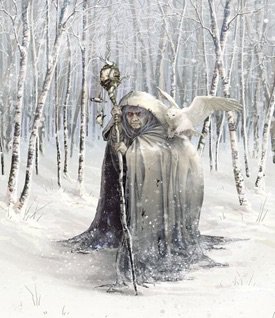
Those mountains are no accident. They were built intentionally, but a type of deity called Cailleach. Known also as Beira, or the Queen of Winter, she is an aged crone; one-eyed and completely white. 

She battles spring each year to reign her icy dominion over this hemisphere. She is a deer-herder, a lumberjack, and a warrior. She carries in her hand a great hammer as she strides across the Celtic Isles. She is the mother-goddess.

It was Cailleach who built the Highlands. She pulled rocks out of the sea and carved out stepping stones for her giant strides. She pushed through the space, breaking up new mountain faces with her hammer. She walked as winter through the new landscape she had made, and allowed waters to flow and overflow in every crevice.

I was enamoured by this story. Yes, that is what it looks like. It looks like an enormous witch has made it. It feels bursting with purpose.

My boyfriend prefers another version. He is a scientist, a doctor. We see the same world but through different lenses.

Millions of years ago, he read, the earth endured an ice age. Frozen water cut through the earth and wore down the ancient mineral rocks at a glacial pace. When the waters finally thawed, they left behind these precipices and pastures on the Scottish coastlines.

But isn’t that just the same story, told in a different way? Cailleach is simply an anthropomorphic ice current. The processes attributed to gods and fairies – that breaking and carving and flooding – are repackaged in scientific language. The scientists can give us approximate dates and name when the layers of sediment formed, but they are effectively telling the same story.

What difference does it make whether these wells were made by frozen currents or by the Wild Woman of Winter?

It is not fair to say that one is rational and the other is mythical. Both accounts are testament to humanity’s ability to understand its surroundings. The story of Cailleach is no less important a contribution, and we cannot just dismiss it. 

Equally, we cannot treat the national myth in the same way as we would our best scientific discoveries. They are not equally weighted as theories about how the earth was formed. Centuries of technological advancement and detailed research have given us this account of the Highland’s foundations.

The difference between these stories is not whether they tell us something true, but what kind of truth they point us to. The scientific explanation tells us the history of the world in context of great geological events. It teaches us how to identify, exploit or protect the natural surroundings we have inherited.

The story of Cailleach, by contrast, tells us about the unquantifiable truths of the Highlands: the awe they inspire; the magic they seem to hold. It teaches us about the shared national destiny of the Scottish, Irish, and Manx people who tell her story. 

These are not competing, but complementary, stories of creation. One tells us the truth of how a place was made, the other tells us why.

At this time of year, we turn to our own national myth and origin story. Our new year recalls the creation of the world. It is a day for us to delight in the fact that we are alive.

The biblical account of creation does not only explain the origins of one geological formation, but seeks to tell the genesis of the entire world.

5,783 years ago, the world was made in six days, from explosive dividing light, through land and seas and atmosphere, through to sea creatures, winged beasts, mammals, and human beings.

It is no good to compare this religious tradition with the theories of the Big Bang or evolution through natural selection. They are telling the story of the same thing, but from totally different perspectives. 

Science attempts to understand how the world was made; our myths ask us why.

The first chapter of Genesis suggests some reasons. The world was created with great purpose. Each day, with everything that God created, God saw that it was good.

When God created humanity, God gave us responsibility for the earth and what is in it. God gave us companions and promised us regular rest. God created the world for goodness, with humanity at heart.

The scientist and the theologian alike look at the world with a sense of wonder. We both feel awe as we track their stars in their orbit. We both marvel at the fact that a planet has produced the perfect conditions for life to form and grow entire ecosystems to sustain myriads of plants and creatures.

On this we agree.

The difference is that, for the believer, we do not just gaze in awe. Awe gazes back at us. 

You are not just amazed at the world, but the world is amazed by you. 

Not just the parts of you that you share in common with all other living beings, but those things that are unique to you. 

Not just the fact that you have functioning organs and limbs, but you. That transcendental, magical part of you. We might call it personality or soul or neshama.

It is not something mechanical or quantifiable. There is something about you that is wonderful and irreplaceable.

That is you

When we are confronted with the wonder and beauty of the world in which we live, we are tempted to ask what it is all here for. The answer of Judaism is that it is here for you.

To the religious imagination, your life is not an accident. It is a blessing. You were created for the sake of the world and the world was created for the sake of you. 

According to our Torah, at first creation, God wandered round to take in the Garden of Eden in the cool of day. And, there, God called out to the first human being: “Where are you?” God was looking for the human.

The great Jewish philosopher, Martin Buber, understood that this question is addressed to every human being in every age. We, too, are forever hiding, behind the stories we tell ourselves that our lives are meaningless and our actions matter little. We find ways to try and escape truth, even to hide from ourselves. 

And God, that great Source of amazement, nevertheless seeks us out, asking “where are you?”

So, Buber says, you have to answer that question. You have to seek deep inside your soul and answer who you really are. You have to try and give an account of what you are doing on this earth. You have to make yourself present, ready to face Truth, and, crucially, to change.

Where are you?

You are on this beautiful earth, crafted by a magnificent Creator. You are here and alive. You are a miracle.

God is amazed at how wonderful you are.

And now you have to show that God’s faith is rightly placed.

Shanah tovah.

Cailleach, Queen of Winter
judaism · sermon · theology

Abraham and the Paradox of Jewish Evangelism

A priest, a monk and a rabbi are debating which of their religions is the correct one. They decide to settle it with a contest to convert a bear to their religion.

The rabbi tries first. Two days later, the priest and the monk end up visiting him in the hospital.

The rabbi says: “OK, maybe I shouldn’t have begun with circumcision.”

Let’s set aside the foreskin jokes, because I don’t think the rabbi would have had much better luck with a lady bear. Isn’t it a strange fact of our religion that we almost never set out to proselytise?

We, of course, welcome all sincere converts, and this synagogue is happy to encourage anyone on their spiritual journey. But you won’t find us outside Asda, handing out flyers with words from the Mishnah. And you certainly won’t turn on your TV to see a rabbinic televangelist warning you about the perils of pork.

But if you think you have stumbled upon spiritual knowledge, don’t you want to share it with the world? Who are we to zealously guard the secrets of the universe?

Even if you take a more humble approach to Judaism’s teachings, and think they’re just as good as any other people’s, there must be something particularly worthwhile about Judaism for you to log in to this morning’s service rather than watching Bargain Hunt. (Wait, don’t go, I promise this is going somewhere!)

That strange paradox of Judaism – that we have a universal truth but don’t seek to spread it – is encapsulated in the story of Abraham.

This week, God tells Abraham: “Go out by yourself. I will make your name great and you shall be a blessing.”[1]

Then, in the next two verses, as if a parallel to the first, God says: “All the families of the earth shall be blessed by you.” Then Abraham goes out with Lot and Sarah.[2]

So… does Abraham go out to bless himself or does he go out to bless others? Which is it?

This is the great tension in Judaism. Do we exist only for Jews? If so, why are we trying to change the world? Or do we exist for humanity? In which case, why aren’t we trying to make everyone Jews?

Our midrash plays with this tension. Bereishit Rabbah, a collection of rabbinic explorations of Genesis, contains an unusual parable. In it, Rabbi Berekhyah compares Abraham to a tightly sealed bottle of perfume. The bottle was left in the corner and nobody smelt it. As soon as it was moved, its fragrance was emitted. This, says our midrash, is what it was like when God told Abraham to go out from place to place and make his name great in the world.[3]

Makes perfect sense, right? No? Fine, let’s unpack it.

Abraham is a tightly closed bottle of perfume when he starts out in Haran. At this stage, Abraham has encountered God. Abraham has realised that the idols amount to nothing and the Creator of the Universe is a singular and invisible presence. He is somehow pure and untouched. The Pagans have not affected his beliefs, and he has not affected theirs. He is hermetically sealed.

Then God tells him to lech lecha – to go out. Abraham moves around out from Haran and down to Shchem and Be’ersheva in the land of Canaan. As he moves between these places, others get to smell him. They encounter the truth that Abraham has learned about ethical monotheism. God is one and just! Now everywhere he goes people can get a whiff of this knowledge.

Only there’s another problem. Bottles of perfume don’t emit their scent because you move them. They only work when you open them. In this analogy, the balsamic bottle that is Abraham still remains sealed. How is he spreading his fragrances everywhere if he hasn’t even opened up?

I don’t think the editors of our midrash have made some mistake. I think they are telling us something profound about the Jewish paradox. We have a truth that we want others to know and yet we don’t want to convert anyone. Our role as a light unto the nations is that we go from place to place, showing others who we are, but not changing anything about who they are. We are still Abraham, that sealed bottle, going out from Haran, somehow expecting others to smell our perfumes but not opening up wide to spread our scent.

The very word “evangelism” is a Greek one, meaning good news, referring to the Christian Gospels. The early Church actively went out on recruitment drives, telling people about Jesus and his message. We have no such good news to share. What would we say to people? “Rejoice! God has commanded you to pursue justice and only eat unleavened bread in the springtime!” Jewish evangelism seems somehow a contradiction in terms.

And yet we do go out and share our beliefs. We are happy to expound our Torah to anyone. We expect to transform the societies we are in. When we speak out for justice wherever we live, we are very much hoping that others will take note of our concern for the stranger and adjust their actions accordingly. How can we reconcile this desire to change others with our lack of desire to convert them?

Perhaps the problem isn’t perfume metaphors and paradoxes. Maybe the issue is how we understand Judaism’s mission. Abraham wasn’t sent out to turn others into Jews. Abraham was sent out to be a Jew.

Abraham had to go out and be different, to hold a truth that no one else held. Even when he passes it on to his children, they each hold a different truth. Isaac becomes the founder of our Judaism. Ishmael becomes the founder of Islam. They go out holding different truths, both contradictory and complementary. Abraham’s revelation of God’s unity is a realisation that this universal God can never be captured by one person in a single truth.

Abraham’s mission wasn’t to make everyone Jews. It was to enable everyone to be themselves. It was that all these other nations could celebrate their differences, just as Abraham loved his own.

That is our task today. We don’t say to the nations: “we want you all to be Jews.” We say: “we want you all to be you.”

We are models of difference in a society where we are not a majority and in a world where we are not dominant. Our role is to show how to conduct that uniqueness in a way that demonstrates dignity.

This is our evangelism. That is the truth we hold and that we want to share. That difference is a wonderful and treasured thing. From our differences, we are blessed. And in our differences, we bless each other.

So go out from Haran and share that sacred truth. And don’t worry – you don’t need to go circumcising bears.

This sermon is for Parashat Lech Lecha. I will give this sermon on Saturday morning 31st October 2020 at Newcastle Reform Synagogue, and a shortened version the night before for Edgware and Hendon Reform Synagogue.


[1] Gen 12:1-2

[2] Gen 12:3-5

[3] Ber Rab 39:2