sermon · social justice · torah

Don’t make trans people scapegoats

“It makes no sense to hate anybody. It makes no sense to be racist or sexist or anything like that. Because whoever you hate will end up in your family. You don’t like gays? You’re gonna have a gay son. You don’t like Puerto Ricans? Your daughter’s gonna come home Livin’ La Vida Loca!”

This quotation is so erudite, you may wonder which ancient sage said it. That was in fact, the comedian Chris Rock, in his 1999 “Bigger and Blacker” set.

I must have been about 10 when I heard that line, but it has always stuck with me. Over the years since, I have watched it become true. The world is so small that whatever bigotries someone holds, the people they hate are bound to end up in their own homes.

Recently, I realised that this had happened to me. I hope I am not much of a hater, but a friend pointed out to me how much I used to make jokes about Surrey. I used to say that we should saw around the county lines of Surrey and sink it into the sea, drowning all the golf courses and making a shorter trip for Londoners to the beach. 

Now, here I am, eating my words. I am about to marry a man from Surrey and have all my in-laws in Surrey. I’m the rabbi for a congregation in Surrey, and looking to move as soon as I can to Surrey. That thing I hated, even in jest, is right here in my family and inside of me.

I had some terrible stereotypes that everyone who lived here was a tax-dodging, fox-hunting billionaire. They weren’t grounded in reality. They were just about my own fears, projected onto people I had never met. 

Chris Rock was right. Whoever you hate will end up in your family. 

More than that: whoever you hate is already something inside of you. 

All of us can do it: we can stereotype, generalise, and project all our antagonisms onto a group as a way to cast off all the fears we have about ourselves. What do we call someone who captures all this externalised hatred? A scapegoat.

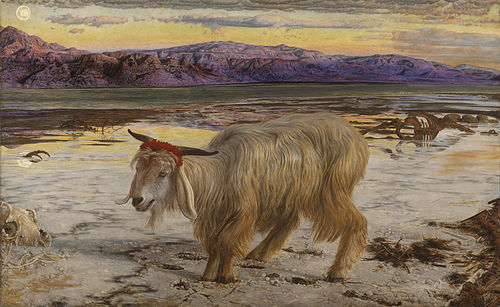
In this week’s Torah portion, we read about the original scapegoat. As part of the rituals for collective atonement, Aaron the High Priest gets two goats and brings them into the tabernacle. They pick straws for the goats. 

The lucky one is to be sacrificed for God. Onto the lucky one, Aaron ceremonially transmits all the sins of the Israelites, then chases it out into the wilderness. As it scarpers off, the scapegoat symbolically carries away all of the Israelites’ misdeeds.

The biblical narrative describes a psychological trick we can all play on ourselves. When we are ashamed of something inside ourselves, we take all that fear, turn it into hatred, and throw it at whatever unwitting bystander will carry it. 

Is this not precisely what Britain has been doing to trans people?

Gender is changing. The roles of men and women are shifting dramatically. There are so many new ways to live gender, to express ourselves, and to talk about our identities. 

Rather than embrace these changes and think about what opportunities they can afford us all to be more free, reactionary parts of British society have whipped up a concoction of bigotry and thrown it all at trans people. Every anxiety our bigots have about gender has been exaggerated and projected onto one small part of the population, who have been turned into monsters through these prejudiced eyes. 

It makes sense that people will find social changes scary and destabilising, but why should trans people bear the brunt of those fears?

A few years ago, I went to hear a panel of esteemed Jewish leaders give a retrospective talk about the ordination of gay, lesbian, bi and trans rabbis. On the bimah was Rabbi Indigo Raphael, Europe’s first openly trans rabbi. 

In his opening words to the congregation, Rabbi Raphael proclaimed: “I am a transgender man. I am not an agenda; I am not an ideology; and you can’t catch trans by respecting my pronouns.” The room immediately erupted into applause.

He should not need to say it. He shouldn’t need to defend his own existence, but such is the level of moral panic in parts of Britain that he has to assert his right not to be scapegoated before he can even teach Torah.

In the last few weeks, trans people have been subjected to legal rulings and government decrees that may make their lives unlivable and keep them from basic participation in public life. Like the goats of the ancient world, they are being cast out into the wilderness to carry away all of people’s fears.

It should not be this way. 

When we feel like scapegoating others, the best thing to do is look inside ourselves. We need to face our fears and work out why others bother us. The chances are, it’s something in ourselves that we’re not happy with, and when we need to get right with our own souls.

When we get to know those we “other” we get to know ourselves better. And when we realise we can like the difference in others, we learn more about what we can like in ourselves.

Reflecting on this, Margaret Moers Wenig, an American Reform rabbi wrote an essay called “Spiritual Lessons from Transsexuals.” She talks about how knowing trans people has enriched her own spiritual life. 

Interacting with trans people, Rabbi Wenig says, has taught her that all of us can craft our bodies as we will; we are all more than just our flesh and blood; we have living souls that can differ from others’ assumptions; that only God knows who we truly are. These are wonderful lessons that can only be learned when we turn away from fear and embrace curiosity.

They chime with my own experiences. At first, knowing trans people made me question myself. If gender is something we can change, am I really a man? With time, seeing other people embrace their gender and become who they are has made me feel far more happy in my own gender. I am a man, and I like being a man, and I like being an effeminate man.

When we turn away from fear, we see that we have no need for scapegoats. The parts within us don’t need to be divided up so that some are holy and others need to be chased out into the wilderness. Every part of us is for God.

The world has more than enough hate. It’s time we swapped it for loving curiosity.

After all, Surrey, it turns out, is rather lovely.

Shabbat shalom.
judaism · sermon · torah

Adam, Eve, and binary gender

The story of creation is probably the most well-known and most misunderstood of our Torah. Full of powerful imagery, t he Talmud says that it is forbidden to study the text alone because it is too easy to misunderstand.[1] Because it is so close to the High Holy Days, many Jews miss this reading in our liturgical cycle, having been exhausted by the great process of Rosh Hashanah, Yom Kippur, Sukkot and Simchat Torah, all festivals crammed together into a very short period of time.

The danger of Jews not hearing these texts and of religious leaders not teaching them is that people go away believing that the version we pick up from our surrounding culture is the only version of events. The story of Adam and Eve, in particular, has such currency in that all of us have likely imbibed a version of their story. We have seen paintings in art galleries of European-looking men and women covered with fig leaves. We have heard the stories told in different ways through popular culture.

The story we are accustomed to is one of binary gender. God made a man on the seventh day of creation. God then made the first woman out of Adam’s rib. They are a model of the natural male-female binary in the world and an example of the heterosexual monogamy God has intended for all of us. I am not going to question whether that is a legitimate or authentic tradition. None of us can say we speak with divine authority, so we have to be able to live with different and contradictory interpretations. What I do want to do is offer up an alternative version of the story of Adam and Eve: a Jewish, rabbinic, midrashic version of the story.

I’m sure it goes without saying that, in the progressive Jewish tradition, these stories are considered metaphors. The question is, however, metaphors for what? The stories we tell are important. If we tell stories, even metaphorical ones, of gender as fundamentally binary, and the natural order as fundamentally patriarchal, then we give credence to that worldview. We betray our feminist values and exclude our congregants who don’t fit into that binary. The rabbinic version of the Bereishit story does not only go against the grain of that perspective, but fundamentally overturns it.

First of all, it is not clear from our story that Adam was the first man. The word “adam”, as it is used in Genesis 1, acts as a noun, not a name. It speaks about a person, a human being. The word shares a root with “adamah”, meaning earth or clay. Adam, therefore, might best be translated as “earthling”.

Nor is it clear that Eve was the first woman, or that she was created from Adam’s rib. The biblical telling of her creation is somewhat inconsistent. In the first version of the story, in Genesis 1, a man and a woman are created at the same time. In the second version, in Genesis 2, Eve is created from Adam’s rib. The rabbis picked up on this strange disjunction. They also noticed that in the second version, when Adam meets Eve, he says “this one at last is the bone of my bones and the flesh of my flesh.” That word “at last”, in the Hebrew is “pa’am”[2], which could mean “this time around.” Our sages inferred therefore that the two stories tell of different relationships: the first of one between equals; the second of one with a dominant man and subordinate woman.

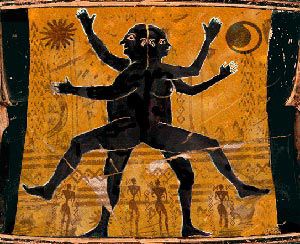
So, first, what was this relationship between equals? The rabbis suggest that man and woman were not just made at the same time. They were, in fact, the same person. The original human being, according to their midrash, had one body, two sets of genitalia and two faces.[3] Professor of Talmud, Daniel Boyarin, calls this person “the primordial androgyne.” Rather than binary gender being the model of original humanity, the first person is intersex.[4]

What then happened to this original intersex person? According to another midrash, they were split into two: Adam and Lilith. Notice that Lilith is not cut from Adam but that both are cut from each other: our original progenitors are equals.

The Ballad of Ben Sira, a medieval religious text that combines previous mythical traditions, tells the story this way:

“When the first man, Adam, saw that he was alone, God made for him a woman like himself, from the earth. God called her name Lilith, and brought her to Adam. They immediately began to quarrel. Adam said: “You lie beneath me.” And Lilith said: “You lie beneath me! We are both equal, for both of us are from the earth.” And they would not listen to one another.As soon as Lilith saw this, she uttered the Divine name and flew up into the air and fled.”[5]

What follows is a high-speed chase across the world involving angels and monsters. Ultimately, Lilith fights against Adam, the patriarchy and even God to become liberated. Undeniably, some tellings of this story are misogynistic, painting Lilith as a demon and a baby-killer, but the fact remains that a crucial part of the Jewish tradition is the story of an empowered woman who refuses to be subordinated. Our model of gendered relationships is a complicated mess of power struggles and queer subversion. It is, really, much closer to the relationships people really have.

The rabbinic tradition on creation tells us stories about intersex people, gender confusion, and resistance to patriarchy. Right now, the telling of those stories matters greatly. The government is debating an update to the Gender Recognition Act. When it was first passed in 2004, this act was a great sign of progress. It enabled trans people to legally change their gender on some certificates. As it stands, however, that process is highly medicalised and expensive. The new legislation would enable trans people to ensure that their gender is reflected on their birth certificates without having to jump through great hoops.[6]

This might seem like simply a bureaucratic change, but it has invoked great ire across the political spectrum. Underpinning much of the backlash is the idea that gender is both binary and innate. For the ideological opponents of the upgrade to the Gender Recognition Act, a gender cannot be changed. Much of their discourse has been quite hateful and aggressive. Transphobic abuse has become exceptionally loud, especially online.

What we can say in response to this is: in our religious tradition, binary gender is deeply disputed. In rabbinic Judaism, the first person was intersex, and transitioned from being one intersex person into two people: men and women. In our religious tradition, gender is complicated and malleable. Perhaps, armed with Jewish understandings of human nature, we may be able to push back against some of this hate.

Shabbat shalom.

androgyne-56a55f455f9b58b7d0dc900a

I gave this sermon on Saturday 6th October at Manchester Liberal Jewish Community. A congregant helped correct some of my understanding of the GRA. If you would like to speak out in support of the GRA, you can respond to the consultation using Stonewall’s resources.

[1] Hagigah 11b

[2] Gen 2:23

[3] Leviticus Rabbah on Genesis 2

[4] Daniel Boyarin, Carnal Israel

[5] https://www.myjewishlearning.com/article/lilith-lady-flying-in-darkness/

[6] https://lgbt.foundation/gra