sermon · spirituality

It’s not just what you see, it’s the way that you see it

During prayers, I find my mind wanders- or rather focuses. It sees things it otherwise wouldn’t.

The details of the space I am in suddenly interest me in new ways. I, who live in a world of words, suddenly find myself in a world of space: physical and embodied.

Look around: what do you see?

Perhaps a more pertinent question is: how do you see it? In a synagogue, walls are not just walls. Ceilings are not just ceilings. Curtains are not just curtains.

Every inch of space buzzes with meaning, crying out for interpretation.

For months, we have looked at this space with a certain set of eyes. For the Council, commissioning a new sanctuary, they have looked at the room with eyes of possibility. For the team responsible for the redesign, they have been looking at the space with the eyes of architects, artists and technicians. Those who were accustomed to this space have perhaps looked at it with nostalgic loss, knowing that their familiar sanctuary would be transformed.

I want to invite you now to look at this space anew: through the eyes of a believer.

In 539 BCE, Cyrus the Great permitted the Jews to return to Jerusalem and rebuild their Temple, which had been destroyed in the reign of Nebuchadnezzar. A generation of exiled elites returned and remade their holy space.

The books of Ezra and Nehemiah are dedicated to explaining what happened in those formative years.

Ezra recounts the dramatic unveiling ceremony for the new Temple. He says that, when the elders of the generation saw the new Temple, they began to cry, while the young cheered out in jubilation.

Seventy years they had been held captive. Seventy years they had not seen their holy mountain.

For the old, this was a place they never dreamed they would see again, certainly not within their own lifetimes. For the young, this was a place that had only existed in myth and psalm.

What a moving experience it must have been to witness it.

So, I invite you to come to this building with the eyes of exiles. True, our four weeks in the next door hall do not quite compare to the seventy years the Jews spent in Babylon.

Nevertheless, soak it up, because it is a marvel to enter after a period away. Absence surely makes the heart grow fonder, and I know I had missed the beautiful serenity of this synagogue.

Yet the commentaries on the book of Ezra believe that the elders were not shedding tears of joy. Rashi says they were, in fact, crying for the Temple they had lost. The First Temple, he says, was even bigger. Solomon’s Temple was enormous by comparison.

This is an interesting proposition, because it is almost certainly not true. We do not have any archaeological evidence to suggest there was a First Temple, still less a bigger one with wider foundations. By all accounts, it is far more likely that the First Temple was smaller and more frail.

Yet, Rashi is right that the elders could truly have believed the old Temple was bigger and grander. When they last saw it, they would all have been infants.

My primary school’s doors were enormous wooden structures that towered over all who entered them… until I returned as an adult and realised they were just doors.

There may be a part of you that looks back with wistful nostalgia at the old sanctuary, dilapidated though it was. This is natural: in our synagogues we find safe spaces that ground us in our youth. Adjusting can be hard.

So, this is an invitation: try to look at this space through the eyes of a child. Try to feel the comfort and wonderment that you did in your youth.

When Ezra returned and rebuilt the Temple, he sought to recreate all that was best in the one that had stood before.

Like us, the Jews dedicated and blessed their Second Temple in the month of Adar, between the festivals of Purim and Pesach.

They brought in what they had preserved from the last Temple: cleansing bowls and musicals instruments. Where they could not repeat, they replicated, weaving curtains and priestly garments.

In Solomon’s Temple, there had been a permanently lit flame above the altar, symbolising God’s eternal presence with the Israelites.

When the exiles returned with Ezra, they relit the pyre, to show that, while they had left the Temple, God had never left them.

After the destruction of the Second Temple, the Jews installed in their synagogues a ner tamid, an everlasting light. Through this emblem, the flames showed that God’s light was not only in every time, but also in every space.

So, look at our light, with its memorial to the Shoah, and see how this same flame has burned for 3,000 years, linking us to hundreds of generations of worshippers.

But do not stop there, or you may be tempted by conservatism.

After the Temple, our rabbis reinvented every ritual item so that they could have new homes in the synagogues.

The Ark that contained the Two Tablets of the Law became the ark that holds our Torah scroll. The breastplate and crown that the priests wore became adornments for Torah. The sacrificial altar became the bimah from which Torah was read.

In every object, you can see the theological creativity of our people. You witness the myriad ways in which we constantly reinvent and reanimate our traditions.

So, look at the details of this sanctuary and embrace all the ways that our artists and architects have participated in that great tradition of innovation.

Everything contains the holy sparks of what went before. Every spark is breathed new life by the creatives who recreate it.

You, too, can fill this space with life, as you bring your own meanings to it.

Come to this sanctuary. Come with the eyes of an exile; the eyes of an elder; the eyes of a child. Come with eyes that are ancient and new. Come with eyes that have seen thousands of years and still look to the future.

Then bring those eyes back out into the world – and see what needs to be done.

Shabbat shalom.

sermon · social justice

A peasant farmer was my father

A peasant farmer was my father

When my mind wanders, I like to think about where I would go if I could travel in time. Have you ever considered this? When you would want to visit?

Personally, my first thought is Paris in the 1890s. In my higher moments, I project myself into medieval Andalus, the Golden Age of Hebrew poetry in Spain. 

And, of course, I’d love to go back to biblical times. Wouldn’t it be marvellous to see the First Temple in all its glory? What would it be like to inhabit that world of prophets and visionaries?

But this time travel thought experiment always comes with a corollary. I’d have to be a rich man. No matter what spot of history I got dropped in, the only way to enjoy it would be to be part of the elite.

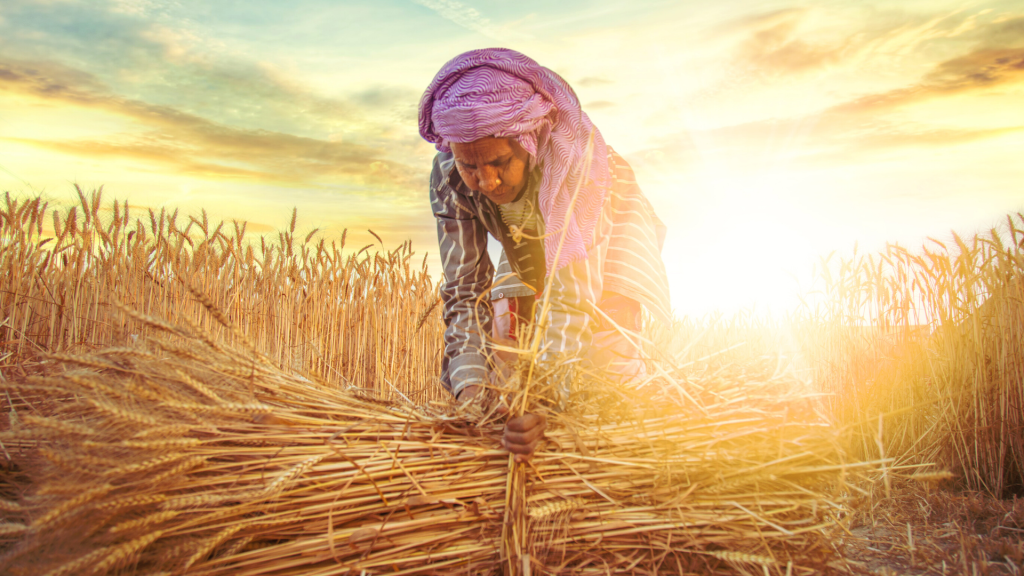
If I were sent back to biblical times without that condition, I’d probably be a peasant farmer. We like to imagine our ancestors as great kings and high priests. In reality, they were less than a small fraction of the ancient Israelite population.

95% of people in the biblical period worked the land. Dropped back to the time of David and Solomon, we probably wouldn’t be in their courts, but in the fields. 

I take a perverse pride in this knowledge.

Think how hard they must have worked to bring that ancient society into being!

As a peasant farmer in the ancient world, you would have about 3 acres, growing different crops, including grains, fruit trees, and olives. You would, almost certainly, have a chicken run and a small herd of goats. 

If you were really fancy, you might also have a cow.

Your home would be a collection of huts and tents, stretching out to include your extended family. Each would be a bustling, cramped place, with pots and pans and a fire stove. Your animals would potter in and out of your sleeping quarters. 

I am not trying to paint a romantic vision of any of this. Your life would be hard. You would pull a plough with your own hands and sow seeds with your back hunched over. You would cultivate and cut and glean your trees in the searing heat. 

You would spin your own wool, stitch your own clothes, bake your own bread, build your own dwellings, subsist on whatever you needed to survive.

Yes, all that is true for women, too, with an additional burden. You would give birth to ten children and breast feed all of them. You would count yourself incredibly lucky if all of them lived past the age of 5. If they did, they would likely be married off in their teens. 

No, there is nothing romantic about the lives of our real ancestors. 

But we should be proud of them. 

Peasants, labourers and serfs might not be the subject of great poetry and sagas, but without their efforts, nothing exists. There could be no food, no shelter, no community, and no culture, without their graft. That gruelling work made civilisation possible.

This week’s parashah tells us something of how they built ancient Israelite society.

If they had just stuck to their own homesteads, they would have had to survive on the paltry gains of subsistence farming. In a bad year – if rains failed to fall or crops failed to grow – they would simply perish.

So, our family, the farmers of the ancient world, signed up to participate in the agrarian state. 

The agrarian state was responsible for distributing food and creating common irrigation and transport systems. In ancient Israel, the centre of that state was the Jerusalem Temple. 

Our parashah explains the criteria for participating in its systems. You must not glean your fields right to their edges, so that you leave enough for travellers and strangers. You must donate a tenth of your grain and livestock to support those in the community who are most vulnerable, like widows and orphans. 

In some ways, this is the foundation of the earliest welfare state. 

But the poor are not the only beneficiaries of this redistribution. 

In fact, they were not even its primary targets. 

Our parashah begins with a ritual that Israelites must undertake each year. At each harvest of the year, you must collect your first and best fruits. You must bring these, the choicest of all the crops you worked so hard to create, and give them to the priests.

You must lift them above your head and say: “A wandering Aramean was my father. He was enslaved in Egypt, but God brought him out into this land of milk and honey. Now, I bring before you, the first fruits of the soil that God has given me.”

The priest will sacrifice it, perform closed rituals, and eat it in front of you.

That priest did not work to produce those fruits. He did not share in the exhausting work of raising children in a hovel, or run ploughs over the land. In fact, he wasn’t responsible for any land.

The priest’s sole job was to be the leader of the ancient cult. He was in charge. He profited from your work. 

That great Temple in Jerusalem, with all its priests and writings and rituals, only existed because the poor majority paid in and made it happen. That entire society functioned on the basis of our ancestors’ labour. How could they have done it without the work of the people who harvested the grain, built the bricks, and cared for the sick? 

I don’t resent the ancient priests. 

That work made possible great cultural developments. At that time, we couldn’t have had literary culture, organised society, music or scientific discovery without a class who had the leisure time to devote to such pursuits.

We then wouldn’t have benefited from the innovations in agriculture, technology, transport and trade that makes our lives today less horrible than they were in ancient times.

But, while resentment for ancient figures might not be productive, we should feel entitled to be critical.

After all, their world is our world. For all the social progress we have made, the divisions that defined civilisations millenia ago are only greater than they were then.

Far fewer people profit far more from the work of the majority than ever did in the biblical period. 

Almost all of us, I know, are worried about how energy price gouging, interest rate rises, and higher costs of living will affect us. Some are already feeling the effects of an economy where wages won’t rise but prices keep going up. 

Meanwhile, the energy companies and their shareholders are making record profits. These last few years, which have been so frightening for most people, have been a period of great abundance for the world’s richest. 

This is not accidental. The rich are not rich in spite of the poor. They are rich because of the poor.

Perhaps those inequalities were essential to create our current world. But how much greater would society be if we decided to eradicate them? Just imagine what we could accomplish if nobody had to worry about heating their home or feeding their family.

We could unleash the great talents of everyone, whether priest or pauper; shareholder or sharecropper; king or taxi driver. We could enjoy this world, with all its bounties, without the constant friction of struggle.

On reflection, if I could travel in time, I don’t think the past would be the place for me. I would prefer, instead, to make my way to the future.

I want to go to the time when technology is harnessed to benefit everyone in the world, regardless of who they are and where they live. An era in which it is not just a small minority that creams off the profits of the many, but when everything is redistributed between everyone. One in which the gains of civilisation are shared with all humanity. 

We can’t change the past. We can’t go back and rescue our ancestors from the harsh realities of peasantry. But we can build a different future for the next generation. We can make it so that the future is not defined by the same problems of the past.

Let us travel to that point in time together. 

Shabbat shalom.

Ki Tavo 5782, South West Essex and Settlement Reform Synagogue