high holy days · sermon

The world is governed by compassion

“Hineni he’ani mi-ma’as – behold, I am poor in deeds and lacking in merit. Nevertheless, I come trembling in the presence of You, O God, to plead on behalf of Your people Israel who sent me, although I am neither fit nor worthy of the task. You who examine hearts, be my guide, and accept my prayer. Treat these words as if they were spoken by one more righteous than me. For you listen to prayers and delight in repentance. Blessed are You, O God, who hears our prayers.”

In the synagogues of medieval Europe, the service leader used to begin with this public prayer of atonement, openly acknowledging their own inadequacy. 

In the Liberal world, we have been shaped by the Victorian attitude that eschewed public vulnerability. So, instead, this prayer is given out to rabbis to read privately to themselves. 

The days when we had to pretend to be perfectly put-together are over. In our age, we recognise that openly sharing our insecurities builds a more emotionally authentic culture, where people are better at handling their feelings.

So, this year, I not only quietly recite this prayer in my office, but share it with you openly.

This year, these words feel more profound than usual. 

This is a sensitive time, and I know how fragile so many hearts are. 

In the build-up to these Days of Repentance, an American Masorti rabbi, Joshua Gruenberg, wrote:

“Rabbis stand before their congregations with trembling hearts. We know that every word matters. We know that words can wound and words can heal. And we know that in a climate like this one, the margin for error feels impossibly thin. […] The only way we will find wholeness is if we grant each other the space to be imperfect, the courage to be vulnerable, and the grace to be human.”

As this year came to an end, I thought back on the conversations I’d had with you over my time here. I thought back over some of the pain and worry you had felt, and realised just how much stress some members of the community were feeling. 

Words can, indeed, hurt and heal. They matter. I want to honour that, by reflecting on the pain some of you have expressed.

We come here because we want to be together, in our fullness, with all our wounds and trauma, so that we can move towards healing. 

To that end, let’s consider how we can approach anxious and hurting people with compassion. That is, after all, what we all need from each other.

The world has changed greatly in the last few years. So much feels more precarious. 

Ten thousand people rallied at Tommy Robinson’s far right march in London to a speech by Elon Musk telling the crowds to get ready for violence against immigrants. The news from Israel and Gaza, and Russia and Ukraine, and Sudan and Ethiopia, keeps rolling in, feeling ever worse. 

For me – and I know for some of you – the horrors of October 7th and the ensuing assault on Gaza marked a major turning point. In many of us, these events have brought up trauma responses we didn’t even know we had.

Since then, so much has unfolded that is out of our hands. This can feel painful when your instinct is to find solutions and assume control.

We have to accept our own limitations. I sometimes recite to myself the Serenity Prayer: “God, grant me the serenity to accept the things I cannot change, the courage to change the things I can, and the wisdom to know the difference.”

Those of us within this room do not have the power to bring about peace between the Israelis and the Palestinians. We cannot get the hostages back or stop the starvation of Gaza.

That feels hard. If it were up to the members of this synagogue I have no doubt that the whole world could live in peace. 

I am certain that we could indeed solve the country’s problems and fix our hurting planet. But nobody seems to be letting us do that, outside of setting the world to rights over kiddush.

But that does not mean we have no power at all. 

The one area where we have real power is in our own homes and our own community. 

And, there, we have the power to decide how much compassion we feel.

Even in the face of our own trauma and fear, we can choose to feel compassion for others.

Perhaps you can relate: in the immediate aftermath of October 7th, I felt intensely isolated. I felt a void where compassion ought to be.

I felt, among Jews, my own people, that I struggled to find many people who felt compassion for the people in Gaza. 

On the left, as much my natural home as the synagogue, I struggled to find many people who felt compassion for Israelis. 

Initially, I narrowed my circle to a small niche of Progressive Jews with left-wing opinions. It was comfortable and reassuring, when what I needed was to feel safe. 

But if I was looking for compassion in the world, I needed to bring it into the world. I needed to model it. 

Not just with the people who I knew felt like I did, but also with those whom I assumed were miles away from me. 

It is easy to love humanity in general, and fine to pity people on TV. It is much harder to love the people nearest you when you feel so distant, or to understand them when it feels like they are living in a different world. 

How could I look for compassion elsewhere if it wasn’t in my own heart? 

How can we look for compassion if we do not feel it?

You can’t expect others to extend compassion to strangers when you can’t even have conversations with the people you already know.

I felt then – I still feel – that, perhaps, if we can feel compassion in our synagogues, and extend it out towards the world, and that others could extend their compassion too, then it might cause something to shift.  

And, ultimately, that shift might make this world, which is harsh and unkind, a little better than it has been.

The message of compassion is already explicit in the liturgy of our Yom Kippur service. 

God’s name is Compassion. 

We read the refrain that repeats throughout the High Holy Days: “Adonai, adonai, el rachum vechanun… a God compassionate and gracious, slow to anger, abounding in compassion and faithfulness…”

It is a beautiful invocation of God’s qualities to help us through Yom Kippur. 

The verses come from Moses’s second acsent of Mount Sinai, when he takes the new set of the Ten Commandments in his hand. As Moses walks down the mountain, God comes with him.

As Moses chants out these declarations of God’s mercy, it is as if Moses has truly understood what kind of God he is dealing with.

He learns how the world really works. He sees that it is governed by compassion.

Just before coming to get the new tablets of the law, Moses had seen the Israelites worshipping a golden calf, and smashed up the first set of the Ten Commandments. 

These are great sins: idol worship and wanton destruction are strictly prohibited. The Israelites have been wayward. Moses has been angry. 

Still, God, abounding in compassion and faithfulness, says: “Try it again. Have another go.”

In the Talmud, Rabbi Yohanan teaches that whenever the Jewish people sin, they should think back to this verse.

In the repetition of “Adonai, Adonai,” the Jews should understand that God is their Loving Creator before a person sins, and God is their Loving Creator after a person sins and performs repentance.

God is always willing to give people another chance.

In the same section of Talmud, we learn that, in the moment when Moses recited those words, God made a covenant based on thirteen attributes of mercy. It was a promise that God would always hear our prayers.

Later, in the Middle Ages, the French commentator Rashi elucidated what these thirteen attributes were.

In each word, says Rashi, is a reflection of the type of compassion God feels. 

God is slow to anger to give you a chance to repent.

God is abundant in mercy, even with those who don’t deserve it.

God remembers good deeds even for a thousand years.

Even when we hear that God holds grudges for three and four generations, Rashi says that this only refers to people who maintain the evil ways of their ancestors. If they repent, all can be forgiven of them too.

This is how one truly maximises compassion.

So, let us be compassionate.

Let us maximise how much compassion we feel.

Our own community and our own homes are small places where we can truly practise compassion in a world where it seems so sorely lacking.

Last week, in her Rosh Hashanah address, Rabbi Angela Buchdahl, of the American Reform movement’s flagship synagogue in New York, reflected on how the division in the world was creating strife even within her synagogue.

She urged her congregation to practise compassion, saying:

“It now seems that any expression of compassion for “the other side” is regarded with suspicion – as disloyal, or even threatening. Is our capacity for empathy so finite? Are our hearts so small, that if we increase our empathy for certain people, that we need to reduce it for others — until one day, we conclude: that ‘other side’ is not deserving of any compassion?”

Here, the “other side” could be so many different groups in this increasingly polarised and hostile world. 

We all want to feel like people understand our own side, but struggle to extend our understanding the other way.

You don’t have to agree with people to love them. You just have to be curious, and try to understand them.

Some days, we may be capable of less compassion than others. On those days, let’s give ourselves grace, take time out, and remember how flawed we all are.

Even on our worst days, we can always try to understand each other. We can hold our own hearts while making them permeable enough to feel others’ pain too.

When people challenge us, let’s look for the best in them. Imagine their best intentions, and try to consider what problems they might be facing.

We are, all of us, flawed and temperamental. We all ask good grace of others, and we can all give it in return.

This year, let’s try to feel compassion for the people in our own families and homes.

Let’s try to find compassion for the people in our neighbourhoods. Perhaps we will shift something in them.

Let’s find compassion for the people in our community, so that we can hold each other, in our diversity, through these trying times. 

And, as much as we can, let’s try to find compassion for everyone. 

It won’t change the news cycle, but it might change you. And you might change others. 

It is a small contribution to this world, but it is a mighty one. 

It is the best that we can do.

Behold, I am poor in deeds and lacking in merit. Nevertheless, I come trembling in the presence of the One who hears the prayers of Israel. O God, You listen to prayers and delight in repentance. Blessed are You, O God, who hears our prayers.

Amen.
Kol Nidrei 5786, Kingston Liberal Synagogue
israel · liturgy · theology

What can we learn from the Holocaust?

Back in January, I attended a civic service for Holocaust Memorial Day. As part of the proceedings, we watched a video, in which a local volunteer interviewed a survivor from the Warsaw Ghetto. The volunteer was kind and gentle. She asked sensitive questions about the survivor’s life.

Then, she asked another question: “what can we learn from the Holocaust?”

The survivor shook her head: “Nothing.”

This answer clearly took the interviewer aback, so she rephrased, and asked again: “What moral lessons do you think people should take away from what the Nazis did?”

Again, the survivor responded. “Nothing. There is nothing to learn. Nobody can take anything from it.”

Her tone was not accusatory or angry. It was matter-of-fact. It seemed so obvious to this survivor that the genocide was not ethically instructive. It seemed just as obvious to the interviewer that there must be some lesson from it.

This reflects something of how the Holocaust is taught today. In British schools, children are educated that the Nazi genocide is an example of man’s inhumanity to man, and that they must learn from it how to act morally.

In the aftermath of the Nazi genocide, the United Nations signed up to the Universal Declaration of Human Rights. When Holocaust Memorial Day was officially adopted by the United Nations in 2005, its then General-Secretary, Ban Ki-Moon said the purpose was to “apply the lessons of the Holocaust to today’s world.”

This was, presumably, the message the interviewer hoped to hear: “You should learn from the Holocaust how to be morally good.”


Why did the survivor refuse to give her that answer? I can only speculate. I think I can see why somebody who had endured such brutality would not want it to have moral meaning.

After all, what would it say about the death she witnessed and the misery she experienced if it was all just there to teach somebody else a lesson?

What is her life, as a victim of Nazi persecution, if she just a stepping stone for Christian Europeans to develop a moral conscience?

If it is all just a lesson in ethics, then the Shoah’s martyrs are just side characters to help the stars – that is, the genocide’s perpetrators – on their journey to self-improvement.

By giving the Holocaust meaning, something is detracted from the meaning of the survivor’s own life.

Tomorrow, Yom HaShoah starts. In Israel, tomorrow evening, the country will enter into 24 hours of solemn contemplation. They will remember all those who died and suffered during the Second World War.

Then, a week later, next Monday evening, the country will erupt into celebrations for Yom HaAtzmaut, Israeli Independence Day. The streets will be draped in blue and white flags as Israel rejoices at turning 76.

The proximity of genocide remembrance to national celebration is not a coincidence. It is part of how the Shoah is taught in Israel.

There, the country has a national liturgical cycle. The full name of this remembrance day is Yom HaZikaron leShoah veLigvurah: A Day for Remembering the Holocaust and Heroism.

Yom HaShoah is timed to coincide with the Warsaw Ghetto Uprising, when a thousand Jewish militants attempted to physically resist the Nazis. The date is chosen to tell a story that Jews were not passive victims, but did all we could to fight against them.

Six days after Yom HaShoah comes Yom HaZikaron, a day for remembering the soldiers who fought in Israel’s wars. This narrative paves a path. First, the deaths of those killed by Nazis; then, the deaths of those killed for the Israeli state; all pointing towards the joyous outcome, when Israel is founded.

That path is clearly outlined the evening after Yom HaZikaron with Yom HaAtzmaut, Israeli Independence Day.

This is the core story that the state of Israel tells through its Holocaust remembrance services. Once we were victims because we had no state. Now we are not victims because we have a state. The Jews as a people began as ghetto resistance fighters, became soldiers in the wars for Israel, and now enjoy security in their own country.

That liturgical cycle continues on to early June, when Israel celebrates Yom Yerushalayim, the anniversary of the conquest of Jerusalem in the 1967 War. Look, says the calendar, we won, we kept on winning, we will expand as far as we need. We are not victims after all, but military heroes.

You can see why people would want to tell this story. So much of the storytelling paints Jews as pathetic.

This version of events, the heroic one, stands in direct contrast to the one where the victims are just moral guides to instruct Europeans. Here, they are masters of history, taking events into their own hands.

Yet this story is deeply worrying, especially now, in a context of an ongoing and aggressive war. The deep wounds of the Nazi genocide, when told as a story of heroism, can become a justification for just about anything. Every conquest, every military victory, every land grab, becomes just another way of enacting vengeance for the Holocaust. In showing that Jews are not victims, this story absolves Jews of turning others into victims.

In different ways, the Shoah remembrance events are troubling. They tell stories, but, when you start to pick those stories apart, they look problematic.

We are trying to make sense of something which, by its very nature, was senseless. There is no reason to racism, and there is no great moral lesson in unimaginable suffering.

Nevertheless, we are forced to make our own meaning. Through liturgy, through rituals, and through storytelling, we have to find a way to explain how the world could be so incredibly cruel. We have to develop our own answers to that everlasting question of suffering.

Emil Fackenheim survived the Shoah. He was imprisoned in a concentration camp before escaping to Britain, then Canada, and becoming a Reform rabbi. He taught that the Holocaust might not have its own meaning, but that we Jews would create one from its ashes.

Rabbi Fackenheim argued that, in the wake of the Nazi genocide, we Jews had to add our own commandment to the prior 613. In addition to the Laws given to Moses, we would add a 614th Commandment: never to give Hitler a posthumous victory.

To Fackenheim, this meant that, despite everything, we would keep on being Jews. We would not abandon our faith. We would not forget those who had perished or the extent of their suffering. We would never give up hope. If we did any of these things, said Fackenheim, we would be letting Hitler win after his death.

So instead of looking for an answer to the Holocaust, where all of that suffering finally makes sense, let us take up Fackenheim’s clarion call and respond with a vow.

We will never allow Hitler to win.

We will survive as Jews, full of the hope and ethical mission and faith that make us Jews.

We will never allow anyone to erase the memory of the Shoah martyrs or deny what happened to them.

We will not allow fascists and genocidal forces to win.

Ever.

Anywhere.

Shabbat shalom.

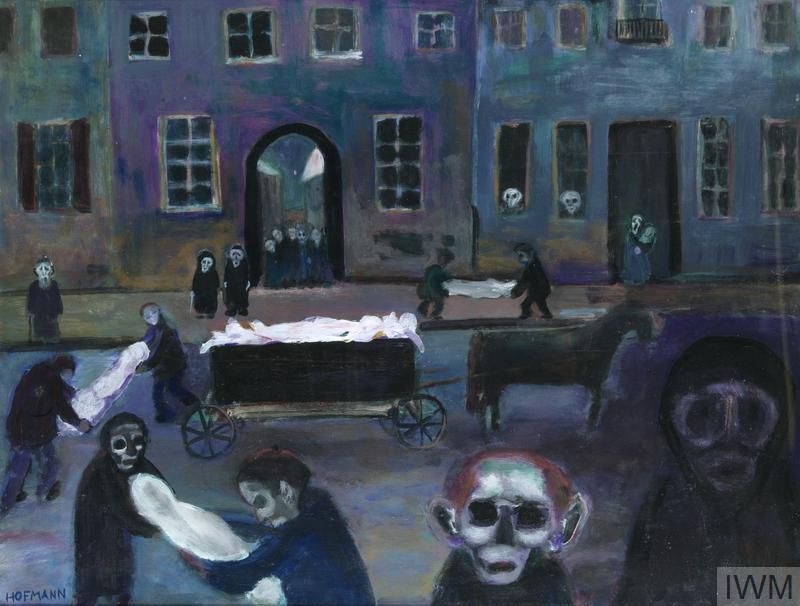
Picture: Edith Birkin, The Death Cart – Lodz Ghetto

Sermon for Birmingham Progressive Synagogue, Parshat Acharei Mot

high holy days · sermon

Come back to hoping, even if only slightly

Do you remember how you were as a child, when you only believed good things about the world, and you thought everyone was trustworthy and kind, and you felt you could achieve anything with the power of imagination? Come back to that. Just for a while. Come back to that.

Before the cynicism of adolescence set in and you realised your parents didn’t know everything and you started to question life’s meaning. Come back to that.

You can’t go all the way back. Years of experience have softened some pretensions and hardened some edges.

But try to reclaim a little bit of that optimism and wonder. The person who believed those things lives somewhere inside you still.

You don’t have to come back all the way. You don’t have to believe everything.

You don’t have to believe that God is perfect and created the world and will bring about the Messianic age any day now and will reunite us all with our loved ones.

You don’t have to have perfect faith. I don’t. I doubt many sincere people do.

But you have to hold onto some faith. You have to believe in something. You have to have hope, no matter how fragile it is.

Today is Shabbat Shuvah: the sabbath of return.

It calls on the words of our haftarah, Hosea, where the prophet beseeches us: “come back, O Israel, to the Eternal One your God.”

Return to the faith you once knew.

You have abandoned your self-confidence, says Hosea. You have accepted defeat by Samaria. Assyria will not save you, nor will its gods.

The prophet calls out: “You could blossom like a lily and be beautiful like an olive tree. You can live again.”

Reviving belief is a challenge. We have all suffered our defeats, personal and communal. They have embittered us with cynicism.

Shabbat Shuva is a calling back to faith. It is an invitation to try and remember what it was like to dream.

That is not easy. Some people had life’s harsh realities thrust upon them too young, and had to grapple with injustice too soon.

Primo Levi was such a man.

He was a Jewish chemist in Italy.

When I was a teenager and full of the arrogance that I’d got the world figured out, my dad gave me one of Levi’s books, The Periodic Table. Outside of religious literature, I think that is the only book I’ve finished reading and immediately restarted.

The Periodic Table tells of Levi’s story, through the prism of different elements.

From the noble gases of his Italian-Jewish heritage to the hard, grey metal of Vanadium in his old age, Levi talks us through his experiences of fascism in Italy, which began when he was an infant.

Italy was the first country to adopt fascism. Mussolini came to power on a platform of nationalism, tradition, corporatism, and dictatorial control. His slogan was “Everything in the State, nothing outside the State, nothing against the State.”

In Primo Levi’s teenage years, the Italian fascists introduced their racial laws, directed primarily against Italian Jews and Africans. The Africans were placed in colonial concentration camps. The Jews were initially stripped of citizenship and assets, banned from the professions.

At the time, Levi was training as a chemist in a laboratory. His Christian classmates were civil, but withdrew from him, and regarded him with suspicion, and he became a loner. He took solace in chemistry, hoping that its solid truths could puncture fascist lies.

To survive the racial laws, Levi said, he needed to take advantage of his youth and turn a willing blindness to everything happening around him. He needed to imagine that the world was still fine, as he imagined it ought to be. In that naivety, he did not even realise he could actively resist fascism.

When he and his comrades decided to fight the fascists, they turned to the Bible. He saw in his own struggle the struggles the prophets had waged against empires. But he also looked up to the sky and felt that it was empty. God would not save them. They would have to save themselves.

Perhaps this is what it means to have just enough faith. Not so much that you blindly invest your hopes in a God who rescues, but enough that you can draw inspiration from others, past and present. Enough faith to believe that your cause is just and that fascism can, ultimately, be defeated.

Levi knew he had to get angry, and act. He filled his heart, more with desperation than hope, and took up arms.

In the snowy mountains, he fought as a partisan, and was captured by the fascists.

How did he survive the camps? Levi took pride that he went into the camps as an atheist and never wavered in his disbelief. But he refused to succumb to pessimism. He never allowed himself to become disheartened completely. He would not let the fascists take from him his hope.

Who could blame Primo Levi for not having ultimate faith in God’s redemption? But he had just enough faith. Just enough to stay alive and keep fighting and, afterwards, to testify to the truth.

You do not have to believe everything. But you must believe something.

You must come back to hoping, even if only slightly.

I think you already know why I am telling you this.

Precisely one hundred years after Mussolini marched on Rome, the fascists have returned to power in Italy.

In the days before the election result came through, an Italian friend of many years texted me, to say how scared he was. It looked like the far right’s victory was already assured before the polls.

When the results came, they were worse than expected. Giorgia Meloni, and her far right party, the Brothers of Italy, had trounced all other parties at the ballot box, and would not even need Berlusconi’s support to form a government.

In her election address, she promised to give back Italian national identity that had been stolen by “international financiers.” She said she would bring back the family, which had been eroded by LGBT people.

She immediately pledged to replace the post-war constitution, which had enshrined democracy and minority rights.

I do not want to be alarmist, but I am also unable to blindfold myself to experience. There was a generation who could wait and see how fascism would pan out in Europe. We do not have the pleasure of such naivety.

We have to be sober. We cannot allow ourselves to be blindfolded to what is happening.

But we cannot ever allow that to become despair.

Hosea does not just implore the Israelites to return, but promises that God will come back too.

The Holy One promises: “I will heal them. I will cause them to return to Me in love. I will turn away from My anger.”

If you take a small step towards hope, hope will step towards you too. Hope will carry you.

On this Shabbat Shuva, however much faith you have, try to have a little more.

Remember faith. Come back to hoping, even if only slightly.

Shabbat shalom.


theology · torah

Stop doubting. Start doing.

Job was a man of complete integrity. According to his eponymous book of the Tanach, no matter what happened, Job was the epitome of Jewish righteousness. Then hardship fell, and Job began to doubt God’s justice.

This was hardly surprising. God had stripped him of everything, ridden him with disease, killed his children and destroyed his livelihood to test whether or not Job would remain faithful.[1]

As it turned out, Job could only endure so much. His friends comforted him with explanations of how God must be righteous after all, but they were insufficient. Finally, Job began to snap. What if God was not just?

Just then, God burst out through the clouds. “Who are you to question Me?” demanded God.[2]

After a lengthy excursus from Job’s inadequate interlocutors, we might expect a more thorough explanation. God has arrived and will explain the nature of justice.

Instead, God goes off on one about mythical beings. God talks about the Behemoth, an enormous bull-like monster that can rampage fields. God describes Livyathan, a fire-breathing dragon that cannot be killed.[3]

And this, apparently, satisfies Job.[4] Well, I’m not satisfied. I don’t know about you, but if I’m having doubts about my faith, “have you heard about the monsters God tamed?” won’t really cut it for me. You can’t respond to rational concerns by piling on ever more improbable legends. Now I’m filled with even more doubts.

But perhaps that’s the point. The author of Job, arguably the most philosophically complex text in our Tanakh, probably knew that these myths weren’t really an answer to the question posed.

The real answer, hidden within these poetic arguments, is that we don’t know. Whatever God is, it is beyond our comprehension.[5] Whatever justice is, we cannot fully reason it enough to grasp it. ‘You don’t need to understand,’ is what God is really saying.

Similarly, our parashah this week concerns Moses’s doubts. We have come to the book of Exodus, and Moses has already run away into the wilderness. Out of a flaming thicket, God summons Moses to rescue the Israelites from their slavery in Egypt.[6]

Just as God answered Job from the clouds, so too does God answer Moses. But the answer Moses receives is no more comforting. ‘You don’t need to understand,’ says God, ‘you need to get going.’

“What if I’m not good enough?” asks Moses. “You will be,” says God.[7]

“Who even are you?” asks Moses. “I will be whatever I will be,” God roars back. “Tell the Israelites ‘I will be’ sent you.”[8]

“What if nobody believes me?” asks Moses. “They will,” says God.[9]

“But what if I can’t find the words?” asks Moses. At this point, God loses patience. “I gave you your mouth, I will give you the words! Now get yourself down to Egypt and set those slaves free!”[10]

Miracles might be convincing to some. Logic and reason might work some of the time. But, ultimately, you have to act. When faced with injustice, there is little time to contemplate the nature of sin and perfection and God’s role in it. You have to get out and do.

Rabbi Abraham Joshua Heschel was a Conservative theologian and civil rights activist, famously pictured alongside Martin Luther King Jr at the march on Selma. He said that Judaism does not require a leap of faith, but a leap of action. We are called upon, first and foremost, to act. Whatever we think about it can come later.

This might sound strange to us, educated in a Western thought system that teaches us to calculate and reason before making choices. But it was not strange to the Israelites. When God called on them at Mount Sinai, they replied “we will do and we will hear.”[11]

According to the Talmud, a heretic accused Rava using this verse. Rava was sitting, so engrossed in study, that he didn’t notice he had trapped his finger in a chair leg and it was spurting blood everywhere. “You impulsive people!” the heretic said. “You still bear your impulsiveness of acting before you think. Listen first, work out what you can do, then act.”[12]

Rava responded with the verse from Proverbs:[13] “The integrity of the upright will guide them.”[14] We trust in our integrity. We trust in our conscience. We can be moved by our faith that we know right from wrong.

I think, over the last few years, progressives have done a great deal of doubting. We have been introspective and thoughtful. We have wondered, internally and out loud, whether we are right after all. Perhaps, as nationalist ideas return and religious conservatism gains strength, we might be able to make compromises on our ideals and find a middle-ground with others.

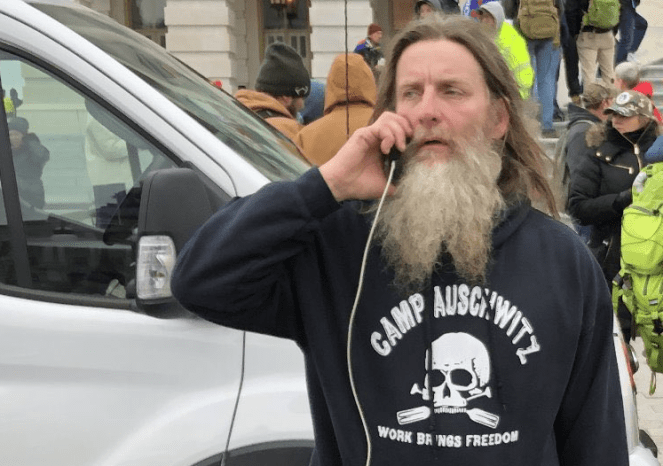
This week, fascists marched on the White House. They carried Confederate flags into Congress. A Nazi showed up among the rioters wearing a shirt that said: “Camp Auschwitz” on the front, and “staff” on the back, as if taking credit for the mass murder of Jews. They proudly displayed nooses, the symbol of anti-Black lynchings. Every brand of far-right conspiracy theorist and white supremacist descended on Washington, and video evidence shows that the police not only tolerated them but let them in.

Where has all our doubt and consideration left us? In our desire to find common ground and engage in reasoned discourse, we now come across as morally ambiguous and uncertain in our principles. We have left an ethical vacuum, and fascists have stormed into it. Intellectual curiosity is little use against the blunt force of white supremacists seeking to violently cease power.

Rabbi Professor Tony Bayfield has pointed out that our uncertainty is what differentiates us from fascists. Fascists are, by definition, absolutists. They do not interrogate their views or consider other perspectives. Our advantage over fascists comes from the fact that we give arguments due consideration and approach our own convictions with humility.

He may be right. Doubt might separate us intellectually from fascists. But it is action that separates fascists politically from power. There is no joy to be had in feeling superior if white supremacists gain power in government.

This week’s events may have been a terrifying climax to Trump’s presidency. But it is equally likely that they are a prelude to worse events. American white nationalists are emboldened and convinced that they can seize power through either ballots or bullets, depending on whichever method suits them. The situation in Britain is scarcely different, where racists have not felt so confident in decades.

Whether Trump now recedes into the background or his racist ideas come to dominate the world will depend on how we act. It will not depend on what we think, but on what we do. Events are calling us to action. If we want to eradicate fascism, we must be willing to fight it.

By all means, have doubts. Moses doubted. Moses was unsure. But God said to him, ‘go anyway. Get down to Egypt and free those people.’

We must be willing to face the Pharaohs of our time with the same vigour. We must be able to say: “I have come to act because God sent me. I am standing for justice because I know it to be right and true. I am standing against racism because I know it to be wrong. I will free these people. I will uproot tyrants. I will defend democracy and advance the cause of the oppressed.”

The integrity of the upright will guide us.

Although we may not fully understand these monsters before us, we will slay them.

And we will vanquish fascism for good.

Shabbat shalom.


I am giving this sermon on 9th January 2021 at Newcastle Reform Synagogue for Parashat Shmot.

[1] Job 1

[2] Job 40

[3] Job 41

[4] Job 42

[5] Job 11

[6] Ex 3

[7] Ex 3:11-12

[8] Ex 3:14

[9] Ex 4:1-9

[10] Ex 4:11-12

[11] Ex 24:7

[12] BT Shabbat 88a

[13] Prov 11:3

[14] BT Shabbat 88b

article · theology

A Tale of Two Gods

In the time of the First Temple, in the world of the Hebrew Bible, the ancient Israelites brought sacrifices to the cultic centre in Jerusalem. One of these was the korban o’la – an offering of burnt animal fat. Every part of the sacrificed animal was burnt on the altar, except for its skin. The Hebrew word o’la, meaning rising up, referred to the pungent smoke released twice daily when the sacrifice was made.

Many centuries after the destruction of the First Temple, in the time of the Second, a group of pious believers came to translate the text into Greek. This early translation of the Bible became known as the Septuagint. Greek had no direct translation for the term o’la, so the editors chose a word meaning ‘completely burnt’ – holo kauston. Holocaust.

That is the word that has come to represent the ritual slaughter of 17 million people, 6 million of whom were Jewish, in the middle of the 20th century. Like the animals of many millennia before, the people in the concentration camps were burnt throughout the day so that nothing remained of them.

It is perhaps for this reason that many of the victims were reluctant to use the term Holocaust. Jews called it by the Hebrew word shoah, meaning ‘disaster’ or churban – ‘destruction’. Roma people called it Porajmos – ‘the devouring’. For historians it was simply called by its Latin name ‘genocide’ – the killing of a people.

Something sinister lurks behind the very word ‘Holocaust’. The Jews, forever seen as relics of the Christian Old Testament, were murdered in the manner described by their book as a tool for expiating sin.

The word calls us to ask: to whom were these Jews sacrificed? On whose behalf? For what sin were they intended to atone? And was the God that received these offerings satisfied?

In the time of the First Temple, minor transgressions were deemed to pollute the land. The o’la served as a way to ritually cleanse ancient Israel of its impurities. Priests appealed to the national god for mercy and knew their petitions had been answered by the arrival of regular rainfall.

In the world of the Third Reich, ethnic impurities and social deviations polluted Europe. Germany and its empire was in breach of its duty to be thoroughly white, Christian, patriarchal and heterosexual. Isolating the minorities was not enough to recompense for their transgressions. The minorities had to be destroyed in their entirety. Devout Nazis played their part to remove and destroy every blemish in their land.

Of course, such blemishes can never be fully removed. The sin of non-whiteness is too volatile and its terms too expansive. The god of nationalism is thoroughly empty, so no amount of flesh will ever fill him. He is insatiable. Modern fascists remind us that the nationalist god is still hungry for blood.

The God of the ancient Temple, by contrast, no longer requires burnt meat. That Temple was destroyed and its people forced into exile. God fled with the refugees and, with them, became transnational. Prayers replaced sacrifices. The God of Israel became the God of the Jews, who wanted good deeds, social justice and piety. It mutated into the God of Love and could be found on every continent.

The god of nationalism, paradoxically, is now no less international. He permeated borders through colonialism and found a home on every soil. In every country, he can be seen represented by each flag. His priests can be found adorned in military uniforms of every stripe. His followers proclaim his word from pulpits the old preachers could never have imagined, reaching millions.

And he still requires blood. His altars are the lynch ropes for Muslims in India. His followers ritually parade through Charlottesville, Belfast, Rangoon, London and Sao Paulo. And, yes, the god of nationalism is worshipped in Israel too. The very land that birthed the universal God now hosts nationalism in its gates. In every place, his offerings are returned in coffins. And, no matter how many die, it will never be enough.

As the god to whom fascists make their sacrifices ascends, the universal God of the Jews withers. In Auschwitz, our God stood trial. The pious Jews who prayed in the camps convened a court and charged God with breach of covenant. God had abandoned them. Or forgotten them. Our rabbis had no choice but to pronounce: God is guilty. And when they knew that divine help was not coming, they did the only thing they could. They prayed.

After the camps were liberated, the remnant survivors had to face a new reality. They wondered whether their God was dead. A bitter irony. For centuries, the Jews had been accused of deicide against Jesus. Now they witnessed their own God burned in the flames of fascism’s altars. Only later did the quiet Christian witnesses realise that their God had been the same one, and was dying too. Their doctrine of goodwill and universal love was no less weakened. And only then did they realise they had killed the wrong God.

Is it too late? Can the old religion of truth and humanity be revived? Certainly, its followers are rebuilding. Synagogues are emerging anew in places where sceptics imagined that God was buried: in Córdoba, Warsaw and York. True believers congregate in mosques, chapels, gurdwaras and living rooms. Those who hold the greatest hope are unafraid to protest in God’s name against violence. They refuse to sacrifice to the new gods. They are the source of my faith.

As we mark Holocaust Memorial Day, we must remember not only the millions of human sacrifices, but the deity for whom they were killed. We must rededicate ourselves to destroying its idols and exposing them for the false gods that they are. In memory of the murdered, we must destroy fascism today.

Yet just because we oppose one god does not mean we must give up the One God. The Force of hope, solidarity and justice cannot be abandoned, even if we feel as if it has abandoned us. So, in memory of all those who were martyred professing a faith in that religion, I ask you to do something normally unthinkable in a radical publication like Novara Media – and pray.

burning smoke columns

I wrote this article for Novara Media for Holocaust Memorial Day on Monday 27 January 2020.

judaism · theology

God will reign forever

Tonight, at Manchester Liberal Jewish Community, I won’t speak much, in order to give everyone a chance to express their sadnesses, fears and hopes. The Jewish community is still reeling from shock at the shooting at Eitz Chayyim synagogue in Pittsburgh. I know I am not alone in fearing the rise of fascists in Brazil, Italy and Hungary. People will need to name their fears and have them heard. But I will say a few words before we daven to set the tone. I share them here.

I have a secret love, perhaps unbecoming of a Liberal Jew. I love Chassidic house music. Shwekey, Nachas, Beri Weber… I love the upbeat, pop-py, happy tunes with Jewish liturgical slogans chanted over them.

A couple of months ago, a housemate came in to find me singing along to it as I cleaned the kitchen. I spritzed the table and mopped it up, chanting “Hashem melech! Hashem malach! Hashem yimloch le’olam va’ed!” The song’s lyrics mean “God reigns, God has reigned, and God will reign forever.”

My housemate, who had grown up in Habonim Dror, a secular socialist Jewish youth movement, was horrified. “How can you say that? You of all people?”

I reflected on his question. Of all the Chassidic house music I’ve sung along to, this seemed the least offensive lyrics I could think of. These were words that we say regularly in prayer.

I think the problem is that we have different views about what God is. What he thought I was singing for was theocratic tyranny. If I imagined that God was that bearded, judgemental man in the sky, I would do everything possible to stop Him from reigning anywhere. Indeed, we have all seen what happens when religious people that do believe such things take power.

For me, God is not that judgemental man, but the force of love and justice that gives morality meaning. God is an indescribable binding power, an energy of love that hums beneath the chatter of man-made hate.

And yes, I believe that force reigns, has reigned, and will reign forever.

Today, when we see the rise of fascists and we mourn murdered Jews, the underlying force of love and justice is still there, and still has power.

In our darkest moments, when we have witnessed personal tragedies and collective atrocities, the power of morality still reigned. Our lives still possessed a deeper meaning.

And God – our God – the God of love – will outlive every antisemite, every president, every nation, every empire. No matter how dark things seem, I know that God will reign forever.

Let us pray.

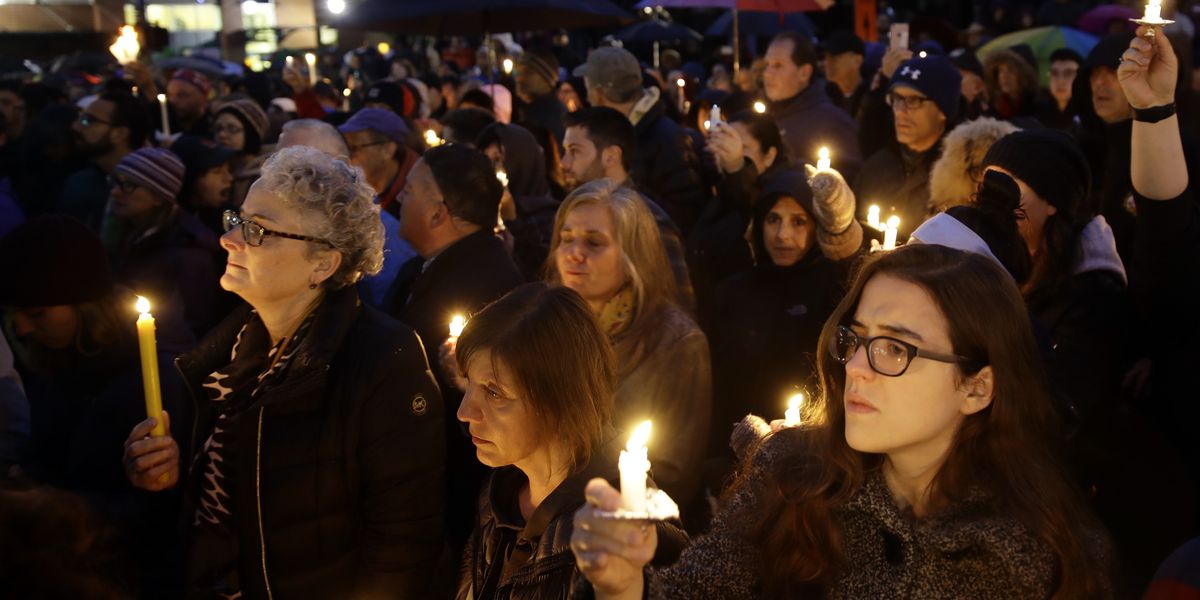
candlelit vigil


judaism · sermon

What makes people change?

What is it that makes people change? People do change, after all. Change is a foundational principle of our religion. We call it teshuvah: turning, repenting. Although we Jews hold fast to few dogmas, we know that people can make mistakes and correct them. We know that people can be better tomorrow than they were yesterday. Without this belief, our religion would be meaningless and our lives devoid of hope.

So what is it that makes people change? In this week’s parashah, Emor, God gives the Israelites a framework for repentance. They will have rest-days and festivals. They will come together on Yom Kippur and present an offering of food in the Temple. But repentance can’t be limited to only one day a year. Week after week, the Israelites must bring offerings of bread and oil to burn on the altar.

Today, it is hard to imagine how these rituals might have brought about meaningful change. We are too far removed from a Temple-centred agrarian society to imagine the spiritual significance of priests sacrificing grain on an altar. But, to those who practised it, this must have been a meaningful experience. They set aside time for worship and brought their only source of income – the harvest and livestock on which they depended for a living – then watched their offerings publicly go up in flames. Perhaps this itself was enough to make people reconsider their lives and commit to acting differently.

In the parallel haftarah, Nehemiah, the Jews throw dust on their heads, separate themselves off and wear sackcloth. They fast and cry. This was how they repented after the return from the Great Exile, when the First Temple had been destroyed. It is a spiritual world that seems so strange and yet so familiar, and we feel a sense of how that ancient cult of Temple priests evolved into the religion we practise today.

Today, we offer up prayers; we take time to reflect in silence or recite ancient meditations. To the Temple cultists, our approaches to changing ourselves might look as bizarre as their rituals appear to us. That’s because they can’t see what’s going on behind our penitentiary words: that, with them, we are examining ourselves and finding ways to be better people. These songs and silences prompt us to repair relations with people we’ve wronged, and adjust our views and actions. At least, we hope they do.

We believe that people change, but it’s hard to put that faith into practice. I have watched with some concern as news has unfolded around political scandals over the last week, both of Amber Rudd stepping down as Home Secretary for her racist policies and the beginnings of expulsions of Labour Party members accused of antisemitism. There can be absolutely no doubt that there is no place for antisemitism, anti-Black discrimination or xenophobic feeling in our public sphere. Everybody who has drawn attention to it has done the right thing. Their campaigns have been wholly legitimate.

But what comes out of them leaving their ministerial posts or their political parties? Have their views changed? Have the political forces that engendered racism been challenged? Or have we got rid of certain people from the public eye so that we can pretend that issues of bigotry are confined to individuals, rather than something we all, collectively, need to address? It seems like we have ruled out the possibility that people can change. By removing them, it seems we assume that Amber Rudd and Labour Party antisemites cannot change. And it seems we assume that we, ourselves, do not need to change. The Jewish principle of teshuvah is made obsolete.

This leaves me wondering: is there an alternative? Is there a way to encourage people to change their bigoted views that can have a lasting impact? This week, I watched a documentary, called ‘Keep Quiet’, about the Hungarian neo-Nazi Csanad Szegedi. He was a leader of the feared far-right party Jobbik, heading up their racist street army. He was celebrated by white supremacists across the world when he won a seat in the European Parliament to promote Holocaust denial, racist conspiracy theories, and anti-immigration policies.

And then something shocking happened. His grandmother informed him that she was Jewish. She had survived Auschwitz. Her daughter, his mother, was also Jewish. In Orthodox religious law, he, too, was Jewish. These revelations forced him to embark on a journey of self-discovery that dramatically changed him.

Only a few days after his Jewish status leaked to the press, Szegedi called up his local rabbi, Boruch Oberlander, a Chabad Lubavitcher, originally from New York, whose parents were Shoah survivors. Although Szegedi was very much the star of the documentary, it was his rabbi, Oberlander, who really stood out to me. Nobody else was willing to engage with Szegedi. Oberlander’s own congregants and funders actively discouraged him from meeting with the neo-Nazi. But Oberlander believed, against all evidence, and against what everyone else was saying, that Szegedi could change. He told the filmmakers that he saw Szegedi as a Jew and believed that every Jew deserved a chance at repentance.

Rabbi Oberlander opened up that space for Szegedi to become someone new. He met with him weekly, then bi-weekly. Over a period of years, he introduced him to the principles of Judaism, educated him about life under the Nazis, and showed him the compassion we would expect of a Jew. Szegedi resigned his membership of Jobbik. He bought up all the copies of his own fascist book he could find, and burnt them. He got circumcised. He began davening daily. And he publicly renounced his racist views. At each stage, Rabbi Oberlander encouraged him, saying: “You’re not done yet. You still have more repenting to do. You still can go further.” And Szegedi believed in that encouragement.

This is a totally different model of engaging bigotry to the one we have seen in British politics. It is one of patience and compassion. It builds from the assumption that people with unpalatable views are on a journey, and that they can be transformed with enough kindness, encouragement and care. It is a model that appeals to me on a deeply spiritual level.

As Jews, we have, by necessity, become hardened to antisemitism, but we should not become so hard that we forget our core values: that all people are created with a spark of the Divine; that the world is perfectible; and that we are tasked as a people to show what a world rooted in ethics might look like. Although it may seem politically unrealistic, it is religiously necessary that we engage people in uncomfortable conversations. The appeal of racism is that it offers easy answers. Our response, therefore, must be a willingness to pose hard questions, and listen sensitively to the answers.

Just as the Temple priests of old knew that repentance was not something that could be done as a one off by one person, but needed to be done constantly by everyone, Britain as a nation must also be willing to engage in teshuvah. We as a nation must face up to our country’s horrible past. Antisemitism owes its origins to the Crusades, where Jews were treated as a fifth column, and physically attacked as stand-in representatives of Palestine that the knights sought out to conquer for Christianity. Tropes of Jew hatred are part of Britain’s class system, where Jews were used by monarchs as pawns for collecting taxes, and for directing the hatred of the masses when rebellion was in the air.

Similarly, anti-Black racism comes out of Britain’s colonial history. Black people were taken from Africa to the Caribbean as slaves and forced to work on plantations. Britain called over its subjects from the colonies to help rebuild it after the war, often taking on menial jobs and living in squalid conditions. That is why the Windrush generation are here, and that is why they are being oppressed as they are.

If we really want to rid our world of the scourge of racism, Szegedi’s story will not be enough. All of us need to examine the racism in our own hearts and throughout our society. We need to create a culture where everyone is willing to learn, develop, and be better people than they have been. We also all need to learn from Rabbi Oberlander’s example: to be more willing to engage with people who have objectionable views, and patiently believe in their capacity to change. If we can meet the world with compassion and self-reflection, we may be able to restore hope.

Shabbat shalom.

null

I gave this sermon on Friday 4th May at Manchester Liberal Jewish Community. The day before, the country had gone to the polls in local elections, where racism and antisemitism were live issues.