protest · social justice

We must build a wall to protect you from the Moabites.

We must build a wall to protect you from the Moabites.

We must build a wall. You cannot trust the Moabites.

The Moabites are on the other side of the salty Dead Sea and the Jordan River. A river is not big enough to keep the Moabites away from our land. They will take everything we have if they get the chance.

The Moabites are dangerous and brutal. They will destroy you if they get the chance. 

We must destroy the Moabites before they can destroy us. We must kill their kings. Their king Eglon is a murderous tyrant. You will never be safe as long as he reigns. You must kill him.

You must kill every Moabite that stands in your way. You must capture the Moabite city of Heshbon. We need it to keep the Moabites away from us. 

We must build a wall to protect you from the Moabites.

They must never come near you. 

You must never meet them. 

Because, if you met the Moabites, you might see that they are not monsters. You might see that they are like you.

And then you would not be able to kill them.

And then you would ask why we are building walls.

And then you would ask who was building these walls.

So you must always abhor the Moabites. You must fear them and revile them.

We must build a wall to protect you from the Moabites.

It must be high enough to protect you from them. It must be high enough to protect you from yourselves. It must be high enough to protect you from peace.

You may not immediately notice it, but nestled in this week’s Torah portion is an early example of war propaganda. In the vulgar and violent story of Lot is an origin myth for the Israelites’ greatest enemy: the Moabites.

The scene begins as God destroys Sodom and Gamorrah, two cities so wicked and licentious that they have to be wiped out and turned into the Dead Sea.

Only Lot and his daughters escape from that awful place. They retreat into the mountains on the east of the Jordan. There, the two daughters get Lot drunk, seduce him, and use him to sire their children.

The oldest is called Moab. And to really drive the point home, the Torah adds explicitly: the father of the Moabites.

The women in this story are not even given names. They are just grotesque plot devices to tell us how awful the Moabites are. 

Those people, Israel’s nearest neighbours to the east, are so wicked that they came from Sodom. Their ancestors are so twisted that they were born of incest, drunkenness, and assault. It is a story to inspire revulsion in its Israelite listeners.

This is part of a general campaign of literary warfare against the Moabites, continued throughout the Torah. 

Isaiah promises that the Moabites will be trampled like straw in a dung pit. Ezekiel vows endless aggression and possession. Amos says the whole of Moab must be burned down. Zephaniah swears that Moab will end up just like Sodom, a place of weeds and salt pits, a wasteland forever.

The war propaganda reflects real wars. The ancient Israelites did repeatedly wage war, conquer, and capture Moabites. They did kill their kings, and they did turn Moab into a vassal state. 

Based on the Moabites’ texts, we can see that it also went the other way, and that Moab also captured, conquered and slaughtered Israel.

We do not know how many Israelites or Moabites died in these wars. We do not know how many people grieved their families and homes. All that remains is the propaganda of the competing tribes.

Today, it is hard to imagine why anyone would have hated the Moabites so much, or even that we would believe the hyped-up stories of how vulgar they were. With centuries of hindsight, we can see that they were probably very similar to the Israelites, but dragged into wars for the glory and material wealth of their kings.

Of course, there were dissenting voices at the time. The Book of Ruth can be read as a polemic about love between Israelites and Moabites. It is a beautifully humanising story where the central character, Ruth, is portrayed as a Moabite who is kind, loving, devoted to her family, and committed to Israelites.

As long as there has been war propaganda, there has been anti-war propaganda, and our Torah contains it all.

This Shabbat, we honour Remembrance Day. We think of all of those who died in wars past, and those who served their countries in military operations. This feels so close to our hearts, as we reflect on the great toll wars took on military personnel and their families, including many in our communities. 

We remember the pain of those who have lived through and died in the awful wars that have passed.

This solemn day dates back to the armistice of the First World War, on November 11th 1918. The following year, England hosted France for a shared banquet as they recalled the ceasefire. From then on, it became an annual day of reflection on the horrors and sacrifices of war.

During the First World War itself, even as the conflict was ongoing, many challenged the war. The great British-Jewish soldier-poet, Siegfried Sassoon, charged that the war had been whipped up by jingoistic propaganda.

In July 1917, Sassoon published “A Soldier’s Declaration,” which denounced the politicians who were waging and prolonging the war with no regard for its human impact. 

Sassoon lambasted “the callous complacence with which the majority of those at home regard the continuance of agonies which they do not share, and which they have not sufficient imagination to realise.”

It is true that people like me, who enjoy peace, cannot even contemplate the pain that people went through in fighting wars and enduring bombing. 

Today, we honour them.

Honouring them does not mean parroting propaganda and whipping up war. 

Quite on the contrary. It is the duty of every civilian to ensure as few people as possible ever have to fight in wars. It is our responsibility to minimise the number of people who suffer and die in armed conflicts.  It is our task to pursue peace.

We, who will never know the sacrifices of the front line, must heed Sassoon’s call, and resist the drive to war.

So instead:

We must tear down every wall with the Moabites. 

Yes, with the Moabites, and, yes, with the Germans, the Russians, the Chinese, the Koreans and the Iranians.

We must find commonalities and engage in shared struggles.

We must learn to trust our fellow human beings and distrust the propaganda of war.

We must cease all killing. The machinery of war has destroyed too much and taken too many lives. We must endeavour to put an end to violence and destruction.

We must learn to understand the people we are told are our enemies.

We must tear down every wall.

Shabbat shalom.

social justice · theology · torah

We are waiting for a different Messiah

Some years ago, an Orthodox friend asked me: “what would you do if the Messiah came and it turned out we’d been right about everything? What would you say to the Messiah?”

What would I do if the End of Days came, and Elijah literally came storming out of the whirlwind in a chariot made of fire and declared that the Son of David had arrived to cast judgement? And that we were to be judged on how strictly we had separated men and women; how well we had obeyed family purity laws; how stringently we had adhered to traditional authorities?

What would I say to this Messiah?

I have thought about it for a good few years and I think I now have my answer.

I would say: “F@£& off.”

I would tell that messenger: “You are not my Messiah and you’re not my king. Now go back where you came from.”

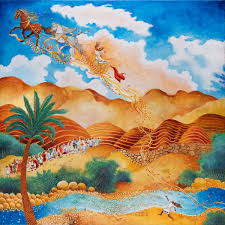
In this week’s haftarah, we read the prophet Ezekiel’s vision of the valley of the dry bones. For centuries, Orthodox Judaism has based its understanding of Messianism on these verses.

Ezekiel finds himself in a desert surrounded by skeletons. God tells Ezekiel to prophesy to the bones, and he does so, covering them in sinew, breathing life back into their lungs, and reviving their bodies, so that they stand up as a skeleton army.

These, says God, are representative of the people of Israel.

So, Orthodox Jewish tradition teaches, a day will come when the dead are literally physically resurrected. The corpses of pious Jews throughout the ages will be brought back to life; the exiles gathered to Jerusalem; and all judged by a righteous king descended from the biblical King David.

For this reason, many Orthodox Jews eschew cremation, and insist on being buried intact, so that their bodies can be resurrected at the End of Days. They vie for graves on the Mount of Olives, so that they can have front row seats when the Messiah arrives at the walls of Jerusalem and summons up the dead from their tombs.  

In recent decades, religious fanatics have come to espouse an even more intense version of this apocalyptic vision. 

There are Orthodox Jewish extremists, funded by American evangelical Christians, who are trying to destroy the Al Aqsa Mosque on the Temple Mount; build a Third Temple; and restore animal sacrifice and priestly leadership.  They seek to expand Israel’s borders to restore the ancient Kingdom of King David.

This week, Rabbi Charley Baginsky was quoted powerfully in The Times, saying: “We are afraid — not just for Israel’s future, but for Judaism itself. What becomes of our tradition if it is captured by messianic extremism, by racism disguised as religion, by power without principle? If the current trajectory continues, if Jewish supremacy becomes policy, then Judaism itself may become synonymous with oppression.”

In this context, you might be forgiven for thinking that messianism itself is the problem. Surely a religious zeal that drives people to commit such crimes is itself dangerous. For some, witnessing this fervour makes them question the foundations of Judaism itself.

The Israeli religious scholar, Avraham Uriah Kalman, warns against this way of thinking. His article earlier this year, entitled Another Messianism, addresses a tendency in Israeli secular society to dismiss all religion as varying stripes of nationalist fanaticism.

Yet, he claims, precisely because of the strength with which racist extremists have captured Judaism, we must return with equal zeal in our reclamation of Judaism. We, who believe in justice, democracy, and human rights must just as vigorously defend our corner.

If we do not have an equally powerful vision for what society could be, we will always be on the back foot, compromising with monstrous ideologies that want to blow up buildings and raze down villages.

Our ethics are grounded in the Jewish tradition. They are derived from the Jewish texts. They are sourced from the Living God. 

We cannot allow the far right to take exclusive hold over any part of Jewish life, or we surrender it to them. That includes Messianism – the grand utopian visions of ideal societies promoted in every book of the Prophets. 

The Prophets, whose mission of speaking truth to power and uplifting the lowly, are far more in line with our Progressive visions of the world than they are with the soulless dreams of those who want to oppress women and gays as part of their supremacist agenda. 

In the Prophets, we see clear visions of a perfected world. Their writings testify to a world of peace; where all resources are shared; where everyone lives in dignity; and where all are free.

Outside of specific esoteric texts like this week’s mystical imaginings from Ezekiel, it is hard to see any of the far right’s fantasies reflected in our Prophetic texts.

Messianism is really supposed to represent a rupture in the established order, but that is not really what the far right offers. War, racism, and misogyny are already the norm. At core, they don’t really want to change anything except to make existing tendencies more violent and oppressive.

So, says Dr Kalman, progressives must embrace messianism. We must turn to the Prophets as our source of hope, rather than buckling under the weight of despair. From our own utopian visions, we can develop ethics that speak to our daily lives and help us practically realise a better religious vision.

Kalman draws on a whole range of Jewish religious traditions, including Talmud, Kabbalah, Musar, and 17th Century Tzfat mystics. 

Yet, curiously, he seems not to be aware that this project, of developing a Progressive Messianism, has already been deeply thought through. The early Reform movement in Germany, from which Liberal Judaism descends, was animated by looking to the Prophets to rethink Jewish eschatology.

The early Reformers taught that the Messiah would not be a man, but an Age. 

It would not be characterised by Temple and Kingdom revival, but through the realisation of the values of the Prophets. It would be a world of peace and justice, achieved through the moral advancement of all humanity.

Explaining this theology, Rabbi Sybil Sheridan writes: 

“Though the end goal is world peace, the ideal is not pacifism, nor is it the peace of treaties at the end of war that are based on winners and losers. That notion continues the imbalance of power among peoples and nurtures the resentment that leads to dreams of revenge. The peace of the Messianic Age is a peace forged in complete mutuality. No one should be afraid that people may covet their vine or fig tree, no one will fear the loss of land or resources, no one will be humiliated. The world provides enough for everyone and sufficiency will take away the desire for war.”

While we Progressives do not accept the Orthodox doctrine of bodily resurrection and rebuilt Temples, that does not mean we should reject Messianic thinking. Times of despair and horror are when we most need to cling onto our hopes for a better world.

Progressive Messianism takes the task of perfecting the world away from mythical figures like Elijah and King David, and places it directly in our own hands. It says: we will not wait for someone else to bring about redemption; we are going to do it ourselves.

So, if Elijah came down from the Heavens and declared that the Orthodox had been correct all along, I would tell him he was wrong. 

For thousands of years, we have sought to create a better world. We have learnt through struggle about the dignity of women; the importance of justice; and the shame of racism. We now have a much better idea of how the world can be.

We can see a future in which every human being lives in harmony with each other and their planet. We can see a world where all live in freedom and peace. We are sure now that we can live in love and equality. 

We are going to realise our Messianic age.

And nobody- not even a prophet descending from the skies – is going to stand in our way.

story · theology

Why do Jews break a glass at weddings?

Whenever a couple comes to discuss their upcoming wedding, there is one ritual more important to them than any other. Anything else, they feel they can set aside, but this one action, they absolutely must do.

They insist on breaking the glass.

Smashing a glass under the chuppah is not a matter of halachah. In Jewish law, it makes no difference whether you do it or not.

It is also probably not the most visually popular image. If you picture a Hollywood Jewish wedding, the stock footage in your mind is the chair dancing, with couples thrust into the air, and holding on for dear life.

Why do couples want so much to smash the glass? When I ask them, they are not sure. It just feels right. It feels natural.

It is like they are remembering something. Something, a story; not just the stories of all the weddings of family members; not even another wedding in a mythic ancestral past. Something else. Something further back.

Perhaps, the Kabbalists suggest, what they have remembered is the very first smashed glass.

The very, very first crack.

Before there were weddings or people or creatures or planets or stars. Before there was anything at all.

Before there was anything, there was a crack.

In the beginning, there was a crack.

A crack in the Nothingness.

Before the crack, we can only talk about the Nothingness. We cannot even really talk about there being such a thing as before the crack, because, in the Nothingness, there was no time. The Nothingness was an absence. Lacking anything, it had no before, nor after, nor now.

When the first crack appeared in the nothingness, it created the first event. The first now.

Before long, the crack split. It broke further, like a chip in a windscreen that slowly breaks. Now there was a succession of events. A story in the cracking of the Nothingness. Now there was such a thing as now, and before, and after. There was time.

Then, the Nothingness could not bear the weight of the crack any more. It burst and shattered into an infinite myriad of broken fragments. Suddenly, there was time and there was space and it was filled up with the thousands of shattered splinters.

The Nothingness was broken. And there could never be another Nothingness again. It had ruptured and given birth to the Something: to all the imploded pieces of possibility.

And out of that possibility came yearning. The shards could see that they could form into combinations and make Somethings that were greater than just their fragmented pieces, but were the genesis of ideas.

So, they made wisdom, knowledge, and understanding. They made strength, love, and beauty. They created endurance and splendour.

From the broken bits of the Nothingness, they made the potential for Everything. And, with that, they made matter. They made the foundations of all existence.

Now, there could be galaxies and moons and oceans and forests and reptiles and insects and primates and civilisations and cities beings that could contemplate this entire mystery of existence and wonder how it all began.

This was how our world was made.

That is where we live: in the broken world.

We are the products of that initial shattering that yearned to be Something greater than Nothing. And we are able to see the world as it is: infinitely complete and completely broken.

We are those sentient beings who can witness this world and wonder how it all came to be, and wonder if it might ever be like that again. We are able to yearn with our whole souls to be reunited with the great forms that once birthed us. We long to feel again that splendour and majesty and wisdom that brought us into being.

Everything that exists is but a microcosm of the original system of shattered fragments that first delivered creation. We contain within us fractals of the understanding, beauty, and strength that initiated all being.

Those creative life forces exist within everything. They continually reach out to each other, interact with each other, and recreate each other, so that everything is one miraculous dance of metaphysical juices, bubbling beneath a mundane surface.

This means that, inside our own souls is the very first crack. We are the broken vessels that yearn for Something more than this. Out of our own breakages is the genesis of all creativity. It is as if the whole world was given order straight from our own souls.

We are perfect. We are broken. Our hearts were broken long before we were ever born. The Creator burst a puncture in our souls right from the outset. It was what would allow us to love and be loved.

And our hearts have been further broken by life. They get fractured every time we encounter something we do not understand. We can feel ourselves breaking every time we lose a loved one, and every time we see the beauty in a sunrise. Yes, our hearts break in sadness, but they also break in joy. It is our brokenness that brings us back to the very first creation.

So much in this society teaches us to scorn our own brokenness. We are encouraged to deny the parts of us that feel most acutely.

Instead, daily life makes us treat this world as if it is still nothing. As we work and pay bills and undertake routines, it can feel like there is no meaning to any of it.

But, deep down, all of us know that our existence is a miracle. We are divine shrapnel in a seemingly impossible universe.

So, when the couple comes under the chuppah, their first thought is: I want to smash the glass.

I want to see outside of me the brokenness that is within.

I want to remember how, once, in a past that never was, the very first crack made everything possible.

I want to be reminded that this brokenness inside of me is what allows me to connect with others. That fracture inside my heart is what makes me yearn for the love of another. It is what makes my being permeable enough that someone else can enter, and share in it their own broken lovingness.

Without this crack inside me, I would never be able to reach beyond myself. This brokenness is what connects me back to God.

We are broken people in a broken world.

Our brokenness is not a cause of shame. Our brokenness is what makes Anything possible.

I know I am broken when I feel grief and anger and jealousy and pain.

Because I am broken, I can feel love and wonderment and resilience and curiosity and awe.

Thank God I am so broken. I only wish to be moreso.

Dear God, let me be more broken.

Let my heart be more porous so that all its dreams may be freed into this world of infinite possibilities.

Puncture my soul and rip it open, so that I can truly feel the longing of all humanity. May I hear in the depths of my being the cries and joys of all that exists and could exist.

May I truly see this world, in all its diverse variance, and marvel at the infinite Nothingness from which we came.

May I fulfil the prophecy of Ezekiel:

“I will give you a new heart and place a new spirit within you. I will remove that heart of stone from your body and give you a heart of flesh. I will put My spirit within you, so that you will walk in My ways and uphold My justice.”

Dear God, break me.

Break me, break me, and break me again.

Shabbat shalom.

sermon · theology · torah

Purity or justice

Let’s start with a question.

An adult couple accidentally runs over their pet dog. Instead of burying their dog in the garden, they take it home, cook it in the oven, and eat it. 

Here’s the question: have they done something immoral? 

Most of us will have an instinctive reaction: what that couple did was disgusting. We will feel some revulsion.

But whether you think it was morally wrong will depend on how you see the world. It will depend on your moral palate. 

This was what was demonstrated by the Jewish-American psychologist, Jonathan Haidt, in his popular book, The Righteous Mind.

Haidt sought to find out why it was that caring, rational people could disagree so profoundly on moral issues. Why was it that America was so polarised? There, people fight furiously about issues like abortion, guns, and marriage, as if they have no common moral basis.

Haidt argues that we do have shared moral bases, but our morality is more like the palate on our tongue. “We humans all have the same five taste receptors, but we don’t all like the same foods,” he says. “It’s the same for moral judgments.”

We have, he says, five main taste receptors: care, fairness, loyalty, authority, and sanctity. 

If you are an educated person who lives in an urban area of a Western capitalist country, you are likely to feel that the couple who ate their dog did not do anything morally wrong. You’ll be disgusted, sure, but you might not think that they violated any kind of moral rule.

That’s because, in these cultures, people have a moral palate that puts a big emphasis on ethics of care and harm. If nobody was hurt, then there’s nothing immoral.

If, however, you live in a close-knit community of farmers, you are far more likely to say that the couple who ate their dog did do something morally wrong. That’s because those cultures have a strong sense of sanctity and taboo.

Both of these systems are ways to help people get on with each other. In a busy metropolis like London, you need to be able to live and let live, because if you can’t tolerate diversity, society will fall apart. In a tribal farming community, like ancient Israel, you need to have strong social norms to protect people.

Both these impulses – care and sanctity – come from a deep, ancient social need. 

Since humanity’s beginning, our survival has depended on our ability to care for our most vulnerable members. How would we have lasted a single generation if not for looking after the young, the old, and the vulnerable?

From the start of civilisation, we have also needed to be able to express disgust. It comes down to the most basic distinction between excrement and edibles. We need to tell each other: “this food is poisonous; this disease is contagious; this behaviour is dangerous…” Without clearly agreed boundaries and taboos, we would quickly perish.

It is worth holding these two tendencies in mind – care and sanctity; purity and justice – as we approach our readings for this week.

Our Torah portion goes into minute detail about how to do proper sacrifices, how to lay out the Temple, and who is supposed to do what in religious services. To us, the attention to detail might seem absurd.

But remember that this is part of a group of people’s moral palate. This is their sense of the sacred. Messing it up, from their point of view, would be ethically disastrous. It would be similar to eating the family pet. 

No wonder, then, that the prophet Ezekiel opens the haftarah by telling the Israelites “if they are ashamed of all they have done, make known to them the design of the temple.” Failure to get it right, says Ezekiel, is a serious sin.

There are two great moral impulses in Torah: justice and purity. This trend appears throughout the whole Scripture: contradictory, competing moral voices speak through our books.

The voice of justice tells us about care and compassion. It tells us about fairness and redistribution. The voice of justice charges us towards more equality and more freedom. Justice says that a society is only as strong as its weakest members.

The voice of purity tells us about how to keep holy things sacred. It tells us what the boundaries are on sex, so that we do not cross them. The voice of purity tells us not to eat octopus and not to mix linens. Purity makes sure everything is kept in its proper place, so that society can function, and people feel safe.

The voice of purity might feel less relevant to us today. We celebrate the prophets for their concern for the most vulnerable, because it fits so well with our ethics of care. We see ourselves in the narratives of the exodus because they chime with our moral intuitions about freedom from slavery. Laws on architecture… feel less like big moral issues.

That’s because what the big taboos and boundaries are can change a lot between time periods. 

When I was growing up, one of the big focuses of popular disgust was gay men. There was a long period when the media was seemingly obsessed over sex between men, especially in public toilets. This was the full gambit of taboos: waste and excrement; sex between the wrong sorts of people; and blurring the boundaries between public and private.

I think that is why some of the things that cause people moral disgust today just don’t bother me. I have had to push through a society telling me I was disgusting, and unlearn that contempt towards gay people. Now, the other sources of disgust just seem like passing fads. 

Knowing that has helped me understand where others are coming from.

I find Haidt’s ideas about moral palates really helpful for thinking through why sometimes it’s hard for people to agree. My ethical taste buds are highly attuned to care and fairness, but I don’t get much flavour from sanctity, and I can barely taste authority. 

Please do not think that one of these is left-wing and the other is right-wing. There are plenty of conservatives deeply motivated by wanting to make sure people are cared for and that distribution is just. There are just as many socialists who want to ensure the purity of the Marxist tradition, and to live in a world without contaminating ideas or contaminating people. 

What we morally feel is not just about ideology, but about all the factors in our cultures and upbringing that make us need to focus on certain values.

So, this is my advice. The next time you encounter someone that you really disagree with, try not to assume they are evil or weird. Think back, instead, to this Torah portion. Maybe what is just a building to you is somebody else’s Temple. Maybe what really triggers one person just doesn’t impact you.

Haidt’s goal, when he did this study, was to make it possible for people to talk to each other across divides. I don’t want us to become like America, where some issues cause massive wedges between neighbours. 

So let’s try listening to each other, and hearing each other’s worldviews.

Shabbat shalom.