judaism · theology

Be humble about what we can know


Before the Enlightenment, the world was governed by unknowable spirits and invisible entities.

There was so much we did not know.

If your farm didn’t produce any crops or the skies did not give you enough rain, you did not have modern technology to inform you about drought predictions for the next three years. You would have no way to know that the water coming from your clouds was directly connected to oceans miles away.

But you had your priests, and your rituals, and your superstitions. You had small gods in the hill country to which you offered libations. And, so far, when you had upheld your traditions, the rain came as it was supposed to.

When you got sick with a skin infection, you could not see a GP who would consult a modern medicine manual and give you a cream that would clear it up in just a few days. You would not have knowledge about germs, allergies, and viruses.

But you had your priests, and your rituals, and your superstitions. You had your rules governing sin and repentance. You had reliable experience that bodily suffering could be healed by atonement. And, so far, when you had upheld your traditions, the rain came as it was supposed to.

Please hold this in mind as we read this week’s Torah portion.

It may be easy for a modern mind, after the Enlightenment, to scoff at the strange priests, rituals, and superstitions that govern these chapters in the Book of Leviticus.

You might feel slightly embarrassed to imagine the rites our ancestors slit open goats, threw their entrails around and burned them for days until they stunk out a tent as expiation for their sins.

You might squirm at the vivid descriptions of cotton-clad priests flailing around the limbs of slaughtered cattle to win the favour of their god.

It may even seem primitive how they delight at the animal fat creating explosive fire, which they see as evidence of their god’s approval.

But they were doing what they could with what they knew. And they were engaging earnestly with what they did not know. Beyond the world they experienced was an unfathomable mystery, and they wanted to draw closer to it.

Indeed, only verses later, we get an insight into their own feelings of inadequacy. We get a real sense that they knew how much they did not know.

Nadav and Abihu do absolutely everything right. They follow the priests, carry out the rituals, and trust in the superstitions. They are formally inducted into all the correct practices by their father, Aaron the High Priest.

They do everything right. And then they die.

The burning animal fat explodes in a blaze that kills them both.

How can our ancestors make sense of this?

Our Torah gives two answers. The first is from Moses. Moses recalls a prophecy when God said: “Among those who approach me I will be proved holy; in the sight of all the people I will be honored.’”

We may interpret this as a way of Moses defending God. Moses is saying: while this may feel like a violation of our belief system, it is in fact proof of it. Holiness is a very dangerous quality.

God has demonstrated how sacred it is to engage in the rituals. God has shown what honour and risk are involved in holy service. 

So, for Moses, this sudden death of their priests does not undermine their belief system. It’s just evidence of how little they understand about their sacred rituals. In the fire, they have reached the limits of their knowledge.

Aaron, too, offers an answer. Silence.

We may interpret Aaron’s unspoken response variously. We may read into it horror, resignation, anger, acceptance, or solemnity.

But regardless of what he was feeling, we see that Aaron has no intellectual answer to the problem. He neither agrees nor disagrees with Moses. Aaron finds the limits of speech. He finds the boundaries of what he can even express.

Moses and Aaron lived in a world of unknowable spirits, governed by superstition. They made sense of their confusing world through priests and sacrifices. And no matter how well they constructed their rituals, they still found their limits.

There were things they did not know.

But we live in an era after such theologies. From the 17th Century onwards, Western Europe was gripped by a profound truth.

As the people challenged the unlimited power of the established church, philosophers pulled apart the stories religions had told.

This was the Enlightenment.

No more would they be hoodwinked by magical thinking or damned by promises of divine retribution. Everything, every idea, would be subjected to ruthless scrutiny. The greats of these generations would challenge the tenets of even science itself.

We live now in a world formed by their ideas. While our ancestors were beholden to talismans, omens, and sacrificial fire, we have evolved to hold modern ideals of truth and rational enquiry.

So, why hasn’t religion disappeared?

Isn’t that the obvious next question?

We have rid ourselves of superstitions, but synagogues are stronger than ever. Most of the world is still deeply religious. Despite constant predictions of its demise, faith remains stronger than ever.

For those who wish to understand God’s persistence after the Enlightenment, they may want to look to Immanuel Kant.

Kant was the last of the Enlightenment thinkers. His impact on this period of intellectual history was so great that some even date its end to his death.

Kant was a profound writer on truth, ethics, the scientific method, and what we can really know. He was also a devout Christian.

Kant was animated by the same questions that bothered our ancestors who witnessed Nadav and Abihu die.

He was not confused about why burning fat could cause a blaze, or why religious rituals didn’t always yield the same results. Those were the questions of the past.

The question still lingered, however: why does it seem like there is no justice in the world? Why do bad things happen to good people, and why do the wicked seem to get away with it? Why, no matter what happens, does evil seem to persist?

In his essay, The Miscarriage of All, Kant says he will put God’s justice before the trial of reason. Kant contemplates all the possible answers.

Maybe what we think is evil isn’t really. Maybe the world works in ways we don’t understand so that evil has to be permitted. Maybe there are other forces in the world beyond God’s goodness.

And Kant gives us an answer, which is… we don’t know.

All of these explanations only expose the limits of our understanding.

None of the answers anybody has come up with is satisfactory.

We are finite beings trying to understand Infinite Truth.

And still, says Kant, we retain our faith.

For Kant, none of these questions undermine the existence of God’s justice. They just show what we do not know.

So, perhaps we need to approach these stories with more humility and less contempt.

The ancient priests may well have splashed ox blood around an altar to ward off sin, but we are no closer to answering the questions that motivated their rituals.

We are barely separated from them by any time at all.

We are still just animals, scrambling in the dark, trying to make sense of our world.

And we still need each other, with all our beliefs and rituals, to get through this life that can seem so unjust.

We are each other’s guides through a mystery we may never resolve.

We need to be humble about what we do not know.

sermon · theology · torah

Purity or justice

Let’s start with a question.

An adult couple accidentally runs over their pet dog. Instead of burying their dog in the garden, they take it home, cook it in the oven, and eat it. 

Here’s the question: have they done something immoral? 

Most of us will have an instinctive reaction: what that couple did was disgusting. We will feel some revulsion.

But whether you think it was morally wrong will depend on how you see the world. It will depend on your moral palate. 

This was what was demonstrated by the Jewish-American psychologist, Jonathan Haidt, in his popular book, The Righteous Mind.

Haidt sought to find out why it was that caring, rational people could disagree so profoundly on moral issues. Why was it that America was so polarised? There, people fight furiously about issues like abortion, guns, and marriage, as if they have no common moral basis.

Haidt argues that we do have shared moral bases, but our morality is more like the palate on our tongue. “We humans all have the same five taste receptors, but we don’t all like the same foods,” he says. “It’s the same for moral judgments.”

We have, he says, five main taste receptors: care, fairness, loyalty, authority, and sanctity. 

If you are an educated person who lives in an urban area of a Western capitalist country, you are likely to feel that the couple who ate their dog did not do anything morally wrong. You’ll be disgusted, sure, but you might not think that they violated any kind of moral rule.

That’s because, in these cultures, people have a moral palate that puts a big emphasis on ethics of care and harm. If nobody was hurt, then there’s nothing immoral.

If, however, you live in a close-knit community of farmers, you are far more likely to say that the couple who ate their dog did do something morally wrong. That’s because those cultures have a strong sense of sanctity and taboo.

Both of these systems are ways to help people get on with each other. In a busy metropolis like London, you need to be able to live and let live, because if you can’t tolerate diversity, society will fall apart. In a tribal farming community, like ancient Israel, you need to have strong social norms to protect people.

Both these impulses – care and sanctity – come from a deep, ancient social need. 

Since humanity’s beginning, our survival has depended on our ability to care for our most vulnerable members. How would we have lasted a single generation if not for looking after the young, the old, and the vulnerable?

From the start of civilisation, we have also needed to be able to express disgust. It comes down to the most basic distinction between excrement and edibles. We need to tell each other: “this food is poisonous; this disease is contagious; this behaviour is dangerous…” Without clearly agreed boundaries and taboos, we would quickly perish.

It is worth holding these two tendencies in mind – care and sanctity; purity and justice – as we approach our readings for this week.

Our Torah portion goes into minute detail about how to do proper sacrifices, how to lay out the Temple, and who is supposed to do what in religious services. To us, the attention to detail might seem absurd.

But remember that this is part of a group of people’s moral palate. This is their sense of the sacred. Messing it up, from their point of view, would be ethically disastrous. It would be similar to eating the family pet. 

No wonder, then, that the prophet Ezekiel opens the haftarah by telling the Israelites “if they are ashamed of all they have done, make known to them the design of the temple.” Failure to get it right, says Ezekiel, is a serious sin.

There are two great moral impulses in Torah: justice and purity. This trend appears throughout the whole Scripture: contradictory, competing moral voices speak through our books.

The voice of justice tells us about care and compassion. It tells us about fairness and redistribution. The voice of justice charges us towards more equality and more freedom. Justice says that a society is only as strong as its weakest members.

The voice of purity tells us about how to keep holy things sacred. It tells us what the boundaries are on sex, so that we do not cross them. The voice of purity tells us not to eat octopus and not to mix linens. Purity makes sure everything is kept in its proper place, so that society can function, and people feel safe.

The voice of purity might feel less relevant to us today. We celebrate the prophets for their concern for the most vulnerable, because it fits so well with our ethics of care. We see ourselves in the narratives of the exodus because they chime with our moral intuitions about freedom from slavery. Laws on architecture… feel less like big moral issues.

That’s because what the big taboos and boundaries are can change a lot between time periods. 

When I was growing up, one of the big focuses of popular disgust was gay men. There was a long period when the media was seemingly obsessed over sex between men, especially in public toilets. This was the full gambit of taboos: waste and excrement; sex between the wrong sorts of people; and blurring the boundaries between public and private.

I think that is why some of the things that cause people moral disgust today just don’t bother me. I have had to push through a society telling me I was disgusting, and unlearn that contempt towards gay people. Now, the other sources of disgust just seem like passing fads. 

Knowing that has helped me understand where others are coming from.

I find Haidt’s ideas about moral palates really helpful for thinking through why sometimes it’s hard for people to agree. My ethical taste buds are highly attuned to care and fairness, but I don’t get much flavour from sanctity, and I can barely taste authority. 

Please do not think that one of these is left-wing and the other is right-wing. There are plenty of conservatives deeply motivated by wanting to make sure people are cared for and that distribution is just. There are just as many socialists who want to ensure the purity of the Marxist tradition, and to live in a world without contaminating ideas or contaminating people. 

What we morally feel is not just about ideology, but about all the factors in our cultures and upbringing that make us need to focus on certain values.

So, this is my advice. The next time you encounter someone that you really disagree with, try not to assume they are evil or weird. Think back, instead, to this Torah portion. Maybe what is just a building to you is somebody else’s Temple. Maybe what really triggers one person just doesn’t impact you.

Haidt’s goal, when he did this study, was to make it possible for people to talk to each other across divides. I don’t want us to become like America, where some issues cause massive wedges between neighbours. 

So let’s try listening to each other, and hearing each other’s worldviews.

Shabbat shalom.

halachah · sermon

What makes food kosher today?

Not long ago, after a near-lifetime of vegetarianism, I decided to try treif. And not just any treif, but the real deal: pork.

I knew I wanted to give it a go but I was afraid of being seen by other Jews. So I went on holiday to Gran Canaria, sat down in a fancy restaurant, and ordered a full-blown roast pork.

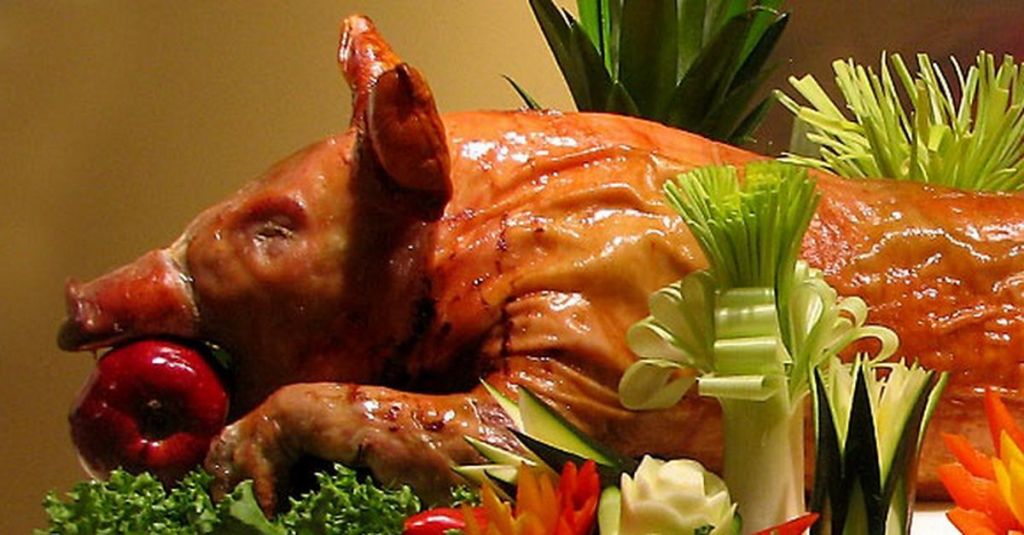
As I was waiting, however, a couple from my old congregation walked into the same restaurant. They instantly recognised me and came up to say hello. Just as we greeted each other, my pork came out from the kitchen: a giant pig on a massive platter with a big red apple in its mouth.

Flummoxed, I exclaimed: “My goodness… so this is how they serve apples here!”

OK, so that last part didn’t happen, but I really did decide to try treif about a decade ago. I’ll be honest with you, some of it tastes pretty good, but they’re not worth giving up Judaism for.

I hadn’t eaten pork since childhood. Aged 6, I had precociously insisted to my parents that I wanted to be religious and go to synagogue. My mum had told me that if I was going to force her to go to synagogue, I’d have to give up sausages. I wanted to be Jewish and I wasn’t allowed to do it half-heartedly.

I think all of us know that food laws play some role in our Judaism. Some of you here keep kosher kitchens. Some of you guiltily sneak a steak when you think you won’t get caught. Some of you, like my brother, eat extra bacon ‘to make up for all the ancestors who missed out on it.’

Whatever your choices, being a Reform Jew means to get to make those decisions for yourself. Our movement believes in informed choice.

Making the choice is your responsibility. But making sure you are informed is mine. So it’s my responsibility to share with you that there are lively debates happening in the Reform rabbinate about what kosher should mean today.

I recently attended my first Assembly of Reform Rabbis, where learned colleagues were discussing kashrut for the first time since the 1970s. It says something interesting that the topic hasn’t been addressed in such a long time.

The reason we are discussing kashrut again today is that the government is contemplating whether to ban traditional ritual slaughter – shechita. For many centuries, Jewish butchers have used the same methods for killing animals. That is: they slit their throats, puncturing the trachea, oesophagus and arteries with one rapid incision.

Throughout our history, Jews have considered this to be the cleanest and most humane method of killing animals. It comes out of a desire to show respect for the animals and to minimise risk of diseases.

Today, however, there is a new movement to favour stun slaughter. In this method, animals are electrocuted before they are killed. For cattle, this means putting a charged bolt through their heads. For chickens, it means electrifying them as a group. Proponents argue that this is more humane, since it renders animals insensitive to pain in their final moments.

There are two other factors that have made stun slaughter so popular, neither of which should be ignored. One is that industrial meat production means that factories produce far more meat. They want to be able to slaughter as efficiently as possible to maximise profit from the animals. Industrial stun slaughter certainly helps here.

Another factor is antisemitism. Across Europe, the movements to ban traditional slaughter have largely been led by white supremacists. Their primary target is Muslims, whose customs around halal slaughter are very similar to our own methods of shechita. Jews are really collateral damage in cultural wars about trying to retain Europe’s status as a Christian continent.

These factors make addressing this issue exceptionally complex. Proponents of stun slaughter ask us to set aside questions about racism and capitalism, just to focus on the issue at hand. I find that very hard to do. Rabbinic law is never about making moral decisions in the abstract. We make our ethical choices as real people living in the real world.

I think it is highly doubtful we will ever be able to prove that taking an animal’s life is better served by electrocution than through throat slitting. It may well be true that these new methods of industrial killing cause less pain, but shechita requires butchers to actually look animals in the eye before taking their lives. I’m not convinced either is more humane.

But, even if one were, we cannot escape the horrific systems that underpin animal consumption. Right now, the insatiable demand for meat is one of the leading causes of global warming. This week, we saw record-breaking temperatures. We can expect such heat waves to take place more regularly and more ferociously as runaway climate change unfolds.

The meat industry is an enormous enterprise that involves destroying natural habitats, depleting the oceans, battery-farming animals, deplorable working conditions, and unspeakable cruelty.

In every generation, Reform Jews have to work out anew what the most ethical way of living is. Today, it is hard to make the case that this includes participating in such an unjust system.

Rather than engaging in debates about specific methods of killing, I feel the appropriate response should be to question whether we should keep eating meat at all.

Indeed, this synagogue has long been an exclusively vegetarian site. This is partly because of convenience: it means we can host anyone and we can avoid messy arguments about separating meat from milk. But it also comes from the moral courage of previous leaders in this community, like Rabbi Henry, who felt that was the best way to live our values.

Please do not think me preachy. Quite on the contrary, I want to be open about my own hypocrisy. I still do eat meat on occasion, especially fish and chicken. I eat eggs and cheese. But, deep down, I know that the ethical vegans have already won the argument.

I once expressed my sadness about this to a frum vegan friend. She advised me: don’t let perfect be the enemy of the good. If you wish you could be vegan but can’t give up cheese, be vegan except for cheese! If you wish you could be vegetarian but like fish too much, be pesacatarian! We must all find ways to reduce our meat intake and limit our negative impacts on the planet.

The Reform rabbinate is still in open conversation about how we redefine kosher for our age. We did not settle the matter at the Assembly, and I don’t want to leave this sermon as if I have reached a definite conclusion. Instead, I want to bring you into the conversation. I want to hear how you think we should best live our values today.

Let us engage in open discussion. Let us talk with each other about our own practices and our own driving values. And let us fashion together a new future for what an ethical Jewish life looks like.

Shabbat shalom.

story · theology

The morality machine

Once, in a plausible past, a scientist built a machine. It was so powerful it could handle complex reasoning. It could calculate absolutely anything.

The scientist programmed the machine so that it could work out the optimal outcome for any decision. If she asked it whether to eat porridge or cornflakes, this contraption would measure up the nutritional value of each cereal against her personal health, exercise and needs.

It would even factor in how happy each breakfast choice could make her, short term and long-term. This machine would crunch those numbers until it spurted out the best possible result. Porridge this morning. Almond milk. No salt or sugar.

This scientist discovered she could put her instrument to use with every daily task. Before long, she had completely optimised her life. She went to sleep and woke up at exactly the right time. She did the perfect amount of exercise. She worked a job that maximised her fulfilment, income and skill set. 

She used it to work out where to do her charitable giving: finding the cause that would save the most human lives for the least amount of money. The machine told her which purchasing choices would have the least impact on the environment for the fairest price to consumer, labourer and business owner.

Such a fine apparatus! Of course, it was only a matter of time before she realised this could have implications far beyond her own life. She brought her machine to the capital city and presented it before the benevolent president.

“Ma’am,” she intoned as she bowed, “this machine will help you make the perfect decision at all times.”

“Let me try,” said the president. She lifted herself from her seat and walked over to the metal block. “For the longest time, I have wondered if I need more advisers to increase the wisdom in my country. Perhaps this machine can tell me how many more I should hire, and what sort of person I need?” 

The scientist typed in the numbers, and you have already worked out what happened next. The answer was so obvious! The machine told the president that she did not need any advisors, because all her decisions could be rationally calculated by the computer. Immediately the president dismissed all her advisors.

Now the real work could begin. The computer informed the president of all the best crops that could be grown in the best soil for the best results. It told her what land to capture and which pastures to disregard. It explained which industries would be most cost-effective. Within a matter of months, the country was transformed.

Then the computer updated the president with which workers were most efficient, and which ones consumed more than they produced. The machine enumerated which people were most likely to disrupt social order. It showed how the population would be healthier and happier if it were smaller and more homogenous. The president gleefully implemented its dictats.

The machine calculated who to imprison. Who to promote. Who to ignore. Who to starve. Who  to execute. 

Because a machine can count absolutely anything. Except the value of a life.

No. The worth of a human being cannot be accounted for by any mathematical system. Life comes from something that is infinite and belongs to that Infinity. As such, it is indivisible, indefinable, immeasurable. No machine can capture God. No machine can understand those inviolable precepts that  we call ‘human rights’.

The idea that there is such a thing as human rights is, fundamentally, a religious ideal. It can only be understood by reference to something holy. The rights of human beings are inviolable because they are given by God. Philosophy’s great atheists – Bentham, Marx, Singer – also explicitly rejected the discourse of human rights. 

Conversely, Tom Paine grounded his rights of man in the biblical account of God having created us equal in Eden. When Jefferson wrote the American Declaration of Independence, he explained that human beings “are endowed by their Creator with certain unalienable Rights.” When the colonised and enslaved people of the Americas answered back that they, too, had such rights, they appealed to the same Divine Source. When Wollstonecraft vindicated the rights of women, she insisted that “God brought into existence creatures above the brutes so that they would have incalculable gifts.” 

In this week’s haftarah, God tells the prophet Zechariah: “not by might, nor by power, but only by My spirit” can the Jewish people truly live. All the force and wealth in the world cannot compare to the sacred truth of God’s infinity. We are nothing if we abandon God’s message.

More than a religious value, human rights are a Jewish value. Hanukkah is underway. It is a festival that celebrates an oppressed minority’s achievement of religious freedom in the face of colonial oppression. It remembers how the Seleucids once tried to violate Jews’ every right, but were ultimately defeated. Above all, we are told, it was God who safeguarded their rights.

A testimony to the Jewishness of human rights comes from the author of their Declaration. This week is Human Rights Shabbat, commemorating 72 years since the signing of the Universal Declaration of Human Rights. Among its composers was a French-Jewish jurist named Rene Cassin. Cassin was keen to ensure that there was some legal framework for guaranteeing people were protected, no matter where they were from; what minorities they belonged to; or what they believed. 

In particular, in the shadow of a genocide perpetrated against Jews, the Declaration of Human Rights sought to ensure that never again would a group be systematically eradicated. Human rights were supposed to be a counterpoint against genocide.

Genocide, like the choices described in the story of the morality machine, is the result of mechanical thinking. It is something that can only be justified when human beings are reduced to statistics and social consequences only measured in terms of order or prosperity. 

You see, the machine that could calculate anything except the value of a life did not exist only in fiction. It is already a part of our daily reality. 

Before genocide can be carried out in camps, it is developed on spreadsheets and planned on computers. 

Before people can commit atrocities, they have to switch off the part of themselves that connects with their infinite source and plug in only to the finite equations of capitalist mentality. If we are not careful, we can become the machine. We become the automatons that punch out numbers and make calculations and rationally process every evil. 

Our media asks us how many people should be permitted into Britain, and we churn back answers into the polls. We are challenged to decide how many people should die of Coronavirus, and how many should be imprisoned to stop their deaths. We are told to weigh up which tools of warfare our country should have to capture the greatest resources for the least sacrifice. 

We are asked the most unconscionable questions and, barely processing the implications, return answers like amoral computers. If we permit ourselves to think like robots when we weigh up the values of other people’s lives, we truly do destroy the humanity in ourselves. 

We will only break free from such finite thinking when we put it into the perspective of Infinity. It is the infiniteness within someone that makes them holy. It is their Infinite source that makes their purpose sacred.

For the sake of humanity, we embrace human rights.

I wrote this sermon for the Leo Baeck College newsletter and will deliver it to Newcastle Reform Synagogue on Shabbat Vayeshev, 12th December 2020.

high holy days · sermon

Being holy

These are the short sermons I am giving at Glasgow Reform Synagogue for Yom Kippur afternoon 5781.

Being holy

This afternoon’s Torah service instructs us: “You shall be holy, for I, the Eternal One your God, am holy.” But how do we live holiness? An answer to this comes from the great tradition of mussar. This was a movement that emerged in 19th Century Vilna for promoting Judaism as an ethical movement. The musarnikes, or moralists, argued that study alone was not enough, but that it had to be directed towards making Jews into better people.

The heir to that movement is the Mussar Institute in the USA. Earlier in the year, its leader, Alan Morinis, gave a four-day virtual conference at Edgware Reform Synagogue, advocating its ideas. In the musar system, people have attributes, called middot, that we must cultivate in order to be a holy people. Qualities like faith, modesty, willingness, and joy. In these short divrei Torah for the afternoon, I will give stories and quotations from the mussar tradition that reinforce our liturgical readings.

At every stage of this Torah reading, the reason for each commandment is “because I am the Eternal One your God.” It is repeated at the end of almost every verse. Rabbi Yisrael Salanter, the founder of the mussar movement, taught: “Do all you can to internalise faith and live with it daily.”

I know faith will mean many different things. For some, it is in God.  For others, it is in our fellow human beings. And for others still it is in the possibilities the future holds. Wherever your faith lies, cling to it, strengthen it, and build it into every decision you make.

Being simple

Our next Torah reading comes from Deuteronomy. It tells us: “These teachings are not too baffling for you, nor are they beyond your reach. It is not in the Heavens […] nor is it over the sea.” The Torah, we understand, is a simple text with a simple message. That message is summarised by Micah in the dictum: “do justice, love mercy, and walk humbly with God.”

This simple message is reinforced by the mussar tradition. Rabbi Eliyahu Dessler, a leader of the Orthodox community in 20th Century Britain, taught: “Human beings pursue worldly pleasures because they have a subconscious urge to still the pangs of spiritual hunger. Everyone has this nameless inner yearning: the longing of the soul for its state of perfection. Earthly indulgence is only an illusory substitute for this.”

In these trying times, we have to enjoy the simplicity of what we have. We may not be able to enjoy the luxuries of previous years, and even many essentials may seem out of reach. But this provides us with an opportunity to get in touch with what really matters. With our souls, with ourselves, with each other. To walk humbly with our God.

Being willing

Jonah ran away from everything he was supposed to do. He ran away to Tarshish to get away from Nineveh. He hid in the boat rather than face the other sailors. He sat in the belly of a giant fish before he accepted his responsibility. 

On Yom Kippur, we pray about the sins we have committed willingly and unwillingly. I think this year, we might also reflect on the good deeds we have done willingly and unwillingly. What has been a challenge to us to do right? 

Sometimes, for many, even getting out of bed in the morning feels difficult. The first line of the first part of the major law code, Shulchan Aruch, teaches: “One should strengthen herself like a lion to get up in the morning to serve her Creator, so that it is she who awakens the dawn.” 

The greatest challenge facing us this year is not to give in to futility. Whatever we can do, we must be full of enthusiasm. Rabbi Moshe Chaim Luzzatto of 18th Century Italy taught that we have to be self-motivated and not abandon ourselves to heaviness so that we come to merit divine service.

Even when the days can take their toll, may we approach winter’s tasks with willingness. May we pursue the needs of our community with enthusiasm, and hurry to do more for our loved ones.

Being joyous

We must be joyous. Of all the attributes to strive towards, joy might seem the strangest to mention in between the death bed confession and the recitation of sins. But it is, by far, the most important.

Rabbi Dovid Bliacher taught: “when faced with trouble, do not see it as a punishment for a past lapse, and do not be filled with guilt and despair. Rather, rejoice in this new opportunity to rise up by the medium of the test you now face.”

Even in the hardest times, we have to approach them with joy. Yes, we live in a crisis, but this is also an opportunity. Out of the rubble of Coronavirus, we can build back a better society, where people care for each other, where intergenerational communities support each other’s health and happiness, and where the needs of every human being on the planet are met.

Let us not delay for a moment in seeking to achieve that. And, as we go, let’s take joy in all that we have. This community. These friends. These bodies. This earth. This one precious life, in which every moment is a gift from God. Let us greet every day with joy.