sermon · social justice · torah

After war

There is a particular kind of sadness that comes from remembering war. It is not only the needless loss of life, nor those who come home traumatised. There is something specific in the discomfort that comes after furious build-up, tragic participation, and ultimate reconciliation. 

In this week’s haftarah, Ovadiah promises a glorious war against Edom. The Edomites will be defeated and humiliated. Israel will be victorious and avenged. 

Ovadiah addresses Israel’s neighbouring nation of Edom: “For the violence against your brother Jacob, disgrace will surround you. You will be cut off for all eternity.”

He tells these nations: “The house of Jacob shall be fire, and the house of Esau shall be straw. They will set fire to it and consume it.”

In these bellicose proclamations, we get the feeling of the build-up to war. We realise, too, that Jacob and Esau are not just the names of characters in a story: they are representatives of nations.

Jacob is Israel. Esau is Edom. They are the respective countries on either side of the River Jordan. Their inhabitants imagine themselves as twin brothers, yet constantly in conflict.

This helps us make sense of the story in Torah this week. Jacob heads over to the river to make amends with Esau. He has been wrestling with his conscience and wants to make amends, but fears that if he puts forth an olive branch, Esau may kill him.

Jacob separates his clan into divisions to approach from different sides, like military battalions. He sends forward gifts and apologies with every single one. As he approaches his brother, he prostrated himself many times, bowing down in peaceful submission. Finally, they reach each other, hug, and cry. They are reconciled.

When we understand that these brothers are representatives of neighbouring nations, this is not just a story of family strife, or conflict between competing characters. It is the biblical redactors’ fantasy of what peace could mean. These countries could be united. Their bitter violence could be set aside. After years of fighting, people might once again embrace each other and cry with relief.

The special sadness of remembrance comes with contemplation after the war. What was it for? Whose interests did it serve? And how do we resolve to prevent it happening again?

After World War 1, poppies bloomed in Flanders Field, where some of the worst battles had been fought. Out of the trenches where so many had died, these scarlet flowers sprouted from the ground. They became a symbol. 

“Never again,” they said. 

Around 40 million people had died. Once it was over, many could no longer remember what they had been fighting for. The motivations of Empire and nationalism no longer seemed so compelling in the wreckage of war. Countries pledged to end the impetus to war with diplomacy, increased international cooperation and greater understanding between peoples.

After World War 2, the politicians once again pledged never again. Never again would fascism be able to rear its ugly head. They would combat, too, the root causes that had allowed Hitler to look appealing. No more would they allow such poverty and inequality to persist, giving way to racist scapegoats. 

The countries of Europe built social democracies, with universal healthcare systems and progressive welfare states. They said they would not repeat old mistakes. They formed alliances and international bodies that, they said, would prevent war.

For as long as I have been alive, Britain has been at war. Earlier this year, NATO troops finally withdrew from their twenty-year conflict in Afghanistan. It had begun when I was starting secondary school. Some of my friends enlisted to fight. 

At the time, we were told the war would avenge the World Trade Centre attacks; find Osama bin Laden; and defeat the Taliban. In the end, Osama bin Laden had never been Afghanistan and the Taliban emerged more powerful than ever. I doubt many of the victims of 9/11 feel much joy in seeing the war that has been carried out in their name.

When the war was declared, it was popular. Today, it is hard to find anyone who says they agreed with it.

Politicians declare war full of nationalist fervour and triumphant spirit, only to return defeated and bereft. Even the victors feel no glory once a war is won. They leave too much devastation in their wake.

Families are torn apart. Cities are destroyed. Lived are lost. Entire ways of life are destroyed. And, at the end of it all, the only thing to do is reflect on what went wrong. We promise once more to make peace.

The Torah’s narrative of Jacob and Esau offers us a glimpse of what peace might look like. It encourages us to look beyond the narrow excitement for violence proclaimed by Ovadiah and the promises of national glory. It reminds us to think of how much greater it would be to have peace.

Like the Prophets of old, we pray for the day when nation no longer lifts up sword against nation, and no more no peoples learn war.

May God grant us, and all the world, peace. 

Shabbat shalom.

I gave this sermon for Remembrance Shabbat, Parashat Vayishlach on Saturday 20th November at South West Essex and Settlement Reform Synagogue
interfaith · sermon · torah

Who gets to be Jacob?

I am told that, as a toddler, whenever it came to game-playing, I had to be Postman Pat. No matter what the game was, I insisted on playing that friendly gentleman with a black and white cat. As I grew up, I had to compete with other children for different parts in our roleplay. We couldn’t all be the robbers, somebody would have to be the cops. Not everyone can be the Yellow Power Ranger and we can’t all be Ginger Spice.

Those were, at least, the parts we competed for in the 1990s. It was fairly low stakes, but it seemed quite important at the time.

But it’s nothing compared to the fight for roles that went on in the 5th Century CE. This big broigus was not just between two individuals, but between two whole religious groups: the Jews and the Christians. That battle was played out in two foundational texts of our traditions: a sermon by St Augustine of Hippo on the Christian side and the midrash, Bereishit Rabbah, for the Jews. Both were determined that they were Jacob, and the other side was Esau.

Which one would get to be Jacob?

At stake in this question is an ancient prophecy, told to Rebecca while she was pregnant: “Two nations are in your womb, and two peoples will emerge from your body. One shall be stronger than the other; and the older shall serve the younger.”

When Rebecca gave birth to Jacob and Esau, she was not just birthing twins, but rival nations. A strong one and a weak one. An older one that would serve the younger.

We have Esau: the hairy, ruddy hunter. We have Jacob: the smart, younger upstart.

The contest over Isaac’s blessing and birthright laid out in our parashah was more than a competition between siblings. It was a war between peoples.

So which one is the Jews? And which one is the Christians?

As far as the Jewish texts are considered, Jacob must be the Jewish nation. Meak and smart? That’s us. Gentle but witty? Sounds Jewish. He even changed his name to Israel. Bnei Yisrael, the children of Israel, klal Yisrael, the community of Israel, daat Yisrael, the laws of the Jews. Surely Jacob must be us!

And meanwhile Esau… well, he’s Rome. He changed his name to Edom, which, granted, is on the other side of the River Jordan in Mount Seir, but was the birthplace of Rome’s most wicked emperor and Temple-destroyer, Hadrian. And look at those Romans. They’re the hairy, barbarous, fighting ones. They’ve got their swords and their empires, just as Esau had his bow and his field.

Bereishit Rabbah, our classical midrash on Genesis, spells it out for us.

Two proud nations are in your womb, one is proud of his world and one is proud of his kingdom. Two prides of their nations are in your womb – Hadrian amongst the gentiles and Solomon amongst the Israelites.

We’re Jacob. We’re the one that God has chosen. We are the descendants of Solomon, proud of the world of Torah and obligation. They’re Esau. They’re the other brother. They’re the descendants of Hadrian, proud of their ill-gotten Empire.

Except, of course, for one obvious problem. Jacob is supposed to be the younger brother. Aren’t we, the Jews, clearly the older sibling? Our revelation is much older than the Christian one and the kingdom of David long predates the Caesarian Empire.

This fact was not missed by our Christian interlocutors.

Foremost among these Christians was St Augustine of Hippo. Augustine was a Father of the Christian Church, a theologian living in North Africa. His ideas were definitive in Christianity for many centuries, and people of all religious stripes still reverentially refer back to his writings. As far as Augustine was concerned, Jacob had to be Christendom. Israel, God’s treasured child, was the Church.

True, says Augustine, the Jewish nation sprang from Jacob, but since then, they have gone on to become Esau. They’re the elder people whom God has rejected. Esau was born shaggy and hairy, which means full of sins. Just look at the Jews – that’s clearly them!

Augustine continues: the prophecy promised that the elder would serve the younger, but that never happens in the biblical text. Esau goes on to become very rich and both wind up blessed in their lifetimes. Clearly, this refers to events that had not yet transpired: that the real Jacob would go on to have the upper hand. Now look at the world of Augustine, where the Christian Empire spans the globe and the Jews are a fractured diaspora in their lands. Surely this is the proof that the Jews are now Esau, serving their younger brother, the Christian Jacob.[1]

This battle of biblical exegesis probably sounds quite twee today. After all, why should it matter which of our religions gets to be Jacob? But this battle for religious identity and purpose shaped interfaith relations in medieval Europe.

If the Jews were Esau, then the Christians had replaced them as Jacob. Judaism was superseded, no longer necessary, and its practitioners were hairy remnants of an outdated doctrine. As Esau, the Jews were a savage menace who needed to be tamed by the genteel, pious Christians in their role as Jacob. This Christian doctrine was the theological basis for Jewish subjugation in Europe.

Faced with such hostility and oppression, it was only natural that medieval Jews felt the need to double down and insist that they were still Jacob. They imagined that Christian dominion would only last so long but that the Jews would ultimately triumph. They could still be Israel, despite what was said about them.

The modern era has seen reconciliation between Jews and Christians. Over time, theologians and historians on both sides have come to emphasise their kinship over rivalry. Perhaps, in the conflict over who got to be Jacob, these twin religions forgot that they were, in fact, siblings. Perhaps, still stuck in childhood contests, our communities had ignored the way the story ends.

By the time of the story’s completion, Jacob and Esau are no longer warring for the same birthright. They have both struggled, and lost, and achieved their own blessing. In maturity, Jacob and Esau meet again and wrap their arms around each other. They weep as they realise that God’s blessing is not finite. They never needed to fight over it.

After 2000 years of struggle, perhaps we Jews and Christians can reach the same intellectual adulthood. The campaign for who is the favourite brother can be put aside as we realise that we are on twin paths. We are both children of the same Divine Parent.

Perhaps we cannot all be Postman Pat, or Ginger Spice, or the same Power Ranger. But everyone can be Jacob.

I will give this sermon at Edgware and Hendon Reform Synagogue on Shabbat 21st November 2020 for Parashat Toldot.


[1] ‘Sermon on Jacob and Esau’, Jacob Rader Marcus and Marc Saperstein, The Jews in Christian Europe, pp. 33-34

judaism · sermon · theology

The importance of not respecting different opinions

This is Interfaith Week, and many of my religious buildings across the country are holding similar services to this one. In most places, I suspect people will talk about the importance of respecting differences of opinion. You have your views, I have mine, but we can all get along. All religions have their own truths. It might be customary to say it, but I can’t bring myself to do it. Not all ideas have the same value. Some ideas are wrong. Some ideas are dangerous. Some ideas must be challenged as soon as we encounter them.

This week, we read a passage in the Torah with a violent history. In it, Jacob and Esau fight over who gets their father Isaac’s birth right. Jacob, the younger brother, tricks his dad into giving him his blessing. He dresses in his brother’s clothes, puts hair on his arms so that he’ll feel rougher, and puts flour on his tongue so that his voice will sound deeper. With the help of his mother, Rebekka, he kills an animal, makes some sweet meats and cons his father into giving him a blessing that was meant for his brother. When Esau comes in, Isaac is distraught to realise that he has given the blessing to the wrong son. Esau begs him to bless him, but Isaac insists that he can’t retract his blessing from Jacob. Instead, he gives him a new blessing: “You will live by the sword and you will serve your brother. But when you grow restless, you will throw his yoke from off your neck.”[1]

This story became more than a tale of sibling rivalry. It became the basis of bloodshed lasting centuries. Jacob took another name: Israel. As a person, he stood in for the whole of the Jewish people. Esau had another name: Edom. As a person, he became a symbol of Christianity and Rome. For centuries, that was the optic through which Jewish-Christian relations were viewed: as a struggle between two brothers for a blessing that could only be held by one of them. The Jews, Israel, insisted that they were the sole bearers of the blessing from God. Christians insisted that they had broken off the yoke of Torah when their Messiah came, and that they had replaced Jews as God’s chosen people.

This had real consequences for people’s lives. If Christians had replaced Jews, then Jews were a stubborn remnant of a bygone age; a people destined to be destroyed. St Augustine of Hippo, one of the Founders of the Church, argued that Jews should be allowed to live only as evidence, in their degraded state, of the superiority of Christianity. This story of Esau replacing Jacob was so influential on European thinking that, some argue, it helped to legitimate the Nazi genocide.

This month saw the five hundredth anniversary of the day that Martin Luther nailed his ninety-five these to the church door, demanding reformation of the Catholic Church. His ideas were so important. Luther was somebody who realised that ideas are powerful. He was responding to a time when the established Church used people’s fear of death to pay for a better place in the afterlife. The abuse of religion was creating a deeply hierarchical and unequal society. Luther wanted to challenge that. He realised that not every religious idea had to be respected. Sometimes they need to be resisted.

Luther was also a notorious antisemite. In his later life, he used his power as an academic to incite race riots against Jews. His ideas were adopted for centuries in justifying racist violence. When the movement he founded, Protestantism, gained the upper hand in Western Europe, his ideas were used to attack Catholics. Unfairly caricatured as automatons doing the bidding of the Pope, Catholics were denied access to citizenship, and imprisoned as foreign infiltrators, in many countries. Luther’s great idea – that religion should not be used to wield power – became subverted to serve its opposite purpose: of entrenching power.

Still, his ideas gave birth to our own religious movements. The Unitarians here draw their roots from Protestantism, wanting to take Luther’s best ideas to their radical conclusion of a religion grounded in equality and acceptance. Liberal Judaism, too, was inspired by Protestant reformation. Our forbearers wanted to create a Judaism without sexism or nationalism. Since then, we’ve tried to also create Judaism that embraces LGBT people and champions just causes like the rights of migrants and workers. I know that many of our Christian friends here share that ambition.

This leaves us with a question: how do we know if an idea is any good or not? If we’re not going to automatically respect differences of opinions, what grounds can we have for disagreeing without creating exactly the kind of competition between Jacob and Esau, that caused so many generations of suffering? I’d like to propose a test for conversations in interfaith dialogue: do our ideas support existing power structures, or do they resist them? Do they bolster the powerful or diminish them? There are questions on which we can agree to disagree – none of us knows for certain what God really is, or what the afterlife is like. But we can challenge our ideas about this world: do they make our world more just, more equal, more compassionate, and more peaceful? If not, can we really sanction them?

This, I would hope, could be the basis of a better model of interfaith. Rather than accepting differences, let’s challenge each other to live up to the best of the values we share. In the spirit of the prophetic tradition that has inspired us, let’s push each other to speak truth to power. The reformation brought about the idea that religion should not be wedded to power. Let’s take it to the next stage, and insist that religion be used as a weapon against power. Let’s work together to fulfil a religious mission of eradicating inequality, championing the cause of the oppressed, eliminating hunger and poverty, bringing about a world where all people are treated with the dignity they deserve. That would be a world that truly respects difference.

[1] Gen 27:40

ipswich church
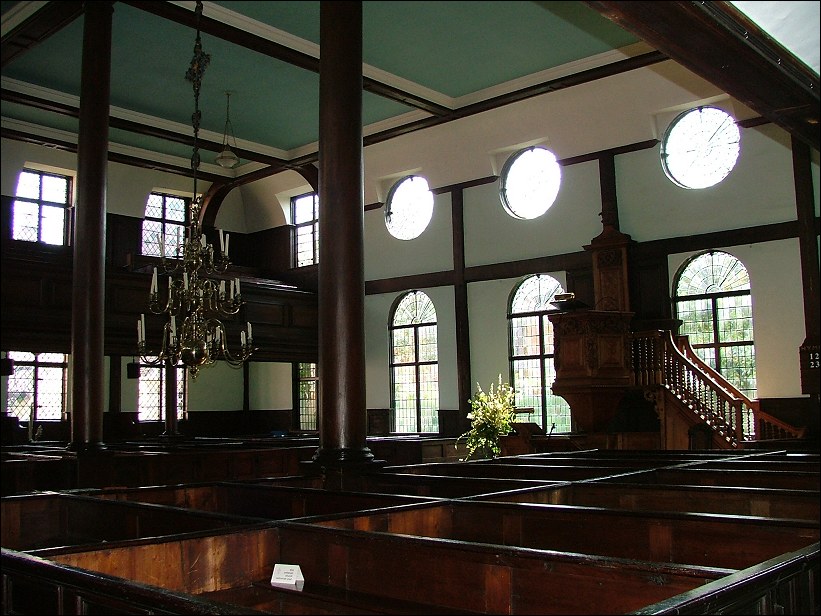
Ipswich Unitarian Meeting House

This sermon was given as part of an interfaith service organised by Suffolk Liberal Jewish Community, and held in the town’s beautiful Unitarian Meeting House. After the service, an Anglican minister pointed out that I had not made clear that current Christian doctrine had tried to rid itself of its supersessionist ideology. I think it is important to note that much of the work challenging offensive ideas in Christianity has been done by Christians themselves, especially by Catholics at Vatican II. I am grateful to him for this constructive feedback.