Everything has changed. Everything keeps changing.
We meet tonight to pause.
Tonight is a return to a definite, reliable point in the calendar. While the world spins on outside, for a brief moment, we stop. We reflect. We take stock of all that has changed, so that we might change too.
You have already seen this evening many simanim – symbols of the Rosh Hashanah seder. These small tokens speak to us about what the festival means.
There is another one, though, that you won’t see here, partly because our synagogue is a meat-free site, and partly because it just would not feel right in a Liberal synagogue.
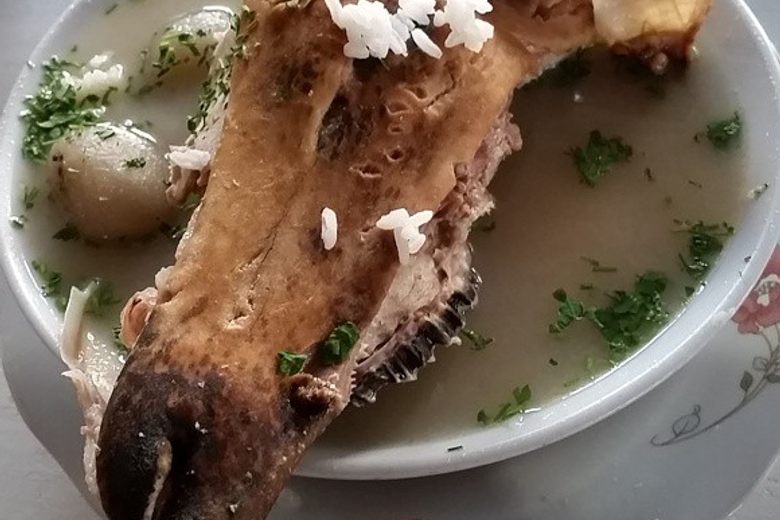
It is a ram’s head.
Yes, in many New Year seders throughout the centuries, Jews would place the carcass of a sheep’s skull in the centre of the table. This tradition goes all the way back to 9th Century Babylonia.
By the 15th Century, the German rabbi, the Maharil, explained the custom using a phrase from the Psalms:
שנהיה לראש ולא לזנב
– that we should be the head and not the tail.
There is a play-on-words here. After all, what does Rosh Hashanah literally mean?
The Rosh is the head. It is the head as in the beginning; it is the head as in the body part; and it is the head as in the one who has control.
This symbolism works because, in Hebrew, a word contains multiple meanings and associations.
So, the fish head represents our being on top of our own lives.
Now, what about hashanah? The word shanah does indeed mean year, but its root ש-נ-ה also means cycle, difference, repetition, or change.
This makes sense: a year is a cycle, a return point that we repeat, each time observing the change.
So Rosh Hashanah does mean “start of the year.” But, through the associations with the words’ other meanings, Rosh Hashanah is also “the master of change.”
Outside of these walls, the world is full of changes. AI unleashes new technology into a society that has already been completely transformed by the Internet. Our climate is changing, and we are truly starting to notice its effects on our own seasons.
International relations are changing: violence, war, and fear feel like a new normal. And, of course, we are only a few years out of global pandemic and lockdowns.
So, at this juncture, we return to the start, and try to find a small oasis of calm to reflect on this changing world.
Yet, inside these walls, things have changed too. This is my first High Holy Days with you. This is your first High Holy Days in the newly refurbished sanctuary. This is our first High Holy Days where we have voted to join a new movement.
This is our first time doing the High Holy Days without the choir in every service and, as you will see, that means we are changing how we do music.
In every case, these changes will evoke many feelings, including excitement, trepidation, loss, and growth. This is a chance to face all our feelings.
Change is inevitable. Change can be good. And, yes, change is hard.
I don’t know about you, but I have changed. I have not just grown a year older since the last Rosh Hashanah. I also feel like I have aged many decades in the last few years.
The world transforms and I shift with it. As I shift, I do not even always notice the ways I change, or work out what they mean.
I don’t even have time to decide if I like who I am becoming before I find that things changing again.
So, at Rosh Hashanah I come to this space, this synagogue, this everlasting home with God, and ask: can I love myself better? Can I love my community? Can I muster up the strength to face all that is changing?
Can I find a way to be the head and not the tail?
Blessed are You, Eternal One our God, who gives us the power to change.
There are some places in this world that fill me up with an awe of creation more than anywhere else can. Places so beautiful they make me wonder why they exist.
The Scottish Highlands are such a place. Those mountain landscapes are cragged rocks and stark hills stitched together by seas and tarns and smaller rock pools. They are peat bogs and waterfalls growing shrubs and trees, so full of life it feels as though they are themselves breathing.
This year, I went to visit them. With my partner, we walked through the hills, saw old churches, visited a beloved rabbinic mentor, and witnessed the birds and wildlife.
In between completing my dissertation and getting ordained as a rabbi, I decided to make a pilgrimage to mark the transition. It truly felt like a religious moment; a chance to draw closer to something sacred.
As we walked, we met with a land that was part of our country but felt decidedly foreign, and we met myths that, while part of our heritage, seemed alien.
For the Gaelic-speaking peoples of Scotland and Ireland, these landscapes have their own origin story.
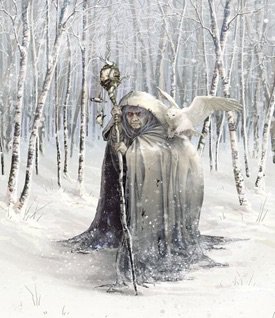
Those mountains are no accident. They were built intentionally, but a type of deity called Cailleach. Known also as Beira, or the Queen of Winter, she is an aged crone; one-eyed and completely white.
She battles spring each year to reign her icy dominion over this hemisphere. She is a deer-herder, a lumberjack, and a warrior. She carries in her hand a great hammer as she strides across the Celtic Isles. She is the mother-goddess.
It was Cailleach who built the Highlands. She pulled rocks out of the sea and carved out stepping stones for her giant strides. She pushed through the space, breaking up new mountain faces with her hammer. She walked as winter through the new landscape she had made, and allowed waters to flow and overflow in every crevice.
I was enamoured by this story. Yes, that is what it looks like. It looks like an enormous witch has made it. It feels bursting with purpose.
My boyfriend prefers another version. He is a scientist, a doctor. We see the same world but through different lenses.
Millions of years ago, he read, the earth endured an ice age. Frozen water cut through the earth and wore down the ancient mineral rocks at a glacial pace. When the waters finally thawed, they left behind these precipices and pastures on the Scottish coastlines.
But isn’t that just the same story, told in a different way? Cailleach is simply an anthropomorphic ice current. The processes attributed to gods and fairies – that breaking and carving and flooding – are repackaged in scientific language. The scientists can give us approximate dates and name when the layers of sediment formed, but they are effectively telling the same story.
What difference does it make whether these wells were made by frozen currents or by the Wild Woman of Winter?
It is not fair to say that one is rational and the other is mythical. Both accounts are testament to humanity’s ability to understand its surroundings. The story of Cailleach is no less important a contribution, and we cannot just dismiss it.
Equally, we cannot treat the national myth in the same way as we would our best scientific discoveries. They are not equally weighted as theories about how the earth was formed. Centuries of technological advancement and detailed research have given us this account of the Highland’s foundations.
The difference between these stories is not whether they tell us something true, but what kind of truth they point us to. The scientific explanation tells us the history of the world in context of great geological events. It teaches us how to identify, exploit or protect the natural surroundings we have inherited.
The story of Cailleach, by contrast, tells us about the unquantifiable truths of the Highlands: the awe they inspire; the magic they seem to hold. It teaches us about the shared national destiny of the Scottish, Irish, and Manx people who tell her story.
These are not competing, but complementary, stories of creation. One tells us the truth of how a place was made, the other tells us why.
At this time of year, we turn to our own national myth and origin story. Our new year recalls the creation of the world. It is a day for us to delight in the fact that we are alive.
The biblical account of creation does not only explain the origins of one geological formation, but seeks to tell the genesis of the entire world.
5,783 years ago, the world was made in six days, from explosive dividing light, through land and seas and atmosphere, through to sea creatures, winged beasts, mammals, and human beings.
It is no good to compare this religious tradition with the theories of the Big Bang or evolution through natural selection. They are telling the story of the same thing, but from totally different perspectives.
Science attempts to understand how the world was made; our myths ask us why.
The first chapter of Genesis suggests some reasons. The world was created with great purpose. Each day, with everything that God created, God saw that it was good.
When God created humanity, God gave us responsibility for the earth and what is in it. God gave us companions and promised us regular rest. God created the world for goodness, with humanity at heart.
The scientist and the theologian alike look at the world with a sense of wonder. We both feel awe as we track their stars in their orbit. We both marvel at the fact that a planet has produced the perfect conditions for life to form and grow entire ecosystems to sustain myriads of plants and creatures.
On this we agree.
The difference is that, for the believer, we do not just gaze in awe. Awe gazes back at us.
You are not just amazed at the world, but the world is amazed by you.
Not just the parts of you that you share in common with all other living beings, but those things that are unique to you.
Not just the fact that you have functioning organs and limbs, but you. That transcendental, magical part of you. We might call it personality or soul or neshama.
It is not something mechanical or quantifiable. There is something about you that is wonderful and irreplaceable.
That is you.
When we are confronted with the wonder and beauty of the world in which we live, we are tempted to ask what it is all here for. The answer of Judaism is that it is here for you.
To the religious imagination, your life is not an accident. It is a blessing. You were created for the sake of the world and the world was created for the sake of you.
According to our Torah, at first creation, God wandered round to take in the Garden of Eden in the cool of day. And, there, God called out to the first human being: “Where are you?” God was looking for the human.
The great Jewish philosopher, Martin Buber, understood that this question is addressed to every human being in every age. We, too, are forever hiding, behind the stories we tell ourselves that our lives are meaningless and our actions matter little. We find ways to try and escape truth, even to hide from ourselves.
And God, that great Source of amazement, nevertheless seeks us out, asking “where are you?”
So, Buber says, you have to answer that question. You have to seek deep inside your soul and answer who you really are. You have to try and give an account of what you are doing on this earth. You have to make yourself present, ready to face Truth, and, crucially, to change.
Where are you?
You are on this beautiful earth, crafted by a magnificent Creator. You are here and alive. You are a miracle.
God is amazed at how wonderful you are.
And now you have to show that God’s faith is rightly placed.
 Sim Lev