debate · sermon · torah

Did the God of the Bible have a body?


After our wedding, everyone was excitedly sharing photos and videos. Laurence pored over them and made albums.

I liked them, but the pictures felt a bit flat. What I was craving was words.

I wanted to re-read everything everyone had said. I went about collecting the speeches people had given, and recounted them again. On honeymoon, Laurence and I re-read our vows to each other, this time pausing and discussing them.

I discovered anew how much more I loved words than pictures or videos. Pictures are static. Even videos, because they only caption one moment from one perspective, feel too final.

To me, words feel so much more alive. Stories are such a great way to engage with events and ideas, because they can be retold so many times and in different ways.

Isn’t this, after all, what religion is: storytelling to access something sublime and unfathomable; a collaboration by people sharing their best narratives and ideas?

We have inherited a literary tradition, our Torah, which is an exercise in storytelling:  a process of openly wondering at the world through poetic sagas and emotion-filled songs.

For some, however, these stories fall flat. They see the words the way that I see pictures.

Fundamentalists will look at our story of a donkey talking to a prophet about an angel and think: that must be the historical truth of what happened.

Similarly, the New Atheists look at this beautiful poetic piece about the prophet Balaam and think: how stupid must religious people be to believe this nonsense?

This is not just a misunderstanding of Scripture. It’s a misunderstanding of storytelling itself.

Seemingly, it does not occur to them that this might be an invitation into conversation. They can’t comprehend that this might be a poem, crying out to be read aloud, sung, chanted, interpreted, and retold to make sense of all the wonders of the world.

Perhaps these talking animals and sword-wielding celestial beings aren’t part of history textbooks but reveal a different kind of truth altogether.

In Britain, we are mercifully spared from most of these types of fundamentalist reading. We don’t have to deal with as many evangelical Christians as our American cousins do.

But we have our own local brand of biblical literalists. They are the radical atheists who have got to know our sacred texts solely for the purpose of showing how irrational they are. The most famous of them is Professor Francesca Stavrakopoulou, a biblical scholar at the University of Exeter.

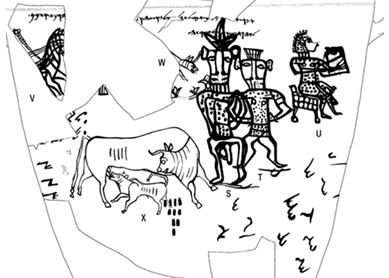
In 2021, Stavrakopoulou brought out her most recent work, God: An Anatomy. The book’s objective is to show that the God of the Bible was an embodied being. He was a gargantuan man with a big beard who sat on his throne in the Jerusalem Temple, gobbling up the sacrifices priests burned for Him.

The God of the Bible, Stavrakopoulou argues, was just like any other ancient god: basically a massive person with all the associated wants and desires. She collapses about 4,000 years of history and three continents into one culture and seeks to show that the biblical god was just like all the others.

And, like all the others, the biblical god had a body.

Sometimes, her evidence for this scant. There are entire pages dedicated to making quite wild claims about the biblical god, appended with just one footnote that points to an obscure translation of a verse from the Psalms.

But, overall, there is plenty of material to go off. If you open up any page of Tanach, you will probably find God described in anthropomorphic terms.

Take our haftarah.

This week’s reading comes from the book of Habakkuk, a 6th Century BCE Prophet in Judah. The book is a vivid war fantasy, where the prophet describes the Judahites crushing the invading armies, some time in the mythic past, and hopes that it will happen again.

Throughout the text, God comes alive as a warrior. He (and I’m going to use the masculine pronoun advisedly here) is an embodied fighter on behalf of the people.

God’s hand lights up with radiance; God’s feet trample over mountains; God’s piercing eyes make the nations trembled with fear. 

God has all the equipment of an ancient military commander. He rides in on a chariot  with His horses and shoots out arrows from His archer’s bow. God rips the spear from the opposing general’s arm and stabs it into his head.

How are we supposed to read this?

Well, for a biblical literalist, you have to take it at face value. That’s exactly what Stavrakopoulou does. She makes the case that this was precisely how the ancient biblical authors and audience understood their god.

Their god was a big bloke with some massive weapons and blood lust.

Stavrakopoulou draws on other ancient gods, whose worshippers also describe them in embodied terms. The Canaanite high god El also had radiant arms. The Akkadian god Enki also trampled over mountains. The Assyrian god Ashur also fought with a bow.

The Israelites, then, were just riffing on old themes. Like the Pagans around them, they were silly enough to believe in all that religious nonsense of big beings. The biblical god was no different to Zeus or Jupiter.

Overall, reading Stavrakopoulou, you get the impression of someone listening to a concerto who can identify every note from every instrument but cannot hear the music. Her entire objective is to show that the tune isn’t even that good because other songs have been written before.

All the way through, it seems like a strange motivation for going to all the effort of learning Scripture and Ancient Near Eastern texts. Then, we get to the final chapter, entitled “Autopsy,” and we understand her true objectives.

She concludes: “the God of the Bible looks nothing like the deity disected and dismissed by modern atheism. […] Their dead deity is a post-biblical hybrid being, a disembodied, science-free Artificial Intelligence, assembled over two thousand years from selected scraps of ancient Jewish mysticism, Greek philosophy, Christian doctrine, Protestant iconoclasm and European colonialism. In the contemporary age, this composite being has become a god who forgot to create dinosaurs and failed to account for evolution; a god who allows cancer to kill children but hates abortion…”

Stavrakopoulou despises religious belief. So, if she can demonstrate that the biblical god was just like the Egyptian pantheon, and that this embodied god could be killed, then she can also strip the modern god of His powers and kill Him too.

This is the worst of Enlightenment hubris. 19th-century anti-religionists imagined that all religion was just silly superstition, which would eventually be washed away by the cold science of reason.

Our movement, like all progressive religions, has consistently argued for an alternative approach. We see all of history as an evolving effort to understand the sacred mystery beyond our comprehension.

It almost certainly is true that, before Ezra led the exiles back from Babylonian captivity in the 4th Century BCE, most Israelites did worship a small pantheon of Canaanite deities. The Prophets from before this time regularly condemn them for it.

But, while they may have been idolaters, they were not idiots.

If you told one of them that you’d just seen the fertility goddess Asherah out for a stroll in the marketplace, or that the storm god Baal came to your house this morning for a cup of tea, they would think something was wrong with you.

Another scholar of ancient religion, Iraqi Assyriologist Zainab Bahrani, helps us make sense of the ancient worldview. For the Mesopotamians, images were not reproductions of originals like portraits and photographs are for us today.

Instead, they saw their icons as ways of writing existence into being. They were in an active process with their gods of creating reality.

In matters of religion, literal interpretations are dead-ends. Words like metaphor don’t do it justice. Symbols like clay deities stand in for whole cosmologies. They are ways that human beings have tried to understand something that, by definition, is beyond our comprehension.

Perhaps most importantly, Stavrakopoulou misses what a massive departure it was that ancient Israelites abandoned all images in favour of a predominantly literary culture.

In a society where you cannot depict God, but can only engage in description and storytelling, you have to be more imaginative when you try to make sense of infinity.

Poems, sagas, and speeches, like those from our Tanach, are never fixed in their meaning. They are openings that invite listeners to think with them, talk back to them, and struggle for deeper understandings.

When someone reads a text too literally, they strip it of its vitality. Atheists and fundamentalists, both literalists of different kinds, strip the soul from the search for divine truth.

Tell stories, make poems, create art, look for that great truth beyond our reach… and don’t take any of it too seriously.
judaism · ritual · spirituality

Wrap your body in prayers

Most of the time, when I’m experiencing something emotional, I feel it in my body before I can even process it. 

I’ll feel a sinking in my stomach and know I’m dealing with dread. I’ll wake up grinding my teeth and realise I must be anxious. I go to bed feeling full of life and visceral feel my joy.

Every emotion is a physical experience. It is not just something we can rationally understand.

In Biblical Hebrew, if you want to say that you are angry, you say that your nose flares. If you are compassionate, you are womb-ful. If you are sad, you rip your hair. If you are lustful, you are big-balled. If you feel respect and awe, that’s in your liver.

In the biblical imagination, the body is a map of all the emotions we might feel. Each limb and organ corresponds to the full range of affective experience. 

We must bear this in mind when we come to read this week’s parashah and its resultant commandments:

Put these words that I command you today on your heart… Wrap them as signs on your arms. Bind them in front of your eyes. 

The words are recited daily by the most observant Jews. They form part of the first paragraph of the Shema, Judaism’s central prayer. 

The Shema begins with an instruction to listen; to pay attention. Hear, O Israel, the Eternal One is our God. The Eternal God is One. 

It then tells us the embodied experiences we must have to make sense of what we are hearing. Heart. Arms. Eyes. 

Of course, these carry metaphorical meanings. For the ancient Israelites, the heart was the seat of thinking, much in the same way as we consider the brain in the modern West. When Torah tells us to keep it on our hearts, it means that it should be part of our whole intellectual being.

The arm is the site of action. It is synonymous with power. The arm is what gives to charity and shields the vulnerable. It is also the body part that raises swords and strikes stones. With an outstretched arm, God redeemed the Israelites from Egypt. The instruction to keep God’s word on our arms is a call to use our power for God.

Eyes, for the Hebrews, are for desiring. Your eyes can wander after foreign gods. They can delight at the wonders of nature. They can covet things that aren’t yours. They can favour children. The Eternal’s eye is always on those who have hope and mercy. If the commandments are frontlets before your eyes, enacting them as all you want to do. You are singularly focused on doing good deeds. 

Over time, our ancestors came to see these words as more than just symbols. Rabbi Akiva, the Mishnah’s great thinker on metaphor and interpretation, is credited with codifying the rules for tefillin.

Tefillin are compartmentalised boxes affixed to leather straps. You can see people wear them wrapped around their heads and arms in weekday morning prayers. 

These prayer aides were invented so that observant Jews could literally enact the commandment of binding the words on the body. Inside the boxes are the words of the Shema. Cheder children tell me they look like Go-Pros.

Carefully, we tie them to our arms, close by our heart. We wrap the leather straps around our arms, seven times. We place them as a crown around our heads, settled between our eyes. We finish up by plotting the straps around our fingers and palms in a set pattern.

If ever you come to Leo Baeck College’s shacharit services, you will see a bunch of students and teachers adorned in them. 

If the founders of the College and its movements could see us, they would be aghast. For many of the originators of our movement, such embodied practices were strange and arcane. 

Progressive Judaism was a response to the Enlightenment. Across Europe, people heralded the triumph of science and reason. Ideas, not feelings, were paramount. Rational thought, not embodied emotion, would be what guided humanity to greatness. 

Reforming rabbis of the past called the practice of bending knees in prayer “bowing and scraping.” They saw their Orthodox contemporaries’ kissing the scroll as a form of idolatry. Above all, they certainly never wore tefillin. 

When, in my early 20s, I asked my dad for a tefillin set for an upcoming birthday, he raised an eyebrow. “Isn’t that an Orthodox thing?” he asked. We didn’t talk much about the theology, but I told him I liked the idea of it, and he got me a beautiful pair.

In a way, he was right. Tefillin were an Orthodox thing. But, over time, progressive Jews have reclaimed them and made them our own. 

Reason is still deeply important. We still hold to the importance of modern scientific inquiry and rational debate. It’s just that we can no longer isolate what goes on in our bodies from what goes on in our brains. 

Living with chronic pain, I see daily how intertwined are my spine and my spirit. Every part of my mental and physical health is connected. I would struggle to draw a line between my body and my ‘self,’ and can’t really comprehend their separateness. 

This is just as true in prayer. So I wrap tefillin. I feel my religious inclinations before I can process them. 

I’ll stick a box on my left bicep and know that my body is part of the miracle of creation. I wrap it around my arms and I am bound by God, submitting to the commandments. I set the straps over my head and feel the weight of responsibility. I rest the box before my eyes and see what I have to do. I tangle the knots around my fingers as if I am being married and I am overwhelmed by the loving gift of a new day.

I wrap my body in prayers. I can work out what they mean later. 

I wrote this sermon for Leo Baeck College’s newsletter, Parashat Vaetchanan

judaism · ritual · spirituality

Sacred skinny-dipping

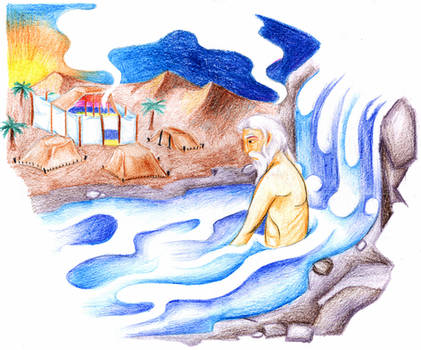
It was midsummer in a basin in the Welsh valleys. I found myself completely naked with a friend in a lukewarm tub of rainwater. We were supposed to wait for it to properly heat up over the log fire, but I was in a hurry to go from teaching Torah there to preaching in north-west London. The sunshine compensated for us. 

All around there were huge green trees, rolling hills, a babbling brook. Hippies not far away chanted in Hebrew while banging on drums.

“OK,” I said. “Now what do I do?”

“So I’m going to tell you my practice,” she said, “but you can come up with your own.”

Her practice, I later discovered, was the same one as you would find Orthodox Jews performing on Friday afternoons, as sanctioned by rabbis and law books. She had a way of making every tradition feel New Age.

She dunked fully underwater three times, twice emerging to recite a prayer.

Al hatvilah – thank you, God, for making me holy by commanding me in immersion.

Shehechiyanu- thank you, God, for keeping me alive to see this day.

On the third dip, she came up, smiled and said: “That’s all there is to it.”

I copied her every move. And that was it: my first mikveh.

I had previously associated this ritual with Orthodox women washing off the ritual impurity associated with menstruation. It had seemed to me outdated and misogynistic. 

The only other people I knew of who did it were converts, undergoing a form of Jewish baptism to initiate them into the religion. I had thought, cynically, that these new Jews were washing off the goy.

But here was my teacher, Yael Tischler, far more radical than I was in terms of religious innovation and transgressive liturgy; a witchy feminist affiliated to the Kohenet movement in America – a bohemian collective for women-centred spirituality. 

With her, the act of immersion didn’t feel problematic. It felt like my whole body was wrapped up in Jewish history. It felt connected to the earthy, fleshy customs of long-gone ancestors.

This was strange, because I know that none of my recent ancestors would have done such a thing. Liberal Jews were, by and large, decidedly opposed to many embodied rituals. 

Like their reforming Christian counterparts, many of the early Progressive Jews felt that religion should be a matter of intellectual faith. It should be stripped down to its essential meanings, devoid of excessive piety or symbols. 

In the great platforms decreed from Germany and the USA, Reform Jews repudiated circumcision, abandoned kashrut and denounced tallits. They ridiculed shockeling, the Eastern Ashkenazi prayer movements, as “bowing and scraping.” One British Liberal rabbi called kippot “the eccentric trappings of the Orient.”

As you can imagine, mikvaot did not get much of a look-in. For decades, ritual immersion was not a requisite part of conversion at the Reform beit din. Today, very few progressive Jews will attend the mikveh before their wedding. It is almost unheard of that a progressive Jew will have a regular toiveling practice as the Orthodox do.

This week’s parashah probably provides a good explanation as to why progressives are so uncomfortable with it. This week, we read Tazria-Metzora, a portion dedicated to defiling skin diseases, leprous houses, sexual infections and menstrual impurity. 

To escape the uncleanness that falls upon people by contact with these things, ancient Israelites would ritually immerse in a mikveh. The Torah describes mayyim chayyim – running water – in which people would wash themselves. We know that in the period after the Great Exile, the mikveh was likely an enormous bath at the entrance to the Second Temple. 

In the biblical world, the mikveh does seem troubling. It exists for a people obsessed by physical purity, who want to remove their blemishes before they enter sacred spaces. I would not feel comfortable advocating immersion to congregants on the grounds that their bodies are unclean and carry associations of sin. 

But my teacher, Rabbi Debbie Young Somers, argues that our rabbis fundamentally transformed what mikveh meant. She did her rabbinic thesis on mikvaot and has taught about their virtues in numerous study sessions. When I asked her for sources for this sermon, she immediately sent me detailed source sheets and tweeted her glee that the subject matter was being discussed in our synagogue. 

Impurity, Rabbi Debbie argues, is not the same as defilement for the rabbis. It is what happens when you come close to something holy. Touching religious texts, having sex, giving birth and changing to a more holy status, are acts that require immersion. Faeces, urine and vomit, which are more obviously disgusting, do not require any religious ritual. When we wash ourselves, we are not scrubbing away sinful dirt, but acknowledging sacred contagion.

In a post-Temple world, nobody can be clean or unclean. The mechanisms for such processes are gone and the need to do so – so that one might perform an animal sacrifice in the correct state – thankfully no longer exists. 

The Talmud records that, nevertheless, Jewish women took the obligation of ritual immersion upon themselves. It was a choice that antique ancestresses made as part of their covenant with God. When they did, the rabbis largely trusted women to self-regulate and organise their own mikvaot. It might well be that they already had very little authority over this aspect of life.

Today, feminists are returning to these practices. Led mostly by religious women, efforts to reclaim the mikveh are popping up all over the world. Scholars and lay people are extolling the virtues of immersion for both men and women.

People take these ritual baths before life-changing events, like trying for a baby, getting married, starting a new job and completing a course of study. They also use the mikveh to process life’s trials, like miscarriage, recovery from illness, divorce and redundancy. 

That was how I ended up, a few summers ago, doing sacred skinny dipping in the countryside. I am now convinced that it is a deeply moving spiritual practice, and I commend it to anyone who is interested. 

The Sternberg Centre in North London has a functioning mikveh. There is also a programme underway called the Wellspring Project, which hopes to soon create a mikveh-oriented wellbeing centre. In Manchester, the new building for Jackson’s Row is planned to have a mikveh.

And the wonderful thing about mikveh is that you don’t have to travel far to do it. You can toivel in any naturally occurring water, like seas, lakes and rivers. Just turn up, jump in, and dip your head underwater. 

And thank God for the commandments. 

And thank God for your body.

And thank God you’re alive.

And thank God that we can take these ancient practices and make them our own.

I gave this sermon on Shabbat 17 April 2021 for Parashat Tazria-Metzora at Newcastle Reform Synagogue