climate change · sermon

This world could just as easily be wonderful


In the time that we are alive on this earth, it could burn in front of us. There could be droughts and famines and wildfires and pandemics of deadly diseases.

But. In the time that we are alive on this earth, it could be transformed into a paradise. The planet could become run entirely on renewable energy, with enough food for everyone, where everything that lives could have all its needs met.

Within our lifetimes, we could once more see a resurgence of fascism, racist nationalism, and global war. We might see once more the increased subjugation of women and the rise of bigoted intolerance.

But. Within our lifetimes, we might be the first generation to witness world peace. We might see a new flourishing of tolerance and inclusion. We might live in a society without inequality, where the rights of all are respected.

Why is it so much easier to imagine disaster than success? Why do we allow our imaginations to deprive us of the possibilities of a better world?

Sure, this world could be horrible. But it could just as easily be wonderful.

What world will our children inherit?

Will it be the burning dystopia that feels so present, or the perfected society that seems so distant?

The Prophet Isaiah was not sure either.

In the build-up to the High Holy Days, we read haftarot from the Prophet Isaiah. The lectionary cycle offered us three readings of warnings and six of comfort. That great leader of ancient Israel struck fear into our hearts with threats of how horrible the future might be. Then he promised us solace with visions of how wonderful life could be. Which should we believe?

In one of his prophecies, Isaiah warns that the coming world will be “a cruel day, with wrath and fierce anger—to make the land desolate and destroy the sinners within it.” He forewarns of unending darkness and exile and terror. He offers no remedy. He tells us that everyone will go to war against each other, that every neighbour will become the other’s oppressor, and nobody will win.

Yet elsewhere, Isaiah envisions a redeemed world, in which the poor see justice, and wolves lie with lambs, and refugees find home, and people beat their swords into ploughshares and no nation goes to war any more.

Isaiah holds two visions in the balance. One of hope and one of fear.

Perhaps we might say that this is the same vision seen from different perspectives: that what would be wondrous for some would seem disastrous for others. That justice for the poor would feel like tragedy to the rich. That the end of war for its victims would be calamity for its profiteers.

But that doesn’t seem plausible. Surely, there will either be outright war or there will be none? Justice may be subjective, but conflict over resources is a fact. Either everyone will have all they need or all humanity will battle fir scraps.

You might say: perhaps these prophecies were given at different points in Isaiah’s life? The historical critics argue that the book of Isaiah in fact had three different authors, all writing in different periods.

But this still doesn’t explain the discrepancy. Within even the same chapter and verse, Isaiah oscillates between dream and nightmare, holding both possibilities in contrast.

The contradiction only exists if you imagine prophets as fore-tellers of a pre-ordained history. The Jewish tradition has tended to see them instead as forth-tellers: bringing God’s word to show what might be possible.

In this week’s haftarah, Isaiah promises both together. Isaiah talks about vengeance and redemption.

Isaiah is showing us the two ways in which humanity might go, and leaving open both options. This world might be brought to its end by disaster. But it could be wonderful too.

The fear of what this world might be can sometimes keep me up at night. I think of unfolding climate catastrophes, with floods and wildfires already engulfing parts of the globe. I see escalating wars between major powers in multiple countries. I hear the rhetoric from political leaders, ramping up racism, xenophobia, sexism and transphobia. And Isaiah’s nightmares do not seem so distant.

But I am trying to rejig my perspective. There is nothing radical or interesting about pessimism. Misery is easy. It is the default for minds accustomed to defeat, prone to anticipate worst case scenarios.

But hope. Hope is harder. Hope demands far more imagination as we expand our horizons of the possible. If we have hope, we cannot give in to how things are. Hope demands of us action.

Recently, I have found reason to hope in fiction. There is a wealth of writing by Jewish eco-futurists, who create worlds set in the not-too-distant future. Instead of the dystopias imagined by 20th Century writers like Orwell and Huxley, they ask a much bolder question: what if we made it right? What would the world look like if, instead of accepting the inevitability of defeat, we projected winning?

A few years ago, TV star and beloved Essex Jew, Simon Amstell, made a film imagining a world fifty years in the future. In it, the whole world is engaged in a truth and reconciliation process, as elders try to explain to the young where they went wrong and how they rebuilt. The new world is idyllic, and all that had to happen, says Amstell, is that everyone stopped eating meat.

The film, called Carnage, is clearly satirical, and takes a self-referential jibe at preachy vegans. But it also posits something intuitively true and beautiful: a better world than this one could be possible with very small changes.

Over the summer, I have been reading the solar-punk fiction of author Sim Kern. Their works imagine alternative worlds to this one. In their major book, ‘Depart Depart’ a dybbuk haunts a Jewish youth as he makes his way through a world ravaged by climate catastrophe. Yet, in more recent works, Kern imagines alternative worlds in which humanity made steps towards addressing these disasters. Imperfect, true, and still full of tension – otherwise there would be no story – but they still pitch another reality. And inhabiting those fictional worlds has helped me realise how real they could be.

Enough with pessimism.

Sure, this world could be horrible. But it could just as easily be wonderful.

Let’s make it so.

climate change · high holy days

Another trip around our fragile planet


This year, Richard Branson saw the planet from a completely different angle. The owner of Virgin was on board a rocket and saw the Earth as it appears from space.

It must have been incredible. The globe with its big blue oceans and grey-green continents, set against the great dark expanse of our solar system. 

I have always associated that image with Rosh Hashanah. I remember being in cheder as a child, drawing out the world like this in crayon.

“This festival is the birthday of the world,” I learned. 

We celebrate the world’s creation and another trip around the sun. According to rabbinic tradition, the Earth is now approaching the ripe old age of 5782. Mazal tov!

Our ancestors may not have known that the world was, in fact, billions of years old. They probably did not even realise that it is, as Branson would have seen, spherical and rotating on its own axis. 

But they understood something deeply important. This planet is a gift from God. It is a sacred place, existing in an improbable balance that allows the perfect conditions for life. It is filled with more animals and plants than we will ever be able to name. As the Psalmist declared: “How manifold are your works, Eternal One!” 

At the Jewish New Year, we celebrate creation and our place within it. We thank God for the bees that made us honey and the trees that bore us apples. We count another year when God placed human beings in a perfect garden and charged us with caring for it.

What Richard Branson might not have seen from all the way up there was how delicate this planet really is. Once again, we experienced our hottest summer on record, where wildfires spread across the western coast of North America. Some congregants at my synagogue in Essex lost their homes to flooding, as sudden thunderstorms struck. 

Our climate is rapidly changing. We have witnessed snowstorms in Texas and flash floods in China and Germany. Whole swathes of the Amazon rainforest have been destroyed. Parts of the Great Barrier Reef in Australia have died from sun bleaching, leaving ocean graveyards behind.

Experts warn that melting polar ice caps and close contact with cattle will mean even more deadly pandemics.

The midrash on Genesis teaches that God took Adam and Eve around Eden, showing them every living thing . “Look after this world and care for it,” said the Holy One. “For if you destroy this world, there will be nobody after you to repair it.”

Now look at this world. Are we not in danger of ruining it? As it stands, the planet is being consumed by a few, while the many are exploited, in a way that could destroy us all.

We cannot separate Richard Branson’s trip into space from the unfolding ecological disaster. Every rocket launch emits one hundred times more greenhouse gases than a single flight on an aeroplane. 

Right now, Branson is engaged in a battle with other billionaires for who can most colonise the atmosphere. Other heads of corporations, including Jeff Bezos and Elon Musk are engaged in a space race. They want to project themselves furthest away from this planet and create an entire industry charging others for the same privilege. 

I do not want to see the world from space if I cannot live in it. I certainly do not want only a covetous few to explore space if it means they leave a burning planet behind for the rest of us.

This earth cannot have been given by God only so that a wealthy few could enjoy seeing it, but that every one of us could live in it and marvel at its wonders.

It doesn’t have to be this way. The last year has shown us how fragile the planet is. But it has also shown us how adaptable human beings are. 

We know how caring and supportive people have been to each other throughout the last year’s difficulties. The Jewish community has shown the very best of itself in its mutual aid and compassion for our most vulnerable members. 

Incredibly, we have also seen a vaccine developed, approved, and distributed in record time. Everyone across the community has rallied to take up the offer of protecting themselves and others. 

We have the power to send people into space and cure diseases. Through hard work, cooperation, and creativity, humanity has already shown it can face off its greatest challenges.  

As Progressive Jews, we talk often about the importance of “tikkun olam”: healing the world. We have a sacred duty to preserve and perfect the planet. 

The energy and investment that has gone into space programmes could support the development of new green technologies and a just transition to a sustainable future. 

Across the country and the world, campaigners are pushing us to rethink our entire economy. They urge governments of the world to invest in jobs, resources and renewable energy. It is not too late to defeat climate change, even as it arrives on our own doorstep.

We can have clean air and clean waters; a flourishing planet for our children to grow up.

If it is possible to see the world from space, it must also be possible to save it.

This year, let us rise to the challenge.

Shanah tovah.

judaism · liturgy · sermon

Pray for the right kind of rain

Every day, we pray for the right kind of rain. 

The Amidah praises God’s holiness and dominion over the natural world. 

We change how we address God in rhythm with the seasons. In the summer, we thank God for making dew descend. in the winter, for bringing on heavy rains. 

For us living in cities, we can feel quite disconnected from how important this water cycle is. I only catch snippets of how it causes concern. A radio broadcast says British farmers are worried that there hasn’t been enough frost in January. In a supermarket, a cashier tells me there is a shortage of aubergines because there wasn’t enough rain in Portugal this year. 

The cycle of the right rains affects whether we have enough to eat. It can mean the difference between living safely and losing everything. There is a reason the greatest catastrophe our ancestors could imagine was a flood.

This week, we gained a sense of how important and delicate the rain cycle is. 

At the start of the week, I was heading back from a holiday in the Lake District. It was searing hot. The hottest summer we’ve ever had, people kept saying. As I climbed mountains, normally soft moss felt like dry straw under my hands. The shops had stopped selling barbecues and matches. 

Everyone said that the slightest spark could set the whole forest on fire. We would wind up like California or the Amazon, with acres burnt to a crisp. Thankfully, it didn’t happen, but I left with an awareness of the forests’ fragility and a deep concern that England was not ready for climate catastrophe. 

Only days later, I came back to intense flooding. The rains fell intensely, relentlessly. I thanked God that I was safe inside as the skies turned black and stayed that way for what seemed like days. The area around our synagogue was drenched. Charlie Brown’s roundabout flooded again. Some in this community saw damage to their property. Members of our synagogue were displaced: moved initially to the higher floor of the care home, then relocated. 

I was taken aback by how well our care team took to handling the crisis. Claire, Sue, Debz and others made sure everyone who might be affected received calls, and that anyone who needed help got it. They showed the very best of what this synagogue is for. 

But I was most impressed by the bnei mitzvah students I met this week. Jacob and Layla, twins, are preparing to come of age around Pesach, at the time when we stop praying for heavy winter rains and start celebrating the gentle dew. I asked them what they want to be when they grow up. Jacob wants to be a primary school teacher. Layla says she wants to be an environmental activist.

I have to be honest. When I was Layla’s age, I had no idea campaigning could be a job. It is a testament to her curiosity and sense of justice that she has found this out.

But it is also a wake-up call of how dire things are with our environment that Layla has to think of this job. The problems we saw this week had many causes. We have a rapidly changing climate. Companies have over-consumed fossil fuels and spoiled the ecosystem. Developers have built on flood plains. Much of the development after the Olympics destroyed natural wetlands, worsening the situation. But all of these factors share a common problem: we have taken nature for granted.

In this week’s parashah, we read: 

If you listen, if you truly pay attention, the Eternal One your God will grant the right rains at the right times: autumn rain for autumn and spring rain for spring. You will be able to eat and so will your cattle. 

But you must guard yourself against a straying heart. If you serve other gods and bow down to them, God’s anger will blaze out against you. God will shut up the sky. There will be no rain.

This text might feel familiar. It is the second paragraph of the Shema, found on page 214 in your siddur for the Shabbat morning service. You may have read it before, but it’s unlikely you’ll have heard it read aloud in any service. 

It is the custom of this synagogue, and of all Reform synagogues, to read these verses in silence. So, why do we whisper it? 

One reason is that we are very uncomfortable with what is implied theologically here. It suggests that good things happen to good people and bad things to bad people. We know this isn’t true. The righteous suffer and the wicked prosper. Our rabbis knew long ago that there is no individual reward for good deeds in this life. So we won’t say it out loud when we have doubts about it.

But what if it is true? The warnings in these verses are not about how God might deal with individuals, but the impact of actions on entire groups of people. If you don’t pay attention to the ethics of Torah, you all can be destroyed. If you worship gods other than the Source of all creation, you will find yourself helpless before the forces of nature. Cause and effect. Action and consequence. 

In the biblical world, worshipping other gods meant turning to material things. Whereas the idol-worshippers bowed down to wood and stone, what marked out the ancient Israelites was that they only prayed to the transcendental God, who held all of nature in balance.

And that is what is happening in our world today. We are disregarding our ethical obligations to care for the planet, and we are seeing what happens. People have substituted the Eternal God for the material elilim of oil and gas. We have traded humility before nature for the arrogant belief that we can control and manipulate our environment without consequences. 

Now we are living the impact. We are dealing with the wrong rains. We are witnessing floods here, in China, in Germany, in New York, and in India. 

The Torah warns us: “Do not believe you have made all this with your own hands!”

We may have built cities and roads and bombs and planes, but we didn’t make the grass grow. We haven’t made the sun shine. It’s not us that makes the rains fall. 

All that is in the hands of a supreme Creator, who has charged us with protecting and sustaining this planet. We must hear, and truly pay attention, to that God, whose Word calls to us today. We must take up the challenge of replacing fossil fuels with renewable energy; of rebuilding our world in harmony with nature, rather than against it; of tackling carbon emissions and climate disaster. We must enable Layla to inherit a living planet so that she actually has something to protect.

We must act now. 

Shabbat shalom.

This sermon is for South West Essex and Settlement Reform Synagogue, 31 July, Parashat Eikev

climate change · protest · social justice · Uncategorized

Tzedakah annuls the evil decree

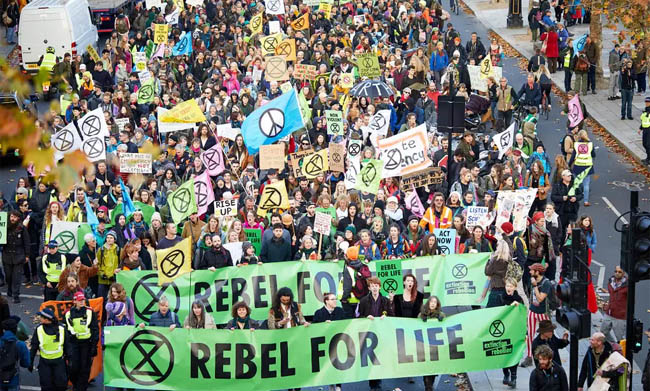
Tonight I will attend a protest against climate change in Parliament Square with Extinction Rebellion Jews. My speech for the demonstration is below.

Tzedakah annuls the evil decree! So we are promised every year in the liturgy for Rosh haShanah and Yom Kippur. And with those words, the chair of your synagogue will usually stand up to tell you about the charity appeal and where you should donate.

Do not be deceived for a minute into thinking that tzedakah is the same as charity. Tzedakah does not mean charity. Tzedakah comes from the same root as ‘tzedek’: economic justice. 

In Deuteronomy we are told: tzedek, tzedek tirdof. Justice, justice you shall pursue, so that you will live and inherit the land. Yes, Torah tells us that justice is a prerequisite for our continued life and for the continued health of the planet. 

This is not justice of the general kind, but specifically of the economic kind. When the Torah brings this word, it brings with it warnings that you must have fair weights and measures, resist corruption, and equitably distribute the wealth. This is what the Torah means when it tells us to pursue justice. 

So we know – we know – that climate justice is deeply connected to the economy. We are facing extinction because the richest corporations are squeezing the planet’s sacred resources for the sake of profit. The world is in crisis because capitalism demands constant production, consumption and expansion. 

When the Torah tells us to pursue justice that we may live, we have to understand this as an economic system that encourages life; that brings our natural world in accordance with people’s needs; where communities govern the resources ourselves. That system is called socialism, and we should not be afraid to say its name. We should be proud to pursue that form of justice.

Tzedakah is the smaller form of tzedek. It is the economic justice that we can do at an individual and community level. Yes, sometimes, that means redistributing wealth within the community. Sometimes that means donating to righteous causes. And sometimes that means taking money away from places where it should not be.

The most forward-thinking synagogues and Jewish movements in this country are taking their funds away from fossil fuels. They are refusing to bank with oil barons, frackers and gas extractors. They are divesting from any association with the corporations that are killing the planet.

That must be our tzedakah for this Extinction Rebellion. We must pursue economic justice in our own communities. When you leave here today, go back to your synagogues and ask them: where is our money invested? Who are we banking with? And does this accord with the stated values of this congregation?

If not, then we will take to our leaders the words of Torah: justice, justice shall you pursue, that you may live and inherit the land. 

May we see climate justice, speedily and in our days.

Amen veamen. 

Extinction-Rebellion