sermon · story · torah

Abel was a nomad, and you may wander too

When they lived in Eden, Adam and Eve did not have to labour for their food. Yet, in the moment that they were expelled from paradise, God gave them stern instructions on what they would have to do.

God warned: “Through painful toil you will eat food from it all the days of your life. By the sweat of your brow you will eat your food until you return to the ground, since from it you were taken; for dust you are and to dust you will return.”

Where once they had a homeland, the original people were cast out into a state of permanent exile, to live in the world with all its struggles.

This fable, though mythic, tells us something true about how human beings came to have the life we do. While there was probably never really an original idyll where people lived without work, there was a moment, millennia ago, when humanity’s ancestors shifted how they lived. 

For most of our history, we had wandered. All people were nomadic. They hunted and gathered, migrating between caves and carrying temporary shelters all over the neolithic continents.

Then, as the last Ice Age ended, around 11,000 years ago, people discovered that they could store seeds from one year to the next. They developed agricultural systems, with plots of land dedicated to growing crops. Having once roamed the earth, they could stay put in a single place, which would be their land. 

Cain and Abel are archetypal characters who tell us about this great change. Abel was a nomad, who herded flocks and grazed them over the hills. His name means “breath” or “waif” – for, like a cloud that drifts across valleys, he wafted without leaving a trace. He was a symbol of the old way of constant movement. 

Cain, his brother, had a name which meant “acquire” or “possess.” Just as God had warned his parents when they were cast out from Eden, he worked by the sweat of his brow. He laboured on the soil, where he sowed, grew, and harvested plants for food.

At the dawn of civilisation, these were the two types of people: those who cultivated the land in fixed places; and those who travelled with no fixed abode. Everything that was movable, like herds and clothes, was held by the nomads, the Abels. Everything immovable – like allotments and orchards – was owned by those who settled, the Cains.

Our Torah says that God favoured Abel over Cain, and it probably felt that way. While agriculture can keep people settled and build lasting cultures, it is unpredictable. One bad year of too much rain, or not enough, or bad seeds or infertile soil, can leave an entire community famished and ruined. 

A pastoralist, on the other hand, has a tough but durable existence. The life of a shepherd means much moving, but that is part of what makes their life sustainable. Sheep can be moved to wherever water is healthy and available. A goat can graze on thistles and other crops that people find inedible.

So, yes, to the ancient mind, it may have seemed like God looked more kindly on the one who wandered than the one who farmed. 

Cain killed Abel. 

The one who tilled the land and made it his home sought to destroy that wandering waif. Perhaps, indeed, he did. Perhaps the founders of the earliest civilisations enforced their new way of life with violence and coercion. 

But not successfully. As soon as Cain commits the first murder, God tells him what he will become. Cain cries out at his punishment: “Today you are driving me from the land, and I will be hidden from your presence; I will be a restless wanderer on the earth, and whoever finds me will kill me.”

For killing Abel, Cain would become Abel. Having been the acquirer, he would take his place as a nomad. Having been so sure in his farmland, Cain would return to the ancient ways of roaming. 

God said to Cain: “Abel had no homeland. Now neither do you. Abel was forced to wander. Now you will wander too.”

Generations passed, but the draw of homeland was irresistible. In ancient Mesopotamia, Abraham was called “ha-ivri” – border-crosser; the one who passed between places. 

He heard the voice call out: “Go, get going, to a land that I will show you,” and Abraham traversed to Canaan, to a new land where he hoped he would settle. 

He took his family, and his possessions, his movable goods that had sustained him in all his wanderings, and went in search of home. 

But, having reached the land that God would show him, he saw it and he left. He pitched his tent and built an altar, then carried on to Egypt. When he returned, he did so as a nomad, travelling with his flocks, threatened by the Canaanites and Perizites who had acquired the land, as Cain had once done.

Abraham sought a home, and found one, but it was never a permanent space. He had wandered to be in one place, but in that one place, he found he had to keep on wandering. 

Abel, Cain, and Abraham all wandered. So did the Israelites in the desert. Deep in our ancient stories, there is an idea that, while a settled home may be desirable, migration is part of the human experience. We may dream of Edens, but life is unpredictable, and fortune may force us to move. 

In Torah stories, we learn the survival of migrants, passed down from generations who knew what it meant to move with the seasons. 

It is a deep knowledge, from before we were Israelites or even Jews, stretching back to our history as neanderthals. 

Please do not imagine that I am romanticising exile. Travelling breeds resilience and creativity, but it is far from idyllic.

Instead, wandering is an inevitability. 

In every community and in every family, if you go back far enough, you will find a traveller. In the stories of our Torah, you learn that it could be you.

Abel was a restless nomad, and we may wander too.

Shabbat shalom.
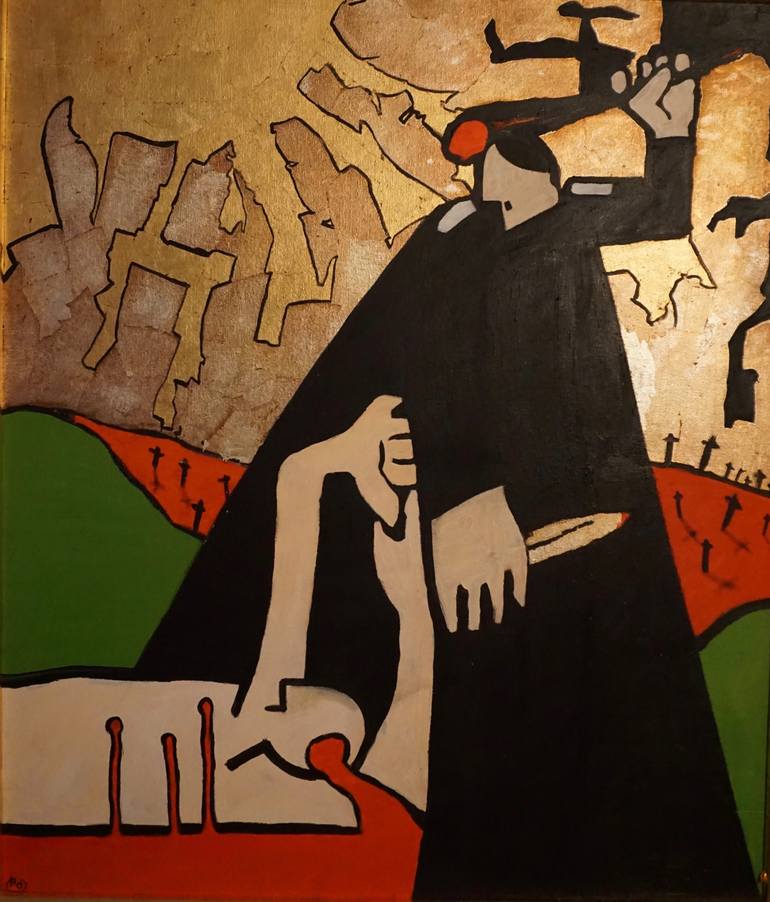
Cain and Abel, by Frank Hoesel

I learnt this Torah from Rabbi Joel Levy at the Conservative Yeshiva in Jerusalem.

israel · theology · torah

I believe that God is screaming.

A few weeks back, I attended a retreat with Christian colleagues. At some point, surprisingly enough, we got onto talking about God. I asked one of the priests a question: “do you believe God speaks to you?”

He looked slightly bewildered by the question. “Literally?” he asked. “No, not really.” He shook his head.

The answer seemed obvious. After all, we were liberals, at an interfaith event. That kind of talk is for fundamentalists. We’re all too rational for that. 

“Why?” he asked, turning back to me, “do you?”

“No,” I said, sheepishly. I don’t know why I felt so embarrassed. Of course, many believers see the voice of God mostly as a metaphor, or as a way of giving expression to moral intuition. I’m just not one of them. 

I do believe in a personal God, who has a loving relationship with every human being on earth. And I do talk to God. It’s not that I expect answers in any sense, but I do believe some One is listening: that prayers are more than idle words I recite to myself.

Perhaps my Christian colleague would have agreed with me if I’d put it in these terms, because finding vocabulary to talk about God is hard. Words like ‘literally’ and ‘metaphorically’ start to evaporate when you are dealing with faith.

I think, perhaps, the reason I gave a sheepish no – maybe even that I asked the question at all – was that I was having a mini-crisis of faith of my own. Ever since the war broke out, I have been praying differently, more fervently, desperately begging the Universe for peace. I have been hurling questions and recriminations into the void. I have been wondering… do I still believe in this God?

My personal relationship with God has carried me through some of the toughest times. When I have felt most lonely, God has been like a best friend. When I have hated myself, God has been like a lover. When I have needed direction, God has been a wise counsellor. I have looked to God in every time of disaster, and always found comfort in a loving Presence that reaches out and caresses from across a boundary of unknowability.

But now I listen for God’s voice. And all I can hear is screaming. 

As long as there have been people who believed in religious meaning, there have been those who questioned it. Usually, they were the same people. Abraham, Moses, Hannah, Kohelet, Job: they all had faith, and they all questioned it. They asked questions so that they could challenge their beliefs, and refine them. Lately, although less adequately than those prophets, I have been forced to do the same thing.

The first question we usually ask when confronted with crises of faith is “do I believe in God?” Fairly regularly, people come to me with conclusions one way or the other: “you should know, rabbi, I don’t believe…” or “you should know, I have a strong sense of belief…” My follow-up is always the same “… and what is it that you do (or don’t) believe in?”

For me, the answer is moral truth. When I talk about believing in God, what I am saying is that moral statements are not just opinions. When we say “murder is wrong” we are not just expressing a preference, like “my favourite flavour of ice cream is tutti-frutti.” We are describing a reality, no different to the claim that there are 24 hours in a day. We are describing something literally true.

I think that’s what God is. When we want to know why our feet are firmly on the ground, we give the shorthand answer of “gravity.” When we want to explain why objects in space interact with each other as they do, we use words like “attraction.” And when we want to express how we know that murder is wrong, we use the word “God.”

So, in feeling the great sense of angst I have had since the war began at the end of the High Holy Days, I am forced to return to the old questions. I am forced to ask whether I still think moral statements are true. I am forced to ask whether I still believe murder is wrong.

I do.

And that is why I believe that God is screaming.

What we talk about when we describe God is obviously more complicated: it is something infinite, and greater than we can put into words. That’s why words like “metaphor” and “literal” are so inadequate – because we are describing something more real than reality. So we have to find shortcuts. We have to find ways of talking about God in human language, to make sense of God on human terms. God is then “a tender parent”; “a loving shepherd”; “a righteous judge”; “a generous creator.” All of these are good descriptors, and all of them are incomplete.

I have been relying on a version of God that has worked for me for a while. I have imagined a sweet aunty or a gentle older friend. In times of loneliness, desperation and heartache, that image of a loving God has helped me get through the day. But that image doesn’t serve me now. I think if I used God for comfort in a time like this, I would be retreating from responsibility. God does not need me to feel safe now, but to shake me from illusions and complacency.

If God is the moral voice of the universe, that voice must be crying out in desperation.

In the last few months, 23,000 Palestinians in Gaza have been killed by Israeli bombs. I am kept awake at night thinking about that. I imagine God, smothered by the rubble of obliterated hospitals, calling out. Like Abel, stricken by Cain, the voice of the blood is calling out from the ground (Gen 4:10). I imagine God, pulled from the wreckage, crying: “Thou shalt not kill. (Ex 20:13) Thou shalt not kill. (Deut 5:17)”

Those were the commandments given to the Jews, above all others. In some variations, it is the very first commandment, the one that holds the most power. And as Israel stands in the dock at the Hague, it is not only South Africa that places it on trial, but God too, who comes with the accusation: “did I not tell you: thou shalt not kill.”

Since the war began, Israeli settlers, with governmental support, have seized around 20 villages in the West Bank, displacing thousands of people, so that Jewish Israelis can expand their territory and claim others’ homes. I imagine God calling out from deserted towns, on the trail with refugee families, wailing “thou shalt not steal” (Ex 20:15), “thou shalt not steal” (Deut 5:19).

Netanyahu says, unabashedly, that he will push the Palestinians from Gaza and create a new border with Egypt. The Torah answers, in desperation: “thou shalt not move thy neighbour’s boundary” (Deut 19:14). Land theft is a sin.

Israeli soldiers enter Gaza and use Jewish symbols as weapons. They recite the Shema from the pulpits of mosques and place mezuzahs on Palestinian homes. They desecrate our religion. They destroy our faith. From the depths of history, God cries out “honour thy mother and thy father (Ex 20:12); honour thy mother and thy father (Deut 5:16).” Do not profane the faith of your ancestors with war crimes.

Worse still, the politicians claim that God gave them the right. That this is what the Torah intended. Can you not hear the scream of revulsion as God decries: “thou shalt not take My name in vain (Ex 20:7); thou shalt not take My name in vain (Deut 5:11).” This is what was intended: do not abuse God’s name for worthless pursuits like war, but elevate it for the purposes of peace. 

I believe that God is screaming. 

The commandments may once have been given as words of instruction or even as a love letter, but now they are a desperate plea. 

God says “I am the Eternal One thy God, which brought thee out of the land of Egypt, from the house of bondage. Thou shalt have none other gods before me.”

No other gods. No state, no flag, no military, no leader, no ideology, no grudge, no border, nothing. None of these can ever be placed before God. None of them have any trump over God’s words.

God’s word says: “You shall not pollute the land in which you live; for blood pollutes the land, and no expiation can be made for the land, for the blood that is shed in it.” (Num 35:33)

So I believe I can hear God screaming: thou shalt not kill.

And I do not want to silence that voice. I want to amplify it. I want the Holy Torah to be heard now, more than ever. I hear God screaming, and I want to join in.

Thou shalt not kill.

Thou shalt not kill.

Thou shalt not kill.