story · theology

Why do Jews break a glass at weddings?

Whenever a couple comes to discuss their upcoming wedding, there is one ritual more important to them than any other. Anything else, they feel they can set aside, but this one action, they absolutely must do.

They insist on breaking the glass.

Smashing a glass under the chuppah is not a matter of halachah. In Jewish law, it makes no difference whether you do it or not.

It is also probably not the most visually popular image. If you picture a Hollywood Jewish wedding, the stock footage in your mind is the chair dancing, with couples thrust into the air, and holding on for dear life.

Why do couples want so much to smash the glass? When I ask them, they are not sure. It just feels right. It feels natural.

It is like they are remembering something. Something, a story; not just the stories of all the weddings of family members; not even another wedding in a mythic ancestral past. Something else. Something further back.

Perhaps, the Kabbalists suggest, what they have remembered is the very first smashed glass.

The very, very first crack.

Before there were weddings or people or creatures or planets or stars. Before there was anything at all.

Before there was anything, there was a crack.

In the beginning, there was a crack.

A crack in the Nothingness.

Before the crack, we can only talk about the Nothingness. We cannot even really talk about there being such a thing as before the crack, because, in the Nothingness, there was no time. The Nothingness was an absence. Lacking anything, it had no before, nor after, nor now.

When the first crack appeared in the nothingness, it created the first event. The first now.

Before long, the crack split. It broke further, like a chip in a windscreen that slowly breaks. Now there was a succession of events. A story in the cracking of the Nothingness. Now there was such a thing as now, and before, and after. There was time.

Then, the Nothingness could not bear the weight of the crack any more. It burst and shattered into an infinite myriad of broken fragments. Suddenly, there was time and there was space and it was filled up with the thousands of shattered splinters.

The Nothingness was broken. And there could never be another Nothingness again. It had ruptured and given birth to the Something: to all the imploded pieces of possibility.

And out of that possibility came yearning. The shards could see that they could form into combinations and make Somethings that were greater than just their fragmented pieces, but were the genesis of ideas.

So, they made wisdom, knowledge, and understanding. They made strength, love, and beauty. They created endurance and splendour.

From the broken bits of the Nothingness, they made the potential for Everything. And, with that, they made matter. They made the foundations of all existence.

Now, there could be galaxies and moons and oceans and forests and reptiles and insects and primates and civilisations and cities beings that could contemplate this entire mystery of existence and wonder how it all began.

This was how our world was made.

That is where we live: in the broken world.

We are the products of that initial shattering that yearned to be Something greater than Nothing. And we are able to see the world as it is: infinitely complete and completely broken.

We are those sentient beings who can witness this world and wonder how it all came to be, and wonder if it might ever be like that again. We are able to yearn with our whole souls to be reunited with the great forms that once birthed us. We long to feel again that splendour and majesty and wisdom that brought us into being.

Everything that exists is but a microcosm of the original system of shattered fragments that first delivered creation. We contain within us fractals of the understanding, beauty, and strength that initiated all being.

Those creative life forces exist within everything. They continually reach out to each other, interact with each other, and recreate each other, so that everything is one miraculous dance of metaphysical juices, bubbling beneath a mundane surface.

This means that, inside our own souls is the very first crack. We are the broken vessels that yearn for Something more than this. Out of our own breakages is the genesis of all creativity. It is as if the whole world was given order straight from our own souls.

We are perfect. We are broken. Our hearts were broken long before we were ever born. The Creator burst a puncture in our souls right from the outset. It was what would allow us to love and be loved.

And our hearts have been further broken by life. They get fractured every time we encounter something we do not understand. We can feel ourselves breaking every time we lose a loved one, and every time we see the beauty in a sunrise. Yes, our hearts break in sadness, but they also break in joy. It is our brokenness that brings us back to the very first creation.

So much in this society teaches us to scorn our own brokenness. We are encouraged to deny the parts of us that feel most acutely.

Instead, daily life makes us treat this world as if it is still nothing. As we work and pay bills and undertake routines, it can feel like there is no meaning to any of it.

But, deep down, all of us know that our existence is a miracle. We are divine shrapnel in a seemingly impossible universe.

So, when the couple comes under the chuppah, their first thought is: I want to smash the glass.

I want to see outside of me the brokenness that is within.

I want to remember how, once, in a past that never was, the very first crack made everything possible.

I want to be reminded that this brokenness inside of me is what allows me to connect with others. That fracture inside my heart is what makes me yearn for the love of another. It is what makes my being permeable enough that someone else can enter, and share in it their own broken lovingness.

Without this crack inside me, I would never be able to reach beyond myself. This brokenness is what connects me back to God.

We are broken people in a broken world.

Our brokenness is not a cause of shame. Our brokenness is what makes Anything possible.

I know I am broken when I feel grief and anger and jealousy and pain.

Because I am broken, I can feel love and wonderment and resilience and curiosity and awe.

Thank God I am so broken. I only wish to be moreso.

Dear God, let me be more broken.

Let my heart be more porous so that all its dreams may be freed into this world of infinite possibilities.

Puncture my soul and rip it open, so that I can truly feel the longing of all humanity. May I hear in the depths of my being the cries and joys of all that exists and could exist.

May I truly see this world, in all its diverse variance, and marvel at the infinite Nothingness from which we came.

May I fulfil the prophecy of Ezekiel:

“I will give you a new heart and place a new spirit within you. I will remove that heart of stone from your body and give you a heart of flesh. I will put My spirit within you, so that you will walk in My ways and uphold My justice.”

Dear God, break me.

Break me, break me, and break me again.

Shabbat shalom.

high holy days · sermon

Why the world was made

There are some places in this world that fill me up with an awe of creation more than anywhere else can. Places so beautiful they make me wonder why they exist.

The Scottish Highlands are such a place. Those mountain landscapes are cragged rocks and stark hills stitched together by seas and tarns and smaller rock pools. They are peat bogs and waterfalls growing shrubs and trees, so full of life it feels as though they are themselves breathing. 

This year, I went to visit them. With my partner, we walked through the hills, saw old churches, visited a beloved rabbinic mentor, and witnessed the birds and wildlife. 

In between completing my dissertation and getting ordained as a rabbi, I decided to make a pilgrimage to mark the transition. It truly felt like a religious moment; a chance to draw closer to something sacred.

As we walked, we met with a land that was part of our country but felt decidedly foreign, and we met myths that, while part of our heritage, seemed alien. 

For the Gaelic-speaking peoples of Scotland and Ireland, these landscapes have their own origin story.

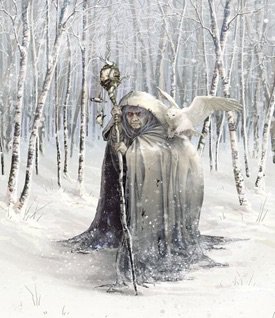
Those mountains are no accident. They were built intentionally, but a type of deity called Cailleach. Known also as Beira, or the Queen of Winter, she is an aged crone; one-eyed and completely white. 

She battles spring each year to reign her icy dominion over this hemisphere. She is a deer-herder, a lumberjack, and a warrior. She carries in her hand a great hammer as she strides across the Celtic Isles. She is the mother-goddess.

It was Cailleach who built the Highlands. She pulled rocks out of the sea and carved out stepping stones for her giant strides. She pushed through the space, breaking up new mountain faces with her hammer. She walked as winter through the new landscape she had made, and allowed waters to flow and overflow in every crevice.

I was enamoured by this story. Yes, that is what it looks like. It looks like an enormous witch has made it. It feels bursting with purpose.

My boyfriend prefers another version. He is a scientist, a doctor. We see the same world but through different lenses.

Millions of years ago, he read, the earth endured an ice age. Frozen water cut through the earth and wore down the ancient mineral rocks at a glacial pace. When the waters finally thawed, they left behind these precipices and pastures on the Scottish coastlines.

But isn’t that just the same story, told in a different way? Cailleach is simply an anthropomorphic ice current. The processes attributed to gods and fairies – that breaking and carving and flooding – are repackaged in scientific language. The scientists can give us approximate dates and name when the layers of sediment formed, but they are effectively telling the same story.

What difference does it make whether these wells were made by frozen currents or by the Wild Woman of Winter?

It is not fair to say that one is rational and the other is mythical. Both accounts are testament to humanity’s ability to understand its surroundings. The story of Cailleach is no less important a contribution, and we cannot just dismiss it. 

Equally, we cannot treat the national myth in the same way as we would our best scientific discoveries. They are not equally weighted as theories about how the earth was formed. Centuries of technological advancement and detailed research have given us this account of the Highland’s foundations.

The difference between these stories is not whether they tell us something true, but what kind of truth they point us to. The scientific explanation tells us the history of the world in context of great geological events. It teaches us how to identify, exploit or protect the natural surroundings we have inherited.

The story of Cailleach, by contrast, tells us about the unquantifiable truths of the Highlands: the awe they inspire; the magic they seem to hold. It teaches us about the shared national destiny of the Scottish, Irish, and Manx people who tell her story. 

These are not competing, but complementary, stories of creation. One tells us the truth of how a place was made, the other tells us why.

At this time of year, we turn to our own national myth and origin story. Our new year recalls the creation of the world. It is a day for us to delight in the fact that we are alive.

The biblical account of creation does not only explain the origins of one geological formation, but seeks to tell the genesis of the entire world.

5,783 years ago, the world was made in six days, from explosive dividing light, through land and seas and atmosphere, through to sea creatures, winged beasts, mammals, and human beings.

It is no good to compare this religious tradition with the theories of the Big Bang or evolution through natural selection. They are telling the story of the same thing, but from totally different perspectives. 

Science attempts to understand how the world was made; our myths ask us why.

The first chapter of Genesis suggests some reasons. The world was created with great purpose. Each day, with everything that God created, God saw that it was good.

When God created humanity, God gave us responsibility for the earth and what is in it. God gave us companions and promised us regular rest. God created the world for goodness, with humanity at heart.

The scientist and the theologian alike look at the world with a sense of wonder. We both feel awe as we track their stars in their orbit. We both marvel at the fact that a planet has produced the perfect conditions for life to form and grow entire ecosystems to sustain myriads of plants and creatures.

On this we agree.

The difference is that, for the believer, we do not just gaze in awe. Awe gazes back at us. 

You are not just amazed at the world, but the world is amazed by you. 

Not just the parts of you that you share in common with all other living beings, but those things that are unique to you. 

Not just the fact that you have functioning organs and limbs, but you. That transcendental, magical part of you. We might call it personality or soul or neshama.

It is not something mechanical or quantifiable. There is something about you that is wonderful and irreplaceable.

That is you

When we are confronted with the wonder and beauty of the world in which we live, we are tempted to ask what it is all here for. The answer of Judaism is that it is here for you.

To the religious imagination, your life is not an accident. It is a blessing. You were created for the sake of the world and the world was created for the sake of you. 

According to our Torah, at first creation, God wandered round to take in the Garden of Eden in the cool of day. And, there, God called out to the first human being: “Where are you?” God was looking for the human.

The great Jewish philosopher, Martin Buber, understood that this question is addressed to every human being in every age. We, too, are forever hiding, behind the stories we tell ourselves that our lives are meaningless and our actions matter little. We find ways to try and escape truth, even to hide from ourselves. 

And God, that great Source of amazement, nevertheless seeks us out, asking “where are you?”

So, Buber says, you have to answer that question. You have to seek deep inside your soul and answer who you really are. You have to try and give an account of what you are doing on this earth. You have to make yourself present, ready to face Truth, and, crucially, to change.

Where are you?

You are on this beautiful earth, crafted by a magnificent Creator. You are here and alive. You are a miracle.

God is amazed at how wonderful you are.

And now you have to show that God’s faith is rightly placed.

Shanah tovah.

Cailleach, Queen of Winter
high holy days · sermon

Grieving the Year

Stage 1. Denial

At the beginning of the Coronavirus crisis, the grief expert David Kessler described our relationship to these unprecedented times as a mourning process:

“The loss of normalcy; the fear of economic toll; the loss of connection. This is hitting us and we’re grieving. Collectively.”

No doubt, over the past 6 months, many of us have felt that complicated array of emotions associated with grief. Indeed, today, it is hard not to feel some anxiety and dissonance that we cannot do Yom Kippur in our usual ways.

Kessler suggests that the best way to face up to this feeling is to know the stages of grief and understand them. Denial. Bargaining. Anger. Sadness. Acceptance.

Each of these feelings is important and needs to be honoured. The Jewish tradition has much to teach us about them. In each of these difficult feelings there is holiness and meaning. I am going to tell Chassidic stories about each of these stages of grief, beginning with stage one: denial.

Rabbi Shmelke once asked the Maggid of Mezritch, to explain a difficult theological concept to him. He said: “Our sages teach that we should thank God for suffering as much as for wellbeing, and receive it with the same joy. How is that possible?”

The Maggid told him to seek out Zusya. Zusya had known nothing but poverty and heartbreak in his life. He had lost his children and lived with chronic illness. “He will explain suffering to you,” said the Maggid.

Rabbi Shmelke found Zusya at the House of Study and asked him the question: how is it possible to thank God for suffering? Zusya laughed: “You’ve come to the wrong person. I haven’t suffered a day in my life.”

As Rabbi Shmelke left the room, he realised that he must accept all suffering with love.[1

Stage 2: Bargaining

Abraham bargained with God to prevent the utter annihilation of Sodom. Moses bargained with God so that not all of Korach’s supporters would be killed. ‘Perhaps,’ thought an old Jew in Jerusalem, ‘I might be able to intercede with God too.’

So every day she went down to the Kotel – the Western Wall in the Old City. Each morning, she davened and prayed to God: “Sovereign of the Universe, I beseech you. Please bring an end to this plague and to economic crisis. Please put an end to the bush fires and the wars.”

“God,” she cried out at the Wailing Wall, “if you grant us peace and stability, I will devote every moment of my life to Torah and prayer. I will be the most righteous person in the world.’

She went down every week on Shabbat. And then every morning. And then three times a day. And then she was praying every day three times a day for months on end.

Her daughter asked her: “how do you feel with your new piety?”

“Like I’m talking to a brick wall.”

Stage 3: Anger

Once, Rebbe Levi Yitchok of Berditchev saw a tailor remonstrating as he prayed, throwing his fists up in the air. After the service, he called over the tailor to ask him what he’d been saying to God.

The tailor said: “I told God what was what. I said: ‘Listen, God, you want me to repent of my sins, but I’ve only committed minor offences compared to You. Sure, I don’t keep perfect shabbat or kosher, and I’m sorry about that. But You – You have taken away mothers from their babies and babies from their mothers. You have allowed all manner of injustice to continue. So let’s call it quits: You forgive me and I’ll forgive You.”

The Berditchever Rebbe laughed: “You’re a fool. You let God off far too easy. You should have demanded the Messiah and the redemption of Israel. That would have been a much fairer exchange.”[2

Stage 4: Sadness

Once, in the middle of the night, one of the Mitteler Rebbe’s children fell out of bed. Entirely engrossed in his studies, he did not hear the child’s cries. However, his father, the Alter Rebbe, heard the cries, closed his Torah books, and went to comfort the child. The Alter Rebbe later said to his son: “No matter how deeply immersed you are in holy pursuits, when a child cries you must hear it; you must stop what you’re doing and soothe their pain.”

So too: we must hear the crying child within us, and acknowledge our own pain.

Stage 5: Acceptance

Professor Aisha Ahmad is a political analyst in Canada, who has worked in Afghanistan, Pakistan, Somalia, Mali, Iraq, and Lebanon, often in some of the most challenging situations. She recently warned that, in her experience, the 6 month mark in a sustained crisis is always very difficult. She advises us:

“It’s not productive to try to ram your head through it. It will break naturally in about 4-6 weeks if you ride it out. This six month wall both arrives and dissipates like clockwork. So I don’t fight it anymore. We have already found new ways to live, love, and be happy under these rough conditions. Trust that the magic that helped you through the first phase is still there. You’ll be on the other side in no time.”

Once, Rabbi Mikhal of Zlotchev was asked: “You are poor, rebbe, and yet every day you thank God for taking care of all your needs. Isn’t that a lie?”

“Not at all. You see, for me, poverty is what I need.”[3]


[1] Martin Buber, Tales of the Hassidim: Early Masters, pp. 237-238

[2] Louis Newman, Hassidic Anthology, p. 57

[3] Elie Wiesel, Souls on Fire, p. 49