interfaith · sermon · torah

Do not hide the tears of tolerance


As some of you know, my kippah is a permanent fixture on my head, and has been since my early 20s. I often get asked whether I experience any feedback for being so visibly Jewish. My answer is: yes. Occasionally, Christians come up to me and say “shalom.” I say “shalom” back.

Well, this week, I have a more interesting story to tell.

Last Saturday night, Laurence and I were on our way back from a friend’s birthday lip synch. (Yes, in my time off, I do competitively mime to Nicki Minaj wearing a space suit and kitten heels.)

We were heading into Vauxhall Station. A group of men in their early 20s were dancing around, holding hands, and reaching out their hands for others to join them.

It will probably not surprise you to hear that I joined in. The boys cheered.

Within moments of joining them, I realised I might have made a terrible mistake. The man whose hand I was holding was, in fact, wearing a Palestine football shirt. They were all speaking Arabic. A taller man noticed my kippah and said to the others “hu yehudi.” I know what this means in Arabic, because you say it the same way in Hebrew: he’s Jewish.

And I thought, well, it’s basically the same language, I’ll try talking with them in Hebrew. Friends, these gentlemen did not, in fact, speak Hebrew. Their English was pretty stilted too.

Right next to us, a fist fight broke out between two white guys.

We all fumbled awkwardly, and tried to communicate across a language barrier. The tension became palpable. It was just me and Laurence and a whole group of Palestinian men.

I asked: “where are you from?”

“We are from Gaza,” the one who had been holding my hand said. “Do you support the government?”

I said: “of course not.”

The man said: “Really?”

I said: “Yes.”

The men cheered, and resumed dancing. I got on my train back to Ditton.

There was no time to explain that the Israeli government wasn’t actually my government at all, but my answer would have been the same whichever government he was talking about.

I am under no illusion that this story could have ended differently. But, as it is, the story ended with dancing in the streets of London, and everybody walking away with their dignity intact.

Now, I may have been the first visibly Jewish person these men had met who was not wearing a military uniform. And perhaps now, with the freedom of London, they will get the chance to learn more about who Jews are.

And perhaps I will go away and actually do my Arabic homework so that I can have a better quality conversation. At least, in the future, I won’t default to Hebrew as a good enough alternative.

I think we tend to imagine that tolerance is the true harmony of everyone fully understanding each other; living side by side; eating in the same restaurants; celebrating and grieving together.

I still believe that true peace will come, when everyone has full equality, and nobody has any more need for conflict.

But, most of the time, life is not like that.

As long as there is inequality, those with less will want what those with more have; and those who have more power will exert it over those with less. Until we all have everything we need, there will be conflict for the power and possessions we lack.

Tolerance, in our society, is the decision to set grudges aside, to suspend prejudice, and to just let each other go on with life. It is the decision of the stronger to spare the weaker. It is a choice to ignore stock characters and old grievances for the sake of everyone getting on with their day.

It is not easy passivity, but a conscious choice to accept the world as it is. Sometimes, that is painful.

So it is with Joseph and his brothers.

Consider all the array of feelings Joseph must have held when he first saw his brothers. The last time he had encountered them, they had thrown him in a pit, then sold him at a cheap price to travelling merchants.

Do you think he was in the mood for forgiving?

And what about his brothers? They are now in abject poverty. They have travelled miles on foot to escape famine in their homeland. And they have to prostrate themselves and beg before a foreign king in a language they do not understand.

The powerful and the powerless have switched places; the resources are now all in Joseph’s hands.

Joseph doesn’t just shrug his shoulders and get over it. Instead, he decides to test his brothers and bring his entire estranged family to Egypt.

Joseph hides a silver cup in his brother Benjamin’s satchel and uses the supposed theft as a pretext to hold him hostage. Joseph announces to his family that he is going to keep their youngest brother as a slave, making them relive what they did to him.

At the moment when our parashah ends, we don’t actually know how the story is going to pan out. We, who have heard this story many times, are already aware that the brothers will repent and offer their lives for Benjamin’s. We know that Joseph will announce himself and forgive his siblings.

But, for this week, we are suspended in the tests of Joseph and his brothers.

The Joseph narrative is the longest part of the Book of Genesis, not least because of the extensive detail given to Jacob’s sons’ journey back and forth between the two countries, and the lengthy description of how Joseph examines his brothers’ hearts.

This story is, in fact, repeated almost exactly in the Quran. Surah Yusuf is a lengthy narrative in the formative text of Islam. Within the chapter itself, the Quran says that it is repeating the words of previous prophets and is confirming the prior revelation of the Torah.

But there is a key difference between the Torah’s version and the Quran’s. In the Islamic retelling, Benjamin is in on the ruse from the start. Joseph reveals himself to Benjamin before hiding the cup and tells him to go along with the ploy.

Perhaps the goal here is to make Joseph seem more righteous. That is, indeed, what many of our midrash do when they retell Torah narratives. They iron out biblical figures’ imperfections.

But, if you look at the texts of the stories side by side, the parallel verse in the Torah reveals something more interesting. In our recension, rather than revealing himself, Joseph runs off to his room and cries.

The Quran’s version, then, makes the story less painful. It glosses over how heart-wrenching and difficult this process is of forgiving and letting go.

There is a lesson here for us. We all want to jump ahead to the part of the story where everyone is friends again and loves each other. We all want to fast forward to the point in history where there is lasting peace and harmony.

But, the Torah tells us, you have to stay in the feelings. You have to live in the mess for a while.

As Jews in Britain, we are forever doing a delicate dance of interfaith relations, while plagued by trauma. As the whole world seems ever more oriented towards intolerance and tribalism, we still need to show up to shared spaces with our best faces and our best expectations of others. We need to set aside prejudices for the sake of a better society.

And that is hard. So don’t gloss over the tears. Don’t hide the pain away in another room. Let us be honest with ourselves and each other that the task of building a multicultural society is tough.

But, while we hold the challenge, remember that we do still know how this story ends. We know that we are heading towards an ultimate conclusion of liberty and equality. God has a plan for the world. And it will end with true peace.

One day, all people will embrace one another as members of the human family. One day, we will all weep together over the years wasted on war. One day, without fear, we will all dance unabashedly in the streets.

May that time come soon and last forever.

Amen.

Alexander Ivanov, The Silver Goblet is Found in Benjamin’s Sack

sermon · torah

When do we know that the day has come?

How can we tell that it is morning?

Perhaps, says the Mishnah, it is when we can see the difference between light blue and white. Or when we can see the difference between sky-blue and leak-green. Or perhaps it is when the sun is fully visible in the sky.

‘No,’ says the Tosefta. It is the moment when you can stand four paces from a friend and recognise their face. That is when you know that the day has come.

In the sunlight, new rays shine upon a familiar face and you can truly see them. In the morning, when the darkness has receded, you can recognise who is standing before you.

How different is this face, and yet how familiar. I see this person, this stranger, and, if the day has come, they are no longer a stranger. They are recognisable. It is possible to interpret their face fully; to understand it in ways one could not comprehend in the night.

Then we know that it is morning.

This is not just true for the passing of time. This is something that happens in life.

There are moments when we encounter someone we thought we knew, and new information, or a new realisation, means that we see them in a completely new light. They are transformed. And, in that process, we, who thought we knew, are transformed too, and our understanding of ourselves is changed.

In 4th Century Greece, the philosopher Aristotle termed this moment “anagnorisis.” It means recognition, or discovery. Aristotle writes that, in the world of theatre, anagnorisis “is a change from ignorance to knowledge, producing either friendship or hatred in those who are destined for good fortune or ill.” 

How different you appear in the new light of day. I stand four paces away from you and I can finally see that the night has disappeared and some glints of the morning have come.

It is most effective, says Aristotle, when it coincides with a reversal. The one who seemed weak is strong; the one who appeared as a pauper is rich; the one who we thought was dead has been alive all along.

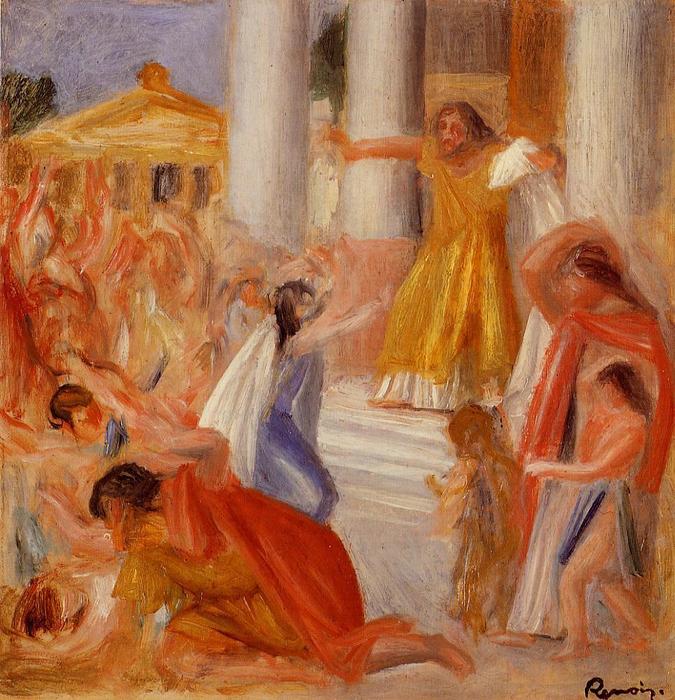
Aristotle presents the example of Oedipus. Throughout the entirety of his tragedy, Oedipus believed he was avoiding a prophecy that warned he would kill his father and marry his mother. In the moment of anagnorisis, at the cathartic climax of the play, Oedipus discovers that he had already fulfilled this prediction right at the start of his story. His father was not his father and his mother was his wife.

The idea of anagnorisis received a revival a few months ago, when the British-Palestinian author, Isabella Hammad, delivered the annual Edward Said lecture. Hammad spoke of anagnorisis as it appears in Palestinian literature, where recognition scenes are crucial.

“To recognise something,” says Hammad, “is to perceive clearly what you have known all along, but that perhaps you did not want to know. Palestinians are familiar with such scenes in real life: apparent blindness followed by staggering realization. When someone, a stranger, suddenly comes to know what perhaps they did not want to know.”

In Hammad’s understanding, anagnorisis is not just a literary trope, but something deeply personal and political, filled with moral meaning.

Let us turn, then, to our own narrative. This week, in the Torah, we witness one of the most staggering moments of anagnorisis.

Joseph wept so loudly that the Egyptians heard him, and Pharaoh’s household heard about it.

Joseph, the Egyptian vizier, strips off his royal clothes, and cries out: “I am your brother Joseph!”

Until this point, Joseph’s brothers believed that he was probably dead, or a slave somewhere miles away. Joseph’s brothers had believed that he was contemptible; a downtrodden misfit. Joseph’s brothers had believed that they themselves were contemptible; that they had sold their own kin into slavery and could never be redeemed for their sin.

Now they learn that Joseph is alive and is, in fact, the vizier over Egypt.

But this itself is not anagnorisis. Because in a real moment of recognition it is not only the characters who understand the truth of their situation, but the audience also discovers something new. We, the audience, already knew that the vizier was Joseph.

So, what did we really find out?

Joseph cried because he finally knew that his brothers regretted what they did to him, and that his father truly mourned his loss. He wailed because he now realised that these brothers could act as a family and care for their youngest brother. Joseph’s brothers were really penitent. Joseph never knew this, and nor did we.

When Joseph sees his brothers as they really are, Joseph changes how he sees himself. 

“Then Joseph said to his brothers, “Come close to me.” When they had done so, he said, “I am your brother Joseph.” One word in Hebrew – just one word – changes entirely our understanding of who Joseph is in this context.

 אֲחִיכֶם – your brother

“I am your brother.”

Joseph recognises himself as someone else. Not as the grand vizier of Egypt, but as the lost brother of his family.

Now we, the audience, can finally understand what Joseph wanted from this tragic play all along. All he ever wanted was to be loved. He did not really want power or favouritism or grandeur. He was just a lonely boy who wanted to be loved and did not know how. He resorted to such ridiculous measures to get attention, but all he ever wanted was to be accepted by his family. He wanted to be their brother. 

This story was not about what we had thought. We thought it was a divine unfolding of a great man’s place in history. We thought we were reading a rags-to-riches story that explained the hidden greatness of our nation and its God.

Then, instead, we see the entire cast as vulnerable human beings. Joseph is just a flawed boy seeking to make his family happy. Judah is just a stupid brother who made a terrible decision and regretted it. This is no tale of triumph, but is a far more gentle narrative, about family reconciliation and the power of repentance.

In the light of this moment, the entire story of the Torah comes into sharp focus. Cain killed Abel. Abraham tried to kill Isaac. Jacob tricked Esau. Laban tried to kill Jacob. Everyone in this family, going right back to the beginning, deployed violence and cruelty to achieve their aims. This is the first time, the climax of the book of Genesis, when these men are able to be vulnerable, use their words, and find healing. 

Suddenly, we understand that this story was not about fulfilling a prophecy but about breaking an intergenerational curse. 

In this moment of anagnorisis, everybody is somebody else. They are not hostages to fortune but breathing human beings capable of shaping their own family relationships. They cease being stock characters and become emotionally deep people who can recognise the vulnerability in each other.

So, how do we know when it is morning?

In the sunlight, new rays shine upon a familiar face and you can truly see them. In the morning, when the darkness has receded, you can recognise who is standing before you. How different is this face, and yet how familiar. 

When you can stand four paces away from someone whom you thought was a stranger, and see yourself anew. That person is not a stranger, and you are in fact a friend.

There is no more a struggle for power, but a moment of recognition. You recognise who you are, and you can finally say: “I am your brother.”

I am your sister. I am your family. I am your kin.

Now I recognise myself in you.

Now I know that the day has come.

Shabbat shalom.

Pierre-Auguste Rodin, Oedipus Rex
interfaith · sermon · torah

Who gets to be Jacob?

I am told that, as a toddler, whenever it came to game-playing, I had to be Postman Pat. No matter what the game was, I insisted on playing that friendly gentleman with a black and white cat. As I grew up, I had to compete with other children for different parts in our roleplay. We couldn’t all be the robbers, somebody would have to be the cops. Not everyone can be the Yellow Power Ranger and we can’t all be Ginger Spice.

Those were, at least, the parts we competed for in the 1990s. It was fairly low stakes, but it seemed quite important at the time.

But it’s nothing compared to the fight for roles that went on in the 5th Century CE. This big broigus was not just between two individuals, but between two whole religious groups: the Jews and the Christians. That battle was played out in two foundational texts of our traditions: a sermon by St Augustine of Hippo on the Christian side and the midrash, Bereishit Rabbah, for the Jews. Both were determined that they were Jacob, and the other side was Esau.

Which one would get to be Jacob?

At stake in this question is an ancient prophecy, told to Rebecca while she was pregnant: “Two nations are in your womb, and two peoples will emerge from your body. One shall be stronger than the other; and the older shall serve the younger.”

When Rebecca gave birth to Jacob and Esau, she was not just birthing twins, but rival nations. A strong one and a weak one. An older one that would serve the younger.

We have Esau: the hairy, ruddy hunter. We have Jacob: the smart, younger upstart.

The contest over Isaac’s blessing and birthright laid out in our parashah was more than a competition between siblings. It was a war between peoples.

So which one is the Jews? And which one is the Christians?

As far as the Jewish texts are considered, Jacob must be the Jewish nation. Meak and smart? That’s us. Gentle but witty? Sounds Jewish. He even changed his name to Israel. Bnei Yisrael, the children of Israel, klal Yisrael, the community of Israel, daat Yisrael, the laws of the Jews. Surely Jacob must be us!

And meanwhile Esau… well, he’s Rome. He changed his name to Edom, which, granted, is on the other side of the River Jordan in Mount Seir, but was the birthplace of Rome’s most wicked emperor and Temple-destroyer, Hadrian. And look at those Romans. They’re the hairy, barbarous, fighting ones. They’ve got their swords and their empires, just as Esau had his bow and his field.

Bereishit Rabbah, our classical midrash on Genesis, spells it out for us.

Two proud nations are in your womb, one is proud of his world and one is proud of his kingdom. Two prides of their nations are in your womb – Hadrian amongst the gentiles and Solomon amongst the Israelites.

We’re Jacob. We’re the one that God has chosen. We are the descendants of Solomon, proud of the world of Torah and obligation. They’re Esau. They’re the other brother. They’re the descendants of Hadrian, proud of their ill-gotten Empire.

Except, of course, for one obvious problem. Jacob is supposed to be the younger brother. Aren’t we, the Jews, clearly the older sibling? Our revelation is much older than the Christian one and the kingdom of David long predates the Caesarian Empire.

This fact was not missed by our Christian interlocutors.

Foremost among these Christians was St Augustine of Hippo. Augustine was a Father of the Christian Church, a theologian living in North Africa. His ideas were definitive in Christianity for many centuries, and people of all religious stripes still reverentially refer back to his writings. As far as Augustine was concerned, Jacob had to be Christendom. Israel, God’s treasured child, was the Church.

True, says Augustine, the Jewish nation sprang from Jacob, but since then, they have gone on to become Esau. They’re the elder people whom God has rejected. Esau was born shaggy and hairy, which means full of sins. Just look at the Jews – that’s clearly them!

Augustine continues: the prophecy promised that the elder would serve the younger, but that never happens in the biblical text. Esau goes on to become very rich and both wind up blessed in their lifetimes. Clearly, this refers to events that had not yet transpired: that the real Jacob would go on to have the upper hand. Now look at the world of Augustine, where the Christian Empire spans the globe and the Jews are a fractured diaspora in their lands. Surely this is the proof that the Jews are now Esau, serving their younger brother, the Christian Jacob.[1]

This battle of biblical exegesis probably sounds quite twee today. After all, why should it matter which of our religions gets to be Jacob? But this battle for religious identity and purpose shaped interfaith relations in medieval Europe.

If the Jews were Esau, then the Christians had replaced them as Jacob. Judaism was superseded, no longer necessary, and its practitioners were hairy remnants of an outdated doctrine. As Esau, the Jews were a savage menace who needed to be tamed by the genteel, pious Christians in their role as Jacob. This Christian doctrine was the theological basis for Jewish subjugation in Europe.

Faced with such hostility and oppression, it was only natural that medieval Jews felt the need to double down and insist that they were still Jacob. They imagined that Christian dominion would only last so long but that the Jews would ultimately triumph. They could still be Israel, despite what was said about them.

The modern era has seen reconciliation between Jews and Christians. Over time, theologians and historians on both sides have come to emphasise their kinship over rivalry. Perhaps, in the conflict over who got to be Jacob, these twin religions forgot that they were, in fact, siblings. Perhaps, still stuck in childhood contests, our communities had ignored the way the story ends.

By the time of the story’s completion, Jacob and Esau are no longer warring for the same birthright. They have both struggled, and lost, and achieved their own blessing. In maturity, Jacob and Esau meet again and wrap their arms around each other. They weep as they realise that God’s blessing is not finite. They never needed to fight over it.

After 2000 years of struggle, perhaps we Jews and Christians can reach the same intellectual adulthood. The campaign for who is the favourite brother can be put aside as we realise that we are on twin paths. We are both children of the same Divine Parent.

Perhaps we cannot all be Postman Pat, or Ginger Spice, or the same Power Ranger. But everyone can be Jacob.

I will give this sermon at Edgware and Hendon Reform Synagogue on Shabbat 21st November 2020 for Parashat Toldot.


[1] ‘Sermon on Jacob and Esau’, Jacob Rader Marcus and Marc Saperstein, The Jews in Christian Europe, pp. 33-34