How can we tell that it is morning?
Perhaps, says the Mishnah, it is when we can see the difference between light blue and white. Or when we can see the difference between sky-blue and leak-green. Or perhaps it is when the sun is fully visible in the sky.
‘No,’ says the Tosefta. It is the moment when you can stand four paces from a friend and recognise their face. That is when you know that the day has come.
In the sunlight, new rays shine upon a familiar face and you can truly see them. In the morning, when the darkness has receded, you can recognise who is standing before you.
How different is this face, and yet how familiar. I see this person, this stranger, and, if the day has come, they are no longer a stranger. They are recognisable. It is possible to interpret their face fully; to understand it in ways one could not comprehend in the night.
Then we know that it is morning.
This is not just true for the passing of time. This is something that happens in life.
There are moments when we encounter someone we thought we knew, and new information, or a new realisation, means that we see them in a completely new light. They are transformed. And, in that process, we, who thought we knew, are transformed too, and our understanding of ourselves is changed.
In 4th Century Greece, the philosopher Aristotle termed this moment “anagnorisis.” It means recognition, or discovery. Aristotle writes that, in the world of theatre, anagnorisis “is a change from ignorance to knowledge, producing either friendship or hatred in those who are destined for good fortune or ill.”
How different you appear in the new light of day. I stand four paces away from you and I can finally see that the night has disappeared and some glints of the morning have come.
It is most effective, says Aristotle, when it coincides with a reversal. The one who seemed weak is strong; the one who appeared as a pauper is rich; the one who we thought was dead has been alive all along.
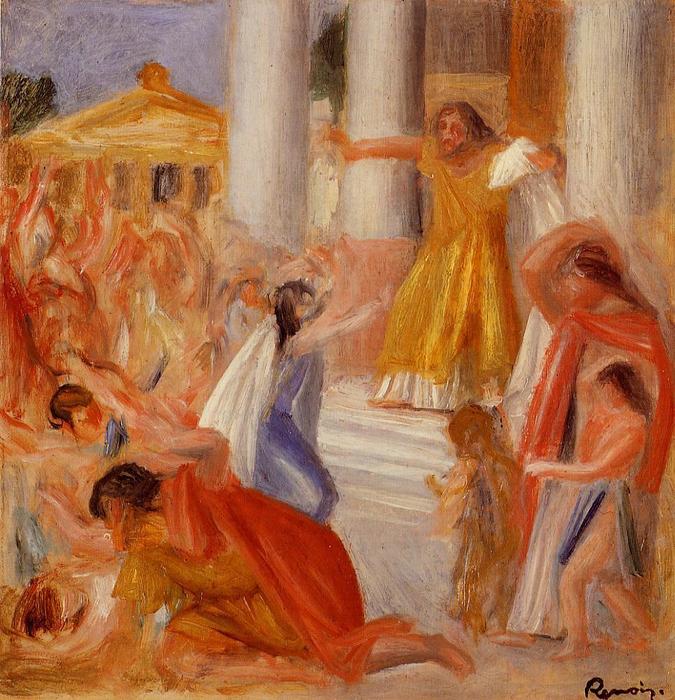
Aristotle presents the example of Oedipus. Throughout the entirety of his tragedy, Oedipus believed he was avoiding a prophecy that warned he would kill his father and marry his mother. In the moment of anagnorisis, at the cathartic climax of the play, Oedipus discovers that he had already fulfilled this prediction right at the start of his story. His father was not his father and his mother was his wife.
The idea of anagnorisis received a revival a few months ago, when the British-Palestinian author, Isabella Hammad, delivered the annual Edward Said lecture. Hammad spoke of anagnorisis as it appears in Palestinian literature, where recognition scenes are crucial.
“To recognise something,” says Hammad, “is to perceive clearly what you have known all along, but that perhaps you did not want to know. Palestinians are familiar with such scenes in real life: apparent blindness followed by staggering realization. When someone, a stranger, suddenly comes to know what perhaps they did not want to know.”
In Hammad’s understanding, anagnorisis is not just a literary trope, but something deeply personal and political, filled with moral meaning.
Let us turn, then, to our own narrative. This week, in the Torah, we witness one of the most staggering moments of anagnorisis.
Joseph wept so loudly that the Egyptians heard him, and Pharaoh’s household heard about it.
Joseph, the Egyptian vizier, strips off his royal clothes, and cries out: “I am your brother Joseph!”
Until this point, Joseph’s brothers believed that he was probably dead, or a slave somewhere miles away. Joseph’s brothers had believed that he was contemptible; a downtrodden misfit. Joseph’s brothers had believed that they themselves were contemptible; that they had sold their own kin into slavery and could never be redeemed for their sin.
Now they learn that Joseph is alive and is, in fact, the vizier over Egypt.
But this itself is not anagnorisis. Because in a real moment of recognition it is not only the characters who understand the truth of their situation, but the audience also discovers something new. We, the audience, already knew that the vizier was Joseph.
So, what did we really find out?
Joseph cried because he finally knew that his brothers regretted what they did to him, and that his father truly mourned his loss. He wailed because he now realised that these brothers could act as a family and care for their youngest brother. Joseph’s brothers were really penitent. Joseph never knew this, and nor did we.
When Joseph sees his brothers as they really are, Joseph changes how he sees himself.
“Then Joseph said to his brothers, “Come close to me.” When they had done so, he said, “I am your brother Joseph.” One word in Hebrew – just one word – changes entirely our understanding of who Joseph is in this context.
אֲחִיכֶם – your brother
“I am your brother.”
Joseph recognises himself as someone else. Not as the grand vizier of Egypt, but as the lost brother of his family.
Now we, the audience, can finally understand what Joseph wanted from this tragic play all along. All he ever wanted was to be loved. He did not really want power or favouritism or grandeur. He was just a lonely boy who wanted to be loved and did not know how. He resorted to such ridiculous measures to get attention, but all he ever wanted was to be accepted by his family. He wanted to be their brother.
This story was not about what we had thought. We thought it was a divine unfolding of a great man’s place in history. We thought we were reading a rags-to-riches story that explained the hidden greatness of our nation and its God.
Then, instead, we see the entire cast as vulnerable human beings. Joseph is just a flawed boy seeking to make his family happy. Judah is just a stupid brother who made a terrible decision and regretted it. This is no tale of triumph, but is a far more gentle narrative, about family reconciliation and the power of repentance.
In the light of this moment, the entire story of the Torah comes into sharp focus. Cain killed Abel. Abraham tried to kill Isaac. Jacob tricked Esau. Laban tried to kill Jacob. Everyone in this family, going right back to the beginning, deployed violence and cruelty to achieve their aims. This is the first time, the climax of the book of Genesis, when these men are able to be vulnerable, use their words, and find healing.
Suddenly, we understand that this story was not about fulfilling a prophecy but about breaking an intergenerational curse.
In this moment of anagnorisis, everybody is somebody else. They are not hostages to fortune but breathing human beings capable of shaping their own family relationships. They cease being stock characters and become emotionally deep people who can recognise the vulnerability in each other.
So, how do we know when it is morning?
In the sunlight, new rays shine upon a familiar face and you can truly see them. In the morning, when the darkness has receded, you can recognise who is standing before you. How different is this face, and yet how familiar.
When you can stand four paces away from someone whom you thought was a stranger, and see yourself anew. That person is not a stranger, and you are in fact a friend.
There is no more a struggle for power, but a moment of recognition. You recognise who you are, and you can finally say: “I am your brother.”
I am your sister. I am your family. I am your kin.
Now I recognise myself in you.
Now I know that the day has come.
Shabbat shalom.
 Sim Lev