israel · sermon · social justice

We must drag the sun over the horizon


In Judaism, night comes before day. The day begins when the sun sets and the first stars appear in the sky.

This has been the way of the world since its mythic origins.

In the beginning, there was endless darkness. Then God said “let there be light.” And there was light.

And God separated the light from the darkness. The first distinction. And the darkness God called night, and the brightness God called day.

And there was evening, and there was morning. A first day.

Having created nights and days, God populated them with matter. At the end of each period of creation, there was evening, then there was morning. Each day.

During the sixth day, God created human beings and placed them in a garden. Then there was evening.

The first human beings had never seen an evening before. They did not know that the sun could set. They did not know the difference between night and day.

What must it have been like for the first sentient beings to realise who they were and who their Creator was, only to see the sun disappear? How frightened they must have been!

Perhaps they called out to God and asked for guidance. But that evening marked the beginning of the seventh day, and God was resting. God did not answer them.

Our Talmud teaches that when the first human beings saw their first nightfall, they fell into despair. Adam feared that the sun had disappeared as punishment for his sin. He worried that the world would now return to the endless darkness with which it began.

Eve cried. She fasted and prayed. Adam and Eve wrapped their arms around each other and held their bodies close as they prepared for the end.

Then the dawn broke.

And they realised: this is the way of the world.

The world began in autumn, at the festival of Rosh Hashanah.

When the first winter nights crept in, and they saw the length of days decreasing, they panicked once more. Now in exile from Eden, they had no way of knowing what would come next.

Again, they fasted, wept, and prayed.

Then the spring came, and brought with it longer days.

And they realised: this is the way of the world.

We begin with darkness. Light follows.

There is evening. Then the dawn comes.

There is winter. And it always becomes spring.

This is the way of the world.

We can observe this dialectic in almost all matters of life. Our suffering is followed by joy. Our struggles are replaced by triumphs.

Some days feel like endless nights, but the dawn is always waiting for those who are patient for it. So we hold each other close and wait for the sun to rise.

This is the way of the world.

These trends appear, too, in history. There will be periods of decline followed by ages of plenty. There will be economic busts, and there will be booms. There will be war, but peace will come.

This is the way of the world.

But human history is different from all other natural rules. The order of night and day and the structure of the seasons was predetermined before we arrived on this earth.

History, on the other hand, is made by human beings. History is the one area of life where we can, collectively, choose what happens. Our actions determine whether we live in the winter of war or bountiful springtime.

So, it is incumbent upon us not just to hold each other and wait for morning, but to drag the sun over the horizon and demand that day appears.

In 1969, “Shir LaShalom,” became the anthem of the Israeli peace movement. In the final stanza of the song, we sing out: “Do not say the day will come. Bring on the day.”

Just as people make the active decision to go to war, peace is also a choice. Those who want an end to war cannot just wait in the darkness.

We sang Shir LaShalom in this sanctuary on Simchat Torah. I felt, and I think many of you did too, truly jubilant at the news of ceasefire and hostage release. After two years, we could finally see a possible end to the suffering.

My jubilation was tinged with pain as I remembered the last time that Shir LaShalom was chanted throughout synagogues.

That was in 1995. Yitzhak Rabin and Yasser Arafat had shaken hands on the lawn of the White House. They had agreed to the Oslo Accords.

While already imperfect and tentative, the Oslo Accords of three decades ago were the last major effort at a comprehensive peace deal between the Israelis and Palestinians. They paved the way for mutual recognition and the possibility of two states.

High on the dream of peace, Rabin joined Peace Now protesters in Tel Aviv Square and sang along to Shir LaShalom. With the lyrics still in his breast pocket, Rabin headed to the car park. There, a far right fundamentalist waited for the Prime Minister, and shot him dead.

There is still a copy of Shir LaShalom, stained with Rabin’s blood. There are those words, covered in the blood of a man who tried to make peace: do not say the day will come, bring on the day.

Yes, we must indeed bring on the day. But there are some who want to return us to endless night.

An Israeli fanatic shot dead Rabin to stop his day from dawning.

When Hamas saw the prospect of the Oslo Accords creating two states, they launched suicide bombing attacks on public transport. They took control of Gaza and promised endless war.

The Israeli far right wrested control over the offices of government. They promised there would be no Palestinian state and that every effort to achieve one would be swiftly repressed.

It saddens me that, even in the brief interludes since Rabin’s assassination when Netanyahu’s party has not had control over the legislature, few Israeli politicians have attempted to break from their logic of violence and occupation as the only answer to the Palestinian national question. 

Daybreak always comes, but there are those who prolong the darkness, and we have been living through a terribly long night. The call to bring on the day from earlier generations has been eclipsed by militarism and fear.

We have endless war. This is the way of the world.

But this is the way of the world as some have chosen to make it. And we can make the world another way.

On Monday, we saw the first thing in a long while that looked like a sun beam.

We celebrated the hostages coming home and an end to the bombing of Gaza. It was the first reminder we have had in a long time that peace is possible, and war is a choice.

We are able to bring on the day.

Now we must create even more sunshine.

But we have become so accustomed to darkness that the dawn may even be painful.

In daylight, we will have to look hard at the choices that made this war so prolonged and destructive. We will likely see that peace was possible much earlier and that more hostages might have come back alive sooner. We may ask searching questions about the morality of this war.

In the light of day, we will have to look hard at what Israel has become, and what the spiritual state of our Jewish institutions now is.

But we must bring on the day. We cannot return to the long-lasting night of war, murder, zealotry, and extremism. We cannot let anything that happened in the last two years ever happen again.

Throughout this dark night, our Progressive Jewish counterparts in the Israeli Reform Movement have been pushing hard for serious change.

They have been protesting outside Netanyahu’s house every Saturday evening. They have been joining Palestinian olive farmers in the West Bank to protect them from settlers. They have been demanding a real overhaul of the deep, structural causes of this century-long conflict.

My month with Rabbis for Human Rights before I began here helped positively frame my rabbinate. Although the picture on the ground is bleak, it made me realise just how many people are desperately trying to create daylight in the darkest contexts.

I hope that we will not fall into complacency now because the hostages are home. The task of peace building is more pressing than ever.

I want us to draw ever closer to those who are defending human rights and trying to bring about a future based on dignity and equality. I hope that, next year, we can bring a full delegation of Progressive Jews to support the West Bank olive harvest. I hope this can be a moment where we truly embrace the cause of peace.

This is not the seventh evening of creation. It is not the time to rest. We cannot leave our colleagues alone in this struggle now.

This is the first dawn of a new morning.

It is an opportunity for real accountability. It is a chance for meaningful peace building. It is the first crack of sunshine, and we have to drag out every possible ray of light to join it.

We must wrest the light into the darkness.

We cannot say the day will come.

We must bring on the day.

israel · sermon · theology · torah

Why does God not just stop the war?

“How many more signs do you need that God is not there?”

This was the question one congregant asked last week when I went round for a cup of tea. In fact, a few of you have asked similar things recently.

None of you was asking out of arrogance or triviality, but expressing a real despair at the state of the world.  The ongoing war, which has claimed far too many lives, is enough to incite a crisis of faith in even the most devout believers.

Why will God not just stop the war? It is a serious question, and one that deserves a serious answer.

How desperate are we all to see a ceasefire, to see Gaza rebuilt, to see the hostages returned home, to know that the Israelis will no longer hide in bomb shelters, to know that no more people will be rushed to hospitals, to see an end to all the violence and bloodshed?

And it goes deeper than that. How much do we all wish that none of this had ever happened; that there was no war for us to wish to end?

In our anguish at the cruelty, we cry out to the Heavens. There is no answer from On High, so we wonder if there is Anyone there listening at all.

I will not be so presumptuous as to imagine I have the answers. I do not know the nature of God and can give no convincing proof of how our Creator lives in this world. In fact, if I found anyone who thought they did, I would consider them a charlatan.

The great 15th Century Sephardi rabbi, Yosef Albo, said: “If I knew God, I would be God.” We are, all of us, animals scrambling in the dark, as we try to make sense of the mystery.

But we come to synagogue so that we can scramble in the dark together, feeling that if we unpick the mystery in community, we will get further, and develop better ideas. Allow me, then, to share some of my own thinking, so that we can be in that conversation together.

How many more signs do you need that God is not there?

In our Torah, there were times when God did indeed show signs of presence. In the early chapters of Genesis, God walks through the Garden of Eden in the cool of day. At the exodus from Egypt, God came with signs and wonders and an outstretched arm. As the Israelites wandered in the desert, God appeared as a pillar of cloud by day and a pillar of fire by night.

This is the kind of sign that we might want from God now, then.

At a hostel in Jerusalem, I met an evangelical Christian who was absolutely convinced that everything happening in the Middle East was already foretold by the Bible and that God was about to rain down hell on the Palestinians and then all the Jews would finally accept Jesus.

Suffice to say I do not think such a God would be worthy of worship.

And I highly doubt this is the kind of divine intervention any of us would embrace.

Is there an alternative way we could wish for a sign?

Some great indication that Someone greater than us is involved in the story and cares about human suffering. Perhaps just a gentle hand to reassure us everything will be OK.

Deep down, most of us know that no such sign will come.

God did, however, send another sign in the Torah. A sign, perhaps, not to look for signs. A sign that God was not going to get involved, no matter how desperate it all seemed.

The rainbow.

At the start of the story of Noah, the world was filled with violence. Everyone had turned to war – nation against nation – all against all. The entire planet was rife with destruction.

God slammed down on the reset button. God sent a flood so catastrophic that it killed everyone bar one family. The flood was like a thorough system cleanse, designed to strip the earth back to its original state and allow Noah to rebuild.

Then, as soon as the rains had stopped and the land had returned, God looked at the devastation, and swore: “never again.”

God promised Noah: “I will maintain My covenant with you: never again shall all flesh be cut off by the waters of a flood, and never again shall there be a flood to destroy the earth.”

God hung a rainbow in the sky, and told Noah it was a symbol that there would be no more divine interventions:

“When I bring clouds over the earth, and the bow appears in the clouds, I will remember My covenant between Me and you and every living creature among all flesh, so that the waters shall never again become a flood to destroy all flesh.”


The rainbow, then, is a sign that God is there, and a sign that God will not get involved. Even if humanity goes back to being as violent as it was in the Generation of the Flood, God is not going to step in and destroy as at the start.

If the rainbow is a sign that God will not come and strike people down when the world is in crisis, it is also a sign of the other half of the covenant. Human beings must now be God’s hands on earth. We have to be the ones to do what we wish God would.

For Jews in the rabbinic period, every rainbow was a reminder to them that God would not act, so they had to take the initiative. They would look up at the sky and say “blessed is God, who remembers the covenant.”

According to the Jerusalem Talmud, no rainbow was seen during the entire lifetime of Rabbi Shimeon bar Yochai. He was so righteous and brought so many others to do good deeds that there was no need to be reminded any more of the covenant. Bar Yochai was one who acted so much like he was God’s actor on earth that even God did not need to send reminders.

The idea that human beings had to be God’s hands became even more important in the post-Holocaust world. Rabbi Eliezer Berkovits escaped from Germany in 1939 and went on to become one of the leading Orthodox rabbis of the 20th Century. For him, a traditional religious Jew, grappling with the enormity of the Shoah, he had to find a way to deal with God’s seeming absence at Auschwitz.

So, Rabbi Berkovits said, the problem lay not with God’s inaction, but with humanity’s. In his book, Faith After the Holocaust, Berkovits wrote:


“Since history is man’s responsibility, one would, in fact, expect [God] to hide, to be silent, while man is going about his God-given task. Responsibility requires freedom, but God’s convincing presence would undermine the freedom of human decision. God hides in human responsibility and human freedom.”

What Berkovits is saying is that it might be in God’s nature to prevent catastrophe, but it would undermine human nature if God did. In order that people can realise our freedom and our full potential, God has to stand back.

It seems that, in almost every generation, Jews are asking why God does not intervene to stop violence.

In each generation, we find an answer: God does not intervene, because that’s our job.

It’s not that any of these classical sources doubt God’s existence or question God’s presence. They just don’t think it is God’s responsibility to act. It is ours.

There is no flood coming to wipe out war or lightning bolt coming from the sky to strike down the wrongdoers.

We began with a question.

How many more signs do you need that God is not there?

Perhaps we can now reframe it positively.

How many more signs do you need that you must act?

God is not going to stop war. So we have to do our bit to bring it to an end.

Even in our small corner of the world, we have to do all we can to push for peace and justice.

So, on the days when you find yourself looking for the sign, you be the sign.

You need to be the sign to somebody else that there is hope in this world.

You need to be the sign that peace is possible.

You need to be the rainbow.

Shabbat shalom.

sermon · story · torah

Abel was a nomad, and you may wander too

When they lived in Eden, Adam and Eve did not have to labour for their food. Yet, in the moment that they were expelled from paradise, God gave them stern instructions on what they would have to do.

God warned: “Through painful toil you will eat food from it all the days of your life. By the sweat of your brow you will eat your food until you return to the ground, since from it you were taken; for dust you are and to dust you will return.”

Where once they had a homeland, the original people were cast out into a state of permanent exile, to live in the world with all its struggles.

This fable, though mythic, tells us something true about how human beings came to have the life we do. While there was probably never really an original idyll where people lived without work, there was a moment, millennia ago, when humanity’s ancestors shifted how they lived. 

For most of our history, we had wandered. All people were nomadic. They hunted and gathered, migrating between caves and carrying temporary shelters all over the neolithic continents.

Then, as the last Ice Age ended, around 11,000 years ago, people discovered that they could store seeds from one year to the next. They developed agricultural systems, with plots of land dedicated to growing crops. Having once roamed the earth, they could stay put in a single place, which would be their land. 

Cain and Abel are archetypal characters who tell us about this great change. Abel was a nomad, who herded flocks and grazed them over the hills. His name means “breath” or “waif” – for, like a cloud that drifts across valleys, he wafted without leaving a trace. He was a symbol of the old way of constant movement. 

Cain, his brother, had a name which meant “acquire” or “possess.” Just as God had warned his parents when they were cast out from Eden, he worked by the sweat of his brow. He laboured on the soil, where he sowed, grew, and harvested plants for food.

At the dawn of civilisation, these were the two types of people: those who cultivated the land in fixed places; and those who travelled with no fixed abode. Everything that was movable, like herds and clothes, was held by the nomads, the Abels. Everything immovable – like allotments and orchards – was owned by those who settled, the Cains.

Our Torah says that God favoured Abel over Cain, and it probably felt that way. While agriculture can keep people settled and build lasting cultures, it is unpredictable. One bad year of too much rain, or not enough, or bad seeds or infertile soil, can leave an entire community famished and ruined. 

A pastoralist, on the other hand, has a tough but durable existence. The life of a shepherd means much moving, but that is part of what makes their life sustainable. Sheep can be moved to wherever water is healthy and available. A goat can graze on thistles and other crops that people find inedible.

So, yes, to the ancient mind, it may have seemed like God looked more kindly on the one who wandered than the one who farmed. 

Cain killed Abel. 

The one who tilled the land and made it his home sought to destroy that wandering waif. Perhaps, indeed, he did. Perhaps the founders of the earliest civilisations enforced their new way of life with violence and coercion. 

But not successfully. As soon as Cain commits the first murder, God tells him what he will become. Cain cries out at his punishment: “Today you are driving me from the land, and I will be hidden from your presence; I will be a restless wanderer on the earth, and whoever finds me will kill me.”

For killing Abel, Cain would become Abel. Having been the acquirer, he would take his place as a nomad. Having been so sure in his farmland, Cain would return to the ancient ways of roaming. 

God said to Cain: “Abel had no homeland. Now neither do you. Abel was forced to wander. Now you will wander too.”

Generations passed, but the draw of homeland was irresistible. In ancient Mesopotamia, Abraham was called “ha-ivri” – border-crosser; the one who passed between places. 

He heard the voice call out: “Go, get going, to a land that I will show you,” and Abraham traversed to Canaan, to a new land where he hoped he would settle. 

He took his family, and his possessions, his movable goods that had sustained him in all his wanderings, and went in search of home. 

But, having reached the land that God would show him, he saw it and he left. He pitched his tent and built an altar, then carried on to Egypt. When he returned, he did so as a nomad, travelling with his flocks, threatened by the Canaanites and Perizites who had acquired the land, as Cain had once done.

Abraham sought a home, and found one, but it was never a permanent space. He had wandered to be in one place, but in that one place, he found he had to keep on wandering. 

Abel, Cain, and Abraham all wandered. So did the Israelites in the desert. Deep in our ancient stories, there is an idea that, while a settled home may be desirable, migration is part of the human experience. We may dream of Edens, but life is unpredictable, and fortune may force us to move. 

In Torah stories, we learn the survival of migrants, passed down from generations who knew what it meant to move with the seasons. 

It is a deep knowledge, from before we were Israelites or even Jews, stretching back to our history as neanderthals. 

Please do not imagine that I am romanticising exile. Travelling breeds resilience and creativity, but it is far from idyllic.

Instead, wandering is an inevitability. 

In every community and in every family, if you go back far enough, you will find a traveller. In the stories of our Torah, you learn that it could be you.

Abel was a restless nomad, and we may wander too.

Shabbat shalom.

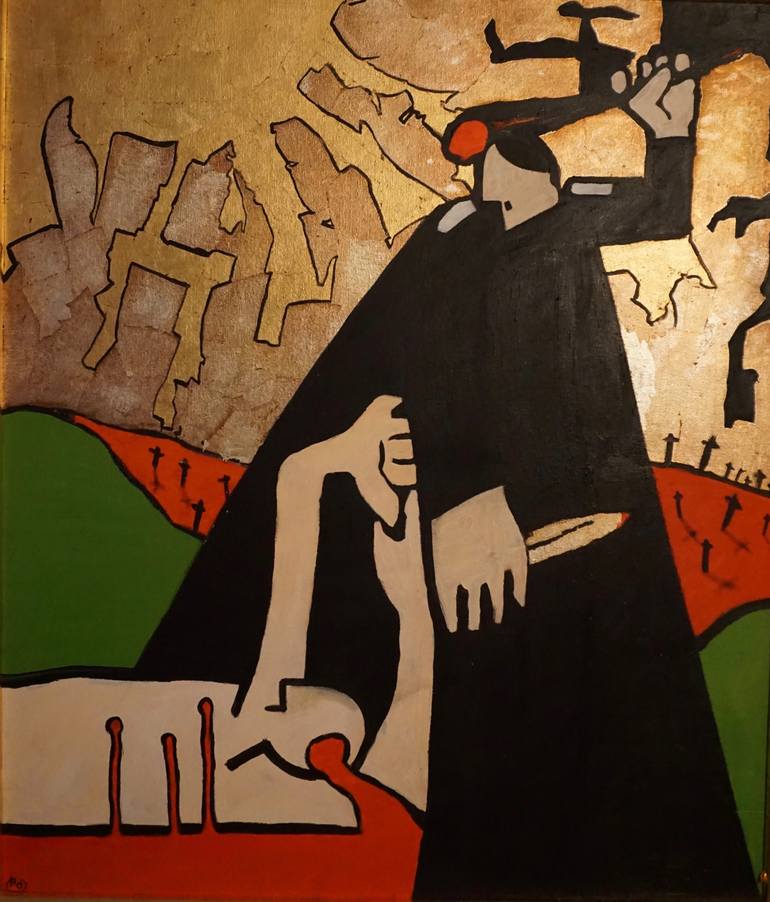
Cain and Abel, by Frank Hoesel

I learnt this Torah from Rabbi Joel Levy at the Conservative Yeshiva in Jerusalem.

judaism · sermon · theology

Abraham and the Paradox of Jewish Evangelism

A priest, a monk and a rabbi are debating which of their religions is the correct one. They decide to settle it with a contest to convert a bear to their religion.

The rabbi tries first. Two days later, the priest and the monk end up visiting him in the hospital.

The rabbi says: “OK, maybe I shouldn’t have begun with circumcision.”

Let’s set aside the foreskin jokes, because I don’t think the rabbi would have had much better luck with a lady bear. Isn’t it a strange fact of our religion that we almost never set out to proselytise?

We, of course, welcome all sincere converts, and this synagogue is happy to encourage anyone on their spiritual journey. But you won’t find us outside Asda, handing out flyers with words from the Mishnah. And you certainly won’t turn on your TV to see a rabbinic televangelist warning you about the perils of pork.

But if you think you have stumbled upon spiritual knowledge, don’t you want to share it with the world? Who are we to zealously guard the secrets of the universe?

Even if you take a more humble approach to Judaism’s teachings, and think they’re just as good as any other people’s, there must be something particularly worthwhile about Judaism for you to log in to this morning’s service rather than watching Bargain Hunt. (Wait, don’t go, I promise this is going somewhere!)

That strange paradox of Judaism – that we have a universal truth but don’t seek to spread it – is encapsulated in the story of Abraham.

This week, God tells Abraham: “Go out by yourself. I will make your name great and you shall be a blessing.”[1]

Then, in the next two verses, as if a parallel to the first, God says: “All the families of the earth shall be blessed by you.” Then Abraham goes out with Lot and Sarah.[2]

So… does Abraham go out to bless himself or does he go out to bless others? Which is it?

This is the great tension in Judaism. Do we exist only for Jews? If so, why are we trying to change the world? Or do we exist for humanity? In which case, why aren’t we trying to make everyone Jews?

Our midrash plays with this tension. Bereishit Rabbah, a collection of rabbinic explorations of Genesis, contains an unusual parable. In it, Rabbi Berekhyah compares Abraham to a tightly sealed bottle of perfume. The bottle was left in the corner and nobody smelt it. As soon as it was moved, its fragrance was emitted. This, says our midrash, is what it was like when God told Abraham to go out from place to place and make his name great in the world.[3]

Makes perfect sense, right? No? Fine, let’s unpack it.

Abraham is a tightly closed bottle of perfume when he starts out in Haran. At this stage, Abraham has encountered God. Abraham has realised that the idols amount to nothing and the Creator of the Universe is a singular and invisible presence. He is somehow pure and untouched. The Pagans have not affected his beliefs, and he has not affected theirs. He is hermetically sealed.

Then God tells him to lech lecha – to go out. Abraham moves around out from Haran and down to Shchem and Be’ersheva in the land of Canaan. As he moves between these places, others get to smell him. They encounter the truth that Abraham has learned about ethical monotheism. God is one and just! Now everywhere he goes people can get a whiff of this knowledge.

Only there’s another problem. Bottles of perfume don’t emit their scent because you move them. They only work when you open them. In this analogy, the balsamic bottle that is Abraham still remains sealed. How is he spreading his fragrances everywhere if he hasn’t even opened up?

I don’t think the editors of our midrash have made some mistake. I think they are telling us something profound about the Jewish paradox. We have a truth that we want others to know and yet we don’t want to convert anyone. Our role as a light unto the nations is that we go from place to place, showing others who we are, but not changing anything about who they are. We are still Abraham, that sealed bottle, going out from Haran, somehow expecting others to smell our perfumes but not opening up wide to spread our scent.

The very word “evangelism” is a Greek one, meaning good news, referring to the Christian Gospels. The early Church actively went out on recruitment drives, telling people about Jesus and his message. We have no such good news to share. What would we say to people? “Rejoice! God has commanded you to pursue justice and only eat unleavened bread in the springtime!” Jewish evangelism seems somehow a contradiction in terms.

And yet we do go out and share our beliefs. We are happy to expound our Torah to anyone. We expect to transform the societies we are in. When we speak out for justice wherever we live, we are very much hoping that others will take note of our concern for the stranger and adjust their actions accordingly. How can we reconcile this desire to change others with our lack of desire to convert them?

Perhaps the problem isn’t perfume metaphors and paradoxes. Maybe the issue is how we understand Judaism’s mission. Abraham wasn’t sent out to turn others into Jews. Abraham was sent out to be a Jew.

Abraham had to go out and be different, to hold a truth that no one else held. Even when he passes it on to his children, they each hold a different truth. Isaac becomes the founder of our Judaism. Ishmael becomes the founder of Islam. They go out holding different truths, both contradictory and complementary. Abraham’s revelation of God’s unity is a realisation that this universal God can never be captured by one person in a single truth.

Abraham’s mission wasn’t to make everyone Jews. It was to enable everyone to be themselves. It was that all these other nations could celebrate their differences, just as Abraham loved his own.

That is our task today. We don’t say to the nations: “we want you all to be Jews.” We say: “we want you all to be you.”

We are models of difference in a society where we are not a majority and in a world where we are not dominant. Our role is to show how to conduct that uniqueness in a way that demonstrates dignity.

This is our evangelism. That is the truth we hold and that we want to share. That difference is a wonderful and treasured thing. From our differences, we are blessed. And in our differences, we bless each other.

So go out from Haran and share that sacred truth. And don’t worry – you don’t need to go circumcising bears.

This sermon is for Parashat Lech Lecha. I will give this sermon on Saturday morning 31st October 2020 at Newcastle Reform Synagogue, and a shortened version the night before for Edgware and Hendon Reform Synagogue.


[1] Gen 12:1-2

[2] Gen 12:3-5

[3] Ber Rab 39:2

judaism · sermon · torah

Adam, Eve, and binary gender

The story of creation is probably the most well-known and most misunderstood of our Torah. Full of powerful imagery, t he Talmud says that it is forbidden to study the text alone because it is too easy to misunderstand.[1] Because it is so close to the High Holy Days, many Jews miss this reading in our liturgical cycle, having been exhausted by the great process of Rosh Hashanah, Yom Kippur, Sukkot and Simchat Torah, all festivals crammed together into a very short period of time.

The danger of Jews not hearing these texts and of religious leaders not teaching them is that people go away believing that the version we pick up from our surrounding culture is the only version of events. The story of Adam and Eve, in particular, has such currency in that all of us have likely imbibed a version of their story. We have seen paintings in art galleries of European-looking men and women covered with fig leaves. We have heard the stories told in different ways through popular culture.

The story we are accustomed to is one of binary gender. God made a man on the seventh day of creation. God then made the first woman out of Adam’s rib. They are a model of the natural male-female binary in the world and an example of the heterosexual monogamy God has intended for all of us. I am not going to question whether that is a legitimate or authentic tradition. None of us can say we speak with divine authority, so we have to be able to live with different and contradictory interpretations. What I do want to do is offer up an alternative version of the story of Adam and Eve: a Jewish, rabbinic, midrashic version of the story.

I’m sure it goes without saying that, in the progressive Jewish tradition, these stories are considered metaphors. The question is, however, metaphors for what? The stories we tell are important. If we tell stories, even metaphorical ones, of gender as fundamentally binary, and the natural order as fundamentally patriarchal, then we give credence to that worldview. We betray our feminist values and exclude our congregants who don’t fit into that binary. The rabbinic version of the Bereishit story does not only go against the grain of that perspective, but fundamentally overturns it.

First of all, it is not clear from our story that Adam was the first man. The word “adam”, as it is used in Genesis 1, acts as a noun, not a name. It speaks about a person, a human being. The word shares a root with “adamah”, meaning earth or clay. Adam, therefore, might best be translated as “earthling”.

Nor is it clear that Eve was the first woman, or that she was created from Adam’s rib. The biblical telling of her creation is somewhat inconsistent. In the first version of the story, in Genesis 1, a man and a woman are created at the same time. In the second version, in Genesis 2, Eve is created from Adam’s rib. The rabbis picked up on this strange disjunction. They also noticed that in the second version, when Adam meets Eve, he says “this one at last is the bone of my bones and the flesh of my flesh.” That word “at last”, in the Hebrew is “pa’am”[2], which could mean “this time around.” Our sages inferred therefore that the two stories tell of different relationships: the first of one between equals; the second of one with a dominant man and subordinate woman.

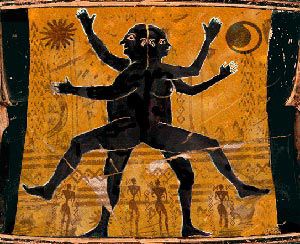
So, first, what was this relationship between equals? The rabbis suggest that man and woman were not just made at the same time. They were, in fact, the same person. The original human being, according to their midrash, had one body, two sets of genitalia and two faces.[3] Professor of Talmud, Daniel Boyarin, calls this person “the primordial androgyne.” Rather than binary gender being the model of original humanity, the first person is intersex.[4]

What then happened to this original intersex person? According to another midrash, they were split into two: Adam and Lilith. Notice that Lilith is not cut from Adam but that both are cut from each other: our original progenitors are equals.

The Ballad of Ben Sira, a medieval religious text that combines previous mythical traditions, tells the story this way:

“When the first man, Adam, saw that he was alone, God made for him a woman like himself, from the earth. God called her name Lilith, and brought her to Adam. They immediately began to quarrel. Adam said: “You lie beneath me.” And Lilith said: “You lie beneath me! We are both equal, for both of us are from the earth.” And they would not listen to one another.As soon as Lilith saw this, she uttered the Divine name and flew up into the air and fled.”[5]

What follows is a high-speed chase across the world involving angels and monsters. Ultimately, Lilith fights against Adam, the patriarchy and even God to become liberated. Undeniably, some tellings of this story are misogynistic, painting Lilith as a demon and a baby-killer, but the fact remains that a crucial part of the Jewish tradition is the story of an empowered woman who refuses to be subordinated. Our model of gendered relationships is a complicated mess of power struggles and queer subversion. It is, really, much closer to the relationships people really have.

The rabbinic tradition on creation tells us stories about intersex people, gender confusion, and resistance to patriarchy. Right now, the telling of those stories matters greatly. The government is debating an update to the Gender Recognition Act. When it was first passed in 2004, this act was a great sign of progress. It enabled trans people to legally change their gender on some certificates. As it stands, however, that process is highly medicalised and expensive. The new legislation would enable trans people to ensure that their gender is reflected on their birth certificates without having to jump through great hoops.[6]

This might seem like simply a bureaucratic change, but it has invoked great ire across the political spectrum. Underpinning much of the backlash is the idea that gender is both binary and innate. For the ideological opponents of the upgrade to the Gender Recognition Act, a gender cannot be changed. Much of their discourse has been quite hateful and aggressive. Transphobic abuse has become exceptionally loud, especially online.

What we can say in response to this is: in our religious tradition, binary gender is deeply disputed. In rabbinic Judaism, the first person was intersex, and transitioned from being one intersex person into two people: men and women. In our religious tradition, gender is complicated and malleable. Perhaps, armed with Jewish understandings of human nature, we may be able to push back against some of this hate.

Shabbat shalom.

androgyne-56a55f455f9b58b7d0dc900a

I gave this sermon on Saturday 6th October at Manchester Liberal Jewish Community. A congregant helped correct some of my understanding of the GRA. If you would like to speak out in support of the GRA, you can respond to the consultation using Stonewall’s resources.

[1] Hagigah 11b

[2] Gen 2:23

[3] Leviticus Rabbah on Genesis 2

[4] Daniel Boyarin, Carnal Israel

[5] https://www.myjewishlearning.com/article/lilith-lady-flying-in-darkness/

[6] https://lgbt.foundation/gra