Some years ago, an Orthodox friend asked me: “what would you do if the Messiah came and it turned out we’d been right about everything? What would you say to the Messiah?”
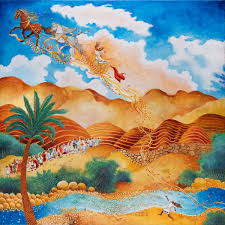
What would I do if the End of Days came, and Elijah literally came storming out of the whirlwind in a chariot made of fire and declared that the Son of David had arrived to cast judgement? And that we were to be judged on how strictly we had separated men and women; how well we had obeyed family purity laws; how stringently we had adhered to traditional authorities?
What would I say to this Messiah?
I have thought about it for a good few years and I think I now have my answer.
I would say: “F@£& off.”
I would tell that messenger: “You are not my Messiah and you’re not my king. Now go back where you came from.”
In this week’s haftarah, we read the prophet Ezekiel’s vision of the valley of the dry bones. For centuries, Orthodox Judaism has based its understanding of Messianism on these verses.
Ezekiel finds himself in a desert surrounded by skeletons. God tells Ezekiel to prophesy to the bones, and he does so, covering them in sinew, breathing life back into their lungs, and reviving their bodies, so that they stand up as a skeleton army.
These, says God, are representative of the people of Israel.
So, Orthodox Jewish tradition teaches, a day will come when the dead are literally physically resurrected. The corpses of pious Jews throughout the ages will be brought back to life; the exiles gathered to Jerusalem; and all judged by a righteous king descended from the biblical King David.
For this reason, many Orthodox Jews eschew cremation, and insist on being buried intact, so that their bodies can be resurrected at the End of Days. They vie for graves on the Mount of Olives, so that they can have front row seats when the Messiah arrives at the walls of Jerusalem and summons up the dead from their tombs.
In recent decades, religious fanatics have come to espouse an even more intense version of this apocalyptic vision.
There are Orthodox Jewish extremists, funded by American evangelical Christians, who are trying to destroy the Al Aqsa Mosque on the Temple Mount; build a Third Temple; and restore animal sacrifice and priestly leadership. They seek to expand Israel’s borders to restore the ancient Kingdom of King David.
This week, Rabbi Charley Baginsky was quoted powerfully in The Times, saying: “We are afraid — not just for Israel’s future, but for Judaism itself. What becomes of our tradition if it is captured by messianic extremism, by racism disguised as religion, by power without principle? If the current trajectory continues, if Jewish supremacy becomes policy, then Judaism itself may become synonymous with oppression.”
In this context, you might be forgiven for thinking that messianism itself is the problem. Surely a religious zeal that drives people to commit such crimes is itself dangerous. For some, witnessing this fervour makes them question the foundations of Judaism itself.
The Israeli religious scholar, Avraham Uriah Kalman, warns against this way of thinking. His article earlier this year, entitled Another Messianism, addresses a tendency in Israeli secular society to dismiss all religion as varying stripes of nationalist fanaticism.
Yet, he claims, precisely because of the strength with which racist extremists have captured Judaism, we must return with equal zeal in our reclamation of Judaism. We, who believe in justice, democracy, and human rights must just as vigorously defend our corner.
If we do not have an equally powerful vision for what society could be, we will always be on the back foot, compromising with monstrous ideologies that want to blow up buildings and raze down villages.
Our ethics are grounded in the Jewish tradition. They are derived from the Jewish texts. They are sourced from the Living God.
We cannot allow the far right to take exclusive hold over any part of Jewish life, or we surrender it to them. That includes Messianism – the grand utopian visions of ideal societies promoted in every book of the Prophets.
The Prophets, whose mission of speaking truth to power and uplifting the lowly, are far more in line with our Progressive visions of the world than they are with the soulless dreams of those who want to oppress women and gays as part of their supremacist agenda.
In the Prophets, we see clear visions of a perfected world. Their writings testify to a world of peace; where all resources are shared; where everyone lives in dignity; and where all are free.
Outside of specific esoteric texts like this week’s mystical imaginings from Ezekiel, it is hard to see any of the far right’s fantasies reflected in our Prophetic texts.
Messianism is really supposed to represent a rupture in the established order, but that is not really what the far right offers. War, racism, and misogyny are already the norm. At core, they don’t really want to change anything except to make existing tendencies more violent and oppressive.
So, says Dr Kalman, progressives must embrace messianism. We must turn to the Prophets as our source of hope, rather than buckling under the weight of despair. From our own utopian visions, we can develop ethics that speak to our daily lives and help us practically realise a better religious vision.
Kalman draws on a whole range of Jewish religious traditions, including Talmud, Kabbalah, Musar, and 17th Century Tzfat mystics.
Yet, curiously, he seems not to be aware that this project, of developing a Progressive Messianism, has already been deeply thought through. The early Reform movement in Germany, from which Liberal Judaism descends, was animated by looking to the Prophets to rethink Jewish eschatology.
The early Reformers taught that the Messiah would not be a man, but an Age.
It would not be characterised by Temple and Kingdom revival, but through the realisation of the values of the Prophets. It would be a world of peace and justice, achieved through the moral advancement of all humanity.
Explaining this theology, Rabbi Sybil Sheridan writes:
“Though the end goal is world peace, the ideal is not pacifism, nor is it the peace of treaties at the end of war that are based on winners and losers. That notion continues the imbalance of power among peoples and nurtures the resentment that leads to dreams of revenge. The peace of the Messianic Age is a peace forged in complete mutuality. No one should be afraid that people may covet their vine or fig tree, no one will fear the loss of land or resources, no one will be humiliated. The world provides enough for everyone and sufficiency will take away the desire for war.”
While we Progressives do not accept the Orthodox doctrine of bodily resurrection and rebuilt Temples, that does not mean we should reject Messianic thinking. Times of despair and horror are when we most need to cling onto our hopes for a better world.
Progressive Messianism takes the task of perfecting the world away from mythical figures like Elijah and King David, and places it directly in our own hands. It says: we will not wait for someone else to bring about redemption; we are going to do it ourselves.
So, if Elijah came down from the Heavens and declared that the Orthodox had been correct all along, I would tell him he was wrong.
For thousands of years, we have sought to create a better world. We have learnt through struggle about the dignity of women; the importance of justice; and the shame of racism. We now have a much better idea of how the world can be.
We can see a future in which every human being lives in harmony with each other and their planet. We can see a world where all live in freedom and peace. We are sure now that we can live in love and equality.
We are going to realise our Messianic age.
And nobody- not even a prophet descending from the skies – is going to stand in our way.
 Sim Lev