protest · sermon · social justice

When a swastika appeared on my primary school wall

Do you remember the first sermon that really moved you?

I do. It was a primary school assembly.

Mrs. Kilou stood at the front of the hall, as all us uniformed children awaited the morning messages.

She began with a question: “who knows what I hate most in the world?”

A kid suggested: “Lateness.”

“No, not lateness.”

Another offered: “scruffiness.”

“No, not scruffiness.”

One more: “When we don’t do our homework.”

“No, this is the thing I hate most in the world. Way worse than lateness or scruffiness or not doing the homework. The thing I truly despise.”

Finally, a kid ventured: “racism.”

“Racism, that’s right!” She spat the word and the whole crowd sat up to attention. The fury in her voice was palpable.

She had good reason to be angry. Somebody had spray-painted a large swastika on the outer wall of our primary school.

***

For the last two months, I have been trying to work out what to say. There have been days recently when many of the parents from this community didn’t send their children into school, worried that they would be targets. Members have shared stories of taking down their mezuzot, and hiding their symbols of Jewishness. I have felt, at times, like the community is overtaken by panic.

What do you say to people who are so anxious and angry? How do you meet people in their fear, and help them move beyond it?

I haven’t known what to say. So, the last few times I have stood on this bimah, I have just shared what is in the Torah.

But there is a trauma that needs to be addressed.

It doesn’t help to tell people that there is nothing to fear. That only makes people feel alone in their feelings, and that just makes them more afraid.

What repeated studies show is that what matters about handling traumatic events is less what happens afterwards than what happened before. People are better able to negotiate destabilising situations when they already have a strong sense of self; feel proud of who they are; and have a clear story about themselves.

So, I think the best thing to do from here, for now, is to tell my own story. My own relationship to antisemitism.

My account is, of course, personal, and not definitive. But I hope it will open up spaces for others to share their stories, and for us to begin a conversation about who we are, and what experiences formed us.

***

The swastika on my school wall was not for me. Not in the direct sense. That is to say: whoever drew it did not have Jews at the forefront of their minds.

We were not a Jewish school. We were a multicultural one in the centre of an industrial town, surrounded by white suburbs, and even whiter countryside. The other students, my friends, were Pakistani Muslims, kids from the Caribbean, refugees from Kosovo… we were a little bubble of people from everywhere, and, though I did not know it then, were a source of moral panic among readers of certain newspapers. We were, to those that feared integration, a symbol that Britain wasn’t British anymore.

And, of course, that swastika very much was for me. It was an attack on my community. It was antisemitic because all swastikas are. It was calling to me, because all racism does.

Around that time, my parents began telling me stories. But not the stories you would expect. They didn’t tell me about family members who had escaped Germany or died there. They did not explain why some members of the synagogue had tattoos on their arms, or how others had met each other on refugee trains. I only came to learn that much later.

They told a story about how, not long ago, the Council had erected a new housing block. One of the first people to be offered a home there was a black woman. Racists came to protest. ‘Houses should be for whites.’ The Pakistani community centre came out in large numbers and escorted the racists back to the train station and out of town.

This is an oral history, and I won’t be able to verify it from newspaper reports, but I suspect my parents made it sound more peaceful than it really was.

They told me other stories too. Stories of hundreds turning out to see off the National Front. Stories like how the Jews and the Irish united to defeat the Blackshirts at Cable Street. Stories of partisans and resistors.

They told me how people could stand up against racism and win. They told me about how, when it comes to racism, our greatest strength is each other.

I don’t know if this was their intention, but I learnt then that the swastika was not something to be feared. It was something to be destroyed. And that people could, and did, destroy it, wherever it appeared.

So, I grew up feeling not so scared of Nazis as determined to stamp them out.

***

Some university students spend their weekends studying. Others spend them partying. Me and my friends? We spent our weekends chasing the English Defence League.

Don’t get me wrong. I did study. And I did party. But some of my most formative memories from that time were of bundling into minivans and car convoys with my housemates to towns in the Midlands and the North.

At that time, Tommy Robinson had assembled a band of white supremacists, bored football hooligans, and lost boys, to go and protest wherever there was a mosque. They usually targeted the mosque itself, and would go to the towns with the express aim of intimidating the Muslims.

Opposing them felt like the only right thing to do. Fighting fascism felt like a calling in a very similar way to how the rabbinate does today.

There was a group of us, from different towns, who always went along, led by a gentle couple called Simon and Sadia. We were always met by locals, usually gathered from community centres and religious groups, who would join in showing the racists that they weren’t welcome.

I learnt from these forays into antifascist activism that, while there were always some who resisted fascism, they weren’t necessarily popular. Media narratives after each protest often framed the unfolding events as if the fascists and their opponents were equally bad. As if it would be better if these small groups of students and locals stayed home and let the racists go unchallenged.

I might have believed them, if it weren’t for what I saw happen in Dudley. There, the English Defence League significantly outnumbered the protesters. Police lost control of the situation. Over that weekend, in broad daylight, those thugs went round smashing in the windows of any house with black and brown people living in it.

As we ran away from the violent gangs storming the town, we passed a house where a black teenager had been visiting a white family. Their windows had been smashed. “I’m sorry,” he was saying, “I think it’s because of me.”

I learnt from this a lesson that has informed how I think about all racism and antisemitism since. Our strength is in each other. Our defence is our neighbours.

This runs contrary to some of the received wisdom about antisemitism. We are, after all, a small minority that lives in concentrated areas of large British cities. One story about how to handle the prejudice we face is that we must depend on the state to defend us against the baying mob of our neighbours. It is because of this that older members will share the axiom: “as long as the king is safe in his castle, we’ll be safe in Tower Hamlets.”

My experiences turn this on its head. The non-Jewish majority is not our enemy. They are our most reliable bulwark against racism. When it comes to fascists, we are the masses and the masses are us. Our greatest strength is each other.

***

That story, of solidarity in the face of racism, is also played out in the story of this synagogue. My friend, Joseph Finlay, just completed his PhD, looking at Jews and race relations in post-war Britain. During his archival research into the history of fighting racism, one shul kept cropping up. This one.

During the 1960s and 1970s, this synagogue was led by the visionary rabbi, Dow Marmur. He arranged visits from volunteers to homes of new immigrants to Redbridge, as well as English conversation classes to help neighbours settle in. In 1978, the synagogue held a “multiracial dance,” in a clear statement of unity against racist scaremongering about miscegenation.

Rabbi Marmur brought a motion to the RSGB Conference of 1968, which encouraged other synagogues to adopt similar policies, and follow SWESRS’ example. He accompanied his motion with a powerful sermon.

While others shied away from fighting racism, or even expressed sympathy with the anti-black and anti-immigrant feeling, Rabbi Marmur issued an impassioned plea. Yes, he said, the racists do draw comparisons between Jews and black people, and “we have a special duty to remember the Prophet’s comparison and to affirm that we are, in fact, alike -in the beneficent eyes of God!”

He encouraged meaningful solidarity, urging “let us beware of condescending and patronising “do-goodery” … “And at no time must we allow ourselves to be fobbed off with cowardly calls for “prudence” and “caution” when these are euphemisms for inactivity and indifference.” Finally, Marmur compelled his listeners: “the primary force of our involvement must be our religious conviction; God bids us act-and we must obey!”

This summons stands at the centre of my own response to antisemitism. It is not only the swastika that calls me, but, more importantly, the voice of the Living God.

In that voice, I hear the demand to continue being Jewish, without apologies.

In God’s Word, I hear the call to resist antisemitism, not only out of self-preservation, but from a religious demand that there must be diversity.

And in God’s Torah, I hear, always, that most-repeated verse: “love your neighbour.” Yes, love your neighbour as yourself. Love them because they are you. Love each other because that is our strength.

And our love for each other may be our salvation.

Shabbat shalom.

high holy days · sermon

Come back to hoping, even if only slightly

Do you remember how you were as a child, when you only believed good things about the world, and you thought everyone was trustworthy and kind, and you felt you could achieve anything with the power of imagination? Come back to that. Just for a while. Come back to that.

Before the cynicism of adolescence set in and you realised your parents didn’t know everything and you started to question life’s meaning. Come back to that.

You can’t go all the way back. Years of experience have softened some pretensions and hardened some edges.

But try to reclaim a little bit of that optimism and wonder. The person who believed those things lives somewhere inside you still.

You don’t have to come back all the way. You don’t have to believe everything.

You don’t have to believe that God is perfect and created the world and will bring about the Messianic age any day now and will reunite us all with our loved ones.

You don’t have to have perfect faith. I don’t. I doubt many sincere people do.

But you have to hold onto some faith. You have to believe in something. You have to have hope, no matter how fragile it is.

Today is Shabbat Shuvah: the sabbath of return.

It calls on the words of our haftarah, Hosea, where the prophet beseeches us: “come back, O Israel, to the Eternal One your God.”

Return to the faith you once knew.

You have abandoned your self-confidence, says Hosea. You have accepted defeat by Samaria. Assyria will not save you, nor will its gods.

The prophet calls out: “You could blossom like a lily and be beautiful like an olive tree. You can live again.”

Reviving belief is a challenge. We have all suffered our defeats, personal and communal. They have embittered us with cynicism.

Shabbat Shuva is a calling back to faith. It is an invitation to try and remember what it was like to dream.

That is not easy. Some people had life’s harsh realities thrust upon them too young, and had to grapple with injustice too soon.

Primo Levi was such a man.

He was a Jewish chemist in Italy.

When I was a teenager and full of the arrogance that I’d got the world figured out, my dad gave me one of Levi’s books, The Periodic Table. Outside of religious literature, I think that is the only book I’ve finished reading and immediately restarted.

The Periodic Table tells of Levi’s story, through the prism of different elements.

From the noble gases of his Italian-Jewish heritage to the hard, grey metal of Vanadium in his old age, Levi talks us through his experiences of fascism in Italy, which began when he was an infant.

Italy was the first country to adopt fascism. Mussolini came to power on a platform of nationalism, tradition, corporatism, and dictatorial control. His slogan was “Everything in the State, nothing outside the State, nothing against the State.”

In Primo Levi’s teenage years, the Italian fascists introduced their racial laws, directed primarily against Italian Jews and Africans. The Africans were placed in colonial concentration camps. The Jews were initially stripped of citizenship and assets, banned from the professions.

At the time, Levi was training as a chemist in a laboratory. His Christian classmates were civil, but withdrew from him, and regarded him with suspicion, and he became a loner. He took solace in chemistry, hoping that its solid truths could puncture fascist lies.

To survive the racial laws, Levi said, he needed to take advantage of his youth and turn a willing blindness to everything happening around him. He needed to imagine that the world was still fine, as he imagined it ought to be. In that naivety, he did not even realise he could actively resist fascism.

When he and his comrades decided to fight the fascists, they turned to the Bible. He saw in his own struggle the struggles the prophets had waged against empires. But he also looked up to the sky and felt that it was empty. God would not save them. They would have to save themselves.

Perhaps this is what it means to have just enough faith. Not so much that you blindly invest your hopes in a God who rescues, but enough that you can draw inspiration from others, past and present. Enough faith to believe that your cause is just and that fascism can, ultimately, be defeated.

Levi knew he had to get angry, and act. He filled his heart, more with desperation than hope, and took up arms.

In the snowy mountains, he fought as a partisan, and was captured by the fascists.

How did he survive the camps? Levi took pride that he went into the camps as an atheist and never wavered in his disbelief. But he refused to succumb to pessimism. He never allowed himself to become disheartened completely. He would not let the fascists take from him his hope.

Who could blame Primo Levi for not having ultimate faith in God’s redemption? But he had just enough faith. Just enough to stay alive and keep fighting and, afterwards, to testify to the truth.

You do not have to believe everything. But you must believe something.

You must come back to hoping, even if only slightly.

I think you already know why I am telling you this.

Precisely one hundred years after Mussolini marched on Rome, the fascists have returned to power in Italy.

In the days before the election result came through, an Italian friend of many years texted me, to say how scared he was. It looked like the far right’s victory was already assured before the polls.

When the results came, they were worse than expected. Giorgia Meloni, and her far right party, the Brothers of Italy, had trounced all other parties at the ballot box, and would not even need Berlusconi’s support to form a government.

In her election address, she promised to give back Italian national identity that had been stolen by “international financiers.” She said she would bring back the family, which had been eroded by LGBT people.

She immediately pledged to replace the post-war constitution, which had enshrined democracy and minority rights.

I do not want to be alarmist, but I am also unable to blindfold myself to experience. There was a generation who could wait and see how fascism would pan out in Europe. We do not have the pleasure of such naivety.

We have to be sober. We cannot allow ourselves to be blindfolded to what is happening.

But we cannot ever allow that to become despair.

Hosea does not just implore the Israelites to return, but promises that God will come back too.

The Holy One promises: “I will heal them. I will cause them to return to Me in love. I will turn away from My anger.”

If you take a small step towards hope, hope will step towards you too. Hope will carry you.

On this Shabbat Shuva, however much faith you have, try to have a little more.

Remember faith. Come back to hoping, even if only slightly.

Shabbat shalom.


theology · torah

Stop doubting. Start doing.

Job was a man of complete integrity. According to his eponymous book of the Tanach, no matter what happened, Job was the epitome of Jewish righteousness. Then hardship fell, and Job began to doubt God’s justice.

This was hardly surprising. God had stripped him of everything, ridden him with disease, killed his children and destroyed his livelihood to test whether or not Job would remain faithful.[1]

As it turned out, Job could only endure so much. His friends comforted him with explanations of how God must be righteous after all, but they were insufficient. Finally, Job began to snap. What if God was not just?

Just then, God burst out through the clouds. “Who are you to question Me?” demanded God.[2]

After a lengthy excursus from Job’s inadequate interlocutors, we might expect a more thorough explanation. God has arrived and will explain the nature of justice.

Instead, God goes off on one about mythical beings. God talks about the Behemoth, an enormous bull-like monster that can rampage fields. God describes Livyathan, a fire-breathing dragon that cannot be killed.[3]

And this, apparently, satisfies Job.[4] Well, I’m not satisfied. I don’t know about you, but if I’m having doubts about my faith, “have you heard about the monsters God tamed?” won’t really cut it for me. You can’t respond to rational concerns by piling on ever more improbable legends. Now I’m filled with even more doubts.

But perhaps that’s the point. The author of Job, arguably the most philosophically complex text in our Tanakh, probably knew that these myths weren’t really an answer to the question posed.

The real answer, hidden within these poetic arguments, is that we don’t know. Whatever God is, it is beyond our comprehension.[5] Whatever justice is, we cannot fully reason it enough to grasp it. ‘You don’t need to understand,’ is what God is really saying.

Similarly, our parashah this week concerns Moses’s doubts. We have come to the book of Exodus, and Moses has already run away into the wilderness. Out of a flaming thicket, God summons Moses to rescue the Israelites from their slavery in Egypt.[6]

Just as God answered Job from the clouds, so too does God answer Moses. But the answer Moses receives is no more comforting. ‘You don’t need to understand,’ says God, ‘you need to get going.’

“What if I’m not good enough?” asks Moses. “You will be,” says God.[7]

“Who even are you?” asks Moses. “I will be whatever I will be,” God roars back. “Tell the Israelites ‘I will be’ sent you.”[8]

“What if nobody believes me?” asks Moses. “They will,” says God.[9]

“But what if I can’t find the words?” asks Moses. At this point, God loses patience. “I gave you your mouth, I will give you the words! Now get yourself down to Egypt and set those slaves free!”[10]

Miracles might be convincing to some. Logic and reason might work some of the time. But, ultimately, you have to act. When faced with injustice, there is little time to contemplate the nature of sin and perfection and God’s role in it. You have to get out and do.

Rabbi Abraham Joshua Heschel was a Conservative theologian and civil rights activist, famously pictured alongside Martin Luther King Jr at the march on Selma. He said that Judaism does not require a leap of faith, but a leap of action. We are called upon, first and foremost, to act. Whatever we think about it can come later.

This might sound strange to us, educated in a Western thought system that teaches us to calculate and reason before making choices. But it was not strange to the Israelites. When God called on them at Mount Sinai, they replied “we will do and we will hear.”[11]

According to the Talmud, a heretic accused Rava using this verse. Rava was sitting, so engrossed in study, that he didn’t notice he had trapped his finger in a chair leg and it was spurting blood everywhere. “You impulsive people!” the heretic said. “You still bear your impulsiveness of acting before you think. Listen first, work out what you can do, then act.”[12]

Rava responded with the verse from Proverbs:[13] “The integrity of the upright will guide them.”[14] We trust in our integrity. We trust in our conscience. We can be moved by our faith that we know right from wrong.

I think, over the last few years, progressives have done a great deal of doubting. We have been introspective and thoughtful. We have wondered, internally and out loud, whether we are right after all. Perhaps, as nationalist ideas return and religious conservatism gains strength, we might be able to make compromises on our ideals and find a middle-ground with others.

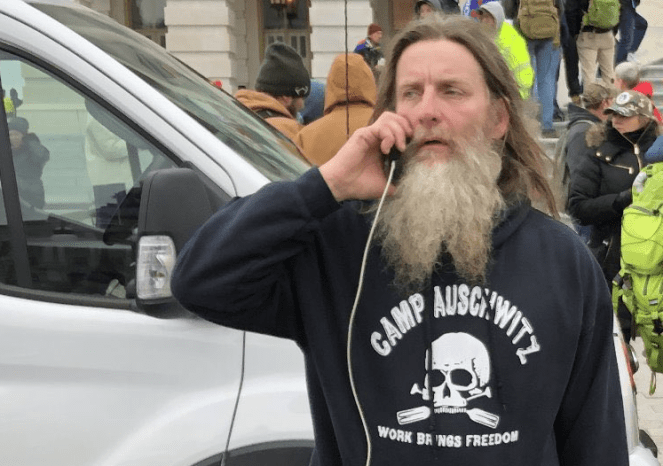
This week, fascists marched on the White House. They carried Confederate flags into Congress. A Nazi showed up among the rioters wearing a shirt that said: “Camp Auschwitz” on the front, and “staff” on the back, as if taking credit for the mass murder of Jews. They proudly displayed nooses, the symbol of anti-Black lynchings. Every brand of far-right conspiracy theorist and white supremacist descended on Washington, and video evidence shows that the police not only tolerated them but let them in.

Where has all our doubt and consideration left us? In our desire to find common ground and engage in reasoned discourse, we now come across as morally ambiguous and uncertain in our principles. We have left an ethical vacuum, and fascists have stormed into it. Intellectual curiosity is little use against the blunt force of white supremacists seeking to violently cease power.

Rabbi Professor Tony Bayfield has pointed out that our uncertainty is what differentiates us from fascists. Fascists are, by definition, absolutists. They do not interrogate their views or consider other perspectives. Our advantage over fascists comes from the fact that we give arguments due consideration and approach our own convictions with humility.

He may be right. Doubt might separate us intellectually from fascists. But it is action that separates fascists politically from power. There is no joy to be had in feeling superior if white supremacists gain power in government.

This week’s events may have been a terrifying climax to Trump’s presidency. But it is equally likely that they are a prelude to worse events. American white nationalists are emboldened and convinced that they can seize power through either ballots or bullets, depending on whichever method suits them. The situation in Britain is scarcely different, where racists have not felt so confident in decades.

Whether Trump now recedes into the background or his racist ideas come to dominate the world will depend on how we act. It will not depend on what we think, but on what we do. Events are calling us to action. If we want to eradicate fascism, we must be willing to fight it.

By all means, have doubts. Moses doubted. Moses was unsure. But God said to him, ‘go anyway. Get down to Egypt and free those people.’

We must be willing to face the Pharaohs of our time with the same vigour. We must be able to say: “I have come to act because God sent me. I am standing for justice because I know it to be right and true. I am standing against racism because I know it to be wrong. I will free these people. I will uproot tyrants. I will defend democracy and advance the cause of the oppressed.”

The integrity of the upright will guide us.

Although we may not fully understand these monsters before us, we will slay them.

And we will vanquish fascism for good.

Shabbat shalom.


I am giving this sermon on 9th January 2021 at Newcastle Reform Synagogue for Parashat Shmot.

[1] Job 1

[2] Job 40

[3] Job 41

[4] Job 42

[5] Job 11

[6] Ex 3

[7] Ex 3:11-12

[8] Ex 3:14

[9] Ex 4:1-9

[10] Ex 4:11-12

[11] Ex 24:7

[12] BT Shabbat 88a

[13] Prov 11:3

[14] BT Shabbat 88b