debate · sermon · torah

Did the God of the Bible have a body?


After our wedding, everyone was excitedly sharing photos and videos. Laurence pored over them and made albums.

I liked them, but the pictures felt a bit flat. What I was craving was words.

I wanted to re-read everything everyone had said. I went about collecting the speeches people had given, and recounted them again. On honeymoon, Laurence and I re-read our vows to each other, this time pausing and discussing them.

I discovered anew how much more I loved words than pictures or videos. Pictures are static. Even videos, because they only caption one moment from one perspective, feel too final.

To me, words feel so much more alive. Stories are such a great way to engage with events and ideas, because they can be retold so many times and in different ways.

Isn’t this, after all, what religion is: storytelling to access something sublime and unfathomable; a collaboration by people sharing their best narratives and ideas?

We have inherited a literary tradition, our Torah, which is an exercise in storytelling:  a process of openly wondering at the world through poetic sagas and emotion-filled songs.

For some, however, these stories fall flat. They see the words the way that I see pictures.

Fundamentalists will look at our story of a donkey talking to a prophet about an angel and think: that must be the historical truth of what happened.

Similarly, the New Atheists look at this beautiful poetic piece about the prophet Balaam and think: how stupid must religious people be to believe this nonsense?

This is not just a misunderstanding of Scripture. It’s a misunderstanding of storytelling itself.

Seemingly, it does not occur to them that this might be an invitation into conversation. They can’t comprehend that this might be a poem, crying out to be read aloud, sung, chanted, interpreted, and retold to make sense of all the wonders of the world.

Perhaps these talking animals and sword-wielding celestial beings aren’t part of history textbooks but reveal a different kind of truth altogether.

In Britain, we are mercifully spared from most of these types of fundamentalist reading. We don’t have to deal with as many evangelical Christians as our American cousins do.

But we have our own local brand of biblical literalists. They are the radical atheists who have got to know our sacred texts solely for the purpose of showing how irrational they are. The most famous of them is Professor Francesca Stavrakopoulou, a biblical scholar at the University of Exeter.

In 2021, Stavrakopoulou brought out her most recent work, God: An Anatomy. The book’s objective is to show that the God of the Bible was an embodied being. He was a gargantuan man with a big beard who sat on his throne in the Jerusalem Temple, gobbling up the sacrifices priests burned for Him.

The God of the Bible, Stavrakopoulou argues, was just like any other ancient god: basically a massive person with all the associated wants and desires. She collapses about 4,000 years of history and three continents into one culture and seeks to show that the biblical god was just like all the others.

And, like all the others, the biblical god had a body.

Sometimes, her evidence for this scant. There are entire pages dedicated to making quite wild claims about the biblical god, appended with just one footnote that points to an obscure translation of a verse from the Psalms.

But, overall, there is plenty of material to go off. If you open up any page of Tanach, you will probably find God described in anthropomorphic terms.

Take our haftarah.

This week’s reading comes from the book of Habakkuk, a 6th Century BCE Prophet in Judah. The book is a vivid war fantasy, where the prophet describes the Judahites crushing the invading armies, some time in the mythic past, and hopes that it will happen again.

Throughout the text, God comes alive as a warrior. He (and I’m going to use the masculine pronoun advisedly here) is an embodied fighter on behalf of the people.

God’s hand lights up with radiance; God’s feet trample over mountains; God’s piercing eyes make the nations trembled with fear. 

God has all the equipment of an ancient military commander. He rides in on a chariot  with His horses and shoots out arrows from His archer’s bow. God rips the spear from the opposing general’s arm and stabs it into his head.

How are we supposed to read this?

Well, for a biblical literalist, you have to take it at face value. That’s exactly what Stavrakopoulou does. She makes the case that this was precisely how the ancient biblical authors and audience understood their god.

Their god was a big bloke with some massive weapons and blood lust.

Stavrakopoulou draws on other ancient gods, whose worshippers also describe them in embodied terms. The Canaanite high god El also had radiant arms. The Akkadian god Enki also trampled over mountains. The Assyrian god Ashur also fought with a bow.

The Israelites, then, were just riffing on old themes. Like the Pagans around them, they were silly enough to believe in all that religious nonsense of big beings. The biblical god was no different to Zeus or Jupiter.

Overall, reading Stavrakopoulou, you get the impression of someone listening to a concerto who can identify every note from every instrument but cannot hear the music. Her entire objective is to show that the tune isn’t even that good because other songs have been written before.

All the way through, it seems like a strange motivation for going to all the effort of learning Scripture and Ancient Near Eastern texts. Then, we get to the final chapter, entitled “Autopsy,” and we understand her true objectives.

She concludes: “the God of the Bible looks nothing like the deity disected and dismissed by modern atheism. […] Their dead deity is a post-biblical hybrid being, a disembodied, science-free Artificial Intelligence, assembled over two thousand years from selected scraps of ancient Jewish mysticism, Greek philosophy, Christian doctrine, Protestant iconoclasm and European colonialism. In the contemporary age, this composite being has become a god who forgot to create dinosaurs and failed to account for evolution; a god who allows cancer to kill children but hates abortion…”

Stavrakopoulou despises religious belief. So, if she can demonstrate that the biblical god was just like the Egyptian pantheon, and that this embodied god could be killed, then she can also strip the modern god of His powers and kill Him too.

This is the worst of Enlightenment hubris. 19th-century anti-religionists imagined that all religion was just silly superstition, which would eventually be washed away by the cold science of reason.

Our movement, like all progressive religions, has consistently argued for an alternative approach. We see all of history as an evolving effort to understand the sacred mystery beyond our comprehension.

It almost certainly is true that, before Ezra led the exiles back from Babylonian captivity in the 4th Century BCE, most Israelites did worship a small pantheon of Canaanite deities. The Prophets from before this time regularly condemn them for it.

But, while they may have been idolaters, they were not idiots.

If you told one of them that you’d just seen the fertility goddess Asherah out for a stroll in the marketplace, or that the storm god Baal came to your house this morning for a cup of tea, they would think something was wrong with you.

Another scholar of ancient religion, Iraqi Assyriologist Zainab Bahrani, helps us make sense of the ancient worldview. For the Mesopotamians, images were not reproductions of originals like portraits and photographs are for us today.

Instead, they saw their icons as ways of writing existence into being. They were in an active process with their gods of creating reality.

In matters of religion, literal interpretations are dead-ends. Words like metaphor don’t do it justice. Symbols like clay deities stand in for whole cosmologies. They are ways that human beings have tried to understand something that, by definition, is beyond our comprehension.

Perhaps most importantly, Stavrakopoulou misses what a massive departure it was that ancient Israelites abandoned all images in favour of a predominantly literary culture.

In a society where you cannot depict God, but can only engage in description and storytelling, you have to be more imaginative when you try to make sense of infinity.

Poems, sagas, and speeches, like those from our Tanach, are never fixed in their meaning. They are openings that invite listeners to think with them, talk back to them, and struggle for deeper understandings.

When someone reads a text too literally, they strip it of its vitality. Atheists and fundamentalists, both literalists of different kinds, strip the soul from the search for divine truth.

Tell stories, make poems, create art, look for that great truth beyond our reach… and don’t take any of it too seriously.
festivals · judaism · torah

What happened at Mount Sinai?


We are days away from Shavuot, the Feast of Weeks, when we celebrate having received the Torah. At this festival, we affirm we have received God’s word and that it is unfailing.

This is what we think we know: these words are not only God’s.


They have human origins, and they were written over many centuries. The Torah is not a single, unaltered revelation. It is a book with a history.

What happened at Mount Sinai matters immensely. It is the foundation of our faith. It is the basis not only of Judaism but of every monotheism that followed it.

The story has been told so many times. Hordes of Hebrews fled from Egypt, gathered around the foot of a desert peak, and heard the voice of the One True God.

What they experienced, they told to their children, and they to theirs, until – after generations – the vision was written down into a collection of stories and laws we call the Torah.

We have to know what really happened at Sinai; so much hinges on this indecipherable point of history.

We have to believe in the real world, where history is something made by human beings, who work, and struggle over resources, and build societies.

We have to believe in the God of Judaism, who is revealed through history.

We must synthesise the two. We cannot split the material and the spiritual. We need to know what the material reality was that lay underneath this spiritual truth. We need to know what happened at Sinai.

We cannot truly know, but we have to try and work it out. A group of human beings felt so inspired that they wrote down ten commandments and passed them on for thousands of generations. Why?

A group of human beings, who surely worked and slept and ate and drank and dreamed, proclaimed that they had seen God.

Something marvellous must have happened at that time. Something awe inspiring – to give us this treasury of ancient wisdom. Who committed these words to paper, what happened to them, and what made these commandments feel so important to them?

What really happened at Mount Sinai? The biblical historian pores over our texts, strips them back, digs out inconsistencies, looks for parallels in ancient cultures, and analyses the language in which the stories are told. The biblical historian discards impossibilities, looks for likelihoods, and reconstructs the best possible version of events.

We cannot know for certain, but we can do our best to do the same – to discard, seek and reconstruct. And, when we do, the truth of/ Mount Sinai that we are left with is far more radical than we might imagine.

For the historian, Mount Sinai may not have been Mount Sinai at all. It may be, as the Samaritans claim, Mount Gerizim, near Nablus, since that is also one of the mountains the Torah names as a site of revelation. It may have been Mount Pisgah or Mount Nebo, on the eastern side of the Jordan River, since our Torah names those locations too.

We do not know at which mountain the important revelation happened. But there was a mountain.


This is what we think we know: there was a mountain.

Some people went there. They may not have been Jews, since that word did not exist yet. They may not even have been Israelites, since the story teaches that they only became Israelites through the process of what happened at that mountain.

They were, says the Torah, a mixed multitude. They were drawn from all the nations of the Ancient Near East: from Ethiopia and Yemen; through Egypt and Sudan; to Lebanon and Syria.

They were, by their own self-description, border-crossing nomads. They had no land or title. There are no records to suggest they owned any weapons, let alone that they had military strength.

If we are to trust how they wrote about themselves, they were menial workers. Water drawers; grain carriers; tenant farmers; shepherds. They had been slaves. They were a ragtag of the ancient world’s lowest classes.

We do not know who these people were. But they were poor and transient.

This is what we think we know:
the poorest people of many ethnicities came together at a mountain.


We are not sure when it happened. It may have been any time from the 15th Century BCE. The latest it could have been is the 5th Century BCE, when the Torah was edited into its final form. That is a difference of nearly a thousand years.

We do not know what brought them to that mountain. We cannot prove that the exodus took place exactly as it was described in the Torah.

But we do know that, in the 12th Century BCE, there was a massive societal collapse in all the nations of the Mediterranean basin. In the broad period when our Torah tells us that our ancestors received the Ten Commandments, the Egyptian empire was crumbling.

We also know this. When Egypt was collapsing in the late Bronze Age, a Pharaoh wrote a stele, complaining of slave uprisings by a group of nomads on the fringes of his empire. He calls those people Habiru. The biblical historian notes the linguistic similarity between these people and the Hebrews.


This is what we think we know: the poorest people of many ethnicities rebelled together against a decaying empire some time around the late Bronze Age.
They met at a mountain.

The stories they tell of their experiences at that mountain are fantastical. Fire descended from heaven. Thunder crashed and lightning roared. Thick smoke descended over the peak. The earth trembled violently. The Creator of Heaven and Earth became manifest before them.

How can we know if any of this happened? Nobody else could have testified to what they saw. There are no contemporary meteorological records. There are only two possibilities: either the authors of our Torah really believed that was what they experienced, or they made it up.

If they made it up, so many others were convinced that they had been part of that experience at the mountain, that they faithfully transmitted the story for hundreds of years to their children and grandchildren. Which is more likely: that these people lied, or that they genuinely believed they had a transcendent experience?

This is what we think we know: the poorest people of many ethnicities rebelled together against a decaying empire some time around the late Bronze Age.
At a mountain, they had an experience so profound that they felt as if they saw God manifest, and it changed their lives and the lives of their descendants forever.

The God they thought they heard told them: “Although the whole earth is Mine, you will be for Me a dominion of priests and a holy nation.”

The poorest people in the world affirmed belief in a God who knew no borders and rejected all hierarchies. Every one of these ancient landless waifs would be holy.

According to our Torah, those people entered into a covenant.

Until this point in history, contracts of these kind were predominantly made between empires and vassal states. They took the form: “you will pay me tribute, and I will be your landlord.”

This was a covenant of a new kind. It said:
“you will do justly by one another, and I will be your God.”

They ratified this new agreement and remade what a covenant was. They swore an oath, committing themselves to an entirely new society. They bound themselves to a Law that knew no Sovereign save for a universal God.

They promised that their society would have no more killing; no more trafficking in human beings; no more greed. They declared fealty to each other, to their God; and to their sacred days of rest.

Take our texts. Strip them back. Dig out inconsistencies. Look for parallels in ancient cultures. Pay close attention to language. Discard impossibilities.

From what remains, you can reconstruct the best possible version of events.

This is where we have arrived.
This is what we think we know.

Thousands of years ago, poor people from many ethnicities got together in common rebellion against a decaying empire. They had an experience so profound that they felt as if they saw God manifest.
At a mountain, they made a covenant to create a society based on dignity.

Many hands have since re-written and interpreted that event – but, deep at its core, buried under years of transmission and analysis, was one moment.

This, is what we think we know:

Somewhere in history, there was a slave rebellion by a mountain.

And it was marvellous.

Originally published in Vashti.

high holy days · israel · sermon

The point was not to sacrifice your children

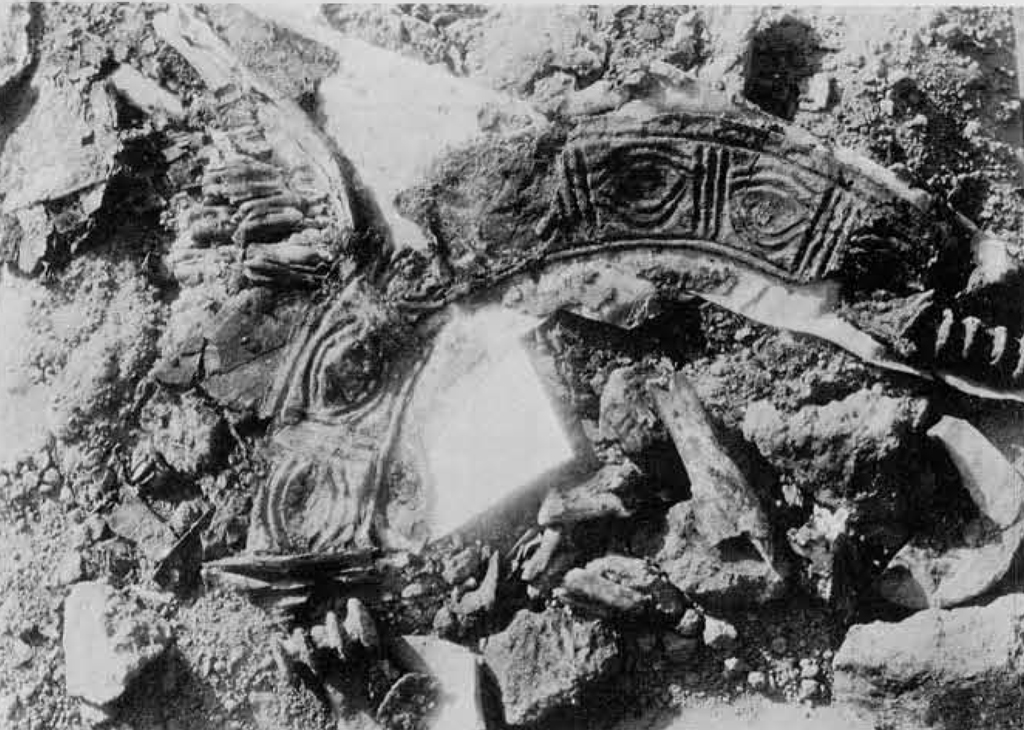
In 1922, archaeologists dug up a site in modern-day southern Iraq. There, they found incredible spans of gold and sophisticated armour, and Iron Age Sumerian artefacts, encased within stone walls. They dubbed this place “the Royal Cemetery of Ur,” an ancient Babylonian mausoleum. 

On that site, they also discovered evidence of hundreds of human sacrifices. Among the human sacrifices, a considerable number were children.

Nearly all of the skeletons were killed to accompany an aristocrat or member of the royal family into the afterlife. Some had drunk poison. Some had been bashed over the head with blunt objects. After their death, many were exposed to mercury vapour, so that they would not decompose, but would remain in a lifelike posture, available for public display.

Excavations from the Royal Cemetery at Ur

This site dates to sometime around 2,500 BCE in the ancient city of Ur. According to our legends, another figure came from the  ancient city of Ur sometime around 2,500 BCE. 

His name was Abraham. 

In the biblical narrative, Abraham wandered from Ur to ancient Canaan, where he began to worship the One God, and founded Judaism.

The world in which Abraham purportedly lived was rife with child sacrifice. Across the Ancient Near East, archaeologists have uncovered remains of children on slaughtering altars. They have found steles describing when and why they sacrificed children. They have found stories of child sacrifice from the Egyptian, Greek, Sumerian, and Assyrian civilisations.

So problematic was child sacrifice in the ancient world that our Scripture repeatedly condemns it. The book of Leviticus warns: “Do not permit any of your children to be offered as a sacrifice to Molech, for you must not bring shame on the name of your God.” The prophet Jeremiah describes disparagingly how the Pagans “have built the high places to burn their children in the fire as offerings to Baal.” In the Book of Kings, King Josiah tears down the altars where people are sacrificing their children.

Abraham put a stop to the practice of child sacrifice. It seems to happen suddenly, and without warning, and with even less explanation. No reason is given why he abruptly ended all the cultural deference that had gone before and opposed an entrenched religious practice. 

The question we now must ask is: why?

One reason that comes to mind is that it is so obviously immoral. Surely it should be self-evident that you don’t kill kids! But that wasn’t obvious to all the people around Abraham. And that wasn’t obvious to traditional commentators, either. In their world, the morally right thing was always to obey God.

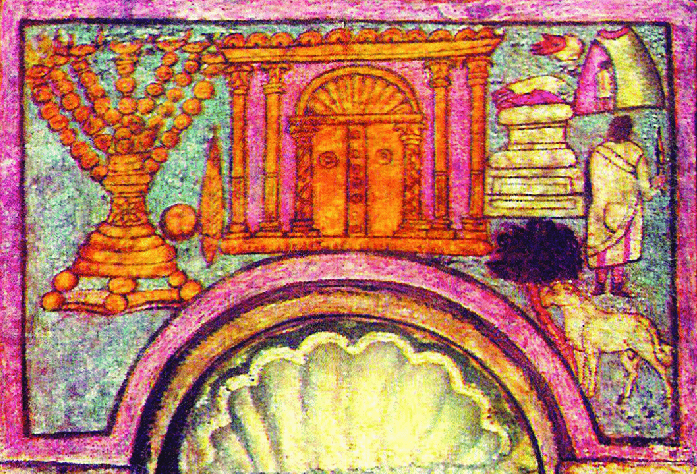
Fresco of the Binding of Isaac at the 3rd Century Duro Europos Synagogue, Syria

A traditional reading says that Abraham stopped child sacrifice in obedience to God. In the story we read today, Abraham is called upon by God to go up on Mount Moriah and slay his son. Only at the summit, when he holds up his arm to murder Isaac, does God stop him, telling Abraham that he has proved his devotion to God by not withholding his son, and that he does not have to kill Isaac. 

Yet there are several problems with this story. If we adhere to the traditional reading, God still wanted child sacrifice, and felt that doing so would prove Abraham’s devotion. In fact, nearly all traditionalist readers interpret it this way,saying that obedience before God should be a sacred virtue. A conservative reader of the Bible says that the moral of the story is that we should be subservient to God, and do what we are told.

God said not to perform child sacrifices, so we no longer do. That would mean, then, that if God had said child sacrifice was permitted, we would still be doing it.

In 2007, the Israeli philosopher Omri Boehm offered a radical reinterpretation of the story of the binding of Isaac. The story, Dr Boehm argues, is not about Abraham’s fealty to God, but his disobedience. Dr Boehm shows how, reading against the grain of traditional interpretation, this is not a story where God changes tact and decides not to ask for child sacrifices anymore, but where Abraham rebels against authority and refuses to commit murder.

For Boehm, what was truly radical about the Binding of Isaac was that it set out a new set of values, completely at odds with those of the Ancient Near East. Where other cultures practised child sacrifice because it was part of their established culture, Abraham resisted and put life above law. Where others encouraged obedience to authority, so much that poor people could be killed in the palaces of Ur to serve their masters in the afterlife, Abraham made a virtue of rebellion. For our ancestor Abraham, refusing to follow orders, even God’s, was the true measure of faith. By not killing, even if God seemingly tells you to, you show where your values really lie.

This is not a story about obedience, but rebellion. And that message – of resistance against authority in defence of human life – has much to teach us today.

Boehm reconstructs what the archetypal story of child sacrifice was in the Ancient Near East. Across many cultures and time periods, there was a familiar refrain to how the story went. The community is faced with a crisis: some kind of famine, natural disaster, or war. The community realises that its gods are angry. To placate the gods, the community leader brings his most treasured child and sacrifices him on an altar following the traditional rites. Then, the gods are pleased and the disaster is averted.

We can see that the biblical narrative clearly subverts the storytelling tradition that was around it. In other cultures, the community leader really did sacrifice his special child, and that really did please their Pagan god. In our story, the community leader does not sacrifice his special child, and the national God proclaims no longer to desire human sacrifice. This is already then, a bold message to the rest of the world: you might sacrifice children, but we will not.

Boehm takes this a step further and looks at source criticism for the text. Most scholars of Scripture accept that Torah is the work of human hands over several centuries. One of the ways we try to work out who wrote which bits is by looking at what names for God they use. Whenever we see the name “Elohim” used for God, we tend to think this source is earlier. Whenever we see the name “YHVH” used for God, we tend to assume the source is a later edit by Temple priests.

The story of the binding of Isaac is odd because it uses the name “Elohim” almost the entire way through, until the very end, when the angel of God appears and tells Abraham not to kill Isaac. That means that most of the text is from the early tradition and only the very end part, where the angel of God tells Abraham not to kill Isaac, comes from the later priests.

So, Boehm asks, what was the earlier version of the text? If you take out the verses where God is YHVH and have only the version where God is Elohim, what story remains?

Well, in the version that we know, where both stories are combined, an angel of God calls out and tells Abraham not to sacrifice Isaac. That’s the bit where God is YHVH. If you take that out, and have only God as Elohim, Abraham makes the decision himself. No angel comes to tell him what to do. Next, if we cut out the parts where God is YHVH, there is no praise from the angel, telling Abraham he made the right choice. Instead, you get a story where Abraham deliberately disobeys his God because he loves the life of his son more.

Adi Nes, ‘Abraham and Isaac’, 2004

The earliest version of the text, before the Torah was edited and a later gloss was added, is one in which Abraham is commanded by God to sacrifice Isaac, goes all the way up Mount Moriah, and then refuses. Without prompt or praise from God, Abraham decides to sacrifice a ram instead of his son. In the earliest version of the biblical narrative, when source critics have stripped away priestly edits, God tells Abraham to sacrifice his son and Abraham rebels.

The earliest version, then, is an even more radical counter-narrative to the other stories of the Ancient Near East. Not only do we not sacrifice children. We also recognise that sometimes you have to say no to your god. In this version, rebellion is more important than obedience, especially when it comes to human life.

This isn’t just a modern Bible scholar being provocative and trying to sell books. In fact, Boehm shows, this was also the view of respected Torah scholars like Maimonides and ibn Caspi. These great mediaeval thinkers didn’t think of the Torah as having multiple authors, but they could see that multiple stories were going on in one narrative. One, they thought, was the simple tale of obedience, intended for the masses. But hiding between the lines was another one, for the truly enlightened, that tells the story of Abraham’s refusal.

Boehm terms this “a religious model of disobedience.” By the end of the book, you go away with the unshakable impression that Boehm is right. True faith, he says, is not always doing what you think God is telling you. Sometimes it is reaching deep within your own soul to find moral truth. Sometimes you really show your values by how you defy orders.

In his conclusion, Boehm takes aim at Rabbi Shlomo Riskin, an American religious leader, who lives in the West Bank settlement of Efrat. Rabbi Riskin had said, in his analysis of the binding of Isaac, that Abraham was a model of faith by his willingness to kill his son. Riskin insisted that he was willing to sacrifice his own children in service of the state of Israel.

This, says Boehm, is precisely the opposite of the message of the binding of Isaac. The point was not to let your children die. The point was to bring a final end to child sacrifice. The point was not to submit to unjust authority, but to rebel in defence of life. 

Rabbi Riskin does not realise it, but by offering child sacrifice, he is really advocating for the Pagan god. He is describing the explicitly forbidden ritual of allowing your children to die. 

Abraham thoroughly opposed these false gods who demanded ritual murder. They were idols; and child sacrifice a monstrous practice that we were supposed to banish to the past. The very essence and origin of Jewish monotheism is its thorough rejection of killing children.

Boehm could not have known how pertinent his words would become. This year has been one of the worst that those of us connected to Israel can remember. Beginning on October 7th, with Hamas’s horrendous massacres and kidnappings, the last Jewish year has seen us rapt in a horrific and seemingly never-ending war.

This year, thousands of Israelis were killed. This is the first time in a generation that more Israeli youth have died in war than in car crashes. Reading through the list of names, it is remarkable how many of the soldiers were teenagers. 

That is not to even mention the 40,000 Palestinians whom the IDF have killed. According to Netanyahu’s own statements, well over half were civilians. Around a third were children. As famine and food insecurity rises, the risk of deaths will only accelerate. It has been agonising to witness, and I cannot imagine how painful it has been to live through.

Yet, during my month in Jerusalem, I saw that the voice of Abraham has not been extinguished. There are few groups I hold in higher esteem than the Israeli peace movement. Against untold threats and coercion, in a society that can be intensely hostile to their message, they uphold Abraham’s injunction against killing.

One of the leaders of the cause against war was Rachel Goldberg-Polin. On October 7th, her 19-year-old son, Hersh, was kidnapped by Hamas. His arm was blown off and he was taken hostage in Gaza. From the very outset, Mrs. Golderg-Polin argued fervently for a ceasefire and a hostage deal that would bring her son home. She warned that the only way her son would come home alive would be as part of political negotiations. 

At the end of August, as Israeli forces neared to capture Hersh as part of a military operation, Hamas shot her son, Hersh, in the head. 

Rachel Goldberg-Polin’s refusal to give up hope, refusal to sacrifice her son, and steadfast insistence on peaceful alternatives is a true model of Abraham’s faith.

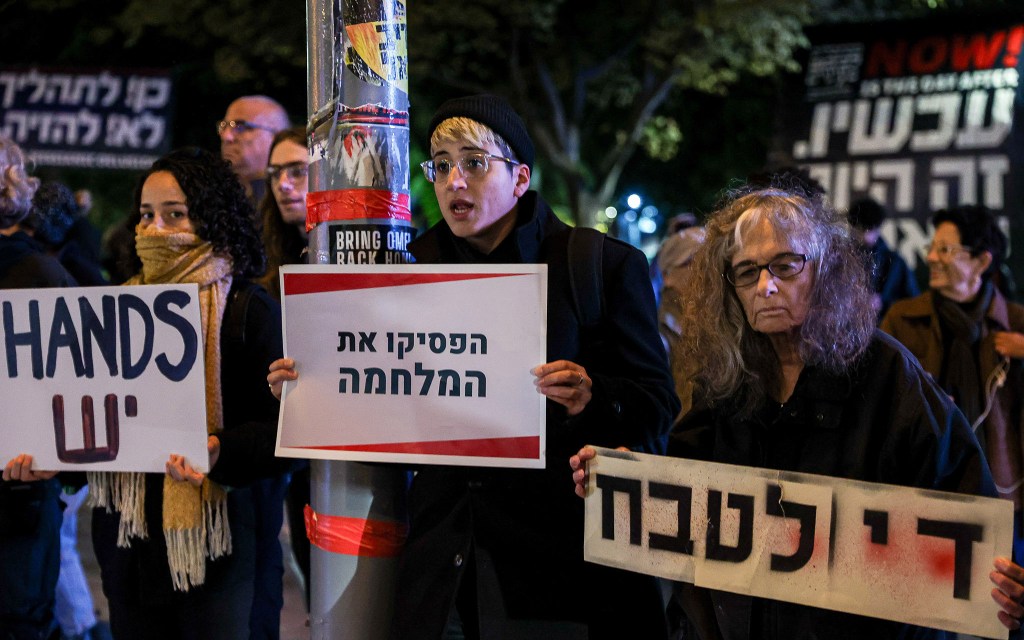
Israeli peace protestors

And it involves serious rebellion too. When I met with hostage families in Jerusalem, I was shocked to hear how, for protesting against the war to bring their families home, they had been beaten up by Ben Gvir’s police. I saw this with my own eyes when I marched alongside them. People shouted and jeered at them, and the police came at them with truncheons.

In July, when I went with Rabbis for Human Rights to defend a village in the West Bank against settler violence, we were joined in our car full of nerdy Talmud scholars by a surprising first-timer. A strapping 18-year-old got in to volunteer in supporting the Palestinian village. What was most remarkable was that he himself lived in a West Bank settlement. 

He explained that he had refused to serve in the military. He did not know that others had done it before, or that there were organisations to support Israeli military refusers. Instead, he said, he thought to himself: “if I don’t go, they won’t kill me; if I do go, I might kill someone.” What could be a truer expression of Abraham’s message: no to death! No to death, no matter the cost.

He really had to rebel. For refusing to serve in the war, the conscientious objector I met spent seven months in jail. Still now, there are dozens of Israeli teenagers in prison because they would not support the war.

Throughout my time in Jerusalem, I attended every protest against the war and for hostage release that I could. One of the most profound groups I witnessed was the Women in White, a feminist anti-war group going back decades. One of these women, with grey hair and the look of a veteran campaigner, held a placard that read in Hebrew: “we do not have spare children for pointless wars.”

Is this not exactly what Abraham would say? We will not sacrifice our children on the altar of war!

Theirs is truly the voice of Abraham, the true voice of Judaism. It is the voice that opposes child sacrifice. Theirs is the voice that upholds the God who chooses life. 

Talmud tells us that, when we blast the shofar one hundred times on Rosh Hashanah, we are repeating the one hundred wails of Sisera’s mother when she heard her son had died. Sisera was, in fact, an enemy of the Israelites, who waged war on Deborah’s armies, and was killed by the Jewish heroine, Yael. Still, at this holy time of year, we place the grief of Sisera’s mother at the forefront of our prayers. 

We take the cry of every mother who has lost a child and we make it our cry.

Thousands of years after the Sumerian Empire had ceased existing, archaeologists dug up its remains, and saw a society that practised child sacrifice. From the very fact of how they carried out murder and permitted death, the excavators could tell a great deal about what kind of society this was. One that killed people to serve their wealthy and their gods.

One day, thousands of years from now, historians may look upon us too, and ask questions about what our society was like, and what we valued. May we take upon ourselves the mantle of Abraham. 

May they look back and say that we chose to value life. May they look back and see that our people despised death and war. May they look back on us and see a society that practised faithful disobedience.

Amen.

festivals · sermon

But Ruth was a Moabite

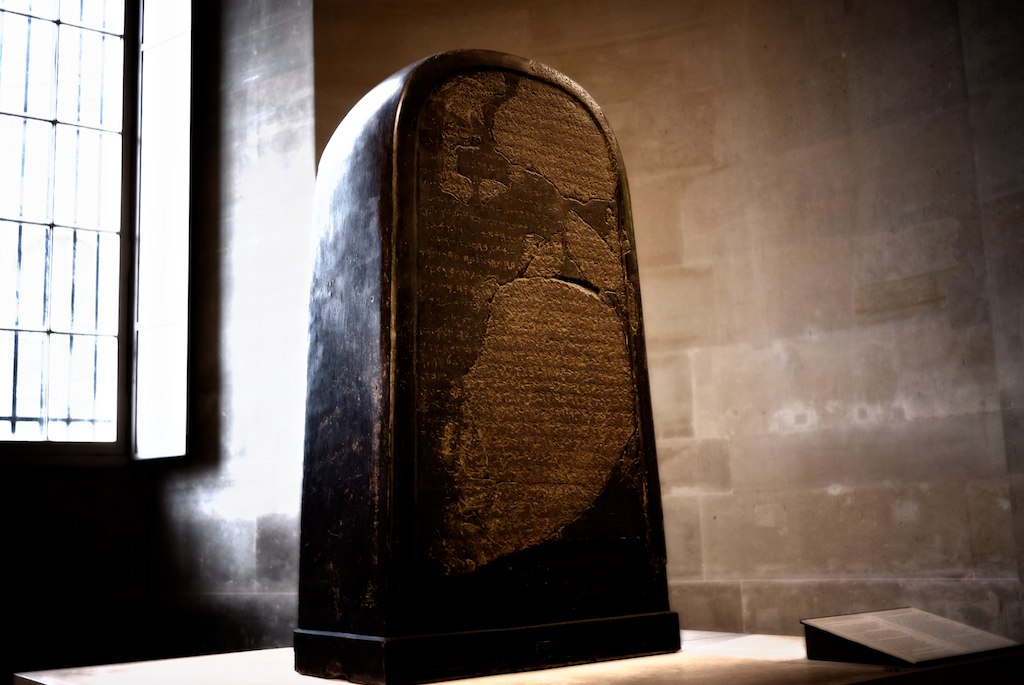
In the Louvre, there is a towering stele, engraved with glyphs in an ancient language. Cast into the stone are the words purported to come from King Mesha of Moab. It tells of how the kingdom of Israel waged war against the Moabites and subjugated them.

He tells how King Omri decided to destroy the house of Moab forever. How he occupied land and oppressed the people. How the Israelites demanded tribute from the Moabites and forced them to send hundreds of men as captive slaves.

And our sources? Our sources agree. The Bible tells the same story. In the book of Kings, Mesha, king of Moab, is described as a sheep breeder who had to hand over 100,000 lambs and the wool of 100,000 rams. He is treated as a despised servant, mocked for his weakness at being conquered. Our Bible groats that the Moabites were utterly destroyed.

But. But Ruth was a Moabite.

Ruth came from the plains of Moab where there was famine and joined herself to Naomi’s household. She joined with them and was a model of love and kindness. She was strong and noble. Ruth is still the model of decency. And she was a Moabite.

These weeks, we turn to the book of Numbers. Almost the entirety of this chapter is a polemic against the Moabites. It tells of never ending war. It talks about how the Moabites feared the Israelites strength and number; how the Israelites went and crushed them. It triumphantly promises that a scepter shall rise out of Israel and smash the forehead of Moab. Death to Moab. Death to the Moabites.

But… Ruth was a Moabite. Ruth was a Moabite. Could she be included in these celebrations of ethnic cleansing? How could anyone do that to Ruth?

In the Psalms, God jokes that Moab is a washpot. The basin in which God’s feet are cleaned. Ezra laments in disgust that Israelites would ever marry Moabites. Numbers calls the Israelites who married Moabites harlots. Deuteronomy treats this intermarriage as a sin.

But Ruth was a Moabite. And Ruth married Boaz. And their story is the one we turn to when we want to understand true love. Their union is how we imagine all marriages should be. For them, marriage wasn’t a problem. It was a joy. Who could forbid such a thing?

When King David took power in Israel, he set out to conquer and destroy the Moabites. He trapped them in the valley and allowed nobody to leave. He split the Moabite camp in two with a line. On one side, he massacred them. He killed them without exception. On the other side, he enslaved them, and kept them as degraded servants.

But Ruth was a Moabite. And Ruth married Boaz. And they has children. And grand-children and great-grandchildren. And one of those descendants was David. Yes, King David, too, was a Moabite by ancestry. He was a product of one of those forbidden unions.

In so many places, the Bible speaks of destroying and degrading the Moabites. Only a few verses in one solitary book speak of Ruth as a Moabite, and position her as a source of love and the originator of the Israelite nation.

The Bible is not so much a book, but a library in discussion with itself. It is a compendium of different contradicting voices.

Somewhere, at some time, some voice thought it was important to say that Ruth was a Moabite. And she was a model of love and kindness. And she took better care of her family than anyone could. And she was the pinnacle of loyalty and devotion. And she was the grandmother of King David. And she was a Moabite.

You might wonder why anyone would bother. The entire Bible is a torrent of hatred against Moabites. Every word is oppositional. All the history speaks of war and conquest. Why would one lone author put their head above the parapet to suggest something otherwise? Why would it be worthwhile to say that Ruth was a Moabite?

But think about it. There are countless verses of contempt for Moabites, and only one that suggests they are worthy of love. And which one do we remember? Does anyone today feel any animosity towards the ancient tribe east of the Jordan? Does anyone still take pride in Israel’s long-gone military victories against its neighbours?

No. But people remember that Ruth was a Moabite.

Empires rise and empires fall. Nations come in and out of being. The names of kings and warriors are lost to the ages. But one loving word can last a thousand lifetimes.

The voices of hatred and jingoism are fleeting. They cannot be sustained. But the voice of love – the voice of humanity – that speaks out across centuries and spans generations. It lasts long after the malaise has subsided.

Ancient Israel was a great kingdom. It was able to conquer lands and bring neighbouring nations to their knees. It could compel people to erect stone monuments to their own misery. And the thought of it makes us, at best, uncomfortable.

But, now, all we take pride in is love. The love our people have had for their God. The love our leaders have had for their Torah. The love they have had for each other. They love they have had for strangers.

Gentle words. Small memorandums of compassion. Fleeting acts of kindness.

A verse. Ruth was a Moabite. Remember that, Ruth was one of them.

Shabbat shalom. Chag sameach.

article · festivals

What does freedom mean?

This is the season of our freedom. 

To show that we are free, we will lean to the left and drink wine like Roman elites once did on their chaise longues. 

We will perform rituals and eat strange foods and, when our children ask us why, we will answer: “we were slaves in the land of Egypt. We were exploited and degraded there. But with mighty deeds and an outstretched arm, the Almighty redeemed us and delivered us. Now we can be free.”


The idea of freedom means far more this year. For the first time since the pandemic began, we are able to gather for Pesach again. We will actually be able to leave our answers and reconnect with people. We will be able to eat and drink together. We will feel free.

But what does freedom mean? What does it really mean to be free in the context of our Pesach celebrations?

Freedom, for the ancient Israelites, was all about who your master was. Society was divided into people who had masters and people who had land. The people who had masters had debts and had to work them off. They could not leave and, even if they did, they had nowhere to go. 

One of the ways out of this was that a family member would come and redeem you. They would pay off your debts and take you out of the place where you were labouring. Then you would be free: you would no longer belong to your master but to your clan. You would work not for the profits of a landowner but for the common good of your people.

This was what happened to the Israelites in Egypt. They were taken as servants; forced to work for their master, Pharaoh. They did gruelling labour, building militarily garrisons for their oppressors. But who could redeem them? Their entire family was enslaved. Nobody from their clan could come and grant them freedom.

But, all this time, they had a family member they had never met. A parent who loved them unconditionally and grieved their absence. One who desperately wanted them back. That was God.

With mighty deeds and an outstretched arm, God came into Egypt and redeemed them. God declared to the Israelites’ masters: you do not own these people. They are My people. They serve me and they will never serve any human being.

That is what freedom means. We have no masters but God. Our only debts are what we owe society. Our only labour is in service of our Creator. Our only bondage is to Torah.

That is what freedom means. Freedom means responsibility. 

This Pesach festival celebrates our redemption. It calls on us to use that responsibility wisely, in service of our God. 

Chag Pesach kasher vesameach.