israel · sermon

Remember in order not to forget

There are ways of remembering intended to make you forget.

There are ways of forgetting intended to help you remember.

So, says the Torah, remember in order not to forget.

This week is Shabbat Zachor, the Sabbath of remembrance. Just before Purim, we are called to read three additional lines of Scripture. Deuteronomy instructs:

Remember what Amalek did to you on your journey out of Egypt [… ] You shall erase the memory of Amalek from under heaven. Do not forget.

Remember… erase the memory… do not forget.

Is the demand to remember not contradicted by the insistence on erasing the memory?

Is the commandment to remember not exactly the same as the one not to forget?

Perhaps not. There are ways of remembering that encourage forgetting, and ways of forgetting that make you remember.

Alan Bennett’s play, The History Boys, is an exploration of what it means to teach history, and what we can learn from it.

In a powerful scene, the newest teacher, Tom Irwin, takes his sixth-form grammar school students on a tour of a war cemetery.

As they walk, he tells them:

The truth was, in 1914, Germany doesn’t want war. Yeah, there’s an arms race, but it’s Britain who’s leading it. So, why does no one admit this?

That’s why. The dead. The body count. We don’t like to admit the war was even partly our fault cos so many of our people died. And all the mourning’s veiled the truth. It’s not “lest we forget”, it’s “lest we remember”. That’s what all this is about -the memorials, the Cenotaph, the two minutes’ silence-. Because there is no better way of forgetting something than by commemorating it.

The truth to these words is palpable. In every village square throughout Britain there is a stone column, inscribed with names. The Cenotaph is so finite. Its concrete defies questions. You cannot ask it: what did they die for?

As we lay wreaths, the liturgy intones that the war dead “made the ultimate sacrifice.” These words carry such gravity that you forget it was a conscript army. You dare not ponder: who sacrificed them, and for what cause?

Then, there is silence. So much silence that you cannot hear the echo: was it worth it?

Real memories are not fixed. They are fluid and living, constantly opening up new interpretations and interrogations. When you really remember, you pore over the details with others, seeking perspectives you missed, guided by a quest for greater understanding. You always want to know what you can learn from it, since the memory teaches something new to each moment.

But, as Alan Bennett’s character teaches us, that is not what happens with certain war memorials.

They are ways of remembering in order to make you forget.

There are, too, ways of forgetting to make you remember.

In 1988, the Israeli historian and Holocaust survivor, Yehuda Elkana, wrote an article for HaAretz called The Need to Forget. Not long after its publication, this article entered the new Jewish canon as one of the most challenging and profound commentaries on Shoah memorialisation.

In it, he warns against the danger that Holocaust consciousness poses to Israeli society.

He writes:

I see no greater threat to the future of the State of Israel than the fact that the Holocaust has systematically and forcefully penetrated the consciousness of the Israeli public.

Reflecting on the school trips to Yad Vashem, Elkana comments:

What did we want those tender youths to do with the experience? We declaimed, insensitively and harshly, and without explanation: “Remember!” “Zechor!” To what purpose? What is the child supposed to do with these memories? Many of the pictures of those horrors are apt to be interpreted as a call to hate. “Zechor!” can easily be understood as a call for continuing and blind hatred.

So, says Elkana, while the rest of the world may need to remember the Holocaust, the Israelis needed to learn to forget it. They needed to uproot the injunction to remember “to displace the Holocaust from being the central axis of our national experience.”

Elkana’s invocation of forgetting is also an invitation to remember. Forget the past in order to remember that we have a future. Forget the cruelties inflicted on our people in order to remember that we are greater than our misery. Forget the wars in order to remember the possibility of peace.

Elkana is not talking about an alternate reality where everyone wakes up tomorrow with amnesia about the last hundred years of history. He is talking about an active process of forgetting: forgetting by asking new questions and building new memories.

These are ways of forgetting intended to help you remember.

There are ways of remembering intended to make you forget.

But, the Torah tells us: remember in order not to forget.

What type of remembering would this be?

A full remembering, the type repeated twice by our parashah, the kind that forces you not to forget.

This remembering, then, must be one that always asks questions and returns to itself. A history that invites constant revision and ever wants to teach new lessons.

For the last sixteen months, Israel has been gripped by war. It has been unavoidable as its details have filled our news feeds and lives.

I know it is too soon to start the painstaking soul-searching involved in real remembering.

But it is plenty early enough to forget.

Already there are those who would like us to forget, so that they can eschew their own accountability.

How easily we can be made complicit in their acts of wilful forgetting.

So I have been considering how to fulfil the Torah’s commandment to remember.

I want to remember in fullness and complexity, always returning to new questions.

I want to remember all the suffering, for there has been so much suffering.

I want to remember all the dead. Every name. There are so many names.

I want to remember all those responsible. Every name. There are so many names.

I want to remember all the alternatives, because there have always been so many options, and there are still so many other ways.

I want to remember completely who I have been, who we have been, at best and at worst throughout this whole time.

It is too soon to remember.

It is too much to remember.

It is too painful to remember.

But, if we do not remember, we will forget.

festivals · sermon · social justice · theology

Those who attack the weak

Purim is such a strange time. It is a time when everything is turned upside down. In our story, the oppressed become the oppressors; the ones who wanted to slaughter become the slaughtered; Jews become Persians; Persians become Jews.

We act out the topsy-turviness of it all by dressing up in costumes, getting drunk, and generally living as we normally wouldn’t. Somehow this grand inversion festival is one of my favourites, but I’m never really sure what it was about until it’s over. In fact, every year for the last year, I’ve preached about Purim after it happened, rather than before. I suppose that fits with the overall back-to-front-ness of the whole celebration.

This year, what struck me most was the connection between the Torah portion and the Megillah reading.1 In our Megillah, the story of Esther, the enemy is the evil Haman. Haman sets himself up as a god, demanding that people bow down to him, and when they do not, he seeks to wipe out the Jews. The Jews, in this antique Persian context, are already the most vulnerable people. They are the smallest minority, unarmed, and completely powerless. Haman decides to wipe them out.

In the Torah reading, taken from Deuteronomy, the enemy is Amalek. We are enjoined to remember him and what he did to the Israelites in the wilderness.2 The Amalekites had attacked the Israelites when they were at their weakest, dehydrated and suffering without water.3 According to our commentators, Amalek attacked from behind, killing the weakest first.4

The Megillah tells us that Haman was a descendant of Amalek, via their king, Agag.5 We do not necessarily need to believe that Haman had any genetic connection to Amalek. What they had in common they showed through their actions. Both attacked the weak. Both went for the most vulnerable first. They are not only symbols of antisemitism, but of all tyrants. This is how the cruel operate: by doing first to the weak what they would like to do to the strong.

It is deeply distressing to see in our times that the ideas of Amalek still prevail. At this moment, the world is closely watching the Coronavirus. My rabbinic colleagues in Italy are on complete lockdown. Many services have been cancelled. I am giving this sermon, for the first time, over the internet, rather than in person with my regular congregation.

That there is a pandemic should not be too alarming. There are often diseases going around the world – some are more contagious and more deadly than others. This one, it seems, is much less deadly than bird flu, but is more contagious than regular flu, and we do not yet have immunity to it.

In these times, maintaining calm and supporting each other is of the utmost importance. We should all, I am sure you already know, be meticulous about following NHS advice to wash our hands regularly, avoid touching our faces and not get too close to each other. If you exhibit symptoms, like a dry cough, shortness of breath, or fever, you should stay home for 7 days. Don’t go to the hospital or the GP.6

Yet there are those who have not helped maintain calm, but who have almost revelled in the potential death toll. Jeremy Warner, a journalist for the Daily Telegraph, wrote in his column that the death of the weak from Coronavirus could be good for the economy. He said:

Not to put too fine a point on it, from an entirely disinterested economic perspective, the COVID-19 might even prove mildly beneficial in the long term by disproportionately culling elderly dependents.7

With this one sentence, the Telegraph reminded me that Amalek’s ideology never ceases. It is in the idea that the weak are disposable, that the strongest survive, and that the strength of the economy or the nation matters more than the lives of the vulnerable.

The idea espoused by Warner might be called ‘social Darwinism’. It is a theory of evolution that sees all species as rugged individuals, fighting over resources. Sickness and death are nature’s way of weeding out those who are unnecessary. If people survive, it is because they deserved to. This was the logic that allowed the weak to be killed by the Nazis. It is the theory that underpinned government inaction to HIV as it killed off gay and black people.

It must be opposed. No idea could be more antithetical to the Jewish mind. We affirm that every human being is created in the image of God, and every life has intrinsic value. The disabled, the elderly and the immuno-compromised are not valuable because of how much they can contribute, but because God has placed them on this Earth. The Creator’s purpose for humanity far exceeds what any stock market has in mind.

We must oppose it not only because it contradicts religious truth, but also because it contradicts scientific truth. In 1902, the biologist and Russian Prince, Piotr Kropotkin, wrote his major work, ‘Mutual Aid’.8 In it, he argues that the survival of the species is due as much to cooperation as it is to competition. In the animal realm and throughout history, the major reason for life’s continuity has been its ability to work together.

Different species depend on each other and selflessly help each other. Most of all, human survival is intrinsically linked up with our social nature. Our skill lies in our ability to communicate complex ideas with each other. We are, by nature, dedicated to the preservation of our young, our elderly and our neighbours.

That is the message we must take away today in this time of sickness. We must support one another. For some, this means staying home so that they do not infect others. For some, this means checking in on our neighbours to see how they are and what they need. For others still, it means making donations to charities and mutual support organisations.

Purim was a time of inversion, when old habits were reversed. Let us shake off the old traditions of individualism and greed, to replace them with the Torah values of love and support.

In the face of those who attack the weak, we will be the ones to make them strong.

Shabbat shalom.

mutual aid animals

1 Mishnah Megillah 3:6

2 Deut 27:17-19

3 Ex 17:8-16

4 Mechilta de Rabbi Ishmael 17

5 Esther 3:1


I donated to Queercare, who are doing work for at-risk LGBT people. I encourage you to give to the charity of your choice.

judaism · sermon · story

Blot out the name of Amalek

It was the evening of Purim in the shtetl. The rebbe and his disciples were sat in the cold wooden yeshiva. They were reading the Megillah. They had almost reached its climax, when the rebbe slammed his hands down on the table, bolted upright on two feet, grabbed his coat and headed for the door.

His disciples were dismayed. “Where are you going?” they asked.

“To blot out the name of Amalek!” he replied.

The students were anxious. They shuffled in their seats. They knew who Amalek was. They knew what the injunction to blot out Amalek’s name meant.

When the Israelites were wandering in the desert, the Amalekites attacked them from behind, targeting the weakest members; the old, the ill and the tired. The book of Deuteronomy adjured them: “blot out the memory of Amalek from under Heaven. Never forget.”[1] This call in the Torah spoke to far more than historic memory. It was a call to violent revenge. Surely this couldn’t be what the rebbe meant?

One of the rebbe’s students stood up. “Rebbe, you can’t be serious?”

“Of course I’m serious,” said the rebbe. “It’s Purim.”

Purim? Purim, of course. It was the time to read the story of Esther. Haman, the wicked adversary of the Jews in the story of Esther, was an Amalekite. Haman was a descendant of Agag, the king of Amalek. Haman had plotted to kill the Jews in their entirety. As they read the Megillah, at every mention of his name in the scroll, the disciples had been booing to drown out the word. By the end of the story, Haman’s fortunes have been completely overturned. The king decrees that, instead of Haman being able to kill all the Jews, the Jews can kill all of Haman’s supporters and descendants. They go on a fortnight-long massacre, killing 75,000 people.[2]

This has always been interpreted as part of the act of blotting out the name of Amalek. Surely this couldn’t be what the rebbe meant? Surely he didn’t think that violence and genocidal rampaging had any place in Judaism? It was a bawdy story, not an instruction manual. What could the rebbe be thinking? The students followed him out into the streets, rushing after him as he pattered away down the cobbled path.

One of his students caught up with the rebbe, panting, saying: “Sir, with the greatest respect, I think you may be mistaken. Our Talmud teaches us that we no longer know who the nations are. Empires and diasporas have scattered us. Nobody knows their lineage. We cannot possibly know who the Amalekites are any more.”[3]

The rebbe was undeterred. “You do not need to know somebody’s ancestry to know who Amalek is,” he said, as he carried on walking. “We know our enemy.”

Another student shot up and interjected. “Sir, with the greatest respect, I think you may be mistaken. Our commentators argue that the duty to blot out Amalek is upon God. The Torah says that Amalek should be blotted out from under Heaven. That is, it is Heaven that will destroy Amalek, not us.”[4]

“Nonsense,” said the rebbe. “Judaism calls us to action. We cannot wait for God to solve our problems. We must go and address them now.”

He marched on, now with the whole village trailing behind him. Everybody was agitated, determined to keep him from doing something foolish.

Another student challenged the rabbi. “Sir, with the greatest respect, I think you may be mistaken. Nahmanides teaches that we cannot attack Amalek out of a sense of revenge, but only out of a sense of the honour of God. If you seek destruction now, you will be violating this mitzvah, not honouring it…”

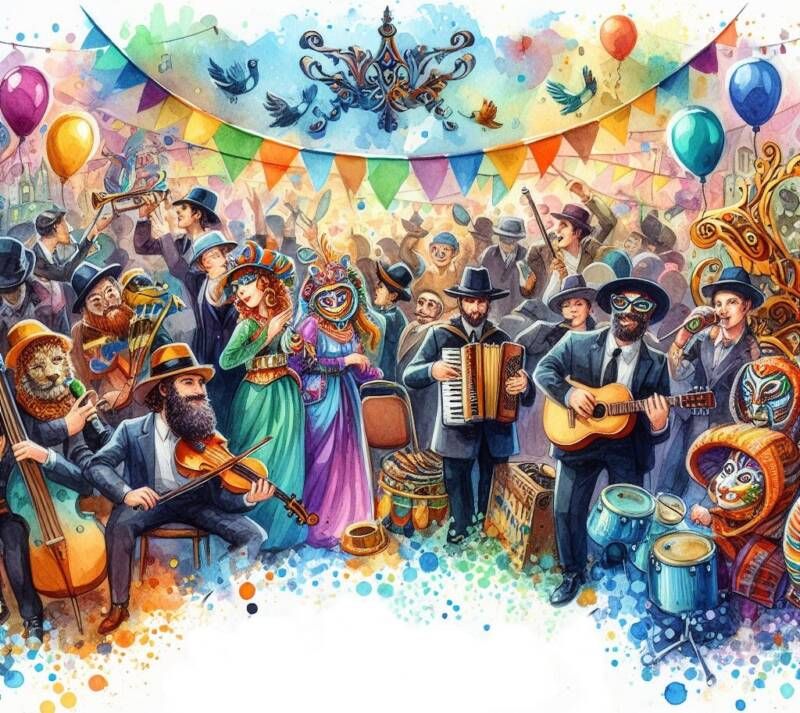
It was too late. The rebbe had already arrived at the nearest village. He headed straight down for a Cossack inn, and burst open the doors. The folk band stopped playing. The publicans looked up in stunned silence. The Jews huddled outside, expectantly looking in. The rebbe stretched out his hand.

Silence. A moment that felt like an eternity. Then, suddenly, a Cossack got up and took the rebbe’s hand. To everybody’s surprise, they began to dance. The band started playing again. Some of the students tentatively made their way into the inn. They, too, began dancing with Cossacks. Before long, all the Jews and all the Cossacks were dancing. This Purim party spilled out into the street. They danced all through the night until they could feel the veins in their feet pumping. They laughed until their bellies ached. They ate and drank and comingled until nobody could tell who was Jew and who was Cossack.

As the sun came up, the rebbe and his students fell about in a heap outside the pub, laughing. “That”, said the rebbe, “is how you blot out the name of Amalek. You see, Amalek is not a person. Amalek is the part of us that wants to trample the weak, just as Amalek did to Israel in the desert. Amalek is the part of us that wants to crush difference and secure power, just as Haman did to the Jews in Shushan. Amalek is any part, in any of us, that chooses hatred. The reason our sages told us not to turn to violence to blot out Amalek is because Amalek cannot be destroyed by violence; only by love. That is our weapon against hatred.”

This is a lesson we have to learn again and again, in every generation. When this week began, we woke up to the news of Muslims being killed at their places of worship in New Zealand. This week has seen yet more attacks on mosques. In Birmingham, a vandal took a hammer to the windows of several masjids across the city. The rise of the far right has spread to the Netherlands, where fascists have made significant gains and unseated the government.

We live in times when the violent attack the vulnerable; when hatred seeks out to take over; when diversity is under threat.

It is understandable that we should feel fear. It is righteous that we should feel anger. But we must also greet these times with an open and outstretched hand, willing to accept that a better world is possible, hopeful that people can change, faithful that we can drown out the impetus to hatred. We must be ready to dance. That is how we blot out the name of Amalek.

3492937-NQWAHNIO-8.jpg

I gave this sermon at Brighton and Hove Progressive Synagogue on Shabbat 23rd March. Although the parasha was Tzav and the themes of this sermon are more congruent with the readings for the previous week, Parashat Zachor, I felt it was important to draw the connections between the just-completed festival of Purim and the week’s news events. I heard a very abridged version of this story as a Hassidic folktale, but I could not remember where I heard it or find a source. If anybody knows its origin, please provide it so I can give due credit.

[1] Deut 25:19

[2] Esther 9

[3] Berakhot 28a

[4] Rabbeinu Bahya on Deut 25:19