halachah · sermon · social justice

How does the Torah say we should treat refugees?

There is a verse in the Torah so radical that one of my teachers did not believe me it was even in there. 

I was working on a project as a rabbinical student and I brought a text that cited this verse. 

“That can’t be in the Torah,” my teacher said. She was a serious scholar, with not only rabbinic ordination but also a PhD in rabbinics and a host of published articles. 

“No ancient society would allow a law like that. The entire economy would collapse.”

I thought, perhaps I had misread it. It was a bold claim. So I went back to look. 

But there it was, nestled among a litany of miscellaneous commandments in Deuteronomy. On one side of this law was the instruction to make sure soldiers did not have nocturnal emissions, and on the other side was the requirement not to bring money gained from prostitution as a Temple offering. 

There it was, a law completely at odds with ancient society, which threatened to collapse an entire economy if enforced:

Do not hand over a slave to his master who is taking refuge with you from his master. He will dwell with you in your neighbourhood in the place he chooses, in one of your gates that is good for him. Do not oppress him.

– Deuteronomy 23:16-17

Let us start by acknowledging why this law is so radical. Ancient agrarian states were built on slavery. Prisoners of war, pillaged people, indentured servants and trafficked humans did back-breaking work to make the farms run. Their unpaid labour was what made the brutal machinations of early states even possible. 

Here we have a rule: do not hand over any slave to their master. The Torah is biased, and it’s not on the side of the owners!

More than this, if you get a runaway, your duty is to look after them. You have to give them accommodation. You have to give it in a place where the refugee himself feels is good for him, within the gates of one of your towns.

This is bold.

But still, it may be I had misunderstood. We already know from many other Torah sources that Israelites cannot be held as slaves. They might be debt labourers and bondsmen, but if somebody is part of the Israelite family, they can never be subjected to lifelong slavery. 

So, perhaps, this law is just talking about what to do if an Israelite runs away. In such a case, they might have been the slave of another Israelite, in which case they were being held against the law. Of course you would then give the slave refuge. 

Or they might have been an Israelite running away from another country, like an Edomite who had captured them in war. Well, then, they have come back to their people and need to be cared for.

So, have I mistranslated? Is this actually about Israelite slaves?

I’d have to look at earlier translations to check what it means. 

The earliest translation of the Torah is Targum Onkelos, a 2nd Century rendition of Scripture into the vernacular Aramaic. 

This translation gives details that clarify things. In this case, it adds an adjective to the Torah’s word for slave. עממין – from the foreign nations. A non-Israelite. The translation is unambiguous: we are talking specifically about foreigners.

This is even more radical. It’s saying we insist on looking after complete outsiders. They have no connection to us. 

They may even, then, be running away from Israelite masters. The Torah is saying that, if a slave runs away from their master, even though the slave is definitely not one of us, and the master might actually be one of us, we are on the side of the slaves.

About a century after this translation, the rabbis in the school of Rabbi Akiva wrote a commentary on the Book of Deuteronomy to expound its meaning. The book is called Sifre Devarim, and it takes all the legal verses from these books and adds oral traditions about how to interpret the laws.

Sifre’s explanation of this verse gives details on how you are supposed to treat a runaway slave when they come to you. Not only do you have to welcome them into your towns, say the rabbis, you also have to make it possible for them to make a living. They have to live with you, and not on the borders of the town.

It adds that the commandment not to oppress the runaway extends even towards words. Even the language you use must be kind. And it insists: you have to make them feel like the place they have come to is better than the one they left.

This is even bolder than where we began. It’s an official open borders policy to every runaway, with the requirement that they not only get refuge but actually get a livelihood and integration in the place where they move to. 

It is not only uneconomical, it goes against all the foundations of the ancient economy. 

You cannot even appeal to other economic reasons. There’s no organised mass of runaway slaves that the law-givers need to accommodate. There’s no suggestion that there was great pressure from the peasantry to be kind to foreigners.

It is a law entirely based on compassion.

What makes this law so radical is that it seems to be motivated entirely by altruism. That is why my teacher was so incredulous about the law being in the Torah at all.

And yet, isn’t that why we turn to the Torah to begin with? Not for cold economics, but to know the right way to live. We want a moral guide for how we should treat people.

Rabbi Julia Neuberger, who serves as a crossbencher in the House of Lords, has been a consistent voice for refugees, as each successive government has threatened hostility and sanctions.

As a lawmaker and a rabbi, she has to balance the high moral demands of our religion with the practicalities of government. 

In all her addresses, she emphasises the need for compassion. She treats refugees as a litmus test for the compassion of a society, because their marginal status tells us how our country is likely to treat everyone else. 

Baroness Neuberger advocates firmly for the rights of refugees.

Perhaps that is why the Torah introduces this seemingly radical rule. It wants to set a culture where the most vulnerable people get the best possible treatment, so that the whole of society will be based on kindness. 

The foundation of Torah law is about caring for the poor, the orphan, and the widow. This most intense case – a complete outsider running away from slavery – is the Torah’s own test for its moral system. 

It is a test every society faces. How people treat refugees shows what they think of human beings.

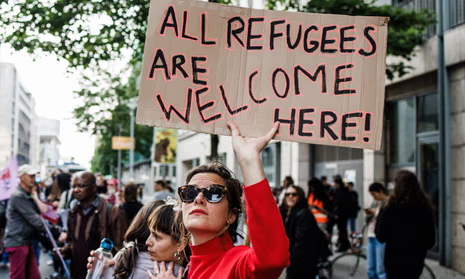
For the past few weeks, protesters have been gathering outside hotels, demanding refugees be sent back. The main political parties have entered into a race to the bottom for how unwelcome they would make refugees. 

Their rhetoric and laws may turn out to be a threat to us all. They may undermine the very basis of a compassionate society. 

Let us consider what would happen if Britain implemented Torah laws in its approach to refugees.

What would happen if this country made an active decision to welcome refugees and refuse to send them back? To deliberately integrate them and make sure they were firmly part of our towns? To set them up so that they could make a livelihood and refuse any insult to them? 

Would this collapse our economy, or would it make this place better for everyone?

And, if we had to choose, why would we not choose to follow the Torah?

Shabbat shalom.
israel · sermon · torah

This is Torah. This is its reward.

Loving others will not make you popular.

Pursuing peace will not make you safe.

Choosing life will not protect you from death.

But, if you do not love others, if you do not seek peace, if you do not choose life, who will you be?

When Moses ascended Sinai, he found God adding flourishes to the Torah’s letters, which only Rabbi Akiva would ever be able to read. Moses asked to see what became of Akiva.

The Holy One showed Moses how the Romans flayed Rabbi Akiva’s skin as they martyred him, then sold his flesh in their marketplace.

Moses threw his hands in the air and demanded: “Is this Torah, and this its reward?”

“Silence,” said God. “Such is My will.”

This is Torah. This is its reward.

Vivian Silver was murdered by Hamas on October 7th.

Vivian Silver founded the Israeli peace organisation, Women Wage Peace. She worked for human rights groups like Btzelem and ALLMEP. She lived on Kibbutz Beeri, near the Gaza border, where she engaged in solidarity work with Bedouins, Gazans, and Palestinian construction workers.

Three days before October 7th, she organised a march of 1500 Israeli and Palestinian women for peace.

On October 7th 2023, terrorists broke into her home and murdered her.

Even as she hid from the militants, she gave an interview to Israeli radio, where she said the very fact that she was under attack showed the need for a peace deal.

A year later, her son, Yonatan Zeigen, eulogised her. He said:

“Being a peace activist is not something to save you from being killed in war. It’s something to prevent a war from happening. And to create a reality where war is not an option.”

Silver’s love of others did not make her popular.

Pursuing peace did not make her safe.

Choosing life did not protect her from death.

But it made her fully human.

This is Torah. This is its reward.

On Monday evening, as my community sat down to listen to poetry in preparation for Tisha B’Av, I received a text to say that a Palestinian peace activist I knew had been murdered.

Awdah Hathaleen was shot in the chest in his home.

Awdah lived in the village of Umm al-Khair in the south Hebron hills. I visited his village twice last year with Rabbis for Human Rights. The second time, I stayed in the bunk beds adjacent to his home. In the morning, he brought breakfast to me and the other solidarity activists.

A delegation of Progressive rabbis met Awdah earlier this year when they went to the West Bank with Yachad.

Awdah was an English teacher. He was born in the south Hebron hills and had known tanks, guns and occupation all his life. He worked with Israelis to protect his home and build a peaceful future.

This did not make him popular. For some Palestinians in neighbouring villages, this meant that he was engaged in normalisation with the Israeli occupier.

Indeed, after the Oscar-winning movie about his village, No Other Land, gained international recognition, the BDS movement called to boycott it, because it showed Israelis and Palestinians working together.

Awdah chose the path of non-violence. Even after his uncle, Haj Suleiman, was crushed by an Israeli police tow truck; yes, even after his elder was cruelly murdered; and yes, even after those who killed his uncle were never brought to justice; after all that, he still chose the peaceful path.

For the settlers who wanted to capture his home and ethnically cleanse his village, his activism made him a target.

He and his family never knew safety.

Awdah wrote for 972 Magazine, a joint Israeli-Palestinian publication, about the struggles of raising his traumatised son in this village under attack. He wrote: “He even knows some of the settlers by name. Sometimes I tell him that they went to jail; I’m lying, but I want to make him feel safe.”

He was lying. Settlers who carry out murders do not go to jail.

The man who murdered Awdah was called Yinon Levi. He was filmed doing it. Still, the only person who has been taken into custody by the Israeli police is Awdah’s cousin, Eid, a fellow non-violent activist.

Yinon Levi was already subject to EU sanctions and recognised internationally as a terrorist. But he is protected by government minister, Ben Gvir, who has dedicated his life to helping settlers get away with murder. Even before the far right coalition took power, plenty of settlers had been able to perpetrate atrocities with impunity.

Loving others did not make Awdah popular.

Pursuing peace did not make him safe.

Choosing life did not protect him from death.

No; you will not be better off if you do the right thing.

But God does not ask us to live lives that are comfortable.

There is no commandment in the Torah that we should be popular.

All of us, regardless of religion, are placed on this earth to be God’s stewards; to uphold God’s most sacred commandments; that we must choose life, pursue peace; seek justice; and love the stranger.

This is Torah. This is its reward.

This sacred work comes with no promises. But who else would you want to be?

It is a charge often laid against woolly moralists like me that we do not really get how militants like Hamas think; that we just cannot understand the mentality of the settlers.

That is true. I do not want to think like them. I do not want to become like them.

Who will we be if we let our hearts become warped and set our minds to cruelty?

Loving others will not make you popular. But it will make you loving. And pursuing peace will make you peaceful. And seeking justice will make you just. And that is what your God asks of you.

We are approaching Tisha B’Av, when we recall every catastrophe that befell our people. If you believe that peace is possible and that these assaults on basic humanity are wrong, you can add another disaster to the roster. On Monday, Awdah was murdered.

Yes, a Muslim murdered by a Jew is a tragedy for us all.

A man who was committed to non-violence was shot in the chest by a settler, leaving behind 3 children. He was 31.

Do not give in to cynicism or try to calculate what you might gain for kindness. This world has no guarantees. And we know nothing about the hereafter.

You do what is right because it is right. Because if you do not, who will you be?

This is Torah. This is its reward.

May God have mercy on us all.

judaism · sermon · social justice

You are not sick

Imagine if I stood up here on a shabbat and I told you I could fix you. 

Imagine if I said there was something fundamentally wrong with you. That some property intrinsic to you, about your soul, was fundamentally wrong. Sinful.

Imagine if, when we read out the names of people in need of healing, your name was on there. You hadn’t asked to be placed there and you felt fine. But somebody in the community had decided that who you were, as a person, was contrary to their religious beliefs, and that made you sick.

Imagine if your child or grandchild came to see me at the synagogue and ask for rabbinic advice about their personality. Instead of offering them love and support to be happy with who they were, I told them that they needed to repent. I told them that God thought they should feel guilty. I told them they should pray and fast until the wickedness in them was gone.

Imagine it. Imagine any preacher in any religious building doing such a thing.

You don’t have to imagine. It happens today, here in Britain.

It is called conversion therapy. 

Conversion therapy is when queer people are told, often by a religious leader, that prayer, exorcism or counselling can change their gender or sexuality. It is when somebody tells a gay person that they can be made straight, or a trans person they can be made cis.

It happens in the British Jewish community. One survivor of this practice, Joe Hyman, spoke out about how a religious Jewish group tried to counsel him out of homosexuality. At first, it involved telephone appointments where he was told he could be healed. He sat round in a room and was forced to examine every homosexual thought he experienced through a lens of judgement and shame.

Another British-Jewish woman, Maya, went through conversion therapy classes that told her that her parents hadn’t nurtured her enough and that she must have been abused as a child. 

There are Jewish retreats in New York and Israel, where participants are made to do psychologically damaging activities including stripping naked and berating themselves while staring at a mirror.

You might well wonder why such an abhorrent practice has not yet been banned. For that, you would have to ask Boris Johnson. 

This week, his government leaked reports that they have abandoned plans to stop conversion therapy. They have bowed to pressure from conservatives and fundamentalists. 

When the various LGBT charities expressed their outrage, and the public followed suit, the government back-pedalled, but only slightly. They said they would ban conversion therapy for sexuality, but not for gender identity. They have decided that lesbian, gay, and bi people should not be subjected to this psychological torture, but that they will keep it up for trans people. 

Not content to only permit the practice, the government has decided to get in on bullying trans people. Boris Johnson used a recent speech to mock trans people. A public discourse has emerged that pathologises and humiliates people who do not conform to gendered expectations. 

Trans women, in particular, are the subject of a horrible narrative of hate. I don’t think it would be helpful or responsible to repeat the things I’ve heard, even from respectable platforms like the BBC. You have probably heard it too, and speaking it from the pulpit would only lend this hate speech legitimacy it doesn’t deserve.

The pathologisation of sex and bodies is as old as the Bible. In ancient Israel, when a person’s genitals seemed emitted an unusual discharge, or found they could not ejaculate, a priest would declare them a zav. This meant they were ritually impure, prohibited from entering holy places and forbidden from engaging in acts of worship. 

This was not just recognising the existence of genital problems or sexual diseases. It was making them into signs of defilement. It was saying that the people who had them were in some way sinful. It turned the body into something shameful. 

By the time of the Mishnah, the rabbis were conscious of how problematic this system of stigmatising people was. They announced mitigating circumstances for when somebody might not be considered a zav: if they had jumped; lifted something heavy; been unwell; seen something arousing; thought about something sexual; had eaten or drunk something unusual. If they had done any of these things, even if they had symptoms of a zav, they were not considered a zav. They were exempt from being treated as sick.

To this already expansive list, Rabbi Akiva added two more categories: if somebody had eaten or drunk anything at all, they were not a zav. His students were astonished. They said: “if that’s the case, there will be no more zavim anywhere any more!” Rabbi Akiva responded: “it is not your job to make sure people are considered impure.”

Rabbi Akiva understood something profound. Nobody should be considered sick. Nobody should be stigmatised for who they are. So, to combat the stigma, he found a way to make sure everyone was exempted.

That is what is needed today to combat this senseless hatred against trans people. That is why we so desperately need to ban conversion therapy and stop treating people as if there is something wrong with them.

All we are asking is that people can access non-judgemental support to talk about their gender. We are asking that people can be free to explore it, open to the possibility that their gender might not be the one they have always been told it was. We are asking for people to have the freedom to go on a journey with their gender, open to the possibility that this might mean changing their name, or their pronouns, or the way they dress, or the way their body looks. 

I understand that perhaps that might sound frightening to some. But what truly terrifies me is that people can’t. Young people exploring their gender currently cannot feel safe turning to authority figures to talk about their gender when there is so much vitriol emanating from the country’s highest offices of power. And they are even less safe when leaders continue to have the power to tell trans kids that they are sick and can be cured.

From this pulpit, there is only one message you will get. You are not sick. You are loved. You are supported by this community. You are safe to be whoever you want to be. 

In this synagogue, we believe in a loving God. In this religious movement, we affirm that you have a unique journey to find your own way with your Creator. And we will never try to change you.

Shabbat shalom.

With massive thanks to Rabbi Laura Janner-Klausner for helping me think through how to talk about this when the issue makes me so emotional

festivals · sermon

Reform Judaism – or Revolution Judaism?

There was a seder that lasted all night. We talk about it every year.

It once happened that Rabbi Eliezer, Rabbi Yehoshua, Rabbi Elazar Ben Azaryah, Rabbi Akiva and Rabbi Tarfon were reclining in Bnei Brak. They were discussing the Exodus from Egypt all that night until their students came and said to them: “Our teachers, the time has arrived to read the morning Shema.”

How could it be that five rabbis could talk all night and not know that the time had come to say Shema? We might imagine them engrossed in animated conversation, but even the best dinner party guests can identify when the sun has come up. The Shema is to be recited at dawn, and surely five great sages would know when the dawn has come.

Unless, of course, they couldn’t possibly know whether it was dark or light. Perhaps, our commentators now speculate, the rabbis were deep underground in a cave. You see, these rabbis lived through the great revolt against Rome, the Bar Kochba Rebellion. During this time, Jews hid out in caverns, as armed conflict raged between Judean zealots and Rome’s imperial armies.

The year was 132 CE. The great Temple in Jerusalem had already been destroyed 60 years earlier. The wicked emperor Hadrian, who was also responsible for the Wall less than an hour from this synagogue, had overtaken the entire region. He erected a new temple to the Roman god Jupiter, renamed the capital city after himself, and persecuted the inhabitants.

Hadrian further antagonised the Jews by introducing new taxes and prohibiting certain religious practices. Shimon bar Koseva, better known as Bar Kochba, emerged as a military leader, determined to wage war against Rome. He gathered troops and summoned the entire Jewish diaspora into revolt. He called on our sages: “get armed! Get ready to reclaim Jerusalem!”

Every single one of the rabbis had an opinion on the matter. The core question facing them was whether they, the spiritual leaders of the Jewish people, should get behind the armed struggle. Do they join with the ranks of the militants, or seek to make compromises with the Empire? Do they risk dying on their feet, or concede to live another day on their knees?

The new Reform Haggadah stages a debate between these five thinkers. Throughout rabbinic literature, we have statements attributed to each sage, many of which may have been directly connected to the struggle against Rome. Haggadateinu stitches them together into a dialogue, where each rabbi advocates his position.

Rabbi Tarfon and Rabbi Joshua tried to persuade the others of pacifism. The Torah teaches peace, so that was what they should pursue. The Jewish mission, after all, was to beat swords into ploughshares.

Rabbi Akiva and Rabbi Eliezer countered them. The Jewish mission was to declare victory for God by opposing tyranny. This was, after all, the festival of Pesach, the celebration of freedom from Pharaoh, when the Jews had brought down the greatest empire of the age. They could relive their former glory, with swords in their hands and God on their side. A messianic fervour took hold of them, and Akiva even concluded that Bar Kochba must be the Messiah, ready to lead the Jews to ultimate salvation.

They continued the debate all night. They didn’t realise that dawn had come.

We do not know whether any of the sages changed their mind. But we do know what happened next. The Jews joined en masse in the revolt against Rome. And they lost. Hadrian persecuted them and destroyed an entire generation of rabbis. Akiva was flailed to death as he recited his prayers. Tarfon joined him as one of the ten martyrs.

So, with hindsight, which one of them was right? A cynic would dismiss Rabbi Akiva’s passion, saying he was foolhardy to take on the empire. But there is no guarantee that they wouldn’t have suffered just as much if they hadn’t resisted.

Maybe collaboration with Rome would have secured their survival. Our ancestors could have gone down Rabbi Tarfon’s route. They could have negotiated and compromised. Perhaps he would have permitted them to stay under his rule in Palestine and they would have lived there.

Then who would we have been? We would never have spread across the Diaspora as a light unto the nations. We may never have composed the Mishnah, the Midrashim, the Talmuds, or any of the subsequent generations of rabbinic literature. Quite possibly, if every Judean of the time had survived, the people would have lived, but there would be no Judaism. We needed the revolutionary spirit, that sense of injustice, and that determination to fight for what was right, in order that we could truly pass on a tradition.

Our Judaism is the Judaism of Rabbi Akiva.

But it is also the Judaism of Rabbi Tarfon. After the failure of the revolt against Rome, our rabbis had to regroup and reconsider what Judaism would mean. They re-made their religion as a movement that was not tied to any country or Temple, but that could live everywhere in the world. They did away with ancient sacrifices and replaced them with universal prayers. They found a way to make an accommodation with reality.

And they held onto Rabbi Akiva’s dreams, too. For two thousand years, Judaism has sustained its hope for a messianic age. At the end of the seder, we still declare ‘next year in Jerusalem!’ We are not making a plan to buy plane tickets. We are talking about the Jerusalem that Akiva had hoped for – the time of the Messiah. The age when tyranny is destroyed and war abolished.

We are, therefore, a religion of both revolution and reformation. We are still holding that tension, between working within oppressive systems, and seeking their abolition. We continue to recite the words of all five sages, holding their ideals alive.

And, as we recall their seder in Bnei Barak at our sederim in Newcastle, we join them back in those caves. We are with them, asking the same questions. We still want to know: how will we get free? What must we do? When will we know that the time has come?

We are still, in many ways, in Mitzrayim. The messianic age has not arrived. But every year we raise our glasses and welcome Elijah. We eat our symbols of liberation. We pray for the coming of a new day.

Yes, although we may feel that we are in darkness, we know that the dawn will come.

The dawn will surely come.

Chag Pesach sameach vkasher.

high holy days · sermon · story · theology · torah

The Torah was given to all of us

The Reform liturgy for Yom Kippur takes on a tour through the progression of Judaism. The reading choices are different to in Orthodoxy. Whereas in Orthodox synagogues, you would hear the story of the High Priest’s atonement rituals with the two goats in the morning and the rules of illicit sexual relations in the afternoon, the editors of the Reform machzor felt these texts did not reflect their values and substituted them. In the morning, in our community, we read Nitzavim, Moses’s final address to the people. For the haftarah, we read Isaiah’s denunciations of exploitation. Then, in the mussaf service, we read the stories of the martyrdoms of our sages with the destruction of the Temple in 70CE. Through this history, we see the values of progressive Judaism elucidated at each stage: freedom, personal responsibility, decentralisation and anti-authoritianism. For my Yom Kippur sermon this year, I retold those stories to show how those values emerged.

“You are all standing here today,” said Moses.

He looked out over the vast plains of Moab. He gazed at his assembled audience, stretching far back into steamed blurry visions in the distant desert. He saw their weariness and felt his own. At 120, his physical strength had not weakened. His eyes still saw clearly and his teeth worked perfectly. Although he carried a stick, he did not depend on it. Physically, he was fine. But, mentally, he was drained.

For forty years, Moses had presided over the people. Gradually, he had tried to cede power. He had appointed judges and officials who would help resolve disputes. He had tried to teach people as far as possible all the laws that he had received from God on that great mountain in the Egyptian desert. More than ever, he felt ready to go. But the question was: were the people ready to be without him? What could he tell them in this last speech to prepare them for a society where they would have to lead themselves?

“You are all standing here today,” Moses repeated. “All of you.”

“But, really, all of you. Women and men. Children and the elderly. All of you are here. All of you were present at Sinai. I need you to know that it wasn’t just me and Aaron who did all this. You emancipated yourselves. Nobody forced you to leave Egypt. You got up and went because you knew you deserved better. You could have turned back to Egypt any time, but you didn’t, because you had faith. Hold on to that feeling now.”

Perhaps, Moses thought, he had not been specific enough. “Yes, the strangers too. All the foreigners who have joined us on the way. And the wood-choppers and the water-drawers. The people who do the most menial work among you. The most neglected among you. I want to mention you especially. I want you to know that you were at Sinai. Nobody can take that away from you. You experienced the full might of God and you choose to be God’s people. Never let any priests or princes tell you this was all their work. It was yours.”

“This,” said Moses. “This covenant that God made stands for all time. It speaks to all future generations to come. The soul of every Jew is here with me. All of you are witnesses. All of you have had the responsibilities of this religion entrusted to you. Even if you are scattered to the ends of the Earth, God will find you there. This religion stands firm in every time and place.”

The Israelites stared back at Moses in a calm silence. Only the sounds of gentle winds and crickets interrupted Moses’s speech. These followers had long known that this speech was coming. They had had plenty of time to prepare for it, and yet felt completely at a loss.

“What I’m saying,” said Moses, “is that the Torah is yours. God didn’t give it to me or to the scholars. God gave it to you, to read it and learn it and interpret it in the way that works for you. These commandments that I put before you today are not too incredible for you, nor are they too far from you. They are not in the heavens, that you should say, ‘Who among us can go up to the Heavens and get it for us and impart it to us, that we may observe it?’ No. It is right with you. It has been with you all along. You are in charge of your lives. You are responsible for your destinies.”

That was the message Moses left with the Israelites and through them with us, the Jewish people. It has a stronger bearing on us now than we may realise. It demands of us way more than we might be prepared to accept. When Moses died, he did not place power in the hands of priests and kings. He handed it over to everybody. There would not be anyone to frighten the masses into following orders or to offer up commands. The rules were all already there. The people had been entrusted to follow them for themselves.

With time, certain leaders did try to control Judaism. With the rise of the Temple, a centralised cult in Jerusalem set out the rules. The priests insisted that penance could only be paid with animal sacrifices and ritual fires. They tithed the people and brought them under authoritarian rule. Outside the centre of the city, the prophets chastised the priests. Among the urban poor and the rural peasants, the prophets cried out that God had given the Torah of justice to everybody, that God abhorred inequality and would never give religious power to the elites.

That is why, today, we read also the haftarah of Isaiah. Isaiah looked upon the centralised cult and was revolted by it. He saw a nation rife with exploitation and hypocrisy. He chastised the wealthy: “On the days when you fast, you exploit the workers! You fast and you strike with a wicked fist.” Such fasts, said Isaiah, meant nothing to the Almighty. God would not listen to the pleas of the wicked. Instead, insisted the prophet, God sought for every oppressed person to be free, for every chain to be broken, for every mouth to be fed and every soul to be remembered. This religion, said Isaiah, was never given to the exploiting class. It is the blessing of the oppressed. It is the hope of freed slaves and menial workers. It is a promise of redemption for people who could never quite believe their lives had meaning. We are the heirs to their Judaism: to the Judaism of the prophets.

When the Temple was destroyed, a group of visionary rabbis realised that the time had finally come to take back control from the priests and hand it over to the people. Chief among them was Rabbi Akiva Rabbi Akiva had been a peasant farmer. He did not even learn to read until he was 40. He came from the poorest class and knew their struggles. He saw the Priesthood trying to control our religion in their own interests and vowed to resist them.

Akiva insisted that the Torah was not a dead letter, but the word of a living God. Everyone could read it and find something in it. Every letter could be analysed. Whole worlds lay hidden in subtle sentences in our holy text. Akiva and his disciples replaced Temple sacrifices with prayers, good deeds and study. These were acts of piety available to everyone, no matter what their wealth our status. He created a Judaism of the people, by the people, for the people.

Our parashah today says “the Torah is your life and the length of your days.” Akiva agreed. He said that Torah was to the Jews what water was to the fish.[1] Akiva truly understood what it meant for everyone to receive the Torah. All of us were there for it. Everyone in this room. So all of us know something unique about the words of the living God. All of us have something important to contribute.

Akiva handed us over freedom. He took Judaism out of the hands of invested leaders and put it into the lives of the Jewish people. Read it, he said. You will find your life’s meaning in it. You will see that these are the words of a loving God. You will realise that you were created in a Divine image and that everyone else was too. You will understand the need to pursue justice.

Moses, Isaiah, Akiva. The progenitors of our Judaism. All of them with a simple message: this is your Judaism. You are free to follow it as you wish. With that freedom, they gave us the greatest gift they could. They gave us responsibility. Pharaohs would not govern our lives. Nor would bearded men in big gowns. We would govern our lives. We would have to choose for ourselves between right and wrong. We would have to live according to the justice demanded on High, with nobody to judge us but the still, small voice of conscience God had planted within us.

Take this day of Yom Kippur and realise that your life is in your own hands. Whether the world is just or unjust is up to you. Whether you are kind or unkind is up to you. Whether the oppressed remain oppressed or go free – that is up to you.

Let us resolve this day to take the true meanings of our religion to heart and to pursue justice in every quarter.

Gmar chatimah tovah.

isaiah chagall

I gave this sermon on Yom Kippur morning at Kehillat Kernow, the Reform Jewish community in Cornwall. If ever you are in the area, I highly recommend going to this warm, welcoming spiritual community.

[1] Berakhot 61b