story · torah

When is a person truly dead?

At home, my fiance paces back and forth, preparing for his exams in anaesthetics. In a week, he will be tested orally to see if he can become a consultant. He recites definitions of key medical terms, revises laws of physics, gives diagnoses of uncommon diseases. 

One definition he has repeated so many times it is now imprinted in my mind too.

Death is the irreversible loss of capacity for consciousness and loss of capacity for breathing.

At times, we have pondered over such terms together. On long walks, we have discussed medical ethics through Jewish lenses. We have debated whether and how modern medicine aligns with ancient wisdom. 

Now is not the moment to challenge him on the medical definition of death. But the definition sticks with me, because this is an area where I do not think science and religion align. 

While Laurence prepares for his exams, you will have to listen to my thoughts on what Judaism teaches about mortality.

Death is the irreversible loss of capacity for consciousness and loss of capacity for breathing.

Is it? Is that what it means to die?

If it were, then would living simply be brain activity and breathing? Is that all we are?

Chayyei Sarah – the life of Sarah – is our portion. It opens with her death. By telling us about her life from her death, the Torah is telling us something about how life and death interact. 

The parashah is a recounting of Sarah’s burial. It is a terse text, where the primary narrative concerns Abraham’s attempt to purchase a lot for internment. 

So much is left unsaid. So many emotions are not expressed. In the silences and interstices, we are left to reconstruct our own imaginings of what Abraham was thinking. Let us try.

Abraham proceeded to cry and eulogise Sarah.

He held her hands, once so strong and firm. Those hands had kneaded bread for strangers at a moment’s notice. They had sewn garments for whole families. They had, at times, pointed accusations, separated children, raised objections… Strong hands. Determined hands. Strong, determined hands, that were now drained of all their vigour, and sat coldly in his own palms.

Abraham rose from beside his dead, and spoke to the Hittites.

Abraham sprang into action. Sarah had not died in the land of her own family in Egypt, nor of Abraham’s in Chaldea. They were in a strange place, far from their own homes, among Hittites in the hill-country of Canaan. 

Abraham said: “Here I am, a stranger and a foreigner among you. Please sell me a piece of land so I can give my wife a proper burial.”

Sarah had left her father’s home in the palaces of Egypt, where she lived as a princess. She was an aristocrat in a great empire who gave it up to travel with a wandering man. Abraham claimed to have spoken with the One True God, and Sarah just followed him. She forsook luxury for a life on the road. Now, she lay dead on the road, and there would be no fine processions to pyramids to entomb her.

The Hittites replied to Abraham, “Listen, my lord, you are an honoured prince among us. Choose the finest of our tombs and bury her there. No one here will refuse to help you in this way.”

Sarah used to laugh with her whole belly. Her shoulders bounced up and down. She can find humour where nobody else could. Even when she struggled with infertility, she found ways of making jokes. Abraham would not hear her laugh again.

So Abraham bowed low before the Hittites and said, “Since you are willing to help me in this way, be so kind as to ask Ephron son of Zohar to let me buy his cave at Machpelah, down at the end of his field. I will pay the full price in the presence of witnesses, so I will have a permanent burial place for my family.”

Sarah had been so beautiful people tripped over themselves staring at her. On their wanders, every prince desired her. Sarah was as beautiful at 127 as she had been when they had first met. She was still just as honourable and God-fearing. Nobody would be as good and beautiful and true again. 

Ephron was sitting there among the others, and he answered Abraham as the others listened, speaking publicly before all the Hittite elders of the town. 

Sarah received no ennoblement or reward for marrying Abraham. Yet so much honour came to Abraham through her. She could see visions and speak with God. 

“No, my lord,” he said to Abraham, “please listen to me. I will give you the field and the cave. Here in the presence of my people, I give it to you. Go and bury your dead.” 

Abraham had bargained over everything. He had struck a deal with Avimelech to share water sources. He had even negotiated with God over the destruction of a city. This was a bargain he could not accept.

Abraham again bowed low before the citizens of the land, and he replied to Ephron as everyone listened. 

“No, listen to me. I will buy it from you. Let me pay the full price for the field so I can bury my dead there.”

Abraham was ageing too. Who would bury him? He had cast out one son and tried to murder another. 

Ephron answered Abraham, “My lord, please listen to me. The land is worth 400 pieces of silver, but what is that between friends?”

What is four hundred shekels between strangers? What is a price on the life of Sarah? What sort of burial could ever be enough for her? 

Ephron said: “Go ahead and bury your dead.”

These are some words we may complete into the silences. They come from the other biblical stories and midrash, and they paint a fuller picture. In the spaces, we see that this is not a negotiation over a burial plot, but a negotiation over the nature of death.

Death is the irreversible loss of capacity for consciousness and loss of capacity for breathing.

Is it? Is that what it means to die?

If it were, then would living simply be brain activity and breathing? Is that all we are?

Medically, scientifically… maybe.

Spiritually, Jewishly… no. 

Death is as much a journey as life is. 

For seven days, we eulogise, as the last imprint of a person leaves us. For thirty days, we mourn, as the shock and grief harrow us. For eleven months, we pray, as some part of the soul heads on its journey to Heaven. 

Then, every year, we say the names of the dead, and some part of our loved ones returns to us. Their soul breaks through the gaps in Aramaic words and we feel them with us once more.

Thousands of years later, we still say Sarah’s name, and some part of her keeps living long after breath and consciousness. 

We are more than what we exhale: we are the laughter and joy we bring to others. We are more than our own thoughts: we are the memories living on in others. 

In memory, in prayer, in faith, we grasp something greater than the material world.

Trusting in You, Eternal God, we see life beyond death.

Amen.
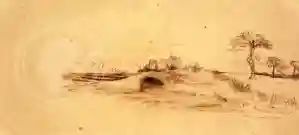
Van Gogh, The Cave of Machpelah

judaism · theology

Why Jews do not believe in Hell

When I was a teenager, I went on some kind of away day with other Progressive Jewish youth.

The rabbi – I can’t remember who – told a story. 

A woman dies and enters the afterlife. There, the angels greet her and offer her a tour of the two possible residencies: Heaven and Hell. 

First, she enters Hell. It is just one long table, filled with delicious foods. The only problem is that they all have splinted arms. Their limbs are fixed in such positions that they could not possibly feed themselves. They struggle, thrusting their hands against the table and the bowl. Even if they successfully get some food, they cannot retract their arms back to their mouths. They are eternally starving, crying out in anguish. That was Hell.

Next, she enters Heaven. Well, it’s exactly the same place! There is a long table, filled with delicious foods, and all the people sitting at it have splinted arms. But here, there is banqueting and merriment; everyone is eating and singing and chatting. The difference is simply that, while in Hell, people only tried to feed themselves, here in Heaven they feed each other. 

She ran back to Hell to share this solution with the poor souls trapped there. She whispered in the ear of one starving man, “You do not have to go hungry. Use your spoon to feed your neighbor, and he will surely return the favour and feed you.”

“‘You expect me to feed the detestable man sitting across the table?’ said the man angrily. ‘I would rather starve than give him the pleasure of eating!’

The difference between Heaven and Hell isn’t the setting, but how people treat each other.

At the conclusion of this story, one of the other teenagers – I can’t remember who, but I promise it wasn’t me – put his hand up and said: “But I thought Jews don’t believe in Hell?”

The rabbi shrugged and said: “True. It’s just a story.”

Years later, though, the story, and the resultant question, have stuck with me. 

Was it just a story? Do Jews really have no concept of Hell?

The truth is complicated. 

Among most Jews, you will find very little assent to the idea of punishment in the afterlife.

In part, that is simply because most of Judaism does not have a clear systematic theology. There is no Jewish version of the catechism, affirming a set of views about the nature of God, the point of this life, and the outcomes in the next. 

Rather, Judaism holds multiple and conflicting ideas. On almost every issue, you can find rabbinic voices in tension, holding opposite views that are part of the Truth of a greater whole. We don’t mandate ideas, we entertain them.

So, a better question would be: does Judaism entertain the idea of Hell?

And the answer is still: it’s complicated. 

Yes, it does. The story that rabbi told of the people with the splinted arms comes from the Lithuanian-Jewish musar tradition. It is attributed to Rabbi Haim of Romshishok.

The idea of pious Jews going on tours of Heaven and Hell has a long history. In the Palestinian Talmud, a pious Jew sees, to his horror, his devoted and charitable friend die but go unmourned. On the same day, a tax collector, a collaborator with the Roman Empire, dies and the entire city stops to attend his funeral. 

To comfort the pious man, God grants him a dream-vision of what happened to each of them in the afterlife. His righteous friend enjoys a life of happiness and plenty in Heaven, surrounded by gardens and orchards. The tax collector, on the other hand, sits by waters, desperately thirsty, with his tongue stretched out, but unable to drink. Where one gave in this life, he received in the next. Where the other took in this life, he was famished in the next. 

This is a revenge fantasy. The story comes from oppressed people coming to terms with the success of their conquerors and the humiliation of the good in their generation.

The fantasy is powerful, and the motifs repeat throughout Jewish history. In almost every generation, you can find people pondering about how bad people will be punished and good people will be rewarded when this life is over.

But, with equal frequency, you can find Jewish scepticism about this view of the world. The Babylonian rabbis warn us not to speculate on what lies in the hereafter, for God alone knows such secrets. Our greatest philosophers like Rambam and Gersonides strenuously deny any concept of post-mortem torture. 

These debates have persisted even into the modern era. During the Enlightenment, there were those who claimed that a rational religion could have no place for the primitive nonsense of Hell. Equally, there were those who said belief in divine retribution was the hallmark of a civilised belief system.

So where did the idea come from, asserted so confidently by that teenager on a day trip, that Jews have no concept of Hell?

The truth is it is very recent.

In surveys of attitudes, Jewish belief in Hell plummeted after the Second World War.

In all the revenge fantasies and horror stories that people could concoct about Hell, not one of them sounded as bad as Auschwitz. 

There is no conceivable God who is cruel enough to do what the Nazis did. No such God would be worthy of worship.

We have no need to fantasise about freezing cold places filled with trapped souls, or raging furnaces. We need not imagine a world after this one where people are starved and tortured and brutalised. We know that world has already existed here on earth.

Isn’t Hell already here still? Doesn’t it still exist right here in this world for all those mothers putting their toddlers in dinghies hoping the sea will take them away from the war? Don’t those horrors already exist in for people working in Congolese gold mines or Bangladeshi sweat shops? 

Hell is already here. It is war and occupation and famine and drought and slavery and trafficking. There is no need for nightmares of brimstone when people are living these things every day.

That was the point of the story that rabbi was telling us. 

The difference between Heaven and Hell isn’t the setting, but how people treat each other.

We already live in a world of plenty. We have the flowing streams and gardens and orchards our sages imagine. But, like the inhabitants of Hell, we are pumping sewage into the streams, turning the gardens into car parks, and logging the orchards for things we do not need. 

We are sat before a fine banquet where there is enough for everyone, but half the population are not eating while a tiny minority are engorged with more than they need. We are living the vision laid out in the parable.

Yes, this world is a Hell, but it could be a Heaven too. 

The difference between Heaven and Hell isn’t the setting, but how people treat each other.

Look at all that we have. Look at the support we can give each other. We may have splinted arms but all we need do is outstretch them. 

We have the capacity to annihilate all hunger, poverty, and war. We really could end all prejudice and oppression. This planet could be a paradise!

And, if we know that we can make this world a Heaven, why would we wait until we die? 

Shabbat shalom.