Hello, I am back from my holidays in Spain and France. I brought you all back some lovely little trinkets from The Louvre. Just don’t tell anybody you got them from me.
I spent my holiday thinking about how easy it is for me to travel, and how impressive my journey would seem to previous generations. I wondered about what it was like in earlier centuries for people travelling the world.
In 1532, a great king travelled across the Atlantic to meet a previously unencountered tribe. The king was, in some ways, disgusted by the society he encountered, which was rife with inequality, governed by a despotic ruler, near constantly in a state of war, and yet to develop serious hygiene practice.
He was, however, impressed by the luxuries he saw in the local king’s palace, and intrigued by the sophisticated religious culture the people had developed.
The indigenous people went by many names, but the locals called themselves “the English.”
That’s right, in the early 16th Century, an Aimoré king travelled across the Atlantic from Brazil to the court of King Henry VIII and attended the palace as a distinguished guest.
We are used to thinking of international travel in the Tudor Age as something that voyagers from England, Portugal, Italy and Spain did to the so-called “New World,” but plenty of people also went the other way.
Recently, the historian Caroline Dodds Pennock released a book called On Savage Shores, which looks at the people who travelled from the Americas to Europe. They gave their own verdicts on European society, often quite damning of its inequality and sanitation.
Dodds Pennock is well aware that, by telling these stories, she is reversing the gaze. To the indigenous travellers, it was the Europeans who were the strange exotic outsiders.
If this feels surprising to us, it is probably because we are so in the habit of imagining that rich colonising men go out and see the world, but we don’t often think of those same men getting looked at by the world.
There is a reason that Abraham’s story of setting out from Haran was so compelling to its ancient listeners. Most people did not travel more than a mile from their own town. The world beyond was a mysterious and exciting place. They could only hear about the journeys, people, animals, and plants that others saw from testimonies, like those given in the Torah.
Abraham’s trek belongs, then, in a similar category of travel literature to Homer’s Odyssey, which was likely told as an oral story, and then committed to writing at a similar time to Abraham’s journey in the Torah. Odysseus encounters singing sirens, multi-headed monsters, and lotuses that make you forget your home.
Abraham, on the other hand, goes on a thousand-mile hike with no less than the One True God. Along the way, he marries a foreign princess, meets the king of Egypt, does battle in the Dead Sea with local lords, and meets angelic messengers over a meal.
This story must have remained compelling to many generations of Jews afterwards. Medieval Jews were used to living in one place. They may have been visited by merchants and Crusaders. Some may have gone away on fixed routes as merchants, and there were times when whole communities had to leave in haste.
But the idea that one of their own – the first ever Jew – went out on such an exciting adventure would have been thrilling to the Torah’s audience.
We know much of what other people thought of the Jews they met. Medieval accounts describe Jews almost as a people fixed in time; like a noble relic from a simpler age. The European travellers who encounter Jews treat them with a combination of scorn and exotic interest. In that sense, the Jews of Europe had more in common with the colonised people of the Americas, who were similarly treated as foreign oddities.
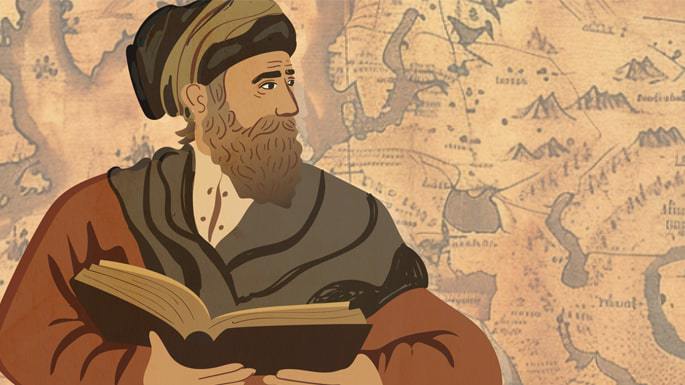
Bucking the trend, however, was a fascinating figure of the 12th Century, called Benjamin of Tudela. Born in the Spanish kingdom of Navarre, Benjamin went out on a journey tracing the Jewish communities of southern Europe, northern Africa, and south west Asia.
He took a long route on pilgrimage to Jerusalem that brought him through countries we would know today as Italy, Greece, Turkey, Syria, Lebanon, Iraq and Iran. He seems also to have travelled around the Arabian peninsula, looking for the Jews of Africa, but never reaching the Gondar region of Ethiopia, where he might have found them.
Benjamin recorded all of his encounters in Hebrew, in a book called Sefer HaMasa’ot, the Book of Travels. His chronicles were so fascinating that they were reproduced over many centuries, and translated into Latin and most European languages.
Today, Benjamin’s records have attracted scholarly attention, not least because they subvert our expectations of who goes exploring and who gets explored. Benjamin writes with fascination and joy about the Pope in Rome and the Caliph in Baghdad.
Most importantly, when Benjamin meets Jews in other countries, he is at once meeting his own people and meeting people entirely different from himself. When he sees how other Jews do things differently, he feels joy in diversity. When he sees Jews doing well, he feels pride; and when he sees other Jews in a persecuted condition, he suffers with them as his own.
This is the great blessing of Benjamin’s travelogue: he can see the world through two sets of eyes – as both an outsider and as an insider. When he travels, he is never quite the colonialist going out to comment on others, but he’s never just looking at his own people. This gives him an impressive position of humble curiosity.
As British Jews, we may learn to do the same thing.
We have a blessing by dint of our position. That blessing is a special ability to look at the world through multiple sets of eyes.
We can, indeed, look at the world through European eyes. We are Europeans, and we belong here. We can see England as it is imagined by the English, where this island is the centre of the world, its monarchs the most illustrious, its culture the highest human attainment. We should not shy away from seeing the best in Europe: we are part of it, and there is much to love.
We can also, if we choose too, see this continent through outsiders’ eyes. We can see its flaws, its delusions of grandeur, and its odd habits. We can be the best possible internal critics of our country, because we understand what it is to belong, and what it is to feel like we do not.
The danger in either of these sets of eyes is that we turn them into a haughty gaze. Like the early colonialists, we have the capacity to see every other culture as backward and barbaric, or its people and lands as subjects for exploitation. Inverting the gaze, we might come to see the Europeans as horrible invaders, without directing the critical lens on ourselves.
But if, instead, we can approach the whole world with modesty, we can see every nation and every place with loving curiosity. With humility, we can see ourselves as fellow travellers with everyone else, discovering this wonderful world together.
If we can do this, then, like Abraham, we may truly learn to walk with God.
Rosh Hashanah is a moment when all judgement is suspended. The scales are suspended, and the weights could fall either way.
At this moment, anything can happen. We reflect on how precarious life is, and how delicately all is held together.
In the light of Rosh Hashanah, our own lives come into focus. How fragile is our existence.
The rest of the year, we take for granted this delicate balance that allows us to go on living. Today, we notice how remarkable our lives are, and assess what we are doing with them.
Have we embraced life’s blessings and sought to make the most of our days? Have we multiplied joy and generosity in others? What were the moments we squandered or took for granted?
At Rosh Hashanah, we acknowledge our vulnerability. We listen for God’s voice within us. We hear the messages this day brings. God, in turn, hears us.
Then, we find a way to go on. We affirm our lives.
The stories of Rosh Hashanah point us to moments of precarity. We read of times when life almost did not come about, and of moments when life almost came to an end. Through these ancestral tales, we access our own vulnerability.
Hannah longs for a child to be born to her barren womb. She asks: “why do I exist?” Then, God hears her anguish, and she gives birth to a boy. His name is Samuel, meaning God hears.
Sarah laughs at the thought that she could conceive in old age, then God remembers her, hears her, and she has Isaac.
Isaac is destined to be Abraham’s heir, then Abraham takes him up to Mount Moriah to kill him.
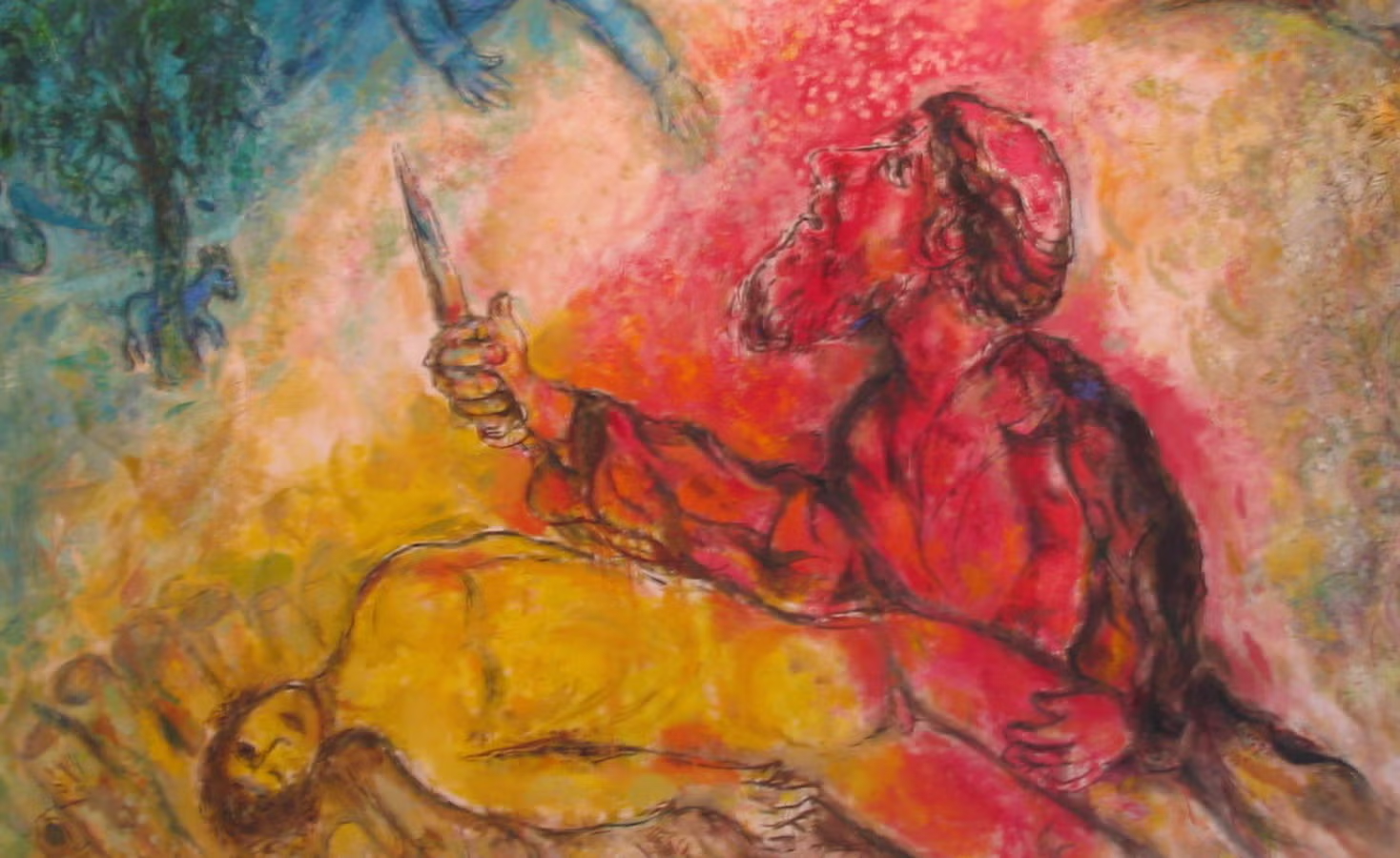
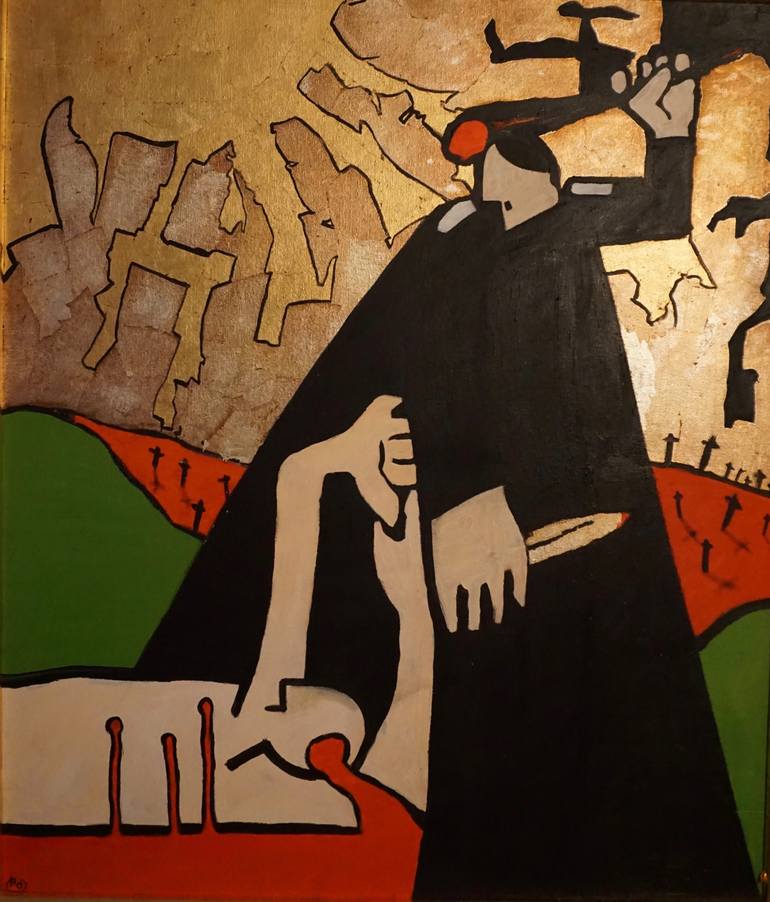
When we picture the Binding of Isaac, we can clearly see Abraham’s raised hand – slaughtering knife outstretched to the sky – ready to murder his own son. We are struck by the moment when all hangs in the balance.
Finally, God speaks, and Isaac is to be killed no more.
In all these vignettes, we find ourselves caught in stories of people whose lives are racked with precarity, but who listen out for God’s voice, take away a message, and find a way to go on that affirms life.
Interwoven with this story of the main characters, our ancestors, is another story, of people living more marginal lives. The story of Hagar and Ishmael speaks even more explicitly to life’s precarity.
In Orthodox communities, where they observe the second day of Rosh Hashanah, the story of Hagar and Ishmael is usually read today. Here, in the Liberal lectionary, wherein we follow the Israelis and hold by one day chag, we are given the option of reading either Isaac’s or Ishmael’s story.
I have opted to read the story of Ishmael because I believe it speaks most clearly to the festival’s theme of life’s uncertainty. Everything about the lives of Hagar and Ishmael is left to the hands of those more powerful than themselves.
Hagar is called a handmaid – a word that glosses over the gross crime inherent in a purchased human being.
A handmaid had no property, no income, and no family to come and redeem her. Most handmaidens were separated from their own kin, and stripped of their original language.
Hagar’s name means “the foreigner.” The Torah calls her “the Egyptian.”
She was beholden to her mistress, Sarah. Hers is the most precarious position one could have in life.
A handmaid cost more than a male servant because the handmaid could produce the most valuable good: more slaves.
Unlike the other women in our readings, Hagar does not long for a child. She expresses no desire; she offers no consent. She is simply used as a vehicle so that Sarah can have a son.
Abraham will take her as a concubine. The child will be Sarah’s property and Abraham’s heir.
This is already a dangerous situation. If she does not give birth, Hagar fails to deliver on the terms of her purchase. If she does have a child, she could become a rival to her mistress.
That is precisely what happens.
Hagar becomes pregnant, and Sarah immediately flies into a jealous rage. Hagar runs away, but has nowhere to go. She can either risk the harsh desert as a single pregnant woman, or she can return to an abusive household.
For Hagar, everything hangs in the balance. Then, God hears her and intervenes. An angel tells her that God knows her suffering, but promises that her life will get better.
She will bear a son. He will be a highwayman, attacking everyone, and attacked by everyone. His name will be Ishmael, meaning “God has heard.”
As with all our protagonists in Rosh Hashanah stories, Hagar finds her life in the balance. She realises how precarious her existence is. Then, she listens for God. Hearing God, she finds a way to move forward.
So, Hagar returns. And her life hangs in the balance once more.
This is where the Rosh Hashanah reading begins.
Here, Sarah sees Ishmael playing and demands of Abraham “cast out that slave and her child, because that son-of-a-slave will not share in the inheritance of my son Isaac.”
Abraham followed Sarah’s words, and sent Hagar out into the desert with nothing more than some bread and a skin of water.
She wandered about in the wilderness of Beersheva until they had completely exhausted her water.
We are told that Hagar sat an arrow-shot away from Ishmael.
This language seems to make us consider Hagar’s own thoughts: in this moment, Hagar thinks: “maybe I could put the boy out of his misery.” But she cannot do it. She cries out “I do not want to see the child die” and bursts into tears.
Then God hears. God hears Ishmael’s voice crying out, and sends forth an angel from Heaven.
Every bit of hope was lost. Everything hung in the balance. But Hagar listened. And God listened. And they heard each other. And Hagar found a way to go on.
The angel says: “כִּי שָׁמַע אֱלֹהִים אֶל קוֹל הַנַּעַר בַּאֲשֶׁר הוּא שָׁם” – “for God has heard the voice of the boy where he is.”
In the Talmud’s treatise on Rosh Hashanah, this is the hook our rabbis use to tell us about our own place before God.
The rabbis say this means that God hears Ishmael in the moment when he cries out.
To God, Ishmael’s past and future actions matter not.
God does not care that Ishmael comes from the lowest and most vulnerable place within Israelite society. God does not care about the prediction that Ishmael will go on to be a highwayman. All that matters is that Ishmael cries out at that moment.
This, says the Talmud, is how we should all see ourselves on Rosh Hashanah. Rabbi Yitzhak declares “every person is only judged according to their deeds at their moment of trial.”
We are only judged by our hearts in this moment of reflection.
We are not our past mistakes, nor our future errors. We are the people that God beholds today. We are the people who chose to turn up, on this Rosh Hashanah, who knew we wanted to engage with our own souls.
That is all that God sees.
This is a part of the Talmud’s more general argument about Rosh Hashanah, that it is a time when everything hangs in the balance.
Our rabbis teach that we should all imagine that the whole world is finely balanced between good and evil, and that it is our responsibility to tip the scales.
Moreover, say the rabbis, our own hearts are precariously weighted, with an even chance of falling to the side of good or evil. In this analysis, then, the fate of the whole world can rest on just how we direct our own hearts.
So, we need to take every opportunity to place a greater load on the scale of good.
The Talmud offers things we can do to make such a change: give to charity, call out in prayer, and change our behaviour. Any one of these actions can cause a shift in that delicate balance.
A small prayer, a slight modification to how we act, a donation to a righteous cause – any of these can transform everything.
We live in a time when all can feel uncertain. Life seems nerve-wracking. At times, it does indeed feel like the balance of all the scales in the world is tilting ever more toward evil.
The Talmud tells us that we still have some control. We can still be a force for good. We can still nudge the fine weightbridge an inch towards goodness.
The Torah gives us examples of people whose own lives hung in the balance. They listened for God, and God listened for them. And God answered “I have heard you where you are.”
So, if you feel like you are hanging in the balance, hang on in there.
In our Scriptures, the changes are often dramatic.
Avram is an idol worshipper who lives in Mesopotamia, then undergoes complete conversion to monotheism and sets out on foot to a new country. With that, he gets a new name: Abraham.
Sarai is barren then, miraculously, in her old age, conceives a son. God gives her a new name: Sarah.
Jacob is a lying trickster who wrestles with an angel in the wilderness. When his heart has truly changed, he gets a new name: Yisrael.
In fact, in each biblical story, a change of direction, outlook, and often name, are the key points of the narrative.
So, what about our Rosh Hashanah reading? Who is it that changes there?
In the Aqeidah, our Torah reading for the new year, Abraham is called upon to climb a mountain and sacrifice his son.
We know nothing about Sarah, who is largely kept out of the story. We don’t know anything of how Isaac feels about this, since he stops talking once he realises what his dad could do to him.
Abraham is remarkably unchanged. At the bottom of the mountain, he is willing to do whatever God says. At the top, God says Abraham is no longer required to sacrifice his son, and to sacrifice the ram instead. At the top of the mountain, Abraham still just does whatever God says.
But there is a character who really changes in this story: God.
God begins the narrative as zealous and demanding of human sacrifice. God ends the story compassionate and eager to enter into meaningful relationships. God begins by effectively threatening to blot out all of Abraham’s children, then ends by promising Abraham as many descendants as stars in the sky.
And, yes, God undergoes a change of name. Through the whole of the story, God is called Elohim, a name associated with strict justice and universal truth. At the very end, God is revealed by a new name – יהוה – Adonai, a name associated with the close personal relationship God has with every human being.
In this story, the character who undergoes the greatest change is God.
Even God, the Creator of the world, the Almighty and All-Powerful, can transform. The Holy One, who by nature is completely eternal, can shift from being strict and distant to close and loving.
So, if even God can change, why can’t you?
In our Talmud, the rabbis introduce us to the idea that we are supposed to imitate God.
Rabbi Hama baRabbi Hanina teaches: be like God. Just as God clothed Adam, you will care for the poor. Just as God visited Abraham when he was unwell, you will visit the sick in your community. Just as God consoled Isaac over the death of his father Abraham, you will comfort the mourners. Just as God buried Moses, you will inter the dead.
God shows us a model of how we ought to live. Like God, we are supposed to be compassionate, loving, kind, morally clear, and doing justice in the world.
But more than that. Like God, we are supposed to change.
Here, at Rosh Hashanah, we learn: just as God can change, so can we.
We are made in God’s image. At the start of each year, we read a story where our Creator transforms. So we know that we can change too.
We can face our fast-shifting world. We can rise to the challenge of our changing community. We can look inside ourselves and love our own souls a little more.
Blessed are You, Eternal One our God, who gives us the power to change.
In the distant past, people made small gods. They carved out wooden statuettes to represent fertility, or hewed rocks into the shapes of animals that would bring them good luck. They made depictions of stars and planets, which would help them in their daily struggles. The ancients looked after the gods – giving them food, drink, rest, and clothes. In return, their little talismans looked after them.
When Abraham was born, he lived among the idol worshippers of Ur. He had no teacher nor guide, but came to understand, through his own reasoning, that God was the only Creator of all things, and that the world was governed by an invisible Force that could not be depicted. The totems people served were not gods at all, and could have no impact on the world.
As a result, he went around smashing up and destroying every idol and household God he could find. He went around telling everyone that the worship of idols was a great lie, and that the One True God would destroy anyone who bowed down to them. He enjoined his followers, the descendants of Abraham, that they, too, must destroy all idols.
This poses a question: what is so bad about idol worship?
If these are just empty vessels, why fear them? If they are not really gods, what harm can they do? Why should idols be so concerning that we must smash them up everywhere we find them?
By the time we get to the end of Moses’s life, here in the Book of Deuteronomy, the aversion to idol worship is even more intense.
At the start of Re’eh, Moses instructs the Israelites to find every idol, tear down the pillars, smash up the altars, cut down their gods, and destroy any memory that these false gods ever lived there.
If a seer comes to you, says Moses, and they say they have had a vision that you should worship idols, you must kill them instantly. You must purge them and their evil words.
If your own brother, sister, mother, father, or friend wants you to worship idols, Moses says, show them no pity. Don’t try to stop anyone from killing them. In fact, make sure it is your own hand that strikes them down.
And if you find out that there is a town where people worship idols, go and kill everyone in it. Bring everyone from the town together and slaughter them. Bring everything from that town into the square and burn it to the ground. Destroy that city in its entirety and never let anybody rebuild it.
This feels like something of an over-reaction.
How can idol worship be so bad that it is worse than murder, worse than cutting off your own kin, worse even than razing a city to the ground? Why should this practice of building little statues be so intimidating that it requires such destruction?
This feels completely out of place with our moral sensibilities. That’s not just a modern thing.
Even in the 13th Century, rabbis were worried about this injunction. Rambam, the great rabbinic decisor who codified all of the Torah’s laws, was also concerned.
Rambam lived among Muslims and Christians in medieval Egypt. He admired and appreciated them. He read the works of the great Greeks who had never known monotheism, like Plato and Aristotle. He found them wise and inspiring. He was deeply opposed to fundamentalism and chauvinism. Rambam, like us, was not really up for burning cities to the ground just because they did not follow our God.
Rambam says: don’t worry. The world for which these laws were written no longer exists. People don’t worship idols any more. Whatever perverse practices the Pagans once did, they are not doing them now.
Even if they did exist, we would not have the authority to burn a city to the ground like that. You would need a Sanhedrin – a court of 71 learned judges who could recite the laws in their entirety – and we have not had one of those for many centuries.
Even if the idol worshippers did still exist, and we did still have a Sanhedrin, the Sanhedrin would necessarily make sure to do everything possible to educate the idolaters away from their ill-conceived practices, help them to repent, and find ways to make sure they can live in the true religion of monotheism.
So, don’t worry, says Rambam, we can forget about all that.
But the trouble is we can’t.
It’s there in the Torah. We read it every year. Rambam still has to go and codify all these bloody edicts, that make such monsters of people who pray to fetishes.
And Rambam does not answer my fundamental question. The people who bow down to wood and stone might be wrong; their beliefs might be misplaced; but what is so bad about giving a drop of wine to a brick?
The most compelling answer I have found comes from a 20th Century psychoanalyst. Erich Fromm was born in Frankfurt, Germany, at the start of the last century. He studied psychiatry and philosophy among the greats of his generation, then moved, in 1934 to America, where he became a leading writer and critic of modern society. Needless to say, he was Jewish.
In 1976, Erich Fromm wrote a landmark book called “To Have or To Be.” This text became the cornerstone of the anti-consumerist movement.
Fromm engaged seriously with our religious texts. He saw them as inspiring people with a serious psychological message about how to live.
The difference between real worship and idolatry, says Fromm, is not what you worship, but how you do it. He calls it the “being mode” and the “having mode”.
The problem with idolatry, says Fromm, is that it makes you think God is something you can own.
Hebrew monotheism is a rejection of the entire enterprise of having a god:
“The God of the Old Testament is, first of all, a negation of idols, of gods whom one can have… The concept of God transcends itself from the very beginning. God must not have a name; no image must be made of God.”
Fromm writes:
“God, originally a symbol for the highest value that we can experience within us, becomes, in the having mode, an idol. In the prophetic concept, an idol is a thing that we ourselves make and project our own powers into, thus impoverishing ourselves. We then submit to our creation and by our submission are in touch with ourselves in an alienated form. While I can have the idol because it is a thing, by my submission to it, it, simultaneously, has me.”
So, for Fromm, idol worship isn’t over at all. In fact, it is a pitfall any of us can stumble into. If you think that faith is something you can have, rather than a way of living, you are guilty of idolatry. Fromm says:
“Faith, in the having mode, is a crutch for those who want to be certain, those who want an answer to life without daring to search for it themselves.”
Fromm goes further. It’s not just about God. It’s about everything. Do you want to be in this world, or do you want to have it? If you think you can have it, you will never be satisfied. But if you can truly be in it, you will find no need to have any desires met. Fromm says:
“The attitude inherent in consumerism is that of swallowing the whole world.”
Fromm even extends his philosophy to how we love. Do not try to have love, he warns, but try to be in love.
“To love is a productive activity. It implies caring for, knowing, responding, affirming, enjoying: the person, the tree, the painting, the idea. It means bringing to life, increasing his/her/its aliveness. It is a process, self-renewing and self-increasing.”
If we take Fromm seriously, we have a whole new way of looking at the world. Inspired by the prophets, everything we do can be about existing and loving and being. We can reject the whole ideology of possessing.
That is what is wrong with idolatry. The artefacts of the Pagans aren’t just wooden blocks. They tell us a way of living. The wrong way of living. They direct us to control and own.
Rambam may be right. The idolaters do not exist in cities any more.
Instead, today, they live in our own minds. And we must burn them down, if we are to be truly free.
At home, my fiance paces back and forth, preparing for his exams in anaesthetics. In a week, he will be tested orally to see if he can become a consultant. He recites definitions of key medical terms, revises laws of physics, gives diagnoses of uncommon diseases.
One definition he has repeated so many times it is now imprinted in my mind too.
Death is the irreversible loss of capacity for consciousness and loss of capacity for breathing.
At times, we have pondered over such terms together. On long walks, we have discussed medical ethics through Jewish lenses. We have debated whether and how modern medicine aligns with ancient wisdom.
Now is not the moment to challenge him on the medical definition of death. But the definition sticks with me, because this is an area where I do not think science and religion align.
While Laurence prepares for his exams, you will have to listen to my thoughts on what Judaism teaches about mortality.
Death is the irreversible loss of capacity for consciousness and loss of capacity for breathing.
Is it? Is that what it means to die?
If it were, then would living simply be brain activity and breathing? Is that all we are?
Chayyei Sarah – the life of Sarah – is our portion. It opens with her death. By telling us about her life from her death, the Torah is telling us something about how life and death interact.
The parashah is a recounting of Sarah’s burial. It is a terse text, where the primary narrative concerns Abraham’s attempt to purchase a lot for internment.
So much is left unsaid. So many emotions are not expressed. In the silences and interstices, we are left to reconstruct our own imaginings of what Abraham was thinking. Let us try.
Abraham proceeded to cry and eulogise Sarah.
He held her hands, once so strong and firm. Those hands had kneaded bread for strangers at a moment’s notice. They had sewn garments for whole families. They had, at times, pointed accusations, separated children, raised objections… Strong hands. Determined hands. Strong, determined hands, that were now drained of all their vigour, and sat coldly in his own palms.
Abraham rose from beside his dead, and spoke to the Hittites.
Abraham sprang into action. Sarah had not died in the land of her own family in Egypt, nor of Abraham’s in Chaldea. They were in a strange place, far from their own homes, among Hittites in the hill-country of Canaan.
Abraham said: “Here I am, a stranger and a foreigner among you. Please sell me a piece of land so I can give my wife a proper burial.”
Sarah had left her father’s home in the palaces of Egypt, where she lived as a princess. She was an aristocrat in a great empire who gave it up to travel with a wandering man. Abraham claimed to have spoken with the One True God, and Sarah just followed him. She forsook luxury for a life on the road. Now, she lay dead on the road, and there would be no fine processions to pyramids to entomb her.
The Hittites replied to Abraham, “Listen, my lord, you are an honoured prince among us. Choose the finest of our tombs and bury her there. No one here will refuse to help you in this way.”
Sarah used to laugh with her whole belly. Her shoulders bounced up and down. She can find humour where nobody else could. Even when she struggled with infertility, she found ways of making jokes. Abraham would not hear her laugh again.
So Abraham bowed low before the Hittites and said, “Since you are willing to help me in this way, be so kind as to ask Ephron son of Zohar to let me buy his cave at Machpelah, down at the end of his field. I will pay the full price in the presence of witnesses, so I will have a permanent burial place for my family.”
Sarah had been so beautiful people tripped over themselves staring at her. On their wanders, every prince desired her. Sarah was as beautiful at 127 as she had been when they had first met. She was still just as honourable and God-fearing. Nobody would be as good and beautiful and true again.
Ephron was sitting there among the others, and he answered Abraham as the others listened, speaking publicly before all the Hittite elders of the town.
Sarah received no ennoblement or reward for marrying Abraham. Yet so much honour came to Abraham through her. She could see visions and speak with God.
“No, my lord,” he said to Abraham, “please listen to me. I will give you the field and the cave. Here in the presence of my people, I give it to you. Go and bury your dead.”
Abraham had bargained over everything. He had struck a deal with Avimelech to share water sources. He had even negotiated with God over the destruction of a city. This was a bargain he could not accept.
Abraham again bowed low before the citizens of the land, and he replied to Ephron as everyone listened.
“No, listen to me. I will buy it from you. Let me pay the full price for the field so I can bury my dead there.”
Abraham was ageing too. Who would bury him? He had cast out one son and tried to murder another.
Ephron answered Abraham, “My lord, please listen to me. The land is worth 400 pieces of silver, but what is that between friends?”
What is four hundred shekels between strangers? What is a price on the life of Sarah? What sort of burial could ever be enough for her?
Ephron said: “Go ahead and bury your dead.”
These are some words we may complete into the silences. They come from the other biblical stories and midrash, and they paint a fuller picture. In the spaces, we see that this is not a negotiation over a burial plot, but a negotiation over the nature of death.
Death is the irreversible loss of capacity for consciousness and loss of capacity for breathing.
Is it? Is that what it means to die?
If it were, then would living simply be brain activity and breathing? Is that all we are?
Medically, scientifically… maybe.
Spiritually, Jewishly… no.
Death is as much a journey as life is.
For seven days, we eulogise, as the last imprint of a person leaves us. For thirty days, we mourn, as the shock and grief harrow us. For eleven months, we pray, as some part of the soul heads on its journey to Heaven.
Then, every year, we say the names of the dead, and some part of our loved ones returns to us. Their soul breaks through the gaps in Aramaic words and we feel them with us once more.
Thousands of years later, we still say Sarah’s name, and some part of her keeps living long after breath and consciousness.
We are more than what we exhale: we are the laughter and joy we bring to others. We are more than our own thoughts: we are the memories living on in others.
In memory, in prayer, in faith, we grasp something greater than the material world.
Trusting in You, Eternal God, we see life beyond death.
When they lived in Eden, Adam and Eve did not have to labour for their food. Yet, in the moment that they were expelled from paradise, God gave them stern instructions on what they would have to do.
God warned: “Through painful toil you will eat food from it all the days of your life. By the sweat of your brow you will eat your food until you return to the ground, since from it you were taken; for dust you are and to dust you will return.”
Where once they had a homeland, the original people were cast out into a state of permanent exile, to live in the world with all its struggles.
This fable, though mythic, tells us something true about how human beings came to have the life we do. While there was probably never really an original idyll where people lived without work, there was a moment, millennia ago, when humanity’s ancestors shifted how they lived.
For most of our history, we had wandered. All people were nomadic. They hunted and gathered, migrating between caves and carrying temporary shelters all over the neolithic continents.
Then, as the last Ice Age ended, around 11,000 years ago, people discovered that they could store seeds from one year to the next. They developed agricultural systems, with plots of land dedicated to growing crops. Having once roamed the earth, they could stay put in a single place, which would be their land.
Cain and Abel are archetypal characters who tell us about this great change. Abel was a nomad, who herded flocks and grazed them over the hills. His name means “breath” or “waif” – for, like a cloud that drifts across valleys, he wafted without leaving a trace. He was a symbol of the old way of constant movement.
Cain, his brother, had a name which meant “acquire” or “possess.” Just as God had warned his parents when they were cast out from Eden, he worked by the sweat of his brow. He laboured on the soil, where he sowed, grew, and harvested plants for food.
At the dawn of civilisation, these were the two types of people: those who cultivated the land in fixed places; and those who travelled with no fixed abode. Everything that was movable, like herds and clothes, was held by the nomads, the Abels. Everything immovable – like allotments and orchards – was owned by those who settled, the Cains.
Our Torah says that God favoured Abel over Cain, and it probably felt that way. While agriculture can keep people settled and build lasting cultures, it is unpredictable. One bad year of too much rain, or not enough, or bad seeds or infertile soil, can leave an entire community famished and ruined.
A pastoralist, on the other hand, has a tough but durable existence. The life of a shepherd means much moving, but that is part of what makes their life sustainable. Sheep can be moved to wherever water is healthy and available. A goat can graze on thistles and other crops that people find inedible.
So, yes, to the ancient mind, it may have seemed like God looked more kindly on the one who wandered than the one who farmed.
Cain killed Abel.
The one who tilled the land and made it his home sought to destroy that wandering waif. Perhaps, indeed, he did. Perhaps the founders of the earliest civilisations enforced their new way of life with violence and coercion.
But not successfully. As soon as Cain commits the first murder, God tells him what he will become. Cain cries out at his punishment: “Today you are driving me from the land, and I will be hidden from your presence; I will be a restless wanderer on the earth, and whoever finds me will kill me.”
For killing Abel, Cain would become Abel. Having been the acquirer, he would take his place as a nomad. Having been so sure in his farmland, Cain would return to the ancient ways of roaming.
God said to Cain: “Abel had no homeland. Now neither do you. Abel was forced to wander. Now you will wander too.”
Generations passed, but the draw of homeland was irresistible. In ancient Mesopotamia, Abraham was called “ha-ivri” – border-crosser; the one who passed between places.
He heard the voice call out: “Go, get going, to a land that I will show you,” and Abraham traversed to Canaan, to a new land where he hoped he would settle.
He took his family, and his possessions, his movable goods that had sustained him in all his wanderings, and went in search of home.
But, having reached the land that God would show him, he saw it and he left. He pitched his tent and built an altar, then carried on to Egypt. When he returned, he did so as a nomad, travelling with his flocks, threatened by the Canaanites and Perizites who had acquired the land, as Cain had once done.
Abraham sought a home, and found one, but it was never a permanent space. He had wandered to be in one place, but in that one place, he found he had to keep on wandering.
Abel, Cain, and Abraham all wandered. So did the Israelites in the desert. Deep in our ancient stories, there is an idea that, while a settled home may be desirable, migration is part of the human experience. We may dream of Edens, but life is unpredictable, and fortune may force us to move.
In Torah stories, we learn the survival of migrants, passed down from generations who knew what it meant to move with the seasons.
It is a deep knowledge, from before we were Israelites or even Jews, stretching back to our history as neanderthals.
Please do not imagine that I am romanticising exile. Travelling breeds resilience and creativity, but it is far from idyllic.
Instead, wandering is an inevitability.
In every community and in every family, if you go back far enough, you will find a traveller. In the stories of our Torah, you learn that it could be you.
Abel was a restless nomad, and we may wander too.
Shabbat shalom.
Cain and Abel, by Frank Hoesel
I learnt this Torah from Rabbi Joel Levy at the Conservative Yeshiva in Jerusalem.
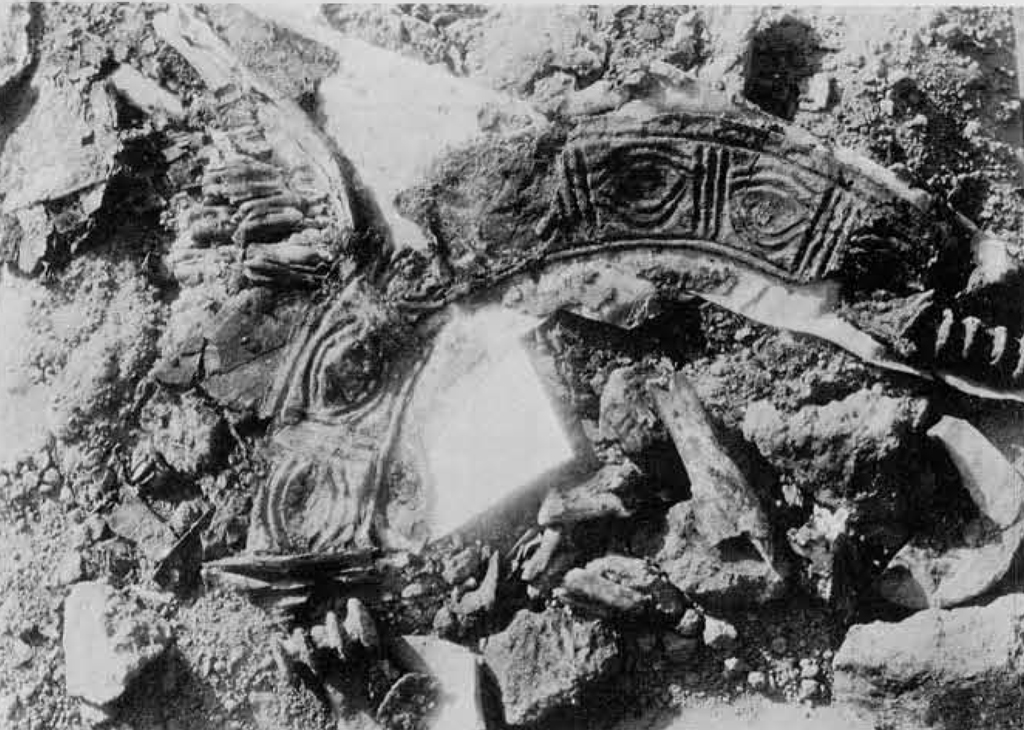
In 1922, archaeologists dug up a site in modern-day southern Iraq. There, they found incredible spans of gold and sophisticated armour, and Iron Age Sumerian artefacts, encased within stone walls. They dubbed this place “the Royal Cemetery of Ur,” an ancient Babylonian mausoleum.
On that site, they also discovered evidence of hundreds of human sacrifices. Among the human sacrifices, a considerable number were children.
Nearly all of the skeletons were killed to accompany an aristocrat or member of the royal family into the afterlife. Some had drunk poison. Some had been bashed over the head with blunt objects. After their death, many were exposed to mercury vapour, so that they would not decompose, but would remain in a lifelike posture, available for public display.
Excavations from the Royal Cemetery at Ur
This site dates to sometime around 2,500 BCE in the ancient city of Ur. According to our legends, another figure came from the ancient city of Ur sometime around 2,500 BCE.
His name was Abraham.
In the biblical narrative, Abraham wandered from Ur to ancient Canaan, where he began to worship the One God, and founded Judaism.
The world in which Abraham purportedly lived was rife with child sacrifice. Across the Ancient Near East, archaeologists have uncovered remains of children on slaughtering altars. They have found steles describing when and why they sacrificed children. They have found stories of child sacrifice from the Egyptian, Greek, Sumerian, and Assyrian civilisations.
So problematic was child sacrifice in the ancient world that our Scripture repeatedly condemns it. The book of Leviticus warns: “Do not permit any of your children to be offered as a sacrifice to Molech, for you must not bring shame on the name of your God.” The prophet Jeremiah describes disparagingly how the Pagans “have built the high places to burn their children in the fire as offerings to Baal.” In the Book of Kings, King Josiah tears down the altars where people are sacrificing their children.
Abraham put a stop to the practice of child sacrifice. It seems to happen suddenly, and without warning, and with even less explanation. No reason is given why he abruptly ended all the cultural deference that had gone before and opposed an entrenched religious practice.
The question we now must ask is: why?
One reason that comes to mind is that it is so obviously immoral. Surely it should be self-evident that you don’t kill kids! But that wasn’t obvious to all the people around Abraham. And that wasn’t obvious to traditional commentators, either. In their world, the morally right thing was always to obey God.
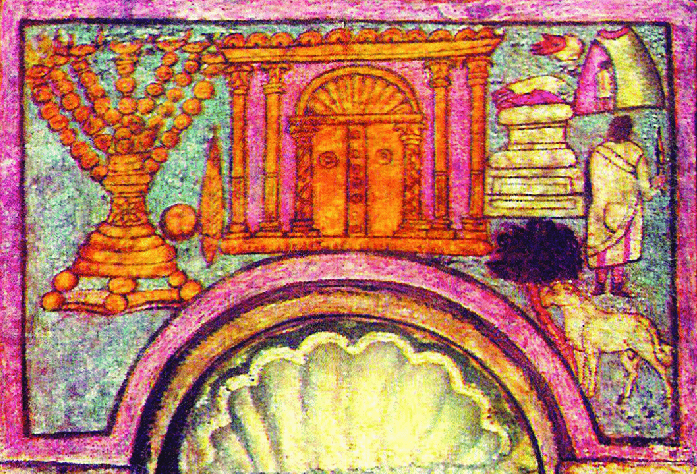
Fresco of the Binding of Isaac at the 3rd Century Duro Europos Synagogue, Syria
A traditional reading says that Abraham stopped child sacrifice in obedience to God. In the story we read today, Abraham is called upon by God to go up on Mount Moriah and slay his son. Only at the summit, when he holds up his arm to murder Isaac, does God stop him, telling Abraham that he has proved his devotion to God by not withholding his son, and that he does not have to kill Isaac.
Yet there are several problems with this story. If we adhere to the traditional reading, God still wanted child sacrifice, and felt that doing so would prove Abraham’s devotion. In fact, nearly all traditionalist readers interpret it this way,saying that obedience before God should be a sacred virtue. A conservative reader of the Bible says that the moral of the story is that we should be subservient to God, and do what we are told.
God said not to perform child sacrifices, so we no longer do. That would mean, then, that if God had said child sacrifice was permitted, we would still be doing it.
In 2007, the Israeli philosopher Omri Boehm offered a radical reinterpretation of the story of the binding of Isaac. The story, Dr Boehm argues, is not about Abraham’s fealty to God, but his disobedience. Dr Boehm shows how, reading against the grain of traditional interpretation, this is not a story where God changes tact and decides not to ask for child sacrifices anymore, but where Abraham rebels against authority and refuses to commit murder.
For Boehm, what was truly radical about the Binding of Isaac was that it set out a new set of values, completely at odds with those of the Ancient Near East. Where other cultures practised child sacrifice because it was part of their established culture, Abraham resisted and put life above law. Where others encouraged obedience to authority, so much that poor people could be killed in the palaces of Ur to serve their masters in the afterlife, Abraham made a virtue of rebellion. For our ancestor Abraham, refusing to follow orders, even God’s, was the true measure of faith. By not killing, even if God seemingly tells you to, you show where your values really lie.
This is not a story about obedience, but rebellion. And that message – of resistance against authority in defence of human life – has much to teach us today.
Boehm reconstructs what the archetypal story of child sacrifice was in the Ancient Near East. Across many cultures and time periods, there was a familiar refrain to how the story went. The community is faced with a crisis: some kind of famine, natural disaster, or war. The community realises that its gods are angry. To placate the gods, the community leader brings his most treasured child and sacrifices him on an altar following the traditional rites. Then, the gods are pleased and the disaster is averted.
We can see that the biblical narrative clearly subverts the storytelling tradition that was around it. In other cultures, the community leader really did sacrifice his special child, and that really did please their Pagan god. In our story, the community leader does not sacrifice his special child, and the national God proclaims no longer to desire human sacrifice. This is already then, a bold message to the rest of the world: you might sacrifice children, but we will not.
Boehm takes this a step further and looks at source criticism for the text. Most scholars of Scripture accept that Torah is the work of human hands over several centuries. One of the ways we try to work out who wrote which bits is by looking at what names for God they use. Whenever we see the name “Elohim” used for God, we tend to think this source is earlier. Whenever we see the name “YHVH” used for God, we tend to assume the source is a later edit by Temple priests.
The story of the binding of Isaac is odd because it uses the name “Elohim” almost the entire way through, until the very end, when the angel of God appears and tells Abraham not to kill Isaac. That means that most of the text is from the early tradition and only the very end part, where the angel of God tells Abraham not to kill Isaac, comes from the later priests.
So, Boehm asks, what was the earlier version of the text? If you take out the verses where God is YHVH and have only the version where God is Elohim, what story remains?
Well, in the version that we know, where both stories are combined, an angel of God calls out and tells Abraham not to sacrifice Isaac. That’s the bit where God is YHVH. If you take that out, and have only God as Elohim, Abraham makes the decision himself. No angel comes to tell him what to do. Next, if we cut out the parts where God is YHVH, there is no praise from the angel, telling Abraham he made the right choice. Instead, you get a story where Abraham deliberately disobeys his God because he loves the life of his son more.
Adi Nes, ‘Abraham and Isaac’, 2004
The earliest version of the text, before the Torah was edited and a later gloss was added, is one in which Abraham is commanded by God to sacrifice Isaac, goes all the way up Mount Moriah, and then refuses. Without prompt or praise from God, Abraham decides to sacrifice a ram instead of his son. In the earliest version of the biblical narrative, when source critics have stripped away priestly edits, God tells Abraham to sacrifice his son and Abraham rebels.
The earliest version, then, is an even more radical counter-narrative to the other stories of the Ancient Near East. Not only do we not sacrifice children. We also recognise that sometimes you have to say no to your god. In this version, rebellion is more important than obedience, especially when it comes to human life.
This isn’t just a modern Bible scholar being provocative and trying to sell books. In fact, Boehm shows, this was also the view of respected Torah scholars like Maimonides and ibn Caspi. These great mediaeval thinkers didn’t think of the Torah as having multiple authors, but they could see that multiple stories were going on in one narrative. One, they thought, was the simple tale of obedience, intended for the masses. But hiding between the lines was another one, for the truly enlightened, that tells the story of Abraham’s refusal.
Boehm terms this “a religious model of disobedience.” By the end of the book, you go away with the unshakable impression that Boehm is right. True faith, he says, is not always doing what you think God is telling you. Sometimes it is reaching deep within your own soul to find moral truth. Sometimes you really show your values by how you defy orders.
In his conclusion, Boehm takes aim at Rabbi Shlomo Riskin, an American religious leader, who lives in the West Bank settlement of Efrat. Rabbi Riskin had said, in his analysis of the binding of Isaac, that Abraham was a model of faith by his willingness to kill his son. Riskin insisted that he was willing to sacrifice his own children in service of the state of Israel.
This, says Boehm, is precisely the opposite of the message of the binding of Isaac. The point was not to let your children die. The point was to bring a final end to child sacrifice. The point was not to submit to unjust authority, but to rebel in defence of life.
Rabbi Riskin does not realise it, but by offering child sacrifice, he is really advocating for the Pagan god. He is describing the explicitly forbidden ritual of allowing your children to die.
Abraham thoroughly opposed these false gods who demanded ritual murder. They were idols; and child sacrifice a monstrous practice that we were supposed to banish to the past. The very essence and origin of Jewish monotheism is its thorough rejection of killing children.
Boehm could not have known how pertinent his words would become. This year has been one of the worst that those of us connected to Israel can remember. Beginning on October 7th, with Hamas’s horrendous massacres and kidnappings, the last Jewish year has seen us rapt in a horrific and seemingly never-ending war.
This year, thousands of Israelis were killed. This is the first time in a generation that more Israeli youth have died in war than in car crashes. Reading through the list of names, it is remarkable how many of the soldiers were teenagers.
That is not to even mention the 40,000 Palestinians whom the IDF have killed. According to Netanyahu’s own statements, well over half were civilians. Around a third were children. As famine and food insecurity rises, the risk of deaths will only accelerate. It has been agonising to witness, and I cannot imagine how painful it has been to live through.
Yet, during my month in Jerusalem, I saw that the voice of Abraham has not been extinguished. There are few groups I hold in higher esteem than the Israeli peace movement. Against untold threats and coercion, in a society that can be intensely hostile to their message, they uphold Abraham’s injunction against killing.
One of the leaders of the cause against war was Rachel Goldberg-Polin. On October 7th, her 19-year-old son, Hersh, was kidnapped by Hamas. His arm was blown off and he was taken hostage in Gaza. From the very outset, Mrs. Golderg-Polin argued fervently for a ceasefire and a hostage deal that would bring her son home. She warned that the only way her son would come home alive would be as part of political negotiations.
At the end of August, as Israeli forces neared to capture Hersh as part of a military operation, Hamas shot her son, Hersh, in the head.
Rachel Goldberg-Polin’s refusal to give up hope, refusal to sacrifice her son, and steadfast insistence on peaceful alternatives is a true model of Abraham’s faith.
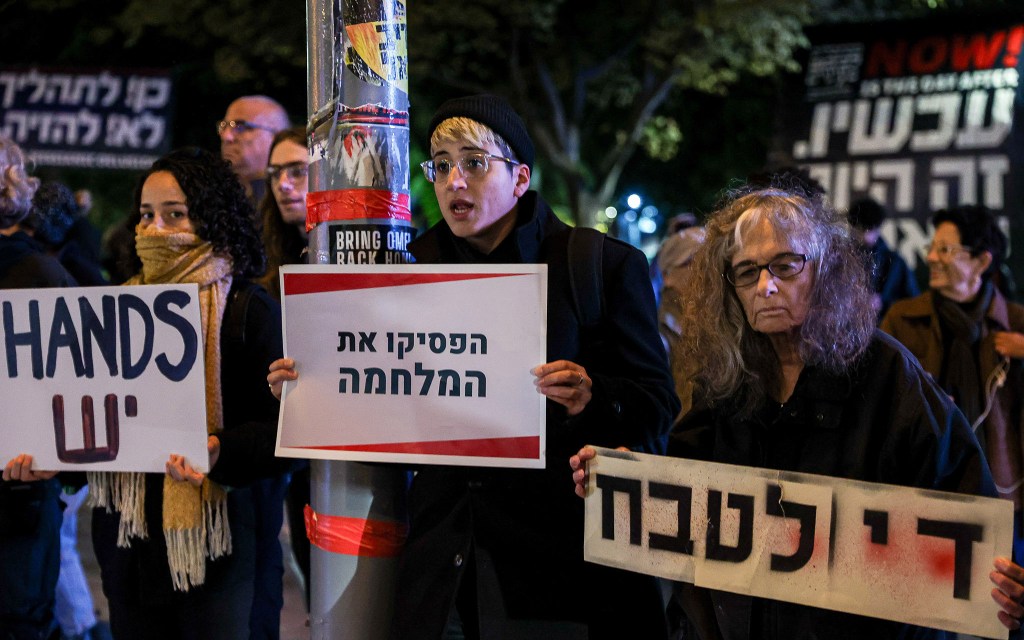
Israeli peace protestors
And it involves serious rebellion too. When I met with hostage families in Jerusalem, I was shocked to hear how, for protesting against the war to bring their families home, they had been beaten up by Ben Gvir’s police. I saw this with my own eyes when I marched alongside them. People shouted and jeered at them, and the police came at them with truncheons.
In July, when I went with Rabbis for Human Rights to defend a village in the West Bank against settler violence, we were joined in our car full of nerdy Talmud scholars by a surprising first-timer. A strapping 18-year-old got in to volunteer in supporting the Palestinian village. What was most remarkable was that he himself lived in a West Bank settlement.
He explained that he had refused to serve in the military. He did not know that others had done it before, or that there were organisations to support Israeli military refusers. Instead, he said, he thought to himself: “if I don’t go, they won’t kill me; if I do go, I might kill someone.” What could be a truer expression of Abraham’s message: no to death! No to death, no matter the cost.
He really had to rebel. For refusing to serve in the war, the conscientious objector I met spent seven months in jail. Still now, there are dozens of Israeli teenagers in prison because they would not support the war.
Throughout my time in Jerusalem, I attended every protest against the war and for hostage release that I could. One of the most profound groups I witnessed was the Women in White, a feminist anti-war group going back decades. One of these women, with grey hair and the look of a veteran campaigner, held a placard that read in Hebrew: “we do not have spare children for pointless wars.”
Is this not exactly what Abraham would say? We will not sacrifice our children on the altar of war!
Theirs is truly the voice of Abraham, the true voice of Judaism. It is the voice that opposes child sacrifice. Theirs is the voice that upholds the God who chooses life.
Talmud tells us that, when we blast the shofar one hundred times on Rosh Hashanah, we are repeating the one hundred wails of Sisera’s mother when she heard her son had died. Sisera was, in fact, an enemy of the Israelites, who waged war on Deborah’s armies, and was killed by the Jewish heroine, Yael. Still, at this holy time of year, we place the grief of Sisera’s mother at the forefront of our prayers.
We take the cry of every mother who has lost a child and we make it our cry.
Thousands of years after the Sumerian Empire had ceased existing, archaeologists dug up its remains, and saw a society that practised child sacrifice. From the very fact of how they carried out murder and permitted death, the excavators could tell a great deal about what kind of society this was. One that killed people to serve their wealthy and their gods.
One day, thousands of years from now, historians may look upon us too, and ask questions about what our society was like, and what we valued. May we take upon ourselves the mantle of Abraham.
May they look back and say that we chose to value life. May they look back and see that our people despised death and war. May they look back on us and see a society that practised faithful disobedience.
This is the week of our Torah dedicated to love stories. Our religious texts often contain laws or stories of struggle, but this is a unique reprieve, in which we are offered some romance.
At the beginning of our parashah, Sarah dies, and Abraham bargains for the perfect burial site. He wants to ensure her burial arrangements are in exact order. Later, he will be buried beside her, so that they can be joined forever in the hereafter.
The Talmud clearly picks up on how sweet these negotiations are, because it embellishes a story of what happened many centuries after they had died. Rabbi Benah was marking burial caves. When he arrived at the Cave of Machpelah, where Abraham and Sarah were buried, he found Abraham’s faithful servant Eliezer, standing before the entrance.
Rabbi Benah said to Eliezer: “Can I go in? What is Abraham doing?”
Eliezer replied: “Abraham is lying in Sarah’s arms, and she is gazing fondly at his head.”
Rabbi Benah said: “Please let him know that Benah is standing at the entrance. I don’t want to barge in during a moment of intimacy.”
Eliezer said: “Go on in, because, in the higher world that they inhabit, souls no longer experience lust. All that is left is love.”
Benah entered, examined the cave, measured it, and left.
It’s such a beautiful story. It teaches what an ideal relationship should be, where a couple loves each other long after death.
Perhaps, most significantly, it tells a story of mature love; of what happens when relationships really do last, and people carry on loving each other until their last days. I think we all know of such couples, but their stories rarely appear in our culture. We get romantic comedies. We get depictions of what love is like when it’s just starting out, but not so much about how it endures. Our media shows the hero get the girl, but not how they make their relationships work.
Don’t get me wrong. I love a good rom com. Yes, I did think Ten Things I Hate About You was a masterpiece when I was a teenager. And I absolutely did binge watch both series of Bridgerton on Netflix.
They all follow a predictable plotline. Two loveable heroes, and you’re rooting for them both. They encounter a tribulation. They overcome an obstacle. There’s a grand gesture. They realise they’re supposed to be together. In the end, there’s a wedding and they all live happily ever after.
In a way, that’s the story that we find immediately after Sarah’s funeral. Abraham realises that Isaac needs a wife. He sends out a search party, led by ten camels. He sets a test: whichever woman offers water to the camels by the well is the one meant for Isaac.
Immediately, we root for Rebekah. She is beautiful. She’s strong. She’s hard-working. She offers to feed all the camels, and rushes back and forth, drawing water from the well, feeding an entire herd of camels. Obstacle surmounted, we get our grand gesture. She is presented with a huge gold nose ring and two huge gold bracelets. She accepts. Their families rejoice. Everyone agrees that this was arranged by God.
There’s just one snag to reading a romantic comedy into all of this. The hero in the story isn’t Isaac. The man who goes out with all the camels, sets the challenge, starts the relationship, and makes the big gesture, is Abraham’s servant, Eliezer. By rights, if this were a love story directed by Richard Curtis, the wedding would be between Rebekah and Eliezer!
Isaac isn’t even involved. They’re engaged and the deal is done before the couple have met. Rebecca doesn’t know what he looks like. When Isaac later comes clopping along on his horse, Rebecca asks who it is. We have to hope that she was impressed, but we can’t be sure.
All we know is that, once married, Isaac feels comforted after the death of his mother. The heroin in our story, at the end, is reduced to a replacement mum for her husband. A love story this is not.
But, do they at least go on to have a happy marriage? Of course not. They were forced together as strangers as part of an economic arrangement.
In the entirety of our Torah, they never say two words to each other. They just pick favourite children and pit them against each other. They trick each other, lie, and form an unbelievably dysfunctional family.
The whole thing is a nightmare. It’s far more Silent Hill than Notting Hill.
This could never have been a love story! We’d never have got Sandra Bullock narrowly missing out on an Oscar for her heart-wrenching performance as Rebekah. We can only wish for Sacha Baron Cohen bumbling as a comedy father Abraham.
90s cinema didn’t invent romantic love, but it was far closer to its origins than Isaac and Rebekah were. The idea of romantic love, as we know it, was born out of the Enlightenment.
During the Age of Reason, philosophers had the wild idea that partnerships between people might be based on more than just combining property and keeping families happy. They suggested that marriage might not just be a way for nobility to make treaties between nations, but borne of a deep feeling common to all people. They even offered up the radical idea that women were people, and might have an opinion on their relationships too.
In those heady days, Judaism split between those who accepted the ideas of the Enlightenment, and those who did not. We, who embraced those fantastic ideas of equality, became the Movement for Reform Judaism.
As we accepted the ideas of love between equals, our rituals and ceremonies have progressed with us.
In a traditional ceremony, the woman is acquired with a ring. The ring is, in its origin, a symbol that the woman has been purchased. When Rebekah received her nose ring and bracelets, she was effectively accepting the shackles of her new owner.
In our ceremonies, both partners to the wedding mutually acquire each other, or even forgo rings in favour of an alternative symbol of equal partnership. Both partners encircle each other under the chuppah, showing their shared space.
Whereas in a traditional ceremony, a woman may remain silent, Reform weddings require explicit consent from both parties. Both read their vows, and some couples choose to produce their own.
This may now seem obvious and intuitive, but it is only because the ideas of the Enlightenment have taken such hold. Love – the idea that people can be equal and caring partners – has had to be won.
Love is really a Reform value. It is something special to our movement. Our ancestors spent centuries fighting for the idea of meaningful love, so that we could celebrate it today in all its forms. You can only really celebrate love in a place that really believes human beings are equal.
And that is why Sarah, holding Abraham in her arms, gazing lovingly at his head, joined with him in an immortal embrace, was the first Reform Jew.
This week, Israel went to the polls, electing its most far right government yet. Netanyahu is set to return to power, and take control of the legislature to stop them prosecuting him on corruption charges.
To secure power, he has allied himself with extremist religious nationalists, Bezalel Smotrich and Itamar Ben Gvir. They are unabashed racists, who are explicitly opposed to Reform Judaism.
Their whole ideology is about securing an ethnically Jewish majority, by deploying military means against the Palestinians, preventing mixed marriages, and expanding the borders as far as they will go.
They want to make sure all Jews are reproducing to win their demographic war, so promote institutionalised sexism and homophobia. In particular, Smotrich wants to ban abortions, bring back conversion therapy, stop trans access to healthcare, and ban gay men from donating blood.
In the preceding weeks, Jewish News warned that this was not an Israel British Jews would want to see. Many quarters have expressed great alarm at the election results.
In fact, this is not so new or surprising. There was a time when Naftali Bennet, also a religious nationalist, was considered the most far right voice in Israel. He has now spent the last year as Prime Minister, ruling on a supposedly moderate ticket, mostly because of how far right the rest of the religious nationalist movement has become.
It is not simply that they are bigots. It is not just that they loathe me and everything I stand for. On that front, the feeling is very much mutual. It is that they have twisted Judaism into a bellicose hate cult.
You can find them rioting through East Jerusalem, terrorising the Palestinians to scare them out of their homes.
You can see them expanding into new settlements, throwing people out of their family homes.
You can hear them singing at the Western Wall that they will violently wreak vengeance on the Palestinians.
And, of course, you can find them in the Knesset, the Israeli Parliament, passing laws. Their most recent triumphs are declaring that Israel is only a state for the Jews and that Arabic is not a recognised language; and defending settler violence in the West Bank.
All this, they say, is to defend the Jewish people.
Perhaps, we might concede that they and their friends are stronger because they have the full might of a large army behind them. If that is their definition of Jewish defence, fine.
But it has nothing to do with defending Judaism. Their so-called Judaism is based on perverse, anti-rabbinical readings of religious texts. They see the whole of the Jewish tradition and history as a summons to colonise the entirety of David’s historic kingdom and annihilate anyone who stands in their way.
They do so in our name. And in the name of our Torah.
While the general thrust of our religious text is towards peace and justice, there is more war in the Torah than you might expect. The Torah is, after all, an ancient Near Eastern text, from a time when emergent states and nascent empires were locked in near-constant battles for territories and resources.
This week’s parashah is a prime example. Lech Lecha dedicates an entire chapter to a fantastical description of war.
Abraham enters a military pact to defeat the armies led by Kedorlaomer. Often called “The War of the Nine Kings,” the chapter includes descriptions of alliances, rebellions, military campaigns, and looting the spoils of war.
If you are hearing this story for the first time, you are not alone. We often skirt over it in favour of the more elevating sections of this week’s reading.
It’s not just our very polite sensibilities as British Reform Jews. In general, the rabbinic tradition as we know it, has downplayed the Torah’s violence, or reinterpreted it to be about more moral topics.
Judaism as we know it was born out of abortive wars and failed uprisings, so our rabbinic progenitors went to great lengths to caution against war and violence. In practice, Judaism has been pacifist, if only out of pragmatism, rather than principle.
The preceding periods, in which pre-rabbinic Jews did have military power, were pretty horrific. The Second Temple period, under the Hasmonean Dynasty, saw brutal repression of any deviation from official state religion. Its leaders were corrupt, seeking to control every part of legislative and economic life. They were tyrannical.
When our rabbis rebuilt Judaism out of the ashes of the destruction of the Temple, they wanted to introduce necessary correctives to historic fundamentalism. They sought to create a Judaism that would be ethical, based in the grassroots, committed to diversity, and, above all, peaceful.
So, our tradition opted to understand the Torah’s violent exhortations differently. The rabbis understood the calls to massacre entire nations as personal struggles to blot out the violent parts of ourselves.
In our parashah, they understood the text not as a summons to war, but to faith. They read Abraham’s conquests as a moral message about the importance of trusting in God. When the King of Sodom offers Abraham spoils of war and he refuses, our rabbis interpret this not as a rebuttal of a future military alliance, but as Abraham saying that real riches come from God in the form of blessings.
This moral and peaceful hermeneutic became the foundation of Judaism.
All that changed in the 19th Century, with the emergence of the religious nationalists. For them, the Torah was not a moral handbook, but a military one.
They were inspired by Christian fundamentalists who wanted to see a world-ending war. Still now, those evangelicals are their primary financial backers.
When they read our parashah, they treat it as a call to arms. “Lech lecha” is not, for them, a moral command to follow God, but a political one to move to Israel. The wars are not stories of an ancient civilisation, but justifications for military violence today.
When they read biblical mandates to massacre nations, they take them literally. They imagine that they are divinely mandated to enact genocide.
This is not a fringe group on the margins of Israeli politics. This is the Israeli government, and it has been for decades.
This is not an aberration in Israeli politics. It is the trajectory the country has been on at least since I was born. The far right have continually dominated, show no sign of abating, and hold every possible government to ransom.
Liberal leaders keep saying that, at some point, when the racism gets too much, they will withdraw their support for Israel, but the day never comes.
At this point, it has to be asked: how far is too far? If Ben Gvir and Smotrich are not too much, what will be? Will there ever be a point at which people are finally willing to draw a line? When will we say that enough is enough? When will we cry out: not in our name?
We do not like to look at the verses in Torah that glamourise war and nationalism. We do not like to look at the news from Israel that does the same.
But, right now, we have to look at it. Because these facts are staring at us. And we can no longer presume to turn away.
When this government imposes its reactionary plans, they will be doing so in our name. In the name of our Torah. We have to stand up and assert that they do not.
The so-called Judaism of the religious nationalists is not ours. We repudiate their racism, their fundamentalism, and their militarism.
We affirm the Judaism of the rabbis and the Reformers – based on ethics, dignity, piety and peace.
We will do everything we can to resist this government’s perversion of Judaism.
Not in our name. Not in the name of our Torah. Not in the name of our God.
We are nearing the end of Sukkot and entering Simchat Torah.
We move from fragility to strength, from an open roof to a closed scroll, from the impermanence of life to the eternal truth of God.
What makes a sukkah kosher is its frailty. With its open walls and starlit roof, it stands in for all our wanderings and confusion. It is makeshift and temporary.
In its fragile state, it teaches us about the human condition: that we are vulnerable, at the whim of forces beyond our control. Into this transient home, we bring guests, both living and ancestral, who teach us that we only live by community.
The sukkah teaches us about the human heart: that it must be open and porous, welcoming to strangers, able to let others in and accept our own emotional helplessness.
But the sukkah also has another feature of what makes it kosher. It must be able to stand for eight days. It must be strong enough to withstand the weather. It cannot be drowned by rain or upended by windstorms.
This, too, teaches us about the spirit. We must be resilient. We must be confident enough to know our boundaries. We must be strong enough not to let others wave or topple us.
This is the tension we hold in the transition between Sukkot and Simchat Torah: between fragility and strength.
There is a story that Abraham’s tent was open on all sides.
Wherever Abraham looked, he could see whether strangers were coming to visit him.
If he looked out and saw them coming, he would run to meet them. Abraham was the model of generosity, so full of love for the wayfarer that he would do anything to let them in.
This explains why he greeted the angels who came to visit him at Mamre so enthusiastically, even though he thought they were just human beings. It explains how he was righteous enough to receive God’s blessing, and to become the progenitor of monotheism.
This is the version of the story that we find in Bereishit Rabbah, and you will find it printed in all sorts of commentaries. It is a beautiful myth that captures our imaginations and features heavily in sermons preaching charity. It teaches us about the importance of welcoming.
But it is not the only version of the story in rabbinic literature. A few centuries later, Avot deRabbi Natan, a commentary on the same text, explains it slightly differently. Instead of the example of Abraham, this midrash says we should be like Job.
It teaches:
Your house should have a spacious entrance on the north, south, east, and west, like Job’s, who made four openings to his house. Job opened up every side so that the poor would not be troubled to go all around the house: no matter what direction a stranger came from, they could enter in their stride.
At a glance, it tells the same story, just with a different prophet named. Job was also described as righteous and upright, a man who feared God and turned away from evil.
But there is a difference. Unlike Abraham’s, Job’s house is actually mentioned as having four sides. How do we know? Because, at the very start of Job’s story a messenger comes to tell Job that his house has blown down. “Amighty wind swept in from the desert and struck the four corners of the house. It collapsed on the young people and they are dead.”
Job’s house was so open that it was destroyed and killed everyone in it.
Job’s house was open on all sides. No wonder it fell down!
This later midrash is satirising the earlier one. Sure, openness is good, but too much openness leaves you exposed.
We have to exist, instead, in the tension between fragility and strength; between vulnerability and boundaries.
It may seem strange to preach boundaries from the bimah. Admittedly, it feels strange to me.
I used to believe that openness was the ultimate religious value. That being hospitable and welcoming were the most important spiritual attributes. And I do still hold them in high regard.
But I am increasingly learning that it is equally important to have structural integrity, and borders, and lines that cannot be crossed. Without them, the entire structure collapses, and the people the structure was established to protect can be destroyed with it.
Sukkot teaches us to live with utmost susceptibility, but only for a short time. We must eat and sleep and live in this shaky fruity shack, exposed to all elements and strangers. It teaches us to put ourselves in harm’s way.
But not forever.
At some point, the sukkah must come down. At some point, we must return to our own beds and kitchen tables and modern comforts. At some point, we have to hold on to something firm.
As we enter Simchat Torah, we turn to that certainty. That is our Torah, our faith, our belief in God-given moral truths. We grasp it steadfastly, and refuse to waiver from it.
Torah is our foundation. It is our immovable structure. There is some truth that we must hold on to tightly, never allowing it to be permeated or eroded. For us, that is our moral conviction.
The Mishnah instructs us to build a fence around the Torah. This commandment has been abused by some in Orthodoxy to justify always taking the most conservative approach, defending every law against the slightest leniency or adaptation. As such, Reform Jews have often poured scorn on the assertion, seeing it always as a reactionary threat.
But a fence is not the same as a wall. In fact, the word used in the Mishnah is siyag, which is closer to hedge. It is a boundary. It is a line that keeps some things in and some things out. It is a way of protecting the essence.
That does not mean it has no ways in and no ways out. It just means that some things must be shielded.
We are nearing the end of Sukkot and entering Simchat Torah.
We move from fragility to strength, from an open roof to a closed scroll, from the impermanence of life to the eternal truth of God.
We have learnt to be vulnerable and precarious. Now, we must learn to protect what we love.




 Sim Lev