festivals · story

Set a place for Elijah


If you receive a knock on your door over this Pesach season from a beggar, please be warned. It could be Elijah.

You have been setting a place at the table for him every year, leaving him an extra glass of wine. You have been waiting for him. Did you never imagine what he would look like?

Sure, in the children’s stories, he is like a jolly Jewish Santa carrying presents. But you are all old enough and learned enough to know how Elijah is really depicted in our tradition.

When you think of Elijah, you need to imagine somebody who absolutely stinks. You need to picture wild matted hair and cackling laughter and a leather hip flask filled with hooch. 

The prophet is a drinker, and who can blame him?

No crueller punishment has ever been doled out than that given to Elijah the Tishbite. Elijah was cursed with unending life.

His sentence came in the time of Queen Jezebel but he was already much older than that. Nobody knew how old, or where he was from.

Back then, the people called him the Tishbite: the immigrant. The name stuck so hard that later generations imagined he must have come from a place called Tishab. 

He made enemies in life. Prophets always do. They have God on their side, but the powerful have the weapons, and, for now, the truth of swords is stronger than Scripture. 

At first, Elijah revelled in his mission. He was a notorious outcast. He went out in the streets making fun of the false gods. He wound people up in the markets. He poured scorn on every priest. 

And, at first, his adversaries found him entertaining too. He was like a court jester, telling the monarchs what they didn’t want to hear, as onlookers cheered him on.

But the joke grew thin. And the ruling powers had enough.

“I swear by all my gods, I will kill you,” said Queen Jezebel, and Elijah fled into the mountain caves. 

“The trouble is,” Elijah wailed, “people don’t know what’s good for them. Nobody is faithful any more. The real ones have vanished from humanity. Everyone lies. They have twisted lips and two faces. Why can’t you just cut out their tongues?”

God gave him food and water and rest through the kindness of ravens. 

“Please, Almighty,” prayed the prophet. “Send me a sign.”

The wind rattled mercilessly through the mountains, shattering rocks and splitting cliffs.

“Please, God,” said Elijah. “Just a small sign of Your provenance.”

In the valley below, the earth rumbled and quaked apart.

“Are you there, God?” he asked.

Over the tops of the hills, Elijah saw black smoke puffing out of white flames as a raving fire blistered through the thickets. 

That’s when Elijah made his fatal error. He begged God to let him die.

“I’m not looking for miracles, O Merciful One. I’m all out of hope. I have had enough. Please take my life.”

Then there was silence. 

No more infernos or hurricanes or earthquakes. 

The pressure dipped. The ravens stopped chirping. 

Not even an echo in the still canyon. 

He heard a whisper in the cave. 

“What are you doing here, Elijah?”

The Tishbite stood up in the dark silence. He mustered his courage. He announced: “I am a zealous warrior for the Almighty God. And I am the only one left.”

“A zealous warrior who wishes he were dead?”

Elijah got ready to speak, but the whisper interrupted him.

“A man of the people who despises the people? A faithful prophet who does not see miracles? A truth teller who lies in the face of God?”

Elijah was still and small.

“Faithless, are they?” 

God’s words reverberated in the cave. 

“In that case,” said the Creator. “You will need to watch over them. They will never perform our rituals without you there. So you will attend every circumcision and attend every seder until the end of time. Then you will see how faithless My people are.”

A hurricane of flames burst from the clouds and dragged Elijah, screaming, into the sky.

“Your mission is ongoing,” the Eternal One instructed him. “You will turn the hearts of parents to their children and the hearts of children to their parents. You will be my herald of a greater age.”

“When people are ready to listen to you, when they believe you and see you,” said God, “then I will send the Messiah.”

So Elijah trudged on. He stood in the gateways of every city, proclaiming visions of a coming world. “There will be no hunger or war; neither envy nor competition. Goodness will flow in abundance and all the delights will be freely available as dust. The occupation of the entire world will be solely to know God.”

But nobody listened. 

He had no more cheerleaders, and no more adversaries. He was just another vagrant with a vivid imagination. 

Do you know what happens to a body when it is condemned to live? It trundles on with all the distress of ageing but without any hope of repose. Over centuries, the bones break, the eyes dim, the flesh rots, the organs become riddled with disease. In each era new viruses and plagues are created and you contract them all. It takes a long time, but you get sick and your lungs fill up and feet swell and your joints fuse and your muscles contract and your pores reek and your hands tremble.

It is like being unbelievably tired but never, ever allowed to sleep. 

It took a while before Elijah really allowed time to lay waste to his body. Before he let his hair become matted and knotted. Before he stopped washing and his skin turned to oily fungal patches.

Talmud teaches that, when the Romans ruled the world, he used to sit at the gates of their capital city. He would sit with the other beggars, tending to his wounds. He would unwrap each bandage and then tie it again, gingerly holding his body together as it broke.

A great rabbi came to visit him and recognised him from a mystic’s description. 

“My master, my teacher, peace be upon you,” the young rabbi beamed as he alighted on the prophet.

Elijah was filled with joy. For a brief moment Elijah felt he was seen. 

“When will the Messiah be coming?” The rabbi asked. 

“Today!” Elijah laughed. “Today! Today! Today!”

The rabbi went back to his homeland with the prophet’s words in his ears. 

“Today,” said Elijah, as he sat back down to tend his wounds. “Today. If you are able to see me and you are willing to hear my words, it really could be today.”

“I don’t think that was really Elijah,” the rabbi said to his friends on his return.

So the Messiah didn’t come then, and the Messiah hasn’t come yet. 

Some snooty Jews are expecting him to turn up with beaming smiles and a suit and tie. Or they imagine he will be a wispy spirit. Or they think the Heavens will open and they will see God themselves. 

They open the door to him. But, even with the place set and the doors wide open, they don’t notice that the old prophet is already there, dressed in his rags and nursing his whiskey. He has always been there.

Only when we are able to realise that intoxicated crazy people might be Elijah will we really be able to see the prophet.

And when we all recognise that every outcast and despised person may be the harbinger of the greater age, we will not need to wait any longer. The Messianic age will have already arrived. 

So, set a place for Elijah this Pesach. Fill a glass of wine for his health. Open your door to welcome him.

Just be sure you know who you’re looking for.

Shabbat shalom.

judaism · theology

Why Jews do not believe in Hell

When I was a teenager, I went on some kind of away day with other Progressive Jewish youth.

The rabbi – I can’t remember who – told a story. 

A woman dies and enters the afterlife. There, the angels greet her and offer her a tour of the two possible residencies: Heaven and Hell. 

First, she enters Hell. It is just one long table, filled with delicious foods. The only problem is that they all have splinted arms. Their limbs are fixed in such positions that they could not possibly feed themselves. They struggle, thrusting their hands against the table and the bowl. Even if they successfully get some food, they cannot retract their arms back to their mouths. They are eternally starving, crying out in anguish. That was Hell.

Next, she enters Heaven. Well, it’s exactly the same place! There is a long table, filled with delicious foods, and all the people sitting at it have splinted arms. But here, there is banqueting and merriment; everyone is eating and singing and chatting. The difference is simply that, while in Hell, people only tried to feed themselves, here in Heaven they feed each other. 

She ran back to Hell to share this solution with the poor souls trapped there. She whispered in the ear of one starving man, “You do not have to go hungry. Use your spoon to feed your neighbor, and he will surely return the favour and feed you.”

“‘You expect me to feed the detestable man sitting across the table?’ said the man angrily. ‘I would rather starve than give him the pleasure of eating!’

The difference between Heaven and Hell isn’t the setting, but how people treat each other.

At the conclusion of this story, one of the other teenagers – I can’t remember who, but I promise it wasn’t me – put his hand up and said: “But I thought Jews don’t believe in Hell?”

The rabbi shrugged and said: “True. It’s just a story.”

Years later, though, the story, and the resultant question, have stuck with me. 

Was it just a story? Do Jews really have no concept of Hell?

The truth is complicated. 

Among most Jews, you will find very little assent to the idea of punishment in the afterlife.

In part, that is simply because most of Judaism does not have a clear systematic theology. There is no Jewish version of the catechism, affirming a set of views about the nature of God, the point of this life, and the outcomes in the next. 

Rather, Judaism holds multiple and conflicting ideas. On almost every issue, you can find rabbinic voices in tension, holding opposite views that are part of the Truth of a greater whole. We don’t mandate ideas, we entertain them.

So, a better question would be: does Judaism entertain the idea of Hell?

And the answer is still: it’s complicated. 

Yes, it does. The story that rabbi told of the people with the splinted arms comes from the Lithuanian-Jewish musar tradition. It is attributed to Rabbi Haim of Romshishok.

The idea of pious Jews going on tours of Heaven and Hell has a long history. In the Palestinian Talmud, a pious Jew sees, to his horror, his devoted and charitable friend die but go unmourned. On the same day, a tax collector, a collaborator with the Roman Empire, dies and the entire city stops to attend his funeral. 

To comfort the pious man, God grants him a dream-vision of what happened to each of them in the afterlife. His righteous friend enjoys a life of happiness and plenty in Heaven, surrounded by gardens and orchards. The tax collector, on the other hand, sits by waters, desperately thirsty, with his tongue stretched out, but unable to drink. Where one gave in this life, he received in the next. Where the other took in this life, he was famished in the next. 

This is a revenge fantasy. The story comes from oppressed people coming to terms with the success of their conquerors and the humiliation of the good in their generation.

The fantasy is powerful, and the motifs repeat throughout Jewish history. In almost every generation, you can find people pondering about how bad people will be punished and good people will be rewarded when this life is over.

But, with equal frequency, you can find Jewish scepticism about this view of the world. The Babylonian rabbis warn us not to speculate on what lies in the hereafter, for God alone knows such secrets. Our greatest philosophers like Rambam and Gersonides strenuously deny any concept of post-mortem torture. 

These debates have persisted even into the modern era. During the Enlightenment, there were those who claimed that a rational religion could have no place for the primitive nonsense of Hell. Equally, there were those who said belief in divine retribution was the hallmark of a civilised belief system.

So where did the idea come from, asserted so confidently by that teenager on a day trip, that Jews have no concept of Hell?

The truth is it is very recent.

In surveys of attitudes, Jewish belief in Hell plummeted after the Second World War.

In all the revenge fantasies and horror stories that people could concoct about Hell, not one of them sounded as bad as Auschwitz. 

There is no conceivable God who is cruel enough to do what the Nazis did. No such God would be worthy of worship.

We have no need to fantasise about freezing cold places filled with trapped souls, or raging furnaces. We need not imagine a world after this one where people are starved and tortured and brutalised. We know that world has already existed here on earth.

Isn’t Hell already here still? Doesn’t it still exist right here in this world for all those mothers putting their toddlers in dinghies hoping the sea will take them away from the war? Don’t those horrors already exist in for people working in Congolese gold mines or Bangladeshi sweat shops? 

Hell is already here. It is war and occupation and famine and drought and slavery and trafficking. There is no need for nightmares of brimstone when people are living these things every day.

That was the point of the story that rabbi was telling us. 

The difference between Heaven and Hell isn’t the setting, but how people treat each other.

We already live in a world of plenty. We have the flowing streams and gardens and orchards our sages imagine. But, like the inhabitants of Hell, we are pumping sewage into the streams, turning the gardens into car parks, and logging the orchards for things we do not need. 

We are sat before a fine banquet where there is enough for everyone, but half the population are not eating while a tiny minority are engorged with more than they need. We are living the vision laid out in the parable.

Yes, this world is a Hell, but it could be a Heaven too. 

The difference between Heaven and Hell isn’t the setting, but how people treat each other.

Look at all that we have. Look at the support we can give each other. We may have splinted arms but all we need do is outstretch them. 

We have the capacity to annihilate all hunger, poverty, and war. We really could end all prejudice and oppression. This planet could be a paradise!

And, if we know that we can make this world a Heaven, why would we wait until we die? 

Shabbat shalom.

sermon · spirituality

How do those stories taste?


As human beings, we are constantly carrying stories with us of who we are, what we have done, and how we should be in the world. On top of those stories, we build edifices: whole structures and personalities to serve those narratives. But, when those structures are forced to face up to reality, they can come crumbling down completely. And then we are left with only our stories, and we have to reconsider whether they were ever true.

That is what happened to the Israelites when they built the Golden Calf.

Moses went up Mount Sinai and spent time with God. There, on the precipice, God’s finger inscribed in stone the two tablets of the Law, as Moses watched in awe.

Meanwhile, down below, the Israelites grew restless. They didn’t know where Moses was or when he would be back. Under Aaron’s instruction, they built for themselves a Golden Calf, which would serve as their God. Now they could have something to worship.

When Moses returned, he found the people prostrating themselves before the calf, singing praise to the idol that it had brought them out of Egypt. Immediately, in a fit of rage, Moses threw the tablets on the ground and shattered them.

Those stone slabs were not the only thing destroyed that day. Moses also took the calf the people had made and burned it in fire; then he ground it to powder, scattered it on the water and made the Israelites drink it.

This is perhaps one of the strangest things that happens in the whole Torah. Two questions have really animated commentators on this passage. The first is: how is this possible? Can gold really be ground to dust and consumed with water? What sort of process would enable Moses to break the idol down so fine and feed it to the Israelites? Is such a thing actually potable? Wouldn’t it injure or kill the Israelites to drink it?

The second question is why? Why would Moses do such a thing? What is the value?

Rashi, following the Talmud, suggests that this was similar to the Sotah ritual. Elsewhere in Torah, we read of a custom for wives suspected of being unfaithful to their husbands. They are required to drink soot mixed with water. If they are guilty, they will miscarry. If not, they will survive.

There are obvious parallels in terms of procedure: both involve drinking water mixed with soot. It is also true that, in much of biblical theology, the Israelites are understood to be God’s faithless wife. Whenever the Israelites worship other gods, they are described as philanderers who have rejected their loyal husband. Here, then, the ritual would be testing the adulterous people to see whether they had broken their marriage vows. Based on this, says Rashi, God would determine what punishments were appropriate for their misconduct.

While I like the elegance of the solution, it doesn’t quite sit right. It’s not just because of the obviously misogynistic undertones. It’s also because it doesn’t make sense. The Sotah ritual is for wives suspected of adultery. A Sotah ritual might find its victim guilty, but, more likely, it would clear them of wrongdoing. Here, there is no doubt. They have been caught in the act. You don’t need to check whether something has happened if you saw it happening and talked about it.

Nachmanides was obviously also perturbed by this explanation. He offers an alternative suggestion: Moses was trying to humiliate the Israelites. He was turning their god into something loathsome and disgusting, that they would be forced to excrete. Once the Golden Calf had come out of them as dung, they would surely recognise that it wasn’t really God.

This is actually an argument that Nachmanides had used in the infamous Barcelona Disputation. Nachmanides was brought to the Spanish palace and ordered to defend Judaism against the Christian official, Friar Pablo Christiani. He said that the eucharist, the bread given at Catholic masses as a body of Jesus, could not possibly be God, because the Christians disgraced it by excreting it. Nachmanides’ interpretation, then, seems more motivated by his theological proofs against Christianity than by the matter of the text itself.

But Nachmanides has a point. The Israelites really needed to understand that the Golden Calf was not God. It was not enough for them to know that idolatry is a sin. They had to really feel, emotionally and physically, that what they had been worshipping amounted to nought.

Thus, the question of how the Israelites could drink the calcined Golden Calf is intimately bound up with why. Sure, it is possible to reduce and grind up gold, but there is no way of consuming it without getting sick. No matter how diluted, oxidised metal is a dangerous concoction.

Moses is saying to the Israelites: if you really think this is God, see how it tastes. Drink it. Is it alive? Is it helping you? Can it really do anything for you?

As the Israelites drank their mixture, they were forced to reckon with the reality that they had built themselves a structure that did not serve them.

They had told themselves a story. We need a God we can see to worship. We need physical things to feel secure. If we make something magnificent, we can tell ourselves that this is what saves us. When those stories were confronted by the hard truth of fire and water, it was evident they weren’t true.

So, they had to rebuild, this time with new stories. The Golden Calf could not be recreated, and nor could their narrative that idols would serve them.

The only thing left to do was to return up the mountain and rebuild the other thing that was broken: the Two Tablets of the Law. They had to tell a new story: of an invisible God, whose proof was in deliverance. They had to build a new structure: the moral laws that would build a harmonious society.

I feel like this is part of the human condition. So often, I have caught myself telling internal stories that keep me on guard and afraid. If I allow such narratives to take hold, I will build up edifices that I imagine will defend me, like anger, resentment, and a victim mindset. I will build up walls so others cannot get in.

But, like the Golden Calf, are serving these structures more than they are serving us. When the walls we build are tested by the fire and water of real life, they amount to nothing. They are just toxic substances that will destroy us. And, when they crumble, all we can do is go back and rebuild the structures that are actually secure: the moral laws that bind us to each other in obligation.

So, this is the challenge. When you find yourself building up a defensive story, pause and ask yourself how it tastes. If you were to drink what you are telling yourself, would it taste like the freshwater of a living God, or would you be imbibing the toxins of an idol?

The stories we tell ourselves are no different to anything else we allow in our bodies. They can either keep us alive, or they can destroy us.

Choose life. Shabbat shalom.

festivals · sermon

I saw a world turned upside down

Yosef, the son of Rabbi Yehoshua, had a near-death experience. Yehoshua asked him: “what did you see?” He said: “I saw a world turned upside down, where the poor were rich and the rich were poor.” His father answered: “You saw a world turned right way up.”

For a long time, this was my favourite passage from all of Gemara. Recently, I’ve started to feel more conflicted about it. 

This brief story is an interlude in Masechet Bava Batra of the Babylonian Talmud. The chapter is all about economic redistribution, charity, the rights of the poor, and fiscal justice. It encapsulates a beautiful idea. The poor should know what it is to be rich and the rich should know what it is to be poor.

Six years ago, the then-26-year-old duke, Hugh Grosvenor, became the world’s richest man under 30. Upon his father’s death, he inherited £10 billion, a title, and some of London’s most profitable land deeds. He remains Britain’s fourth richest person.

According to a recent report by the Joseph Rowntree Foundation, 1 in 5 households in this country are in poverty. 7.2 million households are going without essentials, like heating, food, showers, toiletries and adequate clothing. 

It’s hard to picture statistics, so let’s take a story. Heather is a mum of two girls, aged 10 and 4, in Camborne, Cornwall. Her family is one of those millions in poverty. They opted to tell their story to ITV. Cameras followed her round as she worked multiple shifts, round the clock, and fed her family from food banks.

What would it be like if, as in Yosef ben Rabbi Yehoshua’s vision, the two swapped places?

How would the duke fare if he woke up as a social renter on a council estate in Cornwall, with no money, and unpaid debts, and needed to get his children to school but couldn’t afford the bus fare?

How would it be for Heather if she suddenly found herself a duchess, living on a 300 acre estate in Lancashire, waited on for every meal, never having to clean, and able to indulge in boozy parties costing upwards of £5 million? She wouldn’t need to go shopping. She would own the shopping centre.

It is a tempting fantasy. Seeing this world, so clearly turned upside down, I, too, take pleasure in imagining seeing the day.

We can see why it would have appealed to the authors of the Talmud, too. Rabbi Yehoshua was a poor tailor living under Roman persecution. Yehoshua saw the incredible wealth of Emperor Hadrian, which he had extracted from colonising and impoverishing the people of Eretz Yisrael, among many other territories of his Empire. Why wouldn’t Yehoshua, a pious scholar, want to switch places with that brutish tyrant?

But is it really motivated by righteousness, or is it just a desire for revenge? As we approach Purim, I remember what can happen when a world is turned upside down like that. How easily the oppressed can become the oppressors. How quickly hurt people can hurt people.

Our story begins in a world where one man has a ludicrously bloated empire and spends all his time flaunting his wealth on extravagant banquets. Achashverosh has a harem of women at his beck and call, who live in fear of death and exile.

This is a system already ripe for abuse, and, when Haman is appointed as chief vizier, we see just how far that society can go in its cruelty. Haman insists that everyone bow down to him. He took an ethnic disliking to Mordechai and the Jews, who, in turn, refused to accept his authority. So Haman plans a genocide, with full indulgence from the king and his court. He erects a stake on which to impale Mordechai.

In the end, the world is turned upside down. Mordechai is put in Haman’s position. He is given royal robes and the signet ring. He gallops through town on a horse and everyone bows down to him. Haman is impaled on the stake he planted for Mordechai.

Then, the Jews enact a genocide. In one day, they kill three hundred men. On the next, they kill seven thousand. They massacre and exterminate all who stand in their way, including women and children, with royal permission to plunder their possessions.

Look, a complete inversion of events! The poor are rich and the rich are poor. The strong are weak and the weak are strong.

But, is this justice? 

In Progressive movements, we are so embarrassed by this chapter of the Megillah that we often omit it from our readings. In Orthodoxy, the goal is to get so drunk you don’t know what’s happening. By the end, you’re supposed to be unsure whether you are booing or cheering for Mordechai. That’s not a surprise: if we hears it sober, we’d probably jeer everyone.

The problem the story highlights is not that some people are good and others are wicked, but that broken systems make good people do wicked things.

The same system that permitted egregious exploitation and violence remains intact, with different people doing the killing. Everything is turned upside down, but, somehow everything is just the same.

This story is just a fantasy. There was no historical massacre by Jews in ancient Persia. In reality, they never got the upper hand during their exile. This is just their dream of what they might do if that world was turned upside down.

That doesn’t mean the fantasy is harmless. While Jewish history includes many times when we have been oppressed, it also includes occasions when we have been the oppressors. 

There is nothing in our history to indicate we are any less capable of cruelty and malice. In fact, we know too well that oppressed people, when handed power, can act in ways that would make their persecutors blush. Revenge is a powerful drug.

That doesn’t mean we should never try to turn the world upside down. We are still right to take umbrage at the outrageous wealth of Hugh Grosvenor while most live in poverty. It is still correct to hiss Haman as he uses his powers for ethnic persecution. 

But a world where the rich are poor and the weak are mighty is not a world turned upside down. It is the same world with people in different positions. 

The problem is not Yosef ben Yehoshua’s dream. It’s his lack of imagination. 

When we dream of the inversion of this world, we need to think of more than just switching who gets to be in charge. 

We, too, must have a vision of a world turned upside down. Where there are no rich and there are no poor because everyone has enough. Where there are no persecutors and there are no oppressed because power is shared evenly and democratically. Where racism and abuse are unfathomable because communities strive towards accountability and progress.

That would be a world turned right way up. 

Shabbat shalom.

halachah · judaism · social justice

Are Jews allowed to lend money at interest?

Of course, I am Jewish, but I also consider myself very English. I am English in the very parochial sense that I love canal boats, think provincial churches are beautiful, will definitely barbecue on the only day of summer, and put mayonnaise with everything. But, last autumn, I did the most English thing I have ever done. 

I wrote a disapproving letter of correction.

I had never done it before. I’ve never written in to the BBC or a newspaper. To the best of my knowledge, I’ve never sent a letter of complaint about anything. But this one was too important to simply ignore.

Someone in a play had misrepresented a complex point of Jewish law. 

Now, this may seem trivial. But, six months later, I am still so incensed about this common misconception of halachah, that I feel the need to preach on it. 

In September, last year, I got a real treat: to go see one of our members perform at the Royal Court Theatre. Rachel Hosker, who will be getting married under our auspices in the summer, was performing in a play called ‘Jews. In their Own Words.’ Written by Jonathan Freedland, the play interviews famous Jews, including Tracy-Ann Oberman, Luciana Berger, Margaret Hodge, and Howard Jacobson, trying to give a sense of antisemitism, past and present. 

I’m not a theatre critic, but let me tell you: Rachel acted fantastically. She and the rest of the cast did a fantastic job of bringing the characters to life. 

But there was a line, really a throwaway comment, that stuck with me. The play was attempting to explain the trope of the money-hungry Jew, and how Jews had come to be associated with money-lending. An actor representing CST’s Dave Rich said: “the rulings of the church forbade lending money at interest, which was considered usury, whereas Jewish law allowed it.”

This, to me, is alarmingly inaccurate. It shows not only a misunderstanding of Jewish law, but also of antisemitism, and how it works. It places the responsibility for Jews as medieval money-lenders onto Jews, and our religion. Nothing could be further from the truth.

If it was the case that Jewish law allowed money-lending at interest, you would be hard-pressed to explain the commandment in this week’s Torah portion: “You may not act as a creditor to your people. You may not exact interest from them.” You would also have to reckon with the same commandment, given in the Holiness Code: “Do not exact advance or accrued interest, but fear your God… Do not lend your money at interest, and do not give your food at interest.” The same commandment is repeated again in Deuteronomy: “do not deduct interest from loans to your kindred.”

Of course, you might say, the Torah is not the only source of Jewish law. Perhaps these commandments are amended in the Mishnah, or the Talmud, or the Codes. No, no, and no. The Mishnah says charging interest is so reprehensible that it involves breaking six commandments. The Talmud says that even scribes and witnesses who participate in such contracts are guilty. 

In the defining law code for most of the Jewish world, the Mishneh Torah, Rambam looks at the word for interest – neshech – which is the same as the word for a snakebite, and says it is called as such “because it bites, it causes pain to a fellow human being, and consumes a person.” He repudiates it completely.

Be in no doubt: Jewish law does not permit money-lending at interest.

So, how did it happen that Jews nevertheless ended up associated with money-lending, despite its very explicit prohibition?

In the 4th Century CE, Church Father Augustine of Hippo declared that Jews would be permitted to survive as “living witnesses” to the truth of the Bible, but must be kept in a degraded state, with the mark of Cain, for their refusal to accept Jesus. This became the official policy of Christian Europe’s primary institutions: its churches and monarchies. 

Jews were allowed to live in England neither as citizens nor serfs. They could not own land or participate in the nation. They were excluded from universities, and cut out of the professions. They were only allowed to live in the country on condition that they did the dirty work of the ruling class: tax collecting and money-lending. 

Now, most Jews did not do such jobs. They did the work that was needed for their community, as bakers, vintners, stonemasons, and millers. But, as long as some Jews fulfilled these functions for the monarchy, all Jews could live in European countries as “treasured subjects” – effectively pets of the king. 

This had a profound impact on the lives of medieval European Jews. They were forced to wear humiliating clothes to mark them out. Associated with tax collecting and money-lending, many of the local peasants associated the Jews with all the financial problems they faced. 

The local lords actively exploited this division. They drummed up hatred against Jews, and treated them as a pressure valve, so that, in times of economic crisis, peasants would attack their local Jews rather than turn their ire on the landowner class.

That is why the worst pogroms that we have recorded came in times when the monarchy was in financial straits. In England, these came when the country was bankrupted by its military Crusades to capture Jerusalem. Jews, the perceived cause of money problems, and naturally associated with the Holy Land, had all the anger and resentment of impoverished people poured out on them. 

If the monarchy or the Church were struggling with their own debts, they had an easy way out: they could simply expel the Jews and confiscate all their property. In 1290, Edward I expelled the Jews from England to cancel his debts and win back the support of the knights and lords in parliament, who were also heavily indebted.

This put the rabbis, the arbiters of Jewish law, in a very difficult position. If they permitted lending at interest, they would turn their backs on their entire religious inheritance. If they insisted that Judaism forbade money-lending at interest, they would effectively force their community to leave where they were. And, since all of Christian Europe had adopted the same policy, they would have nowhere to go. 

So, the rabbis had to find a way. They looked at the laws, which said such lending was only prohibited to their kin. Rabbi David Kimchi, writing in medieval France during pogroms and expulsions, said that Jews were not permitted to lend at interest to people who respect Jews. The corollary was that if people would not treat the Jews as full human beings, then they, in turn, could lend to them at interest. In England, the Christians had estranged them and made them explicitly not their kin.

This is why correcting this point on the understanding of Jewish law is so important. It is not just because we are sticklers for getting the halachah right. It is so that we understand what antisemitism is and how it works. 

We Jews did not create this system. We did not allow it, nor have the power to stop it. For over a millennium, European powers embedded and promoted antisemitism to prop up their system. As Rabbi Lionel Blue, of blessed memory, so pithily wrote: “The problem of the Jews in Europe was never the Jews. It was Europe.”

Now, we are citizens in this country. With Emancipation, we might have hoped that it would bring an end to cultures of debt and division. True, most of the banks and money-lenders are now not owned by Jews, and very few Jews today engage in such work. 

But that is not because we are living closer to the laws of the Torah or our rabbis. It is because the whole of our society is caught up in loans. All of us are more indebted and more divided than we ever were. We are pitted against each other by a media eager to see us all fighting. 

Combating antisemitism does not only mean counteracting myths and biases against Jews. It is also about dismantling the material realities that created antisemitism. The hatred of Jews erupts when we are scapegoated for economic problems in society. We must not only contradict the myth that we are responsible, but also fight to ensure that the problems people face of economic hardship and drowning in debts no longer exist. 

When we realise that the world has enough for all of us, and distribute it so that everyone can prosper, we will be far closer to a world without prejudice and fear.

Shabbat shalom.

sermon · theology

A grown-up God for grown-up Jews


When we are children, we have a child’s view of God. A big bearded man in the sky with a benevolent smile, a beard and sandals. Maybe a maternal godhead, embracing us.

We imagine God as our idealised parent, fulfilling all our needs, giving punishments and rewards, guiding us to do right. We see the world as children because we have no other reference point.

Then, we become teenagers, and our worldview shifts. Suddenly, we are able to question authority, push boundaries, and assert our own independence.

We go through growth spurts, physically and emotionally. We close the gap in height with our parents so that we can see over their shoulders. They are no longer demigods, but imperfect human beings that we can challenge.

At this point, many of us give up on God. The childlike view we once had cannot hold, because the view we had of our parents has altered too. We realise that, if we can challenge authority, we can push back against the ultimate force we had imagined too.

I fulfilled the stereotype of a rebellious teenage atheist. I rejected the sky-daddy and all the nonsense of religion. This was a pretty lacklustre rebellion to my parents, who were themselves Marxist atheists.

I don’t remember the moment I stopped believing, or when I started again. But when I came back to faith, the beliefs I held were not the same as when I had been a child. I had to reconstruct God.

I took snippets from Jewish tradition. I listened attentively to my friends who were Quaker, Baptist, Muslim, Sikh, and Catholic, finding the parts that resonated. I reimagined what it would mean to believe in God if the Divine Parent surrounded by clouds no longer existed.

I realised that many others had engaged in the same thoughts too. All the while, when grown-ups had been talking about God, they hadn’t believed in the primary school version either. They had also gone through that process of maturing, and their ideas had developed with them.

It turns out that the God that atheists don’t believe in, the religious don’t believe in either.

This week is the Israelites’ coming of age.

Throughout Genesis, we only knew the God of stories. God created the world; God made people and gave them special purpose; God gave out punishments for wrongdoing and rewarded the good.

Now, we find ourselves in a situation in which we must rebel. We enter the Book of Exodus, where the Israelites are enslaved and forced to do hard labour. They are beaten and abused. Meanwhile, all around them, the Egyptian empire and the social order on which it is built are crumbling. We cannot believe in their gods, and we cannot find our own.

Our hero, Moses, sees through the nonsense. He stands up against his father’s power in the royal palace. He beats a slaver to death. He breaks away from the only regime he has known and runs into exile.

In the years that Moses ran away, he had to give up on all his old beliefs. The fantasies he’d held about his family. The dreams he’d had about what his own life meant.

He married a woman of a different tribe, Tzipporah, and worked for her father, Yitro. They were Kenites, and Yitro was a Midianite priest. Perhaps Moses could just have substituted his old beliefs for the Midianite ways. He would have simply worshipped a new pantheon of gods and taken on different customs.

Instead, Moses is forced to reimagine God altogether.

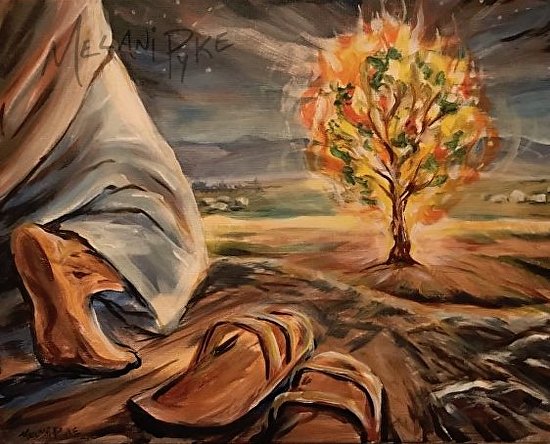
While tending his flocks, Moses meets his Creator in a thicket on a mountain. He sees a bush on fire, but not burning, that calls out to him and demands he remove his shoes.

Could this be one of the gods of Midian or Egypt? Could it be one of the spirits that inhabited the ancient world?

Moses must know. He asks “who are you?”

The voice from the burning bush replies: “אהיה אשר אהיה.” I will be what I will be.

This God does not have a name. It is not one of the idols that the nations worship. It is not something that can be held or controlled. This God will be what it will be. This God is the sum total of all that will ever exist.

When I teach bnei mitzvah children portions, I try to get them to understand what they are saying, so I teach them the roots of Hebrew words. They learn what is going on in each word of their parashah.

In Hebrew, every word has a root: three letters that hold all the possible meanings. Words like kaddish (the prayer for the dead), kiddush (blessing the sabbath), and kiddushin (getting married) all have the same root: kaf-dalet-shin. The root gives us all the words to do with holiness and making things special.

In nearly every parashah, we get to the unpronounceable name of God. The students nearly always try to pronounce it, but find it quite impossible.

We don’t say the word as it appears, but substitute it with “Adonai” (my Ruler) or “Hashem” (the name). That way the name stays sacred, or kadosh.

And then I teach them the root of this ineffable name. Hashem is a composite of three words: היה (what was); הוה (what is) and יהיה (what will be). God’s root is existence. God is the thing that always exists, and from which all existence comes.

When God says “I will be what I will be,” it means that God is everything. God is existence itself. God is whatever it means for something to actually exist.

This is the mature view of God. It is not a fairytale or a Santa Claus. It is a way of understanding all of reality.

This God will not do what it is told, or sort out your problems for you.

That’s why this God comes with a demand. “Go back to Egypt. Get over there and bring the people out of that land. Do whatever you can, bring everyone with you, and get yourselves free.”

When we are children, we have a child’s view of God. One who gives out punishments and rewards. One like an ideal parent.

Now, we are faced with the good of adulthood. The one who is the foundation of all existence. The one who gives all life meaning. The one who says: “I am not going to free you by magic. You will have to start freeing yourself.”

Shabbat shalom.

judaism · sermon · torah

Hold onto your grudges

Friends, the message of this week’s homily is: hold on to your grudges. 

Throughout your life, people will hurt you. Sometimes intentionally, sometimes unintentionally, and you must hold on tight to that hurt. Make sure you bottle it up and let it fester until you are ready to seek revenge. 

That’s where great drama always comes from. Thanks to grudges, we were treated to eight seasons of Desperate Housewives.

At the end of your life, you may wonder what legacy to pass on to your children. Perhaps you have considered wealth or sentimental items or tidbits of wisdom. Can I suggest that you add to that list: give your children a grudge to bear.

The best kinds of grudges are intergenerational. It’s never enough to be resentful on your own. Share it with your loved ones.

If you can keep a grudge going until nobody remembers what the original broiges was about, you will have really succeeded. Without ancient grudges, we would never have had Romeo & Juliet. And look how well that turned out. 

So remember every way in which you were wronged and make sure to even the score.

That’s what King David did. At the end of his life, reflecting on his mortal life, and preparing for the hereafter, he called his son Solomon near to him. He began by offering up some advice. “Act like a man,” David instructed. 

From personal experience, I can tell you that whenever somebody has told me to man up, what follows is always emotionally healthy. And this occasion is no exception. 

David told Solomon: “Remember what Joab, son of Zeruiah, did to me. Remember how he engaged in bloodthirsty mutiny. Do what you like with him, but do not let his grey head go down to the grave in peace.”

And David wasn’t done. He had other grudges to pass on. “Solomon,” he urged. “Remember Shimei son of Gera, the Benjamite from Bahurim, who called down bitter curses on me the day I went to Mahanaim. I said I wouldn’t kill him. But I didn’t say you wouldn’t kill him. So do what you like with him, but do not let his grey head go down to the grave in peace.”

Like a good Jewish boy, Solomon made sure his reign over Israel began with a killing spree.

Let King David be a role model to you all. If someone has insulted you during the course of your life, make sure you remember their names. If you can’t get retribution yourself, make sure your bitterness lives on beyond the grave.

Now, you might think, “of course, King David has big gripes to pass on. He’s a king, after all. He had real enemies. All of my slights feel petty in comparison.” Don’t worry. If misery is good enough for the elites, it’s good enough for the masses, too. It’s time we took a stand for equal distribution of resentment. Anyone can carry hate.

Just look at Jacob. Jacob was blessed with thirteen children. And couldn’t stand any of them. Throughout their lives, he made sure they all knew who his favourites were. First, Joseph. Then Benjamin. 

At the end of his life, Jacob did what every good Jew ought to do. He settled old scores and told everyone what he really thought of them. He brought his boys round to make sure they could hear his views.

“Gather round, my sons, and listen to your father.”

“Reuben,” he says, “you will never succeed at anything.”

“Simeon and Levi, you are too angry to deal in anything but violence.”

“Issachar, you’re an ass. Dan, you’re a snake. Gad, people will trample all over you.”

Then, just to top it off, he turns to Joseph and says: “Joseph, you are really beautiful. You’ve done great things.”

That’s how you do it. That’s how you end your life, making sure the people close to you knew how little you thought of them.

But, for some reason, Joseph’s brothers did not love their blessings. They had hoped for a slightly more conciliatory deathbed scene.

So, they got together and talked to Joseph. They said: “Um, Joseph, you might not have heard this, but as dad lay dying, he begged you to forgive us. He said, now that you’re in charge of Egypt, you shouldn’t hurt us and you should let us have food here.”

And Joseph said: “Dad didn’t say that, did he?”

“No. Dad didn’t say that.”

If Joseph had learned from history and all the good examples you’ve heard, Joseph would have known that the best thing to do is hold onto his grudges and get revenge on his siblings while they were weakest.

But, in a shocking turn of events, Joseph decides not to. He says: “I’m not in the place of God. I’m not here to keep score and dole out punishment. Whatever has happened, do not be afraid; I will provide for you and your little ones.”

And, with just a few words, Joseph can annul decades of mistrust. He can undo his father’s callous favouritism. He can bind his siblings back together as a family.

And, with those words, Joseph seemingly corrects every sibling rivalry of his family. From Cain and Able to Abraham and Lot to Jacob and Esau. All of a sudden, an intergenerational curse is lifted. They can heal. 

Joseph had every reason to hold onto his grudges. He was sold into slavery. His brothers pretended he was dead. He was wrongly imprisoned. He was betrayed by his friends. Of everyone who had held their grudges, Joseph probably had been through the worst. 

But he decided to forgive. He concluded the origin story of the Jewish people with love and kindness. 

The Baal haTurim, a great Jewish lawmaker of the 14th Century, said that Joseph should stand as an example to us all. Say out loud what is hurting you rather than holding onto your pain. And harbour no desire for revenge.”

So, OK, I lied. The moral of this sermon wasn’t that grudges are good. Sure, they are natural, but they’re not helpful or healthy.

I don’t really think you should pass on your bitterness to your descendants. Tempting, but not constructive.

In fact, for a lot of this, I was being sarcastic. I hope you won’t hold it against me.

Shabbat shalom.

festivals · sermon · talmud

Why did the Rabbis rewrite Hanukkah?

Hanukkah. It’s such a great festival. The candles, the dreidls, the latkes. Everything about it seems so heimishe, so wholesome, so Jewish.

Would you believe me if I told you that, in the biggest, most important corpuses of Jewish literature, it barely gets a mention?

Of course, it doesn’t appear in our Bible, the Tanach. Hanukkah is one of the only festivals we celebrate that isn’t ordained by the Torah. That’s because everything recalled by the Hannukah festivities took place in the 2nd Century BCE, right at the time our canon was closing. All the stories that were going to be in our Bible were already there. 

The accounts of what happened – how the Hasmoneans rose up against Greek occupation – were only preserved by the Catholic Church, who considered them ‘Apocrypha,’ or intertestamental books, leading up to the time of Jesus. The Jews didn’t hold on to them.

But it’s not just our Bible that omits Hanukkah. Even our rabbis, the creators of Judaism as we know it, scarcely paid attention to the festival.

The Talmud is an enormous compendium on every aspect of Jewish life. Want to know about marriages? There’s a book for that? Divorces? There’s a book for that. What to do if somebody swears an oath that they won’t cut their hair and then wants to renege on it? There’s a book for that. What to do if your ox attacks another farm animal? Book for that.

Every festival has its own book. Yom Kippur, Rosh Hashanah, Pesach, Purim, Sukkot, and Shavuot all get extensive tractates. But not Hannukah.

If you want to know what the Talmud says about Chanukah, you have to look in a completely different treatise, on the topic of Shabbat. There, it gets a brief mention, in amongst a much larger conversation about candles. 

In the whole library that is rabbinic literature, Chanukah only gets four pages (or two sheets, front and back) dedicated to it. What did this poor Festival of Lights do to deserve such neglect?

You might say, well, it’s just a minor festival. It’s not one of our big ones. It’s only really become a major holiday in response to the booming of commercialised Christmas.

But, looking at what the Talmud actually says about Chanukah, we are confronted by a bigger mystery. The Talmud begins with a debate between the two great Sages who founded rabbinic Judaism, Hillel and Shammai. Shammai says that we should start by lighting eight candles, and decrease each day. Hillel says we should start with one and work our way up. As usual, we follow Hillel.

Here’s the thing. This debate does not appear anywhere earlier in the tradition. It’s not in the Mishnah or the Tosefta, where we would expect to find it. It’s certainly not attested from the time of Hillel and Shammai. Hillel would only have been born about 50 years after the Maccabees came to power. Surely we would expect to find something contemporary?

The Talmud seems to have invented this debate, nearly 800 years after the event took place and the rabbis named were alive.

There’s a good reason why they would want to do that. When we tell the story of Chanukah, we tell the rabbis’ version. We tell the story as it appears in the Talmud. You’ve probably heard it already. The invading Greeks defiled the Sanctuary and all that was left was one cruse of oil. That cruse of oil lasted eight days, which was an astonishing miracle. Now, as a result, we light candles for eight days.

The story from the time paints a very different picture. The Books of Maccabees were probably written as military propaganda by the Hasmoneans themselves. They show a zealous army of militants, who rose up against Greece, but spent a good chunk of their time massacring Jews who they thought had assimilated too much. They were, effectively, a terrorist organisation.

When they won power, they set up a theocratic dictatorship. They put themselves in charge of the monarchy, the Temple, and the economy. They ripped up centuries of checks and balances in Israelite politics. They engorged themselves with wealth and crushed all dissent.

At the time when Hillel was alive, they would still have been in power. It is unlikely they thought highly of the rabbis, whose interest in Jewish law would have threatened their power. They probably didn’t think much of the early rabbinic schools either, which looked suspiciously like Greek philosophy academies. There’s no way Hillel and Shammai would have celebrated their festivals.

It seems that, centuries later, the celebration of the Hasmonean victory persisted, but people had forgotten why. So, our rabbis came up with a new story to replace it. They replaced war with joy. They replaced spears with candles. They replaced military victory with faith in God.

That’s why they omitted the story of military conquest. Instead, they developed the stories of miracles and burning lights that we recognise today. They replaced the corrupt rulers and zealous extremists with pious sages, who saw the festival as a celebration of God’s surety, rather than of human strength.

The rabbis concocted a festival lectionary, giving us biblical readings to focus our mind on its themes. They chose for our haftarah the prophecy of Zechariah: “not by might, nor by power, but only by My Spirit, says God Almighty.” 

This verse directly contradicts the Maccabee myth. Not might. Not power. But God, and faith, and peace.

That is the Judaism we have inherited. That is the Judaism our rabbis intended for us when they created the Talmud. They wanted us to live as the prophets of old dreamed: in peace with our neighbours; seeking justice at every turn; and walking humbly with our God.

Faced with persecution under the corrupt tyranny of the Maccabees, our rabbis reinvented Judaism so that it would be a positive guiding force for all people.

That is a much greater revolution than the Hasmonean victory. 

That is the real miracle of Chanukah.

May this Festival of Lights bring you boundless joy. Chag urim sameach. 

May this Day of Rest bring you peace. Shabbat shalom.

judaism · sermon · torah

If you don’t believe in equality, you don’t believe in love

This is the week of our Torah dedicated to love stories. Our religious texts often contain laws or stories of struggle, but this is a unique reprieve, in which we are offered some romance.

At the beginning of our parashah, Sarah dies, and Abraham bargains for the perfect burial site. He wants to ensure her burial arrangements are in exact order. Later, he will be buried beside her, so that they can be joined forever in the hereafter.

The Talmud clearly picks up on how sweet these negotiations are, because it embellishes a story of what happened many centuries after they had died. Rabbi Benah was marking burial caves. When he arrived at the Cave of Machpelah, where Abraham and Sarah were buried, he found Abraham’s faithful servant Eliezer, standing before the entrance.

Rabbi Benah said to Eliezer: “Can I go in? What is Abraham doing?”

Eliezer replied: “Abraham is lying in Sarah’s arms, and she is gazing fondly at his head.”

Rabbi Benah said: “Please let him know that Benah is standing at the entrance. I don’t want to barge in during a moment of intimacy.”

Eliezer said: “Go on in, because, in the higher world that they inhabit, souls no longer experience lust. All that is left is love.”

Benah entered, examined the cave, measured it, and left.

It’s such a beautiful story. It teaches what an ideal relationship should be, where a couple loves each other long after death.

Perhaps, most significantly, it tells a story of mature love; of what happens when relationships really do last, and people carry on loving each other until their last days. I think we all know of such couples, but their stories rarely appear in our culture. We get romantic comedies. We get depictions of what love is like when it’s just starting out, but not so much about how it endures. Our media shows the hero get the girl, but not how they make their relationships work.

Don’t get me wrong. I love a good rom com. Yes, I did think Ten Things I Hate About You was a masterpiece when I was a teenager. And I absolutely did binge watch both series of Bridgerton on Netflix.

They all follow a predictable plotline. Two loveable heroes, and you’re rooting for them both. They encounter a tribulation. They overcome an obstacle. There’s a grand gesture. They realise they’re supposed to be together. In the end, there’s a wedding and they all live happily ever after.

In a way, that’s the story that we find immediately after Sarah’s funeral. Abraham realises that Isaac needs a wife. He sends out a search party, led by ten camels. He sets a test: whichever woman offers water to the camels by the well is the one meant for Isaac.

Immediately, we root for Rebekah. She is beautiful. She’s strong. She’s hard-working. She offers to feed all the camels, and rushes back and forth, drawing water from the well, feeding an entire herd of camels. Obstacle surmounted, we get our grand gesture. She is presented with a huge gold nose ring and two huge gold bracelets. She accepts. Their families rejoice. Everyone agrees that this was arranged by God.

There’s just one snag to reading a romantic comedy into all of this. The hero in the story isn’t Isaac. The man who goes out with all the camels, sets the challenge, starts the relationship, and makes the big gesture, is Abraham’s servant, Eliezer. By rights, if this were a love story directed by Richard Curtis, the wedding would be between Rebekah and Eliezer!

Isaac isn’t even involved. They’re engaged and the deal is done before the couple have met. Rebecca doesn’t know what he looks like. When Isaac later comes clopping along on his horse, Rebecca asks who it is. We have to hope that she was impressed, but we can’t be sure.

All we know is that, once married, Isaac feels comforted after the death of his mother. The heroin in our story, at the end, is reduced to a replacement mum for her husband. A love story this is not.

But, do they at least go on to have a happy marriage? Of course not. They were forced together as strangers as part of an economic arrangement.

In the entirety of our Torah, they never say two words to each other. They just pick favourite children and pit them against each other. They trick each other, lie, and form an unbelievably dysfunctional family.

The whole thing is a nightmare. It’s far more Silent Hill than Notting Hill.

This could never have been a love story! We’d never have got Sandra Bullock narrowly missing out on an Oscar for her heart-wrenching performance as Rebekah. We can only wish for Sacha Baron Cohen bumbling as a comedy father Abraham.

90s cinema didn’t invent romantic love, but it was far closer to its origins than Isaac and Rebekah were. The idea of romantic love, as we know it, was born out of the Enlightenment.

During the Age of Reason, philosophers had the wild idea that partnerships between people might be based on more than just combining property and keeping families happy. They suggested that marriage might not just be a way for nobility to make treaties between nations, but borne of a deep feeling common to all people. They even offered up the radical idea that women were people, and might have an opinion on their relationships too.

In those heady days, Judaism split between those who accepted the ideas of the Enlightenment, and those who did not. We, who embraced those fantastic ideas of equality, became the Movement for Reform Judaism.

As we accepted the ideas of love between equals, our rituals and ceremonies have progressed with us.

In a traditional ceremony, the woman is acquired with a ring. The ring is, in its origin, a symbol that the woman has been purchased. When Rebekah received her nose ring and bracelets, she was effectively accepting the shackles of her new owner.

In our ceremonies, both partners to the wedding mutually acquire each other, or even forgo rings in favour of an alternative symbol of equal partnership. Both partners encircle each other under the chuppah, showing their shared space.

Whereas in a traditional ceremony, a woman may remain silent, Reform weddings require explicit consent from both parties. Both read their vows, and some couples choose to produce their own.

This may now seem obvious and intuitive, but it is only because the ideas of the Enlightenment have taken such hold. Love – the idea that people can be equal and caring partners – has had to be won.

Love is really a Reform value. It is something special to our movement. Our ancestors spent centuries fighting for the idea of meaningful love, so that we could celebrate it today in all its forms. You can only really celebrate love in a place that really believes human beings are equal.

And that is why Sarah, holding Abraham in her arms, gazing lovingly at his head, joined with him in an immortal embrace, was the first Reform Jew.

Shabbat shalom.


Parashat Chayyei Sarah, 5783

israel · protest · sermon

Not in our name

This week, Israel went to the polls, electing its most far right government yet. Netanyahu is set to return to power, and take control of the legislature to stop them prosecuting him on corruption charges.

To secure power, he has allied himself with extremist religious nationalists, Bezalel Smotrich and Itamar Ben Gvir. They are unabashed racists, who are explicitly opposed to Reform Judaism.

Their whole ideology is about securing an ethnically Jewish majority, by deploying military means against the Palestinians, preventing mixed marriages, and expanding the borders as far as they will go.

They want to make sure all Jews are reproducing to win their demographic war, so promote institutionalised sexism and homophobia. In particular, Smotrich wants to ban abortions, bring back conversion therapy, stop trans access to healthcare, and ban gay men from donating blood.

In the preceding weeks, Jewish News warned that this was not an Israel British Jews would want to see. Many quarters have expressed great alarm at the election results.

In fact, this is not so new or surprising. There was a time when Naftali Bennet, also a religious nationalist, was considered the most far right voice in Israel. He has now spent the last year as Prime Minister, ruling on a supposedly moderate ticket, mostly because of how far right the rest of the religious nationalist movement has become.

It is not simply that they are bigots. It is not just that they loathe me and everything I stand for. On that front, the feeling is very much mutual. It is that they have twisted Judaism into a bellicose hate cult.

You can find them rioting through East Jerusalem, terrorising the Palestinians to scare them out of their homes.

You can see them expanding into new settlements, throwing people out of their family homes.

You can hear them singing at the Western Wall that they will violently wreak vengeance on the Palestinians.

And, of course, you can find them in the Knesset, the Israeli Parliament, passing laws. Their most recent triumphs are declaring that Israel is only a state for the Jews and that Arabic is not a recognised language; and defending settler violence in the West Bank.

All this, they say, is to defend the Jewish people.

Perhaps, we might concede that they and their friends are stronger because they have the full might of a large army behind them. If that is their definition of Jewish defence, fine.

But it has nothing to do with defending Judaism. Their so-called Judaism is based on perverse, anti-rabbinical readings of religious texts. They see the whole of the Jewish tradition and history as a summons to colonise the entirety of David’s historic kingdom and annihilate anyone who stands in their way.

They do so in our name. And in the name of our Torah.

While the general thrust of our religious text is towards peace and justice, there is more war in the Torah than you might expect. The Torah is, after all, an ancient Near Eastern text, from a time when emergent states and nascent empires were locked in near-constant battles for territories and resources.

This week’s parashah is a prime example. Lech Lecha dedicates an entire chapter to a fantastical description of war.

Abraham enters a military pact to defeat the armies led by Kedorlaomer. Often called “The War of the Nine Kings,” the chapter includes descriptions of alliances, rebellions, military campaigns, and looting the spoils of war.

If you are hearing this story for the first time, you are not alone. We often skirt over it in favour of the more elevating sections of this week’s reading.

It’s not just our very polite sensibilities as British Reform Jews. In general, the rabbinic tradition as we know it, has downplayed the Torah’s violence, or reinterpreted it to be about more moral topics.

Judaism as we know it was born out of abortive wars and failed uprisings, so our rabbinic progenitors went to great lengths to caution against war and violence. In practice, Judaism has been pacifist, if only out of pragmatism, rather than principle.

The preceding periods, in which pre-rabbinic Jews did have military power, were pretty horrific. The Second Temple period, under the Hasmonean Dynasty, saw brutal repression of any deviation from official state religion. Its leaders were corrupt, seeking to control every part of legislative and economic life. They were tyrannical.

When our rabbis rebuilt Judaism out of the ashes of the destruction of the Temple, they wanted to introduce necessary correctives to historic fundamentalism. They sought to create a Judaism that would be ethical, based in the grassroots, committed to diversity, and, above all, peaceful.

So, our tradition opted to understand the Torah’s violent exhortations differently. The rabbis understood the calls to massacre entire nations as personal struggles to blot out the violent parts of ourselves.

In our parashah, they understood the text not as a summons to war, but to faith. They read Abraham’s conquests as a moral message about the importance of trusting in God. When the King of Sodom offers Abraham spoils of war and he refuses, our rabbis interpret this not as a rebuttal of a future military alliance, but as Abraham saying that real riches come from God in the form of blessings.

This moral and peaceful hermeneutic became the foundation of Judaism.

All that changed in the 19th Century, with the emergence of the religious nationalists. For them, the Torah was not a moral handbook, but a military one.

They were inspired by Christian fundamentalists who wanted to see a world-ending war. Still now, those evangelicals are their primary financial backers.

When they read our parashah, they treat it as a call to arms. “Lech lecha” is not, for them, a moral command to follow God, but a political one to move to Israel. The wars are not stories of an ancient civilisation, but justifications for military violence today.

When they read biblical mandates to massacre nations, they take them literally. They imagine that they are divinely mandated to enact genocide.

This is not a fringe group on the margins of Israeli politics. This is the Israeli government, and it has been for decades.

This is not an aberration in Israeli politics. It is the trajectory the country has been on at least since I was born. The far right have continually dominated, show no sign of abating, and hold every possible government to ransom.

Liberal leaders keep saying that, at some point, when the racism gets too much, they will withdraw their support for Israel, but the day never comes.

At this point, it has to be asked: how far is too far? If Ben Gvir and Smotrich are not too much, what will be? Will there ever be a point at which people are finally willing to draw a line? When will we say that enough is enough? When will we cry out: not in our name?

We do not like to look at the verses in Torah that glamourise war and nationalism. We do not like to look at the news from Israel that does the same.

But, right now, we have to look at it. Because these facts are staring at us. And we can no longer presume to turn away.

When this government imposes its reactionary plans, they will be doing so in our name. In the name of our Torah. We have to stand up and assert that they do not.

The so-called Judaism of the religious nationalists is not ours. We repudiate their racism, their fundamentalism, and their militarism.

We affirm the Judaism of the rabbis and the Reformers – based on ethics, dignity, piety and peace.

We will do everything we can to resist this government’s perversion of Judaism.

Not in our name. Not in the name of our Torah. Not in the name of our God.

Shabbat shalom.