high holy days · sermon

It’s time to go home

At the end of a holiday, you pack your bags the same way as you did when you were heading out. Only now, your clothes are covered in sand. Your swimwear is salty and smells of chlorine. You put them in black bin bags, and tie them up. Some of the books you brought with you are battered on the spine because you lay them flat on your subbed while you were reading. And some of the books you brought haven’t been opened – why did you think you needed so many?

Maybe you took a photo or two. Maybe there’s a group shot of everyone who was there. Maybe you’ll go back with a postcard from the gift shop, or a keyring, or a fridge magnet, or one of those novelty pencils that you’ll never use.

But ultimately, all you’ll have is your memories. The clothes you wore will get washed and go back in the drawers. The photos you took might get put in a scrapbook, or saved online somewhere, or posted to social media, and then they’ll fade. But it doesn’t matter, because the goal wasn’t to get souvenirs. It was to experience it, and be on the holiday, and enjoy it.

So it is with life. Our mortal bodies are only here for a short stay. Our souls come on a brief holiday. And when we have to go back where we came, everything is a little more worn and broken and used than when we first got it. But that’s only because we’ve used it the way we were meant to. Our faces are a little bit more wrinkled and our hearts are a bit more tired. And we’re ready to go home.

Today is Shabbat Shuva, the Sabbath of Return. It sits at the cusp of Yom Kippur, today, only a day before. Tomorrow evening, we will gather for judgement day, a dress rehearsal for our deaths. Tradition asks us to wear the clothes in which we will be buried and deprive ourselves of food and drink and recite the deathbed confessions and last rites over our own bodies.

Today, Shabbat Shuva, is more muted. It is a day of preparation for that funereal enactment. It is a time when we reflect on the end that is coming, and on what was the point of our lives.

In this week’s Torah portion, we read the final words of Moses and his preparation to depart the mortal world.

God instructs Moses: “Go, climb Mount Nebo, and survey the land. Look over the plains of Moab and the country of Canaan. That is where the others are going.”

“But,” says God. “You can’t go with them. You are mortal just like everyone else. You were only here in this life for a short stay, and now you have to come home. Now, it’s time to come back to Me.”

Moses went up from the steppes of Moab to the summit of Pisgah and looked over absolutely everything, from the western sea to the city of palm trees, and breathed in the life he had lived. Moses was mortal, just like you and me.

He had lived, and he had been great, and he will be remembered longer than any of us will. But, in the end, he was just a man. He had tried and failed and worked just like anybody else. He came to an end and was buried in a plot on the mountain.

Moses returned his soul back to its Sender, now second-hand and a bit more battered than when it had first arrived. He died, as we all know we will.

If you believe the rabbinic tradition, the scroll which recounts the death of Moses was discovered by King Josiah, hidden under a layer of stones in the First Temple. When builders were carrying out renovations on the Temple, they discovered a new text there. That parchment, it is said, was the Book of Deuteronomy, containing all of Moses’ last words and relaying his final hours.

Josiah sent that book by messengers to the prophetess, Huldah, the keeper of the sacred wardrobe. Huldah was then an elderly woman, and one of the sagest prophets to be found throughout Israel. She gingerly inspected the scroll and confirmed that it was indeed the word of God.

Huldah said to the messengers “Go tell the man that you sent you that everything he read in this Book will come true, including the disasters it warns of for Israel.”

The rabbis, reading these words from the prophetess, are horrified. Why does she say “go tell that man” and not “Please inform the King…?” Isn’t this haughty arrogance on her part? Quite on the contrary, because through her gift of prophecy, Huldah could see that Josiah, although King, was still just a man. She knew that he must be, because she had just read in the Torah that even Moses was just a man.

A folktale says that, when Josiah died, there was an enormous procession. Thousands of mourners came out, grieving, and crying, and beating their chests, and lamenting songs in distress.

They carried the King’s casket all the way from Megiddo to Jerusalem, surrounded by crying subjects. They walked with the coffin up to Mount Zion, to the sepulchre of the House of David.

There, at the gates to the tomb where all the great kings had been buried, Huldah, the keeper of the sacred wardrobe, was waiting, keys in her hands. She was ready to begin the final prayers.

At the head of the procession, the High Priest called out: “The Great King Josiah demands admittance to his temple to be laid to rest alongside his ancestors.”

Huldah the prophetess shook her head. “I do not know him.”

The High Priest ruffled with consternation. “King Josiah, son of Amon and Yedidah, descendant of the House of David, Ruler of Judah, insists on being interred according to the Laws of the God of Israel.

Huldah shook her head. “I do not know him.”

Again, the High Priest issued a proclamation. “This is the King, Josiah, restorer of the true faith, protector of the Torah of Moses, rebuilder of God’s Temple, opponent of idolaters and destroyer of the altars of Baal. He must receive burial.”

Again, Huldah shook her head. “I do not know him.”

Now the priest approached Huldah directly and whispered: “A penitent sinner humbly requests to lie down in the ground.”

“Ah yes,” smiled Huldah. “I know him. He can come home.” And she opened the gates.

On Shabbat Shuva, we remember that, no matter who we were in life, we all become the same in death. We were just mortals, offered a split second of existence, permitted to take a short stay on this beautiful planet. We are just holidaymakers here, required only to enjoy this life, and leave this place a little better than when we came. But, eventually, our bodies will go back like battered suitcases from a week away.

On this Shabbat Shuvah, we are called on to return. We remember that we only ever had one true place we belong, and that is with God.

And, soon, it will be time to go home.

Shabbat shalom.

high holy days · sermon · theology

You are the impossible child God yearned for.

You are the impossible child God yearned for.

You are a miracle. 

You may not hear that often, and you probably think about it even less, but you truly are.

The British-Indian poet Nikita Gill has written about just how unlikely is the fact of your existence:

“The very idea that you exist considering those extremely low odds is a miracle on its own. You see, the exact DNA that comes from your parents to create you could have only happened when your parents met, which is 1 chance in 20,000. That alone should be enough, but when you add up the fact that it has taken 5-10 million years of human evolution for you to exist at this time, in this moment, you begin to recognise just how much of an impossibility you are.”

– Nikita Gill

Add to that, and remember that you are a Jew. Remember that in those 10 million years of evolution, Judaism has existed for only 3,000 of them, and is still one of the world’s oldest continuously existing cultures. You are the product of a long line of ancestors, dating back to desert nomads, who, at one time, heard the voice of an invisible God, and kept that story alive for hundreds of generations. That is a miracle.

In the last century, the ancestors who held onto that story fled from countries all over the world, and migrated to farthest corners of the earth, and faced down war and genocide, and survived extermination. Faced with such experiences, many turned away from their heritage and disappeared from Jewish life.

But you are here, in the 21st Century, alive, and Jewish, and living out that story. You are the product of billions of years of matter interacting and millions of years of human evolution and thousands of years of cultural transmission. You are here. And that is an incredible, awe-inspiring miracle.

One of the prevailing themes of Rosh Hashanah is the miracle of human life. It is everywhere: in our liturgy, in our Torah portions, and in our haftarah. All of them are bound together by a sense of wonder at our existence.

Three weeks ago, we read the prophet Isaiah, who expressed joy at the wonder of childbirth. His great prophecy opens:

“Sing for joy, infertile woman, you who never bore a child! Sing for joy and laugh aloud, you who never felt a stomach cramp. Because the children of the barren are more numerous than those who suckled infants.”

But who is this talking about? Who is the sterile woman giving birth to the miracle child?

In the 9th Century, the great collection of rabbinic stories, Midrash Pesikta Rabbati, offered us three answers: Sarah, Hannah, and Jerusalem. At Rosh Hashanah, we read the stories of all three.

In the Torah portion, we read of Sarah’s miraculous labour. Sarah was elderly and post-menopausal. When three angels told her she would give birth in a year, she laughed. For years, she had yearned for a child, but, in her old age, she had given up. How would her withered husband and her empty womb bear a child? 

A year later, Sarah gave birth. She ate her words and called her baby boy Yitzhak, meaning ‘laughter.’ She said: “God has brought me laughter, and everyone who hears about this will laugh with me.”

A miracle. An impossible birth. So that infertile woman who had never had a child rejoiced, just as Isaiah described.

In our haftarah, we read, too, of Hannah’s wondrous labour. She was infertile. Her husband Elkanah’s other wife, Peninah, had plenty of children. Peninah became her rival, and relentlessly mocked her, saying that God had closed her womb.

In the depths of her despair, Hannah prayed to God. She whispered fervent promises to God that, if she was allowed a baby, he would be dedicated forever to religious service. 

As Hannah prayed, she was so full of silent anguish and tears, that the High Priest Eli thought she was drunk. He heckled her to sober up. But when she explained that her behaviour was the product of deep distress, Eli prayed with her that her wish be granted.

A year later, Hannah gave birth, and called her baby “Shmuel,” meaning “I asked God for this.”

Another miracle. A barren woman who bore no children rejoiced, just as Isaiah described.

Pesikta Rabbati offers a third infertile woman to whom Isaiah’s proclamation might refer: the city of Jerusalem.

At the last major event in the Jewish calendar, Tisha BeAv, we commemorated Jerusalem’s destruction. We fasted, wept and prayed, remembering how the holy city was razed to the ground. Following the destructions by Assyria and Rome, that city was left stripped of its inhabitants. Its most sacred spaces were desecrated and burned. The whole town was abandoned like an empty womb.

And out of that barren place came Judaism. At the time when it most seemed like the Jews had been destroyed, the rabbis came forward and gave them life previously unknown. They developed tefillah, Mishnah, midrash, and Talmud. 

They spread the message of ethical monotheism throughout the entire globe. Judaism, from its point of near-destruction, became one of the world’s most notable religions, and influenced civilisations everywhere.

Jerusalem was an infertile womb, out of which came more children than could ever have been imagined.

Sarah yearned for a child and was blessed. Hannah yearned for a child and was blessed. Jerusalem yearned for children, and now has millions.

But there is another impossible birth that we must celebrate. An unbridled miracle. A human being created by God out of nothing, who had the potential to be the saviour of all humanity.

Whose birth was that? 

Yours.

What, did you think I was going to say somebody else?

For the Christians, that person was Jesus. In their story, their Messiah was born by immaculate conception to a virgin mother. For them, Jesus’ birth fulfilled the prophecy related by Isaiah.

In the 9th Century CE, when this midrash was composed, Christianity had become a full-fledged international religion. It was the official doctrine of the Roman Empire, and was spreading throughout Europe through the Carolingian Empire. Christian polemicists criticised Jews for denying the truth of their Testament, and insisted that their story completed our Torah. 

Part of the motivation for the compiler of Pesikta Rabbati must have been to show that Isaiah could easily be proven from texts within the Jewish canon. But, more than a difference of interpretation, this midrash speaks to a fundamental difference between how Jews and Christians have seen the world. For us, Jesus is not the beloved child of God born by miracle. You are.

As Lily Montagu, the great religious reformer and East End social worker, put it:

“We have the belief that man can directly commune with his God, that he needs no intercessor […] The Christian feels himself brought into contact with God by means of Jesus, his Saviour. Jesus is conceived as, in a special sense, the son of God, and as able to direct all seekers to the divine sanctuary. We Jews hold that every man is the son of God, and that all His children have access to Him when they try to live righteously.”

– Lily Montagu

So, all humanity is God’s miraculous creation. All humanity is in direct relationship with our Divine Creator. And all humanity has the potential to bring this world closer to its salvation.

Rosh Hashanah, as a festival, marks the sixth day of the world’s creation, on which the first ever human being was made. It celebrates the miraculous creation of Adam HaRishon, the original person, sculpted from clay and breathed alive with the sacred air from God’s nostrils.

Consider what a wonder this is. Knowing all that we do about the history of the universe, how many billions of years must God have spent yearning to create the first ever person. 

How impossibly beautiful is it, that, after the creations of thousands of galaxies and multitudes of planets, the Universe somehow put together the exact elements that would support life. And that life became social and conscious and able to reflect on its own existence. And, conscious of its own selfhood, that being was able to reach beyond itself and worship the Eternal Mystery that created it.

Who knows what the chances are? But it is certainly a miracle.

The cosmos was, at one point, an insignificant speck, devoid even of matter, and now it includes human beings. And now it includes you.

You are the impossible child God yearned for. You are a miracle.

However much you wish to connect with your Creator, just think how much your Creator wants to connect with you. Whenever you feel like you can’t quite find God, just take a second to contemplate how many billions of years God spent trying to find you.

Your existence is a miracle, and I am so glad you are here.

Shana tovah.

climate change · sermon

This world could just as easily be wonderful


In the time that we are alive on this earth, it could burn in front of us. There could be droughts and famines and wildfires and pandemics of deadly diseases.

But. In the time that we are alive on this earth, it could be transformed into a paradise. The planet could become run entirely on renewable energy, with enough food for everyone, where everything that lives could have all its needs met.

Within our lifetimes, we could once more see a resurgence of fascism, racist nationalism, and global war. We might see once more the increased subjugation of women and the rise of bigoted intolerance.

But. Within our lifetimes, we might be the first generation to witness world peace. We might see a new flourishing of tolerance and inclusion. We might live in a society without inequality, where the rights of all are respected.

Why is it so much easier to imagine disaster than success? Why do we allow our imaginations to deprive us of the possibilities of a better world?

Sure, this world could be horrible. But it could just as easily be wonderful.

What world will our children inherit?

Will it be the burning dystopia that feels so present, or the perfected society that seems so distant?

The Prophet Isaiah was not sure either.

In the build-up to the High Holy Days, we read haftarot from the Prophet Isaiah. The lectionary cycle offered us three readings of warnings and six of comfort. That great leader of ancient Israel struck fear into our hearts with threats of how horrible the future might be. Then he promised us solace with visions of how wonderful life could be. Which should we believe?

In one of his prophecies, Isaiah warns that the coming world will be “a cruel day, with wrath and fierce anger—to make the land desolate and destroy the sinners within it.” He forewarns of unending darkness and exile and terror. He offers no remedy. He tells us that everyone will go to war against each other, that every neighbour will become the other’s oppressor, and nobody will win.

Yet elsewhere, Isaiah envisions a redeemed world, in which the poor see justice, and wolves lie with lambs, and refugees find home, and people beat their swords into ploughshares and no nation goes to war any more.

Isaiah holds two visions in the balance. One of hope and one of fear.

Perhaps we might say that this is the same vision seen from different perspectives: that what would be wondrous for some would seem disastrous for others. That justice for the poor would feel like tragedy to the rich. That the end of war for its victims would be calamity for its profiteers.

But that doesn’t seem plausible. Surely, there will either be outright war or there will be none? Justice may be subjective, but conflict over resources is a fact. Either everyone will have all they need or all humanity will battle fir scraps.

You might say: perhaps these prophecies were given at different points in Isaiah’s life? The historical critics argue that the book of Isaiah in fact had three different authors, all writing in different periods.

But this still doesn’t explain the discrepancy. Within even the same chapter and verse, Isaiah oscillates between dream and nightmare, holding both possibilities in contrast.

The contradiction only exists if you imagine prophets as fore-tellers of a pre-ordained history. The Jewish tradition has tended to see them instead as forth-tellers: bringing God’s word to show what might be possible.

In this week’s haftarah, Isaiah promises both together. Isaiah talks about vengeance and redemption.

Isaiah is showing us the two ways in which humanity might go, and leaving open both options. This world might be brought to its end by disaster. But it could be wonderful too.

The fear of what this world might be can sometimes keep me up at night. I think of unfolding climate catastrophes, with floods and wildfires already engulfing parts of the globe. I see escalating wars between major powers in multiple countries. I hear the rhetoric from political leaders, ramping up racism, xenophobia, sexism and transphobia. And Isaiah’s nightmares do not seem so distant.

But I am trying to rejig my perspective. There is nothing radical or interesting about pessimism. Misery is easy. It is the default for minds accustomed to defeat, prone to anticipate worst case scenarios.

But hope. Hope is harder. Hope demands far more imagination as we expand our horizons of the possible. If we have hope, we cannot give in to how things are. Hope demands of us action.

Recently, I have found reason to hope in fiction. There is a wealth of writing by Jewish eco-futurists, who create worlds set in the not-too-distant future. Instead of the dystopias imagined by 20th Century writers like Orwell and Huxley, they ask a much bolder question: what if we made it right? What would the world look like if, instead of accepting the inevitability of defeat, we projected winning?

A few years ago, TV star and beloved Essex Jew, Simon Amstell, made a film imagining a world fifty years in the future. In it, the whole world is engaged in a truth and reconciliation process, as elders try to explain to the young where they went wrong and how they rebuilt. The new world is idyllic, and all that had to happen, says Amstell, is that everyone stopped eating meat.

The film, called Carnage, is clearly satirical, and takes a self-referential jibe at preachy vegans. But it also posits something intuitively true and beautiful: a better world than this one could be possible with very small changes.

Over the summer, I have been reading the solar-punk fiction of author Sim Kern. Their works imagine alternative worlds to this one. In their major book, ‘Depart Depart’ a dybbuk haunts a Jewish youth as he makes his way through a world ravaged by climate catastrophe. Yet, in more recent works, Kern imagines alternative worlds in which humanity made steps towards addressing these disasters. Imperfect, true, and still full of tension – otherwise there would be no story – but they still pitch another reality. And inhabiting those fictional worlds has helped me realise how real they could be.

Enough with pessimism.

Sure, this world could be horrible. But it could just as easily be wonderful.

Let’s make it so.

judaism · sermon

How to be a Jewish man

וּבְמָקוֹם שֶׁאֵין אֲנָשִׁים הִשְׁתַּדֵּל לִהְיוֹת אִישׁ

Pirkei Avot 2:6

“In a place where there are no men, strive to be a man.”

This is one of the central teachings of the founder of rabbinic Judaism, Hillel. You may know him better from his famous aphorisms “treat others as you would be treated” and “if not now, when?” This one gets quoted a little less. Perhaps it is because we instinctively recoil at the expression. It brings to mind those horrible exhortations to “man up.” 

So uncomfortable are we with the idea that some have reinterpreted the verse as “in a place where there is no humanity, strive to be human.” We want to make it gender-neutral, so as not to exclude over half of the Jewish population. But it seems to me that the verse means what it says: “in a place where there are no men, strive to be a man.” 

This is a teaching about masculinity, and it comes with Hillel’s own manifesto of what it means to be a Jewish man:

A brute cannot fear sin; an ignorant person cannot be compassionate; a lazy person cannot learn; an angry person cannot teach; and a money-grabbing person cannot become wise. 

These are the qualities of masculinity Hillel is seeking to impart: be conscientious, not brutal. Be loving, not bigoted. Be studious, not idle. Be generous, not rash. Be sagely, not greedy.

This is a far cry from the image of manhood many of our boys are receiving. 

This week, I want to talk about manhood and masculinity. I must, therefore, apologise to the rest of the room, because, in many ways, this sermon is mostly for the men. I hope, however, that the women and non-binary people in this community will appreciate that this is coming from an urgent need to intervene in ongoing conversations directed at teenage boys in Britain. 

Every few years, a new figurehead emerges for an unfolding crisis of masculinity. Their goal is to bring back an imagined past of burly blokes who hunted animals, chopped wood and went to war. Right now, their leader is Andrew Tate – a man who looks like he stole the entire Russian Olympic swimming team’s supply of steroids. 

Tate is a famous YouTuber, determined to restore what he sees as masculinity lost to a war on men. He wants a return to men’s “natural instincts” as territorial, violent and unemotional. He advocates for men to adopt avarice and aggression to bend the world to their will. His advice to his subscribers is to control, manipulate and stake ownership over women. 

He has even forayed into the world of theology, saying: “Read the Bible, every single man had multiple wives, not a single woman had multiple husbands. It’s against the will of God.” This is his justification for having multiple “girlfriends” whose passports he has confiscated and made to work for him in scam call centres.

This misogyny is taking a sinister hold on our youth. A study carried out only a few months ago found that 8 in 10 British teens had watched his videos and nearly half had a positive view of what he had to say. Increasingly, schoolteachers are raising alarm bells about boys being radicalised into sexism.

We have to be honest. If boys are looking to answers like these, it is because they are confused about what their role is in our society. We have to be able to answer them with better values and better role models.

Let us look at the example of Moses. Early on in his story, Moses witnesses a slaver beating an elderly Israelite. According to our Torah, Moses looked this way and that, saw that there was no man, and beat the slaver back. Our tradition asks: what can mean that Moses saw no man? We know that everyone saw what Moses did. 

Rather, he saw no man in the sense that Hillel advocated. He saw nobody who cared enough to do anything. The rabbis rebuke Moses for his violence, but praise him for his motivations. What made him a man, in this setting, was that he burned with compassion, even for a complete stranger, and the lowliest in society. His masculinity is defined by his sense of love and justice.

Right now, Andrew Tate is going through the judicial courts in Romania for human trafficking, sexual exploitation, and violence against women. Tate is nothing like what Torah imagines to be a real man. He has literally taken on the role of the slaver. He is everything that God sees as contemptible and wrong.

In this week’s parashah, Moses warns the Israelites not to become like the other nations. He insists that Israelites must not be seduced into worshipping what others worship or valuing what they value. Their practices, Moses warns, burn their sons and their daughters. So it is with the misogyny we see here: it might look alluring to some, but are ultimately destructive.

According to Professor Daniel Boyarin, one of the world’s leading Talmud scholars, Jewish masculinity has always been articulated differently. In Eastern Ashkenaz, the ideal male was gentle and pale, buried in books, concerned with sensitivity and kindness. They imagined the non-Jews, by comparison, as brutes. Their boasts of success in domination of women, land, and resources were dismissed as “goyishe naches.”

For most of Jewish history, women have been the primary breadwinners in households. This is still the case, especially in the most traditional communities. Eastern European Jews prized many of the things that non-Jews saw as feminine traits. They were musicians, gardeners, candle-makers, tailors, and translators. Our Christian neighbours were so surprised by Jewish men’s commitment to housework and childcare that it was even a common rumour among gentiles that Jewish men menstruate. 

Think about this in the context of the bar mitzvah, and what we do to turn Jewish boys into men. They are set the task of learning a new language, and mastering a section of holy text. We get them to talk about how these words make them feel, and treat their ideas as if they matter. We send them on expeditions to do charity work, getting them to raise money, visit the sick and care for the elderly. We encourage them to lead the community in prayer. These are the values of traditional Jewish masculinity: scholarly, thoughtful, emotional, charitable, and caring.

Professor Boyarin is keen to be clear that this does not mean Jewish masculinity is unproblematic. After all, we, too, have operated a patriarchal society, and it is still an ongoing struggle, even in Reform synagogues, for us to produce gender-equal communities. 

Personally, much of my own journey over the last three years has been to learn that being a man is not just about self-sacrifice, but must also include self-care. I had imagined my only role was to provide, and didn’t know how to receive. I have had to learn to talk about feelings with trusted friends, include my own needs in important decisions, and strive towards open dialogue. This is hard, but I recognise that this is part of the work of becoming a good Jewish man.

I know that there are many men in this community who have been on similar journeys. I see the way you love your families; how you treat discussions with reasoned compassion; how you have spent your lives perfecting your professional crafts; how you seek to model your lives on Torah teachings of gentle wisdom.

That is why this is a heartfelt plea to the men in the community to talk with teenage boys in their lives about what being a man means. Teach them what you have learned about respect, tolerance, and sensitivity. Talk to the boys. Because somebody else is talking to them, and you would be horrified by what he is saying. 

And if his ideas infect the minds of our youth, we will lose our nice Jewish boys. And then there truly will be no more men. 

So, in a place where there are no men, strive to be a man. A loving, kind, generous, sensitive, and gentle man.

Shabbat shalom. 

judaism · sermon · theology

Barbie World’s Jewish Metaphysics

As you know from all the advertising hype, there is a film out at the moment that deals with some of the most complex moral and philosophical questions of our time. It is already touted to win many awards, and has spurned fantastic conversations about truth, ethics, and politics.

I’m talking, of course, about Barbie.

Barbie already holds such a sentimental place in my heart. While the other boys liked wrestling, Fifa and war toys, I just wanted to play with my dolls’ hair. 

I know, you’d never guess it. The butch man you see before you was once obsessed with the Dreamtopia Mermaid Barbie.

So, last week I did my duty as a good consumer, and went to the cinema for the first time since Dead Pool 2 came out. A lot has changed since I last went to the movies five years ago, and it seems that now everyone dresses up as the characters in the film. I was thrilled to get out my Ken costume, which I never knew I would have a use for.

During the film, I laughed, I cried, I reminisced. And as I left the theatre, I thought: “I’m sure I can squeeze a sermon out of this.”

Yes, that’s right, welcome to your Shabbat morning dvar Torah on the theological metaphysics of Barbie World.

Don’t worry if you haven’t seen the movie: I promise that will not help this make any more sense. 

To help put this into perspective, I’ll give a quick summary of the storyline. Margot Robbie is a Barbie girl, in a Barbie world. Her life in plastic is fantastic. She is driven by the power of imagination. Life is her creation. 

In Barbie World, a doll can be anything. A President, a marine biologist, a Nobel Laureate, a mechanic, a pastry chef, or a lawyer. Even a rabbi.

But then a great intrusion comes into Barbie’s dream world. She finds that she now has cellulite and existential dread. This plastic world of fantasy suddenly starts to turn into something… horrifyingly human. 

Barbie therefore must travel to the world in which people play with her, to find out what is going on in the world of real girls. 

The result is distressing. It turns out that the real world is defined by misery and hatred, and, in this world, girls absolutely cannot do anything they want. 

I am interested in the interplay between these two worlds. In the plastic world, anything is possible, but none of it matters. In the human world, everything matters, but nothing is possible. These two versions of reality conform to two popular narratives.

The first is that this world is just a simulation. That view is being propogated right now by Elon Musk and Neil deGrasse Tyson. It says: none of this is really real. Our world is like Barbie World: it is someone else’s fantasy that we are stuck in, playing roles. Anything is possible, but only the terms of the magnificent computer directing our lives.

I understand why that idea is so appealing. The word is a mess. There is something reassuring about believing that none of it is really happening and it’s all out of our control.

Although today this idea can appeal to new innovations in quantum physics, it is actually a very old idea. In the 17th Century, Irish philosopher Bishop George Berkeley promoted a similar philosophy, called “immaterialism.” We are all, he said, simply ideas in the mind of God.

Berkeley continues: if this world is just an illusion, your only duty is to conform to the role you have been given. You must blindly follow authority. We must all submit to the law and do as we are told.

Barbie has been told that she must fulfill the stereotype she has been molded in, and she has no choice but to accept it.

We need not wonder why a group of billionaires would like us to think this way. If reality is just an illusion, we just have to accept our place. And there’s no point resisting it, because the script has already been written, and none of it means anything anyway.

But the alternative world of the Barbie film – the human world – is not compelling either. In the human world, everything is made up of futile facts. It’s all real, and there’s nothing you can do about it. The grass is green. People grow old. You will get cellulite. Patriarchy is inevitable. It is all meaningful, but its only meaning is that everything is deeply, existentially depressing.

This is also a very popular worldview right now. It is best encapsulated by conservative talk show host, Ben Shapiro, whose dictum is “facts don’t care about your feelings.”

And that idea can be seductive too. The world is changing so fast and so much. Why can’t everyone just accept that everything is the way it is and stop moving so much?

Ben Shapiro offers brutal reality as an antidote to too many ideas. You think this world is horrible? Tough. You’re lumbered with it. This vulgar materialism, that says everything just is the way it is and nothing will ever change, is just as reactionary as the immaterialism that says nothing matters. 

So, let’s get to the point. What does Judaism have to say about this? 

Is this all just a simulation so that we are all just living in a fantasy world?

Or is this all the cold, hard, truth of reality?

In the 20th Century, Jewish philosopher Ernst Bloch tried to offer a third way. Bloch was a religious socialist from Germany, who fled around Europe as the Nazis took power everywhere he went. For him, it was deeply important to develop a view of the world where the unfolding horrors of fascism could be stopped. Any metaphysics that kept people from changing their circumstances had to be resisted.

Bloch turned to great religious thinkers of the past to remind people: it doesn’t just matter what is; it matters what could be. 

This world is real, and the one thing we know about reality is that it is constantly in flux. Everything is as it is, and everything will be different. 

Everything is subject to change. Everything that is is also something else that is not yet.

Ice turns into water turns into steam. Acorns become sprouts become mighty trees. People grow and age and learn. Societies progress from hunter-gatherers out of feudal peasantry and move to abolish slavery. 

In all of their forms, these things are exactly what they are, and are also everything they could be. They are only what they are for a brief moment as they are becoming something else. The movement of water into ice is just as real and possible as the movement for women’s equality.

To put it another way: this world is real, but it doesn’t have to be. There are so many other very real worlds we could live in. 

Ernst Bloch would have loved the metaphysics of Barbie World. It doesn’t just leave us with the misery of the real world or the pointlessness of the fantasy world. It shows us that both worlds speak to each other. The real world can become more like the fantasy world, and the fantasy world can become more like the real one.

This is the Jewish approach. Our task is not just to accept the world but to change it. As Rabbi Jonathan Sacks used to teach: “faith is a protest against the world-that-is by the world-that-ought-to-be.” Faith, for Sacks, is the demand that this imperfect world could be more like the utopian one. Like Bloch, Sacks talked about Judaism as the “religion of not-yet,” always moving towards what it would one day be.

This is what animates the Jewish religious mind: the possibility that this world, here and now, could be transformed into the vision we have of a perfected Paradise. 

So, how do we get there? 

Once again, we have to take our inspiration from Barbie. When Barbie  wanted to get from the fantasy world to the real one, first, she got in a car, then on a boat, a tandem, a rocket, a camper, a snowmobile, and finally a pair of rollerskates. 

To bridge the gap between worlds, all she had to do was put one foot in front of the other. 

That is what we must do too. We must take small steps in our pink stilettos, and set out towards the real fantasy world.

Utopia already awaits us.

Shabbat shalom.

sermon · theology

Numbers don’t matter

In the last decade, the number of Jews in Redbridge decreased by 37%. Meanwhile, the number of Jews in Epping Forest increased by 18%, and in Havering they increased by 16%.

These are our numbers. And they don’t matter.

According to the last census, the East of England has now overtaken Yorkshire as having one of the largest Jewish populations, with over 42,000 individual Jews living in this area.

These are our numbers. And they don’t matter.

In 2022, SWESRS gained 43 new household members. In the first quarter of 2023, we continued the same trajectory, gaining 15 new household members.

These are our numbers. And they don’t matter.

None of these numbers matter.

But. There is one person sitting in the synagogue this morning, praying. That number matters. There is one person watching on Zoom, feeling connected to the community despite not being able to attend. That number matters. One of us is in hospital; another just had a baby; another is sitting shiva; another is preparing for a wedding. Yes, those numbers matter. Those ones. Those ones are the only numbers that really matter.

In general, our Scripture takes a pretty dim view of counting activities. In the Book of Samuel, when King David takes a census of the Israelites, he instantly feels guilty and repents before God. God is furious that David has done this, and sends instant punishment. A plague falls on the kingdom lasting three days and wipes out 70,000 people. 

At the time of the census, there had been 130,000 possible warriors. Now their numbers are significantly reduced. 

But why? What’s so bad about counting Jews?

Abravanel says it was a proud and haughty thing to do. David was impetuous, believing that he could control his fate by counting his people. God is saying: you like numbers? Tough. Have fewer. You think your strength comes from how many of you there are? Wrong. Have fewer.

Maybe. But that doesn’t explain the attitude to censuses elsewhere in Scripture.

In our Torah portion this week, Moses takes a census of the Israelites. Moses counted up every man of fighting age who might be able to bear arms. They counted them up by tribe: 46,500 for Reuben; 59,300 for Simeon; 45,650 for Gad… and on it went, until the census reached its total. There were 603,550 Israelites in the desert, ready to fight.

And, as it turned out, those numbers didn’t matter. They listed them all, got them into procession, and then… nothing happened. There was no war to be had. They never entered into combat. 

Instead, the entire narrative instantly pivots completely. Now, instead of talking about all the thousands of people that Moses has on command, the story shifts to talking about Aaron’s two sons, Nadav and Abihu, who died while making strange sacrifices to God. All those big numbers and none of them matter. The only ones that do matter, it turns out, are those two young priests, whom Aaron is still mourning many chapters after their deaths.

That’s right, we’re in the Book of Numbers, and the message of the Book of Numbers is… numbers don’t matter that much.

It’s individuals that matter.

The best explanation comes, I think, from the Jewish philosopher Emmanuel Levinas. Levinas had survived a prisoners’ camp in World War Two. He was one of the most eminent philosophers in the world, but was aghast at how educated people had been seduced by the disease of fascism. What was wrong with his intellectual colleagues and teachers, that they could become Nazis?

The problem, he felt, was that they did not understand the value of human life. 

Every human being, he taught, is infinitely valuable. Not in the mathematical sense. In a deeper spiritual sense. Every one of us is immeasurably, inconceivably sacred. 

We cannot be counted because we are already infinite. We are already part of God, who is beyond any number. People, like God, are unique and infinite. They cannot be divided in any way. 

None of us are supposed to be counted. We are not supposed to have a number assigned to us as individuals. 

This was precisely the sin of the Nazis: they thought that they could measure, quantify, and categorise people. They were so committed to this rationalisation that they tattooed the numbers of their prisoners on their arms. 

Counting people, then, is a detestable thing. No number can be put on our lives. We were created by God to serve a purpose so much higher than any number can describe.

This is why the Torah rebukes counting. Any effort is a complete miscalculation. If you think you can work out how many people there are to prepare for war, you are wildly underestimating what you have before you. In each human being is a living, breathing, spark of the Divine, far beyond calculation.

So, let’s go back to the census. I will be honest at my own sin. I have spent ages poring over it, thinking on how many Jews there are in different areas, and working out what they mean for our synagogue’s development. I have tried to keep track of how many members we have, and where they’re coming from, and where they live. And that is, at best, an error. At worst, it is a grave underestimation of who we already are.

Rabbi Jacob Rader Marcus, one of the leaders of the American Reform movement through the 20th Century, warned: “When you survey your congregation on a Friday night, don’t count bodies, count souls. These chosen few, this elect, has a job to do: these Jews are our future; they have to save us; even more they have something to tell the whole world, to distil for all humanity what the Jew has learned after 3,000 years of bitter experience […] They taught us to abhor hatred, violence, brutality, to avoid every aspect of any concept that manifests itself in contempt for fellow human beings.”

We must count souls, not bodies. We must reject the logic of quantifying people. We must love each other as irreducible, wonderful, infinite expressions of the ultimate Creator, our God.

debate · israel

We are not going to agree about Israel.

It is a blessing in synagogue life when rabbis really get on with each other, and I am so lucky that Rabbi Jordan and I do. We drop in and out of each other’s offices, check in on how the other is doing, and always look for ways to support each other.

And we don’t agree about Israel.

We don’t agree, and we’re not going to. That’s OK. That’s good. It means we can have real conversations. It means when we need to make decisions or work out our thoughts, we can bounce ideas off each other as critical friends. 

Last week, after a discussion on Zionism, he did what he often does, and left an earmarked book on my desk. The book, edited by Rabbi Larry Englander, is called ‘The Fragile Dialogue.’ It includes various reflections on Israel. 

The chapter Jordan highlighted was by a self-proclaimed TwentySomething Congregant. In a heartfelt letter to her rabbi, she pleads not be excluded from her synagogue because of her views on Israel. She speaks on behalf of her generation, which opposes occupation and supports boycotts. She begs that she, and the rest of the Jews of her generation, will not be cut off from their own communities.

The letter highlights something many of us already know but struggle to articulate: the debates around Israel and Zionism are largely generational. 

These differences were visibly lived out last week at a funeral. The great Israeli singer and poet, Yehonatan Geffen, died. He had been a cultural icon, associated with the songs of Israeli childhood. 

In three generations of his family, you can see the wildly different approaches to Israel. 

Yehonatan Geffen’s uncle was Moshe Dayan, a fierce Israeli military chief famed for his eyepatch and hard right attitudes. He had been a combatant in Haganah, the guerilla army that founded Israel, led the IDF, and gone on to become a politician. 

As far as he was concerned, the Holocaust left only one imperative: to conquer and settle the land and become so strong that Jews could never be hurt again. He pledged to blot out Palestine, and respond to hate with greater hate. He was a true hawk.

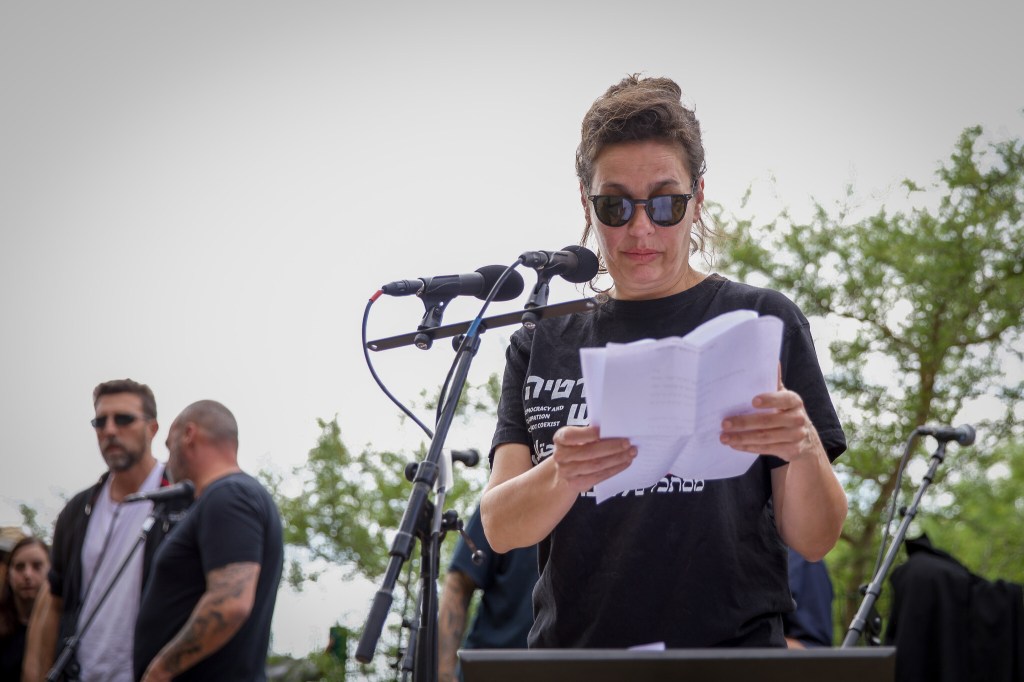
Fast forward to the funeral of his nephew. The mourners arrived wearing shirts that carried the slogan: אין דמוקרטיה עם כבוש – there is no democracy with occupation.

Yehonatan’s daughter, Shira Geffen, wore this slogan as she gave the hesped. 

This slogan argues that Israelis cannot protest Netanyahu’s anti-democratic measures while ignoring the millions of Palestinians denied basic democratic rights to vote, freely assemble, and even walk to their homes without facing checkpoints and guns. 

The t-shirts are produced by מסתכלים לכבוש בעיניים – an Israeli left organisation who insist on looking the occupation in the eye. They speak out about what they call “the power relations between the coloniser and the colonised,” urging the public to see how the occupation is destroying the dignity of Palestinians and the humanity of Israelis.

Sandwiched in the middle between these generations was the man they mourned, Yehonatan Geffen. He had been part of Israel’s cultural establishment, and a true icon. He was associated with what many Israelis saw as the best in their culture. One of his eulogisers was the centre-right politician Yair Lapid.

Geffen was also an outspoken peace campaigner. He wrote extensive criticisms of the army. In 2018, he wrote lyrics in praise of the Palestinian child protester, Ahed Tamimi, resulting in him being cancelled on Israeli military radio and censured by government officials. 

Within one family, within one century, you can see such a huge diversity of Jewish views.

They do not agree about Israel. They will not agree. But they prayed together. They came together to say kaddish and mourning prayers. They joined each other as a family.

Of course, these differences of opinion on Israel are not just generations-based. I know anti-occupation activists in their 80s and I know pro-settlement campaigners in their teens. Nevertheless, what we have seen of Israel in our formative years is decisive.

I belong to Shira’s generation, and one of my most formative memories of Israel was witnessing the inexcusable assault on Gaza in 2009: Operation Cast Lead.

During the commemorations of Yom HaAtzmaut last week, I could not hide my discomfort. I find prayers for a state tantamount to idolatry, and when I hear blessings for troops, I can only think of those priests who poured holy water onto bombs. I do not see how one can pray for peace while praising the instruments of war.

Yet I understand why, for many in this community, honouring Israeli independence and those who fought for it feels like an important undertaking. 

Some of you belong to the generation that came just after the Shoah. The memories of genocide and antisemitism still loom, and it is understandable that you should want to know there is some security against that. For you, defending Israel matters.

Others of you came up in the generation of Peace Now. You believed in Israel and its mission, and held onto its constitutional claims of what it would be: a safe haven for all its peoples. You hoped, even campaigned, for an Israel where Jewish culture could thrive while Palestinian minorities received justice and human rights. For you, holding on to that dream of what Israel could be matters.

My generation came after. I was born not long before the signing of the Oslo Accords, and came of age as they failed. During my 34 years on this planet, Netanyahu has been Israeli Prime Minister for nearly half of them. I have never known Israel as anything but the aggressor and the occupying power. 

Based on our ages and experiences, we will have different views. If we cannot have disagreements about Israel, we cannot have an intergenerational community.

We will not agree about Israel. And that’s fine. That’s good.

Rabbinic literature prizes disagreement. One of my heroes in the Talmud is Rabbi Eliezer. He stood solidly by his principles, no matter how unpopular they were. It’s not that I agree with Eliezer’s principles: he was a conservative surrounded by liberals and radicals. It’s the fact that he held fast to what he believed.

He was so strict in his adherence to religious law that the other rabbis eventually excommunicated him. They wouldn’t talk to him unless he recanted his views, and he never did. Only at the end of his life did his students and colleagues realise what an error they had made by cutting him out. 

They placed him in the Mishnah, the foundational Jewish text, as one of its most-cited rabbis. Even though they completely disagreed with him, you can find his opinions everywhere.

The Maharasha says the reason for this is for future generations. While one position may be minority at one time, it may become majority, and those who follow will need to know what they rest on. Even if they never agree with it, they need to see how the conclusions they support were reached.

This is why we welcome disagreements: for the sake of intergenerational conversation. 

For those growing up now, they are entering a polarised and febrile environment. 

Future generations will develop their own politics, and find their own relationships to Israel, Zionism, and the occupation. 

And I hope they can do so within the synagogue. 

I hope they will find an environment that embraces Zionists, non-Zionists and anti-Zionists. I hope they will find communities that do not impose red lines that keep them out.  I worry that the TwentySomething writing to her rabbi will be proven right, and synagogues will become platforms for single positions on Israel.

What then? Will we split into Zionist and anti-Zionist shuls? Will we keep splitting further, based on varying different policy proposals for what should happen in the Middle East? Those aren’t synagogues – those are political parties!

Such divisions have pulled apart Reform communities before. In the period prior to World War II, Zionists were forbidden from studying at Hebrew Union College, the Reform Rabbinical school in America. This meant that for nearly a century you could not be a Zionist and become a Reform rabbi. One early Reform Zionist, Maurice Perlzweig, said that professing his views in polite Jewish company was like admitting to being a member of the Flat Earth Society.

At the turn of the century, the Reform Movement completely reversed its position. The 1997 Miami Platform declared that Reform Judaism was unequivocally Zionist. It said that Jews were a people; that we should all move to Israel and build it up. Ensuing from that came a programme parallel to the early push to exclude Zionists from the Jewish community, but this time, flipped: to exclude critical voices from the Jewish community and maintain only a pro-Israel consensus.

Is this really what we want? Do we want to keep going back and forth drawing new lines depending on which position has the upper hand? Do we want to enforce conformity of political views in Reform congregations?

Surely what we stand for is bigger than that! Surely our Judaism, our God, our people is bigger than that! 

The joy of a synagogue is that it brings together so many different people. Where else are you going to find people of different backgrounds, classes, genders, abilities, beliefs, and ethnicities, all under one roof, bound together by something greater than themselves? Only the synagogue – greek for beit knesset  – the House of Gathering – can achieve that. 

We are not going to convince each other of our political opinions, and that’s fine. That’s good. If we have a space filled with diverse views, we have a community. If you have uniformity, you have an echo chamber.

We are Reform because we understand that the Jews of tomorrow will not look like the Jews of yesterday. The Judaism of tomorrow will not look like the Judaism of yesterday. Reform Judaism is an ongoing commitment to learn and struggle and grow, always adapting to new ideas and developments. That is what makes it Reform.

And what makes it Jewish is that we do it together. We hold on to belief in the same God, the same cause, the same traditions. We hold all the manifold opinions of the congregation in a single setting.

So, let us answer the question posed in Larry Englander’s book: will this TwentySomething be excluded from her synagogue? 

More pressingly, will she have a home in ours

The answer depends on how we act. If we draw red lines and kick people out based on their views; if we define our Judaism solely by its relationship to Israel; if we make public policies about the synagogue’s stance, then, no. She probably will not.

On the other hand, we can model an alternative Jewish future. A better Jewish future. A Jewish future where we don’t repeat the mistakes and have the same regrets as the framers of the Mishnah. A Jewish future based on plurality and discussion.  We can demonstrate through our relationships with each other and the synagogue that Judaism is diverse, creative and engaging across divisions. 

We can show that we do not have to agree. Even about Israel. 

Shabbat shalom.

festivals · theology

We are still leaving Egypt

We are still leaving Egypt.

There was a time when we lived at the whim of tyrants; when we worked without a break and only rested so we could work more; when we owned nothing but debts. 

There was a time when we lived in mitzrayim. Today, we translate that word as ‘Egypt,’ fixing it to a specific time and place. 

Our Torah does not permit us to read the story as if from a history textbook. Which Egypt were we living in? What were its borders? In which century did it take place? Who was the Pharaoh?

In Torah, all Pharaohs are simply called Pharaoh. To the migrant labourers and the chattel slaves of the ancient world, it made no difference whether the emperor was Ramses, Amenhotep or Cleopatra. As far as their lives were concerned, each century was broadly the same.

We want to imagine that this place is miles away from here and centuries apart from now. We want to draw a line to divide ourselves from the past.

The word for Egypt – mitzrayim – means ‘narrow, oppressive straits.’ It means places of anguish and control. That place does not have fixed borders between Sudan and the Mediterranean sea. It is a place we have all inhabited. It is a place we all still inhabit.

At Pesach, we are commanded to tell the story of the Exodus as if we ourselves had lived it. The haggadah instructs us to recall the events as if they are part of our collective experience. 

It is not just so that we can remember the bitterness of slavery in the taste of maror, or the tears of persecution in our salt water. This is far more than bringing a story to life. 

It is so that we will understand that Egypt was not simply one place and time. It is any place and time in which people are not free. And because it is any place and time, it is every place and time.

We must understand that we really were slaves in Egypt. We must believe, deep within the sinews of our bodies, that we are still there.

Because if we can remember how we were oppressed, we will remember that we were able to free ourselves. 

We will feel the strength and joy that comes from rising up and leaving constricting spaces. It is so that we will feel empowered to do it again. We must still leave Egypt.

The seder is a process of embodied retelling to help us understand that message.

Yes, in the first half of the seder, we read that we were slaves in the land of Egypt. But, in the second, we invoke Messianic redemption. 

When our plates are cleared and the afikoman has been retrieved and the dinner is done, we turn back to our haggadahs and complete our seder. 

We pour out a fifth glass of wine, open the door, and implore the prophet Elijah to return and finally bring us to freedom. We acknowledge that the struggle is not yet complete. We still have to leave the Egypts of our era.

As the seder concludes, we lift our glasses and promise: “next year in Jerusalem!”

Please do not mistake this toast for a tourism brochure. We are not praying for cheap easyJet tickets to Tel Aviv. The Jerusalem we hope to reach next year is miles away from the one in Israel today. 

Our fellow Reform Jews in Israel are still very much in exile, and crying out to leave their own narrow straits. If the Jerusalem in the contemporary Levant were the one we were reaching for, Judaism would be over. History would be complete, and so would the sacred purpose of the Jews.

If that were Jerusalem, the ultimate Jerusalem, we would have to say that we are satisfied with segregation, militarism, and fanaticism. 

But we are not. 

We are not in Jerusalem until the whole world knows unending freedom. Until there is no more oppression, we are all in Egypt.

We British Jews are still in Egypt too. We have made many advancements. We are citizens in our country with full civic rights. When this was granted to European Jews, many felt it was so miraculous that they considered the exile to be over.

Moses Mendelssohn, the founder of the Jewish Enlightenment, proposed that the social and moral progress encapsulated by Jewish emancipation would bring about a new society. A utopia of tolerance and conclusion based on the values Judaism had imparted to humanity. What would such a place be called? Jerusalem. 

He titled his book as such, anticipating that, when we reached such an age, Berlin would be Zion.

For all our greatest aspirations, Europe has not become the Promised Land. Not yet. Nor is Israel. Not yet. 

If we limit ourselves to imagining emancipation as a geographical phenomenon, we will keep chasing after new countries, hoping they will be our final destination, only to find that, in every location, we remain in exile.

That is because exile is not simply a place. It is a state of being isolated from the true and complete justice of God. 

That promised land is yet to be found.

As long as there is progress to be made, we will keep journeying.

As long as there are slopes to freedom, we will continue to climb that mountain. 

Until the day when we are all free, every year, we will pray that, next year, we will live in a world redeemed. 

Now, we are still leaving Egypt.

Next year in Jerusalem. 

festivals · story

Set a place for Elijah


If you receive a knock on your door over this Pesach season from a beggar, please be warned. It could be Elijah.

You have been setting a place at the table for him every year, leaving him an extra glass of wine. You have been waiting for him. Did you never imagine what he would look like?

Sure, in the children’s stories, he is like a jolly Jewish Santa carrying presents. But you are all old enough and learned enough to know how Elijah is really depicted in our tradition.

When you think of Elijah, you need to imagine somebody who absolutely stinks. You need to picture wild matted hair and cackling laughter and a leather hip flask filled with hooch. 

The prophet is a drinker, and who can blame him?

No crueller punishment has ever been doled out than that given to Elijah the Tishbite. Elijah was cursed with unending life.

His sentence came in the time of Queen Jezebel but he was already much older than that. Nobody knew how old, or where he was from.

Back then, the people called him the Tishbite: the immigrant. The name stuck so hard that later generations imagined he must have come from a place called Tishab. 

He made enemies in life. Prophets always do. They have God on their side, but the powerful have the weapons, and, for now, the truth of swords is stronger than Scripture. 

At first, Elijah revelled in his mission. He was a notorious outcast. He went out in the streets making fun of the false gods. He wound people up in the markets. He poured scorn on every priest. 

And, at first, his adversaries found him entertaining too. He was like a court jester, telling the monarchs what they didn’t want to hear, as onlookers cheered him on.

But the joke grew thin. And the ruling powers had enough.

“I swear by all my gods, I will kill you,” said Queen Jezebel, and Elijah fled into the mountain caves. 

“The trouble is,” Elijah wailed, “people don’t know what’s good for them. Nobody is faithful any more. The real ones have vanished from humanity. Everyone lies. They have twisted lips and two faces. Why can’t you just cut out their tongues?”

God gave him food and water and rest through the kindness of ravens. 

“Please, Almighty,” prayed the prophet. “Send me a sign.”

The wind rattled mercilessly through the mountains, shattering rocks and splitting cliffs.

“Please, God,” said Elijah. “Just a small sign of Your provenance.”

In the valley below, the earth rumbled and quaked apart.

“Are you there, God?” he asked.

Over the tops of the hills, Elijah saw black smoke puffing out of white flames as a raving fire blistered through the thickets. 

That’s when Elijah made his fatal error. He begged God to let him die.

“I’m not looking for miracles, O Merciful One. I’m all out of hope. I have had enough. Please take my life.”

Then there was silence. 

No more infernos or hurricanes or earthquakes. 

The pressure dipped. The ravens stopped chirping. 

Not even an echo in the still canyon. 

He heard a whisper in the cave. 

“What are you doing here, Elijah?”

The Tishbite stood up in the dark silence. He mustered his courage. He announced: “I am a zealous warrior for the Almighty God. And I am the only one left.”

“A zealous warrior who wishes he were dead?”

Elijah got ready to speak, but the whisper interrupted him.

“A man of the people who despises the people? A faithful prophet who does not see miracles? A truth teller who lies in the face of God?”

Elijah was still and small.

“Faithless, are they?” 

God’s words reverberated in the cave. 

“In that case,” said the Creator. “You will need to watch over them. They will never perform our rituals without you there. So you will attend every circumcision and attend every seder until the end of time. Then you will see how faithless My people are.”

A hurricane of flames burst from the clouds and dragged Elijah, screaming, into the sky.

“Your mission is ongoing,” the Eternal One instructed him. “You will turn the hearts of parents to their children and the hearts of children to their parents. You will be my herald of a greater age.”

“When people are ready to listen to you, when they believe you and see you,” said God, “then I will send the Messiah.”

So Elijah trudged on. He stood in the gateways of every city, proclaiming visions of a coming world. “There will be no hunger or war; neither envy nor competition. Goodness will flow in abundance and all the delights will be freely available as dust. The occupation of the entire world will be solely to know God.”

But nobody listened. 

He had no more cheerleaders, and no more adversaries. He was just another vagrant with a vivid imagination. 

Do you know what happens to a body when it is condemned to live? It trundles on with all the distress of ageing but without any hope of repose. Over centuries, the bones break, the eyes dim, the flesh rots, the organs become riddled with disease. In each era new viruses and plagues are created and you contract them all. It takes a long time, but you get sick and your lungs fill up and feet swell and your joints fuse and your muscles contract and your pores reek and your hands tremble.

It is like being unbelievably tired but never, ever allowed to sleep. 

It took a while before Elijah really allowed time to lay waste to his body. Before he let his hair become matted and knotted. Before he stopped washing and his skin turned to oily fungal patches.

Talmud teaches that, when the Romans ruled the world, he used to sit at the gates of their capital city. He would sit with the other beggars, tending to his wounds. He would unwrap each bandage and then tie it again, gingerly holding his body together as it broke.

A great rabbi came to visit him and recognised him from a mystic’s description. 

“My master, my teacher, peace be upon you,” the young rabbi beamed as he alighted on the prophet.

Elijah was filled with joy. For a brief moment Elijah felt he was seen. 

“When will the Messiah be coming?” The rabbi asked. 

“Today!” Elijah laughed. “Today! Today! Today!”

The rabbi went back to his homeland with the prophet’s words in his ears. 

“Today,” said Elijah, as he sat back down to tend his wounds. “Today. If you are able to see me and you are willing to hear my words, it really could be today.”

“I don’t think that was really Elijah,” the rabbi said to his friends on his return.

So the Messiah didn’t come then, and the Messiah hasn’t come yet. 

Some snooty Jews are expecting him to turn up with beaming smiles and a suit and tie. Or they imagine he will be a wispy spirit. Or they think the Heavens will open and they will see God themselves. 

They open the door to him. But, even with the place set and the doors wide open, they don’t notice that the old prophet is already there, dressed in his rags and nursing his whiskey. He has always been there.

Only when we are able to realise that intoxicated crazy people might be Elijah will we really be able to see the prophet.

And when we all recognise that every outcast and despised person may be the harbinger of the greater age, we will not need to wait any longer. The Messianic age will have already arrived. 

So, set a place for Elijah this Pesach. Fill a glass of wine for his health. Open your door to welcome him.

Just be sure you know who you’re looking for.

Shabbat shalom.

judaism · theology

Why Jews do not believe in Hell

When I was a teenager, I went on some kind of away day with other Progressive Jewish youth.

The rabbi – I can’t remember who – told a story. 

A woman dies and enters the afterlife. There, the angels greet her and offer her a tour of the two possible residencies: Heaven and Hell. 

First, she enters Hell. It is just one long table, filled with delicious foods. The only problem is that they all have splinted arms. Their limbs are fixed in such positions that they could not possibly feed themselves. They struggle, thrusting their hands against the table and the bowl. Even if they successfully get some food, they cannot retract their arms back to their mouths. They are eternally starving, crying out in anguish. That was Hell.

Next, she enters Heaven. Well, it’s exactly the same place! There is a long table, filled with delicious foods, and all the people sitting at it have splinted arms. But here, there is banqueting and merriment; everyone is eating and singing and chatting. The difference is simply that, while in Hell, people only tried to feed themselves, here in Heaven they feed each other. 

She ran back to Hell to share this solution with the poor souls trapped there. She whispered in the ear of one starving man, “You do not have to go hungry. Use your spoon to feed your neighbor, and he will surely return the favour and feed you.”

“‘You expect me to feed the detestable man sitting across the table?’ said the man angrily. ‘I would rather starve than give him the pleasure of eating!’

The difference between Heaven and Hell isn’t the setting, but how people treat each other.

At the conclusion of this story, one of the other teenagers – I can’t remember who, but I promise it wasn’t me – put his hand up and said: “But I thought Jews don’t believe in Hell?”

The rabbi shrugged and said: “True. It’s just a story.”

Years later, though, the story, and the resultant question, have stuck with me. 

Was it just a story? Do Jews really have no concept of Hell?

The truth is complicated. 

Among most Jews, you will find very little assent to the idea of punishment in the afterlife.

In part, that is simply because most of Judaism does not have a clear systematic theology. There is no Jewish version of the catechism, affirming a set of views about the nature of God, the point of this life, and the outcomes in the next. 

Rather, Judaism holds multiple and conflicting ideas. On almost every issue, you can find rabbinic voices in tension, holding opposite views that are part of the Truth of a greater whole. We don’t mandate ideas, we entertain them.

So, a better question would be: does Judaism entertain the idea of Hell?

And the answer is still: it’s complicated. 

Yes, it does. The story that rabbi told of the people with the splinted arms comes from the Lithuanian-Jewish musar tradition. It is attributed to Rabbi Haim of Romshishok.

The idea of pious Jews going on tours of Heaven and Hell has a long history. In the Palestinian Talmud, a pious Jew sees, to his horror, his devoted and charitable friend die but go unmourned. On the same day, a tax collector, a collaborator with the Roman Empire, dies and the entire city stops to attend his funeral. 

To comfort the pious man, God grants him a dream-vision of what happened to each of them in the afterlife. His righteous friend enjoys a life of happiness and plenty in Heaven, surrounded by gardens and orchards. The tax collector, on the other hand, sits by waters, desperately thirsty, with his tongue stretched out, but unable to drink. Where one gave in this life, he received in the next. Where the other took in this life, he was famished in the next. 

This is a revenge fantasy. The story comes from oppressed people coming to terms with the success of their conquerors and the humiliation of the good in their generation.

The fantasy is powerful, and the motifs repeat throughout Jewish history. In almost every generation, you can find people pondering about how bad people will be punished and good people will be rewarded when this life is over.

But, with equal frequency, you can find Jewish scepticism about this view of the world. The Babylonian rabbis warn us not to speculate on what lies in the hereafter, for God alone knows such secrets. Our greatest philosophers like Rambam and Gersonides strenuously deny any concept of post-mortem torture. 

These debates have persisted even into the modern era. During the Enlightenment, there were those who claimed that a rational religion could have no place for the primitive nonsense of Hell. Equally, there were those who said belief in divine retribution was the hallmark of a civilised belief system.

So where did the idea come from, asserted so confidently by that teenager on a day trip, that Jews have no concept of Hell?

The truth is it is very recent.

In surveys of attitudes, Jewish belief in Hell plummeted after the Second World War.

In all the revenge fantasies and horror stories that people could concoct about Hell, not one of them sounded as bad as Auschwitz. 

There is no conceivable God who is cruel enough to do what the Nazis did. No such God would be worthy of worship.

We have no need to fantasise about freezing cold places filled with trapped souls, or raging furnaces. We need not imagine a world after this one where people are starved and tortured and brutalised. We know that world has already existed here on earth.

Isn’t Hell already here still? Doesn’t it still exist right here in this world for all those mothers putting their toddlers in dinghies hoping the sea will take them away from the war? Don’t those horrors already exist in for people working in Congolese gold mines or Bangladeshi sweat shops? 

Hell is already here. It is war and occupation and famine and drought and slavery and trafficking. There is no need for nightmares of brimstone when people are living these things every day.

That was the point of the story that rabbi was telling us. 

The difference between Heaven and Hell isn’t the setting, but how people treat each other.

We already live in a world of plenty. We have the flowing streams and gardens and orchards our sages imagine. But, like the inhabitants of Hell, we are pumping sewage into the streams, turning the gardens into car parks, and logging the orchards for things we do not need. 

We are sat before a fine banquet where there is enough for everyone, but half the population are not eating while a tiny minority are engorged with more than they need. We are living the vision laid out in the parable.

Yes, this world is a Hell, but it could be a Heaven too. 

The difference between Heaven and Hell isn’t the setting, but how people treat each other.

Look at all that we have. Look at the support we can give each other. We may have splinted arms but all we need do is outstretch them. 

We have the capacity to annihilate all hunger, poverty, and war. We really could end all prejudice and oppression. This planet could be a paradise!

And, if we know that we can make this world a Heaven, why would we wait until we die? 

Shabbat shalom.