story · theology

Why do Jews break a glass at weddings?

Whenever a couple comes to discuss their upcoming wedding, there is one ritual more important to them than any other. Anything else, they feel they can set aside, but this one action, they absolutely must do.

They insist on breaking the glass.

Smashing a glass under the chuppah is not a matter of halachah. In Jewish law, it makes no difference whether you do it or not.

It is also probably not the most visually popular image. If you picture a Hollywood Jewish wedding, the stock footage in your mind is the chair dancing, with couples thrust into the air, and holding on for dear life.

Why do couples want so much to smash the glass? When I ask them, they are not sure. It just feels right. It feels natural.

It is like they are remembering something. Something, a story; not just the stories of all the weddings of family members; not even another wedding in a mythic ancestral past. Something else. Something further back.

Perhaps, the Kabbalists suggest, what they have remembered is the very first smashed glass.

The very, very first crack.

Before there were weddings or people or creatures or planets or stars. Before there was anything at all.

Before there was anything, there was a crack.

In the beginning, there was a crack.

A crack in the Nothingness.

Before the crack, we can only talk about the Nothingness. We cannot even really talk about there being such a thing as before the crack, because, in the Nothingness, there was no time. The Nothingness was an absence. Lacking anything, it had no before, nor after, nor now.

When the first crack appeared in the nothingness, it created the first event. The first now.

Before long, the crack split. It broke further, like a chip in a windscreen that slowly breaks. Now there was a succession of events. A story in the cracking of the Nothingness. Now there was such a thing as now, and before, and after. There was time.

Then, the Nothingness could not bear the weight of the crack any more. It burst and shattered into an infinite myriad of broken fragments. Suddenly, there was time and there was space and it was filled up with the thousands of shattered splinters.

The Nothingness was broken. And there could never be another Nothingness again. It had ruptured and given birth to the Something: to all the imploded pieces of possibility.

And out of that possibility came yearning. The shards could see that they could form into combinations and make Somethings that were greater than just their fragmented pieces, but were the genesis of ideas.

So, they made wisdom, knowledge, and understanding. They made strength, love, and beauty. They created endurance and splendour.

From the broken bits of the Nothingness, they made the potential for Everything. And, with that, they made matter. They made the foundations of all existence.

Now, there could be galaxies and moons and oceans and forests and reptiles and insects and primates and civilisations and cities beings that could contemplate this entire mystery of existence and wonder how it all began.

This was how our world was made.

That is where we live: in the broken world.

We are the products of that initial shattering that yearned to be Something greater than Nothing. And we are able to see the world as it is: infinitely complete and completely broken.

We are those sentient beings who can witness this world and wonder how it all came to be, and wonder if it might ever be like that again. We are able to yearn with our whole souls to be reunited with the great forms that once birthed us. We long to feel again that splendour and majesty and wisdom that brought us into being.

Everything that exists is but a microcosm of the original system of shattered fragments that first delivered creation. We contain within us fractals of the understanding, beauty, and strength that initiated all being.

Those creative life forces exist within everything. They continually reach out to each other, interact with each other, and recreate each other, so that everything is one miraculous dance of metaphysical juices, bubbling beneath a mundane surface.

This means that, inside our own souls is the very first crack. We are the broken vessels that yearn for Something more than this. Out of our own breakages is the genesis of all creativity. It is as if the whole world was given order straight from our own souls.

We are perfect. We are broken. Our hearts were broken long before we were ever born. The Creator burst a puncture in our souls right from the outset. It was what would allow us to love and be loved.

And our hearts have been further broken by life. They get fractured every time we encounter something we do not understand. We can feel ourselves breaking every time we lose a loved one, and every time we see the beauty in a sunrise. Yes, our hearts break in sadness, but they also break in joy. It is our brokenness that brings us back to the very first creation.

So much in this society teaches us to scorn our own brokenness. We are encouraged to deny the parts of us that feel most acutely.

Instead, daily life makes us treat this world as if it is still nothing. As we work and pay bills and undertake routines, it can feel like there is no meaning to any of it.

But, deep down, all of us know that our existence is a miracle. We are divine shrapnel in a seemingly impossible universe.

So, when the couple comes under the chuppah, their first thought is: I want to smash the glass.

I want to see outside of me the brokenness that is within.

I want to remember how, once, in a past that never was, the very first crack made everything possible.

I want to be reminded that this brokenness inside of me is what allows me to connect with others. That fracture inside my heart is what makes me yearn for the love of another. It is what makes my being permeable enough that someone else can enter, and share in it their own broken lovingness.

Without this crack inside me, I would never be able to reach beyond myself. This brokenness is what connects me back to God.

We are broken people in a broken world.

Our brokenness is not a cause of shame. Our brokenness is what makes Anything possible.

I know I am broken when I feel grief and anger and jealousy and pain.

Because I am broken, I can feel love and wonderment and resilience and curiosity and awe.

Thank God I am so broken. I only wish to be moreso.

Dear God, let me be more broken.

Let my heart be more porous so that all its dreams may be freed into this world of infinite possibilities.

Puncture my soul and rip it open, so that I can truly feel the longing of all humanity. May I hear in the depths of my being the cries and joys of all that exists and could exist.

May I truly see this world, in all its diverse variance, and marvel at the infinite Nothingness from which we came.

May I fulfil the prophecy of Ezekiel:

“I will give you a new heart and place a new spirit within you. I will remove that heart of stone from your body and give you a heart of flesh. I will put My spirit within you, so that you will walk in My ways and uphold My justice.”

Dear God, break me.

Break me, break me, and break me again.

Shabbat shalom.

sermon · theology · torah

Purity or justice

Let’s start with a question.

An adult couple accidentally runs over their pet dog. Instead of burying their dog in the garden, they take it home, cook it in the oven, and eat it. 

Here’s the question: have they done something immoral? 

Most of us will have an instinctive reaction: what that couple did was disgusting. We will feel some revulsion.

But whether you think it was morally wrong will depend on how you see the world. It will depend on your moral palate. 

This was what was demonstrated by the Jewish-American psychologist, Jonathan Haidt, in his popular book, The Righteous Mind.

Haidt sought to find out why it was that caring, rational people could disagree so profoundly on moral issues. Why was it that America was so polarised? There, people fight furiously about issues like abortion, guns, and marriage, as if they have no common moral basis.

Haidt argues that we do have shared moral bases, but our morality is more like the palate on our tongue. “We humans all have the same five taste receptors, but we don’t all like the same foods,” he says. “It’s the same for moral judgments.”

We have, he says, five main taste receptors: care, fairness, loyalty, authority, and sanctity. 

If you are an educated person who lives in an urban area of a Western capitalist country, you are likely to feel that the couple who ate their dog did not do anything morally wrong. You’ll be disgusted, sure, but you might not think that they violated any kind of moral rule.

That’s because, in these cultures, people have a moral palate that puts a big emphasis on ethics of care and harm. If nobody was hurt, then there’s nothing immoral.

If, however, you live in a close-knit community of farmers, you are far more likely to say that the couple who ate their dog did do something morally wrong. That’s because those cultures have a strong sense of sanctity and taboo.

Both of these systems are ways to help people get on with each other. In a busy metropolis like London, you need to be able to live and let live, because if you can’t tolerate diversity, society will fall apart. In a tribal farming community, like ancient Israel, you need to have strong social norms to protect people.

Both these impulses – care and sanctity – come from a deep, ancient social need. 

Since humanity’s beginning, our survival has depended on our ability to care for our most vulnerable members. How would we have lasted a single generation if not for looking after the young, the old, and the vulnerable?

From the start of civilisation, we have also needed to be able to express disgust. It comes down to the most basic distinction between excrement and edibles. We need to tell each other: “this food is poisonous; this disease is contagious; this behaviour is dangerous…” Without clearly agreed boundaries and taboos, we would quickly perish.

It is worth holding these two tendencies in mind – care and sanctity; purity and justice – as we approach our readings for this week.

Our Torah portion goes into minute detail about how to do proper sacrifices, how to lay out the Temple, and who is supposed to do what in religious services. To us, the attention to detail might seem absurd.

But remember that this is part of a group of people’s moral palate. This is their sense of the sacred. Messing it up, from their point of view, would be ethically disastrous. It would be similar to eating the family pet. 

No wonder, then, that the prophet Ezekiel opens the haftarah by telling the Israelites “if they are ashamed of all they have done, make known to them the design of the temple.” Failure to get it right, says Ezekiel, is a serious sin.

There are two great moral impulses in Torah: justice and purity. This trend appears throughout the whole Scripture: contradictory, competing moral voices speak through our books.

The voice of justice tells us about care and compassion. It tells us about fairness and redistribution. The voice of justice charges us towards more equality and more freedom. Justice says that a society is only as strong as its weakest members.

The voice of purity tells us about how to keep holy things sacred. It tells us what the boundaries are on sex, so that we do not cross them. The voice of purity tells us not to eat octopus and not to mix linens. Purity makes sure everything is kept in its proper place, so that society can function, and people feel safe.

The voice of purity might feel less relevant to us today. We celebrate the prophets for their concern for the most vulnerable, because it fits so well with our ethics of care. We see ourselves in the narratives of the exodus because they chime with our moral intuitions about freedom from slavery. Laws on architecture… feel less like big moral issues.

That’s because what the big taboos and boundaries are can change a lot between time periods. 

When I was growing up, one of the big focuses of popular disgust was gay men. There was a long period when the media was seemingly obsessed over sex between men, especially in public toilets. This was the full gambit of taboos: waste and excrement; sex between the wrong sorts of people; and blurring the boundaries between public and private.

I think that is why some of the things that cause people moral disgust today just don’t bother me. I have had to push through a society telling me I was disgusting, and unlearn that contempt towards gay people. Now, the other sources of disgust just seem like passing fads. 

Knowing that has helped me understand where others are coming from.

I find Haidt’s ideas about moral palates really helpful for thinking through why sometimes it’s hard for people to agree. My ethical taste buds are highly attuned to care and fairness, but I don’t get much flavour from sanctity, and I can barely taste authority. 

Please do not think that one of these is left-wing and the other is right-wing. There are plenty of conservatives deeply motivated by wanting to make sure people are cared for and that distribution is just. There are just as many socialists who want to ensure the purity of the Marxist tradition, and to live in a world without contaminating ideas or contaminating people. 

What we morally feel is not just about ideology, but about all the factors in our cultures and upbringing that make us need to focus on certain values.

So, this is my advice. The next time you encounter someone that you really disagree with, try not to assume they are evil or weird. Think back, instead, to this Torah portion. Maybe what is just a building to you is somebody else’s Temple. Maybe what really triggers one person just doesn’t impact you.

Haidt’s goal, when he did this study, was to make it possible for people to talk to each other across divides. I don’t want us to become like America, where some issues cause massive wedges between neighbours. 

So let’s try listening to each other, and hearing each other’s worldviews.

Shabbat shalom.

israel · theology · torah

I believe that God is screaming.

A few weeks back, I attended a retreat with Christian colleagues. At some point, surprisingly enough, we got onto talking about God. I asked one of the priests a question: “do you believe God speaks to you?”

He looked slightly bewildered by the question. “Literally?” he asked. “No, not really.” He shook his head.

The answer seemed obvious. After all, we were liberals, at an interfaith event. That kind of talk is for fundamentalists. We’re all too rational for that. 

“Why?” he asked, turning back to me, “do you?”

“No,” I said, sheepishly. I don’t know why I felt so embarrassed. Of course, many believers see the voice of God mostly as a metaphor, or as a way of giving expression to moral intuition. I’m just not one of them. 

I do believe in a personal God, who has a loving relationship with every human being on earth. And I do talk to God. It’s not that I expect answers in any sense, but I do believe some One is listening: that prayers are more than idle words I recite to myself.

Perhaps my Christian colleague would have agreed with me if I’d put it in these terms, because finding vocabulary to talk about God is hard. Words like ‘literally’ and ‘metaphorically’ start to evaporate when you are dealing with faith.

I think, perhaps, the reason I gave a sheepish no – maybe even that I asked the question at all – was that I was having a mini-crisis of faith of my own. Ever since the war broke out, I have been praying differently, more fervently, desperately begging the Universe for peace. I have been hurling questions and recriminations into the void. I have been wondering… do I still believe in this God?

My personal relationship with God has carried me through some of the toughest times. When I have felt most lonely, God has been like a best friend. When I have hated myself, God has been like a lover. When I have needed direction, God has been a wise counsellor. I have looked to God in every time of disaster, and always found comfort in a loving Presence that reaches out and caresses from across a boundary of unknowability.

But now I listen for God’s voice. And all I can hear is screaming. 

As long as there have been people who believed in religious meaning, there have been those who questioned it. Usually, they were the same people. Abraham, Moses, Hannah, Kohelet, Job: they all had faith, and they all questioned it. They asked questions so that they could challenge their beliefs, and refine them. Lately, although less adequately than those prophets, I have been forced to do the same thing.

The first question we usually ask when confronted with crises of faith is “do I believe in God?” Fairly regularly, people come to me with conclusions one way or the other: “you should know, rabbi, I don’t believe…” or “you should know, I have a strong sense of belief…” My follow-up is always the same “… and what is it that you do (or don’t) believe in?”

For me, the answer is moral truth. When I talk about believing in God, what I am saying is that moral statements are not just opinions. When we say “murder is wrong” we are not just expressing a preference, like “my favourite flavour of ice cream is tutti-frutti.” We are describing a reality, no different to the claim that there are 24 hours in a day. We are describing something literally true.

I think that’s what God is. When we want to know why our feet are firmly on the ground, we give the shorthand answer of “gravity.” When we want to explain why objects in space interact with each other as they do, we use words like “attraction.” And when we want to express how we know that murder is wrong, we use the word “God.”

So, in feeling the great sense of angst I have had since the war began at the end of the High Holy Days, I am forced to return to the old questions. I am forced to ask whether I still think moral statements are true. I am forced to ask whether I still believe murder is wrong.

I do.

And that is why I believe that God is screaming.

What we talk about when we describe God is obviously more complicated: it is something infinite, and greater than we can put into words. That’s why words like “metaphor” and “literal” are so inadequate – because we are describing something more real than reality. So we have to find shortcuts. We have to find ways of talking about God in human language, to make sense of God on human terms. God is then “a tender parent”; “a loving shepherd”; “a righteous judge”; “a generous creator.” All of these are good descriptors, and all of them are incomplete.

I have been relying on a version of God that has worked for me for a while. I have imagined a sweet aunty or a gentle older friend. In times of loneliness, desperation and heartache, that image of a loving God has helped me get through the day. But that image doesn’t serve me now. I think if I used God for comfort in a time like this, I would be retreating from responsibility. God does not need me to feel safe now, but to shake me from illusions and complacency.

If God is the moral voice of the universe, that voice must be crying out in desperation.

In the last few months, 23,000 Palestinians in Gaza have been killed by Israeli bombs. I am kept awake at night thinking about that. I imagine God, smothered by the rubble of obliterated hospitals, calling out. Like Abel, stricken by Cain, the voice of the blood is calling out from the ground (Gen 4:10). I imagine God, pulled from the wreckage, crying: “Thou shalt not kill. (Ex 20:13) Thou shalt not kill. (Deut 5:17)”

Those were the commandments given to the Jews, above all others. In some variations, it is the very first commandment, the one that holds the most power. And as Israel stands in the dock at the Hague, it is not only South Africa that places it on trial, but God too, who comes with the accusation: “did I not tell you: thou shalt not kill.”

Since the war began, Israeli settlers, with governmental support, have seized around 20 villages in the West Bank, displacing thousands of people, so that Jewish Israelis can expand their territory and claim others’ homes. I imagine God calling out from deserted towns, on the trail with refugee families, wailing “thou shalt not steal” (Ex 20:15), “thou shalt not steal” (Deut 5:19).

Netanyahu says, unabashedly, that he will push the Palestinians from Gaza and create a new border with Egypt. The Torah answers, in desperation: “thou shalt not move thy neighbour’s boundary” (Deut 19:14). Land theft is a sin.

Israeli soldiers enter Gaza and use Jewish symbols as weapons. They recite the Shema from the pulpits of mosques and place mezuzahs on Palestinian homes. They desecrate our religion. They destroy our faith. From the depths of history, God cries out “honour thy mother and thy father (Ex 20:12); honour thy mother and thy father (Deut 5:16).” Do not profane the faith of your ancestors with war crimes.

Worse still, the politicians claim that God gave them the right. That this is what the Torah intended. Can you not hear the scream of revulsion as God decries: “thou shalt not take My name in vain (Ex 20:7); thou shalt not take My name in vain (Deut 5:11).” This is what was intended: do not abuse God’s name for worthless pursuits like war, but elevate it for the purposes of peace. 

I believe that God is screaming. 

The commandments may once have been given as words of instruction or even as a love letter, but now they are a desperate plea. 

God says “I am the Eternal One thy God, which brought thee out of the land of Egypt, from the house of bondage. Thou shalt have none other gods before me.”

No other gods. No state, no flag, no military, no leader, no ideology, no grudge, no border, nothing. None of these can ever be placed before God. None of them have any trump over God’s words.

God’s word says: “You shall not pollute the land in which you live; for blood pollutes the land, and no expiation can be made for the land, for the blood that is shed in it.” (Num 35:33)

So I believe I can hear God screaming: thou shalt not kill.

And I do not want to silence that voice. I want to amplify it. I want the Holy Torah to be heard now, more than ever. I hear God screaming, and I want to join in.

Thou shalt not kill.

Thou shalt not kill.

Thou shalt not kill.

high holy days · sermon · theology

You are the impossible child God yearned for.

You are the impossible child God yearned for.

You are a miracle. 

You may not hear that often, and you probably think about it even less, but you truly are.

The British-Indian poet Nikita Gill has written about just how unlikely is the fact of your existence:

“The very idea that you exist considering those extremely low odds is a miracle on its own. You see, the exact DNA that comes from your parents to create you could have only happened when your parents met, which is 1 chance in 20,000. That alone should be enough, but when you add up the fact that it has taken 5-10 million years of human evolution for you to exist at this time, in this moment, you begin to recognise just how much of an impossibility you are.”

– Nikita Gill

Add to that, and remember that you are a Jew. Remember that in those 10 million years of evolution, Judaism has existed for only 3,000 of them, and is still one of the world’s oldest continuously existing cultures. You are the product of a long line of ancestors, dating back to desert nomads, who, at one time, heard the voice of an invisible God, and kept that story alive for hundreds of generations. That is a miracle.

In the last century, the ancestors who held onto that story fled from countries all over the world, and migrated to farthest corners of the earth, and faced down war and genocide, and survived extermination. Faced with such experiences, many turned away from their heritage and disappeared from Jewish life.

But you are here, in the 21st Century, alive, and Jewish, and living out that story. You are the product of billions of years of matter interacting and millions of years of human evolution and thousands of years of cultural transmission. You are here. And that is an incredible, awe-inspiring miracle.

One of the prevailing themes of Rosh Hashanah is the miracle of human life. It is everywhere: in our liturgy, in our Torah portions, and in our haftarah. All of them are bound together by a sense of wonder at our existence.

Three weeks ago, we read the prophet Isaiah, who expressed joy at the wonder of childbirth. His great prophecy opens:

“Sing for joy, infertile woman, you who never bore a child! Sing for joy and laugh aloud, you who never felt a stomach cramp. Because the children of the barren are more numerous than those who suckled infants.”

But who is this talking about? Who is the sterile woman giving birth to the miracle child?

In the 9th Century, the great collection of rabbinic stories, Midrash Pesikta Rabbati, offered us three answers: Sarah, Hannah, and Jerusalem. At Rosh Hashanah, we read the stories of all three.

In the Torah portion, we read of Sarah’s miraculous labour. Sarah was elderly and post-menopausal. When three angels told her she would give birth in a year, she laughed. For years, she had yearned for a child, but, in her old age, she had given up. How would her withered husband and her empty womb bear a child? 

A year later, Sarah gave birth. She ate her words and called her baby boy Yitzhak, meaning ‘laughter.’ She said: “God has brought me laughter, and everyone who hears about this will laugh with me.”

A miracle. An impossible birth. So that infertile woman who had never had a child rejoiced, just as Isaiah described.

In our haftarah, we read, too, of Hannah’s wondrous labour. She was infertile. Her husband Elkanah’s other wife, Peninah, had plenty of children. Peninah became her rival, and relentlessly mocked her, saying that God had closed her womb.

In the depths of her despair, Hannah prayed to God. She whispered fervent promises to God that, if she was allowed a baby, he would be dedicated forever to religious service. 

As Hannah prayed, she was so full of silent anguish and tears, that the High Priest Eli thought she was drunk. He heckled her to sober up. But when she explained that her behaviour was the product of deep distress, Eli prayed with her that her wish be granted.

A year later, Hannah gave birth, and called her baby “Shmuel,” meaning “I asked God for this.”

Another miracle. A barren woman who bore no children rejoiced, just as Isaiah described.

Pesikta Rabbati offers a third infertile woman to whom Isaiah’s proclamation might refer: the city of Jerusalem.

At the last major event in the Jewish calendar, Tisha BeAv, we commemorated Jerusalem’s destruction. We fasted, wept and prayed, remembering how the holy city was razed to the ground. Following the destructions by Assyria and Rome, that city was left stripped of its inhabitants. Its most sacred spaces were desecrated and burned. The whole town was abandoned like an empty womb.

And out of that barren place came Judaism. At the time when it most seemed like the Jews had been destroyed, the rabbis came forward and gave them life previously unknown. They developed tefillah, Mishnah, midrash, and Talmud. 

They spread the message of ethical monotheism throughout the entire globe. Judaism, from its point of near-destruction, became one of the world’s most notable religions, and influenced civilisations everywhere.

Jerusalem was an infertile womb, out of which came more children than could ever have been imagined.

Sarah yearned for a child and was blessed. Hannah yearned for a child and was blessed. Jerusalem yearned for children, and now has millions.

But there is another impossible birth that we must celebrate. An unbridled miracle. A human being created by God out of nothing, who had the potential to be the saviour of all humanity.

Whose birth was that? 

Yours.

What, did you think I was going to say somebody else?

For the Christians, that person was Jesus. In their story, their Messiah was born by immaculate conception to a virgin mother. For them, Jesus’ birth fulfilled the prophecy related by Isaiah.

In the 9th Century CE, when this midrash was composed, Christianity had become a full-fledged international religion. It was the official doctrine of the Roman Empire, and was spreading throughout Europe through the Carolingian Empire. Christian polemicists criticised Jews for denying the truth of their Testament, and insisted that their story completed our Torah. 

Part of the motivation for the compiler of Pesikta Rabbati must have been to show that Isaiah could easily be proven from texts within the Jewish canon. But, more than a difference of interpretation, this midrash speaks to a fundamental difference between how Jews and Christians have seen the world. For us, Jesus is not the beloved child of God born by miracle. You are.

As Lily Montagu, the great religious reformer and East End social worker, put it:

“We have the belief that man can directly commune with his God, that he needs no intercessor […] The Christian feels himself brought into contact with God by means of Jesus, his Saviour. Jesus is conceived as, in a special sense, the son of God, and as able to direct all seekers to the divine sanctuary. We Jews hold that every man is the son of God, and that all His children have access to Him when they try to live righteously.”

– Lily Montagu

So, all humanity is God’s miraculous creation. All humanity is in direct relationship with our Divine Creator. And all humanity has the potential to bring this world closer to its salvation.

Rosh Hashanah, as a festival, marks the sixth day of the world’s creation, on which the first ever human being was made. It celebrates the miraculous creation of Adam HaRishon, the original person, sculpted from clay and breathed alive with the sacred air from God’s nostrils.

Consider what a wonder this is. Knowing all that we do about the history of the universe, how many billions of years must God have spent yearning to create the first ever person. 

How impossibly beautiful is it, that, after the creations of thousands of galaxies and multitudes of planets, the Universe somehow put together the exact elements that would support life. And that life became social and conscious and able to reflect on its own existence. And, conscious of its own selfhood, that being was able to reach beyond itself and worship the Eternal Mystery that created it.

Who knows what the chances are? But it is certainly a miracle.

The cosmos was, at one point, an insignificant speck, devoid even of matter, and now it includes human beings. And now it includes you.

You are the impossible child God yearned for. You are a miracle.

However much you wish to connect with your Creator, just think how much your Creator wants to connect with you. Whenever you feel like you can’t quite find God, just take a second to contemplate how many billions of years God spent trying to find you.

Your existence is a miracle, and I am so glad you are here.

Shana tovah.

judaism · sermon · theology

Barbie World’s Jewish Metaphysics

As you know from all the advertising hype, there is a film out at the moment that deals with some of the most complex moral and philosophical questions of our time. It is already touted to win many awards, and has spurned fantastic conversations about truth, ethics, and politics.

I’m talking, of course, about Barbie.

Barbie already holds such a sentimental place in my heart. While the other boys liked wrestling, Fifa and war toys, I just wanted to play with my dolls’ hair. 

I know, you’d never guess it. The butch man you see before you was once obsessed with the Dreamtopia Mermaid Barbie.

So, last week I did my duty as a good consumer, and went to the cinema for the first time since Dead Pool 2 came out. A lot has changed since I last went to the movies five years ago, and it seems that now everyone dresses up as the characters in the film. I was thrilled to get out my Ken costume, which I never knew I would have a use for.

During the film, I laughed, I cried, I reminisced. And as I left the theatre, I thought: “I’m sure I can squeeze a sermon out of this.”

Yes, that’s right, welcome to your Shabbat morning dvar Torah on the theological metaphysics of Barbie World.

Don’t worry if you haven’t seen the movie: I promise that will not help this make any more sense. 

To help put this into perspective, I’ll give a quick summary of the storyline. Margot Robbie is a Barbie girl, in a Barbie world. Her life in plastic is fantastic. She is driven by the power of imagination. Life is her creation. 

In Barbie World, a doll can be anything. A President, a marine biologist, a Nobel Laureate, a mechanic, a pastry chef, or a lawyer. Even a rabbi.

But then a great intrusion comes into Barbie’s dream world. She finds that she now has cellulite and existential dread. This plastic world of fantasy suddenly starts to turn into something… horrifyingly human. 

Barbie therefore must travel to the world in which people play with her, to find out what is going on in the world of real girls. 

The result is distressing. It turns out that the real world is defined by misery and hatred, and, in this world, girls absolutely cannot do anything they want. 

I am interested in the interplay between these two worlds. In the plastic world, anything is possible, but none of it matters. In the human world, everything matters, but nothing is possible. These two versions of reality conform to two popular narratives.

The first is that this world is just a simulation. That view is being propogated right now by Elon Musk and Neil deGrasse Tyson. It says: none of this is really real. Our world is like Barbie World: it is someone else’s fantasy that we are stuck in, playing roles. Anything is possible, but only the terms of the magnificent computer directing our lives.

I understand why that idea is so appealing. The word is a mess. There is something reassuring about believing that none of it is really happening and it’s all out of our control.

Although today this idea can appeal to new innovations in quantum physics, it is actually a very old idea. In the 17th Century, Irish philosopher Bishop George Berkeley promoted a similar philosophy, called “immaterialism.” We are all, he said, simply ideas in the mind of God.

Berkeley continues: if this world is just an illusion, your only duty is to conform to the role you have been given. You must blindly follow authority. We must all submit to the law and do as we are told.

Barbie has been told that she must fulfill the stereotype she has been molded in, and she has no choice but to accept it.

We need not wonder why a group of billionaires would like us to think this way. If reality is just an illusion, we just have to accept our place. And there’s no point resisting it, because the script has already been written, and none of it means anything anyway.

But the alternative world of the Barbie film – the human world – is not compelling either. In the human world, everything is made up of futile facts. It’s all real, and there’s nothing you can do about it. The grass is green. People grow old. You will get cellulite. Patriarchy is inevitable. It is all meaningful, but its only meaning is that everything is deeply, existentially depressing.

This is also a very popular worldview right now. It is best encapsulated by conservative talk show host, Ben Shapiro, whose dictum is “facts don’t care about your feelings.”

And that idea can be seductive too. The world is changing so fast and so much. Why can’t everyone just accept that everything is the way it is and stop moving so much?

Ben Shapiro offers brutal reality as an antidote to too many ideas. You think this world is horrible? Tough. You’re lumbered with it. This vulgar materialism, that says everything just is the way it is and nothing will ever change, is just as reactionary as the immaterialism that says nothing matters. 

So, let’s get to the point. What does Judaism have to say about this? 

Is this all just a simulation so that we are all just living in a fantasy world?

Or is this all the cold, hard, truth of reality?

In the 20th Century, Jewish philosopher Ernst Bloch tried to offer a third way. Bloch was a religious socialist from Germany, who fled around Europe as the Nazis took power everywhere he went. For him, it was deeply important to develop a view of the world where the unfolding horrors of fascism could be stopped. Any metaphysics that kept people from changing their circumstances had to be resisted.

Bloch turned to great religious thinkers of the past to remind people: it doesn’t just matter what is; it matters what could be. 

This world is real, and the one thing we know about reality is that it is constantly in flux. Everything is as it is, and everything will be different. 

Everything is subject to change. Everything that is is also something else that is not yet.

Ice turns into water turns into steam. Acorns become sprouts become mighty trees. People grow and age and learn. Societies progress from hunter-gatherers out of feudal peasantry and move to abolish slavery. 

In all of their forms, these things are exactly what they are, and are also everything they could be. They are only what they are for a brief moment as they are becoming something else. The movement of water into ice is just as real and possible as the movement for women’s equality.

To put it another way: this world is real, but it doesn’t have to be. There are so many other very real worlds we could live in. 

Ernst Bloch would have loved the metaphysics of Barbie World. It doesn’t just leave us with the misery of the real world or the pointlessness of the fantasy world. It shows us that both worlds speak to each other. The real world can become more like the fantasy world, and the fantasy world can become more like the real one.

This is the Jewish approach. Our task is not just to accept the world but to change it. As Rabbi Jonathan Sacks used to teach: “faith is a protest against the world-that-is by the world-that-ought-to-be.” Faith, for Sacks, is the demand that this imperfect world could be more like the utopian one. Like Bloch, Sacks talked about Judaism as the “religion of not-yet,” always moving towards what it would one day be.

This is what animates the Jewish religious mind: the possibility that this world, here and now, could be transformed into the vision we have of a perfected Paradise. 

So, how do we get there? 

Once again, we have to take our inspiration from Barbie. When Barbie  wanted to get from the fantasy world to the real one, first, she got in a car, then on a boat, a tandem, a rocket, a camper, a snowmobile, and finally a pair of rollerskates. 

To bridge the gap between worlds, all she had to do was put one foot in front of the other. 

That is what we must do too. We must take small steps in our pink stilettos, and set out towards the real fantasy world.

Utopia already awaits us.

Shabbat shalom.

sermon · theology

Numbers don’t matter

In the last decade, the number of Jews in Redbridge decreased by 37%. Meanwhile, the number of Jews in Epping Forest increased by 18%, and in Havering they increased by 16%.

These are our numbers. And they don’t matter.

According to the last census, the East of England has now overtaken Yorkshire as having one of the largest Jewish populations, with over 42,000 individual Jews living in this area.

These are our numbers. And they don’t matter.

In 2022, SWESRS gained 43 new household members. In the first quarter of 2023, we continued the same trajectory, gaining 15 new household members.

These are our numbers. And they don’t matter.

None of these numbers matter.

But. There is one person sitting in the synagogue this morning, praying. That number matters. There is one person watching on Zoom, feeling connected to the community despite not being able to attend. That number matters. One of us is in hospital; another just had a baby; another is sitting shiva; another is preparing for a wedding. Yes, those numbers matter. Those ones. Those ones are the only numbers that really matter.

In general, our Scripture takes a pretty dim view of counting activities. In the Book of Samuel, when King David takes a census of the Israelites, he instantly feels guilty and repents before God. God is furious that David has done this, and sends instant punishment. A plague falls on the kingdom lasting three days and wipes out 70,000 people. 

At the time of the census, there had been 130,000 possible warriors. Now their numbers are significantly reduced. 

But why? What’s so bad about counting Jews?

Abravanel says it was a proud and haughty thing to do. David was impetuous, believing that he could control his fate by counting his people. God is saying: you like numbers? Tough. Have fewer. You think your strength comes from how many of you there are? Wrong. Have fewer.

Maybe. But that doesn’t explain the attitude to censuses elsewhere in Scripture.

In our Torah portion this week, Moses takes a census of the Israelites. Moses counted up every man of fighting age who might be able to bear arms. They counted them up by tribe: 46,500 for Reuben; 59,300 for Simeon; 45,650 for Gad… and on it went, until the census reached its total. There were 603,550 Israelites in the desert, ready to fight.

And, as it turned out, those numbers didn’t matter. They listed them all, got them into procession, and then… nothing happened. There was no war to be had. They never entered into combat. 

Instead, the entire narrative instantly pivots completely. Now, instead of talking about all the thousands of people that Moses has on command, the story shifts to talking about Aaron’s two sons, Nadav and Abihu, who died while making strange sacrifices to God. All those big numbers and none of them matter. The only ones that do matter, it turns out, are those two young priests, whom Aaron is still mourning many chapters after their deaths.

That’s right, we’re in the Book of Numbers, and the message of the Book of Numbers is… numbers don’t matter that much.

It’s individuals that matter.

The best explanation comes, I think, from the Jewish philosopher Emmanuel Levinas. Levinas had survived a prisoners’ camp in World War Two. He was one of the most eminent philosophers in the world, but was aghast at how educated people had been seduced by the disease of fascism. What was wrong with his intellectual colleagues and teachers, that they could become Nazis?

The problem, he felt, was that they did not understand the value of human life. 

Every human being, he taught, is infinitely valuable. Not in the mathematical sense. In a deeper spiritual sense. Every one of us is immeasurably, inconceivably sacred. 

We cannot be counted because we are already infinite. We are already part of God, who is beyond any number. People, like God, are unique and infinite. They cannot be divided in any way. 

None of us are supposed to be counted. We are not supposed to have a number assigned to us as individuals. 

This was precisely the sin of the Nazis: they thought that they could measure, quantify, and categorise people. They were so committed to this rationalisation that they tattooed the numbers of their prisoners on their arms. 

Counting people, then, is a detestable thing. No number can be put on our lives. We were created by God to serve a purpose so much higher than any number can describe.

This is why the Torah rebukes counting. Any effort is a complete miscalculation. If you think you can work out how many people there are to prepare for war, you are wildly underestimating what you have before you. In each human being is a living, breathing, spark of the Divine, far beyond calculation.

So, let’s go back to the census. I will be honest at my own sin. I have spent ages poring over it, thinking on how many Jews there are in different areas, and working out what they mean for our synagogue’s development. I have tried to keep track of how many members we have, and where they’re coming from, and where they live. And that is, at best, an error. At worst, it is a grave underestimation of who we already are.

Rabbi Jacob Rader Marcus, one of the leaders of the American Reform movement through the 20th Century, warned: “When you survey your congregation on a Friday night, don’t count bodies, count souls. These chosen few, this elect, has a job to do: these Jews are our future; they have to save us; even more they have something to tell the whole world, to distil for all humanity what the Jew has learned after 3,000 years of bitter experience […] They taught us to abhor hatred, violence, brutality, to avoid every aspect of any concept that manifests itself in contempt for fellow human beings.”

We must count souls, not bodies. We must reject the logic of quantifying people. We must love each other as irreducible, wonderful, infinite expressions of the ultimate Creator, our God.

festivals · theology

We are still leaving Egypt

We are still leaving Egypt.

There was a time when we lived at the whim of tyrants; when we worked without a break and only rested so we could work more; when we owned nothing but debts. 

There was a time when we lived in mitzrayim. Today, we translate that word as ‘Egypt,’ fixing it to a specific time and place. 

Our Torah does not permit us to read the story as if from a history textbook. Which Egypt were we living in? What were its borders? In which century did it take place? Who was the Pharaoh?

In Torah, all Pharaohs are simply called Pharaoh. To the migrant labourers and the chattel slaves of the ancient world, it made no difference whether the emperor was Ramses, Amenhotep or Cleopatra. As far as their lives were concerned, each century was broadly the same.

We want to imagine that this place is miles away from here and centuries apart from now. We want to draw a line to divide ourselves from the past.

The word for Egypt – mitzrayim – means ‘narrow, oppressive straits.’ It means places of anguish and control. That place does not have fixed borders between Sudan and the Mediterranean sea. It is a place we have all inhabited. It is a place we all still inhabit.

At Pesach, we are commanded to tell the story of the Exodus as if we ourselves had lived it. The haggadah instructs us to recall the events as if they are part of our collective experience. 

It is not just so that we can remember the bitterness of slavery in the taste of maror, or the tears of persecution in our salt water. This is far more than bringing a story to life. 

It is so that we will understand that Egypt was not simply one place and time. It is any place and time in which people are not free. And because it is any place and time, it is every place and time.

We must understand that we really were slaves in Egypt. We must believe, deep within the sinews of our bodies, that we are still there.

Because if we can remember how we were oppressed, we will remember that we were able to free ourselves. 

We will feel the strength and joy that comes from rising up and leaving constricting spaces. It is so that we will feel empowered to do it again. We must still leave Egypt.

The seder is a process of embodied retelling to help us understand that message.

Yes, in the first half of the seder, we read that we were slaves in the land of Egypt. But, in the second, we invoke Messianic redemption. 

When our plates are cleared and the afikoman has been retrieved and the dinner is done, we turn back to our haggadahs and complete our seder. 

We pour out a fifth glass of wine, open the door, and implore the prophet Elijah to return and finally bring us to freedom. We acknowledge that the struggle is not yet complete. We still have to leave the Egypts of our era.

As the seder concludes, we lift our glasses and promise: “next year in Jerusalem!”

Please do not mistake this toast for a tourism brochure. We are not praying for cheap easyJet tickets to Tel Aviv. The Jerusalem we hope to reach next year is miles away from the one in Israel today. 

Our fellow Reform Jews in Israel are still very much in exile, and crying out to leave their own narrow straits. If the Jerusalem in the contemporary Levant were the one we were reaching for, Judaism would be over. History would be complete, and so would the sacred purpose of the Jews.

If that were Jerusalem, the ultimate Jerusalem, we would have to say that we are satisfied with segregation, militarism, and fanaticism. 

But we are not. 

We are not in Jerusalem until the whole world knows unending freedom. Until there is no more oppression, we are all in Egypt.

We British Jews are still in Egypt too. We have made many advancements. We are citizens in our country with full civic rights. When this was granted to European Jews, many felt it was so miraculous that they considered the exile to be over.

Moses Mendelssohn, the founder of the Jewish Enlightenment, proposed that the social and moral progress encapsulated by Jewish emancipation would bring about a new society. A utopia of tolerance and conclusion based on the values Judaism had imparted to humanity. What would such a place be called? Jerusalem. 

He titled his book as such, anticipating that, when we reached such an age, Berlin would be Zion.

For all our greatest aspirations, Europe has not become the Promised Land. Not yet. Nor is Israel. Not yet. 

If we limit ourselves to imagining emancipation as a geographical phenomenon, we will keep chasing after new countries, hoping they will be our final destination, only to find that, in every location, we remain in exile.

That is because exile is not simply a place. It is a state of being isolated from the true and complete justice of God. 

That promised land is yet to be found.

As long as there is progress to be made, we will keep journeying.

As long as there are slopes to freedom, we will continue to climb that mountain. 

Until the day when we are all free, every year, we will pray that, next year, we will live in a world redeemed. 

Now, we are still leaving Egypt.

Next year in Jerusalem. 

judaism · theology

Why Jews do not believe in Hell

When I was a teenager, I went on some kind of away day with other Progressive Jewish youth.

The rabbi – I can’t remember who – told a story. 

A woman dies and enters the afterlife. There, the angels greet her and offer her a tour of the two possible residencies: Heaven and Hell. 

First, she enters Hell. It is just one long table, filled with delicious foods. The only problem is that they all have splinted arms. Their limbs are fixed in such positions that they could not possibly feed themselves. They struggle, thrusting their hands against the table and the bowl. Even if they successfully get some food, they cannot retract their arms back to their mouths. They are eternally starving, crying out in anguish. That was Hell.

Next, she enters Heaven. Well, it’s exactly the same place! There is a long table, filled with delicious foods, and all the people sitting at it have splinted arms. But here, there is banqueting and merriment; everyone is eating and singing and chatting. The difference is simply that, while in Hell, people only tried to feed themselves, here in Heaven they feed each other. 

She ran back to Hell to share this solution with the poor souls trapped there. She whispered in the ear of one starving man, “You do not have to go hungry. Use your spoon to feed your neighbor, and he will surely return the favour and feed you.”

“‘You expect me to feed the detestable man sitting across the table?’ said the man angrily. ‘I would rather starve than give him the pleasure of eating!’

The difference between Heaven and Hell isn’t the setting, but how people treat each other.

At the conclusion of this story, one of the other teenagers – I can’t remember who, but I promise it wasn’t me – put his hand up and said: “But I thought Jews don’t believe in Hell?”

The rabbi shrugged and said: “True. It’s just a story.”

Years later, though, the story, and the resultant question, have stuck with me. 

Was it just a story? Do Jews really have no concept of Hell?

The truth is complicated. 

Among most Jews, you will find very little assent to the idea of punishment in the afterlife.

In part, that is simply because most of Judaism does not have a clear systematic theology. There is no Jewish version of the catechism, affirming a set of views about the nature of God, the point of this life, and the outcomes in the next. 

Rather, Judaism holds multiple and conflicting ideas. On almost every issue, you can find rabbinic voices in tension, holding opposite views that are part of the Truth of a greater whole. We don’t mandate ideas, we entertain them.

So, a better question would be: does Judaism entertain the idea of Hell?

And the answer is still: it’s complicated. 

Yes, it does. The story that rabbi told of the people with the splinted arms comes from the Lithuanian-Jewish musar tradition. It is attributed to Rabbi Haim of Romshishok.

The idea of pious Jews going on tours of Heaven and Hell has a long history. In the Palestinian Talmud, a pious Jew sees, to his horror, his devoted and charitable friend die but go unmourned. On the same day, a tax collector, a collaborator with the Roman Empire, dies and the entire city stops to attend his funeral. 

To comfort the pious man, God grants him a dream-vision of what happened to each of them in the afterlife. His righteous friend enjoys a life of happiness and plenty in Heaven, surrounded by gardens and orchards. The tax collector, on the other hand, sits by waters, desperately thirsty, with his tongue stretched out, but unable to drink. Where one gave in this life, he received in the next. Where the other took in this life, he was famished in the next. 

This is a revenge fantasy. The story comes from oppressed people coming to terms with the success of their conquerors and the humiliation of the good in their generation.

The fantasy is powerful, and the motifs repeat throughout Jewish history. In almost every generation, you can find people pondering about how bad people will be punished and good people will be rewarded when this life is over.

But, with equal frequency, you can find Jewish scepticism about this view of the world. The Babylonian rabbis warn us not to speculate on what lies in the hereafter, for God alone knows such secrets. Our greatest philosophers like Rambam and Gersonides strenuously deny any concept of post-mortem torture. 

These debates have persisted even into the modern era. During the Enlightenment, there were those who claimed that a rational religion could have no place for the primitive nonsense of Hell. Equally, there were those who said belief in divine retribution was the hallmark of a civilised belief system.

So where did the idea come from, asserted so confidently by that teenager on a day trip, that Jews have no concept of Hell?

The truth is it is very recent.

In surveys of attitudes, Jewish belief in Hell plummeted after the Second World War.

In all the revenge fantasies and horror stories that people could concoct about Hell, not one of them sounded as bad as Auschwitz. 

There is no conceivable God who is cruel enough to do what the Nazis did. No such God would be worthy of worship.

We have no need to fantasise about freezing cold places filled with trapped souls, or raging furnaces. We need not imagine a world after this one where people are starved and tortured and brutalised. We know that world has already existed here on earth.

Isn’t Hell already here still? Doesn’t it still exist right here in this world for all those mothers putting their toddlers in dinghies hoping the sea will take them away from the war? Don’t those horrors already exist in for people working in Congolese gold mines or Bangladeshi sweat shops? 

Hell is already here. It is war and occupation and famine and drought and slavery and trafficking. There is no need for nightmares of brimstone when people are living these things every day.

That was the point of the story that rabbi was telling us. 

The difference between Heaven and Hell isn’t the setting, but how people treat each other.

We already live in a world of plenty. We have the flowing streams and gardens and orchards our sages imagine. But, like the inhabitants of Hell, we are pumping sewage into the streams, turning the gardens into car parks, and logging the orchards for things we do not need. 

We are sat before a fine banquet where there is enough for everyone, but half the population are not eating while a tiny minority are engorged with more than they need. We are living the vision laid out in the parable.

Yes, this world is a Hell, but it could be a Heaven too. 

The difference between Heaven and Hell isn’t the setting, but how people treat each other.

Look at all that we have. Look at the support we can give each other. We may have splinted arms but all we need do is outstretch them. 

We have the capacity to annihilate all hunger, poverty, and war. We really could end all prejudice and oppression. This planet could be a paradise!

And, if we know that we can make this world a Heaven, why would we wait until we die? 

Shabbat shalom.

sermon · theology

A grown-up God for grown-up Jews


When we are children, we have a child’s view of God. A big bearded man in the sky with a benevolent smile, a beard and sandals. Maybe a maternal godhead, embracing us.

We imagine God as our idealised parent, fulfilling all our needs, giving punishments and rewards, guiding us to do right. We see the world as children because we have no other reference point.

Then, we become teenagers, and our worldview shifts. Suddenly, we are able to question authority, push boundaries, and assert our own independence.

We go through growth spurts, physically and emotionally. We close the gap in height with our parents so that we can see over their shoulders. They are no longer demigods, but imperfect human beings that we can challenge.

At this point, many of us give up on God. The childlike view we once had cannot hold, because the view we had of our parents has altered too. We realise that, if we can challenge authority, we can push back against the ultimate force we had imagined too.

I fulfilled the stereotype of a rebellious teenage atheist. I rejected the sky-daddy and all the nonsense of religion. This was a pretty lacklustre rebellion to my parents, who were themselves Marxist atheists.

I don’t remember the moment I stopped believing, or when I started again. But when I came back to faith, the beliefs I held were not the same as when I had been a child. I had to reconstruct God.

I took snippets from Jewish tradition. I listened attentively to my friends who were Quaker, Baptist, Muslim, Sikh, and Catholic, finding the parts that resonated. I reimagined what it would mean to believe in God if the Divine Parent surrounded by clouds no longer existed.

I realised that many others had engaged in the same thoughts too. All the while, when grown-ups had been talking about God, they hadn’t believed in the primary school version either. They had also gone through that process of maturing, and their ideas had developed with them.

It turns out that the God that atheists don’t believe in, the religious don’t believe in either.

This week is the Israelites’ coming of age.

Throughout Genesis, we only knew the God of stories. God created the world; God made people and gave them special purpose; God gave out punishments for wrongdoing and rewarded the good.

Now, we find ourselves in a situation in which we must rebel. We enter the Book of Exodus, where the Israelites are enslaved and forced to do hard labour. They are beaten and abused. Meanwhile, all around them, the Egyptian empire and the social order on which it is built are crumbling. We cannot believe in their gods, and we cannot find our own.

Our hero, Moses, sees through the nonsense. He stands up against his father’s power in the royal palace. He beats a slaver to death. He breaks away from the only regime he has known and runs into exile.

In the years that Moses ran away, he had to give up on all his old beliefs. The fantasies he’d held about his family. The dreams he’d had about what his own life meant.

He married a woman of a different tribe, Tzipporah, and worked for her father, Yitro. They were Kenites, and Yitro was a Midianite priest. Perhaps Moses could just have substituted his old beliefs for the Midianite ways. He would have simply worshipped a new pantheon of gods and taken on different customs.

Instead, Moses is forced to reimagine God altogether.

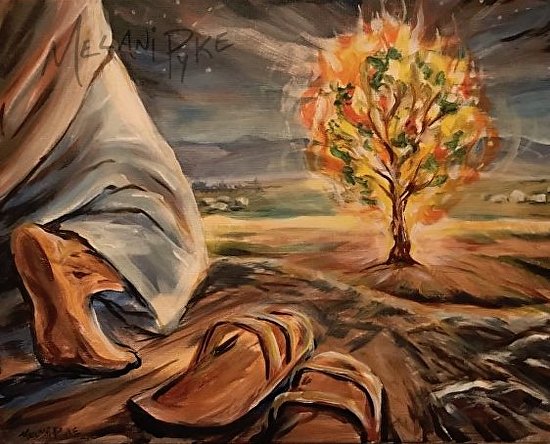
While tending his flocks, Moses meets his Creator in a thicket on a mountain. He sees a bush on fire, but not burning, that calls out to him and demands he remove his shoes.

Could this be one of the gods of Midian or Egypt? Could it be one of the spirits that inhabited the ancient world?

Moses must know. He asks “who are you?”

The voice from the burning bush replies: “אהיה אשר אהיה.” I will be what I will be.

This God does not have a name. It is not one of the idols that the nations worship. It is not something that can be held or controlled. This God will be what it will be. This God is the sum total of all that will ever exist.

When I teach bnei mitzvah children portions, I try to get them to understand what they are saying, so I teach them the roots of Hebrew words. They learn what is going on in each word of their parashah.

In Hebrew, every word has a root: three letters that hold all the possible meanings. Words like kaddish (the prayer for the dead), kiddush (blessing the sabbath), and kiddushin (getting married) all have the same root: kaf-dalet-shin. The root gives us all the words to do with holiness and making things special.

In nearly every parashah, we get to the unpronounceable name of God. The students nearly always try to pronounce it, but find it quite impossible.

We don’t say the word as it appears, but substitute it with “Adonai” (my Ruler) or “Hashem” (the name). That way the name stays sacred, or kadosh.

And then I teach them the root of this ineffable name. Hashem is a composite of three words: היה (what was); הוה (what is) and יהיה (what will be). God’s root is existence. God is the thing that always exists, and from which all existence comes.

When God says “I will be what I will be,” it means that God is everything. God is existence itself. God is whatever it means for something to actually exist.

This is the mature view of God. It is not a fairytale or a Santa Claus. It is a way of understanding all of reality.

This God will not do what it is told, or sort out your problems for you.

That’s why this God comes with a demand. “Go back to Egypt. Get over there and bring the people out of that land. Do whatever you can, bring everyone with you, and get yourselves free.”

When we are children, we have a child’s view of God. One who gives out punishments and rewards. One like an ideal parent.

Now, we are faced with the good of adulthood. The one who is the foundation of all existence. The one who gives all life meaning. The one who says: “I am not going to free you by magic. You will have to start freeing yourself.”

Shabbat shalom.

fast · sermon · theology

Tonight, we begin grieving.

Tonight, we begin grieving.

As the sun goes down, I will eat my last meal for 25 hours. I won’t bathe or shave or change. I’ll probably read a book, or some poetry, and contemplate what it means to be destroyed.

Tonight, the fast of Tisha bAv begins. It commemorates every disaster that has befallen the Jewish people. If we were to dwell on every time we had been injured, our year would be non-stop suffering. We would never have time to celebrate. 

So, we compound all our catastrophes onto a single day. Every exile. Every genocide. Every desecration of sacred texts and spaces. Every racist law and every violent uprising. As far as we are concerned, they all happened on this day: on Tisha BAv.

It is a day of immense profundity. The tunes are haunting. The texts are harrowing. It is the hardest fast of the year, taking place in the heat of summer, with long days and disturbing topics. 

For years, I marked this fast alone. Very few Progressive Jews wanted to participate. Many Reform and Liberal synagogues don’t mark it at all. I would turn up to Bevis Marks, the centre of Sephardi Jewish life in the city, where cantors from the Netherlands regaled us with their greatest piyyutim. But this occasion attracted so little interest from the people who shared my religious beliefs: the other Progressives. 

Why would they not want to mark it?

The first reason is emotional. It is difficult to sit in misery for a full day. It paints a tragic picture of our past, compounding every struggle we have faced into a single problem, overwrit by centuries of destruction. 

In fact, I think this objection is what really commends Tish bAv. Grieving what’s gone can teach us important lessons. It can put us in touch with our most challenging emotions, like guilt, misery and despair. 

True, if we went around all the time complaining about how difficult Jewish history had been, we would never move on, and we would be bound by a negative self-image. By placing all of Jewish suffering on a single day, we are able to confront atrocities, and engage with them, then move on.

Progressives have also objected to Tish bAv on theological grounds. As Reform Jews, we have no desire to return to the Temple or its sacrifices. We are the heirs to the rabbinic revolution, which rebuilt our entire religion after Jerusalem was destroyed. 

Because of the early rabbis, we became a Diaspora people; replaced animal slaughter with prayer; and substituted hereditary priests for a system in which all Jews could be equals. 

But those rabbis understood something profound. You have to engage with the past in order to progress from it. We cannot just pretend things never happened. 

Our rabbis pored over their ancient texts, repeated their oral traditions, and grappled with the world that had gone before. They may have moved beyond the time of the Temple, but they always referred back to it. They faced their tragedy, and rebuilt their religion.

Perhaps the biggest reason that Tish bAv is not given the respect it’s due is because it has been replaced. Since the Second World War, many Jews now instead mark Yom HaShoah or Holocaust Memorial Day.

This is understandable. The Holocaust was, of course, unprecedented in the scale of slaughter; the degree to which industrial machinery could be dedicated to human suffering; and the gleeful participation of so much of Europe in Jewish extermination. It is absolutely right to mark it and honour so many outrageous deaths.

But these events have their own theology. They teach that Jewish suffering was a thing of the past, now resolved. In the case of Holocaust Memorial Day, the problem has now been solved by the United Nations in international commitments to human rights. 

Yom HaShoah is part of the secular cycle of the Israeli calendar, a week before Yom HaAtzmaut celebrates Israel’s victory in 1948, and a fortnight before Yom Yerushalayim celebrates Israel’s Conquest of Jerusalem in 1968. Yom HaShoah suggests that the answer to Jewish suffering is the state of Israel’s military might.

These may well be the political views of some congregants, but they are not the religious views of rabbinic Judaism. Judaism shies away from simplistic answers to subjugation and refuses to allow genocides to be resolved by slogans. We actually have to engage with the horrors of the Shoah, and to understand that they cannot be explained away. We have to sit with our grief.

Tisha bAv poses an alternative response to our experiences of evil. It tells us to fast and grieve, but, unlike on any other fast, we are to carry on working. We can still do many of the things we would on a normal day. Our world is upended, but we must keep going. 

The idea of Tish bAv is that we can face destruction and, through faith and community, nevertheless survive. We can still hold onto our God and our values. Even while we are being destroyed, we are able to rebuild.

Consider how Reform Jews of the past responded to the Shoah in the 20th Century. While in the camps, Rabbi Leo Baeck preached Torah beside waste heaps. When he was liberated from Theresienstadt, he immediately published a work of optimistic theology, expressing his hope of Judaism’s continuity. Think of Rabbi Albert Friedlander, who, having escaped the Nazis, spent the post-war years establishing synagogues and saving scrolls so that our religion could be preserved. Their lives are a testament to Jewish hope in the face of despair.

That is the story told by Tisha bAv. That, yes, we have suffered, but we have also survived. We have refused to let Judaism be extinguished. Into every generation, we have passed on our values and our faith. We have always found ways to rebuild. Tish bAv teaches us that we may always suffer, but that we have also always carried on. 

So, tonight, we begin grieving. I hope you will join me at ELELS for our ECAMPS service to mark this important fast. We will read poetry, hear the chanting of the Megillah, and reflect on the tragedies of destroyed cities and vanquished people. And, through this sorrow, we will learn again the strength and creativity of our people. We will remember all those who have kept this Judaism alive.

Tonight, we begin grieving. Tomorrow night, we will begin rebuilding.

Shabbat shalom.