high holy days · liturgy · sermon

It is on us.

What are we doing here tonight, beating our chests and chanting our sins? Haven’t we been through enough?

We have spent most of this year, from Purim onwards, sitting in our houses, staring at screens as nothing but bad news floods in. Coronavirus. Climate catastrophe. Police brutality. Rising inequality. Economic collapse.

Frankly, shouldn’t we able to take a night off? You might think we should get to the High Holy Days and only hear reassuring pleasantries. But Judaism never lets us off that easily. If that is what you want, Selichot is the wrong service. It’s very meaning is apologies, penitences, petitions. Its whole purpose is to summon us to ethical action and force us to examine our deeds.

At this service, we have to be confronted with Hillel’s maxim:

 אִם אֵין אֲנִי לִי מִי לִי. וּכְשֶׁאֲנִי לְעַצְמִי מָה אֲנִי. וְאִם לֹא עַכְשָׁיו אֵימָתָי

If I am not for myself, who is for me? But if I am for my own self [only], what am I? And if not now, when?[1]

This saying from the Mishnah is often rendered in the more memorable format: if not you, who? Yes, life would be much easier if we could look to others to resolve our problems. If only the government would do a better job… if only the European Union would sort things out… if only Jeff Bezos would spread his wealth around a bit… if only God would stop Coronavirus… if only God would send Moshiach to us today and sort the whole thing out! If only.

But your religion isn’t asking you to look at what others should be doing. It is calling on you to consider what you should be doing. Every time we pray, we recite the immortal words of Aleinu: “t is our duty to praise the Ruler of all, to recognise the greatness of the Creator of first things, who has chosen us from all people by giving us Torah.”[2]

Aleinu. It is on us. The power and responsibility for what happens in this world rests with us. To be a Jew is to be singled out, directly and personally, by God. You, as an individual have been called upon by God and tasked with Torah, with the moral welfare and social responsibility for all humanity. You are asked to take action.

And what does Aleinu say we must do? To cut off the worship of material things. To destroy prejudice and superstition. To speak out against oppression. To unite the whole world. To bring goodness and truth and justice to this world.[3]

That is our calling. That is what we must answer. According to folklore, this prayer was introduced into the daily liturgy in the 12th Century, when a group of Jewish men and women were burned at the stake for refusing conversion. As the flames piled up around them, they sang these lyrics to a haunting melody, refusing to give up even unto death.

Faced even with being burned alive, these martyrs’ first recourse was to recall their own moral duties. They used their last moments to remember why they were placed on earth. Why, in this time of Coronavirus, should we be any different? We must see this season as a time to take up the yoke of responsibility Judaism has bestowed.

As we recite our selichot, challenge yourself. Ask: have I been as generous as I should? Have I done enough to reach out to vulnerable people?  Have I prayed? Have I built community? Have I supported my loved ones? Have I been kind?[4]

And, if, on any point, you find yourself deficient, now is the time to correct your ways. If not you, who? If not now, when?

I gave this sermon on Saturday 12th September 2020 at Glasgow Reform Synagogue for Selichot.

[1] Pirkei Avot, 1:14

[2] Forms of Prayer 2008, p. 310

[3] Forms of Prayer 2008, p. 311

[4] Based on Babylonian Talmud Shabbat 127a

sermon · social justice · torah

The soul of a stranger


1998 is imprinted in my mind as a critical turning point in Jewish history. 

Those who remember it are already nodding sagely in recollection of this key moment of reconciliation between Jews and others. It opened up the Jewish community to being more accepting of difference and showed that Jews had been visibly and publicly embraced.

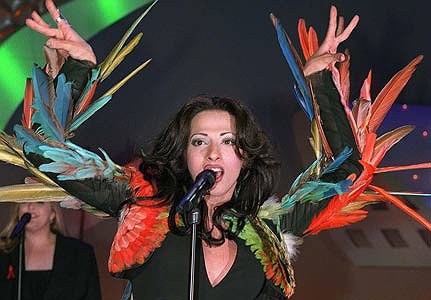
It was, of course, the year Dana International won the Eurovision Song Contest. Like many families across Europe, mine stayed up late watching the results come in. They were as expected – Dana had stormed the public vote. 

Dana. Jewish. Yemeni. Israeli. Glamorous. Melodious. Trans. 

Dana was a trans woman who had already made her name in the underground gay clubs of the Mediterannean and the Middle East. In some places, her albums had been sold illegally and discreetly. 

At that time, trans people had no legal protections in any country. In popular media, they were exclusively the butt of jokes or objects of fear. There were very few public pundits who were trans or even willing to advance their cause. 

But now, all of a sudden, she burst onto television screens to accolades, as if the world might finally be ready for latent queer liberation. Her victory wasn’t just a win for a pop star; it was a statement about what could be. 

For me, it was mostly a watershed moment in Jewish history because it transformed the communal discussion about LGBT acceptance. British Jews celebrated Dana’s win as a win for Jews and a sign of our integration in Europe. At Purim that year, aged 10, I dressed up as Dana and danced around on the bimah.

This snapshot in LGBT Jewish history stands in sharp contrast to this week’s Torah portion. Here, we read: “A woman must not wear men’s clothing, nor a man wear women’s clothing, for the Eternal One your God detests anyone who does this.” This has become known as one of the ‘clobber verses’ – words from Torah quoted at lesbian, gay, bi and trans people to oppress them. 

In the Talmud, Rabbi Eliezer ben Yaakov warns that men will dress up as women in order to sneak into their private women-only spaces. This is precisely the argument used today to exclude trans women, presenting them as sexual predators and imposters. 

If anything, today’s discourse is far worse, since the Gemara ultimately rejects this argument, but such bigotry is often allowed to stand unchallenged in our newspapers, radio call-ins and TV debates. In fact, in the last few weeks, Members of Parliament, the Archbishop of Canterbury, Piers Morgan, JK Rowling and a number of other high profile figures have banded together to criticise what they term ‘transgender ideology.’

Defendants of trans women have spoken up to insist that they are not ‘men masquerading as women,’ but simply people seeking to live their own authentic lives. 

I think, however, this defence is too constricting. There is nothing wrong with men dressing as women or women dressing as men. One of the strongest messages of the trans movement has been that gender need not be a prison. I personally have built on my childhood success imitating Dana by dressing up as Amy Winehouse and Lily Montagu for the last two Purims. 

Trans people belong to a broad spectrum of people who don’t feel like their gender identity matches with what society assigned them at birth. They have diverse ideas about who they are, but shared experiences of people trying to force them to conform to a mould they do not fit.

I hope that by promoting those who do not fit the mould we can reconsider the mould altogether. There are so many ways to be a man, to be a woman, and to sit in the spaces in between.

Our communities should be strong enough to include everyone, regardless of gender presentation and identity. We should be able to accept and celebrate the myriad of gender variance today, as we did for Dana twenty years ago.

It is disappointing that what, in the late nineties, seemed like the inevitable advancement of trans rights, is now being pushed back by a toxic alliance. While other parts of society can have their own arguments, I feel it is important that Progressive Jews position ourselves firmly on the side of inclusion. 

Thankfully, I am not alone. Last month, Reform Judaism’s outgoing senior rabbi, Laura Janner-Klausner, wrote alongside a leading Anglican bishop: “We believe that trans people, like every other person, have every right to be cherished, and protected by society and in the gender in which they choose to live. Our faith compels us to speak up for those on the margins, those whom others would seek to silence or misrepresent.”

This, you must understand, is not simply a matter of our liberalism trumping our Judaism, but is deeply rooted in our understanding of what Judaism requires of us. We do not believe that the Torah is God’s infallible word, but that it is a text, written by men, aiming to understand how best to live an ethical life. As a human work, it contains human biases, including sexism and what we would today term ‘transphobia.’

Instead of living by the letter of ancient words, we use them as the basis to interpret, through our own limited human experience, what morality requires of us today. Joy Ladin, a trans woman and Jewish biblical scholar, argues that while the verses criticising gender non-conformity are sparse, the commandment to know the soul of a stranger is repeated throughout Tanach.

She writes: “The commandment to know the soul of the stranger is more than a summons to social justice or a reminder not to do to others the evil that others have done to us. Knowing the soul of the stranger is part of the spiritual discipline required for a community to make a place for God. […] God commands the Israelites to hitgayer, to identify with the experience of being strangers so that they will know the soul of the stranger – the stranger who dwells among them, the strangers they are, the stranger who is God.”

It is on this deeply Jewish basis that we seek trans inclusion in our Jewish communities. We are commanded to know the soul of the stranger. We are called upon to make our synagogues not just places where words of Torah are heard, but where they are lived, so that our buildings are homes for people of all genders. 

May we all know the soul of a stranger, and may all strangers know that our hearts are with them.

Shabbat shalom. 

dana-international.jpg.750x400_q85_box-0,35,431,265_crop_detail

I will give this sermon on Saturday 29th August for Parashat Ki Teitzei at Newcastle Reform Synagogue.


judaism · sermon · torah

Why only one God?

Why only one God?

A Jewish scientist finds herself at a conference, presenting a paper. A colleague asks her: “what’s your religion?” Nervous of prejudice, she says: “I’m an atheist.” Her colleague answers: “Yes, but is it the God of the Jews or of the Christians in whom you do not believe?”

As everyone knows, the best jokes are the ones you have to explain. And the very best jokes are the ones you spend a whole sermon unpacking, so strap yourselves in, because we’re going to look at the archaeological and scriptural evidence for why that introduction was, in fact, really funny.

It is a basic assumption of religion in the West that there is one God. Even for those who do not believe, they assume that it is one God in whom they have disbelief. Yet our society is filled with different religions and practices. When we encounter Muslims, Sikhs, Christians or Hindus, we assume that underlying the diversity of our doctrines and rituals, there is an underlying unity of belief in a single and universal Being.

But it was not always that way. In fact, the idea of monotheism was novel and contentious throughout the entire development of the Hebrew Bible. The insistence on one God is Judaism’s great innovation, and we have built our monotheism up into an obsession. Knowing God’s oneness is the first commandment.[1] Not worshipping other gods is the second.[2] Worshipping other gods can incur capital punishment.[3] It is treated as an unforgivable crime, on par with murder, and a Jew should choose death rather than worshipping another god.[4] The Deuteronomic insistence on one God has become the centrepoint of Hebrew prayer: “hear, O Israel, the Eternal One is our God; the Eternal God is One.”[5]

In this week’s portion, Moses exhorts the Israelites: “Destroy completely all the places on the high mountains, on the hills and under every spreading tree, where the nations you are dispossessing worship their gods. Break down their altars, smash their sacred stones and burn their Asherah poles in the fire; cut down the idols of their gods and wipe out their names from those places.”[6]

But why? Why is it so important that there be one God? And why is it so important that the ancient Israelites worship no other? What was so bad about the other nations’ religious practices?

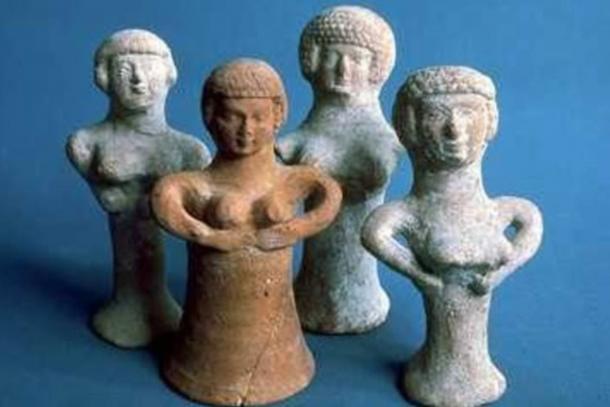
Archaeological excavations help us answer that question.[7] Scientists have dug up altars, shrines, coins and amulets to help us make sense of pre-monotheistic religion. The Canaanites, who preceded the Israelites, had a family of gods: Baal the storm god; Asherah, the fertility goddess; Mot the lord of death; Yam, the judge of the sea; and Moloch, the child-eating fire deity.

This is referenced in Scripture: “Be careful not to be ensnared by inquiring about their gods, saying, “How do these nations serve their gods? We will do the same.” You must not worship your God in their way, because in worshiping their gods, they do all kinds of detestable things the Eternal One hates. They even burn their sons and daughters in the fire as sacrifices to their gods.”[8]

In that case, the issue with polytheism is the unethical behaviour it engenders! The old gods of Canaan required evil practices as part of their worship, like ritual human slaughter. But then why not simply abolish those gods, and leave the others? Or just legislate against those practices but keep the rest of the religion intact? In the mind of the ancient Israelites, there must have been something that directly connected any worship of multiple gods with murder.

Here, archaeology can help us further. Digs from different times show us that polytheism wasn’t suddenly abolished, but fell out of favour when the Israelite religion took off. The Canaanite pantheon reduced down to just a few gods. We can find statuettes representing them at most ancient Israelite Temple sites.

This is backed up by text: Jeremiah condemns the Israelites for baking cakes for the Queen of Heaven and making offerings to Baal.[9] Jeremiah explicitly condemns this because these are the ways of the Egyptians, who held them in slavery. Idol worship, says Jeremiah, means keeping up the practices of theft, murder and lying.[10] It is not just that the old gods require ritual murder, but that their whole religion is based on an Empire that was built on it. Idols are the symbols of captivity.

This point was finally hammered home when Jerusalem was destroyed and Nebuchadnezzar took the Israelites hostage in Babylon. After Ezra led the return to the Land of Israel, we can find no more evidence of idols or their shrines. The people abandoned them altogether.

What could have been more convincing that idols were the work of murderous empires than exile in Babylon? The Israelites saw first-hand how looting, murder, war, conscription and sieges were built into imperial expansion. We know that the Babylonians used their pantheon as a way to legitimise their colonisation, as they brought the local gods of conquered people into their own cult and placed them in inferior positions. We know that the emperors turned themselves into gods and made people throughout their lands worship them.[11]

All those gods in Israelite minds became death-gods. The only way to truly abandon the ways of the oppressors in Babylon and Egypt would be to uproot the idolatrous shrines and eliminate the pagan pantheon altogether.

Monotheism was an act of resistance to these corrupt ways.

God’s unity was not a mathematical question but a moral one.

The One true God could not be co-opted into imperialism because it was universal: no one nation could control it. No ruler could declare himself to be that God because God had no flesh or form. And whereas the many gods constructed hierarchies and different customs for different places, with monotheism came ethical universality.

That is why one God was so important then, and why it remains so important now. God’s unity continues to represent the unity of human beings and the refusal of the faithful to be dominated. So, in answer to the question: “is it the God of the Jews or of the Christians in whom you do not believe?” the atheist could happily answer “neither.” And I will gladly answer “both.” They are One.

Shabbat shalom.

Asherah-figurines
This is a photo of Asherah statuettes, which have been excavated at almost every ancient Israelite cultic site prior to Ezra’s Great Return

I wrote this sermon for Leo Baeck College’s weekly newsletter, and will deliver it for Newcastle Reform Synagogue on Saturday 15th August 2020, Parashat Reeh.

[1] Deut 5:6

[2] Deut 5:7

[3] Ex 22:20

[4] Yoma 82a

[5] Deut 6:4

[6] Deut 12:2-3 NIV

[7] All references to archaeology in this sermon are derived from ‘The Bible Unearthed’ by Israel Finklestein and Neil Asher Silberman

[8] Deut 12:29-31 NIV

[9] Jer 7:5-19

[10] Jer 7:8-11

[11] cf Dan 2

judaism · sermon

Comfort, my people, take comfort

Comfort, my people, take comfort.

This Shabbat and its haftarah take their name, Nachumu, from the opening words of Isaiah 40: ‘Comfort, my people, take comfort, says your God.’[1]

We have entered into the weeks of comfort, the weeks between Tisha b’Av and Yom Kippur. Here, the prophets promise us redemption and renewal if only we will correct our ways. It is a great build-up to the High Holy Days, leading us through the remaining summer months with a message of mercy.

After Tisha b’Av, we so need that reassurance. Tisha b’Av – or the 9th of Av – is a day of intense mourning in the Jewish calendar, which occurred during the week from Wednesday to Thursday nights. It recalls the destruction of the First and Second Temples by successive Empires in the days of our biblical ancestors. It summons Jewish congregations to lament our exiled state and God’s apparent absence from the world.

It is not a fast that is marked in all Reform communities, because it involves grieving for the Temple, which we do not want rebuilt, and because it wallows in so much misery, which we do not want to participate in.

Nevertheless, for the last 5 years, I have diligently engaged in Tisha b’Av rituals. This is mostly practical. On Yom Kippur, I’m often so busy curating religious experiences for others that I don’t get round to having one myself. My head is stuck on the next page in the prayer book, recalling the next tune, or remembering the complicated Hebrew I’ll read later. Tisha b’Av gives me a chance to have my own solemn day, where other people lead the services for me, and I can just use the time to reflect.

Most years, I go to Bevis Marks, the impressive Sephardi-Orthodox synagogue in central London. It is quite an experience. The building’s elegant chandeliers are extinguished. The beautiful decor is covered over with black sheets. A chazan chants the haunting melody of Eichah, beginning: “how lonely sits this city that was once full of people.”[2] A choir of harmonious men chants kinot – dirges – recalling the gruesome details of the destruction of the Temple, and connecting them to every tragedy Jewish people have ever endured.

But this year, I couldn’t go to Bevis Marks. Nobody could. Coronavirus has made physical attendance of synagogues too dangerous. Even those that have braved it have only permitted a tiny number to attend, with strict social distancing and masked faces. The Spanish and Portuguese community was especially hit by Covid back in March, so it makes sense that they would be cautious.

But what about me? What would I do? I depended on the spiritual experience of Tisha b’Av to see me through the rest of the year, and now the gates were closed.[3] I found myself wondering how it would be possible to do anything meaningful if I couldn’t do it the way I always had.

But I decided, for my own sake, I would make an effort. On Wednesday evening, I switched off my phone and tuned in to the streamed services from Lauderdale Road. I read through the Reform liturgies on my own, had one last glass of water before sundown, then went to bed. When I got up in the morning, I dressed as if going to synagogue, and watched a recording of the proceedings from the Kotel. I spent the day intermittently meditating, praying, studying texts and thinking about all the brokenness in the world.

For the first time, the loss of the Temple actually meant something to me. It wasn’t that I suddenly had a desire to return to animal sacrifices and priestly hierarchy, but I felt that I could emotionally connect to the verses in a new way. It can be really devastating to be away from the spiritual space to which you are accustomed. It is a shock to the system to realise that you can’t pray the way you used to.

And, strangely, I liked that I had made the connection. I liked that I could feel some new kinship with Jeremiah and the texts of Scripture. I liked knowing that the things I was experiencing had been suffered by others before. Because when I remembered that they had struggled, I also remembered that they had survived. In the face of difficult times, they had renewed Judaism, and changed its practices so that its message could continue.

I found myself enjoying marking the day alone. I didn’t feel like I was performing piety for others, but I was praying sincerely of my own accord. I realised that I, too, could adapt and reinvent.

In this week’s haftarah, Isaiah tells us: ‘The grass withers and the flowers fall, but the word of our God stands forever.’[4] It wasn’t the building that mattered, it was the words that were spoken there.

After the destruction of Jerusalem, Rabban Yohanan ben Zakkai was among the few sages who remained. He did not try to rebuild the city walls. He tried to rebuild Judaism. He established an academy at Yavne and taught Judaism as he had received it, bringing in new teachings to adapt the religion to post-Temple times.[5] Rabbi Yohanan knew that the words of Torah were more enduring than any citadel.

Every edifice will eventually crumble. Temples, synagogues and familiar buildings get torn down, eroded and replaced. But the moral message of Judaism – the meaning we get from our texts – that will endure forever.

We now begin our ascent to the High Holy Days, with Rosh haShanah only seven weeks away. As we approach these important feasts and fasts, we may feel tempted to despair that the usual building won’t be there. It is true that we will not do things in our usual way. But like generations of Jews before us, we will find new ways to make our liturgy meaningful and turn its moral messages to our own day.

I encourage you to emotionally prepare yourselves for doing the High Holy Days differently. Think about how you can dress, act and participate so that the period will be meaningful for you.

We will explore new ways of praying, meditating, studying and feeling. And we will come out of this experience with a Judaism that has been transformed and renewed. It will be stronger, more versatile, and better equipped to face any crisis that may come. As Isaiah promised, we will soar on wings like eagles and run without ever growing faint.[6]

So take comfort, my people, take comfort.

Shabbat shalom.

5f3ac318f9ec28e284b5bda529754cbc--jewish-art-place

I gave this sermon on Saturday 1st August 2020 for Parashat Vaetchanan/ Shabbat Nachumu at Glasgow Reform Synagogue, over Zoom.

[1] Isa 40:1

[2] Lam 1:1

[3] Lam 1:4

[4] Isa 40:8

[5] Eichah Rabbah 1:31

[6] Isa 40:31


judaism · sermon · social justice

What good is remembering?

Jews do not have history, we have memory. Whereas the rest of the world commits itself to dates, names and figures, our engagement with the past consists in rituals and symbols. At Pesach, we are not interested in the historical facts of the exodus from Egypt, but in reenacting its moral meaning. At Shavuot, as has just passed, we do not care so much about the geography of the Sinai peninsula as the words that were spoken on its mountain.

Memory is, in many ways, more powerful than history. Whereas history is focused on clinical facts, memory calls on raw emotion. Whereas history cares about leaders, memory looks at ordinary people’s lives. And although history looks only at the past, memory wonders what its events mean for the future.

Even when it comes to recent history, we are less interested in the architects and perpetrators of the Nazi genocide than we are in the diary of a 15 year old girl. Anne Frank has become a symbol. As one girl, she stands in for the memory of millions. In classrooms and homes around the world, Anne Frank is the way for people to remember the evils perpetrated in the Third Reich.

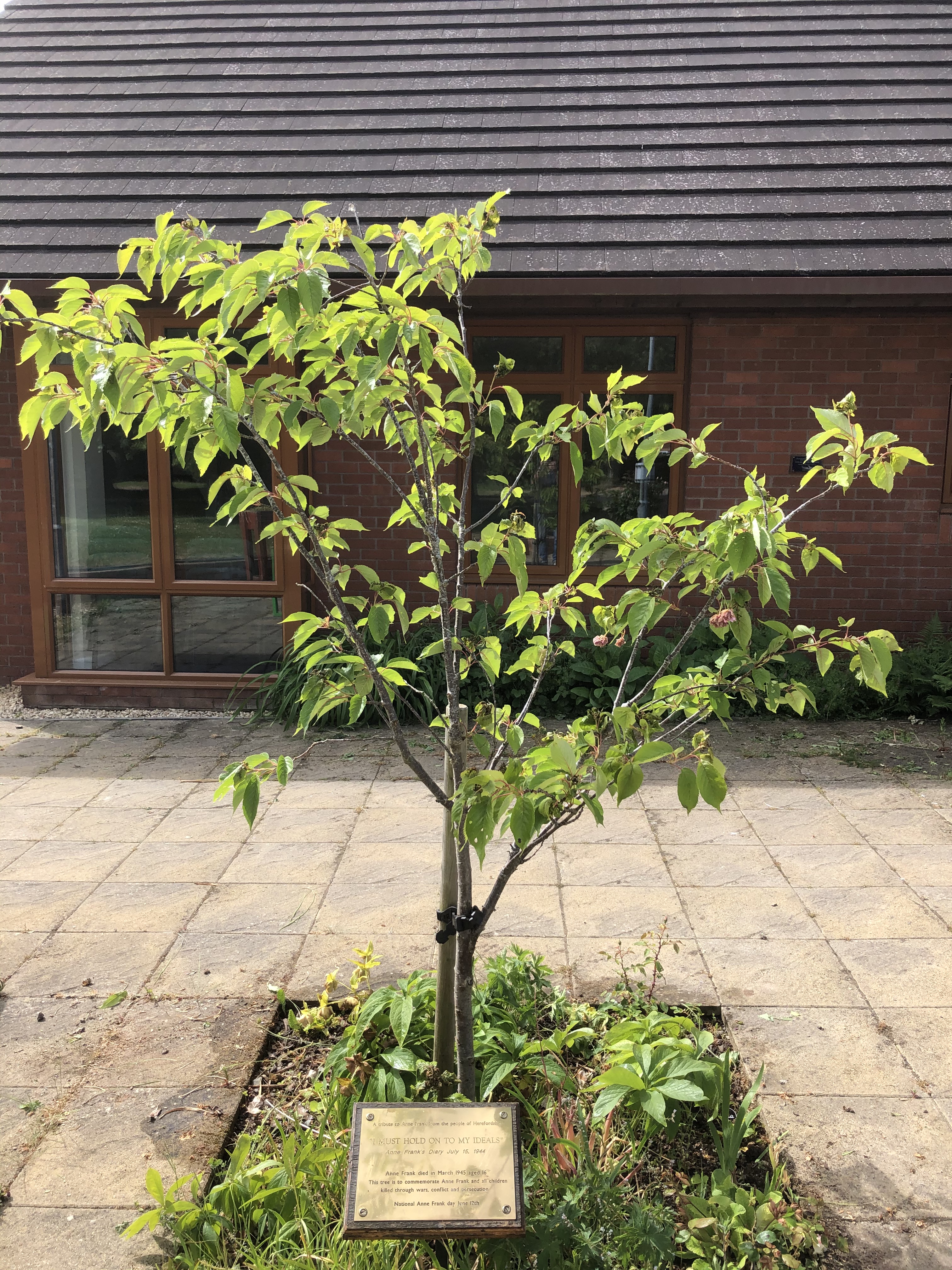
It is a great act of kindness to the Jewish community here, especially its Holocaust survivors and their descendants, that you have all chosen to join us in remembering. To the Council, for planting this tree in memory of Anne Frank, growing in the Herefordshire soil as a symbol to remember a symbol. To the dignitaries who join is in this service today, and who have been friends to our community, for joining us, please accept our thanks.

Memory turns death into meaning. When we remember our martyrs, we remember what they stood for. We remember Rabbi Akiva, flailed to death by the Romans, and we revive his vision for a Judaism that is creative and rich in interpretation. We remember the decapitated Rabbi Ishmael, and relive his conviction that Judaism must be principled and action-based. Their lives and deaths represent the values they inhabited.

Of course, Anne Frank was no martyr. Martyrs are those who die in the service of a cause, consciously choosing to affirm God’s truth rather than compromise. She did not choose her death. She did not pursue it in search of a cause. She was a teenage girl who wanted to ride her bicycle. Nevertheless, she has left behind a legacy of words, hopeful that something of her life could be recalled. And we have translated those words into a commitment to remember cruelty and have cause for hope.

Yes, memory is supposed to prevent evil being repeated. We recall a teenage girl who had to hide in a room in an attic before she was dragged away by soldiers to die of typhus in a concentration camp. And we commit to prevent bringing about a situation when any child has to live and die like that. 

May this tree call out to people with Anne Frank’s moral lesson. May they be the ones who would hide people who have been declared illegal aliens to stop their deportation. May they be the ones who would protest against the encroachment of civil liberties. May they be the ones who would stand up to resist fascism before there was nobody left to speak out for them.

May that memory of Anne Frank speak loud enough that even our world leaders can hear it. The memory of genocide in Europe was supposed to prevent it happening again, but we know that mass slaughter has not ended. We know that there are still children dying of typhus in concentration camps. We know that there are still forced labour prisons surrounded by barbed wire. We know that the nations of the world have only developed crueller and more effective ways to torture and kill people. May this tree and this service and that diary speak loud enough for that evil to be blotted out.

Many of our prayers this week are turned to the evil perpetrated in the United States. Black Americans, who endured centuries of slavery followed by segregation now face the injustice of police brutality. The world watches as they protest once more for their rights and we hope that they will see the justice for which they have longed.

I do not intend to engage in comparisons. Any attempts at equivalence are facile and destined to turn into competitions nobody wants to win. But the horrors endured in Nazi Germany and for Black people in America are united by the common fact of memory. Both call on their dead as symbols, martyrs and aspirations for a better future.

So George Floyd has become an international symbol. The man who could not breathe under the weight of a police boot is now the spark that has reignited a movement. And we should not underestimate the importance of that memory. Without it, our humanity is compromised. Memory makes people human.

Memorialisation gives people a dignity in their death that they were not afforded in life. By saying their names and recounting who they were, the dead are allowed to be people instead of statistics.

We remember George Floyd, and he is once again a gentle giant who said hello to everyone and was trying to look after his six-year-old daughter. Instead of a man in Minneapolis who was strangled to death by police.

We remember Tamir Rice, and he is once again a twelve year old boy playing games outside his home. Instead of a child who was shot dead by police on the street.

We remember Belly Mujinga, and she is a wife and mother working as a ticket inspector on the London Underground. Instead of a woman who died of Coronavirus after somebody spat in her face.

We remember Joy Gardener, and she is a mature student from Jamaica living in Crouch End. Instead of a woman who died from asphyxiation after she was gagged with adhesive tape by police. 

We remember victims of racial violence and they cease to be only victims, but can be full human beings with histories and dreams and potential.

And because we gather today in remembrance, Anne Frank is not a Jew who died of typhus in a Nazi concentration camp. If only for a moment, Anne Frank can be a teenage girl who wants to ride her bike. 

Thank you. Shabbat shalom. 

Anne Frank tree Saxon Hall 26 May 2020 (1)

I gave this sermon for Three Counties Liberal Judaism in honour of Anne Frank’s birthday on Saturday 13th June 2020. The picture is of the Anne Frank tree in Hereford.

festivals · sermon · theology

Falling in Love is a Choice

Lately, I’ve been thinking a lot about falling in love. Maybe it’s the spring heat of May. Maybe it’s the newborn baby delighting me with his first smiles. Maybe it’s my boyfriend moving down from Manchester. Or, perhaps, it’s because it’s Shavuot.

The model of a loving relationship in Tanach is of Ruth and Naomi. It may sound strange to think that two women could be such an example even in Orthodox Judaism, but Ruth’s words are used in wedding liturgies to this day, as well as recited by proselytes upon their conversion to Judaism. Why is it that this text connects falling in love, joining a faith and receiving the Torah at Shavuot?

After Ruth’s husband dies, her mother-in-law, Naomi, begs her to leave. But Ruth responds:

Entreat me not to leave you, nor to turn back from following you. Wherever you go, I will go. Wherever you lodge, I will lodge. Your people shall be my people, and your God, my God. Where you die, I will die, and there I will be buried. May God do so to me, and more, if anything but death parts you from me.

When Ruth tells Naomi she will never leave her, Naomi puts up every possible objection. It would leave her without a husband or income. Her sister has gone. Anybody would leave her. Be sensible. Go. 

But Ruth refuses to see sense. Her choice to stay with Naomi is irrational. She could never explain it in a way that makes sense to anyone else. Something more powerful than reason must have gripped Ruth’s heart. Surely it was love. Messy, confusing, irrational love.

Is that not how falling in love really feels? For anyone who has felt it, is love not completely illogical and nonsensical? Nobody could reason it. It runs not just contrary to reason but is almost its opposite.

And yet, somehow, love is also a choice. Ruth stayed with Naomi because she wanted to. She could have stopped up her heart, grieved and left her mother-in-law. But she stayed. Because love is nothing if it isn’t freely given.

At first it feels like the lapping of an emotion at your insides. And then the waves of longing seem to get bigger as they ask to be allowed to grow. And then you make a choice. If you are not ready to fall in love, you can walk away from its shores. But if it feels right, you will dive in and let its waters subsume you. 

Whether with a first partner or a best friend or a newborn baby or a brother or a mother or a spouse to whom you have been married for years. Love, when it comes, is a choice. But it is a choice we cannot help but make.

I think the same is true of faith. It is not something that can be reasoned or explained, but only felt. Religious belief starts as a nagging feeling of suspicion that there might be something greater than what our senses perceive. After that, we have to make a choice. As Einstein put it, either everything is a miracle or nothing is. 

And so, faced with a latent sense of wonder, the faithful make a choice about how to see the world. For those who believe, God is manifest in everything that exists. Every facet of nature is a revelation of God’s truth and a calling to accept it.

This, to me, was the true miracle of Sinai. It is that, like those who fall in love, the Israelites made an irrational choice that changed their lives and stuck with it. Shavuot is the celebration of the receiving of the Torah. It is the renewal of our wedding vows with God. Whereas anniversaries between human beings celebrate the date of falling in love, Shavuot is the anniversary of our falling in faith.

We are told so much about the fanfare that greeted the Israelites when Moses received the Torah. Thousands of people gathered round and all witnessed exactly the same thing. Thunder and lightning. A giant cloud descended over the mountain. A horn blast sounded loudly from the air. The whole mountain became cloaked in smoke and shook on its foundations.

But a cynic could have looked at all this and said: these are just natural phenomena. Thunder and lightning on the desert are rare, but they happen. It wasn’t really a shofar blasting from the sky, but the sound of sonic shock waves from the lightning. The mountain didn’t really move, it just felt like it from all the noise.

And that would be the rational position. But the Israelites were not interested in reason. They were falling in faith.

When Moses came down the mountain, his face was radiant and shining out beams from his cheeks. He carried with him two tablets, inscribed with the laws that would govern the nation for generations. The Ten Commandments. 

Some say that, as he descended, the desert mountain erupted in blossoming flowers. Some say the Commandments were written in black fire on white fire. Some say the mountain was upended and suspended over the Israelites’ heads.

And, of course, any sceptic could have said: this is trickery. God did not write those laws, but Moses made them himself while he was hiding up that mountain. These flowers and fires are just sleight of hand by an adept magician. 

And that would be the rational position. But the Israelites had made a choice to accept faith over reason. Thousands of them, huddled together in a strange place, made the decision to accept a beautiful belief over a plausible one. And nobody objected. Out of the many hordes assembled, nobody suggested that it was all a lie or a collective delusion. They let faith dictate to them.

And what did that faith say? That God is personally interested in the lives of people, even in those of refugees and runaway slaves! That the moral fate of the universe rested in the hands of a persecuted people, who were singled out to be light unto the nations. That love, truth and justice mattered more than could be calculated.

As Liberal Jews, we place a great deal of emphasis on reason, and rightly so. Reason keeps us from blind submission to antiquated and offensive ideas. It helps us keep Judaism alive in our own time. But we must also celebrate faith. Sometimes we hold beliefs that cannot be pinned down by logic, but can only be felt. Sometimes our irrational choices are so compelling that we live our lives by them.

Like having faith. Like seeing beauty. Like believing in miracles. Like falling in love.

Chag Shavuot sameach. Shabbat shalom.

love in the mountains

I gave this sermon for Shavuot on 29th May 2020 over Zoom for Three Counties Liberal Judaism.


debate · israel · sermon

The end of the two state solution

In 1982, Rabbi David Goldberg, z”l, gave a sermon so controversial that half the congregation at the Liberal Jewish Synagogue stormed out. The other half stuck around for the rest of it just to make sure they disagreed.

I have no way of knowing whether this was strictly true, but it is certainly plausible. It is most believable because, even though I haven’t yet mentioned the word, you already know which topic would elicit such a reaction. 

Israel. Of course it is Israel. It is a topic so contentious that friends and families have refused to speak to each other over it. As a result, although I do have strong views on the matter, I have so far managed to go three years without preaching on it. I have been strongly tempted to do the same thing today and just speak about the Torah portion, but I feel that I cannot do so this week.

What has happened in Israeli politics in the last two weeks will likely fundamentally change the way that Diaspora Jewry will engage with the country. Already every major Jewish communal body has released a statement, some of which I know have been circulated among members of this community. It would be a cowardly dereliction of duty if I did not comment. 

If you are surprised by the gravity of what I’m saying, it’s not because you’ve missed anything. There is no new president or prime minister. No new war, no withdrawal, no peace treaty, no assassination. What has happened is really the result of bureaucratic decision making at the end of another stalemate election. But its result is that the fabled two-state solution to the conflict between Israelis and Palestinians is now impossible.

Previously, sitting Israeli prime minister Benjamin Netanyahu announced that if he won the next general election, he would annex the Jordan Valley. In the last year, there have been three elections, each resulting in impossibly hung parliaments, but it looks like Bibi has now secured the majority to pursue his agenda. 

As such, he will now go through with his plan for annexation, supported by the smaller right wing parties in the Knesset. That means that the entire Jordan Valley will become formally part of Israel. There will remain isolated enclaves of Palestinian towns in the West Bank and Gaza, but what remains of Palestinian territory will never form a viable state.

For most Palestinians, this won’t mean much of a change to their daily lives. For some time now, West Bank Palestinians have lived under Israeli rule. Although able to elect representatives to the Palestinian Authority, Israel has maintained control over the military, borders and economy. Israeli control will become tighter and more far-reaching, but annexation will only formalise a policy that has been in place since at least 2005.

Nor will it make a difference to most Israelis. With official backing from Donald Trump and the United States, an international military backlash is unlikely. It is already the case that few Israelis live east of Jerusalem. For those who do live in settlements, their private security will likely be supplemented by state army support. 

There will, however, be a shift in Israel’s relationship with its Jewish diaspora, especially among progressives. Most Jews in Britain do consider themselves connected to Israel, but want a just peace, even if it means giving up land or power. For decades, Diaspora Jewish support for Israel has been contingent on the possibility of a peaceful solution that involved a Palestinian state alongside Israel.

With Israel’s proposed annexation, a Palestinian state will now become formally impossible. I suspect that the two state solution has not been truly viable for some time. But if the door was closed before, it is now being locked.

In response to these unfolding events, Rabbi Lea Muhlstein of the Liberal Zionist group Artzeinu released a statement insisting that the two state solution was still possible.  I am afraid I do not see how. Most efforts to defend the viability of the two state solution seem more concerned with reassuring Diaspora Jewry than with grappling with the conditions on the ground. 

Diaspora Jewry is, however, not reassured, and the British community has seen considerable fallout. The President of the Board of Deputies, Marie van der Zyl, urged communal unity as representatives from StandWithUs, Habonim Dror and LJY-Netzer wrote to express their opposition.

Even in unlikely quarters, people are lining up to attack Bibi’s decision. Sir Mick Davis, former Treasurer of the Conservative Party, has urged against annexation, saying that it would run contrary to Jewish values.

I think that is right, and that the values that would be contravened are given in precisely this parashah. Moses tells the Israelites: “You shall have one standard for stranger and citizen alike.” (Lev 24:22) Both right and responsibility, privilege and punishment, must be the same for all those living under the same rule.

Annexation will create a situation in which a people is formally and irrevocably governed by a party it did not elect and could not deselect. It will formalise a tiered class system, where Jewish Israelis have full rights, Palestinian citizens of Israel have fewer and West Bank Palestinians have none, while all live in the same space under the same rule. This is unjustifiable. 

Most of the attacks against Bibi’s plans seemed to have focused on belated efforts to salvage the two state solution. As I have made clear, I think that option is already politically defunct. But that does not mean progressives must give up entirely on any hope of a just solution in the Middle East.

One possibility which has so far only been advocated from the political fringes is of enfranchising the Palestinians. It is, strangely, a position that unites both some settlers and Israel’s radical left, but has been considered outside of acceptable political discourse among mainstream Diaspora Jewry until recently.

If Israel is to be a single state from the Mediterranean to the Jordan, let it be a democratic one, where everyone who lives there has full voting rights and representation. The Palestinians should be able to set the political direction of the country just as much as Israelis, if it is indeed to be one country.

The main reason that this has remained a fringe view is that it would certainly mean an end to a Jewish political majority. The Palestinians living in the region almost outnumber the Israelis and could thus theoretically out-vote them. As such, Israel would cease to be a Jewish state, at least in an ethnic sense.

In that sense, a single democratic state could not be considered within the spectrum of Zionist opinion. But I am less concerned by the certainty of an ethnic Jewish majority than I am by the moral standing of the Jewish people. 

If Israel is indeed willing to implement policies tantamount to occupation, segregation and apartheid, and the Diaspora Jewish community does indeed continue to meet such policies with indifference and even support, what will be left of Judaism? Who are Jews if we refuse our God-given task of being a light unto the nations? What are we if we do not meet but exceed the ethical standards our tradition has taught us?

For years, Progressive Zionists have faced a tension between being progressives and being Zionists. Many have managed to hold nuanced aspirations that balanced their desire for peace with their desire for security; their commitment to other Jews with their commitment to all humanity; their belief that Israel could be both Jewish and democratic. That tightrope has now fallen under the weight of the two poles it was balancing, and most Jews will have to choose one or the other. Politically, they will either be Progressives or they will be Zionists.

Given a choice between a Jewish state and Jewish ethics, I will certainly choose the latter. But even then, I do not think that abandoning the idea of Jewish ethnic majority means sacrificing concern for Israelis’ ability to live and thrive where they are now. I believe it is fully possible for Israel to maintain its cultural autonomy and distinctly Jewish character without clinging to an ethnically based majority or to political supremacy.

The third largest grouping in the Israeli Knesset is the Joint List – a coalition of Palestinian and Jewish leftists. They are non-Zionists who hope for joint political power between Israelis and Palestinians. 

Their leader is Ayman Odeh, a lawyer from Haifa. He has now become the de factol opposition leader as Gantz goes into coalition with Bibi. In 2015, in his maiden speech before the Israeli Parliament, he shared his vision for the country:

The year is 2025, the 10-year plan to combat racism and inequality has borne fruit. Hundreds of thousands Arab employees have been integrated into the private sector, the high-tech economy and the public service.

The social gaps between Arab and Jewish citizens have been reduced remarkably and the economy has been prosperous for the benefit of all residents.

Jews are learning Arabic, Arabs are diligently honing their Hebrew skills. Jewish and Arab students are being introduced to the great thinkers and philosophers of both peoples.

His vision has become my vision. That aspiration for a just, peaceful and shared country chimes more with my idea of what would constitute a Jewish state than one based on racial ideas of citizenship or Orthodox ideas of laws. 

I hope that, as you wrestle with the tensions that will be drawn out over the coming weeks and years, others will be able to support that dream.

Of course, many will not. Despite the calls for unity, I think this is more a time for diversity. A collapse in political consensus need not mean fallout of the Diaspora Jewish community, but could mean a flourishing of new ideas and renewed conversations. We now have a true opportunity to intellectually engage each other about what Israel’s future will be and how we will relate to it.

If nothing else, I hope that at least less than half of you will storm out in anger.

Shabbat shalom.

israel palestine flags

I gave this sermon over Zoom on Saturday 9th May 2020 (Parashat Emor) for Three Counties Liberal Judaism. I am especially grateful to Tal Janner-Klausner, for being my political tour guide of Israel-Palestine, and for all their help with editing this sermon.

judaism · sermon

Whose quarantine?

By this stage in quarantine, you have probably broken down, cried, experimented with an unusual haircut, argued with your partner or room mate, attempted to pick up a new skill, laughed, watched a movie, read all the Corona-related news items, avoided reading all the Corona-related news items, lost your mind, twice, and finally accepted the new reality. Now, it’s time to have breakfast and go through the whole process all over again.

It’s hard to put into words what is happening for us in lockdown right now. Whenever I talk to friends or family about how they’re experiencing this unprecedented life event, we revert to discussing the latest rules or the political ramifications or what they understand of the emerging medical news. We can only really sum up how we’re dealing with the situation in odd phrases, like “getting by”, “finding new meanings”, “struggling” or, “drinking before midday.”

That’s probably why I have trouble finding out what quarantine was like for our ancient ancestors. This week’s parashah is Tazria-Metzora. It is the Torah reading about quarantine. Rabbis rejoice! For so long the processes and rituals around self-isolating for infectious diseases seemed so irrelevant to our lives. Suddenly a pandemic comes along and we can join the ranks of overnight experts with a niche specialism in ancient Israel.

Except, strangely, Leviticus doesn’t really tell me what I want to know. It describes in graphic detail the infectious skin disease our forebearers were trying to prevent – called tzara’at, it resulted in white flaky peeling of the skin and made its sufferers look like the walking dead. It would start as a small patch and gradually expand across the body.1

It also tells me exactly how the priests would deal with it. Anybody with the affliction would have to isolate themselves outside of the camp for 7 days. At the end of these, a priest would come out to inspect the patient. If the patient had been healed, the priest would make ritual offerings of birds to spiritually cleanse him.2 They would be shaved, washed and then readmitted to the community.3 If not, back into quarantine he would go.

Yet for all this detail spread out over chapters of the Torah, it doesn’t answer the question I really want to ask: what were their lives like? How did it feel to have the scaly skin disease in ancient Israel? What did they do when they were isolated from their communities? The Torah provides scarce little information about these questions, and biblical scholars seem surprisingly unconcerned. In fact, the main trend among academics has been to question how much we can even know about the biblical world, shedding great doubt on the texts that have reached us.4

We are told that the isolators were kept outside the camp, or outside the city walls. I wonder whether they had dedicated centres. The harsh desert sun of the Negev must have made simply staying outside longterm impossible. I wonder how they got food. Did people deliver it to them in designated places? Were they expected to scavenge for themselves?

All I can gather from the text is how people were managed, punished, ritualised and redeemed. I cannot work out how the ancient people keep themselves entertained when they had no access to other human beings, nor to Netflix, WiFi, or books to read. I do not know how they loved, supported each other, struggled, found things difficult and ultimately survived. Those positive stories of endurance are hidden between the lines of the text. I do not know how they felt.

But, in this community, I don’t need to just wonder how people feel and how they are managing. Our welfare committee has done an incredible job of checking in on everyone. Our healthy members are going out of their way to ensure that the others get the food and supplies they need. I know that, across this community, people are checking in on each other to find out how they are. This community should be an inspiration to others across the country.

Much is made in the media about people’s acts of selfishness and inconsideration, but for my part I have only seen the reverse. I have been overwhelmed by the kindness of people reaching out to share in feelings, offering support with shopping and errands, and generally being as supportive as they can in these exceptional times.

When our biblical forbearers wrote about quarantine, they wrote about its rituals. When the scholars wrote about it, they took interest in its medical diagnoses. When the media write about it, they write about everything that goes wrong. These stories of rituals, rules and wrongdoing might make for compelling reading, but they don’t reflect people’s lived reality.

Meanwhile, we are quietly writing a different story through our deeds. We are writing stories of generosity, kindness and self-sacrifice. We are showing every day in little ways how much we care about ourselves, each other and our communities.

One of the surprising facts about crises is that they do not engender selfishness, but altruism. At the time of the last financial crash, I was working in the charity sector, and we were all perplexed when we discovered that, in times of economic hardship, poorer people’s charitable donations went up. This week, a German science journal reported on a significant uptick in people’s compassion in their attitude to others since the crisis began. We see the results of that: thousands of people volunteering for mutual aid groups and the NHS supporters. The more people struggle, the more they care about the struggles of others.

Priests and politicians may want to write one kind of story, but ordinary people write much better ones. May we continue to write those stories, and may they be the ones we pass on to later generations.

Shabbat shalom.

coronavirus-volunteers-list

I delivered this sermon over Zoom on 25th April 2020 for Three Counties Liberal Judaism.

1Milgrom on Leviticus 1-16, pp. 816-824

2Lev 14:1-6

3Lev 14:9-10

4Watts, Ritual and Rhetoric, pp. 27-32

judaism · sermon · theology

How will we know when this crisis is over?

How will we know when this crisis is over?

Because this crisis will end. Every catastrophe there ever was has been brought to closure at some point.

Wars have begun with shots fired on foreign shores and ended with neighbours kissing outside their front doors.

Our scientists have conquered tuberculosis, leprosy, HIV and polio. It may take months and it may take years, but they will find a cure and people will recover.

Humanity has survived ice ages, famines and nuclear meltdowns. And it will survive this. This crisis will, one day, be over.

And when it is… how will we know?

The ancient world had rituals for bringing every ordeal to a close. When the sick returned from their quarantine, they were ritually bathed seven times, given new clothes, and shaved from head to toe.1

We, too, will wash ourselves anew. We will look at water and soap differently. We will cry in the shower to produce as much water as possible, knowing that those cleansing droplets are the secret to life itself.

And we still won’t know whether the crisis is over.

The priests of the bible would perform ceremonies to indicate that closure had occurred. On recovery from sickness, they would give offerings of unleavened cakes, fine flour, oil and animal blood.1 They would thank God for their health with their sacrifices.2 They would wave their hands in the air, bringing the ingredients together, embodying their wholeness.3

We, too, will make offerings. We will return to reopened pubs and put our glasses in the air and celebrate our survival with pints of cider and drams of whiskey and we will say ‘l’chaim’ like we never knew what it meant to say ‘to life’ before.

We will be grateful. We will thank God that we were among those who survived. We will thank God that even those who did not survive would be proud to see the continuity of the world they built. We will realise that a day when you can drink surrounded by friends and family should never be taken for granted. We will truly understand that life is a gift.

And still we will not know whether the crisis is over.

Our rabbis knew how to mark transitions with words. When good things happened for the first time in a long time, they instituted that we should say “blessed are you, Eternal One our God, Creator of the Universe, who has kept us alive and sustained us and allowed us to reach this season.”4

We will do old things for the first time. We will play in parks with our children again. And they will meet new children for the first time. And we will leave our houses without a purpose just to knock on old friends’ doors and see their faces for the first time. And we will hug. And we will kiss. And we will go to cinemas and nightclubs and gyms and synagogues. Yes! we will most certainly pack out our synagogues again. And we will treasure those moments and thank God that we lived to see them.

And we won’t know whether the crisis is over.

Our rabbis knew how to mark the bad with the good. They knew that not every transition was a recovery. They knew that sometimes people died and it felt like the whole world had been destroyed. They knew how to mark it. They told us to rip our clothes and let our hair grow long.5 They knew that sometimes so many loved ones would die that we would have to shred our whole wardrobes.6

We will grieve. We do not yet know how many we will grieve. It may be only the thousands who have already died. We will learn not to call thousands of deaths ‘only’. We may lose a person whom we love. We may lose many people whom we love. We will grieve for all of them.

We will cry in the streets in funeral processions for all those who never had the chance to mourn properly on lockdown. We will wail without abandon for every life taken too soon. Every life that will be taken will have gone too soon. We will huddle together in houses and let out all our sadness and anger.

We will feel guilty. Because, after all, feeling guilty is a part of grieving and surviving isn’t always such a cause for celebration. And although we will not believe it at first, we will recover. And we will move on.

And we still will not know whether the crisis is over.

Because the crisis will not yet be over.

If we leave our houses and go back to our old jobs to pay rent and mortgages in the same houses to barely survive in the same cities, Coronavirus will not have been defeated. We will only have signed an armistice with sickness, knowing that another plague will face us again. This will not be the last virus. Any effort to return to normality will only exacerbate the problems that have gone before.

Never again will we fight each other for dried pasta and toilet roll and sanitary pads and formula milk. Never again will we stare into our cupboards and wonder how long our tinned food will last us. We cannot ever return to the days of scarcity.

Before we can begin to move on, we have to be assured that all of humanity’s basic needs will be met unconditionally. Healthcare, food, water and clean energy will be considered human rights. When we struggle for them, we will struggle for everyone to have them. We will insist on it the way that world leaders pledge at the end of wars never to pick up weapons again, only this time we will mean it.

And still that will not be enough for us to say that the crisis is over.

Never again will people carry on working when they are sick because dying of starvation sounds worse than dying of disease. Never again will people live one pay cheque away from homelessness. Never again will family homes be foreclosed. Never again will people worry how they are going to self-isolate when they have nowhere to live. Housing will be provided universally on the basis of need, so that these crises can never be repeated.

And that won’t be enough for us to say it’s over.

Because there are today vulnerable, elderly and disabled people who are saying that self-isolation was already their standard practice, and that they did not choose it voluntarily. Because there are sick people who already feel like they are a burden to society when their lives are a gift from God. Because there are families torn about by borders and there is escalating racism that makes people feel even more afraid and we know that loneliness and bigotry and fear make life unbearable. We will judge our society not by the strength of its economy but by the strength of its weakest members. Only when we are assured that the value of human life is unquantifiable will be able to draw a line under the past.

And that day will come. This crisis will end. Ever crisis that ever was has come to an end.

And we will mark it. Every human being who is alive will sign a new international constitution, swearing allegiance only to each other and to God. And we will swear to protect everything that lives and the precious planet that sustains it. And on that document we will enshrine rights we never thought possible. And it will be the benchmark for everything that comes afterwards.

And everyone, all around the world, will subscribe to it.

We will not know the crisis is over because everything goes back to being the same. We will know the crisis is over when we are certain that everything has changed.

Then we will know beyond all doubt that this crisis is over.

salah taher peace treaty

I wrote this sermon for Leo Baeck College, Parashat Tzav. I then decided to publish it early because I have too much free time. 

1Lev 14:1-10

2Lev 7:1-15

3Plaut 787

4Berachot 54a

5Rambam Mishneh Torah Hilchot Avel 7

6Rambam Mishneh Torah Hilchot Avel 8

festivals · sermon · social justice · theology

Those who attack the weak

Purim is such a strange time. It is a time when everything is turned upside down. In our story, the oppressed become the oppressors; the ones who wanted to slaughter become the slaughtered; Jews become Persians; Persians become Jews.

We act out the topsy-turviness of it all by dressing up in costumes, getting drunk, and generally living as we normally wouldn’t. Somehow this grand inversion festival is one of my favourites, but I’m never really sure what it was about until it’s over. In fact, every year for the last year, I’ve preached about Purim after it happened, rather than before. I suppose that fits with the overall back-to-front-ness of the whole celebration.

This year, what struck me most was the connection between the Torah portion and the Megillah reading.1 In our Megillah, the story of Esther, the enemy is the evil Haman. Haman sets himself up as a god, demanding that people bow down to him, and when they do not, he seeks to wipe out the Jews. The Jews, in this antique Persian context, are already the most vulnerable people. They are the smallest minority, unarmed, and completely powerless. Haman decides to wipe them out.

In the Torah reading, taken from Deuteronomy, the enemy is Amalek. We are enjoined to remember him and what he did to the Israelites in the wilderness.2 The Amalekites had attacked the Israelites when they were at their weakest, dehydrated and suffering without water.3 According to our commentators, Amalek attacked from behind, killing the weakest first.4

The Megillah tells us that Haman was a descendant of Amalek, via their king, Agag.5 We do not necessarily need to believe that Haman had any genetic connection to Amalek. What they had in common they showed through their actions. Both attacked the weak. Both went for the most vulnerable first. They are not only symbols of antisemitism, but of all tyrants. This is how the cruel operate: by doing first to the weak what they would like to do to the strong.

It is deeply distressing to see in our times that the ideas of Amalek still prevail. At this moment, the world is closely watching the Coronavirus. My rabbinic colleagues in Italy are on complete lockdown. Many services have been cancelled. I am giving this sermon, for the first time, over the internet, rather than in person with my regular congregation.

That there is a pandemic should not be too alarming. There are often diseases going around the world – some are more contagious and more deadly than others. This one, it seems, is much less deadly than bird flu, but is more contagious than regular flu, and we do not yet have immunity to it.

In these times, maintaining calm and supporting each other is of the utmost importance. We should all, I am sure you already know, be meticulous about following NHS advice to wash our hands regularly, avoid touching our faces and not get too close to each other. If you exhibit symptoms, like a dry cough, shortness of breath, or fever, you should stay home for 7 days. Don’t go to the hospital or the GP.6

Yet there are those who have not helped maintain calm, but who have almost revelled in the potential death toll. Jeremy Warner, a journalist for the Daily Telegraph, wrote in his column that the death of the weak from Coronavirus could be good for the economy. He said:

Not to put too fine a point on it, from an entirely disinterested economic perspective, the COVID-19 might even prove mildly beneficial in the long term by disproportionately culling elderly dependents.7

With this one sentence, the Telegraph reminded me that Amalek’s ideology never ceases. It is in the idea that the weak are disposable, that the strongest survive, and that the strength of the economy or the nation matters more than the lives of the vulnerable.

The idea espoused by Warner might be called ‘social Darwinism’. It is a theory of evolution that sees all species as rugged individuals, fighting over resources. Sickness and death are nature’s way of weeding out those who are unnecessary. If people survive, it is because they deserved to. This was the logic that allowed the weak to be killed by the Nazis. It is the theory that underpinned government inaction to HIV as it killed off gay and black people.

It must be opposed. No idea could be more antithetical to the Jewish mind. We affirm that every human being is created in the image of God, and every life has intrinsic value. The disabled, the elderly and the immuno-compromised are not valuable because of how much they can contribute, but because God has placed them on this Earth. The Creator’s purpose for humanity far exceeds what any stock market has in mind.

We must oppose it not only because it contradicts religious truth, but also because it contradicts scientific truth. In 1902, the biologist and Russian Prince, Piotr Kropotkin, wrote his major work, ‘Mutual Aid’.8 In it, he argues that the survival of the species is due as much to cooperation as it is to competition. In the animal realm and throughout history, the major reason for life’s continuity has been its ability to work together.

Different species depend on each other and selflessly help each other. Most of all, human survival is intrinsically linked up with our social nature. Our skill lies in our ability to communicate complex ideas with each other. We are, by nature, dedicated to the preservation of our young, our elderly and our neighbours.

That is the message we must take away today in this time of sickness. We must support one another. For some, this means staying home so that they do not infect others. For some, this means checking in on our neighbours to see how they are and what they need. For others still, it means making donations to charities and mutual support organisations.

Purim was a time of inversion, when old habits were reversed. Let us shake off the old traditions of individualism and greed, to replace them with the Torah values of love and support.

In the face of those who attack the weak, we will be the ones to make them strong.

Shabbat shalom.

mutual aid animals

1 Mishnah Megillah 3:6

2 Deut 27:17-19

3 Ex 17:8-16

4 Mechilta de Rabbi Ishmael 17

5 Esther 3:1


I donated to Queercare, who are doing work for at-risk LGBT people. I encourage you to give to the charity of your choice.