judaism · sermon · story

Blot out the name of Amalek

It was the evening of Purim in the shtetl. The rebbe and his disciples were sat in the cold wooden yeshiva. They were reading the Megillah. They had almost reached its climax, when the rebbe slammed his hands down on the table, bolted upright on two feet, grabbed his coat and headed for the door.

His disciples were dismayed. “Where are you going?” they asked.

“To blot out the name of Amalek!” he replied.

The students were anxious. They shuffled in their seats. They knew who Amalek was. They knew what the injunction to blot out Amalek’s name meant.

When the Israelites were wandering in the desert, the Amalekites attacked them from behind, targeting the weakest members; the old, the ill and the tired. The book of Deuteronomy adjured them: “blot out the memory of Amalek from under Heaven. Never forget.”[1] This call in the Torah spoke to far more than historic memory. It was a call to violent revenge. Surely this couldn’t be what the rebbe meant?

One of the rebbe’s students stood up. “Rebbe, you can’t be serious?”

“Of course I’m serious,” said the rebbe. “It’s Purim.”

Purim? Purim, of course. It was the time to read the story of Esther. Haman, the wicked adversary of the Jews in the story of Esther, was an Amalekite. Haman was a descendant of Agag, the king of Amalek. Haman had plotted to kill the Jews in their entirety. As they read the Megillah, at every mention of his name in the scroll, the disciples had been booing to drown out the word. By the end of the story, Haman’s fortunes have been completely overturned. The king decrees that, instead of Haman being able to kill all the Jews, the Jews can kill all of Haman’s supporters and descendants. They go on a fortnight-long massacre, killing 75,000 people.[2]

This has always been interpreted as part of the act of blotting out the name of Amalek. Surely this couldn’t be what the rebbe meant? Surely he didn’t think that violence and genocidal rampaging had any place in Judaism? It was a bawdy story, not an instruction manual. What could the rebbe be thinking? The students followed him out into the streets, rushing after him as he pattered away down the cobbled path.

One of his students caught up with the rebbe, panting, saying: “Sir, with the greatest respect, I think you may be mistaken. Our Talmud teaches us that we no longer know who the nations are. Empires and diasporas have scattered us. Nobody knows their lineage. We cannot possibly know who the Amalekites are any more.”[3]

The rebbe was undeterred. “You do not need to know somebody’s ancestry to know who Amalek is,” he said, as he carried on walking. “We know our enemy.”

Another student shot up and interjected. “Sir, with the greatest respect, I think you may be mistaken. Our commentators argue that the duty to blot out Amalek is upon God. The Torah says that Amalek should be blotted out from under Heaven. That is, it is Heaven that will destroy Amalek, not us.”[4]

“Nonsense,” said the rebbe. “Judaism calls us to action. We cannot wait for God to solve our problems. We must go and address them now.”

He marched on, now with the whole village trailing behind him. Everybody was agitated, determined to keep him from doing something foolish.

Another student challenged the rabbi. “Sir, with the greatest respect, I think you may be mistaken. Nahmanides teaches that we cannot attack Amalek out of a sense of revenge, but only out of a sense of the honour of God. If you seek destruction now, you will be violating this mitzvah, not honouring it…”

It was too late. The rebbe had already arrived at the nearest village. He headed straight down for a Cossack inn, and burst open the doors. The folk band stopped playing. The publicans looked up in stunned silence. The Jews huddled outside, expectantly looking in. The rebbe stretched out his hand.

Silence. A moment that felt like an eternity. Then, suddenly, a Cossack got up and took the rebbe’s hand. To everybody’s surprise, they began to dance. The band started playing again. Some of the students tentatively made their way into the inn. They, too, began dancing with Cossacks. Before long, all the Jews and all the Cossacks were dancing. This Purim party spilled out into the street. They danced all through the night until they could feel the veins in their feet pumping. They laughed until their bellies ached. They ate and drank and comingled until nobody could tell who was Jew and who was Cossack.

As the sun came up, the rebbe and his students fell about in a heap outside the pub, laughing. “That”, said the rebbe, “is how you blot out the name of Amalek. You see, Amalek is not a person. Amalek is the part of us that wants to trample the weak, just as Amalek did to Israel in the desert. Amalek is the part of us that wants to crush difference and secure power, just as Haman did to the Jews in Shushan. Amalek is any part, in any of us, that chooses hatred. The reason our sages told us not to turn to violence to blot out Amalek is because Amalek cannot be destroyed by violence; only by love. That is our weapon against hatred.”

This is a lesson we have to learn again and again, in every generation. When this week began, we woke up to the news of Muslims being killed at their places of worship in New Zealand. This week has seen yet more attacks on mosques. In Birmingham, a vandal took a hammer to the windows of several masjids across the city. The rise of the far right has spread to the Netherlands, where fascists have made significant gains and unseated the government.

We live in times when the violent attack the vulnerable; when hatred seeks out to take over; when diversity is under threat.

It is understandable that we should feel fear. It is righteous that we should feel anger. But we must also greet these times with an open and outstretched hand, willing to accept that a better world is possible, hopeful that people can change, faithful that we can drown out the impetus to hatred. We must be ready to dance. That is how we blot out the name of Amalek.

3492937-NQWAHNIO-8.jpg

I gave this sermon at Brighton and Hove Progressive Synagogue on Shabbat 23rd March. Although the parasha was Tzav and the themes of this sermon are more congruent with the readings for the previous week, Parashat Zachor, I felt it was important to draw the connections between the just-completed festival of Purim and the week’s news events. I heard a very abridged version of this story as a Hassidic folktale, but I could not remember where I heard it or find a source. If anybody knows its origin, please provide it so I can give due credit.

[1] Deut 25:19

[2] Esther 9

[3] Berakhot 28a

[4] Rabbeinu Bahya on Deut 25:19

judaism · sermon · torah

Rest is resistance

“Take a break,” Moses said to the Israelites. “I’ve spoken to God, and we’re both very keen on this: you need to take Saturdays off.”

“Yes, we know, we’ve heard this before,” said the Israelites. “You told us when we were around that mountain. You told us when we were building the mishkan. You said these exact same words only a few weeks ago in another parashah. You don’t need to keep going on about it.”

“I do, though,” said Moses. “It’s really important. I’m telling you now so you get it. 24 hours of rest. 25 if you want to be extra about it. But definitely no less. You need to take a break.”

The Israelites sighed. “We get it. Tell us something new.”

“OK,” said Moses. “Take a break. Or I’ll kill you. I’m serious now. Not resting on Shabbat is punishable by death. If I catch any of you picking up sticks or lighting fires on Saturdays, that’s it. Dead.”

“But why?  Why does this matter so much to you?”

“Because,” said Moses. “For generations, we were slaves. Our whole lives we worked. When our masters had their days off, we still worked, serving them. We broke our backs. We lost touch with what mattered. We forgot how to think. We forgot how to enjoy life. We have a chance here that we’ve never had before. We can build an entirely new society, where the measure of life isn’t how well we work, but how well we rest. If we instill this day of rest with holiness and make it the cornerstone of our society, we can build a community that resists the tyranny of work and the oppression of masters.”

And that was that. Shabbat became enshrined as the hallmark of Jewishness. No more would people exploit each other on their holy days. No more would we be defined by our productivity. Instead, the marker of Jewish observance was how holy we could make this day by refraining from work.

Generations later, our rabbis were faced with a new question. If work was forbidden, what actually was work? Perhaps in the peasant and smallholder society of ancient Israel, it was obvious. But in the new reality of urban living across a wide Diaspora, it was no longer so clear. They needed to know how to make the day holy.

So they looked to this week’s parashah. Here, in this section of Torah, the commandment to honour the Sabbath bookends descriptions of how to build God’s dwelling place. They looked at all the work that must have been involved in creating this momentous desert structure. Lighting fires. Tanning leather. Dying cloth. Joining wood. Polishing stones. Spinning wool. Carrying. Pushing. Lifting. Choosing. Separating. Drawing. Planning.

If this was the work that was required to build God’s dwelling place in ancient times, they reasoned, then abstention would be the way to build God’s dwelling place today. Just as the performance of work was a holy act in the Torah, not doing the same things could be a holy act in our world. Through their interpretation of this text, our rabbis gave new life to the holiness of Shabbat and the value in not working.

This idea has so much relevance to us today. In recent months, an article has been circulating entitled ‘How Millennials Became the Burnout Generation.’ It argues that the generation of people now in our twenties and thirties live in a permanent state of overwork and exhaustion. It gives good material reasons why this should be the case. We were born into post-Soviet Thatcherite Britain. The dominant idea was that anyone could work hard enough to become rich, and we were educated in a system that reinforced this. By the time we entered the job market, the country was in recession, wages permanently stagnated, housing became completely unaffordable and job security became a rare luxury. As a result, we are primed with a need to work hard, but the rewards for this seem completely unattainable.

I think the reason this article was so widely shared was because it spoke to many of my peers’ lived experiences. I doubt, however, that the issue is generational. I look at the teenagers I am tutoring for bar mitzvah, and I am overwhelmed by how much pressure is on them. They seem to be constantly examined, overburdened with extra-curricular activities, and pushed to constantly improve their CVs, even from the youngest age.

At the same time, I see friends in their fifties and sixties who are permanently exhausted. I recently asked an older friend how he was doing. He answered that he wasn’t sure if he was tired from sickness or just living out the regular fatigue that comes from working. We are, as an entire society, exhausted and struggling to keep our heads above water.

This systemic problem may feel insurmountable. The people sitting in this room cannot, on our own, redesign society, push wages up, make housing affordable, or transform the labour market. (Much as I my try to push the line that we can.) Yet there is one thing we can do. We can do what our ancestors did when they left slavery and decided to institute their own rules. We can do what our rabbis did when they were confronted with urban living and needed to re-imagine work. That is: we can shift our focus.

Against a culture that sees work as the end of human existence, we can prioritise rest. In a world that demands us to be constantly online, we can switch off. In a society that tells us we are isolated competitors, we can build meaningful community. We can insist that we do not live to work, but we work to live. Our lives do not have meaning because of how productive we are, but because of how much compassion we can put into this world.

Against the crushing pressure of modern capitalism, Judaism continues to issue forth a two-word rallying cry of protest: Shabbat shalom!

Shabbat-Kodesh_art

I gave an earlier version of this sermon at Kehillah North London in 2013 for Parashat Vayakahel. I reworked it and delivered it at Manchester Liberal Jewish Community on Saturday 2nd March 2019. 

judaism · sermon · social justice · theology

Yes, to heal the world

What is the point of Judaism?

Last night, I gave a defence of Judaism for the disengaged. I argued that religion gives us a sense of community, purpose and meaning. I talked about how Judaism is an antidote to many of the greatest problems we face in the 21st Century.

This morning, I want to talk about why progressive Judaism, specifically, ought to be our way forward. Progressive Judaism has, in recent years, come under attack. Last year, Jonathan Neumann released a book entitled ‘To Heal the World?’. Its subtitle – ‘How the Jewish Left Corrupts Judaism and Endangers Israel’ – probably tells you everything you need to know about this book.

In it, he argues that progressive Jews have distorted Judaism and created their own denomination, completely divorced from tradition. He pours scorn on one idea in particular, that of ‘tikkun olam’. The basic premise of this idea comes from Jewish mysticism. It argues that the world in which we live is broken, and that through the pursuit of social justice, we can begin to heal it.

For Neumann, this idea is an innovation. It is the ideology of the American New Left combined with some Jewish theology. In a way, he is certainly right. The idea of ‘tikkun olam’ was a new development. It was a rallying cry to bring together many of the issues on which the Jewish community in America was campaigning, particularly black civil rights, women’s liberation and international peace.

While he may be right about the nomenclature, he is completely wrong about the idea. This idea, that Judaism’s core is one of social justice, has been integral to progressive Judaism since its inception. Our founders, like Rabbi Abraham Geiger in 19th Century Germany, argued that the soul of Judaism was not in its laws but in its prophetic texts. The Reformers sought to reposition Judaism from its narrow focus on ritual to the universalist message of justice.

The prophets spoke in a language of justice that would be recognisable even today. In this week’s haftarah, we read of Elijah, arguably the greatest prophet post-Moses. His life was full of miracles: he could split rivers, heal the sick and bring on rainfall. At the end of his life, he was carried away to Heaven in a chariot of fire. All the wonder in Elijah’s life should not gloss over Elijah’s message.

He challenged kings, demanded an end to idol-worship and called on the Israelites to remember their covenant. For Jews the world over, he is the harbinger of messianic redemption. He is the first among our prophets to promise that a messianic age is coming. Subsequent prophets, such as Malachi, prophecy that, when Elijah returns, God “shall turn the heart of the parents to the children, and the heart of the children to their parents.”

For progressive Jews, this promise of liberation is built into our very understanding of what it means to live a Jewish life. We cannot just wait, passively, for a better age to come up to us, but must participate in building it. We do that through our pursuit of justice, by following our consciences, and by seeking to make the world a more loving place.

While the branding of this idea as ‘tikkun olam’ may be new in Judaism, its message can be found throughout the Tanakh, rabbinic literature, and our liturgy. It is at the core of what Judaism calls on us to do.

This authentic Jewish idea is what Neumann finds terrifying. He argues that this is a deviation from traditional Judaism. Of course, he never defines what precisely that is. In all likelihood, that is because he doesn’t know. In a review of the book in Tablet magazine, Shaul Magid argues that Neumann’s argument falls flat because he doesn’t have the requisite knowledge of Judaism to make his case. Neumann is, after all, not a Torah scholar, nor a Jewish historian. He is an opinion columnist. Magid shows very successfully how Neumann simply doesn’t understand how Judaism, whether Orthodox or progressive, actually works. There can be no more damning critique of a book than that it would have been better if it had been written by somebody who knew what they were talking about.

For Neumann, progressive Judaism must be contrasted with ‘traditional’ Judaism. He seems to have in mind an idea of bearded men in segregated synagogues keeping kosher, observing shabbat and keeping to a very strict set of rules. The first issue with this is that he seems not to understand that Orthodox Judaism is, itself, a modern innovation. It is a response to the modern world, that takes a conservative approach to life and a dogmatic approach to commandments.

It is deeply depressing that, even within our own ranks, many of our members imagine that the black hats have, in some sense, a more authentic version of Judaism than we do. When we look at other religions, we are fully aware that the most compassionate, charitable and honest version is the most authentic. We do not imagine that Christianity is at its most authentic in its belligerent form, nor that Islam is most authentic in its fundamentalist form. We know that they are both closest to God when they are humble, sincere and loving. Why are we so shy about expecting the same standards of our own religion? We are not at our most Jewish when we have the strictest food laws, but when we are sharing that food with others.

Most importantly, Neumann’s idea of traditional Judaism is so narrow and limiting. He never seeks to answer the question: what, then, is the point of Judaism? If our purpose on earth is not to heal the world, what is it? Should we just be slavishly obedient to some rules because we have a mythologised idea of how our ancestors were? Does Judaism have nothing to say to the modern world? If that is all we are, how can we be expected to survive? What would even make us worth preserving?

The truth is that, for we progressives, halachic observance and social justice are not competitors. They complement each other. Our food laws help us because they force us to think ethically about our consumption. Shabbat is a joy because it teaches us about the value of rest and the holiness of God. All our rules and rituals have value because they turn us into disciplined, conscientious people, who will seek out justice when it is necessary. Progressive Judaism sees very clearly that the point of Judaism is not the rules in themselves but the pursuit of a better world through them.

And, yes, all of this points us in a particular direction. You might call it the messianic age, as our prophets did. You might call it progressive Judaism, as our German founders did. You might call it tikkun olam, as the Americans in the ’70s did. Whatever name you give it, the message is clear. We have a short time on earth and we are here with a mission. As Jews, we have been tasked with a sacred purpose of perfecting the world, demanding justice and pursuing peace.

That is the point of Judaism. Let us work to heal the world together.

Shabbat shalom.

tikkun olam

I gave this sermon at Newcastle Reform Synagogue for Parashat Ki Tisa on Saturday 23rd February.


judaism · sermon

What is the point of Judaism?

What is the point of Judaism?

It might seem a strange question to ask. Do we even need to justify ourselves? In the shadow of antisemitism, and still reeling from the atrocities of the Holocaust, the fact that we exist at all is cause for celebration. It might seem egregious to even ask for explanation. We exist, and live our lives. Isn’t that enough?

But, I feel, it is exactly against this background that we have to ask this question. Many of the people we would expect to see here on Shabbat have become disillusioned with the religion. They might feel Jewish in their heart, and maintain a sense of Jewish culture, and even speak out with a moral voice in the name of their Jewishness. But our synagogues, our rituals, our traditional practices and our religious beliefs seem to have no meaning to them. To them, we have to answer the question: what is the point of Judaism?

At the same time, we progressive Jews are beset by a confrontation from the Orthodox. For them, Judaism’s point lies in its adherence to mitzvot: a total commitment to law codes laid down in the Middle Ages. Certainly, most would acknowledge that Judaism has an ethical and spiritual character, but the observance of law codes comes foremost.

To those who are Orthodox and to those who are disengaged, we have to be able to explain who we are and why Judaism holds such relevance to us. Tonight, I want to begin by addressing the first group. I want to spell out why, I think, Judaism should matter to somebody, even who does not believe in God, or who sees our practices as irrelevant to their world. Tomorrow morning, I will address the second question, and explain why I feel the progressive approach to Jewish religion is the best one for the 21st Century.

So what relevance does Judaism have to the people who feel it has no bearing on their lives? Let’s start with what people’s lives today are really like. Despite great advancements in time-saving technology, we seem to work harder than ever. Despite greater communication tools than we’ve ever known, people feel more lonely and disconnected. Although we are told that our economy is one of the greatest in the world, work is more precarious; housing more unstable; basic needs harder to meet.

Against this backdrop, religion might feel like an unnecessary burden, or a relic from a time when life was simpler. For many disconnected Jews, adding synagogue life to their commitments might well feel like another responsibility when all they’re looking to do is decompress.

Yet Judaism is precisely the antidote to this world. Whereas the secular world insists on work as the greatest virtue, Judaism elevates the highest form of life to rest – our Shabbat. Whereas the secular world seems to promote a life where everything can be reasoned and categorised, Judaism asks us to suspend all that in wonder at the fact that we exist. Whereas the secular world leaves people feeling lonely and disconnected, Judaism is, at its core, an effort to create a community.

That is exactly what happens in this week’s parashah. Having last week built the physical structures of their religion – the tabernacle in the desert – this week the Israelites create the community for which the space was intended. People volunteer. They pay subscription fees. They turn the tabernacle into more than a house for God, but into a home. This is the beginning of a lived community. We may see this is the start of an organised Jewish religion.

The idea of organised religion can make people bristle. People associate it with hierarchy, abuse and financial profiteering. If I thought that was essential to the idea, I would oppose it as vigorously and militantly as the most obsessed New Atheist. But what does it mean to be organised? Organised religion means religion that is made up of people working together. It must be contrasted with the isolated, individualised ‘spirituality’ that treats people as atoms with no connection to each other. Organised religion insists that people need each other. We are interdependent, strengthened by our relationships, and part of a community that goes way beyond our own homes.

It is true that, when people get organised, they can do terrible things. I do not need to list for you the crimes that have been committed in the name of religion. But it is also true that religion spurs people to do the most wonderful things for each other. I have never seen such good pastoral care of the elderly as I have here at Newcastle Reform Synagogue. I have never seen a place give children such a sense of pride and dignity as our synagogues do. In our synagogues, we bring together people from different classes, communities, backgrounds and ages to build truly integrated communities. Without the synagogue, how would that be possible?

You might object that this is just an argument in favour of community, not of religion itself. You might say, yes, but I can get community like that anywhere. To that, I have to ask: where? Where else is providing community of this kind? Where else has sustainably managed to bring people together like this for centuries and millennia?

The great Marxist-Jewish thinker of the last century, Gerry Cohen, reflected on this question when he wrote about his upbringing in the communist kibbutzim of Montreal. He acknowledges that the secular socialist Jewish community that had sustained him only managed to continue because the religious world on which they depended trundled on too.

This is the point of Judaism. No other community can sustain people in the way that religion can. That is not just because it is ancient and adaptable. It is because religion asks of us to put our faith in something greater than ourselves. We cannot live just by our self-interest. That is a lie of the 21st Century. The truth is that we need to believe that we are working towards something greater than this material world. For a community to truly function, we need God. We need hope in a world to come.

Tomorrow, I will talk about why progressive Judaism has the best answer to what the world we are building should look like.

diversity

I had intended to deliver this sermon on Friday 22nd February at Newcastle Reform Synagogue. In the end, however, I facilitated a discussion that yielded similar questions and conclusions.

judaism · sermon

We know darkness

It was a dark, cold and stormy night. Mendelsohn, an old man, knew that the end was near. “Call the priest,” he said to his wife “and tell him to come right away.”

“The priest? Honey, you’re delirious. You mean the rabbi!”

“No, no,” said Mendelsohn. “Call the priest. Why disturb the rabbi on a night like this?”

Darkness is familiar to most of us.

In this week’s parashah, God brings a plague worse than all those that have preceded. Worse than frogs, blood, boils and locust. God brings on eternal darkness. When it’s day, it’s dark. When it’s night, it’s dark. After a while, people lose track of whether it’s day or night. Nothing grows. It’s never warm. People can feel the lack of sunlight on their skin and in their bones. They’re agitated and grumpy. It sounds a lot like London in January.

The month of January is notorious for being the most miserable. The days are so short. The nights are so long. It’s cold and wet and it feels like it will never end. Personally, I find just getting out of bed a struggle. The idea of slogging along on a bus with cold hands and feet, dripping in my raincoat with all the other commuters, just feels unbearable. It’s not a coincidence that this is the time when people can be most unhappy.

In fact, this coming Monday is said to be the most unhappy day of the year. Perhaps consequently, today is Mental Health Shabbat. People are broke. We’re at our coldest. Our bodies are aching. The darkness feels like it will never end.

A few years ago, the darkness started driving me to distraction. I couldn’t sleep when I needed to, and when I needed to be awake, I felt constantly tired. I was itchy and irritable. I have a spine disease, which fuses the joints in my back, and this was the worst year I’d had for pain. I could barely move. All that pain made sleeping even harder, being awake even more tiring, and my mood even worse.

I tried all sorts of things to get my body back on track. I tried upping the dosage of painkillers. I started drinking camomile tea in the evening to soothe me. I invested in one of those SAD lamps that slowly lights up, creating a synthetic dawn in my bedroom. Still, I felt hopeless.

I tried something else as well. I tried praying. I got up in the morning and said a few words of gratitude. Thank you, God, Creator of the Universe, for giving me this day. I wrapped tefillin on my head and arms and took a few moments for reflection. It was a struggle. It required discipline. I forced myself to say thank you even when I felt like I had nothing to be thankful for.

But that discipline did something new to me. It made me reflect on what was good in the world. Even if everything was dark and cold and painful, I was still alive. That was enough.

I realised, with time, that I’d been trying to push myself to be something I wasn’t. I was cursing my body for being disabled. I was trying to pretend that it was dawn when it wasn’t. I was angry, all the time, at the way the world was. And I was angry at myself just for being angry.

I couldn’t handle that it was cold and dark because that was just the way January was meant to be. January was the way it was meant to be and I was the way I was meant to be. I was comparing January to July, when they’re completely different months. Neither of them are meant to be like each other.

I was comparing myself to healthy people, with all the mobility, flexibility and energy they had. That wasn’t the body I had. That wasn’t who I was. The problem wasn’t me and the problem wasn’t the month. The problem was that I was comparing everything to an artificial standard. As if there was one ideal body, one ideal night’s sleep, one ideal mind, one ideal season, one ideal month, one ideal day. No such thing exists.

Prayer gave me permission to stop trying to live up to false standards. When I pray in the morning, thanking God that I’m alive, I’m not asking to be any different. I’m not saying thank you for things I don’t have or wishing for things I did. I’m just acknowledging one reality: that I’m alive.

We live in a system that teaches us that we have to always live up to this perfect standard. Capitalism requires us to be productive. We internalise that attitude so that we worry when we’re not efficient enough. We can even take that attitude home with us, striving for an ideal of a perfect home that we can never quite attain. And we can’t attain that ideal because it’s impossible. It’s somebody else’s standard.

Judaism teaches us that we are created in the image of God. We are, each one of us, a mirror of the Divine. So, no matter what cards we’ve been dealt, we are the standard. Just by being alive, we are living up to the standard that God set for us.

That’s what’s enabled me to deal with the darkness. When things are at their worst, I remind myself that things can’t always be perfect. I cannot live up to somebody else’s expectations of me. All I can do is accept myself for who I am, and give thanks that I’m alive.

January is a difficult month. This week may feel unusually hard. But I believe that we can get through it. If we are willing to love ourselves for who we are, and accept what we are not, we can make this darkness a little easier.

Shabbat shalom.

rainy london

I gave this sermon at Mosaic Liberal in Harrow for Parashat Bo on 12 January 2019.


judaism · sermon · theology · torah

Who wrote the Torah?

I realise that, this week, people will have a great deal on their minds. We are living in uncertain times. If we knew each other well, this week’s events would very likely be the topic of this morning’s sermon. As it’s my first time here, however, I don’t want to risk offending anyone, or opening up uncomfortable conversations. So I think it best if I focus on talking about something far less contentious: the question of who wrote the Torah.

Once, in my early teens, I sat with my rabbi, helping her to organise some books. As I picked up a chumash, a question occurred to me. “Rabbi,” I asked “who wrote the Torah?”

“God,” she answered, without skipping a beat.

I thought that perhaps I had phrased the question wrong. “But… who published it?” I asked.

“Hmm… if you look in the inside cover of that one, it should tell you. I think that was Soncino.”

Her answer reflected a familiar and tradition of Torah authorship. As we raise the Torah for hagbah before reading it, we sing to each other: “this is the Torah that Moses put before the children of Israel – from the mouth of God, by the hand of Moses.”

It was an answer, but it wasn’t the answer I was looking for. The trouble was that I wasn’t sure what question I was trying to ask.

A few years ago, I sat in a university seminar and did get the answer I’d been seeking out as a teenager. The Torah, my lecturer explained, was written by four main schools over a period of several centuries. Each one represented a different theology and interest group. Their traditions were later redacted into a single document.

It was a revelation. A profoundly disappointing revelation. I felt a bit disillusioned. By explaining the Torah historically, my lecturer had robbed the text of something of its mystery. Part of me wanted to go back to the answer of my rabbi: the Torah was written by God, and that was that.

And yet the conclusions of the historical approach were very hard to ignore. In this week’s parasha, for example, we read the list of “the kings who reigned in the land of Edom before any king reigned over the Israelites.”[1] Yet our text speaks to a time centuries before the Israelites got their first king. The idea of an Israelite kingdom is, seemingly, completely unknown to the Torah and doesn’t appear in Tanach until the book of Samuel. How could Moses know that there would one day be an Israelite king?

Asking questions like these is, indeed, the basis for the entire enterprise of working out the historical authorship of the Torah. The book of Deuteronomy, for example, legislates for the possibility of monarchy and sets out a series of reforms for the Israelites that match quite closely with the laws set down by King Josiah. As a result, early historians of the text suggested that the two likely came from the same era – the 6th Century BCE, several hundred years after the Torah was said to have been revealed at Mount Sinai.

When the theory that the Torah had multiple authors was first advanced by Protestants in 19th Century Germany, it was embraced by many of the early Reform Jews. Part of the impetus behind the Jewish reformation was a feeling that the tools of science and history were fundamentally challenging old beliefs about the nature of religious truth. Our Reform ancestors felt that they had to adapt to this new knowledge or lose their own integrity.

Understanding the Torah in its historical context can also help us today. There is no getting round the reality that some verses are quite objectionable to modern ears. In our parashah this week, too, we read about Jacob having two wives (Rachel and Leah) and two concubines (Bilhah and Zilpah). The idea that our founding prophet had two women as low-status mistresses in addition to his wives doesn’t do much to elevate his moral status in our eyes. Putting the Torah in its historical context doesn’t necessarily absolve him of our moral concerns, but it does help justify why we would never allow such practices today.

This week, I told a group of adult students who grew up secular and are connecting with their heritage that the question of who wrote the Torah is a denominational difference. One woman was really disappointed. Her reaction was the same as mine when I first heard about historical criticism: “how can you be Jewish and not think the Torah was given to Moses at Sinai?”

It’s understandable to be deflated by hearing that the Torah may not have come directly from God. If it doesn’t come from the Divine Author, what makes it holy? Why is it worth reading at all? Why do we come here each week to hear these words?

There are some good answers that help keep the holiness of the Torah intact. One of these is to challenge the assumptions of the historical critical method itself. How can anyone definitely assert that this text came from multiple authors? If you are willing to accept that an omniscient God is present in the text, there’s no reason why that God couldn’t foresee the future of Israelite kings or anticipate the needs of future societies. Any form of faith involves some suspension of judgement – why can’t we extend that to the authorship of the Torah?

Yet it is hard to deny that human hands were involved in the transmission of our text. In this very portion, there are already dots above certain words, which traditional Judaism teaches were put in by Ezra the Scribe over words he believed might be spelling errors. Even on the most Orthodox reading of the text, there is more going on here than simply God handing down a pristine document.

Perhaps we could say, as some do, that the texts were divinely inspired but written by human beings. God revealed different messages to different people for their own times, knowing that God would continue to work with humanity to help us better understand truth. Just as God spoke to the Israelites at  Sinai, God engages with us today, and helps us to find spiritual meaning for our times. Yet this answer has its own problem: isn’t there an arrogance in us claiming to know more about moral truth than our prophets like Moses did?

Personally, the answer I like best is that what makes the Torah holy isn’t its author but its readership. We, the  Jewish people, through centuries of transmission, questioning, storytelling and interpreting based on this book, have turned it into a holy book. When we engage with it today, God is not waiting in the text to be found, but is with us as an active participant in the conversations we have with Torah. God is in the space where two people pore over this ancient text.

The Torah, then, is not so much a destination for divine revelation, as a mode of transport for getting there. Difficult, challenging, confusing and strange. But it’s a wonderful ride. It’s a journey worth making. Let’s continue to join each other on this voyage of discovery, to uncover the deepest truths we can today.

sinai

[1] Gen 36:31

I gave this sermon for Parashat Vayishlach on Saturday 24th November at Newcastle Reform Synagogue.

judaism · theology

God will reign forever

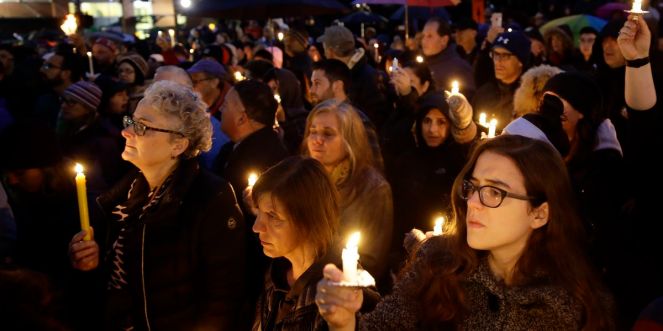
Tonight, at Manchester Liberal Jewish Community, I won’t speak much, in order to give everyone a chance to express their sadnesses, fears and hopes. The Jewish community is still reeling from shock at the shooting at Eitz Chayyim synagogue in Pittsburgh. I know I am not alone in fearing the rise of fascists in Brazil, Italy and Hungary. People will need to name their fears and have them heard. But I will say a few words before we daven to set the tone. I share them here.

I have a secret love, perhaps unbecoming of a Liberal Jew. I love Chassidic house music. Shwekey, Nachas, Beri Weber… I love the upbeat, pop-py, happy tunes with Jewish liturgical slogans chanted over them.

A couple of months ago, a housemate came in to find me singing along to it as I cleaned the kitchen. I spritzed the table and mopped it up, chanting “Hashem melech! Hashem malach! Hashem yimloch le’olam va’ed!” The song’s lyrics mean “God reigns, God has reigned, and God will reign forever.”

My housemate, who had grown up in Habonim Dror, a secular socialist Jewish youth movement, was horrified. “How can you say that? You of all people?”

I reflected on his question. Of all the Chassidic house music I’ve sung along to, this seemed the least offensive lyrics I could think of. These were words that we say regularly in prayer.

I think the problem is that we have different views about what God is. What he thought I was singing for was theocratic tyranny. If I imagined that God was that bearded, judgemental man in the sky, I would do everything possible to stop Him from reigning anywhere. Indeed, we have all seen what happens when religious people that do believe such things take power.

For me, God is not that judgemental man, but the force of love and justice that gives morality meaning. God is an indescribable binding power, an energy of love that hums beneath the chatter of man-made hate.

And yes, I believe that force reigns, has reigned, and will reign forever.

Today, when we see the rise of fascists and we mourn murdered Jews, the underlying force of love and justice is still there, and still has power.

In our darkest moments, when we have witnessed personal tragedies and collective atrocities, the power of morality still reigned. Our lives still possessed a deeper meaning.

And God – our God – the God of love – will outlive every antisemite, every president, every nation, every empire. No matter how dark things seem, I know that God will reign forever.

Let us pray.

candlelit vigil


judaism · sermon · theology · torah

Go for yourself

Trying to get by with biblical Hebrew with modern Hebrew speakers is difficult. Among a group in Jerusalem this summer, I tried to coax out a dog, saying “Lech lecha, celev.” The Israelis around me burst out laughing. “What? What did I say?” I asked. “Nothing,” they said. “It doesn’t mean anything.”

I had just repeated the first words of our parashah, when God instructs Abraham to get out of Haran and go to Canaan. Without context, the expression was bizarre. Phrases that were once meaningful in this language can lose their sense. But, for our commentators throughout history, this specific phrase has been perplexing. Without the vowels we might think it is emphatic – a repetition of the same verb, telling Abraham “go, go, get out.” But the Masoretic markings are quite clear. This is not “lech lech” but “lech lecha” – which could be read ‘go to yourself’, or ‘go for yourself’, or ‘go as yourself’… It is a strange construction.

Ramban suggests that it’s just an idiom of biblical Hebrew. He points to other examples in Jeremiah and Deuteronomy where similar constructions are used. But that answer feels disappointing. Why this idiom? And why here? Every idiom has a purpose, even if that purpose isn’t even entirely clear to the native speaker.

The answer I like best comes from Rashi. Rashi says “go for your own benefit, for your own advantage”. This puts the rest of the sentence into context: “and all the families of the earth shall be blessed through you.” Don’t go for their sake. Go for your own sake. But when you go for your own sake, when you go knowing that you are seeking out a blessing for yourself, then everyone will receive that blessing too.

It calls to mind the distinction between charity and solidarity. That idea was summarised by Lilla Watson, an Australian indigenous rights activist, in her address to the UN Women’s Conference in Nairobi in 1985: “If you have come here to help me you are wasting your time, but if you have come because your liberation is bound up with mine, then let us work together.” Watson herself has challenged the attribution, saying that it was thinking that had come out of collective work by indigenous women in Queensland over a long period of time.

Indeed, differentiating between charity and solidarity has long been a feature of thought for oppressed peoples. Charity, seeking to help people for their own sake without any regard for your own, is surely a noble feeling. But it leaves the person who gives it feeling better than the one who receives it. For the one who gives it, it leaves them feeling helpful, assuages their conscience, and contributes to a sense that they are doing the right thing. For the recipient, it can leave them feeling powerless, pitied, supported, and not treated as a full human being.

Charity is ultimately, too, not that helpful to the one giving it. It turns human interaction into a form of sacrifice, based on guilt, self-effacement and pity. It forces people to ignore their own lived realities and struggles, and put themselves at a position of distance from others.

While charity can address material needs in a positive way, it reminds everyone of the power relations that caused the need for charity in the first place. It reminds the donor of their power and the receiver of their lack. It can even reinforce those structures, as the impoverished turn to the donors as a source of wealth rather than looking to their own talents. The donor can impose restrictions on how the money is used or on how the receiver might conduct themselves in ways that ultimately secure the authority of the donor.

Solidarity asks us to “lech lecha” – to go for ourselves, to go as ourselves. It asks us to come to problems as full people with our own issues and concerns that we need to address. It asks us to treat everybody as if they, too, are going for themselves: full human beings who have a great deal in common with us and their own unique purposes.

Solidarity requires both parties to feel vulnerable together. It asks that the person motivated to give charity considers their own interests and what stake they have in changing the current circumstances. It also asks both parties to work together: they have a common interest and need to empower each other. Solidarity places people’s self-respect and cooperation at the centre of organising change.

Rambam picks up this theme in his eight levels of ‘tzedaka’. The word ‘tzedaka’ is often translated as ‘charity’, but it shares a common root with the word for ‘justice’. The concepts of charity and solidarity are held together by this same word, so Rambam needed to spell out the differences between different forms of giving. Like the indigenous activists of Australia, Rambam puts solidarity on a much higher level than charity. He considers “empowering others with meaningful employment” to be the highest level of tzedaka. Unlike giving into the hands of the poor, empowerment such as this ensures that everyone’s dignity is preserved, and everyone benefits from the work.

So it is that G-d says to Abraham: “Go for your own sake and all the families of the earth will be blessed through you.” When you go out considering your own self-respect first and foremost, it follows that everyone else can act from theirs. Abraham does not go out to save the world. He goes out to save himself. But by being prepared to take risks for his own soul, he sets an example and sets the wheels in motion that everybody can seek out G-d’s blessing.

That is how the nations became blessed through Abraham. As we approach the challenges of our day, we should seek to ask the same questions as he was forced to. What do I really need? What does G-d require of me? How can I see others as full human beings and respond to their needs? How can I go for myself, so as to be a blessing for others?

Go for yourself, and all the nations of the world will be blessed through you.

white horseman nahum gutman

I gave this sermon on the morning of Thursday 18th October at Leo Baeck College for Parashat Lech Lecha. 

judaism · sermon · social justice

End the hostile environment

“My mum has been deported.”

“I want to stay in this country after I finish studying, but the government won’t let me.”

“If they send my wife back, I don’t know what will happen to our children.”

These are all sentences I have heard in the last few months. Some from Jews. Some from non-Jews. All from people I never imagined would have to go through such trauma.

At first, these stories felt like anomalous tragedies. Now, I have begun to hear so many stories of visa and migration problems that I can’t dismiss them as individual instances. A government policy is underway, and it scares me.

In 2012, in a speech to the Conservative Party conference, then-Home Secretary Theresa May promised “a really hostile environment for illegal immigrants.” The following year, she sent out a fleet of vans around the suburbs of London, directing illegal immigrants to “Go home or face arrest.”

As prime minister, May has strengthened and extended that ‘hostile environment’ policy. Commonwealth citizens, students, people on marriage visas, immigrants who have been here for over 50 years – all have felt the blunt force of the UK’s strict border policy. There are, inevitably, fears that this will soon come to affect EU nationals.

Perhaps I should not be so alarmed. The UK’s strict controls over immigrations are over a century old. In 1905, Parliament first passed a law placing restrictions on who could come into the country, dubbed ‘the Aliens Act’, whose express intention was to stop migration of Jews from eastern Europe. The parliamentary debate called Jewish immigrants “dirty, destitute, diseased, verminous and criminal.”

For as long as I have been alive, successive governments have promised to get tough on immigration. Tony Blair boasted about doubling immigration officers, increasing raids, clamping down on migration and turning away asylum seekers. Gordon Brown famously pledged “British jobs for British workers.” David Cameron called the refugees at Calais “a bunch of migrants.” During Ed Miliband’s election campaign, he brandished red mugs with his top five election promise: “Controls on immigration.”

Until recently, however, the UK’s hostility to immigrants had felt like low background noise. It was like the buzz of a dodgy lightbulb in a house I’d always lived in, humming away almost imperceptibly. Now, that noise has become a din. It has gone from being an irritant to a major problem, affecting people I care about deeply. And I am scared.

Beyond the fear I feel for those who are affected by this, what worries me most is the attitude that is seeping into our society. Underpinning all this anti-immigrant action is a pernicious culture. Fear of difference. Hatred of others. Desire for homogeneity. A striving for monoculture. A reactionary and regressive drive to return to a mythical, ethnically-pure past.

Our Torah portion has much to say on this issue. In the beginning, Genesis tells us, the whole world was of one language and of one speech.[1] The people gathered together in fear: “let us make for ourselves a name, lest we be scattered abroad upon the face of the earth.”[2] A homogenous, fearing society, they decide to build a tower reaching up to Heaven to challenge even God.[3] Out of this culture emerged an attitude where human life no longer mattered. Pregnant women were forced to do hard labour.[4] If a person fell and died they paid no attention, but if a brick fell they sat and wept, saying, ‘Woe upon us! Where will we get another to replace it?’[5]

In response, God recognises that there is only one solution: “let us go down, and confuse their language, so that they may not understand each other.”[6] When the people no longer understood each other, they could no longer exploit each other. They gave up their meaningless work.[7] The antidote to tyranny is diversity.

While Babel may initially have seemed like a curse, it became a blessing. The bedrock of our civilisation is its diversity. Because of the scattered peoples of the earth and its variant languages, we have been given many gifts. We have the Diaspora. We have a world full of incredible cultures. We have Jews spread out across the world, spreading our vision of ethical monotheism. We have the joy of learning to communicate across all these barriers. What diversity of peoples means is that nobody can exploit another without first learning to understand them. We have to really speak to each other. And, when we do, we find in each other that great spark of divinity that guards us against oppression.

What is happening in Britain today feels like Babel in reverse. All my life, I have known this island as one teeming with diversity. I have come to meet people from every different language, religion and background. It has not been perfect. It has not been easy. But the fact that it isn’t easy is what makes it so wonderful. We learn from each other and try to understand each other. We all muck in together to build a country that works for everyone.

In this ‘hostile environment’, people are turning to each other in fear. The undertones of oppression and exploitation are becoming explicit. We are building our own tower: a monolith that refuses human compassion. It should be a source of concern to all of us.

Solutions are not forthcoming from the political parties. The Conservatives are dead set on their agenda. During their recent party conference, Diane Abbott told delegates: “Real border security – to stop drug traffickers, sex traffickers, gangsters and terrorists – that is what Labour stands for.” What made Abbott’s speech most disappointing was that, up until this point, she had been one of very few politicians to resist such rhetoric. It seems our politicians genuinely believe that the public are committed to their programme of fortifying the borders.

We must challenge their narrative. It is not too late to turn back. Babel granted us the gift of communication. I cannot be alone in having heard so many stories of problems with migration and borders. We need to tell each other those stories. We need to share our own family histories. We need to discuss our anxieties about what kind of country can be created out of fear.

We can challenge that fear with the greatest tool we have at our disposal: love. Babel created strangers and gave us the opportunity to love them. It turned us into strangers. Our Torah teaches us that we know the heart of the stranger. Not the pain or the suffering or the struggle. But the beating, loving, creative heart of somebody who has to move from one country to another and strives to make the best of it. With love, we can defeat fear. With hope, we can end this hostile environment.

Immigration Van

This sermon was published in Leo Baeck College’s weekly newsletter and delivered at Sheffield Reform Congregation on 14th October 2018. Afterwards, many of us did discuss our own family’s migration histories.

[1] Genesis 11:1

[2] Genesis 11:4

[3] BT Sanhedrin 109a

[4] Baruch 3:5

[5] Pirke de Rabbi Eliezer 24:7

[6] Genesis 11:7

[7] Sefer haYashar 12b

judaism · sermon · torah

Adam, Eve, and binary gender

The story of creation is probably the most well-known and most misunderstood of our Torah. Full of powerful imagery, t he Talmud says that it is forbidden to study the text alone because it is too easy to misunderstand.[1] Because it is so close to the High Holy Days, many Jews miss this reading in our liturgical cycle, having been exhausted by the great process of Rosh Hashanah, Yom Kippur, Sukkot and Simchat Torah, all festivals crammed together into a very short period of time.

The danger of Jews not hearing these texts and of religious leaders not teaching them is that people go away believing that the version we pick up from our surrounding culture is the only version of events. The story of Adam and Eve, in particular, has such currency in that all of us have likely imbibed a version of their story. We have seen paintings in art galleries of European-looking men and women covered with fig leaves. We have heard the stories told in different ways through popular culture.

The story we are accustomed to is one of binary gender. God made a man on the seventh day of creation. God then made the first woman out of Adam’s rib. They are a model of the natural male-female binary in the world and an example of the heterosexual monogamy God has intended for all of us. I am not going to question whether that is a legitimate or authentic tradition. None of us can say we speak with divine authority, so we have to be able to live with different and contradictory interpretations. What I do want to do is offer up an alternative version of the story of Adam and Eve: a Jewish, rabbinic, midrashic version of the story.

I’m sure it goes without saying that, in the progressive Jewish tradition, these stories are considered metaphors. The question is, however, metaphors for what? The stories we tell are important. If we tell stories, even metaphorical ones, of gender as fundamentally binary, and the natural order as fundamentally patriarchal, then we give credence to that worldview. We betray our feminist values and exclude our congregants who don’t fit into that binary. The rabbinic version of the Bereishit story does not only go against the grain of that perspective, but fundamentally overturns it.

First of all, it is not clear from our story that Adam was the first man. The word “adam”, as it is used in Genesis 1, acts as a noun, not a name. It speaks about a person, a human being. The word shares a root with “adamah”, meaning earth or clay. Adam, therefore, might best be translated as “earthling”.

Nor is it clear that Eve was the first woman, or that she was created from Adam’s rib. The biblical telling of her creation is somewhat inconsistent. In the first version of the story, in Genesis 1, a man and a woman are created at the same time. In the second version, in Genesis 2, Eve is created from Adam’s rib. The rabbis picked up on this strange disjunction. They also noticed that in the second version, when Adam meets Eve, he says “this one at last is the bone of my bones and the flesh of my flesh.” That word “at last”, in the Hebrew is “pa’am”[2], which could mean “this time around.” Our sages inferred therefore that the two stories tell of different relationships: the first of one between equals; the second of one with a dominant man and subordinate woman.

So, first, what was this relationship between equals? The rabbis suggest that man and woman were not just made at the same time. They were, in fact, the same person. The original human being, according to their midrash, had one body, two sets of genitalia and two faces.[3] Professor of Talmud, Daniel Boyarin, calls this person “the primordial androgyne.” Rather than binary gender being the model of original humanity, the first person is intersex.[4]

What then happened to this original intersex person? According to another midrash, they were split into two: Adam and Lilith. Notice that Lilith is not cut from Adam but that both are cut from each other: our original progenitors are equals.

The Ballad of Ben Sira, a medieval religious text that combines previous mythical traditions, tells the story this way:

“When the first man, Adam, saw that he was alone, God made for him a woman like himself, from the earth. God called her name Lilith, and brought her to Adam. They immediately began to quarrel. Adam said: “You lie beneath me.” And Lilith said: “You lie beneath me! We are both equal, for both of us are from the earth.” And they would not listen to one another.As soon as Lilith saw this, she uttered the Divine name and flew up into the air and fled.”[5]

What follows is a high-speed chase across the world involving angels and monsters. Ultimately, Lilith fights against Adam, the patriarchy and even God to become liberated. Undeniably, some tellings of this story are misogynistic, painting Lilith as a demon and a baby-killer, but the fact remains that a crucial part of the Jewish tradition is the story of an empowered woman who refuses to be subordinated. Our model of gendered relationships is a complicated mess of power struggles and queer subversion. It is, really, much closer to the relationships people really have.

The rabbinic tradition on creation tells us stories about intersex people, gender confusion, and resistance to patriarchy. Right now, the telling of those stories matters greatly. The government is debating an update to the Gender Recognition Act. When it was first passed in 2004, this act was a great sign of progress. It enabled trans people to legally change their gender on some certificates. As it stands, however, that process is highly medicalised and expensive. The new legislation would enable trans people to ensure that their gender is reflected on their birth certificates without having to jump through great hoops.[6]

This might seem like simply a bureaucratic change, but it has invoked great ire across the political spectrum. Underpinning much of the backlash is the idea that gender is both binary and innate. For the ideological opponents of the upgrade to the Gender Recognition Act, a gender cannot be changed. Much of their discourse has been quite hateful and aggressive. Transphobic abuse has become exceptionally loud, especially online.

What we can say in response to this is: in our religious tradition, binary gender is deeply disputed. In rabbinic Judaism, the first person was intersex, and transitioned from being one intersex person into two people: men and women. In our religious tradition, gender is complicated and malleable. Perhaps, armed with Jewish understandings of human nature, we may be able to push back against some of this hate.

Shabbat shalom.

androgyne-56a55f455f9b58b7d0dc900a

I gave this sermon on Saturday 6th October at Manchester Liberal Jewish Community. A congregant helped correct some of my understanding of the GRA. If you would like to speak out in support of the GRA, you can respond to the consultation using Stonewall’s resources.

[1] Hagigah 11b

[2] Gen 2:23

[3] Leviticus Rabbah on Genesis 2

[4] Daniel Boyarin, Carnal Israel

[5] https://www.myjewishlearning.com/article/lilith-lady-flying-in-darkness/

[6] https://lgbt.foundation/gra