One of the loveliest parts of synagogue life, which many of you will have experienced here, is getting to teach our religion to visiting schools. It’s such a joy to pull out things we normally leave aside, and point to things we often take for granted.
By teaching others about our ritual objects, things that are familiar become foreign. We have to reconsider what they are, and why we have them.
Take, for example, the tallit. Of course, these prayer shawls have existed in some form since biblical times. But, showing them to non-Jewish children, we need to come up with an explanation for why we continue to use them here and now.
I tell the school kids: these four corners remind me that God is everywhere, and the knots on them tell me all of the good deeds I can do in my life.
I do, indeed, feel that way when I wrap myself in the tzitzit. I feel enveloped by God’s mantle. I see the strings and think of all the mitzvot- not, in the Orthodox sense of listing out food rules, but of all that God has asked me to do in this world.
It’s nice to have a visible reminder of God’s presence.
That’s just what Jacob gets in this week’s Torah portion. Jacob lies down while travelling on a certain mountain and has the profound dream of a ladder ascending to heaven, with angels going up and down.
In his dream, the Eternal One appears to promise Jacob many descendants, spreading out like dust across the desert, and that God will forever accompany Jacob on his travels.
When he awakes, Jacob exclaims: “Wow, God is in this place and I did not know it!”
How could Jacob not realise that God was on that mountain? Surely he already knows that God is everywhere?
Perhaps Jacob did not realise already that God is everywhere. For some commentators, this is the beginning of Jacob’s prophecy. Only now does he really understand who God is and that this God is with him.
There is a deeper meaning in the language, too. Before the revelation, God is called Elohim. For the ancients, Elohim was universal- the God that permeates all places and things.
Then, in the dream, God is announced by the ineffable Name, Hashem, which we often render as Adonai. This name of God, in Torah, is specific. It is the personal God, who communicates directly with human beings.
When Jacob awakes, he says: “Behold, Hashem is in this place, and I did not know it.”
Jacob knew that God in general was there, because God is generally everywhere, but only at this moment does Jacob realise that the personal God who cares about him is also present.
Now we can understand why God says to Jacob: “I will not leave you until I have done with you what I promised.” God is helping Jacob understand that he is never truly alone. Not only is the world full of God, but so is Jacob’s own life.
In fact, in the moment before Jacob falls asleep, a miracle happens that is so subtle it can’t be noticed until after he wakes up.
When Jacob lays down his head, the Torah says there are many stones in the place, and he takes one of them as a pillow. When he wakes up, there is only one under his head.
Our Talmud says that this is a divine act. According to Rabbi Yitzḥak, all the stones on the mountain argued with each other about who would lie under Jacob’s head. Unable to decide, they merged together into a single rock. That rock, in turn, became an altar to God.
This is a wonderful view of the world, where God is not only in all places and with human beings personally, but acts in every part of nature. Even stones are agents of miracles and servants of God.
If we take seriously this idea that God is everywhere and personally connected with all that exists, there are real consequences for our lives. It means that everything is sacred. It suggests that we need to treat this world as an arena for revealing divinity.
For Progressive Jews, this is one way we might think of commandments. Rather than just a list of dos and don’ts, they’re an attitude towards reality. They see everything as an opportunity to do good, and to make the world better. We are blessed with the chance to show how God is everywhere, including in our own actions.
The same section of the Talmud says that this is why God loves humanity so much. Angels can only praise God when they are told to. Rocks can only move by miracle. But we, endowed with freedom and reason, can perform miracles and make things sacred whenever we want.
That’s what I see when I look at the tzitzit of my tallit. That God is in every place and that every moment is a chance to do right.
You don’t need to wear a tallit to do that. This is my suggestion to you for this week. Try and shift, ever so slightly, how you see the world.
Look around, for a moment, and imagine that everything permeates God’s presence. See God in the bricks of your home and the slabs of the street. At some point this week, try to picture the space where you are as a massive canvas that you can paint with good deeds.
Let us all try to be like Jacob and say: “Wow, God was here, and I did not even know it.”
Today, you get a million pounds. But the catch is, tomorrow you die.
Any takers?
I didn’t think so.
You value living more than you value money.
In fact, when you put death into the equation, you realise how much living matters to you. It matters more than any amount of wealth or status you could accrue.
Knowing we will die helps us understand what we value from life.
In many ways, Yom Kippur is a death rehearsal.
We act out today as if these were the last moments we would be alive.
Like the dying, we refrain from food and water.
We turn up in modest clothes, without jewellery. Some wear white, the colour of the funeral shroud. Some wear kittels, the gowns in which we will be buried. Some wear tallits all day, from evening to evening – a unique point in the year when we do so – just as the dead are traditionally buried wearing their tallits.
Over the course of this fast, we repeatedly recite vidui, the prayer of deathbed confession. We say psalms and chant petitions that are associated with death and funerals.
All of this serves as a ritual memento mori: a reminder that we will die.
Then, as we approach the end, we erupt into songs. We joyfully recite the neilah prayers. For many of us, there is a great rush of relief and joy as we realise we have made it through this marathon day.
Yes, today is a reminder of our death, and it is one that affirms life.
On this day, our Torah instructs us: “choose life.” Only by recognising that death is inevitable can we do so.
By really considering the finite amount of time we have on this earth, we are able to celebrate the days we have and live them to the fullest.
So much of modern Western society shies away from death.
For previous generations, death was a sacred process undertaken among family and community.
Today, it is sanitised: dealt with in hospitals and hospices by qualified experts.
There are great advantages to this. The professionalisation of death means that the sick can receive high quality care and pain relief right up to the last moments of their life. It takes a great deal of pressure off of family and friends, because the care for the dying does indeed require constant work.
But one downside to our compartmentalisation of death is that it means it is kept out of sight and taboo.
When we do have to face death, it is often a shock, and can cause great trauma to living loved ones. Intellectually, all of us know we are mortal, but facing death as a lived and embodied experience can feel like a real rupture.
Having the Yom Kippur experience – which draws our attention to our mortality and makes us reflect on the quality of our lives – can be a powerful way to help us face death. In these rituals and fasts, we can prepare for our mortality.
This real confrontation with death isn’t morbid. It’s a direction to truly embrace life.
Knowing we will die helps us consider what we want to do with life.
In Progressive Judaism, we have a tendency to downplay some of the more explicit symbolism of death and mortality in our services. It is there in the machzor – in our silent confessions, themed readings, and traditional prayers. But our services often tiptoe over death’s undercurrents in the prayers.
This year, I have tried to reintroduce some of those themes to the service.
Last night, at Kol Nidrei, we joined the rest of the Jewish world in holding the scrolls out of the ark, leaving it bare. The great American Reform liturgist, Rabbi Larry Hoffman, points out that the open ark is supposed to evoke a coffin. We stare into the empty space, which usually includes our Book of Life, and lay witness to our own tomb.
This morning, during shacharit prayers, we reintroduced the prayer “who by fire,” a traditional part of Unetaneh Tokef, which recounts the many ways in which a person might die. It is painful to consider life’s fragility, and all the vulnerabilities we face in life.
But, by facing up to the possibility we will die, we get better at deciding how we will live.
We realise that we value life, and we take stock of what it is we love about it.
Marie de Hennezel is a French therapist focused on end-of-life care. In the early 90s, she was among the first staffers at a palliative care unit for people dying of HIV/AIDS. At this time, there was no cure – the deaths of HIV patients often involved rapid deterioration and great suffering.
In 1995, de Hennezel wrote up her experiences of accompanying the dying into a memoir, entitled Intimate Death: How the Dying Teach Us to Live. The book even carried a foreword by French president Francois Mitterand.
She recounts stories of individual patients, as well as their carers, doctors, and nurses. In each vignette, she tenderly lays out how important it is to be with the dying.
From her support, the patients often learn to live through challenging ordeals. Those who feel like giving up or who contemplate suicide decide that they will indeed live until their last moments on earth. By helping them face their death, the patients gain the strength to embrace their life.
This work, it seems, also transforms the carer. De Hennezel writes that she has learnt so much about living from the dying.
She writes poignantly:
Life has taught me three things: The first is that I cannot escape my own death or the deaths of the people I love.
The second is that no human being can be reduced to what we see, or what we think we see. Any person is infinitely larger and deeper than our narrow judgments can discern.
And third: one can never be considered to have uttered the final word on anything, is always developing, always has the power of self-fulfilment, and a capacity through all the crises and trials of life.
Let us take this as our message from Yom Kippur today.
Our lives are not over. We can affirm them. We can do so much with them.
And, though we do not always realise it, we love our lives more than any amount of wealth or status.
By facing up to the fact that we will die, we can live the days we have to the fullest.
Gmar chatimah tovah – may you be inscribed in the Book of Life for good.
It is time to tell a different story about ourselves.
We are writing a story about our lives right now.
On Rosh Hashanah, our story is written. On Yom Kippur, the story is sealed.
What, then, are we doing today?
This morning, we are editing. We are looking over our story and choosing what to keep and what to discard. What to highlight and what to relegate to the footnotes.
Of course, we cannot change the events of our past, but we can decide what they mean. In writing our story today, we choose what role we played in the narrative of our own lives.
When you tell this story, are you a victim, or a villain? A saviour or a sinner?
Look at your mistakes. The way you tell your story will help you decide whether they were a defining part of your personality, or whether they were opportunities you took to learn and grow.
Look at your suffering. Others have hurt you. You need to tell your own story of what that pain means. You need to decide if your suffering is the sum of your life, or if it is something you overcome.
You are writing the story of your life right now. Be careful how you tell it.
In our Mishnah, Rabbi Yehudah HaNasi teaches: “Apply your mind to three things and you will not come into the clutches of sin: Know that there is above you: an eye that sees, an ear that hears, and all your deeds are written in a book.”
But here is what the Mishnah does not tell us:
The eye that sees can see more perspectives than we can.
The ear that listens knows all hearts in ways we do not.
And, most importantly, the book is constantly being edited and re-written.
We are always re-writing the Book of Life with our God, and that means we have the power to shape our story.
We cannot imagine that God’s eyes and ears are anything like ours, or that God writes a book the way we would. The story that an Infinite Being has to tell about you must be incomprehensible from your perspective.
When we tell ourselves our story, we are biased, seeing only our perspective. Our narrative is partial, not knowing what others really feel. Our account is unreliable, because we tell it to fit the character we have already made of ourselves.
God, on the other hand, sees not just what we did, but what we hoped to do. God says to the prophet Samuel: “I do not see as human beings see; human beings see only what is visible, but I see into the heart.”
God instructs the Prophet Isaiah: “Whenever anyone turns back to Me for pardon, I freely forgive, for as the heavens are high above the earth, so are My ways high above your ways, and My plans above your plans.”
God is able to see errors in ways we cannot. And God can understand our pain in a context that is beyond us.
This is because God is telling a different story about you to your own.
In God’s plan, you are the main character. Of course, so is everyone else.
But that is because God has written a great novel where every creature has a vital role to play. No character could be introduced if they did not have a role in the great unfolding tale that progresses towards goodness’s triumph over evil.
So, today, look at the manuscript of your life. Decide what you want to focus on. Tell yourself stories of gratitude and joy. Consider the events that have given you pride and a sense of accomplishment.
Look, too, at the stories in your life that are hard. Re-tell the stories of where you have been hurt, and decide for yourself what meaning you take from them.
Re-examine the stories of when you have hurt others, and decide what changes these will bring for you when you enter your next chapter.
In this way, you can take control over the story of your life.
You cannot change what happened, but you can decide what it means.
Only you can decide how your story ends.
Treat God as your co-editor, rather than as the author of your destiny.
For some of you, the story I have told so far is too wrapped up in religious language. You cannot get on board with all this God-talk, and the quotations from Scripture prove nothing.
Let us turn, then, to the science of psychology.
Over many decades, psychologists have experimented with what makes for a good life. We now have more data than ever about how people forgive. We understand a great deal more about how to overcome trauma. And we know what motivates people to live better lives.
I am going to assume that, if you are here on Yom Kippur, you came because you want to let go of some past hurt, to repent of things you have done wrong, and to live a more fulfilling life.
The Scriptures tell us how to do this, but the language they use may feel too alien to the modern mind. The sciences, however, can corroborate the same claims.
Dr Fred Luskin runs the Stamford University forgiveness project. His team has researched the best methods to help people overcome their grudges and live more fulfilling lives.
He has tried out his techniques for helping hundreds of people forgive, including in the most extreme cases, like mothers whose children were killed in sectarian violence.
His book, Forgive for Good, is an accessible version of his research.
Dr Luskin teaches that our inability to forgive comes when we tell ourselves a “grievance narrative.”
You may have such a story yourself. If you keep coming back to an event in your life where you were wronged and replaying it, you may be stuck on recalling a past hurt. If, in this story, there is a clear villain, and you are a helpless victim, the chances are you have a grievance narrative.
Don’t worry, you’re not alone. Many people do.
I began reading Dr Luskin’s book out of academic curiosity, but soon found I was noticing my own grievance narratives. Some of them went right back to old hurts in school. I looked over some of the stories I had about my own life, and found they did not serve me.
Dr Luskin says that the key to getting out of the trap of these painful stories is to consider how you tell them.
First of all, decide how much space in your mind you want this story to occupy. Yes, you have been hurt, but do you want to keep letting those same people hurt you by giving them unlimited air play in your head?
One way forward is just to change how much you think about them. Rather than letting them be the main character in your story, focus your internal account on your own successes and joys.
Secondly, consider how you are telling your story. If you have a grievance narrative, the hurt you experienced may determine everything that comes after.
You were wronged, and that may have a lasting impact. But is it not also true that you survived, overcame, and learnt from the experience? You have the power to tell the story so that you are not a victim, but a hero.
None of this means pretending that pain doesn’t hurt, or that the wrongs others did were not wrong. Quite on the contrary: in order to move on with anything, you have to be able to say how wrong it was, and what it made you feel.
The difference is that you get to decide what it means. You can decide whether someone else has written your story for you, or whether you are your own author. You can choose to focus your attention on your own pride and resilience.
Just as our faith tells you to pay attention to how you tell your story, so, too, do the psychologists. The story you tell can help shape how able you are to move on from past pain and be a better person.
This is true, not just on the individual level, but also at the collective level. The stories we tell about Jews are the stories we tell about ourselves. What is the story we tell about ourselves as Jews?
There are plenty of stories out there about us. There are stories where we are perfect victims, forever blameless for the suffering we endured. There are stories where we are bloodthirsty brutes, responsible for the worst evils in the world.
Both of these stories deny us agency. These stories turn us into history’s stock character, whether as martyr or as monster. They deny Jews the ability to do what everyone else does: to hurt others, to learn from our mistakes, and to become better people. They strip us of the opportunity to grow and change.
We need, therefore, to think hard about what the narrative is that we are writing about Jews.
Rabbi Dr Tirzah Firestone sits at the intersection of spirituality and psychiatry. Firestone began her career as a psychoanalyst, then came back to the religion of her birth, embraced Renewal Judaism, and became one of its leading rabbis.
Firestone grew up with Holocaust-surviving parents. She felt that she and her siblings inherited great trauma from her family, and from the stories they told. Or rather, did not tell. Much of their former life escaping genocide was clouded by secrecy. The stories her father did tell were of persecution: that the non-Jews inherently hated Jews and would destroy them at every opportunity.
As a therapist and rabbi, Firestone urgently felt the need to tell different stories about Jews. She insists: “Identifying ourselves as victims freezes our focus on the past, and therefore forecloses our future.”
This does not mean pretending that Jews have never been victims. We need to face up to the traumas of Jewish history, including Shoah, pogroms, and persecution. Ignoring them, and refusing to tell the stories, can actually exacerbate the transmission of trauma.
What we need to do, says Rabbi Firestone, is honour Jewish history without internalising the harmful aspects of Jewish trauma.
We need to remember that, as Jews, we have collective power. We are able to influence the world, and not just subject to the vicissitudes of history. We must claim our agency, and take ownership over what happens to our future.
Most importantly, says Firestone, we should draw connections with others suffering from persecuting systems. By making these links, we strengthen ourselves, support our neighbours, and find positive meaning out of difficult circumstances.
We must, therefore, tell a new story about Jews. A story where we are survivors, who have been hurt and used creativity and resilience to overcome our pain. A story where we are complete human beings, who can hurt others, and who can repent and change. A story where our story connects to all of humanity for the sake of a shared future.
The story we are writing does not have to be one where we are always victims, nor incomparable monsters. We can create a narrative that acknowledges our past, honours it, and uses it to direct us towards a more positive future.
On Rosh Hashanah, our story is written. On Yom Kippur, the story is sealed.
We are writing a story about our lives right now.
Today, with the help of God and this sacred time, write your story.
Write a story you can be proud of. Write a story where you have the power to do better. Write a story where you overcome your challenges.
The events of your life so far have already been written. What they mean is up to you.
Gmar chatimah tovah – may you be written in the Book of Life for good.
Rosh Hashanah is a moment when all judgement is suspended. The scales are suspended, and the weights could fall either way.
At this moment, anything can happen. We reflect on how precarious life is, and how delicately all is held together.
In the light of Rosh Hashanah, our own lives come into focus. How fragile is our existence.
The rest of the year, we take for granted this delicate balance that allows us to go on living. Today, we notice how remarkable our lives are, and assess what we are doing with them.
Have we embraced life’s blessings and sought to make the most of our days? Have we multiplied joy and generosity in others? What were the moments we squandered or took for granted?
At Rosh Hashanah, we acknowledge our vulnerability. We listen for God’s voice within us. We hear the messages this day brings. God, in turn, hears us.
Then, we find a way to go on. We affirm our lives.
The stories of Rosh Hashanah point us to moments of precarity. We read of times when life almost did not come about, and of moments when life almost came to an end. Through these ancestral tales, we access our own vulnerability.
Hannah longs for a child to be born to her barren womb. She asks: “why do I exist?” Then, God hears her anguish, and she gives birth to a boy. His name is Samuel, meaning God hears.
Sarah laughs at the thought that she could conceive in old age, then God remembers her, hears her, and she has Isaac.
Isaac is destined to be Abraham’s heir, then Abraham takes him up to Mount Moriah to kill him.
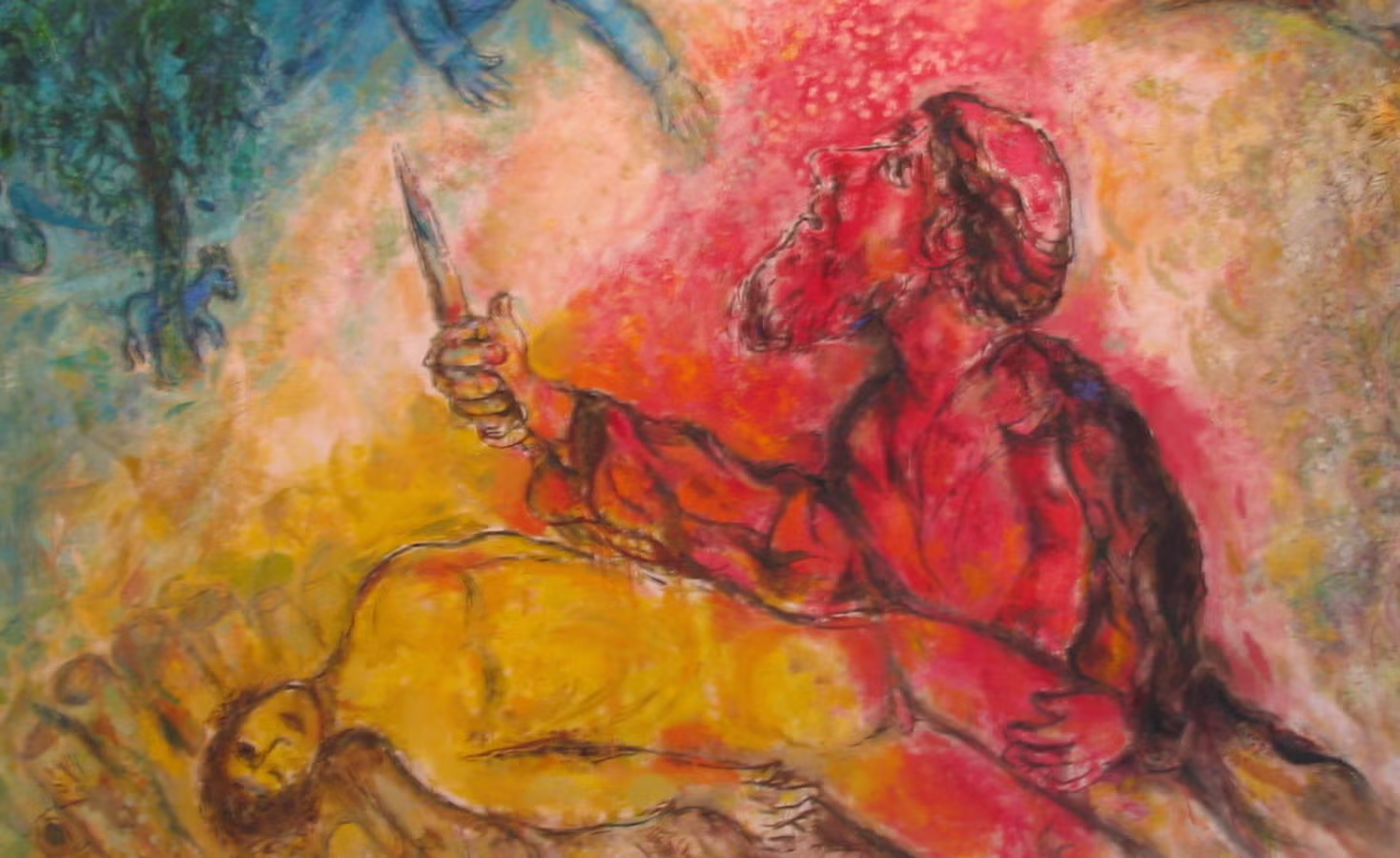
When we picture the Binding of Isaac, we can clearly see Abraham’s raised hand – slaughtering knife outstretched to the sky – ready to murder his own son. We are struck by the moment when all hangs in the balance.
Finally, God speaks, and Isaac is to be killed no more.
In all these vignettes, we find ourselves caught in stories of people whose lives are racked with precarity, but who listen out for God’s voice, take away a message, and find a way to go on that affirms life.
Interwoven with this story of the main characters, our ancestors, is another story, of people living more marginal lives. The story of Hagar and Ishmael speaks even more explicitly to life’s precarity.
In Orthodox communities, where they observe the second day of Rosh Hashanah, the story of Hagar and Ishmael is usually read today. Here, in the Liberal lectionary, wherein we follow the Israelis and hold by one day chag, we are given the option of reading either Isaac’s or Ishmael’s story.
I have opted to read the story of Ishmael because I believe it speaks most clearly to the festival’s theme of life’s uncertainty. Everything about the lives of Hagar and Ishmael is left to the hands of those more powerful than themselves.
Hagar is called a handmaid – a word that glosses over the gross crime inherent in a purchased human being.
A handmaid had no property, no income, and no family to come and redeem her. Most handmaidens were separated from their own kin, and stripped of their original language.
Hagar’s name means “the foreigner.” The Torah calls her “the Egyptian.”
She was beholden to her mistress, Sarah. Hers is the most precarious position one could have in life.
A handmaid cost more than a male servant because the handmaid could produce the most valuable good: more slaves.
Unlike the other women in our readings, Hagar does not long for a child. She expresses no desire; she offers no consent. She is simply used as a vehicle so that Sarah can have a son.
Abraham will take her as a concubine. The child will be Sarah’s property and Abraham’s heir.
This is already a dangerous situation. If she does not give birth, Hagar fails to deliver on the terms of her purchase. If she does have a child, she could become a rival to her mistress.
That is precisely what happens.
Hagar becomes pregnant, and Sarah immediately flies into a jealous rage. Hagar runs away, but has nowhere to go. She can either risk the harsh desert as a single pregnant woman, or she can return to an abusive household.
For Hagar, everything hangs in the balance. Then, God hears her and intervenes. An angel tells her that God knows her suffering, but promises that her life will get better.
She will bear a son. He will be a highwayman, attacking everyone, and attacked by everyone. His name will be Ishmael, meaning “God has heard.”
As with all our protagonists in Rosh Hashanah stories, Hagar finds her life in the balance. She realises how precarious her existence is. Then, she listens for God. Hearing God, she finds a way to move forward.
So, Hagar returns. And her life hangs in the balance once more.
This is where the Rosh Hashanah reading begins.
Here, Sarah sees Ishmael playing and demands of Abraham “cast out that slave and her child, because that son-of-a-slave will not share in the inheritance of my son Isaac.”
Abraham followed Sarah’s words, and sent Hagar out into the desert with nothing more than some bread and a skin of water.
She wandered about in the wilderness of Beersheva until they had completely exhausted her water.
We are told that Hagar sat an arrow-shot away from Ishmael.
This language seems to make us consider Hagar’s own thoughts: in this moment, Hagar thinks: “maybe I could put the boy out of his misery.” But she cannot do it. She cries out “I do not want to see the child die” and bursts into tears.
Then God hears. God hears Ishmael’s voice crying out, and sends forth an angel from Heaven.
Every bit of hope was lost. Everything hung in the balance. But Hagar listened. And God listened. And they heard each other. And Hagar found a way to go on.
The angel says: “כִּי שָׁמַע אֱלֹהִים אֶל קוֹל הַנַּעַר בַּאֲשֶׁר הוּא שָׁם” – “for God has heard the voice of the boy where he is.”
In the Talmud’s treatise on Rosh Hashanah, this is the hook our rabbis use to tell us about our own place before God.
The rabbis say this means that God hears Ishmael in the moment when he cries out.
To God, Ishmael’s past and future actions matter not.
God does not care that Ishmael comes from the lowest and most vulnerable place within Israelite society. God does not care about the prediction that Ishmael will go on to be a highwayman. All that matters is that Ishmael cries out at that moment.
This, says the Talmud, is how we should all see ourselves on Rosh Hashanah. Rabbi Yitzhak declares “every person is only judged according to their deeds at their moment of trial.”
We are only judged by our hearts in this moment of reflection.
We are not our past mistakes, nor our future errors. We are the people that God beholds today. We are the people who chose to turn up, on this Rosh Hashanah, who knew we wanted to engage with our own souls.
That is all that God sees.
This is a part of the Talmud’s more general argument about Rosh Hashanah, that it is a time when everything hangs in the balance.
Our rabbis teach that we should all imagine that the whole world is finely balanced between good and evil, and that it is our responsibility to tip the scales.
Moreover, say the rabbis, our own hearts are precariously weighted, with an even chance of falling to the side of good or evil. In this analysis, then, the fate of the whole world can rest on just how we direct our own hearts.
So, we need to take every opportunity to place a greater load on the scale of good.
The Talmud offers things we can do to make such a change: give to charity, call out in prayer, and change our behaviour. Any one of these actions can cause a shift in that delicate balance.
A small prayer, a slight modification to how we act, a donation to a righteous cause – any of these can transform everything.
We live in a time when all can feel uncertain. Life seems nerve-wracking. At times, it does indeed feel like the balance of all the scales in the world is tilting ever more toward evil.
The Talmud tells us that we still have some control. We can still be a force for good. We can still nudge the fine weightbridge an inch towards goodness.
The Torah gives us examples of people whose own lives hung in the balance. They listened for God, and God listened for them. And God answered “I have heard you where you are.”
So, if you feel like you are hanging in the balance, hang on in there.
In our Scriptures, the changes are often dramatic.
Avram is an idol worshipper who lives in Mesopotamia, then undergoes complete conversion to monotheism and sets out on foot to a new country. With that, he gets a new name: Abraham.
Sarai is barren then, miraculously, in her old age, conceives a son. God gives her a new name: Sarah.
Jacob is a lying trickster who wrestles with an angel in the wilderness. When his heart has truly changed, he gets a new name: Yisrael.
In fact, in each biblical story, a change of direction, outlook, and often name, are the key points of the narrative.
So, what about our Rosh Hashanah reading? Who is it that changes there?
In the Aqeidah, our Torah reading for the new year, Abraham is called upon to climb a mountain and sacrifice his son.
We know nothing about Sarah, who is largely kept out of the story. We don’t know anything of how Isaac feels about this, since he stops talking once he realises what his dad could do to him.
Abraham is remarkably unchanged. At the bottom of the mountain, he is willing to do whatever God says. At the top, God says Abraham is no longer required to sacrifice his son, and to sacrifice the ram instead. At the top of the mountain, Abraham still just does whatever God says.
But there is a character who really changes in this story: God.
God begins the narrative as zealous and demanding of human sacrifice. God ends the story compassionate and eager to enter into meaningful relationships. God begins by effectively threatening to blot out all of Abraham’s children, then ends by promising Abraham as many descendants as stars in the sky.
And, yes, God undergoes a change of name. Through the whole of the story, God is called Elohim, a name associated with strict justice and universal truth. At the very end, God is revealed by a new name – יהוה – Adonai, a name associated with the close personal relationship God has with every human being.
In this story, the character who undergoes the greatest change is God.
Even God, the Creator of the world, the Almighty and All-Powerful, can transform. The Holy One, who by nature is completely eternal, can shift from being strict and distant to close and loving.
So, if even God can change, why can’t you?
In our Talmud, the rabbis introduce us to the idea that we are supposed to imitate God.
Rabbi Hama baRabbi Hanina teaches: be like God. Just as God clothed Adam, you will care for the poor. Just as God visited Abraham when he was unwell, you will visit the sick in your community. Just as God consoled Isaac over the death of his father Abraham, you will comfort the mourners. Just as God buried Moses, you will inter the dead.
God shows us a model of how we ought to live. Like God, we are supposed to be compassionate, loving, kind, morally clear, and doing justice in the world.
But more than that. Like God, we are supposed to change.
Here, at Rosh Hashanah, we learn: just as God can change, so can we.
We are made in God’s image. At the start of each year, we read a story where our Creator transforms. So we know that we can change too.
We can face our fast-shifting world. We can rise to the challenge of our changing community. We can look inside ourselves and love our own souls a little more.
Blessed are You, Eternal One our God, who gives us the power to change.
1. We are living in apocalyptic times. War, climate disaster, and neoliberal capitalism are plunging us into ongoing and worsening crisis. Apocalyptic times call for apocalyptic theologies.
2. When we survey how Jewish people rebuilt their communities in the face of devastation, we see that Jews have stubbornly held onto hope. From the destructions of the Temples, through Crusades and Expulsions, to colonialism and genocide, our greatest leaders have never wallowed in despair. They always reaffirmed their faith in God and humanity.
3. The task of building the Messianic age is more pressing than ever. Like our forebears, we affirm that the Messiah will not be a man, but a time, in which all will understand the Oneness that lies beneath all superficial differences. The Messianic Age will be defined by equality between people, peace between nations, and harmony with nature. Our task is to build it.
4. Because of faith in God, we understand that our desire for a transformed world is sacred and just. With an outstretched arm and wondrous deeds, God liberated the slaves from Egypt. God hears the cries of all who suffer and shares their pain. God continues to defend the dignity of all who are subjugated.
5. In every age, our people have sought to understand the will of God. In their hardship, they communed with their Creator. Out of their struggles, they developed theologies. These are our inheritance: Torah; Prophets; Writings; rabbinic literature; Jewish philosophies. We claim them for our own time.
6. Our texts are central to our worldview. They are incomplete and polyvocal. We will never make idols of them by treating them as unquestionable authorities. Rather, they are our dialogue partners to understand our God, our world, and ourselves. We uphold the tradition of questioning, reconsidering, and retelling. Every answer is open to interrogation.
7. We affirm belief in the pure monotheism to which our ancestors aspired. We seek to connect with God, who is singular and infinite; immaterial and transcendent; eminent and imminent. Our God is nevertheless directly part of our lives. As the source of ultimate truth, God seeks to impart to us truth as we can understand it.
8. Life has meaning. Its meaning is intrinsic. Everything that lives on this earth was placed here deliberately by a loving Creator to serve a purpose. All that affirms life affirms God.
9. Jews are called upon specifically and by name. We feel that the task of healing the world has been entrusted to us, personally and collectively. This is what it means to be chosen. The task of Jews is to speak God’s truth and to fulfill God’s dominion on earth. A world ruled by God will be one in which no human being can subjugate another.
10. God created all people, replete with diversity, deliberately. We do not wish to make others like us. We reject any uniformity. We accept that people inhabit multiple, contradictory, and overlapping spiritual realities.
11. We bring our spiritual reality to life through our rituals. Our laws, practices and customs are all articulations of our moral purpose. Even where they carry no obvious moral instruction, they instill within us discipline, wonder at creation, and hold us together in community.
12. Our ancestors call to us from history. As refugees and outcasts, they knew what it was to live on the margins. Their memories demand vindication.
13. We have witnessed the progress of humanity. Scientists have developed incredible medicines. Engineers have shown how to harness natural resources to power the entire planet. Activists have shown how collective strength can transform history. We believe that it is our duty to sustain that progress.
14. In the hands of oppressors, progress is a dangerous force. Warmongers have found ever more efficient ways to kill. Capitalists have found increasingly profitable ways to exploit. We have seen how human ingenuity can be employed for systemic violence. We must wrest the tools of progress from those who worship the false god of wealth.
15. Nationalism is a sickness that is plaguing the world. We repudiate all xenophobia and chauvinism. We will not worship the false idols of states and their symbols. We reject all efforts to politically divide humanity.
16. Until all of humanity is fully redeemed, we remain in exile. Only when everyone has achieved full political, economic and spiritual freedom can we say we have reached our Jerusalem. The earthly Jerusalem is as much a part of exile as any other city, until the day when it becomes the heartland for peace and brings all humanity into unity with God. As such, we align ourselves with all those who seek to bring about an earthly Jerusalem based on the prophets’ visions of dignity, human rights, and liberation.
17. Individualism is killing us. Human beings have survived by being social creatures. The ideas of autonomy and personal choice do not serve us in this age. We need to resist the atomisation of people and create community, which necessitates sharing norms, ideals, and practices.
18. We see the Jewish family as expansive and interconnected. We are all responsible for one another, and want to live as if we are one family. This includes a commitment to loving rebuke where necessary.
19. We return to halachah. We see it not as the binding decisions of previous generations but as the creative forum of the present, in which we find new ways to live by our shared values.
20. We commit to Jewish time, which is shaped like a snail shell: always progressing, and always returning to the same points. We return constantly to our shabbats, our fasts, and our festivals. Every time we return to them, we learn more of what God requires of us, and we urge ourselves on to the next stage of our development.
21. The end of time is coming. It does not have to be disastrous. It could be wondrous. Our telos is a perfected world. We will never reach it. We will always fight for it.
In the distant past, people made small gods. They carved out wooden statuettes to represent fertility, or hewed rocks into the shapes of animals that would bring them good luck. They made depictions of stars and planets, which would help them in their daily struggles. The ancients looked after the gods – giving them food, drink, rest, and clothes. In return, their little talismans looked after them.
When Abraham was born, he lived among the idol worshippers of Ur. He had no teacher nor guide, but came to understand, through his own reasoning, that God was the only Creator of all things, and that the world was governed by an invisible Force that could not be depicted. The totems people served were not gods at all, and could have no impact on the world.
As a result, he went around smashing up and destroying every idol and household God he could find. He went around telling everyone that the worship of idols was a great lie, and that the One True God would destroy anyone who bowed down to them. He enjoined his followers, the descendants of Abraham, that they, too, must destroy all idols.
This poses a question: what is so bad about idol worship?
If these are just empty vessels, why fear them? If they are not really gods, what harm can they do? Why should idols be so concerning that we must smash them up everywhere we find them?
By the time we get to the end of Moses’s life, here in the Book of Deuteronomy, the aversion to idol worship is even more intense.
At the start of Re’eh, Moses instructs the Israelites to find every idol, tear down the pillars, smash up the altars, cut down their gods, and destroy any memory that these false gods ever lived there.
If a seer comes to you, says Moses, and they say they have had a vision that you should worship idols, you must kill them instantly. You must purge them and their evil words.
If your own brother, sister, mother, father, or friend wants you to worship idols, Moses says, show them no pity. Don’t try to stop anyone from killing them. In fact, make sure it is your own hand that strikes them down.
And if you find out that there is a town where people worship idols, go and kill everyone in it. Bring everyone from the town together and slaughter them. Bring everything from that town into the square and burn it to the ground. Destroy that city in its entirety and never let anybody rebuild it.
This feels like something of an over-reaction.
How can idol worship be so bad that it is worse than murder, worse than cutting off your own kin, worse even than razing a city to the ground? Why should this practice of building little statues be so intimidating that it requires such destruction?
This feels completely out of place with our moral sensibilities. That’s not just a modern thing.
Even in the 13th Century, rabbis were worried about this injunction. Rambam, the great rabbinic decisor who codified all of the Torah’s laws, was also concerned.
Rambam lived among Muslims and Christians in medieval Egypt. He admired and appreciated them. He read the works of the great Greeks who had never known monotheism, like Plato and Aristotle. He found them wise and inspiring. He was deeply opposed to fundamentalism and chauvinism. Rambam, like us, was not really up for burning cities to the ground just because they did not follow our God.
Rambam says: don’t worry. The world for which these laws were written no longer exists. People don’t worship idols any more. Whatever perverse practices the Pagans once did, they are not doing them now.
Even if they did exist, we would not have the authority to burn a city to the ground like that. You would need a Sanhedrin – a court of 71 learned judges who could recite the laws in their entirety – and we have not had one of those for many centuries.
Even if the idol worshippers did still exist, and we did still have a Sanhedrin, the Sanhedrin would necessarily make sure to do everything possible to educate the idolaters away from their ill-conceived practices, help them to repent, and find ways to make sure they can live in the true religion of monotheism.
So, don’t worry, says Rambam, we can forget about all that.
But the trouble is we can’t.
It’s there in the Torah. We read it every year. Rambam still has to go and codify all these bloody edicts, that make such monsters of people who pray to fetishes.
And Rambam does not answer my fundamental question. The people who bow down to wood and stone might be wrong; their beliefs might be misplaced; but what is so bad about giving a drop of wine to a brick?
The most compelling answer I have found comes from a 20th Century psychoanalyst. Erich Fromm was born in Frankfurt, Germany, at the start of the last century. He studied psychiatry and philosophy among the greats of his generation, then moved, in 1934 to America, where he became a leading writer and critic of modern society. Needless to say, he was Jewish.
In 1976, Erich Fromm wrote a landmark book called “To Have or To Be.” This text became the cornerstone of the anti-consumerist movement.
Fromm engaged seriously with our religious texts. He saw them as inspiring people with a serious psychological message about how to live.
The difference between real worship and idolatry, says Fromm, is not what you worship, but how you do it. He calls it the “being mode” and the “having mode”.
The problem with idolatry, says Fromm, is that it makes you think God is something you can own.
Hebrew monotheism is a rejection of the entire enterprise of having a god:
“The God of the Old Testament is, first of all, a negation of idols, of gods whom one can have… The concept of God transcends itself from the very beginning. God must not have a name; no image must be made of God.”
Fromm writes:
“God, originally a symbol for the highest value that we can experience within us, becomes, in the having mode, an idol. In the prophetic concept, an idol is a thing that we ourselves make and project our own powers into, thus impoverishing ourselves. We then submit to our creation and by our submission are in touch with ourselves in an alienated form. While I can have the idol because it is a thing, by my submission to it, it, simultaneously, has me.”
So, for Fromm, idol worship isn’t over at all. In fact, it is a pitfall any of us can stumble into. If you think that faith is something you can have, rather than a way of living, you are guilty of idolatry. Fromm says:
“Faith, in the having mode, is a crutch for those who want to be certain, those who want an answer to life without daring to search for it themselves.”
Fromm goes further. It’s not just about God. It’s about everything. Do you want to be in this world, or do you want to have it? If you think you can have it, you will never be satisfied. But if you can truly be in it, you will find no need to have any desires met. Fromm says:
“The attitude inherent in consumerism is that of swallowing the whole world.”
Fromm even extends his philosophy to how we love. Do not try to have love, he warns, but try to be in love.
“To love is a productive activity. It implies caring for, knowing, responding, affirming, enjoying: the person, the tree, the painting, the idea. It means bringing to life, increasing his/her/its aliveness. It is a process, self-renewing and self-increasing.”
If we take Fromm seriously, we have a whole new way of looking at the world. Inspired by the prophets, everything we do can be about existing and loving and being. We can reject the whole ideology of possessing.
That is what is wrong with idolatry. The artefacts of the Pagans aren’t just wooden blocks. They tell us a way of living. The wrong way of living. They direct us to control and own.
Rambam may be right. The idolaters do not exist in cities any more.
Instead, today, they live in our own minds. And we must burn them down, if we are to be truly free.
“The history of a community, like the history of an individual, is marked by the recurrence of periods of self-consciousness and self-analysis. At such times its members consider their aggregate achievements and failures, and mark the tendencies of their corporation.”
These are the opening words of an essay that gave birth to our Jewish movement.
In 1898, a social worker named Lily Montagu published an essay in the Jewish Quarterly Review, entitled “The Spiritual Possibilities of Judaism Today.”
What this pioneering thinker asked of Jewish London was that it take stock of what it had achieved and what it wished to be. Only by giving an honest and sober account of where we were, could we imagine a better future for our Jewish life.
This is the perfect time to revisit that essay. We are forming a new movement, which will be far bigger and broader than Miss Lily could have anticipated, and may even soon make up the majority of British Jews. Is that not summons enough to the period of introspection Montagu required of us?
But, more than that, when you look at her essay from over 120 years ago, you can see that the issues Montagu wanted to address had much in common with the challenges facing us today.
Montagu was scathing in her perception of Anglo-Jewry. She accused it of “materialism and spiritual lethargy” and charged “that Judaism has been allowed by the timid and the indifferent to lose much of its inspiring force.”
Judaism, she felt, was supposed to be a great and inspiring system that would draw Jews closer to God and motivate its adherents to face the real-world challenges of the day. Instead, it had been captured by a lazy spirit that wanted nothing more than to assimilate, appease the establishment, and provide a lackluster imitation of religious rituals. Does that sound familiar?
Montagu assessed how London’s Jews actually lived. She called them “East End Jews” and “West End Jews,” but was clear that this was not just a geographical phenomenon. She was talking about class, culture, and background.
The “East End Jews” of her day were working class, poor, Ashkenazi immigrants. They were highly observant, but obedient to a fault. They followed along with the old words they already knew, but rarely spent much time thinking about what any of those prayers might mean for their soul. Their main motivation for practising Judaism was a combination of superstition and fear.
“West End Jews,” by contrast, were from higher classes and mixed ethnic backgrounds. They were materialistic, obsessed with status, and only attended synagogue because they thought it was more respectable to be Jewish than to have no religion at all. Yet, she said, by replacing real religion with possessions and status, they ultimately still had a vacuum where religion ought to be.
These types of Jews, as Montagu described them, don’t exist in the same way today as they did then. However much one might nostalgise the factory-working Jews of the Whitechapel shtetl or the days when Jewish aristocrats held drawing room parties in Maida Vale, that world is gone. Economic disparities persist, but far less visibly, and without entire Jewish cultures built around location and class.
She warned that, although the Jews of her age might be economically divided, they still had the same thing in common: their religion was vapid and empty. It was about having an identity rather than having a relationship with God. For both sets of Jews, Montagu argued, Judaism needed a complete spiritual revival.
Apparently, a great number of people agreed with her, because over the years and decades that followed, many came together to form congregations for exactly this purpose. Together, they made the Jewish Religious Union, which then became Liberal Judaism, and is now becoming part of Progressive Judaism.
Our Judaism has, indeed, been reinvigorated. We have opened up new approaches to liturgy, prayer, and worship. Synagogue teams come together to make sure that every Shabbat and festival is meaningful.
Montagu warned a previous generation that they would have to actually live Jewishly, or they would not be Jewish at all. Her prediction has come true, as some generations have just shaken off their roots, while others have decided to commit to Jewish life entirely.
One happy surprise is that, through the Liberals’ embrace of converts, we have Jews who are committed and educated in ways previously unknown in earlier generations. The dedication of converts has also inspired those who might have taken their Jewishness for granted to step up their game, learn more, and embrace their heritage.
Miss Lily did not just advocate for spiritual revival, but wanted to see Jews play a full role in the life of Britain. Full citizenship had only been granted to Jews a few decades previously, and Montagu wanted Jews to rise to the challenge.
Other communal bodies felt that the best thing for Jews to do was toe the establishment line, tell the government how wonderful they were, and hope that they would let us stay in the country without impeding on our religious practices. Our founders wanted us to embrace a more expansive sense of citizenship.
They wanted us to say: we live here, this is our home, and we have the right to change it. They wanted us not to grovel before power, but to make demands of it. They wanted us to ask ourselves “what does God require of our country?” and go about pushing for it.
This wasn’t something that belonged to one political persuasion. The intellectual leader, Montefiore was a capital C Conservative. The first Liberal rabbi, Mattuck, was a socialist who wanted the religious institutions to unite with the unions for revolution.
Montagu herself was a political Liberal. She was a suffragist and social reformer. She believed that the pursuit of peace and human rights were sacred commandments. She dedicated herself to alleviating poverty.
While politically diverse, our founders held in common a conviction that Jews could, in conversation with our God, make demands.
We could change the world. The world, too, could change us, and we should not be afraid of it or hide away in ghettos.
Montagu asserted that the youth were crying out for a Judaism that made moral demands and had something to say to their society. If their elders did not rise to the challenge, the next generation of Jews would vanish away into nothingness.
Montagu knew such Jews because her daily life was taken up as a social worker in London’s youth clubs.
I believe we are facing such a challenge today. Many Jewish young adults are looking at us, including in the movement she founded, and see a Judaism that is reluctant to take stands for fear of rocking the boat. They see a Jewish life where God is, at best, a nice accessory tacked onto a cultural centre. If we look honestly at our own institutions, can we deny their aspersions?
Throughout my twenties, I was one of these disaffected young people, bewildered by why my institutions were so ambivalent on the moral issues of the day, from massive inequality through catastrophic climate change to ongoing Israeli military occupation.
I felt acutely the absence of religious conviction in the establishment and in the institutions. There were pioneering rabbis who led the way on some issues, like gay rights, women’s equality, and refugees, but they were often marginal, and their impact could be felt only dimly in most synagogues. There was a gap.
In terms of our spiritual life, there were peer-led groups that tried to engage in serious prayer and text study, but you’d struggle to find any evidence for their existence in most synagogues.
I do not know how many young Jews fell by the wayside, but I stuck around. I had a strong sense, at least from my peers, that a better Judaism was possible. That we could speak out on social issues and we could have meaningful spirituality. That the Judaism of tomorrow might be more meaningful.
Now, in my thirties, I am a part of the establishment I railed against, and I feel that the issues facing Jewish youth are even worse. The moral and spiritual vacuum has only grown wider, and it looks even harder to fill.
I worry that the demands of our age for renewed spirituality and moral meaning are being quietly subsumed under a banner of “inclusivity.”
Inclusion is a positive and noble goal, but it must be inclusion in something. It must have real substance, if it isn’t just trying to market synagogue membership to the lowest common denominator while offering nothing and standing for nothing.
The challenge facing our movement is, I think, not so much to be broader, but to go deeper. We need to have a deeper relationship with God. We need to ask ourselves searching questions about what God demands of us. We need, as they did over a century ago, a thorough moral and spiritual revival.
In her essay, Montagu warned: “no fresh discovery can be made exactly on the lines of the past; the temperament of one generation differs from that of another.” We cannot apply Montagu’s methods in the same way today.
But we can ask the same questions that she did, and go through a serious process of reflection, as she suggested.
We can look together for new ways of revitalising our spiritual life, and put God at the centre of our synagogue.
We can work together to provide bold answers to the moral questions of our age. We can ask ourselves what God demands of Britain and hold up those prophetic clarions to our leaders.
These are the spiritual possibilities for Judaism today.
That is the spiritual challenge facing our new movement.
If we can rise to it, Progressive Judaism may yet last another century and beyond.
We are days away from Shavuot, the Feast of Weeks, when we celebrate having received the Torah. At this festival, we affirm we have received God’s word and that it is unfailing.
This is what we think we know: these words are not only God’s.
They have human origins, and they were written over many centuries. The Torah is not a single, unaltered revelation. It is a book with a history.
What happened at Mount Sinai matters immensely. It is the foundation of our faith. It is the basis not only of Judaism but of every monotheism that followed it.
The story has been told so many times. Hordes of Hebrews fled from Egypt, gathered around the foot of a desert peak, and heard the voice of the One True God.
What they experienced, they told to their children, and they to theirs, until – after generations – the vision was written down into a collection of stories and laws we call the Torah.
We have to know what really happened at Sinai; so much hinges on this indecipherable point of history.
We have to believe in the real world, where history is something made by human beings, who work, and struggle over resources, and build societies.
We have to believe in the God of Judaism, who is revealed through history.
We must synthesise the two. We cannot split the material and the spiritual. We need to know what the material reality was that lay underneath this spiritual truth. We need to know what happened at Sinai.
We cannot truly know, but we have to try and work it out. A group of human beings felt so inspired that they wrote down ten commandments and passed them on for thousands of generations. Why?
A group of human beings, who surely worked and slept and ate and drank and dreamed, proclaimed that they had seen God.
Something marvellous must have happened at that time. Something awe inspiring – to give us this treasury of ancient wisdom. Who committed these words to paper, what happened to them, and what made these commandments feel so important to them?
What really happened at Mount Sinai? The biblical historian pores over our texts, strips them back, digs out inconsistencies, looks for parallels in ancient cultures, and analyses the language in which the stories are told. The biblical historian discards impossibilities, looks for likelihoods, and reconstructs the best possible version of events.
We cannot know for certain, but we can do our best to do the same – to discard, seek and reconstruct. And, when we do, the truth of/ Mount Sinai that we are left with is far more radical than we might imagine.
For the historian, Mount Sinai may not have been Mount Sinai at all. It may be, as the Samaritans claim, Mount Gerizim, near Nablus, since that is also one of the mountains the Torah names as a site of revelation. It may have been Mount Pisgah or Mount Nebo, on the eastern side of the Jordan River, since our Torah names those locations too.
We do not know at which mountain the important revelation happened. But there was a mountain.
This is what we think we know: there was a mountain.
Some people went there. They may not have been Jews, since that word did not exist yet. They may not even have been Israelites, since the story teaches that they only became Israelites through the process of what happened at that mountain.
They were, says the Torah, a mixed multitude. They were drawn from all the nations of the Ancient Near East: from Ethiopia and Yemen; through Egypt and Sudan; to Lebanon and Syria.
They were, by their own self-description, border-crossing nomads. They had no land or title. There are no records to suggest they owned any weapons, let alone that they had military strength.
If we are to trust how they wrote about themselves, they were menial workers. Water drawers; grain carriers; tenant farmers; shepherds. They had been slaves. They were a ragtag of the ancient world’s lowest classes.
We do not know who these people were. But they were poor and transient.
This is what we think we know: the poorest people of many ethnicities came together at a mountain.
We are not sure when it happened. It may have been any time from the 15th Century BCE. The latest it could have been is the 5th Century BCE, when the Torah was edited into its final form. That is a difference of nearly a thousand years.
We do not know what brought them to that mountain. We cannot prove that the exodus took place exactly as it was described in the Torah.
But we do know that, in the 12th Century BCE, there was a massive societal collapse in all the nations of the Mediterranean basin. In the broad period when our Torah tells us that our ancestors received the Ten Commandments, the Egyptian empire was crumbling.
We also know this. When Egypt was collapsing in the late Bronze Age, a Pharaoh wrote a stele, complaining of slave uprisings by a group of nomads on the fringes of his empire. He calls those people Habiru. The biblical historian notes the linguistic similarity between these people and the Hebrews.
This is what we think we know: the poorest people of many ethnicities rebelled together against a decaying empire some time around the late Bronze Age. They met at a mountain.
The stories they tell of their experiences at that mountain are fantastical. Fire descended from heaven. Thunder crashed and lightning roared. Thick smoke descended over the peak. The earth trembled violently. The Creator of Heaven and Earth became manifest before them.
How can we know if any of this happened? Nobody else could have testified to what they saw. There are no contemporary meteorological records. There are only two possibilities: either the authors of our Torah really believed that was what they experienced, or they made it up.
If they made it up, so many others were convinced that they had been part of that experience at the mountain, that they faithfully transmitted the story for hundreds of years to their children and grandchildren. Which is more likely: that these people lied, or that they genuinely believed they had a transcendent experience?
This is what we think we know: the poorest people of many ethnicities rebelled together against a decaying empire some time around the late Bronze Age. At a mountain, they had an experience so profound that they felt as if they saw God manifest, and it changed their lives and the lives of their descendants forever.
The God they thought they heard told them: “Although the whole earth is Mine, you will be for Me a dominion of priests and a holy nation.”
The poorest people in the world affirmed belief in a God who knew no borders and rejected all hierarchies. Every one of these ancient landless waifs would be holy.
According to our Torah, those people entered into a covenant.
Until this point in history, contracts of these kind were predominantly made between empires and vassal states. They took the form: “you will pay me tribute, and I will be your landlord.”
This was a covenant of a new kind. It said: “you will do justly by one another, and I will be your God.”
They ratified this new agreement and remade what a covenant was. They swore an oath, committing themselves to an entirely new society. They bound themselves to a Law that knew no Sovereign save for a universal God.
They promised that their society would have no more killing; no more trafficking in human beings; no more greed. They declared fealty to each other, to their God; and to their sacred days of rest.
Take our texts. Strip them back. Dig out inconsistencies. Look for parallels in ancient cultures. Pay close attention to language. Discard impossibilities.
From what remains, you can reconstruct the best possible version of events.
This is where we have arrived. This is what we think we know.
Thousands of years ago, poor people from many ethnicities got together in common rebellion against a decaying empire. They had an experience so profound that they felt as if they saw God manifest. At a mountain, they made a covenant to create a society based on dignity.
Many hands have since re-written and interpreted that event – but, deep at its core, buried under years of transmission and analysis, was one moment.
This, is what we think we know:
Somewhere in history, there was a slave rebellion by a mountain.
Before the Enlightenment, the world was governed by unknowable spirits and invisible entities.
There was so much we did not know.
If your farm didn’t produce any crops or the skies did not give you enough rain, you did not have modern technology to inform you about drought predictions for the next three years. You would have no way to know that the water coming from your clouds was directly connected to oceans miles away.
But you had your priests, and your rituals, and your superstitions. You had small gods in the hill country to which you offered libations. And, so far, when you had upheld your traditions, the rain came as it was supposed to.
When you got sick with a skin infection, you could not see a GP who would consult a modern medicine manual and give you a cream that would clear it up in just a few days. You would not have knowledge about germs, allergies, and viruses.
But you had your priests, and your rituals, and your superstitions. You had your rules governing sin and repentance. You had reliable experience that bodily suffering could be healed by atonement. And, so far, when you had upheld your traditions, the rain came as it was supposed to.
Please hold this in mind as we read this week’s Torah portion.
It may be easy for a modern mind, after the Enlightenment, to scoff at the strange priests, rituals, and superstitions that govern these chapters in the Book of Leviticus.
You might feel slightly embarrassed to imagine the rites our ancestors slit open goats, threw their entrails around and burned them for days until they stunk out a tent as expiation for their sins.
You might squirm at the vivid descriptions of cotton-clad priests flailing around the limbs of slaughtered cattle to win the favour of their god.
It may even seem primitive how they delight at the animal fat creating explosive fire, which they see as evidence of their god’s approval.
But they were doing what they could with what they knew. And they were engaging earnestly with what they did not know. Beyond the world they experienced was an unfathomable mystery, and they wanted to draw closer to it.
Indeed, only verses later, we get an insight into their own feelings of inadequacy. We get a real sense that they knew how much they did not know.
Nadav and Abihu do absolutely everything right. They follow the priests, carry out the rituals, and trust in the superstitions. They are formally inducted into all the correct practices by their father, Aaron the High Priest.
They do everything right. And then they die.
The burning animal fat explodes in a blaze that kills them both.
How can our ancestors make sense of this?
Our Torah gives two answers. The first is from Moses. Moses recalls a prophecy when God said: “Among those who approach me I will be proved holy; in the sight of all the people I will be honored.’”
We may interpret this as a way of Moses defending God. Moses is saying: while this may feel like a violation of our belief system, it is in fact proof of it. Holiness is a very dangerous quality.
God has demonstrated how sacred it is to engage in the rituals. God has shown what honour and risk are involved in holy service.
So, for Moses, this sudden death of their priests does not undermine their belief system. It’s just evidence of how little they understand about their sacred rituals. In the fire, they have reached the limits of their knowledge.
Aaron, too, offers an answer. Silence.
We may interpret Aaron’s unspoken response variously. We may read into it horror, resignation, anger, acceptance, or solemnity.
But regardless of what he was feeling, we see that Aaron has no intellectual answer to the problem. He neither agrees nor disagrees with Moses. Aaron finds the limits of speech. He finds the boundaries of what he can even express.
Moses and Aaron lived in a world of unknowable spirits, governed by superstition. They made sense of their confusing world through priests and sacrifices. And no matter how well they constructed their rituals, they still found their limits.
There were things they did not know.
But we live in an era after such theologies. From the 17th Century onwards, Western Europe was gripped by a profound truth.
As the people challenged the unlimited power of the established church, philosophers pulled apart the stories religions had told.
This was the Enlightenment.
No more would they be hoodwinked by magical thinking or damned by promises of divine retribution. Everything, every idea, would be subjected to ruthless scrutiny. The greats of these generations would challenge the tenets of even science itself.
We live now in a world formed by their ideas. While our ancestors were beholden to talismans, omens, and sacrificial fire, we have evolved to hold modern ideals of truth and rational enquiry.
So, why hasn’t religion disappeared?
Isn’t that the obvious next question?
We have rid ourselves of superstitions, but synagogues are stronger than ever. Most of the world is still deeply religious. Despite constant predictions of its demise, faith remains stronger than ever.
For those who wish to understand God’s persistence after the Enlightenment, they may want to look to Immanuel Kant.
Kant was the last of the Enlightenment thinkers. His impact on this period of intellectual history was so great that some even date its end to his death.
Kant was a profound writer on truth, ethics, the scientific method, and what we can really know. He was also a devout Christian.
Kant was animated by the same questions that bothered our ancestors who witnessed Nadav and Abihu die.
He was not confused about why burning fat could cause a blaze, or why religious rituals didn’t always yield the same results. Those were the questions of the past.
The question still lingered, however: why does it seem like there is no justice in the world? Why do bad things happen to good people, and why do the wicked seem to get away with it? Why, no matter what happens, does evil seem to persist?
In his essay, The Miscarriage of All, Kant says he will put God’s justice before the trial of reason. Kant contemplates all the possible answers.
Maybe what we think is evil isn’t really. Maybe the world works in ways we don’t understand so that evil has to be permitted. Maybe there are other forces in the world beyond God’s goodness.
And Kant gives us an answer, which is… we don’t know.
All of these explanations only expose the limits of our understanding.
None of the answers anybody has come up with is satisfactory.
We are finite beings trying to understand Infinite Truth.
And still, says Kant, we retain our faith.
For Kant, none of these questions undermine the existence of God’s justice. They just show what we do not know.
So, perhaps we need to approach these stories with more humility and less contempt.
The ancient priests may well have splashed ox blood around an altar to ward off sin, but we are no closer to answering the questions that motivated their rituals.
We are barely separated from them by any time at all.
We are still just animals, scrambling in the dark, trying to make sense of our world.
And we still need each other, with all our beliefs and rituals, to get through this life that can seem so unjust.
We are each other’s guides through a mystery we may never resolve.