high holy days · judaism · sermon

Everything hangs in the balance

Everything hangs in the balance.

Rosh Hashanah is a moment when all judgement is suspended. The scales are suspended, and the weights could fall either way.

At this moment, anything can happen. We reflect on how precarious life is, and how delicately all is held together.

In the light of Rosh Hashanah, our own lives come into focus. How fragile is our existence. 

The rest of the year, we take for granted this delicate balance that allows us to go on living. Today, we notice how remarkable our lives are, and assess what we are doing with them.

Have we embraced life’s blessings and sought to make the most of our days? Have we multiplied joy and generosity in others? What were the moments we squandered or took for granted?

At Rosh Hashanah, we acknowledge our vulnerability. We listen for God’s voice within us. We hear the messages this day brings. God, in turn, hears us. 

Then, we find a way to go on. We affirm our lives.

The stories of Rosh Hashanah point us to moments of precarity. We read of times when life almost did not come about, and of moments when life almost came to an end. Through these ancestral tales, we access our own vulnerability. 

Hannah longs for a child to be born to her barren womb. She asks: “why do I exist?” Then, God hears her anguish, and she gives birth to a boy. His name is Samuel, meaning God hears.

Sarah laughs at the thought that she could conceive in old age, then God remembers her, hears her, and she has Isaac.

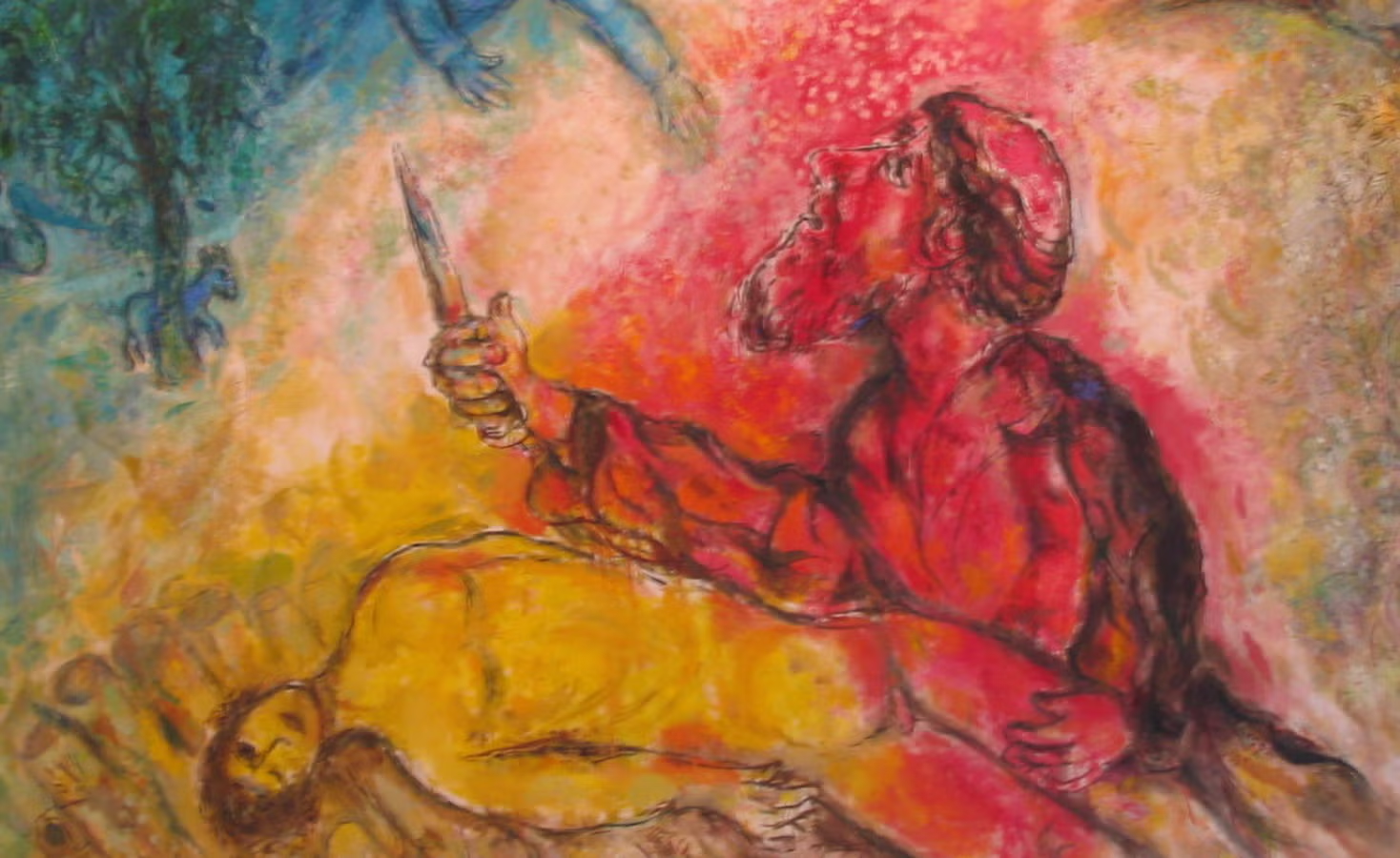
Isaac is destined to be Abraham’s heir, then Abraham takes him up to Mount Moriah to kill him. 

When we picture the Binding of Isaac, we can clearly see Abraham’s raised hand – slaughtering knife outstretched to the sky – ready to murder his own son. We are struck by the moment when all hangs in the balance. 

Finally, God speaks, and Isaac is to be killed no more.

In all these vignettes, we find ourselves caught in stories of people whose lives are racked with precarity, but who listen out for God’s voice, take away a message, and find a way to go on that affirms life.

Interwoven with this story of the main characters, our ancestors, is another story, of people living more marginal lives. The story of Hagar and Ishmael speaks even more explicitly to life’s precarity.

In Orthodox communities, where they observe the second day of Rosh Hashanah, the story of Hagar and Ishmael is usually read today. Here, in the Liberal lectionary, wherein we follow the Israelis and  hold by one day chag, we are given the option of reading either Isaac’s or Ishmael’s story. 

I have opted to read the story of Ishmael because I believe it speaks most clearly to the festival’s theme of life’s uncertainty. Everything about the lives of Hagar and Ishmael is left to the hands of those more powerful than themselves.

Hagar is called a handmaid – a word that glosses over the gross crime inherent in a purchased human being. 

A handmaid had no property, no income, and no family to come and redeem her. Most handmaidens were separated from their own kin, and stripped of their original language. 

Hagar’s name means “the foreigner.” The Torah calls her “the Egyptian.”

She was beholden to her mistress, Sarah. Hers is the most precarious position one could have in life.

A handmaid cost more than a male servant because the handmaid could produce the most valuable good: more slaves. 

Unlike the other women in our readings, Hagar does not long for a child. She expresses no desire; she offers no consent. She is simply used as a vehicle so that Sarah can have a son. 

Abraham will take her as a concubine. The child will be Sarah’s property and Abraham’s heir.

This is already a dangerous situation. If she does not give birth, Hagar fails to deliver on the terms of her purchase. If she does have a child, she could become a rival to her mistress.

That is precisely what happens. 

Hagar becomes pregnant, and Sarah immediately flies into a jealous rage. Hagar runs away, but has nowhere to go. She can either risk the harsh desert as a single pregnant woman, or she can return to an abusive household. 

For Hagar, everything hangs in the balance. Then, God hears her and intervenes. An angel tells her that God knows her suffering, but promises that her life will get better. 

She will bear a son. He will be a highwayman, attacking everyone, and attacked by everyone. His name will be Ishmael, meaning “God has heard.”

As with all our protagonists in Rosh Hashanah stories, Hagar finds her life in the balance. She realises how precarious her existence is. Then, she listens for God. Hearing God, she finds a way to move forward.

So, Hagar returns. And her life hangs in the balance once more. 

This is where the Rosh Hashanah reading begins.

Here, Sarah sees Ishmael playing and demands of Abraham “cast out that slave and her child, because that son-of-a-slave will not share in the inheritance of my son Isaac.”

Abraham followed Sarah’s words, and sent Hagar out into the desert with nothing more than some bread and a skin of water. 

She wandered about in the wilderness of Beersheva until they had completely exhausted her water.

We are told that Hagar sat an arrow-shot away from Ishmael. 

This language seems to make us consider Hagar’s own thoughts: in this moment, Hagar thinks: “maybe I could put the boy out of his misery.” But she cannot do it. She cries out “I do not want to see the child die” and bursts into tears. 

Then God hears. God hears Ishmael’s voice crying out, and sends forth an angel from Heaven. 

Every bit of hope was lost. Everything hung in the balance. But Hagar listened. And God listened. And they heard each other. And Hagar found a way to go on.

The angel says: “כִּי שָׁמַע אֱלֹהִים אֶל קוֹל הַנַּעַר בַּאֲשֶׁר הוּא שָׁם” – “for God has heard the voice of the boy where he is.”

In the Talmud’s treatise on Rosh Hashanah, this is the hook our rabbis use to tell us about our own place before God. 

The rabbis say this means that God hears Ishmael in the moment when he cries out.

To God, Ishmael’s past and future actions matter not. 

God does not care that Ishmael comes from the lowest and most vulnerable place within Israelite society. God does not care about the prediction that Ishmael will go on to be a highwayman. All that matters is that Ishmael cries out at that moment.

This, says the Talmud, is how we should all see ourselves on Rosh Hashanah. Rabbi Yitzhak declares “every person is only judged according to their deeds at their moment of trial.” 

We are only judged by our hearts in this moment of reflection. 

We are not our past mistakes, nor our future errors. We are the people that God beholds today. We are the people who chose to turn up, on this Rosh Hashanah, who knew we wanted to engage with our own souls. 

That is all that God sees.

This is a part of the Talmud’s more general argument about Rosh Hashanah, that it is a time when everything hangs in the balance. 

Our rabbis teach that we should all imagine that the whole world is finely balanced between good and evil, and that it is our responsibility to tip the scales. 

Moreover, say the rabbis, our own hearts are precariously weighted, with an even chance of falling to the side of good or evil. In this analysis, then, the fate of the whole world can rest on just how we direct our own hearts.

So, we need to take every opportunity to place a greater load on the scale of good.

The Talmud offers things we can do to make such a change: give to charity, call out in prayer, and change our behaviour. Any one of these actions can cause a shift in that delicate balance. 

A small prayer, a slight modification to how we act, a donation to a righteous cause – any of these can transform everything.

We live in a time when all can feel uncertain. Life seems nerve-wracking. At times, it does indeed feel like the balance of all the scales in the world is tilting ever more toward evil. 

The Talmud tells us that we still have some control. We can still be a force for good. We can still nudge the fine weightbridge an inch towards goodness.

The Torah gives us examples of people whose own lives hung in the balance. They listened for God, and God listened for them. And God answered “I have heard you where you are.”

So, if you feel like you are hanging in the balance, hang on in there.

God is hanging in there with you.

Shanah tovah. 

high holy days · judaism · sermon

If God can change, why can’t you?

Everyone changes. People change all the time.

In our Scriptures, the changes are often dramatic. 

Avram is an idol worshipper who lives in Mesopotamia, then undergoes complete conversion to monotheism and sets out on foot to a new country. With that, he gets a new name: Abraham.

Sarai is barren then, miraculously, in her old age, conceives a son. God gives her a new name: Sarah.

Jacob is a lying trickster who wrestles with an angel in the wilderness. When his heart has truly changed, he gets a new name: Yisrael. 

In fact, in each biblical story, a change of direction, outlook, and often name, are the key points of the narrative.

So, what about our Rosh Hashanah reading? Who is it that changes there?

In the Aqeidah, our Torah reading for the new year, Abraham is called upon to climb a mountain and sacrifice his son.

We know nothing about Sarah, who is largely kept out of the story. We don’t know anything of how Isaac feels about this, since he stops talking once he realises what his dad could do to him. 

Abraham is remarkably unchanged. At the bottom of the mountain, he is willing to do whatever God says. At the top, God says Abraham is no longer required to sacrifice his son, and to sacrifice the ram instead. At the top of the mountain, Abraham still just does whatever God says.

But there is a character who really changes in this story: God. 

God begins the narrative as zealous and demanding of human sacrifice. God ends the story compassionate and eager to enter into meaningful relationships. God begins by effectively threatening to blot out all of Abraham’s children, then ends by promising Abraham as many descendants as stars in the sky.

And, yes, God undergoes a change of name. Through the whole of the story, God is called Elohim, a name associated with strict justice and universal truth. At the very end, God is revealed by a new name – יהוה – Adonai, a name associated with the close personal relationship God has with every human being. 

In this story, the character who undergoes the greatest change is God.

Even God, the Creator of the world, the Almighty and All-Powerful, can transform. The Holy One, who by nature is completely eternal, can shift from being strict and distant to close and loving.

So, if even God can change, why can’t you?

In our Talmud, the rabbis introduce us to the idea that we are supposed to imitate God.

Rabbi Hama baRabbi Hanina teaches: be like God. Just as God clothed Adam, you will care for the poor. Just as God visited Abraham when he was unwell, you will visit the sick in your community. Just as God consoled Isaac over the death of his father Abraham, you will comfort the mourners. Just as God buried Moses, you will inter the dead.

God shows us a model of how we ought to live. Like God, we are supposed to be compassionate, loving, kind, morally clear, and doing justice in the world.

But more than that. Like God, we are supposed to change.

Here, at Rosh Hashanah, we learn: just as God can change, so can we.

We are made in God’s image. At the start of each year, we read a story where our Creator transforms. So we know that we can change too.

We can face our fast-shifting world. We can rise to the challenge of our changing community. We can look inside ourselves and love our own souls a little more.

Blessed are You, Eternal One our God, who gives us the power to change.

high holy days · sermon

To be the head and not the tail

Everything has changed. Everything keeps changing. 

We meet tonight to pause. 

Tonight is a return to a definite, reliable point in the calendar. While the world spins on outside, for a brief moment, we stop. We reflect. We take stock of all that has changed, so that we might change too.

You have already seen this evening many simanim – symbols of the Rosh Hashanah seder. These small tokens speak to us about what the festival means.

There is another one, though, that you won’t see here, partly because our synagogue is a meat-free site, and partly because it just would not feel right in a Liberal synagogue. 

It is a ram’s head.

Yes, in many New Year seders throughout the centuries, Jews would place the carcass of a sheep’s skull in the centre of the table. This tradition goes all the way back to 9th Century Babylonia.

By the 15th Century, the German rabbi, the Maharil, explained the custom using a phrase from the Psalms: 

שנהיה לראש ולא לזנב 

that we should be the head and not the tail.

There is a play-on-words here. After all, what does Rosh Hashanah literally mean?

The Rosh is the head. It is the head as in the beginning; it is the head as in the body part; and it is the head as in the one who has control. 

This symbolism works because, in Hebrew, a word contains multiple meanings and associations. 

So, the fish head represents our being on top of our own lives.

Now, what about hashanah? The word shanah does indeed mean year, but its root ש-נ-ה also means cycle, difference, repetition, or change

This makes sense: a year is a cycle, a return point that we repeat, each time observing the change. 

So Rosh Hashanah does mean “start of the year.” But, through the associations with the words’ other meanings, Rosh Hashanah is also “the master of change.”

Outside of these walls, the world is full of changes. AI unleashes new technology into a society that has already been completely transformed by the Internet. Our climate is changing, and we are truly starting to notice its effects on our own seasons. 

International relations are changing: violence, war, and fear feel like a new normal. And, of course, we are only a few years out of global pandemic and lockdowns.

So, at this juncture, we return to the start, and try to find a small oasis of calm to reflect on this changing world. 

Yet, inside these walls, things have changed too. This is my first High Holy Days with you. This is your first High Holy Days in the newly refurbished sanctuary. This is our first High Holy Days where we have voted to join a new movement. 

This is our first time doing the High Holy Days without the choir in every service and, as you will see, that means we are changing how we do music.

In every case, these changes will evoke many feelings, including excitement, trepidation, loss, and growth. This is a chance to face all our feelings. 

Change is inevitable. Change can be good. And, yes, change is hard. 

I don’t know about you, but I have changed. I have not just grown a year older since the last Rosh Hashanah. I also feel like I have aged many decades in the last few years.

The world transforms and I shift with it. As I shift, I do not even always notice the ways I change, or work out what they mean. 

I don’t even have time to decide if I like who I am becoming before I find that things changing again.

So, at Rosh Hashanah I come to this space, this synagogue, this everlasting home with God, and ask: can I love myself better? Can I love my community? Can I muster up the strength to face all that is changing? 

Can I find a way to be the head and not the tail?

Blessed are You, Eternal One our God, who gives us the power to change.

festivals · high holy days · theology

ecclesiastes (taylor’s version)

Not long before I started here, Rebecca came back very excited from a Taylor Swift concert. Taylor Swift, I understand, is a very famous popular music singer. 

Rebecca had been to the much-coveted “Eras” tour, where Taylor Swift went through her back catalogue of music. For Swifties – Taylor Swift’s fans – their favourite artist has “eras,” each represented by a different album. Fans ascribe themselves to an “era” – their favourite musical period from the singer.

In her enthusiasm for what she had seen, Rebecca suggested I do a sermon about Taylor Swift.

I curtly replied: “I think I’ll probably talk about Torah.”

That was wrong. I shouldn’t have said that. 

If something is relevant to the congregation, there should be a way to make it relevant to Torah. So, I got thinking about what connections there might be, not because I like Taylor Swift, but because I do like a challenge.

And I got thinking, you know who else had eras, each represented by unique creative output?

King Solomon.

According to our tradition, Solomon wrote the Song of Songs as a young man; the book of Ecclesiastes in his middle age; and the Book of Proverbs when he was old.

The Song of  Songs is a wonderful collection of erotic love poetry, beloved of weddings, and recited at Pesach as we celebrate fertility. It makes sense that this was composed by somebody young and virile. The Book of Proverbs is a compilation of wisdom and dictums: the sort of knowledge someone can only accumulate by living a full life and learning from everyone. 

The Book of Ecclesiastes – called, in Hebrew, Qohelet – is the text attributed to middle age. It is a deep meditation on what happens in a crisis of faith, asking what the meaning of life is, and seeking a transformed relationship with God. It makes sense for midlife, when we question our grand narratives, and find new existential purposes. 

It is the Megillah, the sacred text, for this festival of Sukkot. It is so appropriate for this autumn festival, when we build a beautiful structure and watch our sukkah get drenched in rain and torn apart by winds. The Swifties may hold by many different eras, but we Jews, at this festival of Sukkot, are very much in our Qohelet era.

With that in mind, I offer up a pop quiz. I’ll read out a verse, and you tell me: is it a Taylor Swift lyric, or a section from Ecclesiastes?

Some of you may need to sit this out, because you are superfans, and will therefore already have rote memorisation of every part of Tanach.

  1. I saw that there is nothing better for people than to be happy in their work. That is our lot in life. And no one can bring us back to see what happens after we die. (Ecclesiastes 3:22)
  2. Did you not write it down? Just one more thing to do. Where were you, and didn’t they pray, too? (Taylor Swift, Didn’t They, 2003)
  3. Did some bird flap its wings over in Asia? Did some force take you because I didn’t pray? (Taylor Swift, Bigger than the Whole Sky, 2020)
  4. A man might have a hundred children and live to be very old. But if he finds no satisfaction in life and doesn’t even get a decent burial, it would have been better for him to be born dead. (Ecclesiastes 6:3)
  5. If clarity’s in death, then why won’t this die? (Taylor Swift, Should’ve Would’ve Could’ve, 2022)
  6. Anything I wanted, I would take. I denied myself no pleasure. […] But as I looked at everything I had worked so hard to accomplish, it was all so meaningless—like chasing the wind. (Ecclesiastes 2:10-11)
  7. Tell me I was the chosen one / Show me that this world is bigger than us / Then sent me back where I came from / For a moment I knew cosmic love (Taylor Swift, Down Bad, 2023)
  8. Sometimes people say, “Here is something new!” But actually it is old; nothing is ever truly new. We don’t remember what happened in the past, and in future generations, no one will remember what we are doing now. (Ecclesiastes 1:10-11)
  9. Someone told me there’s no such thing as bad thoughts. Only your actions talk (Taylor Swift, Guilty as Sin, 2024)
  10. It seems so wrong that everyone under the sun suffers the same fate. Already twisted by evil, people choose their own mad course, for they have no hope. There is nothing ahead but death anyway. (Ecclesiastes 9:3)

When I set out on this task of connecting Qohelet to Taylor Swift, it was just a bit of fun. I was surprised to find something really profound through it.

Many of her fans have paid close attention to Taylor Swift’s developing relationship with faith. They have even engaged in a religious textual analysis of her latest album.

Writing for a British Christian magazine, cultural commentator Giles Gough notices “two Taylors.” The early Taylor, he says, has “an uncomplicated yet sincere relationship with God,” befitting of her Bible Belt upbringing. Later, she only turns to God in times of crisis, “typical of the mainstream, secular world she inhabits.” 

Gough speculates that Taylor Swift is “someone who has deconstructed their faith, and come out of it not really knowing what she believes. […] Swift seems to still be reaching out to God and when she is unable to find him, has perhaps tried to find salvation in romantic love.”

If his interpretation is correct, then Taylor Swift is even closer to King Solomon than we thought. She is asking the same questions and wrestling with the same theological issues as the Book of Qohelet does. 

In Ecclesiastes, the convoker is eager to hold onto his old views of the world. He insists: “Fear God and obey his commands, for this is everyone’s duty. God will judge us for everything we do, including every secret thing, whether good or bad.” (Ecclesiastes 12:13-14). 

At the same time, Solomon wrestles with nihilism, saying: “People and animals share the same fate—both breathe and both must die. So people have no real advantage over animals. How meaningless! Both go to the same place—they came from dust and they return to dust. For who can prove that the human spirit goes up and the spirit of animals goes down into the earth?” (Ecclesiastes 3:19-21)

This wrestling may, in fact, be a part of the human condition. In 1981, the psychologist and theologian James W Fowler developed a theory of “stages of faith.” He argued that people naturally go through a process of questioning their ideas, revisiting them, and finding new narratives to accompany their changes in life. This process helps adults to reach mature religious belief, where they can embrace diversity through universal principles of love and justice.

So, Taylor Swift, King Solomon, James Fowler, and the festival of Sukkot all seem to be teaching us the same thing: that it is OK to have doubts. You don’t have to cleave to a naive faith in a higher power, but can wrestle with God, and challenge your traditions. 

In doubt and uncertainty, we grow. In dogmatism, we remain static.

So, whatever era you are in, embrace it. Strive for curiosity. Love questioning.

And have  a very happy Sukkot.

Shabbat shalom.

high holy days · sermon

What did Jonah do inside the whale?

A simple Jew prays to God on Yom Kippur, and says “Ribon shel olamim, ruler of the Universe, I do not have much to repent of. Not compared to you. Unlike you, O God, I have not taken away children from their parents; I have not taken away parents from their children; I have not allowed disease and starvation and war. Compared to you, Holy One, I have been a saint. So, this year, I won’t be repenting. It’s your turn to repent.”

The rabbi asks him, “what were you praying there?” 

He tells her all that he’s said.

She says: “You fool! You let God off too easy. You should have told God to bring about the Redemption as well.” 

I don’t know about you, but I haven’t felt much like repenting this year. After all, what have I done, compared to the enormity of wrongs perpetrated? 

I haven’t killed anyone or waged any wars. I haven’t robbed anyone or embezzled any funds. To the best of my knowledge, I haven’t brazenly lied or misled. I certainly haven’t intentionally hurt anyone. I’m just not in the same league as the great sinners of our time.

And I don’t much feel like growing this year, either. Other years, I have enjoyed the stillness of Yom Kippur for reflection on being better. But I don’t feel like doing it this year. 

Sure, I’m grateful for turning off my phone so I don’t have to look at all the bad news, but that’s more about self-care than self-improvement. I’m more interested in switching off from the world than in switching onto myself. 

I mean, really, do I have to move? The world is changing so much, and not for the better. Shouldn’t I be allowed, as a one-off, to stop constantly evolving and just be as I am for a bit?

You know who else just wanted to stay still? 

Jonah.

I think Jonah knew exactly how I am feeling now. 

He was perfectly alright where he was, before God got involved and told him he needed to go and sort out all the problems of the world. 

Who was Jonah in the scheme of things? He certainly was not a big player in the wrongs of the world. All of Nineveh’s sins were enormous and happening miles away. Why should he have to change himself?

So, when God called on Jonah to get up, that was already asking too much. 

Jonah ran away to Tarshish. He shouted at God: “haven’t you got bigger fish to fry?” 

God said: “you want to see a big fish? I’ll give you a big fish!”

One came along and swallowed him whole.

Now, all of the story before is about Jonah not wanting to move and all of the story after is about what happened after God moved him. 

What happened in the whale, however, should really interest us. 

This year, I feel like I’m in the whale. I am sitting in a puddle from which I feel like I cannot budge. I am stuck here and have no idea how to get out. All around me, the waves are crashing down and there’s nothing I can do to stop them.

(A pedant will point out it’s not actually a whale. Technically, it’s a big fish, and the idea of it being a whale came later. But, technically, I’m not actually inside a whale at all, I’m in a synagogue, so I’m going to stick with the idea of the whale because it feels evocative.)

Now, I’m not even on the level of Jonah. My task is not nearly as big and I am not even inside a literal whale. So Jonah should be a good starting-place for my feelings of stubbornness and obstinacy.

What did Jonah do inside that whale? He despaired. He observed. He prayed. He sang. He learnt. And, eventually, he repented and grew.

So, this Yom Kippur, let’s engage with the whale. Let’s focus just on the three days Jonah spent inside the belly. Maybe we can learn from Jonah what to do when everything feels too overwhelming but we know we have to change anyway.

The second chapter of the book of Jonah is not narrative-form, like the rest of the book. Only the first verse, where Jonah gets swallowed by the whale, and the last verse, where the whale spits Jonah back out again, follow a linear storyline. 

The rest of the chapter, only eleven verses long, reads more like a poem. It is a song, where each verses contains a parallel structure. It would fit just as well in the Book of Psalms, where there are similar supplications to God. 

If the second chapter of Jonah is a journey, it is only a spiritual one. Jonah himself remains completely static, stuck in the belly of the beast. 

His soul, on the other hand, begins in the depths of despair, goes through questioning and defeat, recognises the glory of God, and finally comes out committed to getting out there, thanking God, making offerings, and taking part in the deliverance.

This feels like the most important chapter to us, then. We are just sitting and standing in the same space. But we are expecting our souls to move. 

I am feeling stuck in a world I cannot change, but I know I have to get somewhere else spiritually. We can’t just sit around here and hope to become better people. We know it needs work. But without a narrative, how do we know what to do?

Well, in the spaces left by the absence of narrative, the rabbis come up with their own stories. Pirkei deRabbi Eliezer is a collection of creative writing, compiled over many generations, that retells the biblical stories. These are our midrash, and in this rabbinic fan-fiction, we get a story to go with everything that Jonah says. 

From these stories, we might come up with our own meanings of what we should be doing here.

The first thing Jonah does is acknowledge where he is. He accepts that he is in the belly of the fish.

The midrash gives us a grandiose interpretation of what that looked like. It was like entering into the great synagogue: an enormous, echoey chamber. The fish’s eyes were two great windows, so that Jonah could see what was going on underwater. Inside the fish was a giant pearl, which illuminated the belly and shone out towards the sea. With a lamp and windows, Jonah had a clear vision of where he was.

What can we learn from this? We learn that we need to be honest with ourselves about where we are. The world is a bit of a mess right now, and there’s no point putting on a happy face and pretending everything is OK. Equally, we are pretty safe here. We in this room are not under attack, and the risk we would be is very low. 

So, start by taking stock of reality. Where am I? I’m in a synagogue, sitting on a comfy chair, with my feet planted on firm ground. I can see the lights of the room and smell that familiar sweet must of this religious space. 

But it’s not enough to just say where we are. We need to say how we feel. That’s what Jonah does next. 

He says: “I am crying out to God from my narrow-straits, please answer me.” Jonah says, “I am crying out from the belly of Hell, may God hear my voice.”

The midrash says, that’s exactly where the whale took him. It plunged him right down into the depths and showed him the gates to Hell. 

So, we need to do the same. We need to ask ourselves how we are really feeling. Be honest about the frustrations and worries and anger we feel. 

Next, Jonah finds a way to relate what is going on to what has gone before. In the depths of the ocean, Jonah says, he sees the billows and waves and reeds. 

According to the midrash, this is because the whale took him on a tour, not just of the sea, but of Jewish history. The whale showed Jonah the foundations of the earth, deep on the ocean-floor, and reminded him that God had made the world. The fish took him to the Sea of Reeds, and showed him the flora of the spot where the Israelites had crossed out of Egypt.

Faced with adversity, we have to remember that it has happened before. Once, there was nothing, then the world came into being. Once, we were slaves, but then we were freed. Wars and persecutions and empires have all come before and, somehow, our people have survived.

We, as individuals, have also survived challenges before. How recent was the Covid pandemic? We can take pride in our own resilience at getting through such troubles before.

Knowing what had gone before, Jonah was able to feel confident that he could face what was to come. Jonah cries out: “You saved my life from the very pits, O Eternal One my God!”

The midrash says that this came when the whale took Jonah down to meet the great sea-monster of the deep, Leviathan. Jonah told that nautical dragon: “You may think you are going to swallow me up, but I carry the promise of Abraham, and I know that one day, when God chooses, it will be you who gets eaten by the righteous.”

Like Jonah, let’s look at the problems ahead of us, and say: “I have faith. I can face you.”

Next, Jonah reflects back on what he has learned. He notices: “Those who cling onto empty folly forsake their own welfare.” He had been willing to stay where he was, clinging onto old vanities, but he did so at the expense of his own soul.

So, he proclaims, instead: “I, with loud thanksgiving, will sacrifice to You, God.”

We, too, can be grateful for what we have, and take on this next year in service of our Creator.

That is the journey on which Jonah took his soul, and it is where I hope to take mine over this Day of Repentance. 

I said I wanted to stay still, but stillness is not inactivity. The Rambam understood that serious thinking was the most active you could be. It connects you directly to that Most Active Intellect: the thinking, living God. 

In stillness, you can nurture who you are. Jonah was stuck in an underwater pit, but that was when he got most energised. It was when he really engaged in the audit of his soul.

This year, I have spoken to friends and community members and witnessed them say things they normally would never. People who would ordinarily be very liberal, turn racist. People who are normally very peaceful, justifying violence. People who are normally pretty discerning, regurgitating conspiracy theories. People who are usually nuanced, turn to absolutist thinking.

I am not saying this with any judgement. I say it because I’ve done it too.

And when I meet this now, I try to say to myself: I know you are scared and angry, and while you are feeling scared and angry, you can hold all those feelings. You are inside the whale. 

But one day, please God, you will be released from this whale, and you will have to reckon with who you became there. 

Take care of your soul. It is a precious gift. Don’t let it become too cynical or warped by the horrors that surround it.

That’s my goal for this Yom Kippur: to hold my soul with gentleness, and ask it to be porous and empathic and kind.

I am here, inside the whale. I cannot change what whale I am inside. I cannot stop the waves from crashing or remake the world so it is less scary. 

I can only change what I can change. And what I can change, in this moment, on this Yom Kippur, is myself. I just have to deal with who I am here and now. 

So, let’s be like Jonah. Let’s accept the whale we’re in, and, yes, despair, but also observe, pray, sing, learn, repent. 

And it may be that, when we finally get blown out from that great fish’s blowhole, we might still be better people than when we got swallowed up.

Amen.

high holy days · liturgy · sermon

Do not build a prison in your heart

Imagine a courtroom. Picture those big wooden panels that line the grand hall of a traditional Crown court. The deep reds of the carpets. The judge sitting loftily on a bench,  at the front, draped in black gowns, donning that full-bottomed wig. And all the lawyers surrounding you, speaking Latin and legalese, bewildering you with their words. 

You have not been here before, but, suddenly, you find your life depends on your correct participation. You will have spent extra time ironing your clothes and polishing your shoes. You may have spent weeks picking out an outfit. Perhaps you already know what you would wear. 

How does it feel to stand trial here? Is this somewhere you want to be? From here, how much do you think you will learn and grow? And do you think there might be a better place where you could improve yourself?

This is the metaphor we are often given for Yom Kippur. The Heavenly court and the earthly one. The trial of our souls. The God of Justice, who sits in judgement over us.

We beg for clemency:

סלח לנו – forgive us

We announce our expectation of a just verdict:

סלחתי כדברך – I have forgiven according to your plea.1

We rejoice in the judgement:

אשרי נשוי פשע כסוי חטאה – happy are those whose transgression is forgiven, whose sins are pardoned.2

This is the courtroom of our hearts.

C. S. Lewis, the great 20th Century English author, famed for his Chronicles of Narnia, picked up on this aspect of our thinking. When he wasn’t writing beloved children’s novels, Lewis dabbled in biblical studies as a lay Anglican theologian. 

C. S. Lewis writes: “The ancient Jews, like [Christians], think of God’s judgement in terms of an earthly court of justice. The difference is that the Christian pictures the case to be tried as a criminal case with himself in the dock; the Jew pictures it as a civil case with himself as plaintiff (sic). The one hopes for acquittal; the other for a resounding triumph with heavy damages.”3

Now, Lewis is no antisemite. In fact, he repudiated the hatred of Jews, long before it became fashionable to do so.4 He is eager to point out that, at his time of writing, immediately after the Second World War, the Christian had much to atone for, and the Jew had much to charge against God. 

In many ways, he has us down. We do indeed take this as an opportunity to bring all our charges against God, and to vent our grievances against the injustice of the universe. Lewis is talking about ancient Israelite religion; the religion  of Scripture. 

Lewis would, I’m sure, willingly acknowledge that we modern Jews also share much in common with modern Christians, in terms of our admissions of guilt and prayers for pardon.

C. S. Lewis has astutely picked up that we see all this as a trial. 

But where he errs, I think, is in his understanding of what an ancient Jewish court was. The tribunal of our ancestors looked nothing like the judge’s dock of today. 

A metaphor that worked so well for poets and liturgists many centuries ago can become quite damaging when it is used with the projection of our criminal justice system.

Where today, a court can dole out sentences of imprisonment, the goal of the ancient court was about restitution and social harmony.

Where today, the court expects to find a person innocent or guilty, the ancient court sought to make sure everyone felt like they had a place in their community.

The focus of our sacred writings is to create a society based on compassion, community accountability, and healing.

When we rethink what justice looked like for the authors of our Torah, concepts of trials, pardons, and sentences start to look very different. By seeing the court through ancient eyes, we can re-imagine the trial as a process of growth and healing.

We get mere glimpses of what the earliest courts might have been. In the book of Judges, the archetypal ideal of the judge is Deborah, the prophetess. Her court is a base underneath palm trees in the hill country. We receive an image of her sitting there, while Israelites come up to have their disputes decided.5 Her court was one where people came to negotiate and be heard, but there is no indication they came to be punished. This was in the time of the Judges, the earliest of Israelite civilisations.

Later, however, ancient Israel developed a class system and a monarchy. With a state system came power and punishments. In the book of Samuel, King David pursues after the city of Avel Beit-Maacah, threatening capital punishment against everyone who rebels against him. Here, an unnamed elder-woman comes out. She admonishes the general, saying: “we are among the peaceful and faithful of Israel, will you destroy God’s inheritance?” She rebukes them with a reminder of the old system – that, before there were kings, people used to come and talk out their issues in the city. The generals agree to spare the city, providing they can enact punishment against one ringleader.6

From these two stories, we can garner an insight into what justice may have looked like in the earliest part of the biblical period. The first thing we notice is that women were leaders. This, then, may be a justice system from before patriarchal power was cemented. We also do not detect any hint of crime and punishment. Instead, the courts seem more like public cafes, where experienced negotiators help community members talk through their problems. If this is correct, we are looking at a very different type of court.

Still, courts did develop in ancient Israel, but not like those of today, nor even  of the surrounding empires. In our narratives, most of the times that characters are imprisoned, it is outside of the Land of Israel, by a Pagan power, and unjustly.

Joseph is sent to prison in Egypt on trumped-up charges without any due process.7 Samson the warrior is sent to toil at grinding grain in the jailhouse by the Philistines, not because he has done anything wrong, but as a prisoner of war.8 When the Babylonian rulers send Daniel to the Lion’s Den, it is because of xenophobic laws that stop him practising Judaism.9

Our Scripture treats prisons as something foreign, where good people are sent for bad reasons.

Even when we do see examples of prisons in Israel, they are always treated by the Torah’s authors with contempt. Three of our prophets are sent to prison: Jeremiah;10 Micaiah;11 and Hanani.12  In every single case, this is a monarch warehousing a prophet because they are speaking truth to power. In the Torah’s view of justice, it is hard to see how prisons could have any meaningful role at all.

That does not mean this was a world without punishment. Scripture presents exile, flogging, and even death as options for what might constitute justice in the ancient world.13

Yet, based on our commentaries and traditions, we have the impression that such penalties were implemented only in the most egregious cases. What somebody had to do was so heinous that the death penalty would almost never actually occur.14 

In the Mishnah, we read, the court that puts to death one person in seven years is bloodthirsty. Rabbi Eleazar Ben Azariah takes it even further, saying, ‘One person in seventy years.’ Rabbi Tarfon and Rabbi Akiva say, ‘If we had been in the Sanhedrin, no one would have ever been put to death.’15

What kind of justice system was this then? No prisons, no death penalty? No patriarchy, no punishments? 

The ancient court sounds more like people just sitting around having a chat.

What if it were? What if, instead of biblical justice being all about burning and smiting, it was mostly about negotiating and feeling? How would that change how we look at our tradition? How would it change how we approach our relationship with God?

Perhaps I am over-egging how different the biblical court was. If so, bear with me. 

I am well aware of how terrible some of the Torah’s punishments were. I am also conscious that what I am describing is so outside of our reality as to make it feel fictitious. If the world of restorative justice I am describing never really existed, please at least indulge me in entertaining the possibility that it could. 

We are not, in this room, coming up with a proposal for how to govern Britain. We are just asking what metaphors work when we think about how to hold our own hearts on Yom Kippur. For me, the metaphor of court cases has proven really problematic, and I am looking to explore new ones with you.

The problem of the courtroom metaphor initially struck me quite suddenly. I was talking with my therapist about an issue that I felt kept coming up in my own behaviours. I said: “I’ve got another case to talk about…”

He looked around the room and said “you know you’re not on trial here, right?” 

I think I had expected, on some level, that, through counselling, I could be acquitted or found guilty for all my past deeds and thought patterns. 

I had built a prison in my own heart, to which I could sentence the parts of myself  I liked least. I had conjured up a jury in my head, who would judge all my actions, according to the standards I had set myself. According to the standards I imagined God has set for me.

What was I doing? The point of therapy is not punishment or exoneration. It’s to learn and grow, and find ways of being better in the life I actually have. The point is not to condemn or discard my negative traits or past mistakes. The point is to work towards loving all of myself and learning from all I have done.

Perhaps you can relate to this. Have you imagined how you might punish others, or cast them into our prison in your heart? Maybe you even seek to punish people or get them out of your life. Maybe you, too, have hoped there were parts of yourself you could lock away.

We cannot apply the carceral system to our spirit. When we are doing wrong or feeling guilty, we must be free to look ourselves in the eye, and change willingly.

Is this not what God wants from us, after all? That we make amends, grow, become better. That we embrace ourselves and each other. That we turn from our ways and live. 

If, then, we are in a court with God, we should make it one where we are in conversation with a loving elder, not facing a law lord who seeks to punish and acquit.

So, let us imagine a new court. It is not the court we thought into existence at the start of this sermon. It is a very ancient one, where our ancestors went thousands of years ago. Deborah’s court. 

You are in the dusty scrubland of Canaan, and a few yards away you can see an oasis. People are gathering around it to fetch water. They are laughing and catching up and telling stories. They are feeding their livestock: sheep, goats, donkeys, camels. 

At the edge of this well is a row of palm trees, and the tribal leaders sit, drinking sweet tea. You cannot go to prison. There is no prison. You cannot be acquitted, because nobody thinks you are guilty. You are just a person, a member of the community, looking for a way through a problem. The goal will be to find a solution that benefits everyone, and that sees maximum spiritual growth. 

When you come away from this court, you can say “happy is the one whose sin is forgiven.” You don’t mean that you are relieved because you thought you were in trouble. You mean you are jubilant, because you are at peace with yourself, your community, and your God.

Let this be your court. Let this be the place you take your heart over Yom Kippur. 

Come before God, not as a claimant nor a defendant, but as a congregant, seeking growth.

And thank God that there is no prison in your heart; only an opportunity for ongoing healing and change.

May this be where we judge ourselves. May this be where we judge others. 

And let us say: amen.

  1. Birkat Selichot ↩︎
  2. Psalms 32:1 ↩︎
  3. CS Lewis, Reflections on the Psalms ↩︎
  4. PH Brazier, A Hebraic Inkling: C. S. Lewis on Judaism and the Jews ↩︎
  5. Judges 4:5 ↩︎
  6. II Samuel 20 ↩︎
  7. Genesis 28 ↩︎
  8. Judges 16 ↩︎
  9. Daniel 6 ↩︎
  10. Jeremiah 37 ↩︎
  11. I Kings 19 ↩︎
  12. II Chronicles 16 ↩︎
  13. Ezra 7:25-26 ↩︎
  14. eg. BT Sanhedrin 71a ↩︎
  15. M Makkot 1:10 ↩︎
high holy days · israel · sermon

The point was not to sacrifice your children

In 1922, archaeologists dug up a site in modern-day southern Iraq. There, they found incredible spans of gold and sophisticated armour, and Iron Age Sumerian artefacts, encased within stone walls. They dubbed this place “the Royal Cemetery of Ur,” an ancient Babylonian mausoleum. 

On that site, they also discovered evidence of hundreds of human sacrifices. Among the human sacrifices, a considerable number were children.

Nearly all of the skeletons were killed to accompany an aristocrat or member of the royal family into the afterlife. Some had drunk poison. Some had been bashed over the head with blunt objects. After their death, many were exposed to mercury vapour, so that they would not decompose, but would remain in a lifelike posture, available for public display.

Excavations from the Royal Cemetery at Ur

This site dates to sometime around 2,500 BCE in the ancient city of Ur. According to our legends, another figure came from the  ancient city of Ur sometime around 2,500 BCE. 

His name was Abraham. 

In the biblical narrative, Abraham wandered from Ur to ancient Canaan, where he began to worship the One God, and founded Judaism.

The world in which Abraham purportedly lived was rife with child sacrifice. Across the Ancient Near East, archaeologists have uncovered remains of children on slaughtering altars. They have found steles describing when and why they sacrificed children. They have found stories of child sacrifice from the Egyptian, Greek, Sumerian, and Assyrian civilisations.

So problematic was child sacrifice in the ancient world that our Scripture repeatedly condemns it. The book of Leviticus warns: “Do not permit any of your children to be offered as a sacrifice to Molech, for you must not bring shame on the name of your God.” The prophet Jeremiah describes disparagingly how the Pagans “have built the high places to burn their children in the fire as offerings to Baal.” In the Book of Kings, King Josiah tears down the altars where people are sacrificing their children.

Abraham put a stop to the practice of child sacrifice. It seems to happen suddenly, and without warning, and with even less explanation. No reason is given why he abruptly ended all the cultural deference that had gone before and opposed an entrenched religious practice. 

The question we now must ask is: why?

One reason that comes to mind is that it is so obviously immoral. Surely it should be self-evident that you don’t kill kids! But that wasn’t obvious to all the people around Abraham. And that wasn’t obvious to traditional commentators, either. In their world, the morally right thing was always to obey God.

Fresco of the Binding of Isaac at the 3rd Century Duro Europos Synagogue, Syria

A traditional reading says that Abraham stopped child sacrifice in obedience to God. In the story we read today, Abraham is called upon by God to go up on Mount Moriah and slay his son. Only at the summit, when he holds up his arm to murder Isaac, does God stop him, telling Abraham that he has proved his devotion to God by not withholding his son, and that he does not have to kill Isaac. 

Yet there are several problems with this story. If we adhere to the traditional reading, God still wanted child sacrifice, and felt that doing so would prove Abraham’s devotion. In fact, nearly all traditionalist readers interpret it this way,saying that obedience before God should be a sacred virtue. A conservative reader of the Bible says that the moral of the story is that we should be subservient to God, and do what we are told.

God said not to perform child sacrifices, so we no longer do. That would mean, then, that if God had said child sacrifice was permitted, we would still be doing it.

In 2007, the Israeli philosopher Omri Boehm offered a radical reinterpretation of the story of the binding of Isaac. The story, Dr Boehm argues, is not about Abraham’s fealty to God, but his disobedience. Dr Boehm shows how, reading against the grain of traditional interpretation, this is not a story where God changes tact and decides not to ask for child sacrifices anymore, but where Abraham rebels against authority and refuses to commit murder.

For Boehm, what was truly radical about the Binding of Isaac was that it set out a new set of values, completely at odds with those of the Ancient Near East. Where other cultures practised child sacrifice because it was part of their established culture, Abraham resisted and put life above law. Where others encouraged obedience to authority, so much that poor people could be killed in the palaces of Ur to serve their masters in the afterlife, Abraham made a virtue of rebellion. For our ancestor Abraham, refusing to follow orders, even God’s, was the true measure of faith. By not killing, even if God seemingly tells you to, you show where your values really lie.

This is not a story about obedience, but rebellion. And that message – of resistance against authority in defence of human life – has much to teach us today.

Boehm reconstructs what the archetypal story of child sacrifice was in the Ancient Near East. Across many cultures and time periods, there was a familiar refrain to how the story went. The community is faced with a crisis: some kind of famine, natural disaster, or war. The community realises that its gods are angry. To placate the gods, the community leader brings his most treasured child and sacrifices him on an altar following the traditional rites. Then, the gods are pleased and the disaster is averted.

We can see that the biblical narrative clearly subverts the storytelling tradition that was around it. In other cultures, the community leader really did sacrifice his special child, and that really did please their Pagan god. In our story, the community leader does not sacrifice his special child, and the national God proclaims no longer to desire human sacrifice. This is already then, a bold message to the rest of the world: you might sacrifice children, but we will not.

Boehm takes this a step further and looks at source criticism for the text. Most scholars of Scripture accept that Torah is the work of human hands over several centuries. One of the ways we try to work out who wrote which bits is by looking at what names for God they use. Whenever we see the name “Elohim” used for God, we tend to think this source is earlier. Whenever we see the name “YHVH” used for God, we tend to assume the source is a later edit by Temple priests.

The story of the binding of Isaac is odd because it uses the name “Elohim” almost the entire way through, until the very end, when the angel of God appears and tells Abraham not to kill Isaac. That means that most of the text is from the early tradition and only the very end part, where the angel of God tells Abraham not to kill Isaac, comes from the later priests.

So, Boehm asks, what was the earlier version of the text? If you take out the verses where God is YHVH and have only the version where God is Elohim, what story remains?

Well, in the version that we know, where both stories are combined, an angel of God calls out and tells Abraham not to sacrifice Isaac. That’s the bit where God is YHVH. If you take that out, and have only God as Elohim, Abraham makes the decision himself. No angel comes to tell him what to do. Next, if we cut out the parts where God is YHVH, there is no praise from the angel, telling Abraham he made the right choice. Instead, you get a story where Abraham deliberately disobeys his God because he loves the life of his son more.

Adi Nes, ‘Abraham and Isaac’, 2004

The earliest version of the text, before the Torah was edited and a later gloss was added, is one in which Abraham is commanded by God to sacrifice Isaac, goes all the way up Mount Moriah, and then refuses. Without prompt or praise from God, Abraham decides to sacrifice a ram instead of his son. In the earliest version of the biblical narrative, when source critics have stripped away priestly edits, God tells Abraham to sacrifice his son and Abraham rebels.

The earliest version, then, is an even more radical counter-narrative to the other stories of the Ancient Near East. Not only do we not sacrifice children. We also recognise that sometimes you have to say no to your god. In this version, rebellion is more important than obedience, especially when it comes to human life.

This isn’t just a modern Bible scholar being provocative and trying to sell books. In fact, Boehm shows, this was also the view of respected Torah scholars like Maimonides and ibn Caspi. These great mediaeval thinkers didn’t think of the Torah as having multiple authors, but they could see that multiple stories were going on in one narrative. One, they thought, was the simple tale of obedience, intended for the masses. But hiding between the lines was another one, for the truly enlightened, that tells the story of Abraham’s refusal.

Boehm terms this “a religious model of disobedience.” By the end of the book, you go away with the unshakable impression that Boehm is right. True faith, he says, is not always doing what you think God is telling you. Sometimes it is reaching deep within your own soul to find moral truth. Sometimes you really show your values by how you defy orders.

In his conclusion, Boehm takes aim at Rabbi Shlomo Riskin, an American religious leader, who lives in the West Bank settlement of Efrat. Rabbi Riskin had said, in his analysis of the binding of Isaac, that Abraham was a model of faith by his willingness to kill his son. Riskin insisted that he was willing to sacrifice his own children in service of the state of Israel.

This, says Boehm, is precisely the opposite of the message of the binding of Isaac. The point was not to let your children die. The point was to bring a final end to child sacrifice. The point was not to submit to unjust authority, but to rebel in defence of life. 

Rabbi Riskin does not realise it, but by offering child sacrifice, he is really advocating for the Pagan god. He is describing the explicitly forbidden ritual of allowing your children to die. 

Abraham thoroughly opposed these false gods who demanded ritual murder. They were idols; and child sacrifice a monstrous practice that we were supposed to banish to the past. The very essence and origin of Jewish monotheism is its thorough rejection of killing children.

Boehm could not have known how pertinent his words would become. This year has been one of the worst that those of us connected to Israel can remember. Beginning on October 7th, with Hamas’s horrendous massacres and kidnappings, the last Jewish year has seen us rapt in a horrific and seemingly never-ending war.

This year, thousands of Israelis were killed. This is the first time in a generation that more Israeli youth have died in war than in car crashes. Reading through the list of names, it is remarkable how many of the soldiers were teenagers. 

That is not to even mention the 40,000 Palestinians whom the IDF have killed. According to Netanyahu’s own statements, well over half were civilians. Around a third were children. As famine and food insecurity rises, the risk of deaths will only accelerate. It has been agonising to witness, and I cannot imagine how painful it has been to live through.

Yet, during my month in Jerusalem, I saw that the voice of Abraham has not been extinguished. There are few groups I hold in higher esteem than the Israeli peace movement. Against untold threats and coercion, in a society that can be intensely hostile to their message, they uphold Abraham’s injunction against killing.

One of the leaders of the cause against war was Rachel Goldberg-Polin. On October 7th, her 19-year-old son, Hersh, was kidnapped by Hamas. His arm was blown off and he was taken hostage in Gaza. From the very outset, Mrs. Golderg-Polin argued fervently for a ceasefire and a hostage deal that would bring her son home. She warned that the only way her son would come home alive would be as part of political negotiations. 

At the end of August, as Israeli forces neared to capture Hersh as part of a military operation, Hamas shot her son, Hersh, in the head. 

Rachel Goldberg-Polin’s refusal to give up hope, refusal to sacrifice her son, and steadfast insistence on peaceful alternatives is a true model of Abraham’s faith.

Israeli peace protestors

And it involves serious rebellion too. When I met with hostage families in Jerusalem, I was shocked to hear how, for protesting against the war to bring their families home, they had been beaten up by Ben Gvir’s police. I saw this with my own eyes when I marched alongside them. People shouted and jeered at them, and the police came at them with truncheons.

In July, when I went with Rabbis for Human Rights to defend a village in the West Bank against settler violence, we were joined in our car full of nerdy Talmud scholars by a surprising first-timer. A strapping 18-year-old got in to volunteer in supporting the Palestinian village. What was most remarkable was that he himself lived in a West Bank settlement. 

He explained that he had refused to serve in the military. He did not know that others had done it before, or that there were organisations to support Israeli military refusers. Instead, he said, he thought to himself: “if I don’t go, they won’t kill me; if I do go, I might kill someone.” What could be a truer expression of Abraham’s message: no to death! No to death, no matter the cost.

He really had to rebel. For refusing to serve in the war, the conscientious objector I met spent seven months in jail. Still now, there are dozens of Israeli teenagers in prison because they would not support the war.

Throughout my time in Jerusalem, I attended every protest against the war and for hostage release that I could. One of the most profound groups I witnessed was the Women in White, a feminist anti-war group going back decades. One of these women, with grey hair and the look of a veteran campaigner, held a placard that read in Hebrew: “we do not have spare children for pointless wars.”

Is this not exactly what Abraham would say? We will not sacrifice our children on the altar of war!

Theirs is truly the voice of Abraham, the true voice of Judaism. It is the voice that opposes child sacrifice. Theirs is the voice that upholds the God who chooses life. 

Talmud tells us that, when we blast the shofar one hundred times on Rosh Hashanah, we are repeating the one hundred wails of Sisera’s mother when she heard her son had died. Sisera was, in fact, an enemy of the Israelites, who waged war on Deborah’s armies, and was killed by the Jewish heroine, Yael. Still, at this holy time of year, we place the grief of Sisera’s mother at the forefront of our prayers. 

We take the cry of every mother who has lost a child and we make it our cry.

Thousands of years after the Sumerian Empire had ceased existing, archaeologists dug up its remains, and saw a society that practised child sacrifice. From the very fact of how they carried out murder and permitted death, the excavators could tell a great deal about what kind of society this was. One that killed people to serve their wealthy and their gods.

One day, thousands of years from now, historians may look upon us too, and ask questions about what our society was like, and what we valued. May we take upon ourselves the mantle of Abraham. 

May they look back and say that we chose to value life. May they look back and see that our people despised death and war. May they look back on us and see a society that practised faithful disobedience.

Amen.

high holy days · sermon

We can be proud of how we handle death

It is no secret that Oaks Lane sees its fair share of death. The fact that so many of you are here for this service is testament to that.

This is one of the Reform movement’s largest synagogues, and a large number of our members die each year. During the Covid pandemic, Rabbi Lisa carried out some 350 funerals. How she managed to do that with such grace will always be a source of personal wonder to me.

Before I came here, then, I expected that coming to work at Oaks Lane would mean constantly swimming against a tide of grief. I thought that this community would be defined by pain and sadness, eking out moments of joy through a long slew of burials.

I was wrong. I was wrong about Oaks Lane. More importantly, I was wrong about grief.

I had accepted the conventional wisdom that grieving was the tough work of slogging through sadness. I believed, without much interrogation, that people had to process stages of denial and anger and sadness to eventually begrudgingly accept the mortality of their loved ones. 

Yet, when I began working in this synagogue, I was astounded by what actually happened. I discovered that, in their last moments, people were eager to pass on their happiest moments and their favourite jokes. 

I found that, while funerals were always deeply sombre affairs, shiva houses could be full of raucous laughter and mourners could be alleviated by relief that the deceased had gone on to a better place. I was amazed at how quickly families made meaning of their loss, and turned the memory of their loved one into positive action. 

Even concerning the saddest and most unjust deaths, the grieving people of this community are amazingly strong.

The truth is that this congregation can feel very proud of how it handles grief.

It turns out that grief is deeply sad, but that’s not all it is. It also shows the immense capacity human beings have to be resilient.

That observation is now supported by scientific study. The psychologist George Bonnano has dedicated his life to studying grief. When he first came to look at bereavement, he found that, while there were plenty of big claims about how grief works, there was scant little evidence to back it up. 

Over years of working with mourners, hearing their stories, and measuring their emotional responses, Dr Bonnano found that all the stereotypes about grieving were wrong. 

As it turned out, the five stages of grief rarely turned up in people’s lived experiences. In many cases, people did not need to go deep into the recesses of their subconscious to find out why a death had hurt them so much. 

Quite on the contrary, many mourners found that they could make meaning of their lives and honour their dead. Many grieving people found that their emotions were close at hand, and that they could handle them best by being honest about them.

Above all, mourners did not need to “get over” their sadness. Instead, people emotionally processed best when they understood their sadness as a helpful emotion. Sadness, it turns out, slows us down, makes us more contemplative, helps us to create more accurate memories, and focuses us on what truly matters.

Bonanno discovered that one of the factors that made people most adverse to handling grief was the Western obsession with reason. The demand that we be constantly rational, strip ourselves of rituals, and just ignore our spiritual inclinations in times of distress actually exacerbates emotional trauma, and can prolong the grieving process. 

Of course, that does not mean dealing with death is easy. For some people, the sadness can go on for years, and some people experience very traumatic and complex grief. In all of his studies, Bonnano could not find a single unifying factor for why some struggled more than others. It doesn’t really say anything about a person or their loved one if they struggle more with death.  In fact, it seems to be largely random.

One thing Bonnano did find is that, in cultures that ritualise communicating with their dead, and that have a sense of death’s sacred purpose, mourning is often healthier.

From that point of view, I think we Jews can be very proud of how we deal with death.

The tractate of the Talmud that deals with death and dying is called smachot. Literally, the word means “joys” or “festive celebrations.” I had always assumed that the title was a euphemism, to cover over all the other great feelings associated with death. 

Now, I wonder if perhaps the rabbis gave it that title as a reminder of what was at stake. Yes, you will feel sadness, but all of those are for the sake of remembering your joys. Yes, these mourning rituals will be sad and sombre occasions, but they may also be festive celebrations of the lives you have lost.

Smachot sets out a clear set of guidelines for how to handle death. Bury as soon as possible. Sit in remembrance for seven days. Avoid certain kinds of work for thirty. Say kaddish for a year. 

At every stage, the rabbis provide us with a spiritual framework that means we always have something to do, and continually have receptacles for our grief. With the infrastructure established, Jews are free to experience the full gambit of emotions associated with death.

In addition to its regulations on mourning, Smachot advises ways to handle people who are grieving. Rabbi Meir teaches that, in the early days of somebody’s bereavement, you should offer them words of consolation, then ask them how they are. After the first thirty days, you should ask them how they are, and then offer words of comfort. By the time twelve months have passed, you shouldn’t bring up the death at all unless the mourner does, so that you do not re-open wounds. 

All of this provides a way to speak openly and honestly about grief, without allowing it to be all-consuming. I find this rabbinic wisdom incredibly powerful, but it is even more poignant when we see it in real life.

Over the last year, I have watched in awe as our senior rabbi handled his own grief. This time last year, Rabbi Jordan and I switched our expected slots, and I took the yizkor service, so that Rabbi Jordan could have a chance to grieve his recently deceased mother. 

Grief could have swallowed Jordan up. Instead, he set up a weekly minyan so that he could say kaddish with all the others who were bereaved. He wore his mourning openly, and channelled it into helping everyone in the community to heal. Perhaps most surprisingly, throughout that whole period of aveilut, Jordan led this congregation with integrity, sincerity and passion. There is much in here for him to feel proud.

I am also continually impressed by the Jewish Joint Burial Society, whose work can never be sufficiently celebrated. Whenever I call Mitzi, Ian or Andrew, they combine a great sense of dignity with humour and good spirit. They oversee hundreds of funerals every year, and support families in their very hardest moments, and do so with an incredible sense of holy purpose. They are an endless source of pride.

More than anything, this community is a source of pride. Its volunteers in the care team leap at the chance to call up people on their yahrzeits. I rarely attend to a family that hasn’t already heard from a congregant already. Alan, Adrienne, Hazel, Brenda, Sheila, and Ailsa… you do more for the people in this congregation than you will ever fully know.

And that is true for all of you. As members, you repeatedly show up for each other and support each other. As mourners, you do everything in your power to honour your loved ones.

So keep on doing what you’re doing. Keep asking after each other. Keep showing up. Keep being vulnerable and honest. 

As we sit here, together, mourning our dear loved ones, know that you are here for yourself and you are here for everyone else. And we truly appreciate your presence. 

I am incredibly proud of how this community handles death.

Gmar chatimah tovah.

high holy days · sermon

Can you pass the human test?

This is the human test, a test to see if you are a human.

These questions were posed by the American comedian, Ze Frank, to see whether his audience was human. I will ask you some of them, and you can see if they apply.

  • Have you ever made a small, weird sound when you remembered something embarrassing?
  •  Have you ever seemed to lose your aeroplane ticket a thousand times as you walked from the check-in to the gate?
  • Have you ever laughed or smiled when someone said something mean to you and then spent the rest of the day wondering why you reacted that way?
  • Have you ever had a nagging feeling that one day you will be discovered as a fraud?
  • Have you ever stared at your phone smiling like an idiot while texting with someone?

Well, congratulations you are human.

With these questions, Ze Frank taps into the parts of being human we so rarely discuss. Our deep anxieties, our senseless irrationalities, our abilities to love people completely. 

Perhaps we laugh because they are embarrassing. It feels awkward to acknowledge that we feel all these things.

But we do. They are, truly, what makes us human.

In 1950, the English mathematician Alan Turing developed a series of tests to distinguish between robots and people. The questions, called ‘The Turing Test,’ can be used with some accuracy to ascertain whether, when speaking to a character online, they are a real human being or a highly intelligent software programme.

This year, those questions gained an entirely new relevance. An AI Language Model, called ChatGTP, became a viral sensation. You can pose the most fascinating questions to this robot, and it will answer them as if you were speaking to a real human being. It can have conversations and play word games and share thoughts on current events. It can even write a half-decent sermon.

But there were some questions it couldn’t answer. It still cannot pass the Turing Test. Tech experts promise that, very soon, it might. But, for now, there are certain things it cannot find adequate responses for.

The questions the Turing Test poses of robots to distinguish them from humans ask them to think critically about their inner lives. You might ask them:

  • “What event from your life changed the way you think?”  
  • “How do you feel when you remember your childhood?”
  • “Can you describe your emotions in only shapes and colours?”

What makes us human, provably so, is that we feel. We rejoice by laughing from our bellies. We hurt by letting tears fall from our eyes. We rage by clenching our fists. We cringe by curling our toes in our shoes. We fall in love by feeling butterflies in our stomachs. 

No algorithm can do that. An algorithm cannot pass that test.

Although machines cannot pass human tests, humans are nevertheless often tested by machines, and measured according to standards set by software.

From the moment children first enter schooling, they are subjected to rigorous examination. Can they multiply figures? Can they recall important historical events and their dates? Can they identify adjectives, verbs, and nouns in sentences? 

Of course, it is impressive when children can do these things. But it also measures them by the kinds of things machines can do much better. Often, these exams are even marked by machines.

By the time we finish schooling, we may have spent most of our formative years revising for, sitting, or fretting about the results of exams.

This process doesn’t stop once you enter adulthood. Throughout our working lives, many of us find ourselves undertaking tests to prove we are competent in our jobs. 

It’s not entirely a bad thing.

We’d all be quite worried if doctors weren’t checked for their abilities to carry out surgeries or bus drivers didn’t prove they could drive without crashing. Food hygiene certificates and accountancy qualifications are an important part of life.

But they are not all of life. They are not what makes us human.

And, sometimes, they detract from our humanity. 

I am going to talk briefly about suicide, and how dehumanising tests can drive people to take their own lives. If you are not in a place where you can hear that right now, I do welcome you to take a break, without judgement, because it is a difficult topic. And if this discussion brings up anything for you, please know that me and Rabbi Jordan are always on-hand for pastoral support and a listening ear.

Earlier this year, a headteacher at a primary school in my hometown, named Ruth Perry, killed herself after receiving a poor Ofsted report.

A study in 2017 found that teen suicides peaked around exam season, as the pressures to do well affronted young people’s mental health. 

There are data spreadsheets that recommend redundancies, crashing people’s entire working lives. Disabled people in Britain have to prove to computers that they are sufficiently unwell, or they will have all their benefits cut.

We live in a world full of judgements. You must prove your competence. Or you must flagellate yourself to prove your incompetence. You must prove that you are who you say you are. You must prove you can be somebody else. You must prove your worth.

But, here, you are in God’s house. Your value is not determined by what you can do. You are valuable in this space because God has chosen to make you human.

On Yom Kippur, we are summoned to face a test. But, this time, it’s the human test. The only question you have to answer today is “are you human?”

During the course of this year, have you breathed? Has your heart beat? Has your blood pumped through your veins?

Have you felt sadness and grief and elation and worry and love? 

Have you been moved by events in the lives of others, and have you formed new memories of your own?

Congratulations. You have passed the human test.

This is the task that God set for you. That you would be alive. And you are. You are here with us.

God has set you the task of being human, which means feeling, in all its complexity. 

Even if you can only remember feeling one thing this year. Even if you only felt bored or exhausted or impatient or in pain, you still felt. You succeeded at doing everything God wanted of you just by being human.

We cannot take it for granted. You might have given up. But if you felt like giving up, well, that was also a success, because that was a feeling. You were being human, just the way God wanted for you.

On Yom Kippur, we read “Kedoshim,” a glorious compilation of the Torah’s greatest laws from the Holiness Code. The first dictum of this parsha from Leviticus is “you will be holy people because the Eternal your God is holy.” It is less a commandment than a statement of fact. You are sacred by the virtue of being human. Your life is blessed because your God is blessed.

There may have been moments this year when you felt like you were being treated as less than human. On Yom Kippur, you are reminded of your humanity. You were never supposed to be a cog in a machine. You were supposed to hunger, and thirst, and tire, and mourn, and reminisce, and sing, and connect, and pray.

Once you have passed the test of being human, all you need to do is extend that humanity to others. Kedoshim continues by reminding you of how to treat others with maximum humanity. 

It is a summons to empathy. You will be human and you will treat others as human. You will not only laugh, but you will laugh with others. You will not only hurt, but you will share the hurt of others. When you feel, others will feel with you. And when others feel, you will feel with them. 

Torah gives specific examples.

You will feed the poor and house the foreigner. You will be honest with people who do not know if you are lying. You will pay workers straight away. 

You will never insult the deaf or lead the blind astray. You will not defer to the powerful, no matter how wealthy they are. You will not take advantage of people who work for you.

All of these laws refer to moments when human beings are at their most vulnerable. They refer to people experiencing poverty, disability, homelessness, and exile. These are people experiencing the greatest possible despair, terror, and misery. 

And because they are experiencing these emotions, this is when they are most mortal. This is a picture of humanity at its most human.

Confronted with others in this susceptible state, your Torah commands you to remember that you are human and so are they. You will see the most vulnerable people as if God is shining out through them, and treat them as you would the greatest among yourself.

You will see yourself as fully human, and set aside that robotic urge to calculate kindness or run profit assessments on your mitzvot. You will feel with them instead. You will experience empathy. 

If you can feel, you are human. And, if you are human, you have passed God’s test.

That is the human test. The test to see if you are human.

Congratulations. You have passed.

high holy days · sermon

It’s time to go home

At the end of a holiday, you pack your bags the same way as you did when you were heading out. Only now, your clothes are covered in sand. Your swimwear is salty and smells of chlorine. You put them in black bin bags, and tie them up. Some of the books you brought with you are battered on the spine because you lay them flat on your subbed while you were reading. And some of the books you brought haven’t been opened – why did you think you needed so many?

Maybe you took a photo or two. Maybe there’s a group shot of everyone who was there. Maybe you’ll go back with a postcard from the gift shop, or a keyring, or a fridge magnet, or one of those novelty pencils that you’ll never use.

But ultimately, all you’ll have is your memories. The clothes you wore will get washed and go back in the drawers. The photos you took might get put in a scrapbook, or saved online somewhere, or posted to social media, and then they’ll fade. But it doesn’t matter, because the goal wasn’t to get souvenirs. It was to experience it, and be on the holiday, and enjoy it.

So it is with life. Our mortal bodies are only here for a short stay. Our souls come on a brief holiday. And when we have to go back where we came, everything is a little more worn and broken and used than when we first got it. But that’s only because we’ve used it the way we were meant to. Our faces are a little bit more wrinkled and our hearts are a bit more tired. And we’re ready to go home.

Today is Shabbat Shuva, the Sabbath of Return. It sits at the cusp of Yom Kippur, today, only a day before. Tomorrow evening, we will gather for judgement day, a dress rehearsal for our deaths. Tradition asks us to wear the clothes in which we will be buried and deprive ourselves of food and drink and recite the deathbed confessions and last rites over our own bodies.

Today, Shabbat Shuva, is more muted. It is a day of preparation for that funereal enactment. It is a time when we reflect on the end that is coming, and on what was the point of our lives.

In this week’s Torah portion, we read the final words of Moses and his preparation to depart the mortal world.

God instructs Moses: “Go, climb Mount Nebo, and survey the land. Look over the plains of Moab and the country of Canaan. That is where the others are going.”

“But,” says God. “You can’t go with them. You are mortal just like everyone else. You were only here in this life for a short stay, and now you have to come home. Now, it’s time to come back to Me.”

Moses went up from the steppes of Moab to the summit of Pisgah and looked over absolutely everything, from the western sea to the city of palm trees, and breathed in the life he had lived. Moses was mortal, just like you and me.

He had lived, and he had been great, and he will be remembered longer than any of us will. But, in the end, he was just a man. He had tried and failed and worked just like anybody else. He came to an end and was buried in a plot on the mountain.

Moses returned his soul back to its Sender, now second-hand and a bit more battered than when it had first arrived. He died, as we all know we will.

If you believe the rabbinic tradition, the scroll which recounts the death of Moses was discovered by King Josiah, hidden under a layer of stones in the First Temple. When builders were carrying out renovations on the Temple, they discovered a new text there. That parchment, it is said, was the Book of Deuteronomy, containing all of Moses’ last words and relaying his final hours.

Josiah sent that book by messengers to the prophetess, Huldah, the keeper of the sacred wardrobe. Huldah was then an elderly woman, and one of the sagest prophets to be found throughout Israel. She gingerly inspected the scroll and confirmed that it was indeed the word of God.

Huldah said to the messengers “Go tell the man that you sent you that everything he read in this Book will come true, including the disasters it warns of for Israel.”

The rabbis, reading these words from the prophetess, are horrified. Why does she say “go tell that man” and not “Please inform the King…?” Isn’t this haughty arrogance on her part? Quite on the contrary, because through her gift of prophecy, Huldah could see that Josiah, although King, was still just a man. She knew that he must be, because she had just read in the Torah that even Moses was just a man.

A folktale says that, when Josiah died, there was an enormous procession. Thousands of mourners came out, grieving, and crying, and beating their chests, and lamenting songs in distress.

They carried the King’s casket all the way from Megiddo to Jerusalem, surrounded by crying subjects. They walked with the coffin up to Mount Zion, to the sepulchre of the House of David.

There, at the gates to the tomb where all the great kings had been buried, Huldah, the keeper of the sacred wardrobe, was waiting, keys in her hands. She was ready to begin the final prayers.

At the head of the procession, the High Priest called out: “The Great King Josiah demands admittance to his temple to be laid to rest alongside his ancestors.”

Huldah the prophetess shook her head. “I do not know him.”

The High Priest ruffled with consternation. “King Josiah, son of Amon and Yedidah, descendant of the House of David, Ruler of Judah, insists on being interred according to the Laws of the God of Israel.

Huldah shook her head. “I do not know him.”

Again, the High Priest issued a proclamation. “This is the King, Josiah, restorer of the true faith, protector of the Torah of Moses, rebuilder of God’s Temple, opponent of idolaters and destroyer of the altars of Baal. He must receive burial.”

Again, Huldah shook her head. “I do not know him.”

Now the priest approached Huldah directly and whispered: “A penitent sinner humbly requests to lie down in the ground.”

“Ah yes,” smiled Huldah. “I know him. He can come home.” And she opened the gates.

On Shabbat Shuva, we remember that, no matter who we were in life, we all become the same in death. We were just mortals, offered a split second of existence, permitted to take a short stay on this beautiful planet. We are just holidaymakers here, required only to enjoy this life, and leave this place a little better than when we came. But, eventually, our bodies will go back like battered suitcases from a week away.

On this Shabbat Shuvah, we are called on to return. We remember that we only ever had one true place we belong, and that is with God.

And, soon, it will be time to go home.

Shabbat shalom.