In the distant past, people made small gods. They carved out wooden statuettes to represent fertility, or hewed rocks into the shapes of animals that would bring them good luck. They made depictions of stars and planets, which would help them in their daily struggles. The ancients looked after the gods – giving them food, drink, rest, and clothes. In return, their little talismans looked after them.
When Abraham was born, he lived among the idol worshippers of Ur. He had no teacher nor guide, but came to understand, through his own reasoning, that God was the only Creator of all things, and that the world was governed by an invisible Force that could not be depicted. The totems people served were not gods at all, and could have no impact on the world.
As a result, he went around smashing up and destroying every idol and household God he could find. He went around telling everyone that the worship of idols was a great lie, and that the One True God would destroy anyone who bowed down to them. He enjoined his followers, the descendants of Abraham, that they, too, must destroy all idols.
This poses a question: what is so bad about idol worship?
If these are just empty vessels, why fear them? If they are not really gods, what harm can they do? Why should idols be so concerning that we must smash them up everywhere we find them?
By the time we get to the end of Moses’s life, here in the Book of Deuteronomy, the aversion to idol worship is even more intense.
At the start of Re’eh, Moses instructs the Israelites to find every idol, tear down the pillars, smash up the altars, cut down their gods, and destroy any memory that these false gods ever lived there.
If a seer comes to you, says Moses, and they say they have had a vision that you should worship idols, you must kill them instantly. You must purge them and their evil words.
If your own brother, sister, mother, father, or friend wants you to worship idols, Moses says, show them no pity. Don’t try to stop anyone from killing them. In fact, make sure it is your own hand that strikes them down.
And if you find out that there is a town where people worship idols, go and kill everyone in it. Bring everyone from the town together and slaughter them. Bring everything from that town into the square and burn it to the ground. Destroy that city in its entirety and never let anybody rebuild it.
This feels like something of an over-reaction.
How can idol worship be so bad that it is worse than murder, worse than cutting off your own kin, worse even than razing a city to the ground? Why should this practice of building little statues be so intimidating that it requires such destruction?
This feels completely out of place with our moral sensibilities. That’s not just a modern thing.
Even in the 13th Century, rabbis were worried about this injunction. Rambam, the great rabbinic decisor who codified all of the Torah’s laws, was also concerned.
Rambam lived among Muslims and Christians in medieval Egypt. He admired and appreciated them. He read the works of the great Greeks who had never known monotheism, like Plato and Aristotle. He found them wise and inspiring. He was deeply opposed to fundamentalism and chauvinism. Rambam, like us, was not really up for burning cities to the ground just because they did not follow our God.
Rambam says: don’t worry. The world for which these laws were written no longer exists. People don’t worship idols any more. Whatever perverse practices the Pagans once did, they are not doing them now.
Even if they did exist, we would not have the authority to burn a city to the ground like that. You would need a Sanhedrin – a court of 71 learned judges who could recite the laws in their entirety – and we have not had one of those for many centuries.
Even if the idol worshippers did still exist, and we did still have a Sanhedrin, the Sanhedrin would necessarily make sure to do everything possible to educate the idolaters away from their ill-conceived practices, help them to repent, and find ways to make sure they can live in the true religion of monotheism.
So, don’t worry, says Rambam, we can forget about all that.
But the trouble is we can’t.
It’s there in the Torah. We read it every year. Rambam still has to go and codify all these bloody edicts, that make such monsters of people who pray to fetishes.
And Rambam does not answer my fundamental question. The people who bow down to wood and stone might be wrong; their beliefs might be misplaced; but what is so bad about giving a drop of wine to a brick?
The most compelling answer I have found comes from a 20th Century psychoanalyst. Erich Fromm was born in Frankfurt, Germany, at the start of the last century. He studied psychiatry and philosophy among the greats of his generation, then moved, in 1934 to America, where he became a leading writer and critic of modern society. Needless to say, he was Jewish.
In 1976, Erich Fromm wrote a landmark book called “To Have or To Be.” This text became the cornerstone of the anti-consumerist movement.
Fromm engaged seriously with our religious texts. He saw them as inspiring people with a serious psychological message about how to live.
The difference between real worship and idolatry, says Fromm, is not what you worship, but how you do it. He calls it the “being mode” and the “having mode”.
The problem with idolatry, says Fromm, is that it makes you think God is something you can own.
Hebrew monotheism is a rejection of the entire enterprise of having a god:
“The God of the Old Testament is, first of all, a negation of idols, of gods whom one can have… The concept of God transcends itself from the very beginning. God must not have a name; no image must be made of God.”
Fromm writes:
“God, originally a symbol for the highest value that we can experience within us, becomes, in the having mode, an idol. In the prophetic concept, an idol is a thing that we ourselves make and project our own powers into, thus impoverishing ourselves. We then submit to our creation and by our submission are in touch with ourselves in an alienated form. While I can have the idol because it is a thing, by my submission to it, it, simultaneously, has me.”
So, for Fromm, idol worship isn’t over at all. In fact, it is a pitfall any of us can stumble into. If you think that faith is something you can have, rather than a way of living, you are guilty of idolatry. Fromm says:
“Faith, in the having mode, is a crutch for those who want to be certain, those who want an answer to life without daring to search for it themselves.”
Fromm goes further. It’s not just about God. It’s about everything. Do you want to be in this world, or do you want to have it? If you think you can have it, you will never be satisfied. But if you can truly be in it, you will find no need to have any desires met. Fromm says:
“The attitude inherent in consumerism is that of swallowing the whole world.”
Fromm even extends his philosophy to how we love. Do not try to have love, he warns, but try to be in love.
“To love is a productive activity. It implies caring for, knowing, responding, affirming, enjoying: the person, the tree, the painting, the idea. It means bringing to life, increasing his/her/its aliveness. It is a process, self-renewing and self-increasing.”
If we take Fromm seriously, we have a whole new way of looking at the world. Inspired by the prophets, everything we do can be about existing and loving and being. We can reject the whole ideology of possessing.
That is what is wrong with idolatry. The artefacts of the Pagans aren’t just wooden blocks. They tell us a way of living. The wrong way of living. They direct us to control and own.
Rambam may be right. The idolaters do not exist in cities any more.
Instead, today, they live in our own minds. And we must burn them down, if we are to be truly free.
Shabbat shalom.
Author: levtaylor
We are guests in God’s mansion
Suppose you woke up one morning and discovered, to your surprise, that you had inherited an enormous mansion.
The lord of the manor has welcomed you as a guest to his entire estate. You have no need to pay rent.
This country villa has plush places to sleep, wonderful waters to swim in, and endless entertainment.
More than that, this house is magical. It provides for your every need. Its luscious garden grows your favourite fruit and vegetables. There is plenty of space to graze and raise whatever animals you desire.
It belongs to you and your descendants forever.
What if I told you that you had indeed been bequeathed such a home, and that you were already living in it?
It is this Earth.
That is how Moses understood the planet on which we live when he instructed the Israelites in Deuteronomy. Moses wanted to impart to the people what a miracle it was to be alive, and to get to live in this abundant and fertile world.
So, says Moses, “the Eternal One your God is bringing you into a good land – with brooks, streams, and deep springs gushing out into the valleys and hills; a land with wheat and barley, vines and fig trees, pomegranates, olive oil and honey; a land where you can eat bread and never run out, where you will lack nothing; a land where the rocks are iron and you can dig copper out of the hills.”
This is the biblical mindset. You are guests in God’s mansion.
You have inherited a paradise and it is the whole world. The seas, the ice caps, the deserts, the mountains, and the forests. They are all yours. And they are all everyone else’s too.
Every human being was granted this world as a gift. Every living creature was placed here by their loving Creator.
Now, if you inherited a mansion like that, you wouldn’t trash it on the first day. You’d want to look after it and make sure your children and theirs got to enjoy it the way you did. You’d want to make sure the grass stayed green and the water kept flowing and the fruit trees kept producing. You’d want to know that everybody would be able to dwell in it for all time.
So, says Moses: “Keep faithfully every commandment I am giving to you this day, so that you can thrive and increase and come and inherit this land which was promised to your ancestors.”
Yes, this land requires no rent, but it does have conditions attached. You have to tend to it. You cannot be violent or greedy or deceitful. You must regularly redistribute the land, and make sure that everyone who lives in it gets their fill, and make sure everyone gets plenty of time for rest.
Well, these are small stipulations, given how wonderful my portion is. I get to live on this earth, which is so abundant, and all I have to do is look after it and share it? It sounds like a fantastic deal.
It is, but there is a trap. You see, you might get used to how great this mansion is. You might forget who gave it to you.
You might commit the gravest sin: you might think that this is yours, and yours alone.
This, says Moses, is a terrible error. “You may say to yourself, “My power and the strength of my hands have produced this wealth for me.” Instead, remember the Eternal One your God, for it is God who gives you the power to produce wealth.”
You might think that you earned the mansion, and you built it, and you can do with it as you please. Well, then, you would become a threat. A threat to the mansion and everyone that lives there. A threat to its babbling brooks and fig trees.
If you fool yourself into thinking this is yours, warns Moses, then “your heart will become proud and you will forget the Eternal One, your God, who brought you out of Egypt, out of the land of slavery.”
Yes, you have a dark past. A history of slaves and masters. There was a time when people claimed ownership over everything. They declared that the Nile River and the rainwater belonged to them. They hoarded the grain and took possession over the vineyards. They owned the animals. They even owned you.
Do you want to go back there?
Now, look around at our home, here in Surrey. This place truly is wonderful. Working here, I have had the chance to paddleboard down the River Wey, walk on the Surrey Downs, and watch others swim in Divers Cove. I can really believe this county was a gift from God.
And yet this county is certainly not treated as a common treasury.
How did it happen that God’s creation became so gated?
You see, Moses’s description of the world as a common heritage bequeathed by God wasn’t just an idle fantasy. That was how many people saw the world throughout a large part of history.
Until the start of the 17th Century, large swathes of English land were held in common by all people. This meant that everyone could graze the land together. They could rotate crops together; care for the land together; and make sure everyone got fed.
It’s not that England was one great egalitarian utopia. Far from it. There had been kings, paupers, lords, peasants, and landless workers, for centuries. But, at least a part of it was treated as a shared inheritance.
Then, in 1605, the government began a process called Inclosure. They took all that had been previously common and handed it over to the already wealthy. They stripped the poor from their land and forced them into the cities to work in factories. They destroyed whole ways of life.
This mansion, already divided, became the possession of just a few. Just as Moses had warned, the wealthy imagined that their power had come about by their own hands. They thought of themselves as more than lords; more than pharaohs: as gods.
Now, right here in Surrey, a group of people tried to resist them. In 1649, on St George’s Hill, and at Little Heath near Cobham, a group of religious dissidents got together, and decided that they would take the land back from the lords. They were called The Diggers.
Their leader, Gerard Winstanley, has a memorial plaque near Weybridge Station, and there is a tour you can take with historic placards, showing where the Diggers went.
The Diggers wanted a return to the Law of Moses and the biblical attitude.
In the Levellers’ Standard, Gerard Winstanley wrote: “The Earth (which was made to be a Common Treasury of relief for all, both Beasts and Men) was hedged in to In-closures by the teachers and rulers, and the others were made Servants and Slaves: And that Earth that is within this Creation made a Common Store-house for all, is bought and sold, and kept in the hands of a few, whereby the great Creator is mightily dishonoured, as if he were a respector of persons, delighting in the comfortable Livelihoods of some, and rejoycing in the miserable povertie and straits of others.”
Like Moses before him, Winstanley was adamant that God was not a propertarian but a generous host, and human beings simply welcome guests. How, then, could some divide up the land and force others off of it?
The Diggers lost their battle for the land, and the world we inherit is made according to the laws of those who enacted Inclosure.
But there is a message, that rings out through time, from the era of Moses through the 17th Century, and right up to today.
That message is that this world is a paradise, bequeathed to us all. And we need to act like it is so.
Shabbat shalom.

This is Torah. This is its reward.
Loving others will not make you popular.
Pursuing peace will not make you safe.
Choosing life will not protect you from death.
But, if you do not love others, if you do not seek peace, if you do not choose life, who will you be?
When Moses ascended Sinai, he found God adding flourishes to the Torah’s letters, which only Rabbi Akiva would ever be able to read. Moses asked to see what became of Akiva.
The Holy One showed Moses how the Romans flayed Rabbi Akiva’s skin as they martyred him, then sold his flesh in their marketplace.
Moses threw his hands in the air and demanded: “Is this Torah, and this its reward?”
“Silence,” said God. “Such is My will.”
This is Torah. This is its reward.
Vivian Silver was murdered by Hamas on October 7th.
Vivian Silver founded the Israeli peace organisation, Women Wage Peace. She worked for human rights groups like Btzelem and ALLMEP. She lived on Kibbutz Beeri, near the Gaza border, where she engaged in solidarity work with Bedouins, Gazans, and Palestinian construction workers.
Three days before October 7th, she organised a march of 1500 Israeli and Palestinian women for peace.
On October 7th 2023, terrorists broke into her home and murdered her.
Even as she hid from the militants, she gave an interview to Israeli radio, where she said the very fact that she was under attack showed the need for a peace deal.
A year later, her son, Yonatan Zeigen, eulogised her. He said:
“Being a peace activist is not something to save you from being killed in war. It’s something to prevent a war from happening. And to create a reality where war is not an option.”
Silver’s love of others did not make her popular.
Pursuing peace did not make her safe.
Choosing life did not protect her from death.
But it made her fully human.
This is Torah. This is its reward.
On Monday evening, as my community sat down to listen to poetry in preparation for Tisha B’Av, I received a text to say that a Palestinian peace activist I knew had been murdered.
Awdah Hathaleen was shot in the chest in his home.
Awdah lived in the village of Umm al-Khair in the south Hebron hills. I visited his village twice last year with Rabbis for Human Rights. The second time, I stayed in the bunk beds adjacent to his home. In the morning, he brought breakfast to me and the other solidarity activists.
A delegation of Progressive rabbis met Awdah earlier this year when they went to the West Bank with Yachad.
Awdah was an English teacher. He was born in the south Hebron hills and had known tanks, guns and occupation all his life. He worked with Israelis to protect his home and build a peaceful future.
This did not make him popular. For some Palestinians in neighbouring villages, this meant that he was engaged in normalisation with the Israeli occupier.
Indeed, after the Oscar-winning movie about his village, No Other Land, gained international recognition, the BDS movement called to boycott it, because it showed Israelis and Palestinians working together.
Awdah chose the path of non-violence. Even after his uncle, Haj Suleiman, was crushed by an Israeli police tow truck; yes, even after his elder was cruelly murdered; and yes, even after those who killed his uncle were never brought to justice; after all that, he still chose the peaceful path.
For the settlers who wanted to capture his home and ethnically cleanse his village, his activism made him a target.
He and his family never knew safety.
Awdah wrote for 972 Magazine, a joint Israeli-Palestinian publication, about the struggles of raising his traumatised son in this village under attack. He wrote: “He even knows some of the settlers by name. Sometimes I tell him that they went to jail; I’m lying, but I want to make him feel safe.”
He was lying. Settlers who carry out murders do not go to jail.
The man who murdered Awdah was called Yinon Levi. He was filmed doing it. Still, the only person who has been taken into custody by the Israeli police is Awdah’s cousin, Eid, a fellow non-violent activist.
Yinon Levi was already subject to EU sanctions and recognised internationally as a terrorist. But he is protected by government minister, Ben Gvir, who has dedicated his life to helping settlers get away with murder. Even before the far right coalition took power, plenty of settlers had been able to perpetrate atrocities with impunity.
Loving others did not make Awdah popular.
Pursuing peace did not make him safe.
Choosing life did not protect him from death.
No; you will not be better off if you do the right thing.
But God does not ask us to live lives that are comfortable.
There is no commandment in the Torah that we should be popular.
All of us, regardless of religion, are placed on this earth to be God’s stewards; to uphold God’s most sacred commandments; that we must choose life, pursue peace; seek justice; and love the stranger.
This is Torah. This is its reward.
This sacred work comes with no promises. But who else would you want to be?
It is a charge often laid against woolly moralists like me that we do not really get how militants like Hamas think; that we just cannot understand the mentality of the settlers.
That is true. I do not want to think like them. I do not want to become like them.
Who will we be if we let our hearts become warped and set our minds to cruelty?
Loving others will not make you popular. But it will make you loving. And pursuing peace will make you peaceful. And seeking justice will make you just. And that is what your God asks of you.
We are approaching Tisha B’Av, when we recall every catastrophe that befell our people. If you believe that peace is possible and that these assaults on basic humanity are wrong, you can add another disaster to the roster. On Monday, Awdah was murdered.
Yes, a Muslim murdered by a Jew is a tragedy for us all.
A man who was committed to non-violence was shot in the chest by a settler, leaving behind 3 children. He was 31.
Do not give in to cynicism or try to calculate what you might gain for kindness. This world has no guarantees. And we know nothing about the hereafter.
You do what is right because it is right. Because if you do not, who will you be?
This is Torah. This is its reward.
May God have mercy on us all.

The spiritual possibilities for our new Jewish movement
“The history of a community, like the history of an individual, is marked by the recurrence of periods of self-consciousness and self-analysis. At such times its members consider their aggregate achievements and failures, and mark the tendencies of their corporation.”
These are the opening words of an essay that gave birth to our Jewish movement.
In 1898, a social worker named Lily Montagu published an essay in the Jewish Quarterly Review, entitled “The Spiritual Possibilities of Judaism Today.”
What this pioneering thinker asked of Jewish London was that it take stock of what it had achieved and what it wished to be. Only by giving an honest and sober account of where we were, could we imagine a better future for our Jewish life.
This is the perfect time to revisit that essay. We are forming a new movement, which will be far bigger and broader than Miss Lily could have anticipated, and may even soon make up the majority of British Jews. Is that not summons enough to the period of introspection Montagu required of us?
But, more than that, when you look at her essay from over 120 years ago, you can see that the issues Montagu wanted to address had much in common with the challenges facing us today.
Montagu was scathing in her perception of Anglo-Jewry. She accused it of “materialism and spiritual lethargy” and charged “that Judaism has been allowed by the timid and the indifferent to lose much of its inspiring force.”
Judaism, she felt, was supposed to be a great and inspiring system that would draw Jews closer to God and motivate its adherents to face the real-world challenges of the day. Instead, it had been captured by a lazy spirit that wanted nothing more than to assimilate, appease the establishment, and provide a lackluster imitation of religious rituals. Does that sound familiar?
Montagu assessed how London’s Jews actually lived. She called them “East End Jews” and “West End Jews,” but was clear that this was not just a geographical phenomenon. She was talking about class, culture, and background.
The “East End Jews” of her day were working class, poor, Ashkenazi immigrants. They were highly observant, but obedient to a fault. They followed along with the old words they already knew, but rarely spent much time thinking about what any of those prayers might mean for their soul. Their main motivation for practising Judaism was a combination of superstition and fear.
“West End Jews,” by contrast, were from higher classes and mixed ethnic backgrounds. They were materialistic, obsessed with status, and only attended synagogue because they thought it was more respectable to be Jewish than to have no religion at all. Yet, she said, by replacing real religion with possessions and status, they ultimately still had a vacuum where religion ought to be.
These types of Jews, as Montagu described them, don’t exist in the same way today as they did then. However much one might nostalgise the factory-working Jews of the Whitechapel shtetl or the days when Jewish aristocrats held drawing room parties in Maida Vale, that world is gone. Economic disparities persist, but far less visibly, and without entire Jewish cultures built around location and class.
She warned that, although the Jews of her age might be economically divided, they still had the same thing in common: their religion was vapid and empty. It was about having an identity rather than having a relationship with God. For both sets of Jews, Montagu argued, Judaism needed a complete spiritual revival.
Apparently, a great number of people agreed with her, because over the years and decades that followed, many came together to form congregations for exactly this purpose. Together, they made the Jewish Religious Union, which then became Liberal Judaism, and is now becoming part of Progressive Judaism.
Our Judaism has, indeed, been reinvigorated. We have opened up new approaches to liturgy, prayer, and worship. Synagogue teams come together to make sure that every Shabbat and festival is meaningful.
Montagu warned a previous generation that they would have to actually live Jewishly, or they would not be Jewish at all. Her prediction has come true, as some generations have just shaken off their roots, while others have decided to commit to Jewish life entirely.
One happy surprise is that, through the Liberals’ embrace of converts, we have Jews who are committed and educated in ways previously unknown in earlier generations. The dedication of converts has also inspired those who might have taken their Jewishness for granted to step up their game, learn more, and embrace their heritage.
Miss Lily did not just advocate for spiritual revival, but wanted to see Jews play a full role in the life of Britain. Full citizenship had only been granted to Jews a few decades previously, and Montagu wanted Jews to rise to the challenge.
Other communal bodies felt that the best thing for Jews to do was toe the establishment line, tell the government how wonderful they were, and hope that they would let us stay in the country without impeding on our religious practices. Our founders wanted us to embrace a more expansive sense of citizenship.
They wanted us to say: we live here, this is our home, and we have the right to change it. They wanted us not to grovel before power, but to make demands of it. They wanted us to ask ourselves “what does God require of our country?” and go about pushing for it.
This wasn’t something that belonged to one political persuasion. The intellectual leader, Montefiore was a capital C Conservative. The first Liberal rabbi, Mattuck, was a socialist who wanted the religious institutions to unite with the unions for revolution.
Montagu herself was a political Liberal. She was a suffragist and social reformer. She believed that the pursuit of peace and human rights were sacred commandments. She dedicated herself to alleviating poverty.
While politically diverse, our founders held in common a conviction that Jews could, in conversation with our God, make demands.
We could change the world. The world, too, could change us, and we should not be afraid of it or hide away in ghettos.
Montagu asserted that the youth were crying out for a Judaism that made moral demands and had something to say to their society. If their elders did not rise to the challenge, the next generation of Jews would vanish away into nothingness.
Montagu knew such Jews because her daily life was taken up as a social worker in London’s youth clubs.
I believe we are facing such a challenge today. Many Jewish young adults are looking at us, including in the movement she founded, and see a Judaism that is reluctant to take stands for fear of rocking the boat. They see a Jewish life where God is, at best, a nice accessory tacked onto a cultural centre. If we look honestly at our own institutions, can we deny their aspersions?
Throughout my twenties, I was one of these disaffected young people, bewildered by why my institutions were so ambivalent on the moral issues of the day, from massive inequality through catastrophic climate change to ongoing Israeli military occupation.
I felt acutely the absence of religious conviction in the establishment and in the institutions. There were pioneering rabbis who led the way on some issues, like gay rights, women’s equality, and refugees, but they were often marginal, and their impact could be felt only dimly in most synagogues. There was a gap.
In terms of our spiritual life, there were peer-led groups that tried to engage in serious prayer and text study, but you’d struggle to find any evidence for their existence in most synagogues.
I do not know how many young Jews fell by the wayside, but I stuck around. I had a strong sense, at least from my peers, that a better Judaism was possible. That we could speak out on social issues and we could have meaningful spirituality. That the Judaism of tomorrow might be more meaningful.
Now, in my thirties, I am a part of the establishment I railed against, and I feel that the issues facing Jewish youth are even worse. The moral and spiritual vacuum has only grown wider, and it looks even harder to fill.
I worry that the demands of our age for renewed spirituality and moral meaning are being quietly subsumed under a banner of “inclusivity.”
Inclusion is a positive and noble goal, but it must be inclusion in something. It must have real substance, if it isn’t just trying to market synagogue membership to the lowest common denominator while offering nothing and standing for nothing.
The challenge facing our movement is, I think, not so much to be broader, but to go deeper. We need to have a deeper relationship with God. We need to ask ourselves searching questions about what God demands of us. We need, as they did over a century ago, a thorough moral and spiritual revival.
In her essay, Montagu warned: “no fresh discovery can be made exactly on the lines of the past; the temperament of one generation differs from that of another.” We cannot apply Montagu’s methods in the same way today.
But we can ask the same questions that she did, and go through a serious process of reflection, as she suggested.
We can look together for new ways of revitalising our spiritual life, and put God at the centre of our synagogue.
We can work together to provide bold answers to the moral questions of our age. We can ask ourselves what God demands of Britain and hold up those prophetic clarions to our leaders.
These are the spiritual possibilities for Judaism today.
That is the spiritual challenge facing our new movement.
If we can rise to it, Progressive Judaism may yet last another century and beyond.

Did the God of the Bible have a body?
After our wedding, everyone was excitedly sharing photos and videos. Laurence pored over them and made albums.
I liked them, but the pictures felt a bit flat. What I was craving was words.
I wanted to re-read everything everyone had said. I went about collecting the speeches people had given, and recounted them again. On honeymoon, Laurence and I re-read our vows to each other, this time pausing and discussing them.
I discovered anew how much more I loved words than pictures or videos. Pictures are static. Even videos, because they only caption one moment from one perspective, feel too final.
To me, words feel so much more alive. Stories are such a great way to engage with events and ideas, because they can be retold so many times and in different ways.
Isn’t this, after all, what religion is: storytelling to access something sublime and unfathomable; a collaboration by people sharing their best narratives and ideas?
We have inherited a literary tradition, our Torah, which is an exercise in storytelling: a process of openly wondering at the world through poetic sagas and emotion-filled songs.
For some, however, these stories fall flat. They see the words the way that I see pictures.
Fundamentalists will look at our story of a donkey talking to a prophet about an angel and think: that must be the historical truth of what happened.
Similarly, the New Atheists look at this beautiful poetic piece about the prophet Balaam and think: how stupid must religious people be to believe this nonsense?
This is not just a misunderstanding of Scripture. It’s a misunderstanding of storytelling itself.
Seemingly, it does not occur to them that this might be an invitation into conversation. They can’t comprehend that this might be a poem, crying out to be read aloud, sung, chanted, interpreted, and retold to make sense of all the wonders of the world.
Perhaps these talking animals and sword-wielding celestial beings aren’t part of history textbooks but reveal a different kind of truth altogether.
In Britain, we are mercifully spared from most of these types of fundamentalist reading. We don’t have to deal with as many evangelical Christians as our American cousins do.
But we have our own local brand of biblical literalists. They are the radical atheists who have got to know our sacred texts solely for the purpose of showing how irrational they are. The most famous of them is Professor Francesca Stavrakopoulou, a biblical scholar at the University of Exeter.
In 2021, Stavrakopoulou brought out her most recent work, God: An Anatomy. The book’s objective is to show that the God of the Bible was an embodied being. He was a gargantuan man with a big beard who sat on his throne in the Jerusalem Temple, gobbling up the sacrifices priests burned for Him.
The God of the Bible, Stavrakopoulou argues, was just like any other ancient god: basically a massive person with all the associated wants and desires. She collapses about 4,000 years of history and three continents into one culture and seeks to show that the biblical god was just like all the others.
And, like all the others, the biblical god had a body.
Sometimes, her evidence for this scant. There are entire pages dedicated to making quite wild claims about the biblical god, appended with just one footnote that points to an obscure translation of a verse from the Psalms.
But, overall, there is plenty of material to go off. If you open up any page of Tanach, you will probably find God described in anthropomorphic terms.
Take our haftarah.
This week’s reading comes from the book of Habakkuk, a 6th Century BCE Prophet in Judah. The book is a vivid war fantasy, where the prophet describes the Judahites crushing the invading armies, some time in the mythic past, and hopes that it will happen again.
Throughout the text, God comes alive as a warrior. He (and I’m going to use the masculine pronoun advisedly here) is an embodied fighter on behalf of the people.
God’s hand lights up with radiance; God’s feet trample over mountains; God’s piercing eyes make the nations trembled with fear.
God has all the equipment of an ancient military commander. He rides in on a chariot with His horses and shoots out arrows from His archer’s bow. God rips the spear from the opposing general’s arm and stabs it into his head.
How are we supposed to read this?
Well, for a biblical literalist, you have to take it at face value. That’s exactly what Stavrakopoulou does. She makes the case that this was precisely how the ancient biblical authors and audience understood their god.
Their god was a big bloke with some massive weapons and blood lust.
Stavrakopoulou draws on other ancient gods, whose worshippers also describe them in embodied terms. The Canaanite high god El also had radiant arms. The Akkadian god Enki also trampled over mountains. The Assyrian god Ashur also fought with a bow.
The Israelites, then, were just riffing on old themes. Like the Pagans around them, they were silly enough to believe in all that religious nonsense of big beings. The biblical god was no different to Zeus or Jupiter.
Overall, reading Stavrakopoulou, you get the impression of someone listening to a concerto who can identify every note from every instrument but cannot hear the music. Her entire objective is to show that the tune isn’t even that good because other songs have been written before.
All the way through, it seems like a strange motivation for going to all the effort of learning Scripture and Ancient Near Eastern texts. Then, we get to the final chapter, entitled “Autopsy,” and we understand her true objectives.
She concludes: “the God of the Bible looks nothing like the deity disected and dismissed by modern atheism. […] Their dead deity is a post-biblical hybrid being, a disembodied, science-free Artificial Intelligence, assembled over two thousand years from selected scraps of ancient Jewish mysticism, Greek philosophy, Christian doctrine, Protestant iconoclasm and European colonialism. In the contemporary age, this composite being has become a god who forgot to create dinosaurs and failed to account for evolution; a god who allows cancer to kill children but hates abortion…”
Stavrakopoulou despises religious belief. So, if she can demonstrate that the biblical god was just like the Egyptian pantheon, and that this embodied god could be killed, then she can also strip the modern god of His powers and kill Him too.
This is the worst of Enlightenment hubris. 19th-century anti-religionists imagined that all religion was just silly superstition, which would eventually be washed away by the cold science of reason.
Our movement, like all progressive religions, has consistently argued for an alternative approach. We see all of history as an evolving effort to understand the sacred mystery beyond our comprehension.
It almost certainly is true that, before Ezra led the exiles back from Babylonian captivity in the 4th Century BCE, most Israelites did worship a small pantheon of Canaanite deities. The Prophets from before this time regularly condemn them for it.
But, while they may have been idolaters, they were not idiots.
If you told one of them that you’d just seen the fertility goddess Asherah out for a stroll in the marketplace, or that the storm god Baal came to your house this morning for a cup of tea, they would think something was wrong with you.
Another scholar of ancient religion, Iraqi Assyriologist Zainab Bahrani, helps us make sense of the ancient worldview. For the Mesopotamians, images were not reproductions of originals like portraits and photographs are for us today.
Instead, they saw their icons as ways of writing existence into being. They were in an active process with their gods of creating reality.
In matters of religion, literal interpretations are dead-ends. Words like metaphor don’t do it justice. Symbols like clay deities stand in for whole cosmologies. They are ways that human beings have tried to understand something that, by definition, is beyond our comprehension.
Perhaps most importantly, Stavrakopoulou misses what a massive departure it was that ancient Israelites abandoned all images in favour of a predominantly literary culture.
In a society where you cannot depict God, but can only engage in description and storytelling, you have to be more imaginative when you try to make sense of infinity.
Poems, sagas, and speeches, like those from our Tanach, are never fixed in their meaning. They are openings that invite listeners to think with them, talk back to them, and struggle for deeper understandings.
When someone reads a text too literally, they strip it of its vitality. Atheists and fundamentalists, both literalists of different kinds, strip the soul from the search for divine truth.
Tell stories, make poems, create art, look for that great truth beyond our reach… and don’t take any of it too seriously.
What happened at Mount Sinai?
We are days away from Shavuot, the Feast of Weeks, when we celebrate having received the Torah. At this festival, we affirm we have received God’s word and that it is unfailing.
This is what we think we know: these words are not only God’s.
They have human origins, and they were written over many centuries. The Torah is not a single, unaltered revelation. It is a book with a history.
What happened at Mount Sinai matters immensely. It is the foundation of our faith. It is the basis not only of Judaism but of every monotheism that followed it.
The story has been told so many times. Hordes of Hebrews fled from Egypt, gathered around the foot of a desert peak, and heard the voice of the One True God.
What they experienced, they told to their children, and they to theirs, until – after generations – the vision was written down into a collection of stories and laws we call the Torah.
We have to know what really happened at Sinai; so much hinges on this indecipherable point of history.
We have to believe in the real world, where history is something made by human beings, who work, and struggle over resources, and build societies.
We have to believe in the God of Judaism, who is revealed through history.
We must synthesise the two. We cannot split the material and the spiritual. We need to know what the material reality was that lay underneath this spiritual truth. We need to know what happened at Sinai.
We cannot truly know, but we have to try and work it out. A group of human beings felt so inspired that they wrote down ten commandments and passed them on for thousands of generations. Why?
A group of human beings, who surely worked and slept and ate and drank and dreamed, proclaimed that they had seen God.
Something marvellous must have happened at that time. Something awe inspiring – to give us this treasury of ancient wisdom. Who committed these words to paper, what happened to them, and what made these commandments feel so important to them?
What really happened at Mount Sinai? The biblical historian pores over our texts, strips them back, digs out inconsistencies, looks for parallels in ancient cultures, and analyses the language in which the stories are told. The biblical historian discards impossibilities, looks for likelihoods, and reconstructs the best possible version of events.
We cannot know for certain, but we can do our best to do the same – to discard, seek and reconstruct. And, when we do, the truth of/ Mount Sinai that we are left with is far more radical than we might imagine.
For the historian, Mount Sinai may not have been Mount Sinai at all. It may be, as the Samaritans claim, Mount Gerizim, near Nablus, since that is also one of the mountains the Torah names as a site of revelation. It may have been Mount Pisgah or Mount Nebo, on the eastern side of the Jordan River, since our Torah names those locations too.
We do not know at which mountain the important revelation happened. But there was a mountain.
This is what we think we know: there was a mountain.
Some people went there. They may not have been Jews, since that word did not exist yet. They may not even have been Israelites, since the story teaches that they only became Israelites through the process of what happened at that mountain.
They were, says the Torah, a mixed multitude. They were drawn from all the nations of the Ancient Near East: from Ethiopia and Yemen; through Egypt and Sudan; to Lebanon and Syria.
They were, by their own self-description, border-crossing nomads. They had no land or title. There are no records to suggest they owned any weapons, let alone that they had military strength.
If we are to trust how they wrote about themselves, they were menial workers. Water drawers; grain carriers; tenant farmers; shepherds. They had been slaves. They were a ragtag of the ancient world’s lowest classes.
We do not know who these people were. But they were poor and transient.
This is what we think we know:
the poorest people of many ethnicities came together at a mountain.
We are not sure when it happened. It may have been any time from the 15th Century BCE. The latest it could have been is the 5th Century BCE, when the Torah was edited into its final form. That is a difference of nearly a thousand years.
We do not know what brought them to that mountain. We cannot prove that the exodus took place exactly as it was described in the Torah.
But we do know that, in the 12th Century BCE, there was a massive societal collapse in all the nations of the Mediterranean basin. In the broad period when our Torah tells us that our ancestors received the Ten Commandments, the Egyptian empire was crumbling.
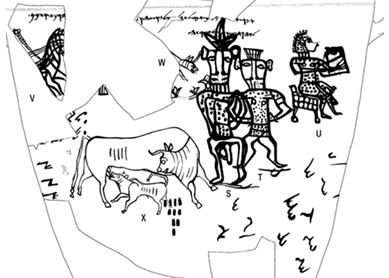
We also know this. When Egypt was collapsing in the late Bronze Age, a Pharaoh wrote a stele, complaining of slave uprisings by a group of nomads on the fringes of his empire. He calls those people Habiru. The biblical historian notes the linguistic similarity between these people and the Hebrews.
This is what we think we know: the poorest people of many ethnicities rebelled together against a decaying empire some time around the late Bronze Age.
They met at a mountain.
The stories they tell of their experiences at that mountain are fantastical. Fire descended from heaven. Thunder crashed and lightning roared. Thick smoke descended over the peak. The earth trembled violently. The Creator of Heaven and Earth became manifest before them.
How can we know if any of this happened? Nobody else could have testified to what they saw. There are no contemporary meteorological records. There are only two possibilities: either the authors of our Torah really believed that was what they experienced, or they made it up.
If they made it up, so many others were convinced that they had been part of that experience at the mountain, that they faithfully transmitted the story for hundreds of years to their children and grandchildren. Which is more likely: that these people lied, or that they genuinely believed they had a transcendent experience?
This is what we think we know: the poorest people of many ethnicities rebelled together against a decaying empire some time around the late Bronze Age.
At a mountain, they had an experience so profound that they felt as if they saw God manifest, and it changed their lives and the lives of their descendants forever.
The God they thought they heard told them: “Although the whole earth is Mine, you will be for Me a dominion of priests and a holy nation.”
The poorest people in the world affirmed belief in a God who knew no borders and rejected all hierarchies. Every one of these ancient landless waifs would be holy.
According to our Torah, those people entered into a covenant.
Until this point in history, contracts of these kind were predominantly made between empires and vassal states. They took the form: “you will pay me tribute, and I will be your landlord.”
This was a covenant of a new kind. It said:
“you will do justly by one another, and I will be your God.”
They ratified this new agreement and remade what a covenant was. They swore an oath, committing themselves to an entirely new society. They bound themselves to a Law that knew no Sovereign save for a universal God.
They promised that their society would have no more killing; no more trafficking in human beings; no more greed. They declared fealty to each other, to their God; and to their sacred days of rest.
Take our texts. Strip them back. Dig out inconsistencies. Look for parallels in ancient cultures. Pay close attention to language. Discard impossibilities.
From what remains, you can reconstruct the best possible version of events.
This is where we have arrived.
This is what we think we know.
Thousands of years ago, poor people from many ethnicities got together in common rebellion against a decaying empire. They had an experience so profound that they felt as if they saw God manifest.
At a mountain, they made a covenant to create a society based on dignity.
Many hands have since re-written and interpreted that event – but, deep at its core, buried under years of transmission and analysis, was one moment.
This, is what we think we know:
Somewhere in history, there was a slave rebellion by a mountain.
And it was marvellous.
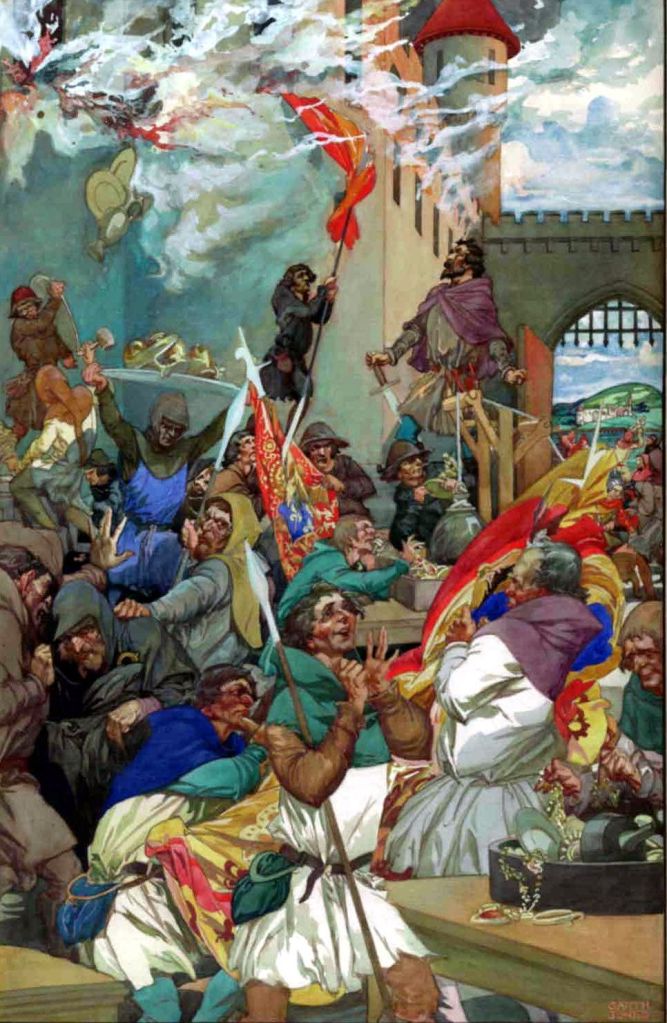
Originally published in Vashti.
The maddening well of war
There is a story – I cannot remember where I heard it – about a village where the well was cursed by an angry magician. Anyone who drank from its water immediately became mad. They became violent and hostile. They were certain of things that could not possibly be true – but when anyone challenged them on their delusions – they flew into a furious rage.
The royals of this town had their own water source. When they tried to talk to their subjects, they were the ones who were deemed mad. They could not govern, because all the villagers, having drunk from the well, saw their leaders as insane. So, the king and his family went down to the cursed well and drank from it themselves, so that they, too, would be afflicted with insanity, but at least able to retain their power.
In the immediate weeks after October 7th, this story repeated in my mind relentlessly.
When Jews met each other, they immediately scoped each other out. We asked: how are you feeling? Where are you on this?
But the question we were really asking was: have you drunk from the well?
Have you thrown yourself into the grip of the madness that demands war?
At a friend’s house, another Jewish religious leader, having made sure everyone in the room had not swallowed the poisoned water, said: “don’t worry, this happens sometimes. People get angry and frightened and turn to violence, but… it passes. They will calm down.”
So we hunkered down and waited. Waited for the effects of the maddening well of war to wear off.
A ceasefire and a hostage deal. Those were the words coming from everyone who had not drunk from the well.
“One day,” we said, “everyone will say they always opposed this.”
“And, when they do, we will not begrudge them for it. We will just be happy to have the killing over.”
I wondered when the day would come. When people would finally come to their senses and say that enough was enough.
Within days, the death toll in Gaza exceeded any number of any previous war. Then, in weeks, it reached into the thousands. Then tens of thousands. It seemed that the numbers dead only made the mad more ravenous.
And we, who said it should stop, were ever more out of sync with our society; ever more criminally insane.
A ceasefire and a hostage deal. It was a basic humanitarian position that guaranteed everyone got to live. It would bring the captives home and stop the massacre of Gaza.
There were moments, even, when they demonstrated what could be. Temporary ceasefires with limited hostage releases. But, even then, the drive to war was insatiable.
I have asked myself many searching questions over the last eighteen months. Increasingly, the one that pains me is: what happens the day after this all ends, when my people finally awaken from their stupor? What will Jews and Judaism have become when the effects of the well wear off and everyone finally sees what happened?
There have been so many needless deaths. So much unfathomable destruction. So many dreams have been killed.
Now, I think that people are finally shaking the madness. I feel I can talk more openly, and I see others doing the same.
I feel ashamed. I feel like I did not do enough to prevent this. I wish I had been louder and bolder from the start. I wish I had been prepared for this, so I wouldn’t be shocked by it. I regret having turned away from watching at times, unable to bear the pain.
And you? How are you feeling now? Where are you on this?
I have a feeling that, after a year and a half, something is finally changing. Now it seems like the ripple of peace may become an anti-war wave. Maybe now the cleansing waters of truth will finally come and dilute all the curses of the well.
If you are one of the people who feels like your heart is beginning to turn, you are not alone.
I do not begrudge you. Trauma does that. Anger and fear can break you, and you don’t know how and when it will happen.
I am just happy that the killing may finally come to an end.
Now there is even more trauma to heal. Now there is even more peace to pursue.
We have been waiting for you. We are still waiting for you.
But the well is still there.
The war machine is still waiting for you, too.
Don’t make trans people scapegoats
“It makes no sense to hate anybody. It makes no sense to be racist or sexist or anything like that. Because whoever you hate will end up in your family. You don’t like gays? You’re gonna have a gay son. You don’t like Puerto Ricans? Your daughter’s gonna come home Livin’ La Vida Loca!”
This quotation is so erudite, you may wonder which ancient sage said it. That was in fact, the comedian Chris Rock, in his 1999 “Bigger and Blacker” set.
I must have been about 10 when I heard that line, but it has always stuck with me. Over the years since, I have watched it become true. The world is so small that whatever bigotries someone holds, the people they hate are bound to end up in their own homes.
Recently, I realised that this had happened to me. I hope I am not much of a hater, but a friend pointed out to me how much I used to make jokes about Surrey. I used to say that we should saw around the county lines of Surrey and sink it into the sea, drowning all the golf courses and making a shorter trip for Londoners to the beach.
Now, here I am, eating my words. I am about to marry a man from Surrey and have all my in-laws in Surrey. I’m the rabbi for a congregation in Surrey, and looking to move as soon as I can to Surrey. That thing I hated, even in jest, is right here in my family and inside of me.
I had some terrible stereotypes that everyone who lived here was a tax-dodging, fox-hunting billionaire. They weren’t grounded in reality. They were just about my own fears, projected onto people I had never met.
Chris Rock was right. Whoever you hate will end up in your family.
More than that: whoever you hate is already something inside of you.
All of us can do it: we can stereotype, generalise, and project all our antagonisms onto a group as a way to cast off all the fears we have about ourselves. What do we call someone who captures all this externalised hatred? A scapegoat.
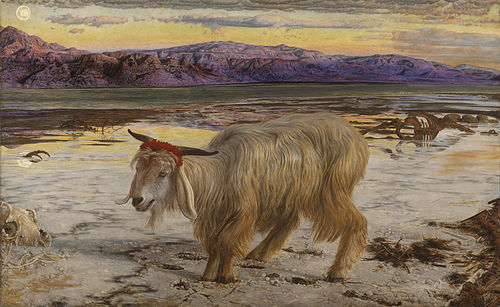
In this week’s Torah portion, we read about the original scapegoat. As part of the rituals for collective atonement, Aaron the High Priest gets two goats and brings them into the tabernacle. They pick straws for the goats.
The lucky one is to be sacrificed for God. Onto the lucky one, Aaron ceremonially transmits all the sins of the Israelites, then chases it out into the wilderness. As it scarpers off, the scapegoat symbolically carries away all of the Israelites’ misdeeds.
The biblical narrative describes a psychological trick we can all play on ourselves. When we are ashamed of something inside ourselves, we take all that fear, turn it into hatred, and throw it at whatever unwitting bystander will carry it.
Is this not precisely what Britain has been doing to trans people?
Gender is changing. The roles of men and women are shifting dramatically. There are so many new ways to live gender, to express ourselves, and to talk about our identities.
Rather than embrace these changes and think about what opportunities they can afford us all to be more free, reactionary parts of British society have whipped up a concoction of bigotry and thrown it all at trans people. Every anxiety our bigots have about gender has been exaggerated and projected onto one small part of the population, who have been turned into monsters through these prejudiced eyes.
It makes sense that people will find social changes scary and destabilising, but why should trans people bear the brunt of those fears?
A few years ago, I went to hear a panel of esteemed Jewish leaders give a retrospective talk about the ordination of gay, lesbian, bi and trans rabbis. On the bimah was Rabbi Indigo Raphael, Europe’s first openly trans rabbi.
In his opening words to the congregation, Rabbi Raphael proclaimed: “I am a transgender man. I am not an agenda; I am not an ideology; and you can’t catch trans by respecting my pronouns.” The room immediately erupted into applause.
He should not need to say it. He shouldn’t need to defend his own existence, but such is the level of moral panic in parts of Britain that he has to assert his right not to be scapegoated before he can even teach Torah.
In the last few weeks, trans people have been subjected to legal rulings and government decrees that may make their lives unlivable and keep them from basic participation in public life. Like the goats of the ancient world, they are being cast out into the wilderness to carry away all of people’s fears.
It should not be this way.
When we feel like scapegoating others, the best thing to do is look inside ourselves. We need to face our fears and work out why others bother us. The chances are, it’s something in ourselves that we’re not happy with, and when we need to get right with our own souls.
When we get to know those we “other” we get to know ourselves better. And when we realise we can like the difference in others, we learn more about what we can like in ourselves.
Reflecting on this, Margaret Moers Wenig, an American Reform rabbi wrote an essay called “Spiritual Lessons from Transsexuals.” She talks about how knowing trans people has enriched her own spiritual life.
Interacting with trans people, Rabbi Wenig says, has taught her that all of us can craft our bodies as we will; we are all more than just our flesh and blood; we have living souls that can differ from others’ assumptions; that only God knows who we truly are. These are wonderful lessons that can only be learned when we turn away from fear and embrace curiosity.
They chime with my own experiences. At first, knowing trans people made me question myself. If gender is something we can change, am I really a man? With time, seeing other people embrace their gender and become who they are has made me feel far more happy in my own gender. I am a man, and I like being a man, and I like being an effeminate man.
When we turn away from fear, we see that we have no need for scapegoats. The parts within us don’t need to be divided up so that some are holy and others need to be chased out into the wilderness. Every part of us is for God.
The world has more than enough hate. It’s time we swapped it for loving curiosity.
After all, Surrey, it turns out, is rather lovely.
Shabbat shalom.
Be humble about what we can know
Before the Enlightenment, the world was governed by unknowable spirits and invisible entities.
There was so much we did not know.
If your farm didn’t produce any crops or the skies did not give you enough rain, you did not have modern technology to inform you about drought predictions for the next three years. You would have no way to know that the water coming from your clouds was directly connected to oceans miles away.
But you had your priests, and your rituals, and your superstitions. You had small gods in the hill country to which you offered libations. And, so far, when you had upheld your traditions, the rain came as it was supposed to.
When you got sick with a skin infection, you could not see a GP who would consult a modern medicine manual and give you a cream that would clear it up in just a few days. You would not have knowledge about germs, allergies, and viruses.
But you had your priests, and your rituals, and your superstitions. You had your rules governing sin and repentance. You had reliable experience that bodily suffering could be healed by atonement. And, so far, when you had upheld your traditions, the rain came as it was supposed to.
Please hold this in mind as we read this week’s Torah portion.
It may be easy for a modern mind, after the Enlightenment, to scoff at the strange priests, rituals, and superstitions that govern these chapters in the Book of Leviticus.
You might feel slightly embarrassed to imagine the rites our ancestors slit open goats, threw their entrails around and burned them for days until they stunk out a tent as expiation for their sins.
You might squirm at the vivid descriptions of cotton-clad priests flailing around the limbs of slaughtered cattle to win the favour of their god.
It may even seem primitive how they delight at the animal fat creating explosive fire, which they see as evidence of their god’s approval.
But they were doing what they could with what they knew. And they were engaging earnestly with what they did not know. Beyond the world they experienced was an unfathomable mystery, and they wanted to draw closer to it.
Indeed, only verses later, we get an insight into their own feelings of inadequacy. We get a real sense that they knew how much they did not know.
Nadav and Abihu do absolutely everything right. They follow the priests, carry out the rituals, and trust in the superstitions. They are formally inducted into all the correct practices by their father, Aaron the High Priest.
They do everything right. And then they die.
The burning animal fat explodes in a blaze that kills them both.
How can our ancestors make sense of this?
Our Torah gives two answers. The first is from Moses. Moses recalls a prophecy when God said: “Among those who approach me I will be proved holy; in the sight of all the people I will be honored.’”
We may interpret this as a way of Moses defending God. Moses is saying: while this may feel like a violation of our belief system, it is in fact proof of it. Holiness is a very dangerous quality.
God has demonstrated how sacred it is to engage in the rituals. God has shown what honour and risk are involved in holy service.
So, for Moses, this sudden death of their priests does not undermine their belief system. It’s just evidence of how little they understand about their sacred rituals. In the fire, they have reached the limits of their knowledge.
Aaron, too, offers an answer. Silence.
We may interpret Aaron’s unspoken response variously. We may read into it horror, resignation, anger, acceptance, or solemnity.
But regardless of what he was feeling, we see that Aaron has no intellectual answer to the problem. He neither agrees nor disagrees with Moses. Aaron finds the limits of speech. He finds the boundaries of what he can even express.
Moses and Aaron lived in a world of unknowable spirits, governed by superstition. They made sense of their confusing world through priests and sacrifices. And no matter how well they constructed their rituals, they still found their limits.
There were things they did not know.
But we live in an era after such theologies. From the 17th Century onwards, Western Europe was gripped by a profound truth.
As the people challenged the unlimited power of the established church, philosophers pulled apart the stories religions had told.
This was the Enlightenment.
No more would they be hoodwinked by magical thinking or damned by promises of divine retribution. Everything, every idea, would be subjected to ruthless scrutiny. The greats of these generations would challenge the tenets of even science itself.
We live now in a world formed by their ideas. While our ancestors were beholden to talismans, omens, and sacrificial fire, we have evolved to hold modern ideals of truth and rational enquiry.
So, why hasn’t religion disappeared?
Isn’t that the obvious next question?
We have rid ourselves of superstitions, but synagogues are stronger than ever. Most of the world is still deeply religious. Despite constant predictions of its demise, faith remains stronger than ever.
For those who wish to understand God’s persistence after the Enlightenment, they may want to look to Immanuel Kant.
Kant was the last of the Enlightenment thinkers. His impact on this period of intellectual history was so great that some even date its end to his death.
Kant was a profound writer on truth, ethics, the scientific method, and what we can really know. He was also a devout Christian.
Kant was animated by the same questions that bothered our ancestors who witnessed Nadav and Abihu die.
He was not confused about why burning fat could cause a blaze, or why religious rituals didn’t always yield the same results. Those were the questions of the past.
The question still lingered, however: why does it seem like there is no justice in the world? Why do bad things happen to good people, and why do the wicked seem to get away with it? Why, no matter what happens, does evil seem to persist?
In his essay, The Miscarriage of All, Kant says he will put God’s justice before the trial of reason. Kant contemplates all the possible answers.
Maybe what we think is evil isn’t really. Maybe the world works in ways we don’t understand so that evil has to be permitted. Maybe there are other forces in the world beyond God’s goodness.
And Kant gives us an answer, which is… we don’t know.
All of these explanations only expose the limits of our understanding.
None of the answers anybody has come up with is satisfactory.
We are finite beings trying to understand Infinite Truth.
And still, says Kant, we retain our faith.
For Kant, none of these questions undermine the existence of God’s justice. They just show what we do not know.
So, perhaps we need to approach these stories with more humility and less contempt.
The ancient priests may well have splashed ox blood around an altar to ward off sin, but we are no closer to answering the questions that motivated their rituals.
We are barely separated from them by any time at all.
We are still just animals, scrambling in the dark, trying to make sense of our world.
And we still need each other, with all our beliefs and rituals, to get through this life that can seem so unjust.
We are each other’s guides through a mystery we may never resolve.
We need to be humble about what we do not know.

We are waiting for a different Messiah
Some years ago, an Orthodox friend asked me: “what would you do if the Messiah came and it turned out we’d been right about everything? What would you say to the Messiah?”
What would I do if the End of Days came, and Elijah literally came storming out of the whirlwind in a chariot made of fire and declared that the Son of David had arrived to cast judgement? And that we were to be judged on how strictly we had separated men and women; how well we had obeyed family purity laws; how stringently we had adhered to traditional authorities?
What would I say to this Messiah?
I have thought about it for a good few years and I think I now have my answer.
I would say: “F@£& off.”
I would tell that messenger: “You are not my Messiah and you’re not my king. Now go back where you came from.”
In this week’s haftarah, we read the prophet Ezekiel’s vision of the valley of the dry bones. For centuries, Orthodox Judaism has based its understanding of Messianism on these verses.
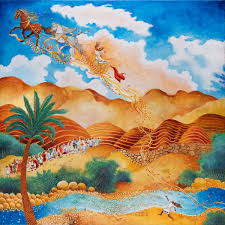
Ezekiel finds himself in a desert surrounded by skeletons. God tells Ezekiel to prophesy to the bones, and he does so, covering them in sinew, breathing life back into their lungs, and reviving their bodies, so that they stand up as a skeleton army.
These, says God, are representative of the people of Israel.
So, Orthodox Jewish tradition teaches, a day will come when the dead are literally physically resurrected. The corpses of pious Jews throughout the ages will be brought back to life; the exiles gathered to Jerusalem; and all judged by a righteous king descended from the biblical King David.
For this reason, many Orthodox Jews eschew cremation, and insist on being buried intact, so that their bodies can be resurrected at the End of Days. They vie for graves on the Mount of Olives, so that they can have front row seats when the Messiah arrives at the walls of Jerusalem and summons up the dead from their tombs.
In recent decades, religious fanatics have come to espouse an even more intense version of this apocalyptic vision.
There are Orthodox Jewish extremists, funded by American evangelical Christians, who are trying to destroy the Al Aqsa Mosque on the Temple Mount; build a Third Temple; and restore animal sacrifice and priestly leadership. They seek to expand Israel’s borders to restore the ancient Kingdom of King David.
This week, Rabbi Charley Baginsky was quoted powerfully in The Times, saying: “We are afraid — not just for Israel’s future, but for Judaism itself. What becomes of our tradition if it is captured by messianic extremism, by racism disguised as religion, by power without principle? If the current trajectory continues, if Jewish supremacy becomes policy, then Judaism itself may become synonymous with oppression.”
In this context, you might be forgiven for thinking that messianism itself is the problem. Surely a religious zeal that drives people to commit such crimes is itself dangerous. For some, witnessing this fervour makes them question the foundations of Judaism itself.
The Israeli religious scholar, Avraham Uriah Kalman, warns against this way of thinking. His article earlier this year, entitled Another Messianism, addresses a tendency in Israeli secular society to dismiss all religion as varying stripes of nationalist fanaticism.
Yet, he claims, precisely because of the strength with which racist extremists have captured Judaism, we must return with equal zeal in our reclamation of Judaism. We, who believe in justice, democracy, and human rights must just as vigorously defend our corner.
If we do not have an equally powerful vision for what society could be, we will always be on the back foot, compromising with monstrous ideologies that want to blow up buildings and raze down villages.
Our ethics are grounded in the Jewish tradition. They are derived from the Jewish texts. They are sourced from the Living God.
We cannot allow the far right to take exclusive hold over any part of Jewish life, or we surrender it to them. That includes Messianism – the grand utopian visions of ideal societies promoted in every book of the Prophets.
The Prophets, whose mission of speaking truth to power and uplifting the lowly, are far more in line with our Progressive visions of the world than they are with the soulless dreams of those who want to oppress women and gays as part of their supremacist agenda.
In the Prophets, we see clear visions of a perfected world. Their writings testify to a world of peace; where all resources are shared; where everyone lives in dignity; and where all are free.
Outside of specific esoteric texts like this week’s mystical imaginings from Ezekiel, it is hard to see any of the far right’s fantasies reflected in our Prophetic texts.
Messianism is really supposed to represent a rupture in the established order, but that is not really what the far right offers. War, racism, and misogyny are already the norm. At core, they don’t really want to change anything except to make existing tendencies more violent and oppressive.
So, says Dr Kalman, progressives must embrace messianism. We must turn to the Prophets as our source of hope, rather than buckling under the weight of despair. From our own utopian visions, we can develop ethics that speak to our daily lives and help us practically realise a better religious vision.
Kalman draws on a whole range of Jewish religious traditions, including Talmud, Kabbalah, Musar, and 17th Century Tzfat mystics.
Yet, curiously, he seems not to be aware that this project, of developing a Progressive Messianism, has already been deeply thought through. The early Reform movement in Germany, from which Liberal Judaism descends, was animated by looking to the Prophets to rethink Jewish eschatology.
The early Reformers taught that the Messiah would not be a man, but an Age.
It would not be characterised by Temple and Kingdom revival, but through the realisation of the values of the Prophets. It would be a world of peace and justice, achieved through the moral advancement of all humanity.
Explaining this theology, Rabbi Sybil Sheridan writes:
“Though the end goal is world peace, the ideal is not pacifism, nor is it the peace of treaties at the end of war that are based on winners and losers. That notion continues the imbalance of power among peoples and nurtures the resentment that leads to dreams of revenge. The peace of the Messianic Age is a peace forged in complete mutuality. No one should be afraid that people may covet their vine or fig tree, no one will fear the loss of land or resources, no one will be humiliated. The world provides enough for everyone and sufficiency will take away the desire for war.”
While we Progressives do not accept the Orthodox doctrine of bodily resurrection and rebuilt Temples, that does not mean we should reject Messianic thinking. Times of despair and horror are when we most need to cling onto our hopes for a better world.
Progressive Messianism takes the task of perfecting the world away from mythical figures like Elijah and King David, and places it directly in our own hands. It says: we will not wait for someone else to bring about redemption; we are going to do it ourselves.
So, if Elijah came down from the Heavens and declared that the Orthodox had been correct all along, I would tell him he was wrong.
For thousands of years, we have sought to create a better world. We have learnt through struggle about the dignity of women; the importance of justice; and the shame of racism. We now have a much better idea of how the world can be.
We can see a future in which every human being lives in harmony with each other and their planet. We can see a world where all live in freedom and peace. We are sure now that we can live in love and equality.
We are going to realise our Messianic age.
And nobody- not even a prophet descending from the skies – is going to stand in our way.
 Sim Lev