high holy days · judaism · sermon

Everything hangs in the balance

Everything hangs in the balance.

Rosh Hashanah is a moment when all judgement is suspended. The scales are suspended, and the weights could fall either way.

At this moment, anything can happen. We reflect on how precarious life is, and how delicately all is held together.

In the light of Rosh Hashanah, our own lives come into focus. How fragile is our existence. 

The rest of the year, we take for granted this delicate balance that allows us to go on living. Today, we notice how remarkable our lives are, and assess what we are doing with them.

Have we embraced life’s blessings and sought to make the most of our days? Have we multiplied joy and generosity in others? What were the moments we squandered or took for granted?

At Rosh Hashanah, we acknowledge our vulnerability. We listen for God’s voice within us. We hear the messages this day brings. God, in turn, hears us. 

Then, we find a way to go on. We affirm our lives.

The stories of Rosh Hashanah point us to moments of precarity. We read of times when life almost did not come about, and of moments when life almost came to an end. Through these ancestral tales, we access our own vulnerability. 

Hannah longs for a child to be born to her barren womb. She asks: “why do I exist?” Then, God hears her anguish, and she gives birth to a boy. His name is Samuel, meaning God hears.

Sarah laughs at the thought that she could conceive in old age, then God remembers her, hears her, and she has Isaac.

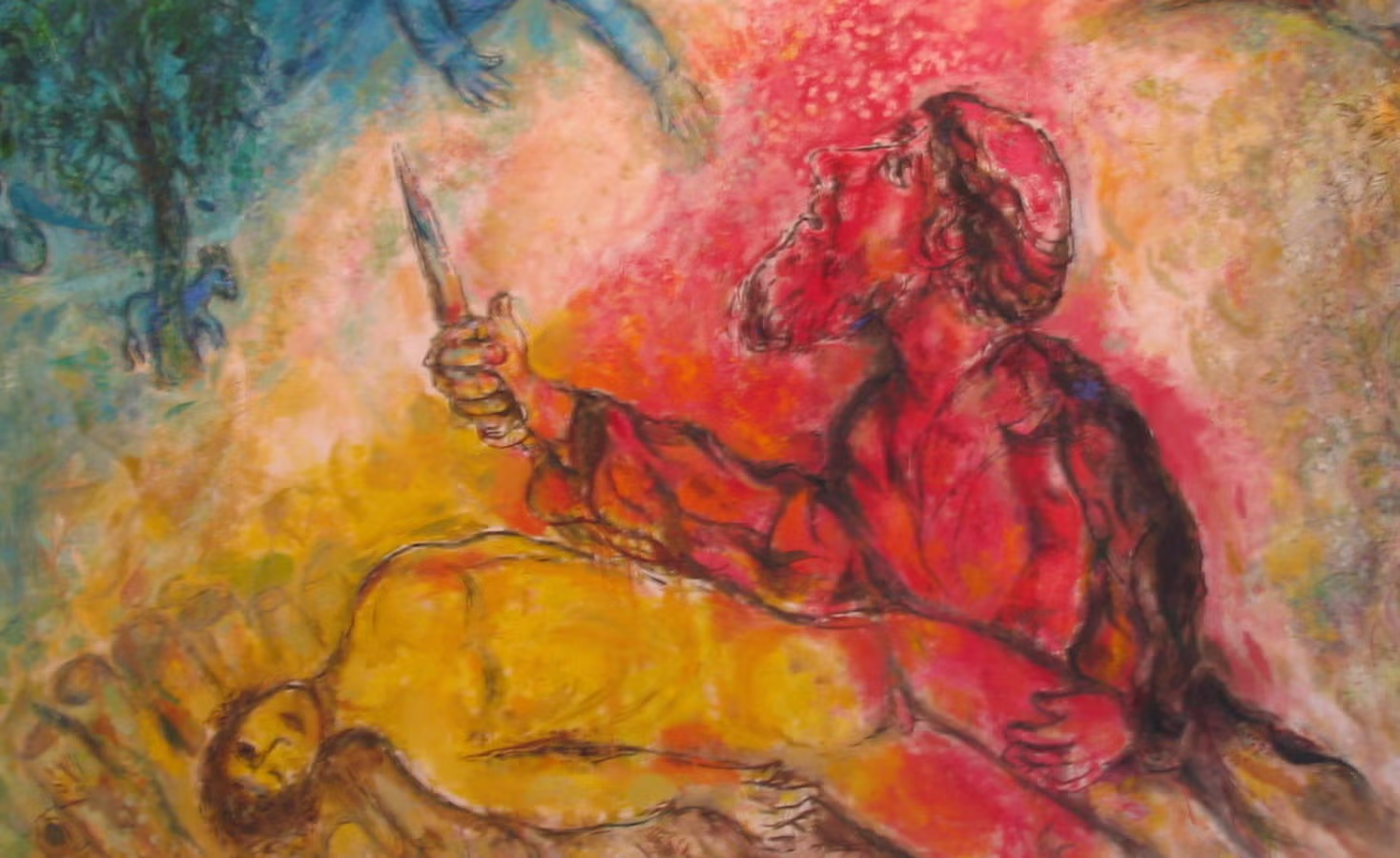
Isaac is destined to be Abraham’s heir, then Abraham takes him up to Mount Moriah to kill him. 

When we picture the Binding of Isaac, we can clearly see Abraham’s raised hand – slaughtering knife outstretched to the sky – ready to murder his own son. We are struck by the moment when all hangs in the balance. 

Finally, God speaks, and Isaac is to be killed no more.

In all these vignettes, we find ourselves caught in stories of people whose lives are racked with precarity, but who listen out for God’s voice, take away a message, and find a way to go on that affirms life.

Interwoven with this story of the main characters, our ancestors, is another story, of people living more marginal lives. The story of Hagar and Ishmael speaks even more explicitly to life’s precarity.

In Orthodox communities, where they observe the second day of Rosh Hashanah, the story of Hagar and Ishmael is usually read today. Here, in the Liberal lectionary, wherein we follow the Israelis and  hold by one day chag, we are given the option of reading either Isaac’s or Ishmael’s story. 

I have opted to read the story of Ishmael because I believe it speaks most clearly to the festival’s theme of life’s uncertainty. Everything about the lives of Hagar and Ishmael is left to the hands of those more powerful than themselves.

Hagar is called a handmaid – a word that glosses over the gross crime inherent in a purchased human being. 

A handmaid had no property, no income, and no family to come and redeem her. Most handmaidens were separated from their own kin, and stripped of their original language. 

Hagar’s name means “the foreigner.” The Torah calls her “the Egyptian.”

She was beholden to her mistress, Sarah. Hers is the most precarious position one could have in life.

A handmaid cost more than a male servant because the handmaid could produce the most valuable good: more slaves. 

Unlike the other women in our readings, Hagar does not long for a child. She expresses no desire; she offers no consent. She is simply used as a vehicle so that Sarah can have a son. 

Abraham will take her as a concubine. The child will be Sarah’s property and Abraham’s heir.

This is already a dangerous situation. If she does not give birth, Hagar fails to deliver on the terms of her purchase. If she does have a child, she could become a rival to her mistress.

That is precisely what happens. 

Hagar becomes pregnant, and Sarah immediately flies into a jealous rage. Hagar runs away, but has nowhere to go. She can either risk the harsh desert as a single pregnant woman, or she can return to an abusive household. 

For Hagar, everything hangs in the balance. Then, God hears her and intervenes. An angel tells her that God knows her suffering, but promises that her life will get better. 

She will bear a son. He will be a highwayman, attacking everyone, and attacked by everyone. His name will be Ishmael, meaning “God has heard.”

As with all our protagonists in Rosh Hashanah stories, Hagar finds her life in the balance. She realises how precarious her existence is. Then, she listens for God. Hearing God, she finds a way to move forward.

So, Hagar returns. And her life hangs in the balance once more. 

This is where the Rosh Hashanah reading begins.

Here, Sarah sees Ishmael playing and demands of Abraham “cast out that slave and her child, because that son-of-a-slave will not share in the inheritance of my son Isaac.”

Abraham followed Sarah’s words, and sent Hagar out into the desert with nothing more than some bread and a skin of water. 

She wandered about in the wilderness of Beersheva until they had completely exhausted her water.

We are told that Hagar sat an arrow-shot away from Ishmael. 

This language seems to make us consider Hagar’s own thoughts: in this moment, Hagar thinks: “maybe I could put the boy out of his misery.” But she cannot do it. She cries out “I do not want to see the child die” and bursts into tears. 

Then God hears. God hears Ishmael’s voice crying out, and sends forth an angel from Heaven. 

Every bit of hope was lost. Everything hung in the balance. But Hagar listened. And God listened. And they heard each other. And Hagar found a way to go on.

The angel says: “כִּי שָׁמַע אֱלֹהִים אֶל קוֹל הַנַּעַר בַּאֲשֶׁר הוּא שָׁם” – “for God has heard the voice of the boy where he is.”

In the Talmud’s treatise on Rosh Hashanah, this is the hook our rabbis use to tell us about our own place before God. 

The rabbis say this means that God hears Ishmael in the moment when he cries out.

To God, Ishmael’s past and future actions matter not. 

God does not care that Ishmael comes from the lowest and most vulnerable place within Israelite society. God does not care about the prediction that Ishmael will go on to be a highwayman. All that matters is that Ishmael cries out at that moment.

This, says the Talmud, is how we should all see ourselves on Rosh Hashanah. Rabbi Yitzhak declares “every person is only judged according to their deeds at their moment of trial.” 

We are only judged by our hearts in this moment of reflection. 

We are not our past mistakes, nor our future errors. We are the people that God beholds today. We are the people who chose to turn up, on this Rosh Hashanah, who knew we wanted to engage with our own souls. 

That is all that God sees.

This is a part of the Talmud’s more general argument about Rosh Hashanah, that it is a time when everything hangs in the balance. 

Our rabbis teach that we should all imagine that the whole world is finely balanced between good and evil, and that it is our responsibility to tip the scales. 

Moreover, say the rabbis, our own hearts are precariously weighted, with an even chance of falling to the side of good or evil. In this analysis, then, the fate of the whole world can rest on just how we direct our own hearts.

So, we need to take every opportunity to place a greater load on the scale of good.

The Talmud offers things we can do to make such a change: give to charity, call out in prayer, and change our behaviour. Any one of these actions can cause a shift in that delicate balance. 

A small prayer, a slight modification to how we act, a donation to a righteous cause – any of these can transform everything.

We live in a time when all can feel uncertain. Life seems nerve-wracking. At times, it does indeed feel like the balance of all the scales in the world is tilting ever more toward evil. 

The Talmud tells us that we still have some control. We can still be a force for good. We can still nudge the fine weightbridge an inch towards goodness.

The Torah gives us examples of people whose own lives hung in the balance. They listened for God, and God listened for them. And God answered “I have heard you where you are.”

So, if you feel like you are hanging in the balance, hang on in there.

God is hanging in there with you.

Shanah tovah. 

high holy days · judaism · sermon

If God can change, why can’t you?

Everyone changes. People change all the time.

In our Scriptures, the changes are often dramatic. 

Avram is an idol worshipper who lives in Mesopotamia, then undergoes complete conversion to monotheism and sets out on foot to a new country. With that, he gets a new name: Abraham.

Sarai is barren then, miraculously, in her old age, conceives a son. God gives her a new name: Sarah.

Jacob is a lying trickster who wrestles with an angel in the wilderness. When his heart has truly changed, he gets a new name: Yisrael. 

In fact, in each biblical story, a change of direction, outlook, and often name, are the key points of the narrative.

So, what about our Rosh Hashanah reading? Who is it that changes there?

In the Aqeidah, our Torah reading for the new year, Abraham is called upon to climb a mountain and sacrifice his son.

We know nothing about Sarah, who is largely kept out of the story. We don’t know anything of how Isaac feels about this, since he stops talking once he realises what his dad could do to him. 

Abraham is remarkably unchanged. At the bottom of the mountain, he is willing to do whatever God says. At the top, God says Abraham is no longer required to sacrifice his son, and to sacrifice the ram instead. At the top of the mountain, Abraham still just does whatever God says.

But there is a character who really changes in this story: God. 

God begins the narrative as zealous and demanding of human sacrifice. God ends the story compassionate and eager to enter into meaningful relationships. God begins by effectively threatening to blot out all of Abraham’s children, then ends by promising Abraham as many descendants as stars in the sky.

And, yes, God undergoes a change of name. Through the whole of the story, God is called Elohim, a name associated with strict justice and universal truth. At the very end, God is revealed by a new name – יהוה – Adonai, a name associated with the close personal relationship God has with every human being. 

In this story, the character who undergoes the greatest change is God.

Even God, the Creator of the world, the Almighty and All-Powerful, can transform. The Holy One, who by nature is completely eternal, can shift from being strict and distant to close and loving.

So, if even God can change, why can’t you?

In our Talmud, the rabbis introduce us to the idea that we are supposed to imitate God.

Rabbi Hama baRabbi Hanina teaches: be like God. Just as God clothed Adam, you will care for the poor. Just as God visited Abraham when he was unwell, you will visit the sick in your community. Just as God consoled Isaac over the death of his father Abraham, you will comfort the mourners. Just as God buried Moses, you will inter the dead.

God shows us a model of how we ought to live. Like God, we are supposed to be compassionate, loving, kind, morally clear, and doing justice in the world.

But more than that. Like God, we are supposed to change.

Here, at Rosh Hashanah, we learn: just as God can change, so can we.

We are made in God’s image. At the start of each year, we read a story where our Creator transforms. So we know that we can change too.

We can face our fast-shifting world. We can rise to the challenge of our changing community. We can look inside ourselves and love our own souls a little more.

Blessed are You, Eternal One our God, who gives us the power to change.

high holy days · sermon

To be the head and not the tail

Everything has changed. Everything keeps changing. 

We meet tonight to pause. 

Tonight is a return to a definite, reliable point in the calendar. While the world spins on outside, for a brief moment, we stop. We reflect. We take stock of all that has changed, so that we might change too.

You have already seen this evening many simanim – symbols of the Rosh Hashanah seder. These small tokens speak to us about what the festival means.

There is another one, though, that you won’t see here, partly because our synagogue is a meat-free site, and partly because it just would not feel right in a Liberal synagogue. 

It is a ram’s head.

Yes, in many New Year seders throughout the centuries, Jews would place the carcass of a sheep’s skull in the centre of the table. This tradition goes all the way back to 9th Century Babylonia.

By the 15th Century, the German rabbi, the Maharil, explained the custom using a phrase from the Psalms: 

שנהיה לראש ולא לזנב 

that we should be the head and not the tail.

There is a play-on-words here. After all, what does Rosh Hashanah literally mean?

The Rosh is the head. It is the head as in the beginning; it is the head as in the body part; and it is the head as in the one who has control. 

This symbolism works because, in Hebrew, a word contains multiple meanings and associations. 

So, the fish head represents our being on top of our own lives.

Now, what about hashanah? The word shanah does indeed mean year, but its root ש-נ-ה also means cycle, difference, repetition, or change

This makes sense: a year is a cycle, a return point that we repeat, each time observing the change. 

So Rosh Hashanah does mean “start of the year.” But, through the associations with the words’ other meanings, Rosh Hashanah is also “the master of change.”

Outside of these walls, the world is full of changes. AI unleashes new technology into a society that has already been completely transformed by the Internet. Our climate is changing, and we are truly starting to notice its effects on our own seasons. 

International relations are changing: violence, war, and fear feel like a new normal. And, of course, we are only a few years out of global pandemic and lockdowns.

So, at this juncture, we return to the start, and try to find a small oasis of calm to reflect on this changing world. 

Yet, inside these walls, things have changed too. This is my first High Holy Days with you. This is your first High Holy Days in the newly refurbished sanctuary. This is our first High Holy Days where we have voted to join a new movement. 

This is our first time doing the High Holy Days without the choir in every service and, as you will see, that means we are changing how we do music.

In every case, these changes will evoke many feelings, including excitement, trepidation, loss, and growth. This is a chance to face all our feelings. 

Change is inevitable. Change can be good. And, yes, change is hard. 

I don’t know about you, but I have changed. I have not just grown a year older since the last Rosh Hashanah. I also feel like I have aged many decades in the last few years.

The world transforms and I shift with it. As I shift, I do not even always notice the ways I change, or work out what they mean. 

I don’t even have time to decide if I like who I am becoming before I find that things changing again.

So, at Rosh Hashanah I come to this space, this synagogue, this everlasting home with God, and ask: can I love myself better? Can I love my community? Can I muster up the strength to face all that is changing? 

Can I find a way to be the head and not the tail?

Blessed are You, Eternal One our God, who gives us the power to change.

halachah · sermon · social justice

How does the Torah say we should treat refugees?

There is a verse in the Torah so radical that one of my teachers did not believe me it was even in there. 

I was working on a project as a rabbinical student and I brought a text that cited this verse. 

“That can’t be in the Torah,” my teacher said. She was a serious scholar, with not only rabbinic ordination but also a PhD in rabbinics and a host of published articles. 

“No ancient society would allow a law like that. The entire economy would collapse.”

I thought, perhaps I had misread it. It was a bold claim. So I went back to look. 

But there it was, nestled among a litany of miscellaneous commandments in Deuteronomy. On one side of this law was the instruction to make sure soldiers did not have nocturnal emissions, and on the other side was the requirement not to bring money gained from prostitution as a Temple offering. 

There it was, a law completely at odds with ancient society, which threatened to collapse an entire economy if enforced:

Do not hand over a slave to his master who is taking refuge with you from his master. He will dwell with you in your neighbourhood in the place he chooses, in one of your gates that is good for him. Do not oppress him.

– Deuteronomy 23:16-17

Let us start by acknowledging why this law is so radical. Ancient agrarian states were built on slavery. Prisoners of war, pillaged people, indentured servants and trafficked humans did back-breaking work to make the farms run. Their unpaid labour was what made the brutal machinations of early states even possible. 

Here we have a rule: do not hand over any slave to their master. The Torah is biased, and it’s not on the side of the owners!

More than this, if you get a runaway, your duty is to look after them. You have to give them accommodation. You have to give it in a place where the refugee himself feels is good for him, within the gates of one of your towns.

This is bold.

But still, it may be I had misunderstood. We already know from many other Torah sources that Israelites cannot be held as slaves. They might be debt labourers and bondsmen, but if somebody is part of the Israelite family, they can never be subjected to lifelong slavery. 

So, perhaps, this law is just talking about what to do if an Israelite runs away. In such a case, they might have been the slave of another Israelite, in which case they were being held against the law. Of course you would then give the slave refuge. 

Or they might have been an Israelite running away from another country, like an Edomite who had captured them in war. Well, then, they have come back to their people and need to be cared for.

So, have I mistranslated? Is this actually about Israelite slaves?

I’d have to look at earlier translations to check what it means. 

The earliest translation of the Torah is Targum Onkelos, a 2nd Century rendition of Scripture into the vernacular Aramaic. 

This translation gives details that clarify things. In this case, it adds an adjective to the Torah’s word for slave. עממין – from the foreign nations. A non-Israelite. The translation is unambiguous: we are talking specifically about foreigners.

This is even more radical. It’s saying we insist on looking after complete outsiders. They have no connection to us. 

They may even, then, be running away from Israelite masters. The Torah is saying that, if a slave runs away from their master, even though the slave is definitely not one of us, and the master might actually be one of us, we are on the side of the slaves.

About a century after this translation, the rabbis in the school of Rabbi Akiva wrote a commentary on the Book of Deuteronomy to expound its meaning. The book is called Sifre Devarim, and it takes all the legal verses from these books and adds oral traditions about how to interpret the laws.

Sifre’s explanation of this verse gives details on how you are supposed to treat a runaway slave when they come to you. Not only do you have to welcome them into your towns, say the rabbis, you also have to make it possible for them to make a living. They have to live with you, and not on the borders of the town.

It adds that the commandment not to oppress the runaway extends even towards words. Even the language you use must be kind. And it insists: you have to make them feel like the place they have come to is better than the one they left.

This is even bolder than where we began. It’s an official open borders policy to every runaway, with the requirement that they not only get refuge but actually get a livelihood and integration in the place where they move to. 

It is not only uneconomical, it goes against all the foundations of the ancient economy. 

You cannot even appeal to other economic reasons. There’s no organised mass of runaway slaves that the law-givers need to accommodate. There’s no suggestion that there was great pressure from the peasantry to be kind to foreigners.

It is a law entirely based on compassion.

What makes this law so radical is that it seems to be motivated entirely by altruism. That is why my teacher was so incredulous about the law being in the Torah at all.

And yet, isn’t that why we turn to the Torah to begin with? Not for cold economics, but to know the right way to live. We want a moral guide for how we should treat people.

Rabbi Julia Neuberger, who serves as a crossbencher in the House of Lords, has been a consistent voice for refugees, as each successive government has threatened hostility and sanctions.

As a lawmaker and a rabbi, she has to balance the high moral demands of our religion with the practicalities of government. 

In all her addresses, she emphasises the need for compassion. She treats refugees as a litmus test for the compassion of a society, because their marginal status tells us how our country is likely to treat everyone else. 

Baroness Neuberger advocates firmly for the rights of refugees.

Perhaps that is why the Torah introduces this seemingly radical rule. It wants to set a culture where the most vulnerable people get the best possible treatment, so that the whole of society will be based on kindness. 

The foundation of Torah law is about caring for the poor, the orphan, and the widow. This most intense case – a complete outsider running away from slavery – is the Torah’s own test for its moral system. 

It is a test every society faces. How people treat refugees shows what they think of human beings.

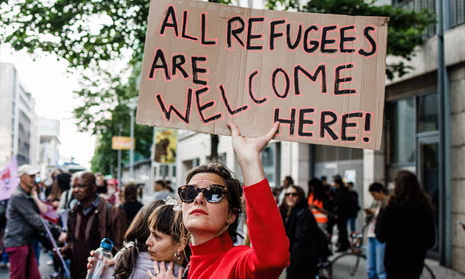
For the past few weeks, protesters have been gathering outside hotels, demanding refugees be sent back. The main political parties have entered into a race to the bottom for how unwelcome they would make refugees. 

Their rhetoric and laws may turn out to be a threat to us all. They may undermine the very basis of a compassionate society. 

Let us consider what would happen if Britain implemented Torah laws in its approach to refugees.

What would happen if this country made an active decision to welcome refugees and refuse to send them back? To deliberately integrate them and make sure they were firmly part of our towns? To set them up so that they could make a livelihood and refuse any insult to them? 

Would this collapse our economy, or would it make this place better for everyone?

And, if we had to choose, why would we not choose to follow the Torah?

Shabbat shalom.

judaism · theology

A Theological Platform for a Judaism that Does Not Yet Exist

1. We are living in apocalyptic times. War, climate disaster, and neoliberal capitalism are plunging us into ongoing and worsening crisis. Apocalyptic times call for apocalyptic theologies.

2. When we survey how Jewish people rebuilt their communities in the face of devastation, we see that Jews have stubbornly held onto hope. From the destructions of the Temples, through Crusades and Expulsions, to colonialism and genocide, our greatest leaders have never wallowed in despair. They always reaffirmed their faith in God and humanity.

3. The task of building the Messianic age is more pressing than ever. Like our forebears, we affirm that the Messiah will not be a man, but a time, in which all will understand the Oneness that lies beneath all superficial differences. The Messianic Age will be defined by equality between people, peace between nations, and harmony with nature. Our task is to build it.

4. Because of faith in God, we understand that our desire for a transformed world is sacred and just. With an outstretched arm and wondrous deeds, God liberated the slaves from Egypt. God hears the cries of all who suffer and shares their pain. God continues to defend the dignity of all who are subjugated.

5. In every age, our people have sought to understand the will of God. In their hardship, they communed with their Creator. Out of their struggles, they developed theologies. These are our inheritance: Torah; Prophets; Writings; rabbinic literature; Jewish philosophies. We claim them for our own time.

6. Our texts are central to our worldview. They are incomplete and polyvocal. We will never make idols of them by treating them as unquestionable authorities. Rather, they are our dialogue partners to understand our God, our world, and ourselves. We uphold the tradition of questioning, reconsidering, and retelling. Every answer is open to interrogation.

7. We affirm belief in the pure monotheism to which our ancestors aspired. We seek to connect with God, who is singular and infinite; immaterial and transcendent; eminent and imminent. Our God is nevertheless directly part of our lives. As the source of ultimate truth, God seeks to impart to us truth as we can understand it.

8. Life has meaning. Its meaning is intrinsic. Everything that lives on this earth was placed here deliberately by a loving Creator to serve a purpose. All that affirms life affirms God.

9. Jews are called upon specifically and by name. We feel that the task of healing the world has been entrusted to us, personally and collectively. This is what it means to be chosen. The task of Jews is to speak God’s truth and to fulfill God’s dominion on earth. A world ruled by God will be one in which no human being can subjugate another.

10. God created all people, replete with diversity, deliberately. We do not wish to make others like us. We reject any uniformity. We accept that people inhabit multiple, contradictory, and overlapping spiritual realities.

11. We bring our spiritual reality to life through our rituals. Our laws, practices and customs are all articulations of our moral purpose. Even where they carry no obvious moral instruction, they instill within us discipline, wonder at creation, and hold us together in community.

12. Our ancestors call to us from history. As refugees and outcasts, they knew what it was to live on the margins. Their memories demand vindication.

13. We have witnessed the progress of humanity. Scientists have developed incredible medicines. Engineers have shown how to harness natural resources to power the entire planet. Activists have shown how collective strength can transform history. We believe that it is our duty to sustain that progress.

14. In the hands of oppressors, progress is a dangerous force. Warmongers have found ever more efficient ways to kill. Capitalists have found increasingly profitable ways to exploit. We have seen how human ingenuity can be employed for systemic violence. We must wrest the tools of progress from those who worship the false god of wealth.

15. Nationalism is a sickness that is plaguing the world. We repudiate all xenophobia and chauvinism. We will not worship the false idols of states and their symbols. We reject all efforts to politically divide humanity.

16. Until all of humanity is fully redeemed, we remain in exile. Only when everyone has achieved full political, economic and spiritual freedom can we say we have reached our Jerusalem. The earthly Jerusalem is as much a part of exile as any other city, until the day when it becomes the heartland for peace and brings all humanity into unity with God. As such, we align ourselves with all those who seek to bring about an earthly Jerusalem based on the prophets’ visions of dignity, human rights, and liberation.

17. Individualism is killing us. Human beings have survived by being social creatures. The ideas of autonomy and personal choice do not serve us in this age. We need to resist the atomisation of people and create community, which necessitates sharing norms, ideals, and practices.

18. We see the Jewish family as expansive and interconnected. We are all responsible for one another, and want to live as if we are one family. This includes a commitment to loving rebuke where necessary.

19. We return to halachah. We see it not as the binding decisions of previous generations but as the creative forum of the present, in which we find new ways to live by our shared values.

20. We commit to Jewish time, which is shaped like a snail shell: always progressing, and always returning to the same points. We return constantly to our shabbats, our fasts, and our festivals. Every time we return to them, we learn more of what God requires of us, and we urge ourselves on to the next stage of our development.

21. The end of time is coming. It does not have to be disastrous. It could be wondrous. Our telos is a perfected world. We will never reach it. We will always fight for it.

Rabbi Lev Saul

judaism · sermon · theology

What’s so bad about idolatry?


In the distant past, people made small gods. They carved out wooden statuettes to represent fertility, or hewed rocks into the shapes of animals that would bring them good luck. They made depictions of stars and planets, which would help them in their daily struggles. The ancients looked after the gods – giving them food, drink, rest, and clothes. In return, their little talismans looked after them.

When Abraham was born, he lived among the idol worshippers of Ur. He had no teacher nor guide, but came to understand, through his own reasoning, that God was the only Creator of all things, and that the world was governed by an invisible Force that could not be depicted. The totems people served were not gods at all, and could have no impact on the world.

As a result, he went around smashing up and destroying every idol and household God he could find. He went around telling everyone that the worship of idols was a great lie, and that the One True God would destroy anyone who bowed down to them. He enjoined his followers, the descendants of Abraham, that they, too, must destroy all idols.

This poses a question: what is so bad about idol worship?

If these are just empty vessels, why fear them? If they are not really gods, what harm can they do? Why should idols be so concerning that we must smash them up everywhere we find them?

By the time we get to the end of Moses’s life, here in the Book of Deuteronomy, the aversion to idol worship is even more intense.

At the start of Re’eh, Moses instructs the Israelites to find every idol, tear down the pillars, smash up the altars, cut down their gods, and destroy any memory that these false gods ever lived there.

If a seer comes to you, says Moses, and they say they have had a vision that you should worship idols, you must kill them instantly. You must purge them and their evil words.

If your own brother, sister, mother, father, or friend wants you to worship idols, Moses says, show them no pity. Don’t try to stop anyone from killing them. In fact, make sure it is your own hand that strikes them down.

And if you find out that there is a town where people worship idols, go and kill everyone in it. Bring everyone from the town together and slaughter them. Bring everything from that town into the square and burn it to the ground. Destroy that city in its entirety and never let anybody rebuild it.

This feels like something of an over-reaction.

How can idol worship be so bad that it is worse than murder, worse than cutting off your own kin, worse even than razing a city to the ground? Why should this practice of building little statues be so intimidating that it requires such destruction?

This feels completely out of place with our moral sensibilities. That’s not just a modern thing.

Even in the 13th Century, rabbis were worried about this injunction. Rambam, the great rabbinic decisor who codified all of the Torah’s laws, was also concerned.

Rambam lived among Muslims and Christians in medieval Egypt. He admired and appreciated them. He read the works of the great Greeks who had never known monotheism, like Plato and Aristotle. He found them wise and inspiring. He was deeply opposed to fundamentalism and chauvinism. Rambam, like us, was not really up for burning cities to the ground just because they did not follow our God.

Rambam says: don’t worry. The world for which these laws were written no longer exists. People don’t worship idols any more. Whatever perverse practices the Pagans once did, they are not doing them now.

Even if they did exist, we would not have the authority to burn a city to the ground like that. You would need a Sanhedrin – a court of 71 learned judges who could recite the laws in their entirety – and we have not had one of those for many centuries.

Even if the idol worshippers did still exist, and we did still have a Sanhedrin, the Sanhedrin would necessarily make sure to do everything possible to educate the idolaters away from their ill-conceived practices, help them to repent, and find ways to make sure they can live in the true religion of monotheism.

So, don’t worry, says Rambam, we can forget about all that.

But the trouble is we can’t.

It’s there in the Torah. We read it every year. Rambam still has to go and codify all these bloody edicts, that make such monsters of people who pray to fetishes.

And Rambam does not answer my fundamental question. The people who bow down to wood and stone might be wrong; their beliefs might be misplaced; but what is so bad about giving a drop of wine to a brick?

The most compelling answer I have found comes from a 20th Century psychoanalyst. Erich Fromm was born in Frankfurt, Germany, at the start of the last century. He studied psychiatry and philosophy among the greats of his generation, then moved, in 1934 to America, where he became a leading writer and critic of modern society. Needless to say, he was Jewish.

In 1976, Erich Fromm wrote a landmark book called “To Have or To Be.” This text became the cornerstone of the anti-consumerist movement.

Fromm engaged seriously with our religious texts. He saw them as inspiring people with a serious psychological message about how to live.

The difference between real worship and idolatry, says Fromm, is not what you worship, but how you do it. He calls it the “being mode” and the “having mode”.

The problem with idolatry, says Fromm, is that it makes you think God is something you can own.

Hebrew monotheism is a rejection of the entire enterprise of having a god:

“The God of the Old Testament is, first of all, a negation of idols, of gods whom one can have… The concept of God transcends itself from the very beginning. God must not have a name; no image must be made of God.”

Fromm writes:

“God, originally a symbol for the highest value that we can experience within us, becomes, in the having mode, an idol. In the prophetic concept, an idol is a thing that we ourselves make and project our own powers into, thus impoverishing ourselves. We then submit to our creation and by our submission are in touch with ourselves in an alienated form. While I can have the idol because it is a thing, by my submission to it, it, simultaneously, has me.”

So, for Fromm, idol worship isn’t over at all. In fact, it is a pitfall any of us can stumble into. If you think that faith is something you can have, rather than a way of living, you are guilty of idolatry. Fromm says:

“Faith, in the having mode, is a crutch for those who want to be certain, those who want an answer to life without daring to search for it themselves.”

Fromm goes further. It’s not just about God. It’s about everything. Do you want to be in this world, or do you want to have it? If you think you can have it, you will never be satisfied. But if you can truly be in it, you will find no need to have any desires met. Fromm says:

“The attitude inherent in consumerism is that of swallowing the whole world.”

Fromm even extends his philosophy to how we love. Do not try to have love, he warns, but try to be in love.

“To love is a productive activity. It implies caring for, knowing, responding, affirming, enjoying: the person, the tree, the painting, the idea. It means bringing to life, increasing his/her/its aliveness. It is a process, self-renewing and self-increasing.”

If we take Fromm seriously, we have a whole new way of looking at the world. Inspired by the prophets, everything we do can be about existing and loving and being. We can reject the whole ideology of possessing.

That is what is wrong with idolatry. The artefacts of the Pagans aren’t just wooden blocks. They tell us a way of living. The wrong way of living. They direct us to control and own.

Rambam may be right. The idolaters do not exist in cities any more.

Instead, today, they live in our own minds. And we must burn them down, if we are to be truly free.

Shabbat shalom.

protest · sermon · theology

We are guests in God’s mansion


Suppose you woke up one morning and discovered, to your surprise, that you had inherited an enormous mansion.

The lord of the manor has welcomed you as a guest to his entire estate. You have no need to pay rent.

This country villa has plush places to sleep, wonderful waters to swim in, and endless entertainment.

More than that, this house is magical. It provides for your every need. Its luscious garden grows your favourite fruit and vegetables. There is plenty of space to graze and raise whatever animals you desire.

It belongs to you and your descendants forever.

What if I told you that you had indeed been bequeathed such a home, and that you were already living in it?

It is this Earth.

That is how Moses understood the planet on which we live when he instructed the Israelites in Deuteronomy. Moses wanted to impart to the people what a miracle it was to be alive, and to get to live in this abundant and fertile world.

So, says Moses, “the Eternal One your God is bringing you into a good land – with brooks, streams, and deep springs gushing out into the valleys and hills; a land with wheat and barley, vines and fig trees, pomegranates, olive oil and honey; a land where you can eat bread and never run out, where you will lack nothing; a land where the rocks are iron and you can dig copper out of the hills.”

This is the biblical mindset. You are guests in God’s mansion.

You have inherited a paradise and it is the whole world. The seas, the ice caps, the deserts, the mountains, and the forests. They are all yours. And they are all everyone else’s too.

Every human being was granted this world as a gift. Every living creature was placed here by their loving Creator.

Now, if you inherited a mansion like that, you wouldn’t trash it on the first day. You’d want to look after it and make sure your children and theirs got to enjoy it the way you did. You’d want to make sure the grass stayed green and the water kept flowing and the fruit trees kept producing. You’d want to know that everybody would be able to dwell in it for all time.

So, says Moses: “Keep faithfully every commandment I am giving to you this day, so that you can thrive and increase and come and inherit this land which was promised to your ancestors.”

Yes, this land requires no rent, but it does have conditions attached. You have to tend to it. You cannot be violent or greedy or deceitful. You must regularly redistribute the land, and make sure that everyone who lives in it gets their fill, and make sure everyone gets plenty of time for rest.

Well, these are small stipulations, given how wonderful my portion is. I get to live on this earth, which is so abundant, and all I have to do is look after it and share it? It sounds like a fantastic deal.

It is, but there is a trap. You see, you might get used to how great this mansion is. You might forget who gave it to you.

You might commit the gravest sin: you might think that this is yours, and yours alone.

This, says Moses, is a terrible error. “You may say to yourself, “My power and the strength of my hands have produced this wealth for me.” Instead, remember the Eternal One your God, for it is God who gives you the power to produce wealth.”

You might think that you earned the mansion, and you built it, and you can do with it as you please. Well, then, you would become a threat. A threat to the mansion and everyone that lives there. A threat to its babbling brooks and fig trees.

If you fool yourself into thinking this is yours, warns Moses, then “your heart will become proud and you will forget the Eternal One, your God, who brought you out of Egypt, out of the land of slavery.”

Yes, you have a dark past. A history of slaves and masters. There was a time when people claimed ownership over everything. They declared that the Nile River and the rainwater belonged to them. They hoarded the grain and took possession over the vineyards. They owned the animals. They even owned you.

Do you want to go back there?

Now, look around at our home, here in Surrey. This place truly is wonderful. Working here, I have had the chance to paddleboard down the River Wey, walk on the Surrey Downs, and watch others swim in Divers Cove. I can really believe this county was a gift from God.

And yet this county is certainly not treated as a common treasury.

How did it happen that God’s creation became so gated?

You see, Moses’s description of the world as a common heritage bequeathed by God wasn’t just an idle fantasy. That was how many people saw the world throughout a large part of history.

Until the start of the 17th Century, large swathes of English land were held in common by all people. This meant that everyone could graze the land together. They could rotate crops together; care for the land together; and make sure everyone got fed.

It’s not that England was one great egalitarian utopia. Far from it. There had been kings, paupers, lords, peasants, and landless workers, for centuries. But, at least a part of it was treated as a shared inheritance.

Then, in 1605, the government began a process called Inclosure. They took all that had been previously common and handed it over to the already wealthy. They stripped the poor from their land and forced them into the cities to work in factories. They destroyed whole ways of life.

This mansion, already divided, became the possession of just a few. Just as Moses had warned, the wealthy imagined that their power had come about by their own hands. They thought of themselves as more than lords; more than pharaohs: as gods.

Now, right here in Surrey, a group of people tried to resist them. In 1649, on St George’s Hill, and at Little Heath near Cobham, a group of religious dissidents got together, and decided that they would take the land back from the lords. They were called The Diggers.

Their leader, Gerard Winstanley, has a memorial plaque near Weybridge Station, and there is a tour you can take with historic placards, showing where the Diggers went.

The Diggers wanted a return to the Law of Moses and the biblical attitude.

In the Levellers’ Standard, Gerard Winstanley wrote: “The Earth (which was made to be a Common Treasury of relief for all, both Beasts and Men) was hedged in to In-closures by the teachers and rulers, and the others were made Servants and Slaves: And that Earth that is within this Creation made a Common Store-house for all, is bought and sold, and kept in the hands of a few, whereby the great Creator is mightily dishonoured, as if he were a respector of persons, delighting in the comfortable Livelihoods of some, and rejoycing in the miserable povertie and straits of others.”

Like Moses before him, Winstanley was adamant that God was not a propertarian but a generous host, and human beings simply welcome guests. How, then, could some divide up the land and force others off of it?

The Diggers lost their battle for the land, and the world we inherit is made according to the laws of those who enacted Inclosure.

But there is a message, that rings out through time, from the era of Moses through the 17th Century, and right up to today.

That message is that this world is a paradise, bequeathed to us all. And we need to act like it is so.

Shabbat shalom.

israel · sermon · torah

This is Torah. This is its reward.

Loving others will not make you popular.

Pursuing peace will not make you safe.

Choosing life will not protect you from death.

But, if you do not love others, if you do not seek peace, if you do not choose life, who will you be?

When Moses ascended Sinai, he found God adding flourishes to the Torah’s letters, which only Rabbi Akiva would ever be able to read. Moses asked to see what became of Akiva.

The Holy One showed Moses how the Romans flayed Rabbi Akiva’s skin as they martyred him, then sold his flesh in their marketplace.

Moses threw his hands in the air and demanded: “Is this Torah, and this its reward?”

“Silence,” said God. “Such is My will.”

This is Torah. This is its reward.

Vivian Silver was murdered by Hamas on October 7th.

Vivian Silver founded the Israeli peace organisation, Women Wage Peace. She worked for human rights groups like Btzelem and ALLMEP. She lived on Kibbutz Beeri, near the Gaza border, where she engaged in solidarity work with Bedouins, Gazans, and Palestinian construction workers.

Three days before October 7th, she organised a march of 1500 Israeli and Palestinian women for peace.

On October 7th 2023, terrorists broke into her home and murdered her.

Even as she hid from the militants, she gave an interview to Israeli radio, where she said the very fact that she was under attack showed the need for a peace deal.

A year later, her son, Yonatan Zeigen, eulogised her. He said:

“Being a peace activist is not something to save you from being killed in war. It’s something to prevent a war from happening. And to create a reality where war is not an option.”

Silver’s love of others did not make her popular.

Pursuing peace did not make her safe.

Choosing life did not protect her from death.

But it made her fully human.

This is Torah. This is its reward.

On Monday evening, as my community sat down to listen to poetry in preparation for Tisha B’Av, I received a text to say that a Palestinian peace activist I knew had been murdered.

Awdah Hathaleen was shot in the chest in his home.

Awdah lived in the village of Umm al-Khair in the south Hebron hills. I visited his village twice last year with Rabbis for Human Rights. The second time, I stayed in the bunk beds adjacent to his home. In the morning, he brought breakfast to me and the other solidarity activists.

A delegation of Progressive rabbis met Awdah earlier this year when they went to the West Bank with Yachad.

Awdah was an English teacher. He was born in the south Hebron hills and had known tanks, guns and occupation all his life. He worked with Israelis to protect his home and build a peaceful future.

This did not make him popular. For some Palestinians in neighbouring villages, this meant that he was engaged in normalisation with the Israeli occupier.

Indeed, after the Oscar-winning movie about his village, No Other Land, gained international recognition, the BDS movement called to boycott it, because it showed Israelis and Palestinians working together.

Awdah chose the path of non-violence. Even after his uncle, Haj Suleiman, was crushed by an Israeli police tow truck; yes, even after his elder was cruelly murdered; and yes, even after those who killed his uncle were never brought to justice; after all that, he still chose the peaceful path.

For the settlers who wanted to capture his home and ethnically cleanse his village, his activism made him a target.

He and his family never knew safety.

Awdah wrote for 972 Magazine, a joint Israeli-Palestinian publication, about the struggles of raising his traumatised son in this village under attack. He wrote: “He even knows some of the settlers by name. Sometimes I tell him that they went to jail; I’m lying, but I want to make him feel safe.”

He was lying. Settlers who carry out murders do not go to jail.

The man who murdered Awdah was called Yinon Levi. He was filmed doing it. Still, the only person who has been taken into custody by the Israeli police is Awdah’s cousin, Eid, a fellow non-violent activist.

Yinon Levi was already subject to EU sanctions and recognised internationally as a terrorist. But he is protected by government minister, Ben Gvir, who has dedicated his life to helping settlers get away with murder. Even before the far right coalition took power, plenty of settlers had been able to perpetrate atrocities with impunity.

Loving others did not make Awdah popular.

Pursuing peace did not make him safe.

Choosing life did not protect him from death.

No; you will not be better off if you do the right thing.

But God does not ask us to live lives that are comfortable.

There is no commandment in the Torah that we should be popular.

All of us, regardless of religion, are placed on this earth to be God’s stewards; to uphold God’s most sacred commandments; that we must choose life, pursue peace; seek justice; and love the stranger.

This is Torah. This is its reward.

This sacred work comes with no promises. But who else would you want to be?

It is a charge often laid against woolly moralists like me that we do not really get how militants like Hamas think; that we just cannot understand the mentality of the settlers.

That is true. I do not want to think like them. I do not want to become like them.

Who will we be if we let our hearts become warped and set our minds to cruelty?

Loving others will not make you popular. But it will make you loving. And pursuing peace will make you peaceful. And seeking justice will make you just. And that is what your God asks of you.

We are approaching Tisha B’Av, when we recall every catastrophe that befell our people. If you believe that peace is possible and that these assaults on basic humanity are wrong, you can add another disaster to the roster. On Monday, Awdah was murdered.

Yes, a Muslim murdered by a Jew is a tragedy for us all.

A man who was committed to non-violence was shot in the chest by a settler, leaving behind 3 children. He was 31.

Do not give in to cynicism or try to calculate what you might gain for kindness. This world has no guarantees. And we know nothing about the hereafter.

You do what is right because it is right. Because if you do not, who will you be?

This is Torah. This is its reward.

May God have mercy on us all.

debate · judaism · spirituality

The spiritual possibilities for our new Jewish movement 

“The history of a community, like the history of an individual, is marked by the recurrence of periods of self-consciousness and self-analysis. At such times its members consider their aggregate achievements and failures, and mark the tendencies of their corporation.” 

These are the opening words of an essay that gave birth to our Jewish movement. 

In 1898, a social worker named Lily Montagu published an essay in the Jewish Quarterly Review, entitled “The Spiritual Possibilities of Judaism Today.” 

What this pioneering thinker asked of Jewish London was that it take stock of what it had achieved and what it wished to be.  Only by giving an honest and sober account of where we were, could we imagine a better future for our Jewish life.

This is the perfect time to revisit that essay. We are forming a new movement, which will be far bigger and broader than Miss Lily could have anticipated, and may even soon make up the majority of British Jews. Is that not summons enough to the period of introspection Montagu required of us? 

But, more than that, when you look at her essay from over 120 years ago, you can see that the issues Montagu wanted to address had much in common with the challenges facing us today. 

Montagu was scathing in her perception of Anglo-Jewry. She accused it of “materialism and spiritual lethargy” and charged “that Judaism has been allowed by the timid and the indifferent to lose much of its inspiring force.”

Judaism, she felt, was supposed to be a great and inspiring system that would draw Jews closer to God and motivate its adherents to face the real-world challenges of the day. Instead, it had been captured by a lazy spirit that wanted nothing more than to assimilate, appease the establishment, and provide a lackluster imitation of religious rituals. Does that sound familiar?

Montagu assessed how London’s Jews actually lived. She called them “East End Jews” and “West End Jews,” but was clear that this was not just a geographical phenomenon. She was talking about class, culture, and background. 

The “East End Jews” of her day were working class, poor, Ashkenazi immigrants. They were highly observant, but obedient to a fault. They followed along with the old words they already knew, but rarely spent much time thinking about what any of those prayers might mean for their soul. Their main motivation for practising Judaism was a combination of superstition and fear.

“West End Jews,” by contrast, were from higher classes and mixed ethnic backgrounds. They were materialistic, obsessed with status, and only attended synagogue because they thought it was more respectable to be Jewish than to have no religion at all. Yet, she said, by replacing real religion with possessions and status, they ultimately still had a vacuum where religion ought to be.

These types of Jews, as Montagu described them, don’t exist in the same way today as they did then. However much one might nostalgise the factory-working Jews of the Whitechapel shtetl or the days when Jewish aristocrats held drawing room parties in Maida Vale, that world is gone. Economic disparities persist, but far less visibly, and without entire Jewish cultures built around location and class.

She warned that, although the Jews of her age might be economically divided, they still had the same thing in common: their religion was vapid and empty. It was about having an identity rather than having a relationship with God. For both sets of Jews, Montagu argued, Judaism needed a complete spiritual revival.

Apparently, a great number of people agreed with her, because over the years and decades that followed, many came together to form congregations for exactly this purpose. Together, they made the Jewish Religious Union, which then became Liberal Judaism, and is now becoming part of Progressive Judaism. 

Our Judaism has, indeed, been reinvigorated. We have opened up new approaches to liturgy, prayer, and worship. Synagogue teams come together to make sure that every Shabbat and festival is meaningful.

Montagu warned a previous generation that they would have to actually live Jewishly, or they would not be Jewish at all. Her prediction has come true, as some generations have just shaken off their roots, while others have decided to commit to Jewish life entirely. 

One happy surprise is that, through the Liberals’ embrace of converts, we have Jews who are committed and educated in ways previously unknown in earlier generations. The dedication of converts has also inspired those who might have taken their Jewishness for granted to step up their game, learn more, and embrace their heritage.

Miss Lily did not just advocate for spiritual revival, but wanted to see Jews play a full role in the life of Britain. Full citizenship had only been granted to Jews a few decades previously, and Montagu wanted Jews to rise to the challenge. 

Other communal bodies felt that the best thing for Jews to do was toe the establishment line, tell the government how wonderful they were, and hope that they would let us stay in the country without impeding on our religious practices. Our founders wanted us to embrace a more expansive sense of citizenship. 

They wanted us to say: we live here, this is our home, and we have the right to change it. They wanted us not to grovel before power, but to make demands of it. They wanted us to ask ourselves “what does God require of our country?” and go about pushing for it. 

This wasn’t something that belonged to one political persuasion. The intellectual leader, Montefiore was a capital C Conservative. The first Liberal rabbi, Mattuck, was a socialist who wanted the religious institutions to unite with the unions for revolution.

Montagu herself was a political Liberal. She was a suffragist and social reformer. She believed that the pursuit of peace and human rights were sacred commandments. She dedicated herself to alleviating poverty.

While politically diverse, our founders held in common a conviction that Jews could, in conversation with our God, make demands.

We could change the world. The world, too, could change us, and we should not be afraid of it or hide away in ghettos.

Montagu asserted that the youth were crying out for a Judaism that made moral demands and had something to say to their society. If their elders did not rise to the challenge, the next generation of Jews would vanish away into nothingness.

Montagu knew such Jews because her daily life was taken up as a social worker in London’s youth clubs. 

I believe we are facing such a challenge today. Many Jewish young adults are looking at us, including in the movement she founded, and see a Judaism that is reluctant to take stands for fear of rocking the boat. They see a Jewish life where God is, at best, a nice accessory tacked onto a cultural centre. If we look honestly at our own institutions, can we deny their aspersions?

Throughout my twenties, I was one of these disaffected young people, bewildered by why my institutions were so ambivalent on the moral issues of the day, from massive inequality through catastrophic climate change to ongoing Israeli military occupation. 

I felt acutely the absence of religious conviction in the establishment and in the institutions. There were pioneering rabbis who led the way on some issues, like gay rights, women’s equality, and refugees, but they were often marginal, and their impact could be felt only dimly in most synagogues. There was a gap.

In terms of our spiritual life, there were peer-led groups that tried to engage in serious prayer and text study, but you’d struggle to find any evidence for their existence in most synagogues.

I do not know how many young Jews fell by the wayside, but I stuck around. I had a strong sense, at least from my peers, that a better Judaism was possible. That we could speak out on social issues and we could have meaningful spirituality. That the Judaism of tomorrow might be more meaningful. 

Now, in my thirties, I am a part of the establishment I railed against, and I feel that the issues facing Jewish youth are even worse. The moral and spiritual vacuum has only grown wider, and it looks even harder to fill.

I worry that the demands of our age for renewed spirituality and moral meaning are being quietly subsumed under a banner of “inclusivity.”

Inclusion is a positive and noble goal, but it must be inclusion in something. It must have real substance, if it isn’t just trying to market synagogue membership to the lowest common denominator while offering nothing and standing for nothing. 

The challenge facing our movement is, I think, not so much to be broader, but to go deeper. We need to have a deeper relationship with God. We need to ask ourselves searching questions about what God demands of us. We need, as they did over a century ago, a thorough moral and spiritual revival.

In her essay, Montagu warned: “no fresh discovery can be made exactly on the lines of the past; the temperament of one generation differs from that of another.” We cannot apply Montagu’s methods in the same way today. 

But we can ask the same questions that she did, and go through a serious process of reflection, as she suggested.

We can look together for new ways of revitalising our spiritual life, and put God at the centre of our synagogue.

We can work together to provide bold answers to the moral questions of our age. We can ask ourselves what God demands of Britain and hold up those prophetic clarions to our leaders.

These are the spiritual possibilities for Judaism today.

That is the spiritual challenge facing our new movement. 

If we can rise to it, Progressive Judaism may yet last another century and beyond.

debate · sermon · torah

Did the God of the Bible have a body?


After our wedding, everyone was excitedly sharing photos and videos. Laurence pored over them and made albums.

I liked them, but the pictures felt a bit flat. What I was craving was words.

I wanted to re-read everything everyone had said. I went about collecting the speeches people had given, and recounted them again. On honeymoon, Laurence and I re-read our vows to each other, this time pausing and discussing them.

I discovered anew how much more I loved words than pictures or videos. Pictures are static. Even videos, because they only caption one moment from one perspective, feel too final.

To me, words feel so much more alive. Stories are such a great way to engage with events and ideas, because they can be retold so many times and in different ways.

Isn’t this, after all, what religion is: storytelling to access something sublime and unfathomable; a collaboration by people sharing their best narratives and ideas?

We have inherited a literary tradition, our Torah, which is an exercise in storytelling:  a process of openly wondering at the world through poetic sagas and emotion-filled songs.

For some, however, these stories fall flat. They see the words the way that I see pictures.

Fundamentalists will look at our story of a donkey talking to a prophet about an angel and think: that must be the historical truth of what happened.

Similarly, the New Atheists look at this beautiful poetic piece about the prophet Balaam and think: how stupid must religious people be to believe this nonsense?

This is not just a misunderstanding of Scripture. It’s a misunderstanding of storytelling itself.

Seemingly, it does not occur to them that this might be an invitation into conversation. They can’t comprehend that this might be a poem, crying out to be read aloud, sung, chanted, interpreted, and retold to make sense of all the wonders of the world.

Perhaps these talking animals and sword-wielding celestial beings aren’t part of history textbooks but reveal a different kind of truth altogether.

In Britain, we are mercifully spared from most of these types of fundamentalist reading. We don’t have to deal with as many evangelical Christians as our American cousins do.

But we have our own local brand of biblical literalists. They are the radical atheists who have got to know our sacred texts solely for the purpose of showing how irrational they are. The most famous of them is Professor Francesca Stavrakopoulou, a biblical scholar at the University of Exeter.

In 2021, Stavrakopoulou brought out her most recent work, God: An Anatomy. The book’s objective is to show that the God of the Bible was an embodied being. He was a gargantuan man with a big beard who sat on his throne in the Jerusalem Temple, gobbling up the sacrifices priests burned for Him.

The God of the Bible, Stavrakopoulou argues, was just like any other ancient god: basically a massive person with all the associated wants and desires. She collapses about 4,000 years of history and three continents into one culture and seeks to show that the biblical god was just like all the others.

And, like all the others, the biblical god had a body.

Sometimes, her evidence for this scant. There are entire pages dedicated to making quite wild claims about the biblical god, appended with just one footnote that points to an obscure translation of a verse from the Psalms.

But, overall, there is plenty of material to go off. If you open up any page of Tanach, you will probably find God described in anthropomorphic terms.

Take our haftarah.

This week’s reading comes from the book of Habakkuk, a 6th Century BCE Prophet in Judah. The book is a vivid war fantasy, where the prophet describes the Judahites crushing the invading armies, some time in the mythic past, and hopes that it will happen again.

Throughout the text, God comes alive as a warrior. He (and I’m going to use the masculine pronoun advisedly here) is an embodied fighter on behalf of the people.

God’s hand lights up with radiance; God’s feet trample over mountains; God’s piercing eyes make the nations trembled with fear. 

God has all the equipment of an ancient military commander. He rides in on a chariot  with His horses and shoots out arrows from His archer’s bow. God rips the spear from the opposing general’s arm and stabs it into his head.

How are we supposed to read this?

Well, for a biblical literalist, you have to take it at face value. That’s exactly what Stavrakopoulou does. She makes the case that this was precisely how the ancient biblical authors and audience understood their god.

Their god was a big bloke with some massive weapons and blood lust.

Stavrakopoulou draws on other ancient gods, whose worshippers also describe them in embodied terms. The Canaanite high god El also had radiant arms. The Akkadian god Enki also trampled over mountains. The Assyrian god Ashur also fought with a bow.

The Israelites, then, were just riffing on old themes. Like the Pagans around them, they were silly enough to believe in all that religious nonsense of big beings. The biblical god was no different to Zeus or Jupiter.

Overall, reading Stavrakopoulou, you get the impression of someone listening to a concerto who can identify every note from every instrument but cannot hear the music. Her entire objective is to show that the tune isn’t even that good because other songs have been written before.

All the way through, it seems like a strange motivation for going to all the effort of learning Scripture and Ancient Near Eastern texts. Then, we get to the final chapter, entitled “Autopsy,” and we understand her true objectives.

She concludes: “the God of the Bible looks nothing like the deity disected and dismissed by modern atheism. […] Their dead deity is a post-biblical hybrid being, a disembodied, science-free Artificial Intelligence, assembled over two thousand years from selected scraps of ancient Jewish mysticism, Greek philosophy, Christian doctrine, Protestant iconoclasm and European colonialism. In the contemporary age, this composite being has become a god who forgot to create dinosaurs and failed to account for evolution; a god who allows cancer to kill children but hates abortion…”

Stavrakopoulou despises religious belief. So, if she can demonstrate that the biblical god was just like the Egyptian pantheon, and that this embodied god could be killed, then she can also strip the modern god of His powers and kill Him too.

This is the worst of Enlightenment hubris. 19th-century anti-religionists imagined that all religion was just silly superstition, which would eventually be washed away by the cold science of reason.

Our movement, like all progressive religions, has consistently argued for an alternative approach. We see all of history as an evolving effort to understand the sacred mystery beyond our comprehension.

It almost certainly is true that, before Ezra led the exiles back from Babylonian captivity in the 4th Century BCE, most Israelites did worship a small pantheon of Canaanite deities. The Prophets from before this time regularly condemn them for it.

But, while they may have been idolaters, they were not idiots.

If you told one of them that you’d just seen the fertility goddess Asherah out for a stroll in the marketplace, or that the storm god Baal came to your house this morning for a cup of tea, they would think something was wrong with you.

Another scholar of ancient religion, Iraqi Assyriologist Zainab Bahrani, helps us make sense of the ancient worldview. For the Mesopotamians, images were not reproductions of originals like portraits and photographs are for us today.

Instead, they saw their icons as ways of writing existence into being. They were in an active process with their gods of creating reality.

In matters of religion, literal interpretations are dead-ends. Words like metaphor don’t do it justice. Symbols like clay deities stand in for whole cosmologies. They are ways that human beings have tried to understand something that, by definition, is beyond our comprehension.

Perhaps most importantly, Stavrakopoulou misses what a massive departure it was that ancient Israelites abandoned all images in favour of a predominantly literary culture.

In a society where you cannot depict God, but can only engage in description and storytelling, you have to be more imaginative when you try to make sense of infinity.

Poems, sagas, and speeches, like those from our Tanach, are never fixed in their meaning. They are openings that invite listeners to think with them, talk back to them, and struggle for deeper understandings.

When someone reads a text too literally, they strip it of its vitality. Atheists and fundamentalists, both literalists of different kinds, strip the soul from the search for divine truth.

Tell stories, make poems, create art, look for that great truth beyond our reach… and don’t take any of it too seriously.