diary · israel

The maddening well of war

There is a story – I cannot remember where I heard it – about a village where the well was cursed by an angry magician. Anyone who drank from its water immediately became mad. They became violent and hostile. They were certain of things that could not possibly be true – but when anyone challenged them on their delusions – they flew into a furious rage.

The royals of this town had their own water source. When they tried to talk to their subjects, they were the ones who were deemed mad. They could not govern, because all the villagers, having drunk from the well, saw their leaders as insane. So, the king and his family went down to the cursed well and drank from it themselves, so that they, too, would be afflicted with insanity, but at least able to retain their power.

In the immediate weeks after October 7th, this story repeated in my mind relentlessly.

When Jews met each other, they immediately scoped each other out. We asked: how are you feeling? Where are you on this?

But the question we were really asking was: have you drunk from the well?

Have you thrown yourself into the grip of the madness that demands war?

At a friend’s house, another Jewish religious leader, having made sure everyone in the room had not swallowed the poisoned water, said: “don’t worry, this happens sometimes. People get angry and frightened and turn to violence, but… it passes. They will calm down.”

So we hunkered down and waited. Waited for the effects of the maddening well of war to wear off.

A ceasefire and a hostage deal. Those were the words coming from everyone who had not drunk from the well.

“One day,” we said, “everyone will say they always opposed this.”

“And, when they do, we will not begrudge them for it. We will just be happy to have the killing over.”

I wondered when the day would come. When people would finally come to their senses and say that enough was enough.

Within days, the death toll in Gaza exceeded any number of any previous war. Then, in weeks, it reached into the thousands. Then tens of thousands. It seemed that the numbers dead only made the mad more ravenous.

And we, who said it should stop, were ever more out of sync with our society; ever more criminally insane.

A ceasefire and a hostage deal. It was a basic humanitarian position that guaranteed everyone got to live. It would bring the captives home and stop the massacre of Gaza.

There were moments, even, when they demonstrated what could be. Temporary ceasefires with limited hostage releases. But, even then, the drive to war was insatiable.

I have asked myself many searching questions over the last eighteen months. Increasingly, the one that pains me is: what happens the day after this all ends, when my people finally awaken from their stupor? What will Jews and Judaism have become when the effects of the well wear off and everyone finally sees what happened?

There have been so many needless deaths. So much unfathomable destruction. So many dreams have been killed.

Now, I think that people are finally shaking the madness. I feel I can talk more openly, and I see others doing the same.

I feel ashamed. I feel like I did not do enough to prevent this. I wish I had been louder and bolder from the start. I wish I had been prepared for this, so I wouldn’t be shocked by it. I regret having turned away from watching at times, unable to bear the pain.

And you? How are you feeling now? Where are you on this?

I have a feeling that, after a year and a half, something is finally changing. Now it seems like the ripple of peace may become an anti-war wave. Maybe now the cleansing waters of truth will finally come and dilute all the curses of the well.

If you are one of the people who feels like your heart is beginning to turn, you are not alone.

I do not begrudge you. Trauma does that. Anger and fear can break you, and you don’t know how and when it will happen.

I am just happy that the killing may finally come to an end.

Now there is even more trauma to heal. Now there is even more peace to pursue.

We have been waiting for you. We are still waiting for you.

But the well is still there.

The war machine is still waiting for you, too.
sermon · social justice · torah

Don’t make trans people scapegoats

“It makes no sense to hate anybody. It makes no sense to be racist or sexist or anything like that. Because whoever you hate will end up in your family. You don’t like gays? You’re gonna have a gay son. You don’t like Puerto Ricans? Your daughter’s gonna come home Livin’ La Vida Loca!”

This quotation is so erudite, you may wonder which ancient sage said it. That was in fact, the comedian Chris Rock, in his 1999 “Bigger and Blacker” set.

I must have been about 10 when I heard that line, but it has always stuck with me. Over the years since, I have watched it become true. The world is so small that whatever bigotries someone holds, the people they hate are bound to end up in their own homes.

Recently, I realised that this had happened to me. I hope I am not much of a hater, but a friend pointed out to me how much I used to make jokes about Surrey. I used to say that we should saw around the county lines of Surrey and sink it into the sea, drowning all the golf courses and making a shorter trip for Londoners to the beach. 

Now, here I am, eating my words. I am about to marry a man from Surrey and have all my in-laws in Surrey. I’m the rabbi for a congregation in Surrey, and looking to move as soon as I can to Surrey. That thing I hated, even in jest, is right here in my family and inside of me.

I had some terrible stereotypes that everyone who lived here was a tax-dodging, fox-hunting billionaire. They weren’t grounded in reality. They were just about my own fears, projected onto people I had never met. 

Chris Rock was right. Whoever you hate will end up in your family. 

More than that: whoever you hate is already something inside of you. 

All of us can do it: we can stereotype, generalise, and project all our antagonisms onto a group as a way to cast off all the fears we have about ourselves. What do we call someone who captures all this externalised hatred? A scapegoat.

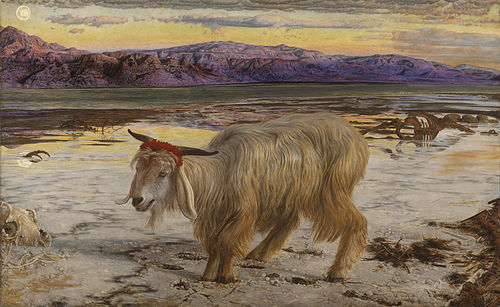
In this week’s Torah portion, we read about the original scapegoat. As part of the rituals for collective atonement, Aaron the High Priest gets two goats and brings them into the tabernacle. They pick straws for the goats. 

The lucky one is to be sacrificed for God. Onto the lucky one, Aaron ceremonially transmits all the sins of the Israelites, then chases it out into the wilderness. As it scarpers off, the scapegoat symbolically carries away all of the Israelites’ misdeeds.

The biblical narrative describes a psychological trick we can all play on ourselves. When we are ashamed of something inside ourselves, we take all that fear, turn it into hatred, and throw it at whatever unwitting bystander will carry it. 

Is this not precisely what Britain has been doing to trans people?

Gender is changing. The roles of men and women are shifting dramatically. There are so many new ways to live gender, to express ourselves, and to talk about our identities. 

Rather than embrace these changes and think about what opportunities they can afford us all to be more free, reactionary parts of British society have whipped up a concoction of bigotry and thrown it all at trans people. Every anxiety our bigots have about gender has been exaggerated and projected onto one small part of the population, who have been turned into monsters through these prejudiced eyes. 

It makes sense that people will find social changes scary and destabilising, but why should trans people bear the brunt of those fears?

A few years ago, I went to hear a panel of esteemed Jewish leaders give a retrospective talk about the ordination of gay, lesbian, bi and trans rabbis. On the bimah was Rabbi Indigo Raphael, Europe’s first openly trans rabbi. 

In his opening words to the congregation, Rabbi Raphael proclaimed: “I am a transgender man. I am not an agenda; I am not an ideology; and you can’t catch trans by respecting my pronouns.” The room immediately erupted into applause.

He should not need to say it. He shouldn’t need to defend his own existence, but such is the level of moral panic in parts of Britain that he has to assert his right not to be scapegoated before he can even teach Torah.

In the last few weeks, trans people have been subjected to legal rulings and government decrees that may make their lives unlivable and keep them from basic participation in public life. Like the goats of the ancient world, they are being cast out into the wilderness to carry away all of people’s fears.

It should not be this way. 

When we feel like scapegoating others, the best thing to do is look inside ourselves. We need to face our fears and work out why others bother us. The chances are, it’s something in ourselves that we’re not happy with, and when we need to get right with our own souls.

When we get to know those we “other” we get to know ourselves better. And when we realise we can like the difference in others, we learn more about what we can like in ourselves.

Reflecting on this, Margaret Moers Wenig, an American Reform rabbi wrote an essay called “Spiritual Lessons from Transsexuals.” She talks about how knowing trans people has enriched her own spiritual life. 

Interacting with trans people, Rabbi Wenig says, has taught her that all of us can craft our bodies as we will; we are all more than just our flesh and blood; we have living souls that can differ from others’ assumptions; that only God knows who we truly are. These are wonderful lessons that can only be learned when we turn away from fear and embrace curiosity.

They chime with my own experiences. At first, knowing trans people made me question myself. If gender is something we can change, am I really a man? With time, seeing other people embrace their gender and become who they are has made me feel far more happy in my own gender. I am a man, and I like being a man, and I like being an effeminate man.

When we turn away from fear, we see that we have no need for scapegoats. The parts within us don’t need to be divided up so that some are holy and others need to be chased out into the wilderness. Every part of us is for God.

The world has more than enough hate. It’s time we swapped it for loving curiosity.

After all, Surrey, it turns out, is rather lovely.

Shabbat shalom.